🎯 نواتج التعلم
🎯 Learning Outcomes
بعد دراسة هذا الدرس ستكون قادرًا على أن:
After this lesson you will be able to:
- تنص على قانون كولوم وتفسّر اعتماد القوة الكهربائية على الشحنتين والمسافة والوسط.State Coulomb’s law and explain how the electric force depends on the charges, the distance and the medium.
- تحسب مقدار القوة بين شحنتين نقطيتين وتحدد اتجاهها (تجاذب أم تنافر).Calculate the magnitude of the force between two point charges and decide its direction (attraction or repulsion).
- تطبّق قانون نيوتن الثالث على القوتين المتبادلتين \(F_{12}=-F_{21}\).Apply Newton’s third law to the two mutual forces \(F_{12}=-F_{21}\).
- تجد القوة المحصلة على شحنة بتراكب القوى على خط مستقيم وفي مثلث قائم.Find the net force on a charge by superposition of forces on a line and at a right triangle.
- تقارن بين القوة الكهروستاتيكية وقوة الجاذبية وتذكر تطبيقات للكهرباء الساكنة.Compare the electrostatic force with gravity and list applications of static electricity.
🧑🔬 اكتشاف كولوم
🧑🔬 Coulomb’s Discovery
درس العالم شارل كولوم القوى المتبادلة بين الشحنات الكهربائية بميزان الليّ، فوجد أن:
The scientist Charles Coulomb studied the mutual forces between electric charges with a torsion balance, and found that:
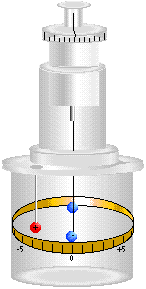
ميزان الليّ: كرتان مشحونتان تتنافران فتلتوي الخيط، ومن زاوية الالتواء تُقاس القوة.
The torsion balance: two charged spheres repel and twist the thread; the twist angle measures the force.
| ما وجدهWhat he found | الصيغةRelation | المعنىMeaning |
|---|---|---|
| مع الشحنتينwith the charges | \(F\propto q_1q_2\)\(F\propto q_1q_2\) | القوة تتناسب طرديًا مع حاصل ضرب مقداري الشحنتينthe force is directly proportional to the product of the charges |
| مع المسافةwith the distance | \(F\propto \dfrac{1}{r^{2}}\)\(F\propto \dfrac{1}{r^{2}}\) | القوة تتناسب عكسيًا مع مربع المسافة بين الشحنتينthe force is inversely proportional to the square of the distance |
| مع الوسطwith the medium | تتغير \(k\)\(k\) changes | تتغير القوة بتغير الوسط الفاصل بين الشحنتينthe force changes with the medium between the charges |
📌 قانون كولوم
📌 Coulomb’s law
القوة الكهربائية بين شحنتين نقطيتين تتناسب طرديًا مع حاصل ضرب مقداريهما وعكسيًا مع مربع المسافة بينهما:
The electric force between two point charges is directly proportional to the product of their magnitudes and inversely proportional to the square of the distance between them:
\[F=k\,\dfrac{|q_1\,q_2|}{r^{2}}\]
حيث \(k\) ثابت كولوم، وفي الفراغ: \(k=9\times10^{9}\ \mathrm{N\cdot m^{2}/C^{2}}\) ويرتبط بالسماحية الكهربائية للفراغ بالعلاقة \(k=\dfrac{1}{4\pi\varepsilon_0}\) حيث \(\varepsilon_0=8.85\times10^{-12}\ \mathrm{C^{2}/N\cdot m^{2}}\).
where \(k\) is Coulomb’s constant; in vacuum \(k=9\times10^{9}\ \mathrm{N\cdot m^{2}/C^{2}}\), related to the permittivity of free space by \(k=\dfrac{1}{4\pi\varepsilon_0}\) with \(\varepsilon_0=8.85\times10^{-12}\ \mathrm{C^{2}/N\cdot m^{2}}\).
| الكميةQuantity | الرمزSymbol | الوحدةUnit |
|---|---|---|
| القوة الكهربائيةElectric force | \(F\)\(F\) | نيوتن \(\mathrm{N}\)newton \(\mathrm{N}\) |
| الشحنةCharge | \(q_1,\ q_2\)\(q_1,\ q_2\) | كولوم \(\mathrm{C}\)coulomb \(\mathrm{C}\) |
| المسافة بين الشحنتينDistance between the charges | \(r\)\(r\) | متر \(\mathrm{m}\)metre \(\mathrm{m}\) |
| ثابت كولومCoulomb’s constant | \(k\)\(k\) | \(\mathrm{N\cdot m^{2}/C^{2}}\)\(\mathrm{N\cdot m^{2}/C^{2}}\) |
⚠️ ثلاثة تنبيهات قبل الحل
⚠️ Three warnings before solving
- حوّل الوحدات: الشحنات في المسائل غالبًا بالميكروكولوم: \(1\ \mu\mathrm{C}=10^{-6}\ \mathrm{C}\)، والمسافات بالمتر.Convert units: charges in problems are often in microcoulombs: \(1\ \mu\mathrm{C}=10^{-6}\ \mathrm{C}\), and distances must be in metres.
- اكتب المقدار بلا إشارات: نعوّض بقيمتي الشحنتين المطلقتين في القانون، ثم نحدد الاتجاه بالمنطق: متشابهتان تتنافران ومختلفتان تتجاذبان.Use magnitudes: put the absolute values of the charges in the law, then decide the direction logically: like charges repel and unlike charges attract.
- المسافة تُربَّع: مضاعفة المسافة تجعل القوة ربعًا لا نصفًا.The distance is squared: doubling the distance makes the force a quarter, not a half.
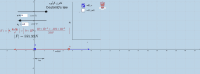
🧪 تجربة 1: قانون كولوم: اسحب الشحنتين وغيّر مقاديرهما
🧪 Experiment 1: Coulomb’s law: drag the charges and change their values
اسحب الشحنتين على المسطرة لتغيير المسافة \(r\)، وغيّر \(q_1\) و\(q_2\) (بإشارتيهما) ونوع الوسط. السهم البنفسجي هو القوة على كل شحنة، والنقطة البرتقالية على المنحنى هي حالتك الحالية. لاحظ كيف تنخفض \(F\) بسرعة عند زيادة \(r\).
Drag the two charges along the ruler to change the distance \(r\), and change \(q_1\) and \(q_2\) (with their signs) and the medium. The purple arrow is the force on each charge and the orange point on the curve is your current case. Notice how fast \(F\) falls as \(r\) grows.
↔️ القوة المتبادلة: تجاذب وتنافر
↔️ The Mutual Force: Attraction and Repulsion
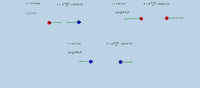
يوجد نوعان للقوة الكهربائية: تجاذب بين شحنتين مختلفتين، وتنافر بين شحنتين متشابهتين. مهما كان النوع فالقوتان على الشحنتين متساويتان في المقدار ومتعاكستان في الاتجاه.
There are two kinds of electric force: attraction between unlike charges and repulsion between like charges. Whatever the kind, the forces on the two charges are equal in magnitude and opposite in direction.
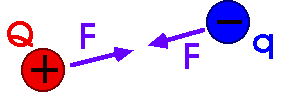
تجاذب: شحنتان مختلفتان.
Attraction: unlike charges.
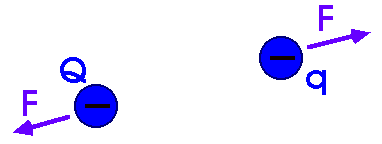
تنافر: شحنتان سالبتان.
Repulsion: two negative charges.
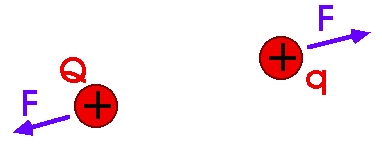
تنافر: شحنتان موجبتان.
Repulsion: two positive charges.
📌 قانون نيوتن الثالث للشحنات
📌 Newton’s third law for charges
القوة التي تؤثر بها الشحنة الأولى في الثانية تساوي في المقدار وتعاكس في الاتجاه القوة التي تؤثر بها الثانية في الأولى، حتى لو اختلفت الشحنتان في المقدار:
The force the first charge exerts on the second equals in magnitude and is opposite in direction to the force the second exerts on the first, even if the charges differ in size:
\[\vec F_{12}=-\vec F_{21}\]
شحنتان مختلفتان في النوع مقدار الأولى ضعف الثانية: \(q_1=+2q\) و\(q_2=-q\). إذا أثرت الشحنة الأولى في الثانية بقوة \(F_{12}=10\ \mathrm{N}\) نحو اليمين فما القوة التي تؤثر بها الثانية في الأولى؟
Two unlike charges, the first twice the second: \(q_1=+2q\) and \(q_2=-q\). If the first charge exerts a force \(F_{12}=10\ \mathrm{N}\) to the right on the second, what force does the second exert on the first?
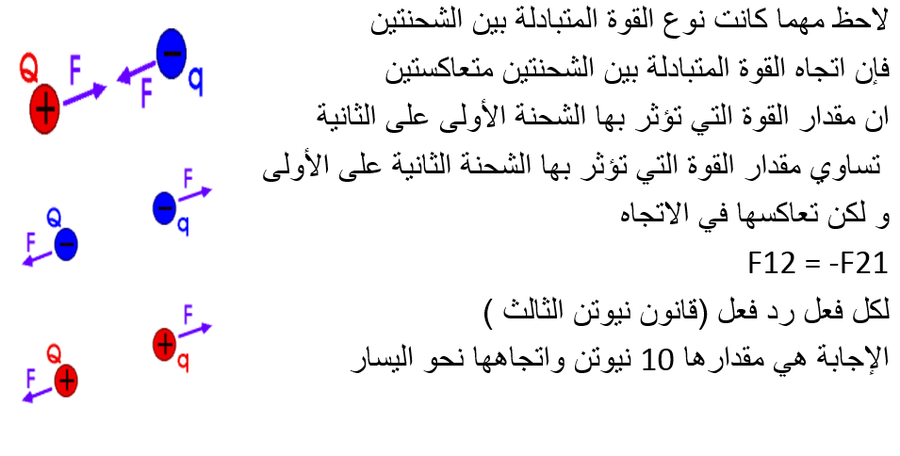
طريقة الحل المصوّرة للمثال 1.
The illustrated solution of example 1.
🔎 خصائص القوة الكهربائية
🔎 Properties of the electric force
- قوة متبادلة: متساويتان مقدارًا ومتعاكستان اتجاهًا.Mutual: equal in magnitude and opposite in direction.
- تزداد بزيادة إحدى الشحنتين أو كلتيهما.It increases when one or both charges increase.
- تقل بزيادة المسافة بينهما (بسرعة، لأن \(F\propto 1/r^{2}\)).It decreases as the distance grows (quickly, since \(F\propto 1/r^{2}\)).
- تعتمد على الوسط العازل: \(F_{\text{medium}}=\dfrac{F_{\text{vacuum}}}{\varepsilon_r}\) حيث \(\varepsilon_r\) ثابت العزل النسبي للوسط (أكبر من 1).It depends on the insulating medium: \(F_{\text{medium}}=\dfrac{F_{\text{vacuum}}}{\varepsilon_r}\) where \(\varepsilon_r\) is the relative permittivity of the medium (greater than 1).
- يمكن أن تكون تجاذبًا أو تنافرًا، بخلاف الجاذبية التي هي تجاذب فقط.It can be attraction or repulsion, unlike gravity which is attraction only.
إذا تضاعفت المسافة بين شحنتين نقطيتين ثابتتين فإن القوة بينهما:
If the distance between two fixed point charges is doubled the force between them:
شحنتان \(q_1\) و\(q_2\) بينهما قوة \(F\). إذا تضاعفت \(q_1\) وتضاعفت \(q_2\) مع بقاء المسافة فإن القوة:
Two charges \(q_1\) and \(q_2\) exert a force \(F\). If both are doubled with the distance unchanged the force becomes:
🧮 حل المسائل بقانون كولوم
🧮 Solving Problems with Coulomb’s Law
شحنتان متساويتان في المقدار والمسافة بينهما \(0.2\ \mathrm{m}\)، والقوة المتبادلة بينهما \(0.4\ \mathrm{N}\). أوجد مقدار كل منهما.
Two charges of equal magnitude are \(0.2\ \mathrm{m}\) apart and the mutual force is \(0.4\ \mathrm{N}\). Find the magnitude of each charge.
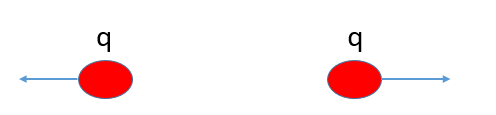
الشكل: شحنتان متساويتان تتنافران.
The figure: two equal charges repelling.
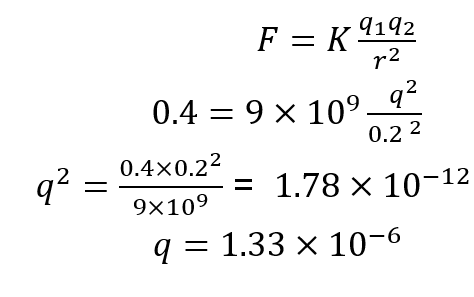
طريقة الحل المصوّرة.
The illustrated solution.
شحنتان \(q_1=+3\ \mu\mathrm{C}\) و\(q_2=-5\ \mu\mathrm{C}\) والمسافة بينهما \(0.3\ \mathrm{m}\) في الهواء. أوجد القوة المتبادلة ونوعها. وماذا تصبح لو غُمرتا في ماء (\(\varepsilon_r\approx80\))؟
Two charges \(q_1=+3\ \mu\mathrm{C}\) and \(q_2=-5\ \mu\mathrm{C}\) are \(0.3\ \mathrm{m}\) apart in air. Find the mutual force and its type. What does it become if they are immersed in water (\(\varepsilon_r\approx80\))?
شحنتان \(+2\ \mu\mathrm{C}\) و\(+2\ \mu\mathrm{C}\) والمسافة \(0.1\ \mathrm{m}\). القوة بينهما:
Two charges \(+2\ \mu\mathrm{C}\) and \(+2\ \mu\mathrm{C}\) are \(0.1\ \mathrm{m}\) apart. The force between them is:
➕ تراكب القوى الكهربائية
➕ Superposition of Electric Forces
عندما توجد أكثر من شحنتين تؤثر كل شحنة في الشحنة المدروسة بقوتها الخاصة كأن الباقيات غير موجودة، ثم نجمع القوى جمعًا متجهيًا. هذا هو مبدأ التراكب.
When there are more than two charges, each one acts on the studied charge with its own force as if the others were absent, and then we add the forces as vectors. This is the principle of superposition.
📘 خطوات إيجاد المحصلة
📘 Steps to find the net force
- حدّد الشحنة المدروسة وارسم اتجاه القوة التي تؤثر بها كل شحنة أخرى (تجاذب نحوها وتنافر بعيدًا عنها).Choose the studied charge and draw the direction of the force of each other charge (attraction towards it, repulsion away from it).
- احسب مقدار كل قوة على حدة بقانون كولوم.Calculate each force separately with Coulomb’s law.
- اجمعها متجهيًا: على خط مستقيم نعطي اتجاهًا موجبًا ونطرح المتعاكسات؛ وفي مثلث قائم نستعمل فيثاغورس.Add them as vectors: on a line choose a positive direction and subtract the opposite ones; at a right triangle use Pythagoras.

ثلاث شحنات على خط واحد، والمسافة بين كل شحنتين متجاورتين \(r\).
Three charges on a line, adjacent charges a distance \(r\) apart.
اكتب في دفترك قبل رؤية الحل: اتجاه القوة على \(q_1\) من \(q_2\)، ثم من \(q_3\)، ثم المحصلة إذا تساوت مقادير الشحنات الثلاث.
Write in your notebook before looking at the answer: the direction of the force on \(q_1\) from \(q_2\), then from \(q_3\), then the net force if the three charges are equal in magnitude.
في الشكل: ما اتجاه القوة التي تؤثر بها \(q_2\) في \(q_1\) وما العلاقة المعبرة عنها؟ وما اتجاه القوة التي تؤثر بها \(q_3\) في \(q_1\)؟ وإذا تساوت مقادير الشحنات الثلاث فما اتجاه المحصلة على \(q_1\)؟
In the figure: what is the direction of the force of \(q_2\) on \(q_1\), and which relation expresses it? What is the direction of the force of \(q_3\) on \(q_1\)? If the three charges are equal in magnitude what is the direction of the net force on \(q_1\)?
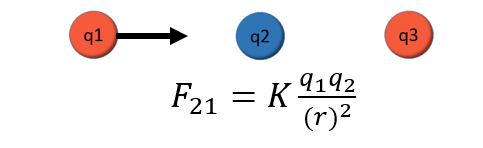
القوة من \(q_2\) على \(q_1\).
The force of \(q_2\) on \(q_1\).
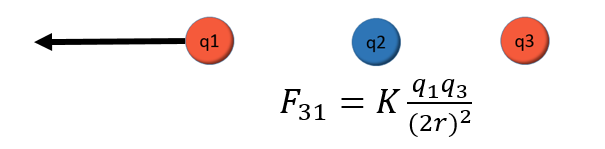
القوة من \(q_3\) على \(q_1\).
The force of \(q_3\) on \(q_1\).
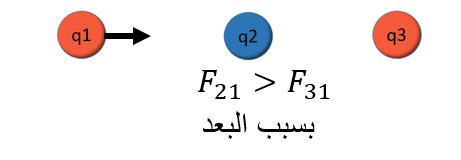
الشحنات متساوية: \(F_{21}\gt F_{31}\) بسبب البعد.
Equal charges: \(F_{21}\gt F_{31}\) because of the distance.
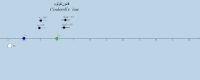
🧪 تجربة 2: تراكب القوى على استقامة واحدة
🧪 Experiment 2: Superposition of forces on a line
ثلاث شحنات على خط واحد. اختر الشحنة المدروسة (الحلقة الخضراء) ثم اسحب الشحنات وغيّر إشاراتها ومقاديرها. تُرسم قوة كل شحنة على الشحنة المدروسة ثم المحصلة (الأخضر). جرّب الحالات الجاهزة لترى متى تنعدم المحصلة.
Three charges on a line. Choose the studied charge (the green ring) then drag the charges and change their signs and values. The force of each other charge on the studied one is drawn, then the net force (green). Try the ready-made cases to see when the net force vanishes.
ثلاث شحنات \(+1\ \mu\mathrm{C}\) على خط مستقيم والمسافة بين كل شحنتين متجاورتين \(0.1\ \mathrm{m}\). أوجد القوة المحصلة على الشحنة الطرفية الأولى.
Three charges of \(+1\ \mu\mathrm{C}\) lie on a line, adjacent charges \(0.1\ \mathrm{m}\) apart. Find the net force on the first end charge.
ثلاث شحنات على خط: \(+q\) ثم \(-q\) ثم \(+q\) متساوية البُعد. القوة المحصلة على الشحنة الوسطى:
Three charges on a line: \(+q\), \(-q\), \(+q\), equally spaced. The net force on the middle charge is:
📐 تراكب القوى في بعدين (مثلث قائم)
📐 Superposition in Two Dimensions (Right Triangle)
إذا كانت القوتان متعامدتين (شحنتان على ضلعي زاوية قائمة) فإن محصلتهما تُحسب بنظرية فيثاغورس ويُحدَّد اتجاهها بالمماس:
When the two forces are perpendicular (charges on the sides of a right angle) their resultant comes from Pythagoras and its direction from the tangent:
\[F=\sqrt{F_{21}^{2}+F_{31}^{2}},\qquad \theta=\tan^{-1}\dfrac{F_{21}}{F_{31}}\]
وُضعت ثلاث شحنات نقطية على رؤوس مثلث قائم الزاوية: \(q_1=2\ \mu\mathrm{C}\) عند الزاوية القائمة و\(q_2=-3\ \mu\mathrm{C}\) و\(q_3=4\ \mu\mathrm{C}\)، والمسافتان \(r_{12}=0.3\ \mathrm{m}\) و\(r_{13}=0.4\ \mathrm{m}\). احسب القوة المؤثرة في الشحنة الأولى.
Three point charges sit at the corners of a right triangle: \(q_1=2\ \mu\mathrm{C}\) at the right angle, \(q_2=-3\ \mu\mathrm{C}\) and \(q_3=4\ \mu\mathrm{C}\), with \(r_{12}=0.3\ \mathrm{m}\) and \(r_{13}=0.4\ \mathrm{m}\). Calculate the force on the first charge.
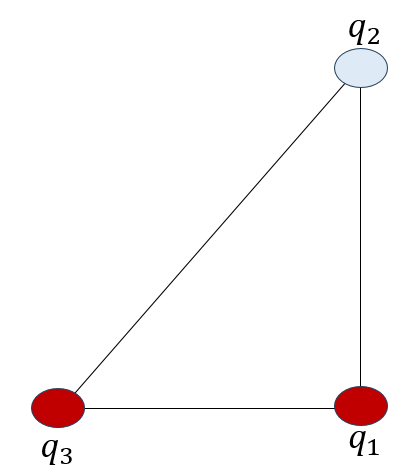
مواضع الشحنات الثلاث.
The positions of the three charges.
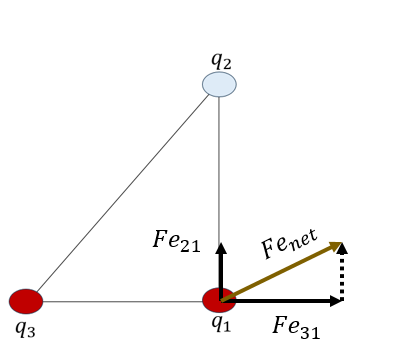
القوتان على \(q_1\) ومحصلتهما.
The two forces on \(q_1\) and their resultant.
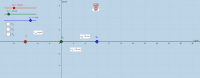
🧪 تجربة 3: تراكب القوى في مثلث قائم
🧪 Experiment 3: Superposition at a right triangle
الشحنة \(q_1\) عند الرأس القائم، و\(q_2\) فوقها و\(q_3\) على يسارها. القوتان \(F_{21}\) و\(F_{31}\) متعامدتان، فالمحصلة قطر المستطيل. اسحب \(q_2\) رأسيًا و\(q_3\) أفقيًا وغيّر الإشارات (القيم الافتراضية هي المثال المحلول في الدرس).
The charge \(q_1\) is at the right-angle vertex, \(q_2\) above it and \(q_3\) to its left. The forces \(F_{21}\) and \(F_{31}\) are perpendicular so the net force is the diagonal of the rectangle. Drag \(q_2\) vertically and \(q_3\) horizontally and change the signs (the defaults are the worked example of the lesson).
قوتان كهربائيتان متعامدتان مقدارهما \(3\ \mathrm{N}\) و\(4\ \mathrm{N}\) تؤثران في شحنة. المحصلة:
Two perpendicular electric forces of \(3\ \mathrm{N}\) and \(4\ \mathrm{N}\) act on a charge. The resultant is:
⚖️ القوة الكهروستاتيكية وقوة الجاذبية
⚖️ Electrostatic Force and Gravity
| وجه المقارنةAspect | القوة الكهروستاتيكيةElectrostatic force | قوة الجاذبيةGravitational force |
|---|---|---|
| تنشأ بينActs between | الشحنات الكهربائيةelectric charges | الكتلmasses |
| العلاقة بالمسافةDependence on distance | \(\propto 1/r^{2}\) (تشابه)\(\propto 1/r^{2}\) (similarity) | \(\propto 1/r^{2}\) (تشابه)\(\propto 1/r^{2}\) (similarity) |
| الوصف بمجالDescribed by a field | مجال كهربائي (تشابه)electric field (similarity) | مجال جذبوي (تشابه)gravitational field (similarity) |
| النوعKind | تجاذب أو تنافرattraction or repulsion | تجاذب فقطattraction only |
| الشدةStrength | أقوى بكثير (بين إلكترون وبروتون \(\approx10^{39}\) مرة)much stronger (between an electron and a proton \(\approx10^{39}\) times) | أضعف بكثيرmuch weaker |
| الثابتConstant | \(k=9\times10^{9}\ \mathrm{N\cdot m^{2}/C^{2}}\)\(k=9\times10^{9}\ \mathrm{N\cdot m^{2}/C^{2}}\) | \(G=6.67\times10^{-11}\ \mathrm{N\cdot m^{2}/kg^{2}}\)\(G=6.67\times10^{-11}\ \mathrm{N\cdot m^{2}/kg^{2}}\) |
| تفسّرExplains | الدوائر والمكثفات والذرةcircuits, capacitors and the atom | حركة الكواكب والمد والجزرplanetary motion and the tides |
لماذا لا نلاحظ القوة الكهربائية بين الأجسام العادية؟ لأنها متعادلة كهربائيًا (عدد الشحنات الموجبة يساوي السالبة) فتتلاشى القوى، بينما الجاذبية تتجمع دائمًا لأنها تجاذب فقط، فتسيطر على المقاييس الكبيرة كالكواكب.
Why don’t we notice the electric force between ordinary objects? Because they are electrically neutral (equal positive and negative charge) so the forces cancel, while gravity always adds up since it is attraction only, so it rules large scales like planets.
🏭 تطبيقات الكهرباء الساكنة
🏭 Applications of Static Electricity
1) مرسّبات الكهروستاتيك لتنقية الدخان
1) Electrostatic precipitators that clean smoke
تمر غازات العادم في حجرة فيها أقطاب تشحن الجسيمات العالقة بشحنة موجبة، فتنجذب إلى ألواح تجميع سالبة وتلتصق بها، وتُنظَّف الألواح دوريًا. تزيل هذه التقنية حتى 99% من الجسيمات الدقيقة.
Exhaust gases pass through a chamber whose electrodes charge the suspended particles positively; they are attracted to negative collection plates and stick to them, and the plates are cleaned periodically. The technique removes up to 99% of fine particles.
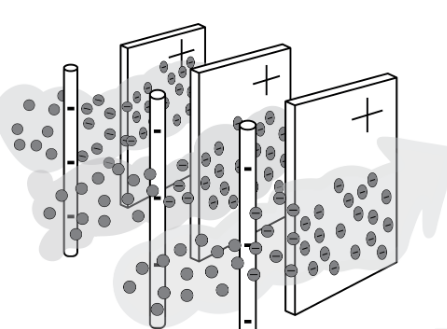
ألواح التجميع تلتقط الجسيمات المشحونة.
Collection plates catch the charged particles.
2) طلاء السيارات
2) Car painting
تُشحن قطرات الطلاء بشحنة موجبة ويُشحن هيكل السيارة بشحنة سالبة، فتنجذب القطرات إلى كل الأسطح حتى الزوايا الخفية، مما يوفر الطلاء ويعطي طبقة منتظمة.
Paint droplets are charged positively and the car body negatively, so the droplets are attracted to every surface even hidden corners, saving paint and giving an even coat.
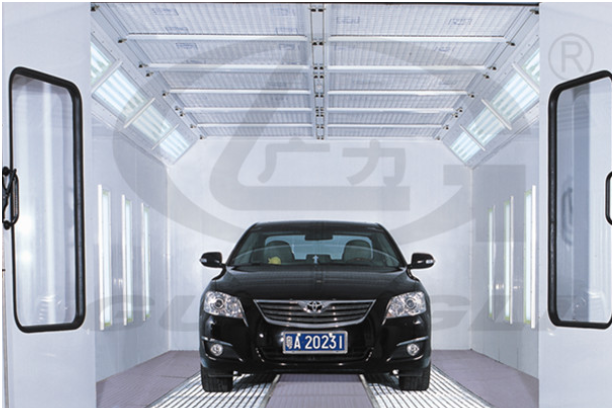
غرفة طلاء كهروستاتيكي.
An electrostatic painting booth.
3) الطابعات الليزرية
3) Laser printers
أسطوانة مشحونة بانتظام، يزيل الليزر الشحنة من مواضع الصورة، فيلتصق مسحوق الحبر المشحون بشحنة معاكسة بالمواضع المشحونة، ثم يُنقل إلى الورقة ويُثبَّت بالحرارة.
A uniformly charged drum has its charge removed by the laser where the image is; toner of opposite charge sticks to the charged parts, is transferred to the paper and fixed by heat.
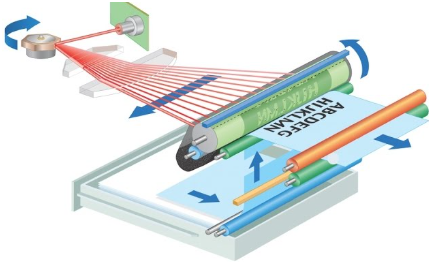
أسطوانة الطابعة والليزر.
The printer drum and the laser.
4) تغليف الأطعمة
4) Food wrapping
تُشحن أغلفة البلاستيك الشفاف فتلتصق بالمنتج وبعضها ببعض بإحكام، فتحمي الطعام من التلف وتطيل مدة صلاحيته.
Clear plastic wraps are charged so they cling tightly to the product and to each other, protecting food from spoilage and lengthening its shelf life.
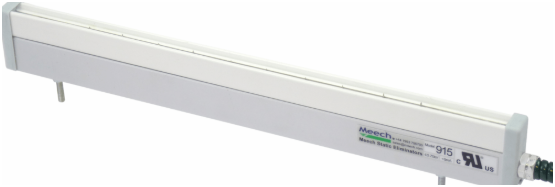
جهاز تحكّم بالشحنات الساكنة في خطوط التغليف.
A static-control bar used on packaging lines.
في طلاء السيارات كهروستاتيكيًّا تنجذب قطرات الطلاء إلى الهيكل لأن:
In electrostatic car painting the droplets are drawn to the body because:
📚 ملخص الدرس
📚 Lesson Summary
| الفكرةIdea | القانون / القاعدةLaw / rule |
|---|---|
| قانون كولومCoulomb’s law | \(F=k\dfrac{|q_1q_2|}{r^{2}}\)\(F=k\dfrac{|q_1q_2|}{r^{2}}\) |
| ثابت كولومCoulomb’s constant | \(k=\dfrac{1}{4\pi\varepsilon_0}=9\times10^{9}\ \mathrm{N\cdot m^{2}/C^{2}}\)\(k=\dfrac{1}{4\pi\varepsilon_0}=9\times10^{9}\ \mathrm{N\cdot m^{2}/C^{2}}\) |
| نوع القوةKind of force | متشابهتان: تنافر · مختلفتان: تجاذبlike: repulsion · unlike: attraction |
| نيوتن الثالثNewton’s third law | \(\vec F_{12}=-\vec F_{21}\)\(\vec F_{12}=-\vec F_{21}\) |
| في وسط عازلIn an insulating medium | \(F=\dfrac{F_{0}}{\varepsilon_r}\)\(F=\dfrac{F_{0}}{\varepsilon_r}\) |
| التراكبSuperposition | جمع متجهي للقوى؛ خط مستقيم: جبري بإشارات، مثلث قائم: فيثاغورسvector sum; on a line: algebraic with signs, at a right triangle: Pythagoras |
⚠️ أخطاء شائعة
⚠️ Common mistakes
- نسيان تحويل \(\mu\mathrm{C}\) إلى \(\mathrm{C}\) أو \(\mathrm{cm}\) إلى \(\mathrm{m}\).Forgetting to convert \(\mu\mathrm{C}\) to \(\mathrm{C}\) or \(\mathrm{cm}\) to \(\mathrm{m}\).
- عدم تربيع المسافة، أو تربيع نصفها فقط.Not squaring the distance, or squaring only half of it.
- الظن أن الشحنة الأكبر تؤثر بقوة أكبر في الأصغر: القوتان متساويتان دائمًا.Thinking the larger charge pulls harder on the smaller one: the two forces are always equal.
- جمع مقادير القوى مباشرة دون مراعاة الاتجاه عند التراكب.Adding force magnitudes directly without considering directions in superposition.
- عكس اتجاه القوة: التنافر بعيدًا عن الشحنة الأخرى والتجاذب نحوها.Reversing the direction: repulsion is away from the other charge, attraction is towards it.
🧪 اختبر نفسك: امتحان من 20 سؤالاً
🧪 Test Yourself: a 20-Question Exam
أنهِ الدرس بالاختبار التفاعلي التالي؛ أسئلته تجمع بين الفهم والحساب وتغطي جميع أقسام الدرس.
Finish with the interactive exam below; its questions mix understanding with calculation and cover every section of the lesson.
اختبار الكهرباء الساكنة وقانون كولوم Static Electricity and Coulomb’s Law Quiz
20 سؤالاً - قانون كولوم وتراكب القوى والتطبيقات 20 Questions - Coulomb’s law, superposition and applications
• عدد الأسئلة: 20 سؤالاً
• مدة الاختبار: 30 دقيقة
• لا يمكنك تغيير إجاباتك أو إعادة الاختبار إلا بعد 24 ساعة من التسليم.
• تأكد من إجاباتك قبل التسليم! 📌 Important Instructions:
• Number of questions: 20 questions
• Quiz duration: 30 minutes
• You cannot change your answers or retake the quiz for 24 hours after submission.
• Make sure of your answers before submitting!
🔗 محاكيات GeoGebra للاستعانة بها عند اللزوم
🔗 GeoGebra Simulations to Use When Needed
اضغط «تشغيل» لتعمل المحاكاة هنا داخل الدرس؛ ويمكن للطالب الرجوع إليها لتجربة الفكرة بطريقة أخرى.
Press “Run” to run the simulation right here inside the lesson; the student can use it to try the idea in another way.