🎯 نواتج التعلم
🎯 Learning Outcomes
بعد دراسة هذا الدرس ستكون قادرًا على أن:
After this lesson you will be able to:
- تعرّف القوة وتميّز بين قوى التلامس وقوى المجال.Define force and distinguish contact forces from field forces.
- تفرّق بين الكتلة والوزن وتحسب \(W=mg\).Distinguish mass from weight and calculate \(W=mg\).
- تحلّل القوة إلى مركّبتين وتجد محصلة القوى على المحورين.Resolve a force into two components and find the net force on the axes.
- تفسّر القوة العمودية وقوة الاحتكاك السكوني والحركي وتحسب معاملي الاحتكاك.Explain the normal force and the static and kinetic friction forces and calculate the friction coefficients.
- تطبّق قوانين نيوتن الثلاثة على المستوى الأفقي والمائل وآلة أتود والبكرة المتحركة.Apply Newton’s three laws to the horizontal and inclined planes, the Atwood machine and the movable pulley.
💪 ما القوة؟
💪 What is a Force?
القوة في حياتنا اليومية: دفع وسحب ورفع وضغط.
Force in daily life: pushing, pulling, lifting and squeezing.
القوة مؤثر خارجي يؤثر في جسم فيعمل على تغيير شكله أو تغيير حالته الحركية. وهي كمية متجهة (مقدار واتجاه) وحدتها النيوتن \(\mathrm N=\mathrm{kg\cdot m/s^2}\)، وتُقاس بالميزان النابضي.
A force is an external influence acting on a body that changes its shape or changes its state of motion. It is a vector quantity (magnitude and direction) whose unit is the newton \(\mathrm N=\mathrm{kg\cdot m/s^2}\), and it is measured with a spring balance.
🧲 أنواع القوى: التلامس والمجال
🧲 Types of Forces: Contact and Field
قوى التلامس: بعض القوى لا يمكن أن تحدث دون ملامسة الجسم (الدفع، الشد، الاحتكاك، القوة العمودية).
Contact forces: some forces cannot occur without touching the body (push, tension, friction, the normal force).
قوى المجال: بعضها لا يحتاج إلى ملامسة الجسم كي يحدث (الجاذبية، القوة الكهربائية، القوة المغناطيسية).
Field forces: some forces need no contact to occur (gravity, the electric force, the magnetic force).
| الخاصيةProperty | قوى التلامسContact forces | قوى المجالField forces |
|---|---|---|
| التعريفDefinition | تتطلب تلامسًا مباشرًاNeed direct contact | تعمل عن بُعدAct at a distance |
| أمثلةExamples | الاحتكاك، الشد، القوة العموديةFriction, tension, the normal force | الجاذبية، المغناطيسية، الكهربائيةGravity, magnetic, electric |
| تطبيقاتApplications | فرامل السيارات، المشيCar brakes, walking | حركة الكواكب، المحركاتPlanetary motion, motors |
🌍 الكتلة والوزن
🌍 Mass and Weight
الكتلة مقدار المادة في الجسم ولا تتغير بتغير المكان. والوزن هو القوة التي يجذب بها الكوكب الجسم، ويتغير بتغير مجال الجاذبية.
Mass is the amount of matter in the body and does not change with place. Weight is the force with which the planet attracts the body, and it changes with the gravitational field.
📌 الوزن
📌 Weight
\[W=F_g=mg\]
\[\mathrm N=\mathrm{kg}\cdot\frac{\mathrm m}{\mathrm s^2}\]
| الخاصيةProperty | الكتلةMass | الوزنWeight |
|---|---|---|
| المفهومConcept | كمية المادةAmount of matter | قوة الجاذبيةForce of gravity |
| التغيّرChange | ثابتةConstant | تتغير بتغير \(g\)Changes with \(g\) |
| الوحدةUnit | كيلوجرام \(\mathrm{kg}\)kilogram \(\mathrm{kg}\) | نيوتن \(\mathrm N\)newton \(\mathrm N\) |
| الاستخدامUse | قياس القصور الذاتيMeasuring inertia | قياس القوة المؤثرةMeasuring the force |
ما وزن رجل كتلته \(70\ \mathrm{kg}\) على الأرض (\(g=9.8\)) وعلى القمر (\(g=1.6\))؟ وما كتلته على القمر؟
What is the weight of a man of mass \(70\ \mathrm{kg}\) on the Earth (\(g=9.8\)) and on the Moon (\(g=1.6\))? And what is his mass on the Moon?
➕ محصلة القوى ومركّباتها
➕ The Net Force and its Components
المحصلة هي مجموع القوى المؤثرة في الجسم. ولسهولة الجمع نأخذها على المحاور الديكارتية، فنحلّل كل قوة لا تنطبق على محور إلى مركّبتين.
The net force is the sum of the forces acting on the body. For ease we take it on the Cartesian axes and resolve every force that does not lie on an axis into two components.
📌 المحصلة على المحاور
📌 The net force on the axes
\[\sum\vec F=\vec F_1+\vec F_2+\cdots+\vec F_n\]
\[\sum F_x=F_{1x}+F_{2x}+\cdots,\qquad \sum F_y=F_{1y}+F_{2y}+\cdots\]
\[F_x=F\cos\theta,\qquad F_y=F\sin\theta\]
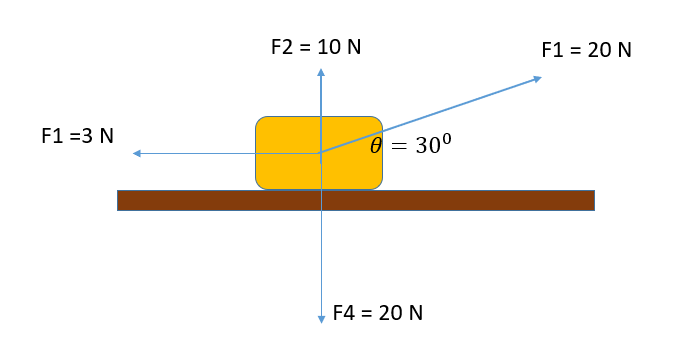
أربع قوى: \(F_1=20\ \mathrm N\) بزاوية \(30^\circ\) و\(F_2=10\ \mathrm N\) للأعلى و\(F_3=3\ \mathrm N\) لليسار و\(F_4=20\ \mathrm N\) للأسفل.
Four forces: \(F_1=20\ \mathrm N\) at \(30^\circ\), \(F_2=10\ \mathrm N\) upward, \(F_3=3\ \mathrm N\) to the left and \(F_4=20\ \mathrm N\) downward.
المثال: حدّد محصلة القوى على المحور \(x\). نحدّد القوى المؤثرة، ونرسم المحورين بحيث يوازي الأفقي المستوى، ثم نحلّل القوة المائلة.
Example: find the net force on the \(x\)-axis. We determine the forces, draw the axes with the horizontal one parallel to the plane, then resolve the oblique force.
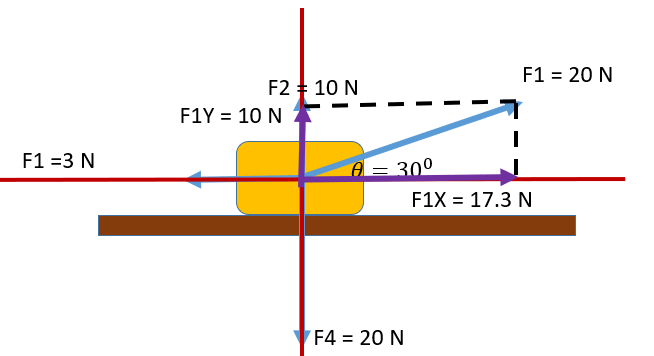
تحليل \(F_1\) إلى مركّبتيها \(F_{1x}=17.3\ \mathrm N\) و\(F_{1y}=10\ \mathrm N\).
Resolving \(F_1\) into its components \(F_{1x}=17.3\ \mathrm N\) and \(F_{1y}=10\ \mathrm N\).
من الشكل أوجد محصلة القوى على المحور \(x\) وعلى المحور \(y\).
From the figure find the net force on the \(x\)-axis and on the \(y\)-axis.
🧪 جرّب بنفسك: المركّبات والمحصلة
🧪 Try It Yourself: Components and the Net Force
🧪 مركّبات القوى والمحصلة على المحورين
🧪 Components of Forces and the Net Force on the Axes
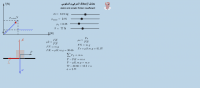
تؤثر على جسم أربع قوى: \(F_1\) مائلة بزاوية \(\theta\) و\(F_3\) أفقية نحو اليسار و\(F_2\) رأسية للأعلى و\(F_4\) للأسفل (الوزن مثلًا). غيّرها وأظهر المركّبات والمحصلة بالزرّين.
Four forces act on a body: \(F_1\) oblique at an angle \(\theta\), \(F_3\) horizontal to the left, \(F_2\) vertical upward and \(F_4\) downward (the weight, for example). Change them and show the components and the net force with the two buttons.
⬆️ القوة العمودية (المتعامدة)
⬆️ The Normal Force
القوة العمودية \(N\) هي القوة التي يؤثر بها السطح في الجسم الملامس له، واتجاهها عمودي دائمًا على سطح التماس. وهي قوة تلامس تنشأ كرد فعل لضغط الجسم على السطح، وليست قوة أساسية.
The normal force \(N\) is the force with which a surface acts on the body touching it, and its direction is always perpendicular to the contact surface. It is a contact force that arises as a reaction to the pressure of the body on the surface; it is not a fundamental force.
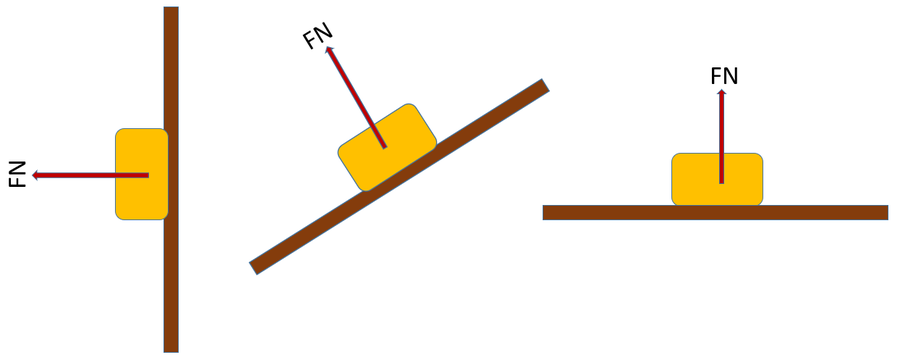
القوة العمودية \(F_N\) عمودية على السطح: رأسي، مائل، أفقي.
The normal force \(F_N\) is perpendicular to the surface: vertical, inclined, horizontal.
متى تظهر وكيف نحسبها؟
When does it appear and how do we find it?
- عند وضع جسم على سطح أفقي (كتاب على طاولة): \(N=mg\) إذا لم تكن هناك قوى رأسية أخرى.When a body rests on a horizontal surface (a book on a table): \(N=mg\) if there are no other vertical forces.
- على المستوى المائل بزاوية \(\theta\): \(N=mg\cos\theta\) إذا لم تؤثر قوى أخرى عمودية على المستوى.On a plane inclined at \(\theta\): \(N=mg\cos\theta\) if no other forces act perpendicular to the plane.
- وفي الحالة العامة نطبّق \(\sum F=ma\) على المحور العمودي على السطح فنجد \(N\) (مثلًا عند السحب بقوة مائلة تقل \(N\)).In the general case we apply \(\sum F=ma\) along the axis perpendicular to the surface to find \(N\) (for example when pulling with an oblique force \(N\) decreases).
- تظهر أيضًا في التصادمات وفي الحركة الدائرية كقوة جاذبة نحو المركز.It also appears in collisions and in circular motion as a force toward the centre.
🔹 القانون الأول: القصور الذاتي
🔹 The First Law: Inertia
📌 القانون الأول
📌 The first law
\[\sum\vec F=0\ \Rightarrow\ \vec v=\text{constant}\]
يبقى الجسم على حالته الحركية (ساكنًا أو متحركًا بسرعة ثابتة في خط مستقيم) ما لم تؤثر فيه قوة محصلة تغيّر هذه الحالة.
A body stays in its state of motion (at rest or moving with constant velocity along a straight line) unless a net force acts on it and changes that state.
شرح
Explanation
- الجسم الساكن يبقى ساكنًا حتى تحرّكه قوة.A body at rest stays at rest until a force moves it.
- الجسم المتحرك يستمر بالسرعة نفسها والاتجاه نفسه حتى تغيّره قوة.A moving body keeps the same speed and direction until a force changes it.
- القصور الذاتي ميل الأجسام إلى مقاومة تغيّر حالتها الحركية، ويزداد بزيادة الكتلة ولا يعتمد على السرعة.Inertia is the tendency of bodies to resist a change in their state of motion; it grows with mass and does not depend on speed.
أمثلة: يندفع الراكب للأمام عند الفرملة المفاجئة (حزام الأمان)، وتستمر الكرة على سطح أملس في حركتها، ويبقى الغبار ساكنًا عند هز الثياب. وفي الفضاء الخارجي تستمر المركبات بسرعتها دون محركات، وتبقى الأقمار الصناعية في مداراتها.
Examples: a passenger lurches forward when the car brakes suddenly (seat belts), a ball on a smooth surface keeps moving, and dust stays put when clothes are shaken. In outer space spacecraft keep their speed without engines and satellites stay in their orbits.
🧪 جرّب بنفسك: الصندوق والشاحنة
🧪 Try It Yourself: the Box and the Truck
🧪 القصور الذاتي: صندوق على شاحنة
🧪 Inertia: a Box on a Truck
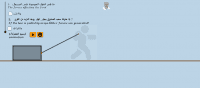
تتسارع الشاحنة بتسارع \(a\) وبين الصندوق والشاحنة احتكاك \(\mu\). إن كان \(a\) أكبر من \(\mu g\) انزلقت الشاحنة وبقي الصندوق في حالته؛ وإلا تحرك معها.
The truck accelerates with \(a\) and there is friction \(\mu\) between the box and the truck. If \(a\) exceeds \(\mu g\) the truck slides away and the box stays in its state; otherwise it moves with it.
صندوق على شاحنة معامل الاحتكاك بينهما \(\mu=0.5\). ما أكبر تسارع للشاحنة يبقى معه الصندوق دون انزلاق؟ (\(g=9.81\))
A box on a truck with friction coefficient \(\mu=0.5\) between them. What is the largest truck acceleration at which the box does not slip? (\(g=9.81\))
عند فرملة الحافلة فجأة يندفع الركاب للأمام بسبب:
When a bus brakes suddenly the passengers lurch forward because of:
🔹 القانون الثاني: القوة والتسارع
🔹 The Second Law: Force and Acceleration
📌 القانون الثاني
📌 The second law
\[\vec F=m\vec a\]
محصلة القوى المؤثرة في جسم تساوي كتلته مضروبة في تسارعه، ويكون التسارع في اتجاه المحصلة. وحدة القوة النيوتن: \(1\ \mathrm N=1\ \mathrm{kg\,m/s^2}\).
The net force on a body equals its mass times its acceleration, and the acceleration is in the direction of the net force. The unit of force is the newton: \(1\ \mathrm N=1\ \mathrm{kg\,m/s^2}\).
شرح
Explanation
- علاقة طردية: \(a\propto F\) عند ثبات الكتلة.Direct: \(a\propto F\) at constant mass.
- علاقة عكسية: \(a\propto\dfrac1m\) عند ثبات القوة.Inverse: \(a\propto\dfrac1m\) at constant force.
- القوة سبب تغيّر الحركة (التسارع) وليست سبب الحركة نفسها.Force is the cause of a change of motion (acceleration), not of the motion itself.
أمثلة: كلما دفعت عربة التسوق بقوة أكبر زاد تسارعها، وسيارات السباق خفيفة وقوية المحركات فتتسارع كثيرًا، وفي المصعد المتسارع للأعلى تشعر بزيادة وزنك.
Examples: the harder you push a shopping cart the greater its acceleration, race cars are light with powerful engines so they accelerate strongly, and in an elevator accelerating upward you feel heavier.
🧪 تجربة 1: التسارع والقوة
🧪 Experiment 1: Acceleration and Force
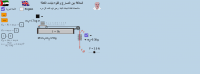
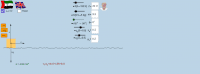
في محاكاة GeoGebra (في آخر الصفحة) تُنقل 100 جرام من العربة إلى الكتلة المعلّقة فتتغير القوة وتبقى كتلة المجموعة ثابتة؛ ثم تُسجَّل قيم التسارع. جرّب ذلك هنا:
In the GeoGebra simulation (at the end of the page) 100 g is moved from the cart to the hanging mass, changing the force while the total mass stays constant; then the accelerations are recorded. Try it here:
🧪 التسارع والقوة (كتلة الجملة ثابتة)
🧪 Acceleration and Force (constant system mass)
كتلة العربة مع أقراصها (100 g لكل قرص) + الأقراص المعلّقة = \(1.0\ \mathrm{kg}\) دائمًا. انقل قرصًا تلو الآخر إلى الكتلة المعلّقة فتزداد القوة \(F=m_2g\) (\(g=10\)) وتبقى كتلة الجملة ثابتة. أطلق العربة وسجّل القراءة.
The cart with its discs (100 g each) + the hanging discs = \(1.0\ \mathrm{kg}\) always. Move one disc at a time to the hanging mass so the force \(F=m_2g\) (\(g=10\)) grows while the system mass stays constant. Release the cart and record the reading.
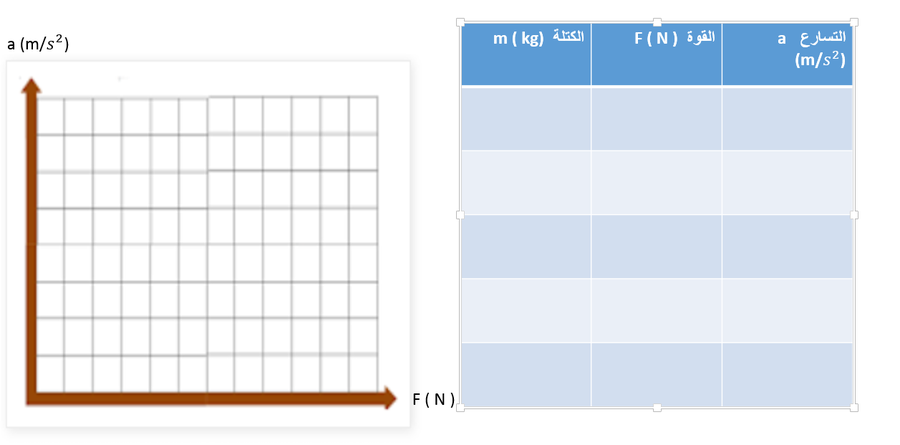
نموذج جدول البيانات والخط البياني للتسارع مقابل القوة.
Template of the data table and the acceleration–force graph.
🧪 تجربة 2: التسارع ومقلوب الكتلة
🧪 Experiment 2: Acceleration and Inverse Mass
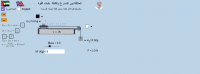
هنا نثبّت قوة الشد ونغيّر كتلة العربة ونسجّل التسارع مقابل \(1/m\):
Here we keep the tension constant, change the cart’s mass and record the acceleration against \(1/m\):
🧪 التسارع ومقلوب الكتلة (القوة ثابتة)
🧪 Acceleration and Inverse Mass (constant force)
يُعلَّق قرصان (\(m_2=0.2\ \mathrm{kg}\)) فتكون القوة ثابتة \(F=2\ \mathrm N\). أضف أقراصًا إلى العربة لتزيد كتلة الجملة \(M\)، أطلق العربة وسجّل التسارع، وراقب العلاقة بين \(a\) و\(1/M\).
Two discs are hung (\(m_2=0.2\ \mathrm{kg}\)) so the force is constant \(F=2\ \mathrm N\). Add discs to the cart to increase the system mass \(M\), release the cart and record the acceleration; watch the relation between \(a\) and \(1/M\).
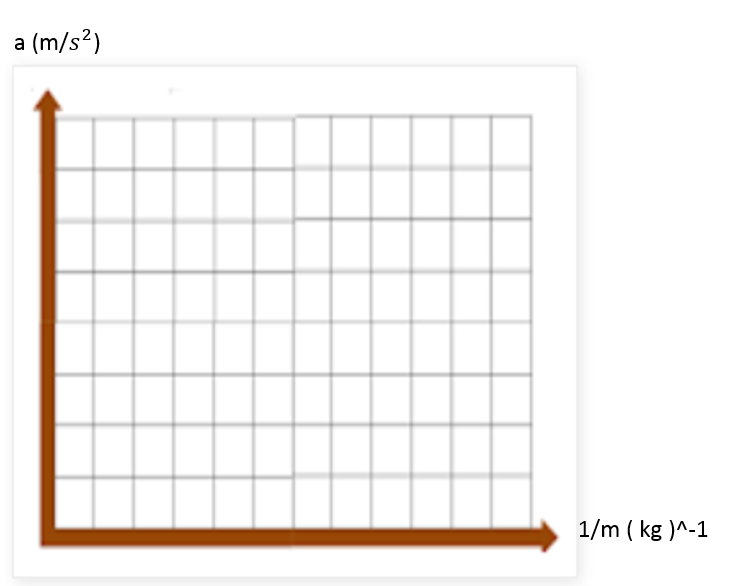
نموذج الخط البياني للتسارع مقابل مقلوب الكتلة.
Template of the acceleration versus inverse-mass graph.
تؤثر قوة محصلة \(50\ \mathrm N\) في جسم كتلته \(10\ \mathrm{kg}\). أوجد تسارعه.
A net force of \(50\ \mathrm N\) acts on a \(10\ \mathrm{kg}\) body. Find its acceleration.
جسم كتلته \(4\ \mathrm{kg}\) يتسارع بمقدار \(6\ \mathrm{m/s^2}\). ما القوة المحصلة المؤثرة فيه؟
A \(4\ \mathrm{kg}\) body accelerates at \(6\ \mathrm{m/s^2}\). What is the net force on it?
إذا تضاعفت كتلة الجسم مع ثبات القوة المحصلة فإن تسارعه:
If the mass of a body doubles while the net force stays constant, its acceleration:
🔹 القانون الثالث: الفعل ورد الفعل
🔹 The Third Law: Action and Reaction
📌 القانون الثالث
📌 The third law
\[\vec F_{12}=-\vec F_{21}\]
لكل فعل رد فعل مساوٍ له في المقدار ومعاكس له في الاتجاه.
For every action there is a reaction equal in magnitude and opposite in direction.
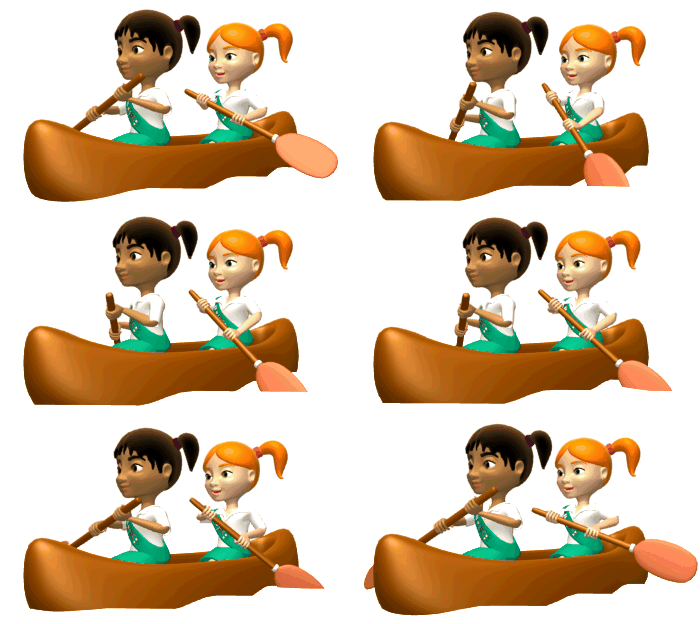
القفز من القارب: تدفع القارب للخلف فيدفعك للأمام.
Jumping from a boat: you push the boat backward and it pushes you forward.
شرح
Explanation
- القوى تظهر دائمًا في أزواج متساوية ومتعاكسة.Forces always appear in equal and opposite pairs.
- الفعل يؤثر في جسم ورد الفعل في جسم آخر، ولذلك لا يلغي أحدهما الآخر.The action acts on one body and the reaction on another, so they do not cancel.
- يحدثان في اللحظة نفسها ومن النوع نفسه من القوى.They occur at the same instant and are forces of the same kind.
أمثلة: القفز من القارب، المشي (تدفع الأرض للخلف فتدفعك للأمام)، وإطلاق النار (الرصاصة للأمام والبندقية ترتدّ للخلف). وتنبيه: ردّ فعل جذب الأرض لك هو جذبك أنت للأرض؛ أما رد فعل القوة العمودية فهو ضغط قدميك على الأرض.
Examples: jumping from a boat, walking (you push the ground backward and it pushes you forward) and firing a gun (the bullet goes forward and the gun recoils). Note: the reaction to the Earth’s pull on you is your pull on the Earth; the reaction to the normal force from the ground is your feet pressing on the ground.
🧪 جرّب بنفسك: متزلجان على الجليد
🧪 Try It Yourself: Two Skaters on Ice
🧪 الفعل ورد الفعل: متزلجان على الجليد
🧪 Action and Reaction: Two Skaters on Ice
يتلامس المتزلجان ويدفع كلٌّ منهما الآخر بقوة \(F\) مدة \(0.5\ \mathrm s\) (قوتان متساويتان ومتعاكستان)، ثم ينفصلان. غيّر الكتلتين وحرّك الزمن لترى التسارعين والسرعتين وحفظ الزخم.
The first skater pushes the second with a force \(F\) and the second pushes back with an equal and opposite force. Change the two masses and look at the accelerations.
يدفع شخص كتلته \(60\ \mathrm{kg}\) قاربًا كتلته \(120\ \mathrm{kg}\) بقوة \(90\ \mathrm N\). أوجد تسارع كل منهما.
A \(60\ \mathrm{kg}\) person pushes a \(120\ \mathrm{kg}\) boat with a force of \(90\ \mathrm N\). Find the acceleration of each.
لماذا لا يلغي الفعل ورد الفعل بعضهما؟
Why do action and reaction not cancel each other?
🔥 قوة الاحتكاك
🔥 The Friction Force
قوة الاحتكاك مقاومة الجسم للحركة عندما يتحرك (أو يحاول التحرك) على سطح جسم آخر؛ اتجاهها دائمًا عكس حركة الجسم (أو عكس اتجاه ميله للحركة) وموازٍ للسطح. وهي قوة تلامس وليست قوة أساسية كالجاذبية أو القوة الكهرومغناطيسية.
Friction is the resistance of a body to motion when it moves (or tries to move) on the surface of another body; its direction is always opposite to the motion of the body (or to its tendency to move) and parallel to the surface. It is a contact force, not a fundamental force like gravity or electromagnetism.
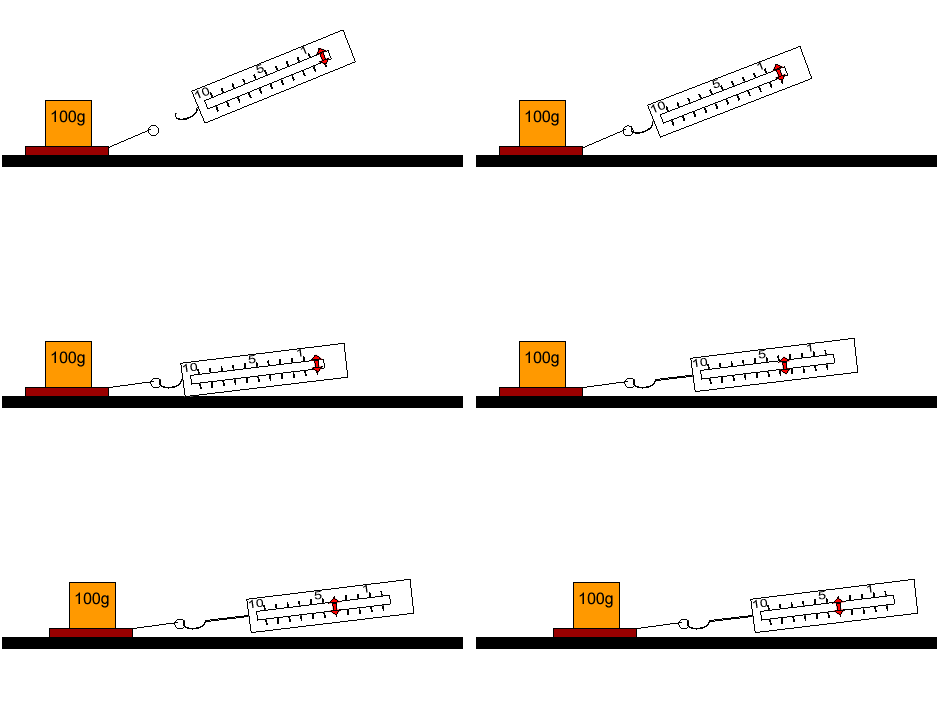
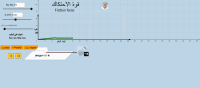
نسحب الجسم بميزان نابضي أفقيًا: القراءة عند بدء الحركة تساوي قوة الاحتكاك.
We pull the body horizontally with a spring balance: the reading at the start of motion equals the friction force.
| نوع الاحتكاكType of friction | متى يظهر؟When does it appear? | مقدارهIts magnitude |
|---|---|---|
| سكونيStatic | عندما نؤثر بقوة شدّ في الجسم ويبقى ساكنًاWhen we pull the body and it stays at rest | يساوي القوة المؤثرة حتى قيمة عظمى \(f_s\le\mu_sN\)Equals the applied force up to a maximum \(f_s\le\mu_sN\) |
| حركيKinetic | عندما نؤثر بقوة شدّ والجسم يتحركWhen we pull and the body is moving | ثابت تقريبًا \(f_k=\mu_kN\)Approximately constant \(f_k=\mu_kN\) |
📌 معاملا الاحتكاك
📌 The friction coefficients
\[\mu_s=\frac{F_s}{N},\qquad \mu_k=\frac{F_k}{N}\]
معامل الاحتكاك السكوني هو النسبة بين أكبر قوة احتكاك سكوني والقوة العمودية، ومعامل الاحتكاك الحركي هو النسبة بين قوة الاحتكاك الحركي والقوة العمودية. وعادةً \(\mu_k\lt \mu_s\).
The coefficient of static friction is the ratio of the maximum static friction to the normal force, and the coefficient of kinetic friction is the ratio of the kinetic friction to the normal force. Usually \(\mu_k\lt \mu_s\).
ما العوامل المؤثرة في الاحتكاك؟
Which factors affect friction?
- القوة العمودية \(N\): كلما زادت زاد الاحتكاك (\(f=\mu N\)).The normal force \(N\): the larger it is the greater the friction (\(f=\mu N\)).
- طبيعة السطحين المتلامسين (خشن أو أملس) وهي التي يعبّر عنها \(\mu\).The nature of the two contacting surfaces (rough or smooth), which \(\mu\) expresses.
- لا يعتمد (تقريبًا) على مساحة التلامس ولا على سرعة الحركة.It does not (approximately) depend on the contact area or on the speed.
جسم كتلته \(10\ \mathrm{kg}\) على سطح أفقي، وأقل قوة أفقية تجعله يبدأ الحركة \(40\ \mathrm N\) وتكفي \(30\ \mathrm N\) لإبقائه يتحرك بسرعة ثابتة (\(g=10\)). أوجد \(\mu_s\) و\(\mu_k\).
A \(10\ \mathrm{kg}\) body is on a horizontal surface; the least horizontal force that starts its motion is \(40\ \mathrm N\) and \(30\ \mathrm N\) keeps it moving at constant velocity (\(g=10\)). Find \(\mu_s\) and \(\mu_k\).
من التجارب السابقة، ما العوامل التي تغيّر قوة الاحتكاك؟
From the previous experiments, which factors change the friction force?
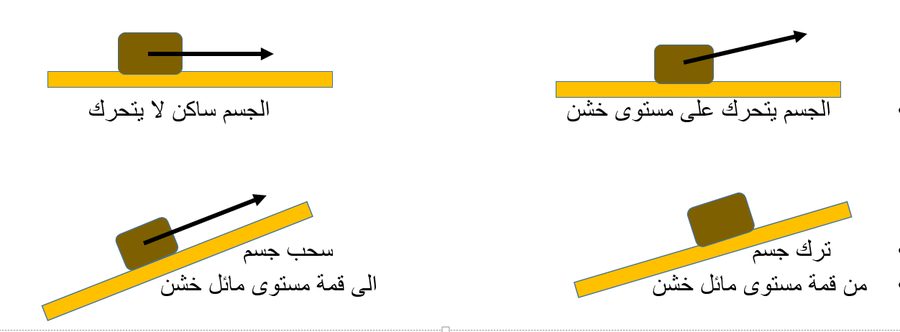
حدّد القوى المؤثرة في كل جسم: على سطح أفقي ساكن ومتحرك وعلى مستوى مائل (سحبًا وانزلاقًا).
Determine the forces acting on each body: on a horizontal surface at rest and moving, and on an incline (pulled and sliding).
حلّ تمرين الأجسام الأربعة
Solution of the four-bodies exercise
- جسم ساكن على سطح أفقي: الوزن \(W\) للأسفل والقوة العمودية \(N\) للأعلى (متساويان) وقوة الشدّ \(F\) والاحتكاك السكوني \(f_s\) المساوي لها.A body at rest on a horizontal surface: the weight \(W\) downward and the normal force \(N\) upward (equal), the pull \(F\) and the static friction \(f_s\) equal to it.
- جسم يتحرك على سطح أفقي: الوزن والقوة العمودية والشدّ \(F\) والاحتكاك الحركي \(f_k\) عكس الحركة.A body moving on a horizontal surface: the weight, the normal force, the pull \(F\) and the kinetic friction \(f_k\) opposite to the motion.
- جسم يُسحب إلى أعلى مستوى خشن: الوزن (مركّبتاه) والعمودية والشدّ والاحتكاك إلى الأسفل مع المستوى.A body pulled up a rough incline: the weight (with its two components), the normal force, the pull and the friction down the plane.
- جسم ينزلق إلى أسفل مستوى خشن: الوزن والعمودية والاحتكاك إلى أعلى المستوى (عكس الانزلاق).A body sliding down a rough incline: the weight, the normal force and the friction up the plane (opposite to the sliding).
🛠️ تطبيقات على قوانين نيوتن
🛠️ Applications of Newton’s Laws
أولًا: جسم على مستوى أفقي
First: a Body on a Horizontal Surface
القوى المؤثرة: الوزن \(W=mg\) إلى الأسفل، والقوة العمودية \(N\) إلى الأعلى (وتساوي \(mg\) إذا لم توجد قوى رأسية أخرى)، وقوة الشد أو الدفع \(F\) في اتجاه الحركة، والاحتكاك \(f=\mu N\) عكس الحركة.
The forces: the weight \(W=mg\) downward, the normal force \(N\) upward (equal to \(mg\) if there are no other vertical forces), the pull or push \(F\) along the motion and friction \(f=\mu N\) opposing it.
\[F_{net}=F-f=ma\]
🧪 جرّب بنفسك: المستوى الأفقي
🧪 Try It Yourself: the Horizontal Surface
🧪 حركة جسم على مستوى أفقي
🧪 Motion on a Horizontal Surface
اضبط القوة المؤثرة والكتلة ومعامل الاحتكاك وراقب مخطط القوى: \(N=mg\)، والاحتكاك، والتسارع.
Set the applied force, the mass and the friction coefficient and watch the free-body diagram: \(N=mg\), friction and acceleration.
يُسحب جسم كتلته \(10\ \mathrm{kg}\) على سطح أفقي بقوة \(50\ \mathrm N\) ومعامل الاحتكاك الحركي \(0.2\). أوجد تسارعه (\(g=9.81\)).
A \(10\ \mathrm{kg}\) body is pulled on a horizontal surface with a force of \(50\ \mathrm N\) and a kinetic friction coefficient \(0.2\). Find its acceleration (\(g=9.81\)).
ثانيًا: جسم على مستوى مائل
Second: a Body on an Inclined Plane
نحلّل الوزن إلى مركبتين: موازية للمستوى \(mg\sin\theta\) وعمودية عليه \(mg\cos\theta\). وبلا احتكاك يكون \(a=g\sin\theta\)، ومع الاحتكاك \(a=g(\sin\theta-\mu\cos\theta)\).
We resolve the weight into a component parallel to the plane \(mg\sin\theta\) and one perpendicular to it \(mg\cos\theta\). Without friction \(a=g\sin\theta\), and with friction \(a=g(\sin\theta-\mu\cos\theta)\).
📌 المستوى المائل
📌 The inclined plane
\[mg\sin\theta-f=ma,\qquad N=mg\cos\theta\]
🧪 جرّب بنفسك: المستوى المائل
🧪 Try It Yourself: the Inclined Plane
🧪 حركة جسم على مستوى مائل
🧪 Motion on an Inclined Plane
غيّر زاوية الميل والكتلة ومعامل الاحتكاك وراقب المركبتين \(mg\sin\theta\) و\(mg\cos\theta\) والتسارع.
Change the angle of the incline, the mass and the friction coefficient and watch the components \(mg\sin\theta\) and \(mg\cos\theta\) and the acceleration.
ينزلق جسم دون احتكاك على مستوى مائل زاويته \(30^\circ\). أوجد تسارعه (\(g=9.81\)).
A body slides without friction on a plane inclined at \(30^\circ\). Find its acceleration (\(g=9.81\)).
ثالثًا: آلة أتود
Third: the Atwood Machine
كتلتان \(m_1\gt m_2\) معلّقتان بخيط يمرّ على بكرة. نطبّق القانون الثاني على كل كتلة: \(m_1g-T=m_1a\) و\(T-m_2g=m_2a\) فنجد:
Two masses \(m_1\gt m_2\) hang from a string passing over a pulley. Applying the second law to each: \(m_1g-T=m_1a\) and \(T-m_2g=m_2a\), giving:
📌 آلة أتود
📌 The Atwood machine
\[a=g\,\frac{m_1-m_2}{m_1+m_2}\]
\[T=\frac{2m_1m_2}{m_1+m_2}\,g\]
🧪 جرّب بنفسك: آلة أتود
🧪 Try It Yourself: the Atwood Machine
🧪 آلة أتود
🧪 The Atwood Machine
كتلتان معلّقتان بخيط على بكرة. غيّر الكتلتين وراقب التسارع وقوة الشد، وحرّك الزمن أو اضغط تشغيل.
Two masses hanging from a string over a pulley. Change the two masses and watch the acceleration and the tension, and move the time or press play.
في آلة أتود \(m_1=5\ \mathrm{kg}\) و\(m_2=3\ \mathrm{kg}\). أوجد التسارع وقوة الشد (\(g=9.81\)).
In an Atwood machine \(m_1=5\ \mathrm{kg}\) and \(m_2=3\ \mathrm{kg}\). Find the acceleration and the tension (\(g=9.81\)).
في آلة أتود إذا تساوت الكتلتان فإن التسارع:
In an Atwood machine, if the two masses are equal the acceleration is:
رابعًا: البكرة المتحركة
Fourth: the Movable Pulley
عندما يحمل مركز البكرة المتحركة الجسم فإن حبلين رأسيين يشتركان في رفعه، فيتوزّع الوزن على قوتي الشدّ: \(2T=W\) أي \(T=W/2\). وكلما زاد عدد الأحبال الرافعة احتجنا إلى قوة أقل، لكن الحبل الذي نشدّه يتحرك مسافة تساوي ضعف المسافة التي يتحركها الجسم (حفظ الشغل).
When the centre of the movable pulley carries the body, two vertical ropes share in lifting it so the weight is divided between the two tensions: \(2T=W\), that is \(T=W/2\). The more lifting ropes the less force we need, but the rope we pull moves a distance twice that moved by the body (conservation of work).
نرفع جسمًا كتلته \(40\ \mathrm{kg}\) ببكرة متحركة واحدة وبسرعة ثابتة (\(g=10\)). ما قوة الشدّ اللازمة؟ وكم نسحب الحبل لرفع الجسم \(1\ \mathrm m\)؟
We lift a \(40\ \mathrm{kg}\) body with one movable pulley at constant velocity (\(g=10\)). What tension is needed? And how much rope must we pull to raise the body \(1\ \mathrm m\)?
🎲 تدرّب
🎲 Practice
🧪 تدرّب: مسائل قوانين نيوتن
🧪 Practice: Newton’s Laws Problems
مسائل عشوائية بأرقام مختلفة. احسب واكتب الجواب ثم اضغط «تحقّق».
Random problems with different numbers. Work it out, enter the answer and press “Check”.
📊 ملخص قوانين نيوتن
📊 Summary of Newton’s Laws
| القانونLaw | الصيغةFormula | المفهومConcept |
|---|---|---|
| الأولFirst | \(\sum\vec F=0\Rightarrow\vec v=\text{const}\)\(\sum\vec F=0\Rightarrow\vec v=\text{const}\) | القصور الذاتيInertia |
| الثانيSecond | \(\vec F=m\vec a\)\(\vec F=m\vec a\) | القوة والتسارعForce and acceleration |
| الثالثThird | \(\vec F_{12}=-\vec F_{21}\)\(\vec F_{12}=-\vec F_{21}\) | الفعل ورد الفعلAction and reaction |
| المستوى الأفقيHorizontal | \(F-\mu mg=ma\)\(F-\mu mg=ma\) | الاحتكاكFriction |
| المستوى المائلInclined | \(a=g(\sin\theta-\mu\cos\theta)\)\(a=g(\sin\theta-\mu\cos\theta)\) | مركبتا الوزنWeight components |
| آلة أتودAtwood | \(a=g\frac{m_1-m_2}{m_1+m_2}\)\(a=g\frac{m_1-m_2}{m_1+m_2}\) | كتلتان وبكرةTwo masses and a pulley |
🧪 اختبر نفسك: امتحان من 20 سؤالاً
🧪 Test Yourself: a 20-Question Exam
أنهِ الدرس بالاختبار التفاعلي التالي؛ أسئلته تجمع بين الفهم والحساب وتغطي جميع أقسام الدرس.
Finish with the interactive exam below; its questions mix understanding with calculation and cover every section of the lesson.
اختبار القوة Force Quiz
20 سؤالاً - أنواع القوى، الوزن، المركّبات، القوة العمودية، الاحتكاك، قوانين نيوتن وتطبيقاتها 20 Questions - types of forces, weight, components, the normal force, friction, Newton’s laws and applications
• عدد الأسئلة: 20 سؤالاً
• مدة الاختبار: 30 دقيقة
• لا يمكنك تغيير إجاباتك أو إعادة الاختبار إلا بعد 24 ساعة من التسليم.
• تأكد من إجاباتك قبل التسليم! 📌 Important Instructions:
• Number of questions: 20 questions
• Quiz duration: 30 minutes
• You cannot change your answers or retake the quiz for 24 hours after submission.
• Make sure of your answers before submitting!
🔗 محاكيات GeoGebra للاستعانة بها عند اللزوم
🔗 GeoGebra Simulations to Use When Needed
اضغط «تشغيل» لتعمل المحاكاة هنا داخل الدرس؛ ويمكن للطالب الرجوع إليها لتجربة الفكرة بطريقة أخرى.
Press “Run” to run the simulation right here inside the lesson; the student can use it to try the idea in another way.