🎯 نواتج التعلم
🎯 Learning Outcomes
بعد دراسة هذا الدرس ستكون قادرًا على أن:
After this lesson you will be able to:
- تفسّر مفهوم الشغل وتحدّد متى تبذل القوة شغلًا ومتى لا تبذله.Explain the concept of work and decide when a force does work and when it does not.
- تحلّل القوة إلى مركبتين وتستنتج أن الشغل \(W=Fd\cos\theta\) ناتج عن المركبة الموازية للإزاحة.Resolve the force into two components and deduce that the work \(W=Fd\cos\theta\) comes from the component along the displacement.
- تحدّد إشارة الشغل (موجب أو سالب أو معدوم) من الزاوية بين القوة والإزاحة.Determine the sign of the work (positive, negative or zero) from the angle between the force and the displacement.
- تحسب الشغل الكلي المبذول على جسم من عدة قوى.Calculate the total work done on a body by several forces.
- تربط الشغل بالمساحة تحت منحنى القوة–الإزاحة.Relate the work to the area under the force–displacement graph.
📖 مفهوم الشغل
📖 The Concept of Work
في الحياة اليومية نسمّي أي مجهود «شغلًا»، أما في الفيزياء فللشغل معنى محدد: تبذل القوة شغلًا على جسم عندما تُحدث إزاحة للجسم وتكون لها مركبة في اتجاه هذه الإزاحة. فدفع حائط ثابت بكل قوتك لا يبذل شغلًا لأن الإزاحة معدومة.
In everyday life we call any effort “work”, but in physics work has a precise meaning: a force does work on a body when the body is displaced and the force has a component along that displacement. Pushing on a fixed wall with all your strength does no work because the displacement is zero.
📌 الشغل الناتج عن قوة ثابتة
📌 Work done by a constant force
\[W=\vec F\cdot\vec d=F\,d\cos\theta\qquad[\mathrm{J}=\mathrm{N\cdot m}]\]
\(\theta\) هي الزاوية بين متجه القوة ومتجه الإزاحة (وليست بالضرورة الزاوية مع الأفقي). الشغل كمية قياسية وحدتها الجول.
\(\theta\) is the angle between the force vector and the displacement vector (not necessarily the angle with the horizontal). Work is a scalar quantity measured in joules.
✂️ لماذا نستعمل \(\cos\theta\)؟ تحليل القوة
✂️ Why \(\cos\theta\)? Resolving the Force
عندما تميل القوة بزاوية \(\theta\) على اتجاه الحركة نحلّلها إلى مركبتين: مركبة موازية للإزاحة مقدارها \(F\cos\theta\)، ومركبة عمودية على الإزاحة مقدارها \(F\sin\theta\). المركبة العمودية لا تحرّك الجسم في اتجاه إزاحته فلا تبذل شغلًا، ولذلك يكون الشغل كله من المركبة الموازية:
When the force makes an angle \(\theta\) with the direction of motion we resolve it into two components: one parallel to the displacement of magnitude \(F\cos\theta\) and one perpendicular to the displacement of magnitude \(F\sin\theta\). The perpendicular component does not move the body along its displacement so it does no work, and all the work comes from the parallel component:
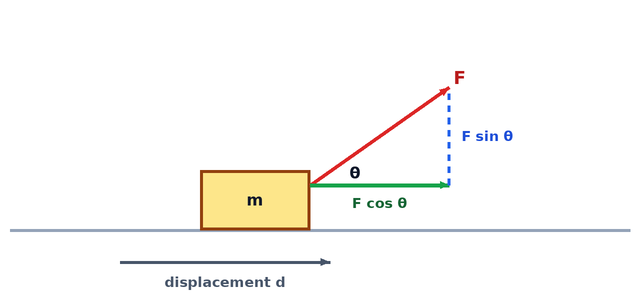
تحليل القوة \(F\) إلى مركبة موازية للإزاحة \(F\cos\theta\) ومركبة عمودية \(F\sin\theta\).
The force \(F\) resolved into a component parallel to the displacement \(F\cos\theta\) and a perpendicular component \(F\sin\theta\).
\[W=(F\cos\theta)\,d\]
⚠️ أخطاء شائعة
⚠️ Common mistakes
• الزاوية \(\theta\) تُقاس بين القوة والإزاحة؛ في المستوى المائل غالبًا ما تكون الإزاحة موازية للمستوى، فاحسب الزاوية بالنسبة إليه.
• The angle \(\theta\) is measured between the force and the displacement; on an incline the displacement is along the plane, so measure the angle relative to it.
• حمل حقيبة والمشي بها أفقيًا بسرعة ثابتة: قوة يدك رأسية والإزاحة أفقية (\(\theta=90^\circ\)) فشغلها صفر، رغم التعب الذي تشعر به.
• Carrying a bag horizontally at constant speed: your hand’s force is vertical and the displacement is horizontal (\(\theta=90^\circ\)) so its work is zero, despite the tiredness you feel.
• لا تنس أن الشغل قياسي، لكن له إشارة موجبة أو سالبة تدل على نقل الطاقة إلى الجسم أو منه.
• Remember that work is a scalar, but its sign (positive or negative) shows energy transferred to or from the body.
🧮 أمثلة محلولة
🧮 Worked Examples
ما مقدار الشغل المبذول عند تطبيق قوة مقدارها \(10\ \mathrm{N}\) لتحريك صندوق مسافة \(4\ \mathrm{m}\) في اتجاه القوة؟
What work is done when a force of \(10\ \mathrm{N}\) moves a box \(4\ \mathrm{m}\) in the direction of the force?
ما مقدار الشغل المبذول عند تطبيق قوة \(60\ \mathrm{N}\) تميل \(35^\circ\) فوق الأفق لتحريك صندوق \(10\ \mathrm{m}\) أفقيًا؟
What work is done by a \(60\ \mathrm{N}\) force at \(35^\circ\) above the horizontal moving a box \(10\ \mathrm{m}\) horizontally?
➕➖ أنواع الشغل: موجب وسالب ومعدوم
➕➖ Types of Work: Positive, Negative and Zero
تتحدد إشارة الشغل بالزاوية \(\theta\) بين القوة والإزاحة، لأن \(\cos\theta\) يغيّر إشارته:
The sign of the work is determined by the angle \(\theta\) between the force and the displacement, because \(\cos\theta\) changes sign:
| الزاوية \(\theta\)Angle \(\theta\) | \(\cos\theta\)\(\cos\theta\) | الشغلWork | المعنىMeaning |
|---|---|---|---|
| \(0^\circ\le\theta\lt 90^\circ\) | \(\gt 0\) | موجبPositive | القوة تسبّب الحركة (تزيد طاقة الجسم)The force causes the motion (adds energy) |
| \(\theta=90^\circ\) | \(=0\) | معدومZero | القوة عمودية على الإزاحةThe force is perpendicular to the displacement |
| \(90^\circ\lt \theta\le180^\circ\) | \(\lt 0\) | سالبNegative | القوة تقاوم الحركة (تنقص طاقة الجسم)The force opposes the motion (removes energy) |
في الشكل أدناه جسم ينزلق على مستوى مائل خشن وتؤثر فيه ثلاث قوى: الوزن \(F_g\) والقوة العمودية \(F_N\) وقوة الاحتكاك \(F_k\) والإزاحة \(d\) على امتداد المستوى إلى الأسفل:
In the figure below a body slides down a rough incline under three forces: the weight \(F_g\), the normal force \(F_N\) and the friction force \(F_k\), with the displacement \(d\) along the plane downward:
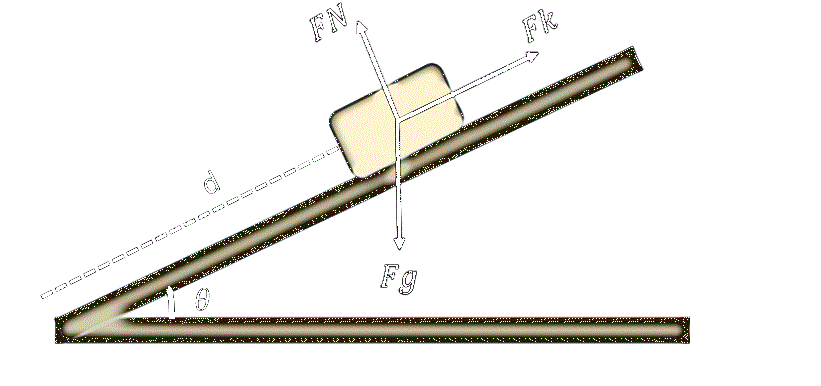
القوى المؤثرة على جسم ينزلق على مستوى مائل خشن: الوزن \(F_g\) والعمودية \(F_N\) والاحتكاك \(F_k\).
The forces on a body sliding down a rough incline: weight \(F_g\), normal \(F_N\) and friction \(F_k\).
① الشغل الموجب: شغل الوزن
① Positive work: the work of the weight
الزاوية بين قوة الوزن والإزاحة حادة (\(90^\circ-\theta\) كما في الشكل) فمركبة الوزن الموازية للمستوى \(mg\sin\theta\) باتجاه الحركة، والشغل موجب ويسبّب الحركة.
The angle between the weight and the displacement is acute (\(90^\circ-\theta\) as in the figure) so the component of the weight along the plane \(mg\sin\theta\) is along the motion, and the work is positive and causes the motion.
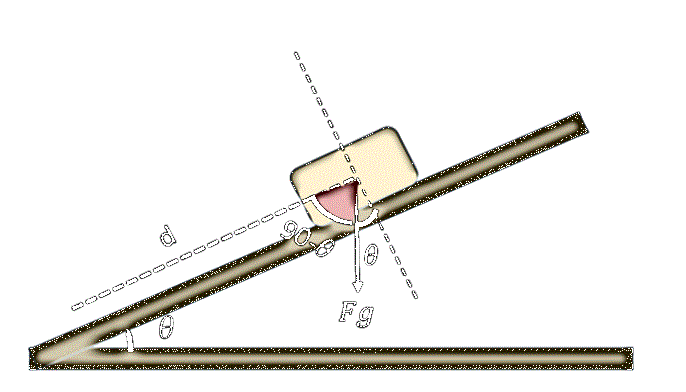
شغل الوزن موجب: الزاوية مع الإزاحة حادة.
The work of the weight is positive: the angle with the displacement is acute.
② الشغل السالب: شغل الاحتكاك
② Negative work: the work of friction
قوة الاحتكاك تعاكس اتجاه الإزاحة تمامًا، فالزاوية بينهما \(180^\circ\) و\(\cos180^\circ=-1\) والشغل سالب (مقاوم للحركة): \(W_k=-F_kd\).
Friction points exactly opposite to the displacement so the angle between them is \(180^\circ\) and \(\cos180^\circ=-1\): the work is negative (it resists the motion): \(W_k=-F_kd\).
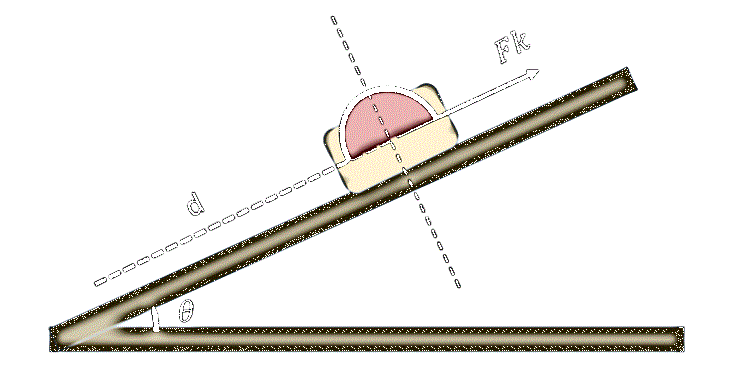
شغل الاحتكاك سالب: الزاوية مع الإزاحة \(180^\circ\).
The work of friction is negative: the angle with the displacement is \(180^\circ\).
③ الشغل المعدوم: شغل القوة العمودية
③ Zero work: the work of the normal force
القوة العمودية \(F_N\) متعامدة دائمًا مع سطح الحركة وبالتالي مع الإزاحة (\(\theta=90^\circ\)) و\(\cos90^\circ=0\) فالشغل معدوم. وكذلك الوزن على سطح أفقي، وقوة الشد المركزية في الحركة الدائرية.
The normal force \(F_N\) is always perpendicular to the surface and therefore to the displacement (\(\theta=90^\circ\)) and \(\cos90^\circ=0\) so the work is zero. The same holds for the weight on a horizontal surface and for the centripetal tension in circular motion.
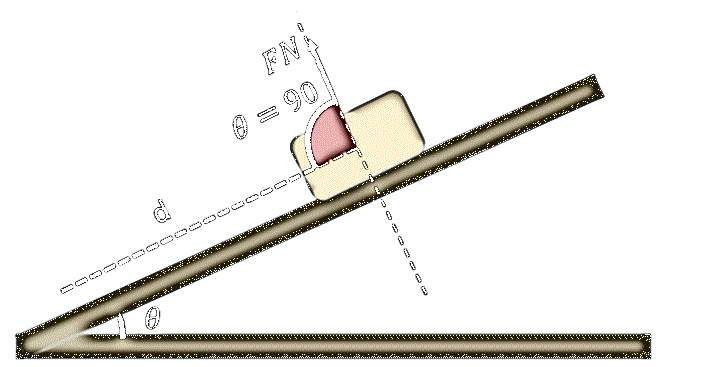
شغل القوة العمودية معدوم: الزاوية مع الإزاحة \(90^\circ\).
The work of the normal force is zero: the angle with the displacement is \(90^\circ\).
أحد الأتي يبذل شغلًا سالبًا على جسم ينزلق على سطح أفقي خشن:
Which of the following does negative work on a body sliding on a rough horizontal surface?
🧮 أمثلة محلولة (تابع)
🧮 Worked Examples (continued)
جسم كتلته \(3\ \mathrm{kg}\) ينزلق مسافة \(4\ \mathrm{m}\) على مستوى مائل زاويته \(20^\circ\). احسب شغل قوة الوزن (\(g=9.8\ \mathrm{m/s^2}\)).
A \(3\ \mathrm{kg}\) body slides \(4\ \mathrm{m}\) down an incline of \(20^\circ\). Find the work done by its weight (\(g=9.8\ \mathrm{m/s^2}\)).
صندوق كتلته \(10\ \mathrm{kg}\) على سطح أفقي خشن سُحب بحبل بقوة \(50\ \mathrm{N}\) تميل \(25^\circ\) فوق الأفق مسافة \(8\ \mathrm{m}\) وكانت قوة الاحتكاك \(15\ \mathrm{N}\). احسب الشغل الكلي.
A \(10\ \mathrm{kg}\) box on a rough horizontal surface is pulled by a rope with \(50\ \mathrm{N}\) at \(25^\circ\) above the horizontal for \(8\ \mathrm{m}\), with friction of \(15\ \mathrm{N}\). Find the total work.
➕ الشغل الكلي لعدة قوى
➕ Total Work of Several Forces
عندما تؤثر عدة قوى على جسم فالشغل الكلي هو المجموع الجبري لأشغال القوى كلها (مع مراعاة إشارة كل منها). وإذا كانت القوى ثابتة فهو يساوي أيضًا شغل المحصلة:
When several forces act on a body the total work is the algebraic sum of the works of all the forces (keeping the sign of each). If the forces are constant it also equals the work of the net force:
📌 الشغل الكلي
📌 Total work
\[W_{tot}=W_1+W_2+\cdots=\left(\sum\vec F\right)\cdot\vec d=F_{net}\,d\cos\theta\]
رفع شخص صندوقًا رأسيًا لأعلى بسرعة ثابتة مسافة \(2\ \mathrm{m}\) بقوة \(100\ \mathrm{N}\)، فإن الشغل الكلي المبذول على الصندوق:
A person lifts a box vertically upward at constant speed through \(2\ \mathrm{m}\) with a force of \(100\ \mathrm{N}\). The total work done on the box is:
📈 الشغل والمساحة تحت منحنى القوة–الإزاحة
📈 Work and the Area under the Force–Displacement Graph
عندما تكون القوة ثابتة وفي اتجاه الإزاحة فإن الرسم البياني للقوة مع الإزاحة مستطيل مساحته \(F\times d\)، وهي تساوي الشغل. وهذه الفكرة هي التي تُظهرها المحاكاة التي في آخر الدرس: الشغل = المساحة المحصورة تحت المنحنى.
When the force is constant and along the displacement the force–displacement graph is a rectangle of area \(F\times d\), which equals the work. This is the idea shown by the simulation at the end of the lesson: work = the area under the graph.
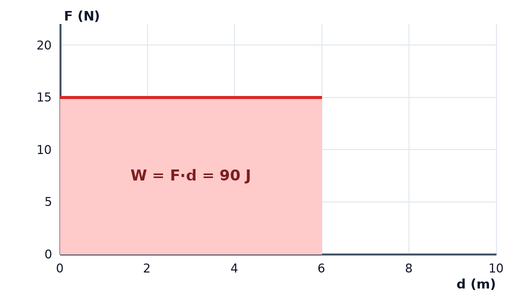
قوة ثابتة \(15\ \mathrm{N}\) خلال \(6\ \mathrm{m}\): الشغل \(15\times6=90\ \mathrm{J}\) يساوي مساحة المستطيل.
A constant \(15\ \mathrm{N}\) force over \(6\ \mathrm{m}\): the work \(15\times6=90\ \mathrm{J}\) equals the area of the rectangle.
وعندما تميل القوة بزاوية \(\theta\) نرسم المركبة \(F\cos\theta\) مع الإزاحة فتكون المساحة هي الشغل أيضًا؛ ويظهر ذلك في المحاكاة بتغيير الزاوية.
When the force is inclined at \(\theta\) we plot the component \(F\cos\theta\) against the displacement and the area is again the work; the simulation shows this by changing the angle.
🧪 جرّب بنفسك
🧪 Try It Yourself
🧪 تجربة 1: حاسبة الشغل بقوة ثابتة
🧪 Experiment 1: Constant-Force Work Calculator
غيّر القوة والإزاحة والزاوية بين القوة والإزاحة ثم اضغط «حرّك الجسم» لترى الجسم يتحرك ويُحسب الشغل \(W=Fd\cos\theta\) ونوعه (موجب أو سالب أو معدوم). لاحظ أن الزاوية \(90^\circ\) تعطي شغلًا معدومًا وأن الزاوية الأكبر من \(90^\circ\) تعطي شغلًا سالبًا.
Change the force, the displacement and the angle between the force and the displacement then press “Move the body” to see the body move and the work \(W=Fd\cos\theta\) and its type (positive, negative or zero) calculated. Notice that \(90^\circ\) gives zero work and an angle larger than \(90^\circ\) gives negative work.
✅ ملخص الدرس
✅ Lesson Summary
أهم ما تعلمناه
Key takeaways
• \(W=Fd\cos\theta\) حيث \(\theta\) الزاوية بين القوة والإزاحة، ووحدته الجول \(\mathrm{J}=\mathrm{N\cdot m}\).
• \(W=Fd\cos\theta\) where \(\theta\) is the angle between the force and the displacement, in joules \(\mathrm{J}=\mathrm{N\cdot m}\).
• الشغل موجب إذا \(\theta\lt 90^\circ\) وسالب إذا \(\theta\gt 90^\circ\) ومعدوم إذا \(\theta=90^\circ\).
• Work is positive if \(\theta\lt 90^\circ\), negative if \(\theta\gt 90^\circ\) and zero if \(\theta=90^\circ\).
• الشغل الكلي = مجموع أشغال القوى جبريًا = شغل المحصلة.
• Total work = the algebraic sum of the works = the work of the net force.
• الشغل = المساحة تحت منحنى القوة–الإزاحة (للمركبة في اتجاه الإزاحة).
• Work = the area under the force–displacement graph (for the component along the displacement).
🧪 اختبر نفسك: امتحان من 20 سؤالاً
🧪 Test Yourself: a 20-Question Exam
أنهِ الدرس بالاختبار التفاعلي التالي؛ أسئلته تجمع بين الفهم والحساب وتغطي جميع أقسام الدرس.
Finish with the interactive exam below; its questions mix understanding with calculation and cover every section of the lesson.
اختبار الشغل الناتج عن قوة ثابتة Work Done by a Constant Force Quiz
20 سؤالاً - مفهوم الشغل، إشارته، حسابه من القوة والزاوية، والشغل الكلي 20 Questions - concept of work, its sign, calculating it from force and angle, and net work
• عدد الأسئلة: 20 سؤالاً
• مدة الاختبار: 30 دقيقة
• لا يمكنك تغيير إجاباتك أو إعادة الاختبار إلا بعد 24 ساعة من التسليم.
• تأكد من إجاباتك قبل التسليم! 📌 Important Instructions:
• Number of questions: 20 questions
• Quiz duration: 30 minutes
• You cannot change your answers or retake the quiz for 24 hours after submission.
• Make sure of your answers before submitting!
🔗 محاكيات GeoGebra للاستعانة بها عند اللزوم
🔗 GeoGebra Simulations to Use When Needed
اضغط «تشغيل» لتعمل المحاكاة هنا داخل الدرس؛ ويمكن للطالب الرجوع إليها لتجربة الفكرة بطريقة أخرى.
Press “Run” to run the simulation right here inside the lesson; the student can use it to try the idea in another way.