🏃 ما التسارع؟
🏃 What Is Acceleration?
في الحياة اليومية نقول إن السيارة «تتسارع» عندما نضغط على دواسة الوقود، لكن في الفيزياء لهذه الكلمة معنى أوسع: التسارع هو أي تغيّر في متجه السرعة، سواء تغيّر مقدار السرعة (زيادة أو نقصان) أو تغيّر اتجاهها. وفي هذا الدرس نركز على الحركة في خط مستقيم حيث يتغير مقدار السرعة فقط.
In everyday life we say a car “accelerates” when we press the gas pedal, but in physics the word has a wider meaning: acceleration is any change in the velocity vector, whether its magnitude changes (increases or decreases) or its direction changes. In this lesson we focus on motion along a straight line, where only the speed changes.
🧩 نشاط: ثلاثة عدّائين
🧩 Activity: Three Runners
سلطان وأحمد وماجد ثلاثة عدّائين: ماجد يتحرك بسرعة متناقصة، وسلطان بسرعة ثابتة، وأحمد بسرعة متزايدة. صورة كل عدّاء أُخذت بفواصل زمنية متساوية. أي التمثيلات النقطية (الصفوف الثلاثة في الشكل) يعبّر عن حركة كل واحد؟ ومن العدّاء الذي تتغير سرعته؟
Sultan, Ahmed and Majed are three runners: Majed moves with decreasing speed, Sultan with constant speed and Ahmed with increasing speed. Each runner was photographed at equal time intervals. Which dot diagram (the three rows in the figure) represents each runner’s motion? And which runners’ speeds change?
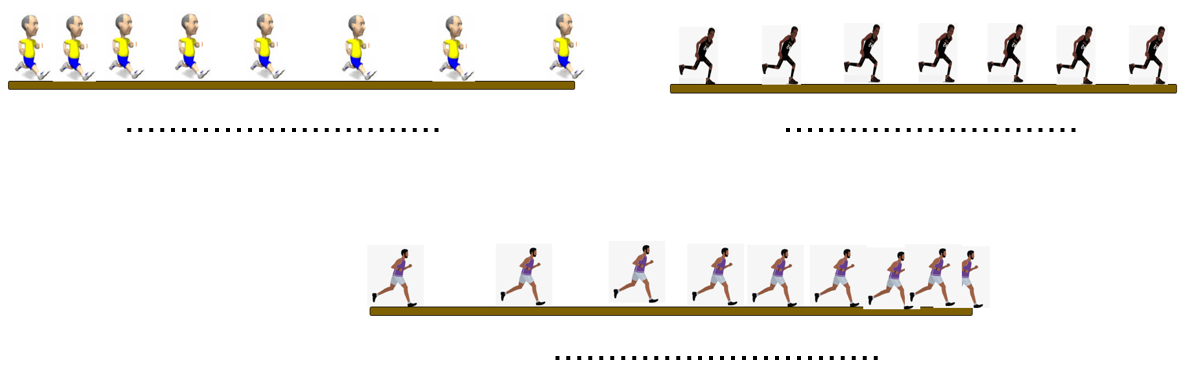
إذن: الجسم الذي يتحرك بسرعة غير ثابتة يملك تسارعًا، والجسم الذي سرعته ثابتة (مقدارًا واتجاهًا) تسارعه صفر.
So: a body moving with non-constant speed has acceleration, and a body whose velocity is constant (in magnitude and direction) has zero acceleration.
📐 كيف نحسب التسارع؟
📐 How Do We Calculate Acceleration?
في سباق الجري التُقطت صور متتالية كل ثانية للعدّاء رقم 7، وكانت حركته بتسارع ثابت. لحساب تسارعه نتبع خطوتين:
In a running race, consecutive photos were taken every second of runner number 7, who moved with constant acceleration. To find his acceleration we follow two steps:
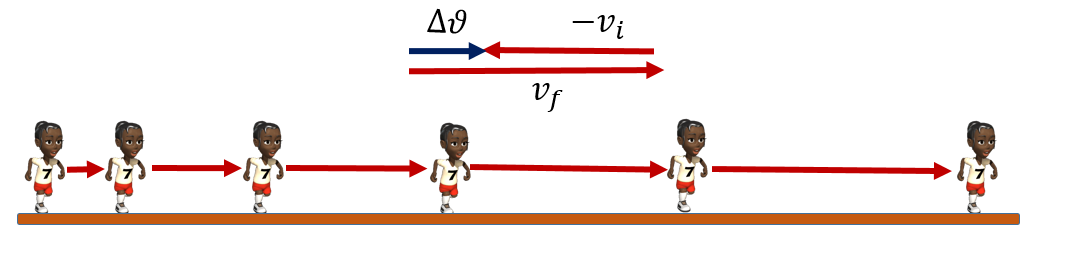
التغير في متجه السرعة \(\Delta\vec v\) هو متجه السرعة النهائية مضافًا إليه سالب متجه السرعة الابتدائية: \(\vec v_f+(-\vec v_i)\).
The change in the velocity vector \(\Delta\vec v\) is the final velocity plus the negative of the initial velocity: \(\vec v_f+(-\vec v_i)\).
📜 قانون التسارع
📜 The Law of Acceleration
الخطوة 1: نجد التغير في متجه السرعة (طرح متجهين):
Step 1: find the change in the velocity vector (subtracting two vectors):
\[\Delta\vec v=\vec v_f-\vec v_i\]
الخطوة 2: نحسب المعدل الزمني لهذا التغير، وهو التسارع:
Step 2: find the time rate of this change, which is the acceleration:
\[\vec a=\frac{\vec v_f-\vec v_i}{\Delta t}=\frac{\Delta\vec v}{\Delta t}\qquad\Rightarrow\qquad[a]=\frac{m/s}{s}=\frac{m}{s^2}\]
رمز التسارع \(a\)، وهو كمية متجهة اتجاهها اتجاه التغير في السرعة \(\Delta\vec v\) (لا اتجاه السرعة نفسها!)، ووحدته \(m/s^2\) أي: كم تتغير السرعة (بالمتر لكل ثانية) في كل ثانية.
The symbol is \(a\); it is a vector whose direction is that of the change in velocity \(\Delta\vec v\) (not of the velocity itself!), and its unit is \(m/s^2\): how many meters per second the speed changes in each second.
💡 لماذا نطرح المتجهات؟
💡 Why Do We Subtract Vectors?
السرعة متجه، فتغيرها يعتمد على المقدار والاتجاه معًا. في الحركة على خط مستقيم نتعامل مع الاتجاه بالإشارة: نختار اتجاهًا موجبًا (مثلًا نحو اليمين)، فتكون السرعة موجبة إلى اليمين وسالبة إلى اليسار. وعندئذ يُحسب \(\Delta v=v_f-v_i\) جبريًا مع مراعاة الإشارات. مثال: من \(+4\ m/s\) إلى \(-2\ m/s\) يكون \(\Delta v=-2-4=-6\ m/s\) وليس \(2\).
Velocity is a vector, so its change depends on both magnitude and direction. For straight-line motion we handle direction with signs: choose a positive direction (say to the right), so velocity is positive to the right and negative to the left. Then \(\Delta v=v_f-v_i\) is computed algebraically with the signs. Example: from \(+4\ m/s\) to \(-2\ m/s\) gives \(\Delta v=-2-4=-6\ m/s\), not \(2\).
✍️ مثال موجَّه خطوة بخطوة
✍️ A Guided Example
سيارة تتحرك بسرعة \(5\ m/s\) غيّرت سرعتها فأصبحت \(15\ m/s\) خلال \(10\ s\). احسب تسارعها المتوسط، ثم فسّر ما يعنيه كل رقم.
A car moving at \(5\ m/s\) changes its speed to \(15\ m/s\) during \(10\ s\). Find its average acceleration, then interpret each number.
جسم يتحرك على خط مستقيم بسرعة ثابتة مقدارها \(15\ m/s\). فإن تسارعه يعادل:
An object moves along a straight line with a constant speed of \(15\ m/s\). Its acceleration is:
🧪 تجربة 1: حاسبة التسارع
🧪 Experiment 1: Acceleration Calculator
أدخل السرعة الابتدائية والنهائية والزمن (يمكن إدخال قيم سالبة للسرعة)، ثم اضغط «احسب». سيبيّن البرنامج \(\Delta v\) والتسارع ونوع الحركة. جرّب: \(5\to15\) خلال \(10\ s\)، ثم \(15\to5\)، ثم \(5\to-5\).
Enter the initial and final velocities and the time (velocities may be negative), then press “Calculate”. The program shows \(\Delta v\), the acceleration and the type of motion. Try \(5\to15\) in \(10\ s\), then \(15\to5\), then \(5\to-5\).
🔀 متى تكون الحركة متسارعة ومتى متباطئة؟
🔀 When Is Motion Speeding Up and When Slowing Down?
نوعان من الحركة بتسارع: حركة متسارعة تزداد فيها سرعة الجسم (مقدار السرعة)، وحركة متباطئة تتناقص فيها سرعة الجسم. وكلتاهما تحدث بتسارع \(a\neq0\).
There are two kinds of accelerated motion: speeding up, where the body’s speed (its magnitude) increases, and slowing down, where it decreases. Both occur with \(a\neq0\).


أعلى: حركة متسارعة (المسافات بين الصور تزداد). أسفل: حركة متباطئة (المسافات تقل).
Top: speeding up (distances between photos grow). Bottom: slowing down (distances shrink).
💡 القاعدة الذهبية
💡 The Golden Rule
نوع الحركة لا تحدده إشارة التسارع وحدها، بل العلاقة بين اتجاه التسارع واتجاه السرعة:
The kind of motion is decided not by the sign of the acceleration alone but by the relation between the direction of acceleration and the direction of velocity:
- التسارع والسرعة في الاتجاه نفسه ⇒ السرعة (المقدار) تزداد ⇒ حركة متسارعة.Acceleration and velocity in the same direction ⇒ the speed increases ⇒ speeding up.
- التسارع عكس اتجاه السرعة ⇒ السرعة (المقدار) تتناقص ⇒ حركة متباطئة.Acceleration opposite to velocity ⇒ the speed decreases ⇒ slowing down.
وبما أن \(\vec a\) في اتجاه \(\Delta\vec v\): إذا زاد مقدار السرعة كان \(\Delta\vec v\) في اتجاه السرعة، وإذا نقص كان \(\Delta\vec v\) عكسها.
Since \(\vec a\) points along \(\Delta\vec v\): if the speed grows, \(\Delta\vec v\) points along the velocity; if the speed shrinks, \(\Delta\vec v\) points against it.
| نوع الحركةType of motion | اتجاه التسارعAcceleration direction | اتجاه السرعةVelocity direction | التغير في السرعةChange in speed |
|---|---|---|---|
| متسارعةSpeeding up | موجب (+)positive (+) | موجب (+)positive (+) | تزداد السرعةSpeed increases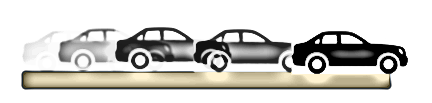 |
| متباطئةSlowing down | سالب (−)negative (−) | موجب (+)positive (+) | تتناقص السرعةSpeed decreases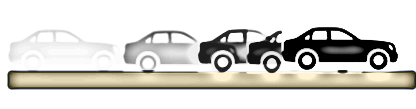 |
| متسارعةSpeeding up | سالب (−)negative (−) | سالب (−)negative (−) | تزداد السرعةSpeed increases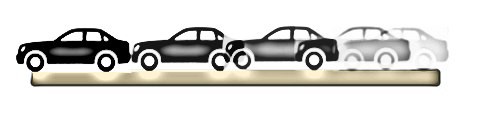 |
| متباطئةSlowing down | موجب (+)positive (+) | سالب (−)negative (−) | تتناقص السرعةSpeed decreases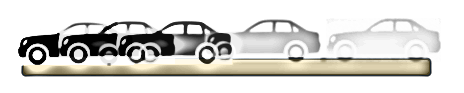 |
لاحظ الصف الثاني والرابع: التباطؤ قد يأتي بتسارع سالب (إذا كانت الحركة نحو الاتجاه الموجب) أو بتسارع موجب (إذا كانت الحركة نحو الاتجاه السالب). فالإشارة وحدها لا تكفي.
Notice rows 2 and 4: slowing down can come with a negative acceleration (if the motion is toward the positive direction) or a positive acceleration (if the motion is toward the negative direction). The sign alone is not enough.
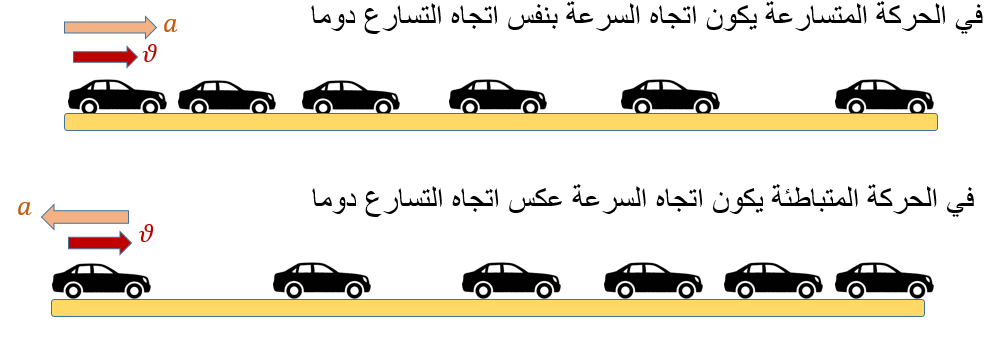
ملخص: في الحركة المتسارعة يكون اتجاه التسارع هو اتجاه السرعة نفسه، وفي المتباطئة يكون عكسه.
Summary: in speeding-up motion the acceleration points along the velocity; in slowing-down motion it points against it.
سيارة تتحرك نحو الشرق (الاتجاه الموجب) وتتباطأ حتى تتوقف. ما اتجاه تسارعها؟
A car is moving east (the positive direction) and slows down to a stop. What is the direction of its acceleration?
📈 الحركة بالرسوم البيانية: الموقع والسرعة والتسارع
📈 Describing Motion with Graphs
يمكن وصف الحركة في بعد واحد بثلاثة رسوم بيانية مع الزمن، ولكل منها معنى: ميل منحنى (الموقع–الزمن) هو السرعة، وميل منحنى (السرعة–الزمن) هو التسارع، والمساحة تحت منحنى (التسارع–الزمن) هي التغير في السرعة، والمساحة تحت منحنى (السرعة–الزمن) هي الإزاحة. جرّب التجربة التالية: غيّر السرعة الابتدائية والتسارع وراقب الصور المتتالية (بفواصل زمنية متساوية) والرسوم الثلاثة معًا.
Motion in one dimension can be described by three graphs against time, each with a meaning: the slope of the position–time graph is the velocity, the slope of the velocity–time graph is the acceleration, the area under the acceleration–time graph is the change in velocity, and the area under the velocity–time graph is the displacement. Try the next experiment: change the initial velocity and the acceleration and watch the equally spaced snapshots and the three graphs together.
🧪 تجربة 2: الحركة بتسارع ثابت: الصور المتتالية والرسوم الثلاثة
🧪 Experiment 2: Constant Acceleration — Snapshots and the Three Graphs
اضبط السرعة الابتدائية \(v_0\) والتسارع \(a\) (يمكن أن يكونا سالبين) ثم اضغط «ابدأ». تظهر نقطة جديدة (صورة) كل ثانية فتتضح الفرق بين السرعة الثابتة والمتزايدة والمتناقصة، وتُرسم معها منحنيات (التسارع–الزمن) و(السرعة–الزمن) و(الموقع–الزمن). جرّب: \(a=0\)، ثم \(a>0\) و\(v_0=0\)، ثم \(v_0>0\) و\(a<0\).
Set the initial velocity \(v_0\) and the acceleration \(a\) (either may be negative) and press “Start”. A new snapshot dot appears every second, making the difference between constant, increasing and decreasing speed clear, while the acceleration–time, velocity–time and position–time graphs are drawn. Try \(a=0\), then \(a>0\) with \(v_0=0\), then \(v_0>0\) with \(a<0\).
📜 ماذا نستنتج من الرسوم؟
📜 What Do the Graphs Tell Us?
- سرعة ثابتة: خط أفقي في (السرعة–الزمن)، و\(a=0\) أي خط على محور الزمن في (التسارع–الزمن)، وخط مستقيم مائل في (الموقع–الزمن).Constant velocity: a horizontal line in the velocity–time graph, \(a=0\) (a line on the time axis) in the acceleration–time graph, and a straight sloped line in the position–time graph.
- تسارع ثابت: خط مستقيم مائل في (السرعة–الزمن)، وخط أفقي في (التسارع–الزمن)، ومنحنى قطع مكافئ في (الموقع–الزمن).Constant acceleration: a straight sloped line in the velocity–time graph, a horizontal line in the acceleration–time graph, and a parabola in the position–time graph.
- منحنى (الموقع–الزمن) مقعّر لأعلى ⇒ \(a>0\)، ومقعّر لأسفل ⇒ \(a<0\) (لأن ميله — أي السرعة — يتزايد أو يتناقص).A position–time curve that bends up ⇒ \(a>0\), and one that bends down ⇒ \(a<0\) (its slope, the velocity, increases or decreases).
🔍 العلاقة بين ميل الخط (السرعة–الزمن) والتسارع
🔍 Slope of the Velocity–Time Graph and Acceleration
الخط البياني التالي يبين العلاقة بين السرعة والزمن لدراجة. تأمله ثم أجب عن الأسئلة التالية:
The following graph shows the velocity–time relationship for a bicycle. Study it, then answer the questions:
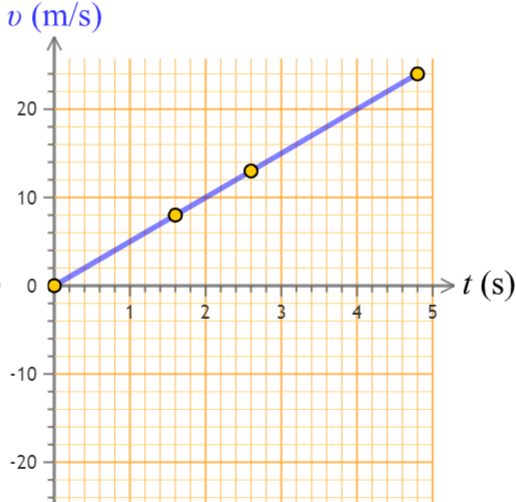
العلاقة بين السرعة والزمن لدراجة (خط مستقيم يمر بنقطة الأصل).
Velocity–time relationship for a bicycle (a straight line through the origin).
من الخط البياني: (أ) هل السرعة ثابتة أم متزايدة أم متناقصة؟ (ب) هل التسارع منتظم أم معدوم أم متزايد أم متناقص؟ (ج) احسب مقدار التسارع. (د) احسب ميل الخط البياني. (هـ) قارن الميل بالتسارع.
From the graph: (a) is the velocity constant, increasing or decreasing? (b) is the acceleration uniform, zero, increasing or decreasing? (c) find the magnitude of the acceleration. (d) find the slope of the graph. (e) compare the slope with the acceleration.
ميل الخط البياني (السرعة–الزمن) يمثّل:
The slope of a velocity–time graph represents:
💡 المساحة تحت منحنى (السرعة–الزمن)
💡 Area Under the Velocity–Time Graph
في أي فترة زمنية صغيرة تكون الإزاحة \(\Delta x=v\,\Delta t\) وهي مساحة شريط عرضه \(\Delta t\) وارتفاعه \(v\). فمجموع الإزاحات = المساحة تحت المنحنى. وإذا كان المنحنى خطًا مستقيمًا من \(v_i\) إلى \(v_f\) فالمساحة شبه منحرف: \(\Delta x=\tfrac12(v_i+v_f)\,t\). والمساحة فوق محور الزمن إزاحة موجبة وتحته إزاحة سالبة؛ فالإزاحة الكلية هي مجموعهما الجبري، أما المسافة فمجموعهما بالقيمة المطلقة.
In any small time interval the displacement is \(\Delta x=v\,\Delta t\), the area of a strip of width \(\Delta t\) and height \(v\). So the sum of displacements = the area under the graph. If the graph is a straight line from \(v_i\) to \(v_f\), the area is a trapezoid: \(\Delta x=\tfrac12(v_i+v_f)\,t\). The area above the time axis is positive displacement and below it is negative; the net displacement is their algebraic sum, whereas the distance is the sum of their absolute values.
🧪 تجربة 3: ارسم منحنى (السرعة–الزمن) واستخرج التسارع والإزاحة
🧪 Experiment 3: Plot a Velocity–Time Graph and Extract Acceleration and Displacement
أدخل أزواج (الزمن، السرعة) بترتيب زمني متزايد (يمكن إدخال سرعات سالبة)، ثم اضغط «ارسم». سيحسب البرنامج تسارع كل مرحلة (ميل القطعة) وإزاحتها (المساحة تحتها) والإزاحة الكلية والمسافة الكلية. القيم الجاهزة مثال: تسارع ثم سرعة ثابتة ثم تباطؤ حتى التوقف.
Enter (time, velocity) pairs in increasing time order (negative velocities allowed), then press “Plot”. The program computes each stage’s acceleration (the slope of the segment) and displacement (the area under it), and the total displacement and total distance. The preset values are an example: speed up, cruise at constant speed, then brake to a stop.
| الزمن \(t\) (s)Time \(t\) (s) | السرعة \(v\) (m/s)Velocity \(v\) (m/s) |
|---|
🧮 معادلات الحركة بتسارع ثابت
🧮 Equations of Motion with Constant Acceleration
عند الحركة في بعد واحد قد يتحرك الجسم بسرعة ثابتة (\(a=0\)) أو بسرعة تتغير بانتظام (\(a\neq0\) ثابت). ولكل حالة معادلات:
In one-dimensional motion a body may move with a constant velocity (\(a=0\)) or with a velocity that changes uniformly (constant \(a\neq0\)). Each case has its equations:
| جسم يتحرك بسرعة متغيرة بانتظامUniformly changing velocity | جسم يتحرك بسرعة ثابتةConstant velocity |
|---|---|
| \(a\neq0\) | \(a=0\) |
| \(v_f=v_i+a\,t\) \(v_f^2=v_i^2+2a\,(x_f-x_i)\) \(x_f=x_i+v_i\,t+\tfrac12a\,t^2\) \(x_f=x_i+\tfrac12(v_f+v_i)\,t\) | \(x_f=x_i+v\,t\) |
💡 من أين جاءت المعادلات؟
💡 Where Do the Equations Come From?
- من تعريف التسارع \(a=\dfrac{v_f-v_i}{t}\) نحصل مباشرة على \(v_f=v_i+at\).From the definition \(a=\dfrac{v_f-v_i}{t}\) we get directly \(v_f=v_i+at\).
- السرعة المتوسطة (لتسارع ثابت) \(\bar v=\dfrac{v_i+v_f}{2}\) فالإزاحة \(x_f-x_i=\bar v\,t=\tfrac12(v_i+v_f)t\) (مساحة شبه المنحرف).The average velocity (for constant acceleration) is \(\bar v=\dfrac{v_i+v_f}{2}\), so the displacement is \(x_f-x_i=\bar v\,t=\tfrac12(v_i+v_f)t\) (the trapezoid area).
- نعوّض \(v_f=v_i+at\) في المعادلة السابقة فنحصل على \(x_f=x_i+v_it+\tfrac12at^2\).Substituting \(v_f=v_i+at\) into the previous result gives \(x_f=x_i+v_it+\tfrac12at^2\).
- بحذف الزمن \(t\) بين المعادلتين الأولى والثانية نحصل على \(v_f^2=v_i^2+2a(x_f-x_i)\).Eliminating the time \(t\) between the first two equations gives \(v_f^2=v_i^2+2a(x_f-x_i)\).
📜 كيف أختار المعادلة المناسبة؟
📜 How Do I Choose the Right Equation?
- اكتب المعطيات والمجهول، وحدّد اتجاهًا موجبًا وأعطِ كل متجه إشارته.Write the givens and the unknown, choose a positive direction and give each vector its sign.
- حدّد الكمية الناقصة (التي لا تُعطى ولا تُطلب) واختر المعادلة التي لا تحتويها:Find the missing quantity (neither given nor asked for) and choose the equation that does not contain it:
| الكمية الناقصةMissing quantity | المعادلة المناسبةSuitable equation |
|---|---|
| \(x_f-x_i\) | \(v_f=v_i+at\) |
| \(v_f\) | \(x_f=x_i+v_it+\tfrac12at^2\) |
| \(a\) | \(x_f=x_i+\tfrac12(v_f+v_i)t\) |
| \(t\) | \(v_f^2=v_i^2+2a(x_f-x_i)\) |
سيارة انطلقت من السكون بتسارع \(4\ m/s^2\). ما السرعة التي وصلت إليها بعد \(6\ s\)؟ وما المسافة التي قطعتها خلالها؟
A car starts from rest with an acceleration of \(4\ m/s^2\). What speed does it reach after \(6\ s\), and how far does it travel in that time?
سائق يسير بسرعة \(20\ m/s\) فضغط على الفرامل فتباطأت السيارة بتسارع \(-5\ m/s^2\) حتى توقفت. احسب زمن التوقف ومسافة التوقف.
A driver moving at \(20\ m/s\) brakes and the car decelerates at \(-5\ m/s^2\) until it stops. Find the stopping time and the stopping distance.
سيارة انطلقت من السكون بمعدل تسارع قدره \(4\ m/s^2\)، فإن السرعة التي وصلت إليها بعد زمن قدره \(6\ s\) تعادل:
A car starts from rest with an acceleration of \(4\ m/s^2\). The speed it reaches after \(6\ s\) is:
🍎 السقوط الحر
🍎 Free Fall
السقوط الحر حركة جسم تحت تأثير الجاذبية الأرضية وحدها دون وجود مقاومة هواء. وهو حركة بتسارع ثابت هو تسارع الجاذبية \(g\approx9.8\ m/s^2\) باتجاه الأسفل، ولا يعتمد على كتلة الجسم. وقد ينطلق الجسم ساقطًا أو مقذوفًا لأعلى أو لأسفل؛ يبقى تسارعه \(g\) نحو الأسفل في كل لحظة (حتى عند أعلى نقطة حيث تنعدم السرعة لحظيًا).
Free fall is the motion of a body under the influence of Earth’s gravity alone, with no air resistance. It is motion with a constant acceleration, the gravitational acceleration \(g\approx9.8\ m/s^2\) pointing downward, independent of the body’s mass. The body may be dropped or thrown up or down; its acceleration stays \(g\) downward at every instant (even at the top where the velocity is momentarily zero).
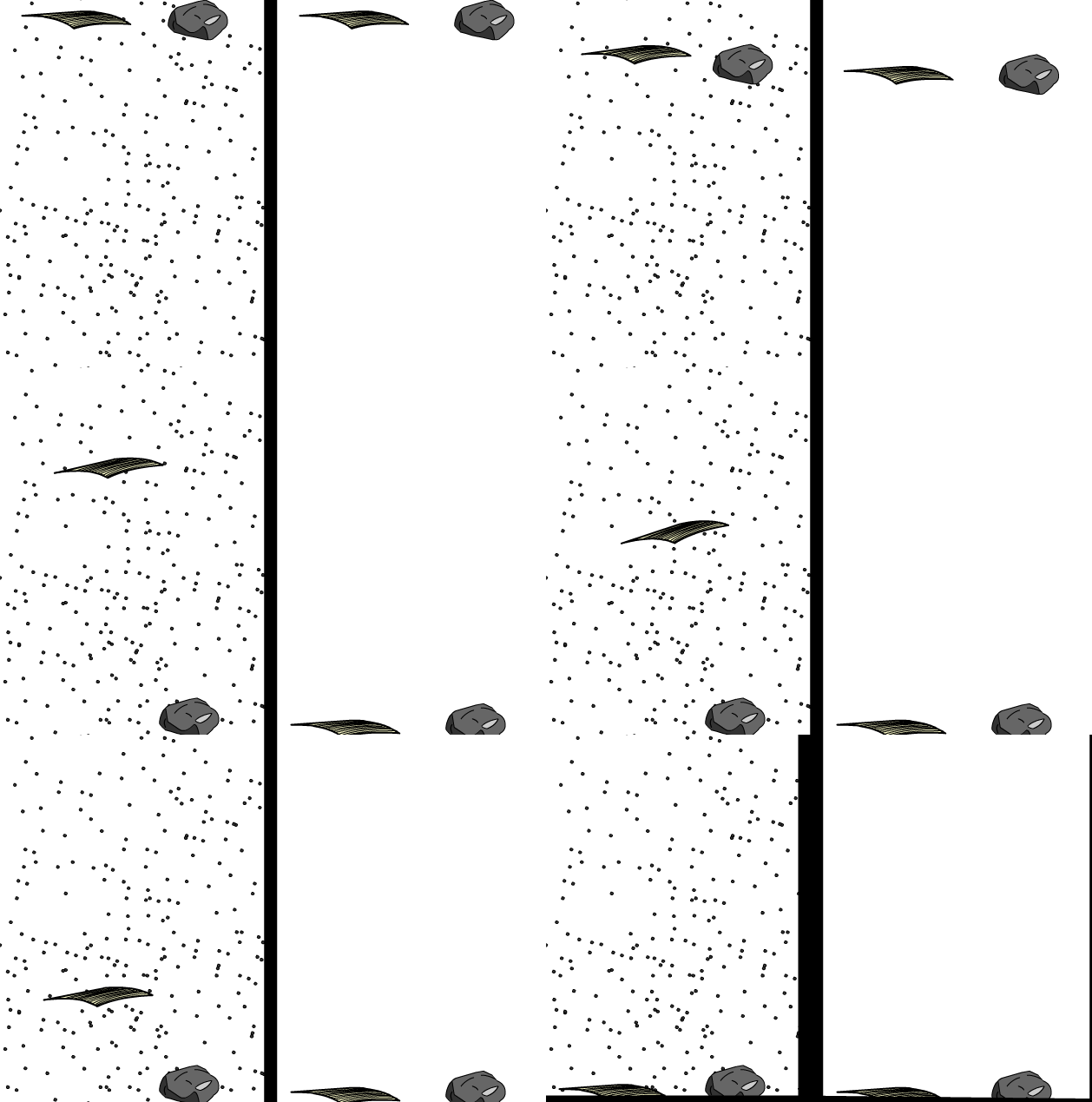
في الهواء تسقط الريشة ببطء بسبب مقاومة الهواء، وفي الفراغ تسقط الريشة والحجر معًا بالتسارع نفسه.
In air the feather falls slowly because of air resistance; in a vacuum the feather and the rock fall together with the same acceleration.
🔭 العالم جاليليو جاليلي
🔭 Galileo Galilei
أول من درس السقوط الحر دراسة علمية في القرن السابع عشر، وبيّن أن الأجسام تسقط بالتسارع نفسه مهما اختلفت كتلتها إذا أُهملت مقاومة الهواء (كما يحدث في الفراغ). وما نراه من سقوط الريشة ببطء في الهواء سببه مقاومة الهواء لا الجاذبية.
He was the first to study free fall scientifically, in the 17th century, and showed that bodies fall with the same acceleration whatever their mass when air resistance is neglected (as in a vacuum). The slow fall of a feather in air is due to air resistance, not gravity.
📜 معادلات السقوط الحر
📜 Free-Fall Equations
هي معادلات الحركة بتسارع ثابت نفسها مع \(a=g\). إذا اخترنا الاتجاه إلى أسفل موجبًا (مناسب لجسم يسقط) فإن \(a=+g\):
They are the same constant-acceleration equations with \(a=g\). If we choose downward as positive (convenient for a falling body) then \(a=+g\):
\[v=v_0+g\,t\qquad\Delta y=v_0\,t+\tfrac12g\,t^2\qquad v^2=v_0^2+2g\,\Delta y\]
وإذا اخترنا الاتجاه إلى أعلى موجبًا (مناسب للمقذوف لأعلى) فإن \(a=-g\) ونكتب \(v=v_0-gt\) و\(\Delta y=v_0t-\tfrac12gt^2\). المهم أن نثبّت الاتجاه الموجب طوال المسألة.
If we choose upward as positive (convenient for an object thrown up) then \(a=-g\) and we write \(v=v_0-gt\) and \(\Delta y=v_0t-\tfrac12gt^2\). What matters is to keep the same positive direction throughout the problem.
سقط جسم من ارتفاع \(100\ m\) (من السكون). احسب زمن وصوله للأرض وسرعته لحظة الاصطدام (\(g=9.8\ m/s^2\)).
An object falls from rest from a height of \(100\ m\). Find the time it takes to reach the ground and its speed at impact (\(g=9.8\ m/s^2\)).
تُركت كرة لتسقط سقوطًا حرًا من السكون. فإن سرعتها بعد \(2\ s\) تعادل (\(g=9.8\ m/s^2\)):
A ball is dropped from rest and falls freely. Its speed after \(2\ s\) is (\(g=9.8\ m/s^2\)):
⬆️ القذف الرأسي إلى أعلى
⬆️ Throwing Upward
عند قذف جسم إلى أعلى بسرعة \(v_0\) تتناقص سرعته بمعدل \(9.8\ m/s\) كل ثانية إلى أن تنعدم عند أقصى ارتفاع، ثم يسقط عائدًا بالتسارع نفسه. (نأخذ الاتجاه إلى أعلى موجبًا): زمن الصعود \(t=\dfrac{v_0}{g}\)، وأقصى ارتفاع \(h=\dfrac{v_0^2}{2g}\)، والزمن الكلي للعودة إلى نقطة القذف \(\dfrac{2v_0}{g}\)، وتكون سرعة العودة مساوية لسرعة القذف مقدارًا وعكسها اتجاهًا.
When a body is thrown upward at \(v_0\), its speed drops by \(9.8\ m/s\) every second until it is zero at the maximum height; then it falls back with the same acceleration. (Taking upward as positive): the time to rise is \(t=\dfrac{v_0}{g}\), the maximum height is \(h=\dfrac{v_0^2}{2g}\), the total time to return to the launch point is \(\dfrac{2v_0}{g}\), and the return speed equals the launch speed in magnitude but is opposite in direction.
قُذف جسم رأسيًا إلى أعلى بسرعة \(14.7\ m/s\). فإن الزمن اللازم للوصول إلى أقصى ارتفاع يعادل (\(g=9.8\ m/s^2\)):
An object is thrown vertically upward at \(14.7\ m/s\). The time needed to reach the maximum height is (\(g=9.8\ m/s^2\)):
🧪 تجربة 4: السقوط الحر في أماكن مختلفة من الكون
🧪 Experiment 4: Free Fall in Different Places in the Universe
اختر المكان وارتفاع السقوط ثم اضغط «أسقط». يعرض البرنامج الزمن والسرعة لحظة بلحظة ويسجّل في الجدول الإزاحة والزمن، ثم احسب التسارع من \(a=\dfrac{2\Delta y}{t^2}\) (الجسم يسقط من السكون: \(\Delta y=\tfrac12at^2\)). قارن قيمة \(g\) في الأماكن المختلفة. (يسقط الجسم من السكون وتُهمل مقاومة الهواء.)
Choose the place and the drop height, then press “Drop”. The program shows the time and speed moment by moment and records the displacement and the time in the table; then compute the acceleration from \(a=\dfrac{2\Delta y}{t^2}\) (the body falls from rest: \(\Delta y=\tfrac12at^2\)). Compare \(g\) in the different places. (The body falls from rest and air resistance is neglected.)
| المكانPlace | \(\Delta y\) (m) | \(t\) (s) | \(a=\dfrac{2\Delta y}{t^2}\) (m/s²) |
|---|
🌍 تطبيقات عملية
🌍 Practical Applications
- تصميم أنظمة المظلات (موازنة وزن الجسم بمقاومة الهواء).Designing parachute systems (balancing weight against air resistance).
- حساب زمن سقوط الأجسام وسرعة وصولها في الإنشاءات والسلامة.Calculating falling times and impact speeds in construction and safety.
- حساب المسافات اللازمة لتوقف المركبات وتحديد السرعات الآمنة.Calculating stopping distances of vehicles and safe speeds.
- تحسين أداء الرياضات الجوية وبرمجة محاكيات الفضاء.Improving air-sports performance and programming space simulators.
📝 ملخص الدرس
📝 Lesson Summary
- \(a=\dfrac{\Delta v}{\Delta t}=\dfrac{v_f-v_i}{t}\) كمية متجهة بوحدة \(m/s^2\)؛ تُحسب بطرح السرعتين مع مراعاة الإشارة.\(a=\dfrac{\Delta v}{\Delta t}=\dfrac{v_f-v_i}{t}\) is a vector in \(m/s^2\); find it by subtracting the velocities with their signs.
- التسارع في اتجاه السرعة ⇒ متسارعة، وعكسها ⇒ متباطئة؛ والسرعة الثابتة تسارعها صفر.Acceleration along the velocity ⇒ speeding up, against it ⇒ slowing down; constant velocity means zero acceleration.
- ميل (السرعة–الزمن) = التسارع، والمساحة تحتها = الإزاحة؛ وميل (الموقع–الزمن) = السرعة.The slope of velocity–time = acceleration, the area under it = displacement; the slope of position–time = velocity.
- معادلات الحركة: \(v_f=v_i+at\)، \(x_f=x_i+v_it+\tfrac12at^2\)، \(v_f^2=v_i^2+2a\Delta x\)، \(\Delta x=\tfrac12(v_i+v_f)t\).Equations of motion: \(v_f=v_i+at\), \(x_f=x_i+v_it+\tfrac12at^2\), \(v_f^2=v_i^2+2a\Delta x\), \(\Delta x=\tfrac12(v_i+v_f)t\).
- السقوط الحر: \(a=g\approx9.8\ m/s^2\) نحو الأسفل لكل الأجسام (بلا مقاومة هواء)، بما فيها المقذوفة لأعلى.Free fall: \(a=g\approx9.8\ m/s^2\) downward for all bodies (no air resistance), including those thrown upward.
🧪 اختبر نفسك: امتحان من 20 سؤالاً
🧪 Test Yourself: a 20-Question Exam
أنهِ الدرس بالاختبار التفاعلي التالي؛ أسئلته بمستوى متوسط وعالٍ وتجمع بين الفهم والحساب.
Finish with the interactive exam below; its questions are of medium and high difficulty and mix understanding with calculation.
اختبار الحركة المتسارعة Accelerated Motion Quiz
20 سؤالاً - التسارع، الرسوم البيانية، معادلات الحركة، والسقوط الحر 20 Questions - Acceleration, Motion Graphs, Equations of Motion, and Free Fall
• عدد الأسئلة: 20 سؤالاً
• مدة الاختبار: 30 دقيقة
• لا يمكنك تغيير إجاباتك أو إعادة الاختبار إلا بعد 24 ساعة من التسليم.
• تأكد من إجاباتك قبل التسليم! 📌 Important Instructions:
• Number of questions: 20 questions
• Quiz duration: 30 minutes
• You cannot change your answers or retake the quiz for 24 hours after submission.
• Make sure of your answers before submitting!
🔗 محاكيات GeoGebra للاستعانة بها عند اللزوم
🔗 GeoGebra Simulations to Use When Needed
اضغط «تشغيل» لتعمل المحاكاة هنا داخل الدرس؛ ويمكن للطالب الرجوع إليها لتجربة الفكرة بطريقة أخرى.
Press “Run” to run the simulation right here inside the lesson; the student can use it to try the idea in another way.