🎯 نواتج التعلم
🎯 Learning Outcomes
بعد دراسة هذا الدرس ستكون قادرًا على أن:
After this lesson you will be able to:
- تميّز الحركة الدورية والاهتزازية والتوافقية البسيطة وتعرّف السعة والزمن الدوري والتردد.Distinguish periodic, oscillatory and simple harmonic motion and define the amplitude, the period and the frequency.
- تربط قوة الإرجاع \(F=-kx\) بالتسارع \(a=-\omega^2x\) وتستنتج \(T=2\pi\sqrt{m/k}\).Relate the restoring force \(F=-kx\) to the acceleration \(a=-\omega^2x\) and deduce \(T=2\pi\sqrt{m/k}\).
- تكتب معادلات الإزاحة والسرعة والتسارع وتفسّر رسوماتها وقيمها العظمى.Write the equations of the displacement, velocity and acceleration and interpret their graphs and maximum values.
- تحسب الطاقة الحركية وطاقة الوضع والطاقة الكلية وتفسّر تبادلها.Calculate the kinetic energy, the potential energy and the total energy and explain their exchange.
- تطبّق القوانين على النابض والرقّاص البسيط.Apply the laws to the spring and the simple pendulum.
🔁 الحركة الدورية والاهتزازية
🔁 Periodic and Oscillatory Motion
الحركة الدورية هي كل حركة تكرر نفسها كل فترة زمنية ثابتة (كدوران الأرض أو عقارب الساعة). والحركة الاهتزازية نوع منها يهتز فيه الجسم جيئةً وذهابًا حول موضع الاتزان. وسندرس حالة خاصة منها هي الحركة التوافقية البسيطة.
Periodic motion is any motion that repeats itself every constant interval of time (like the rotation of the Earth or the hands of a clock). Oscillatory motion is a kind of it in which the body vibrates to and fro about the equilibrium position. We shall study a special case of it: simple harmonic motion.
〰️ الحركة التوافقية البسيطة
〰️ Simple Harmonic Motion
هي حركة اهتزاز جسم في خط مستقيم حول موضع الاتزان تتناسب فيها قوة الإرجاع طرديًا مع الإزاحة وتعاكسها في الاتجاه \(F=-kx\). ومن أمثلتها حركة كتلة مربوطة بنابض وحركة الرقّاص البسيط (للزوايا الصغيرة). ويتناسب فيها التسارع طرديًا مع الإزاحة ويعاكسها في الاتجاه، وتبقى السعة ثابتة.
It is the vibration of a body in a straight line about the equilibrium position in which the restoring force is directly proportional to the displacement and opposite to it, \(F=-kx\). Examples include a mass attached to a spring and the simple pendulum (for small angles). In it the acceleration is directly proportional to the displacement and opposite to it, and the amplitude stays constant.
خصائص الحركة التوافقية البسيطة
Properties of simple harmonic motion
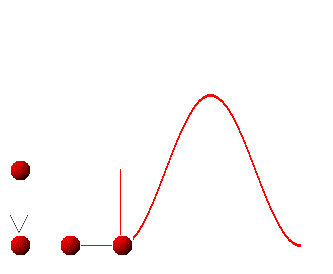
سعة الاهتزاز \(A\): أكبر إزاحة للجسم عن موضع الاتزان (موجبة دائمًا).
The amplitude \(A\): the greatest displacement of the body from the equilibrium position (always positive).
| الكميةQuantity | التعريفDefinition | الرمز والوحدةSymbol and unit |
|---|---|---|
| السعةAmplitude | أكبر إزاحة عن موضع الاتزانThe greatest displacement from equilibrium | \(A\) (m) |
| الزمن الدوريPeriod | الزمن اللازم لاهتزازة كاملةThe time for one complete oscillation | \(T\) (s) |
| الترددFrequency | عدد الاهتزازات الكاملة في الثانيةThe number of complete oscillations per second | \(f=1/T\) (Hz) |
| التردد الزاويAngular frequency | معدل تغيّر الزاوية (الطور)The rate of change of the angle (phase) | \(\omega=2\pi f=2\pi/T\) (rad/s) |
| الطور الابتدائيInitial phase | يحدد موضع بدء الحركة على المنحنىDetermines the starting point on the curve | \(\phi\) (rad) |
التردد والزمن الدوري ثابتان للنظام (يعتمدان على \(m\) و\(k\))، أما السعة والطور فيُحدَّدان بالشروط الابتدائية للحركة.
The frequency and the period are constants of the system (they depend on \(m\) and \(k\)), whereas the amplitude and the phase are determined by the initial conditions of the motion.
📐 القوانين الأساسية
📐 The Basic Equations
من القانون الثاني لنيوتن مع قوة الإرجاع \(F=-kx\): \(ma=-kx\) فيكون \(a=-\dfrac{k}{m}x=-\omega^2x\) حيث \(\omega=\sqrt{k/m}\). وحلّ هذه المعادلة دالة جيبية:
From Newton’s second law with the restoring force \(F=-kx\): \(ma=-kx\) so \(a=-\dfrac{k}{m}x=-\omega^2x\) where \(\omega=\sqrt{k/m}\). The solution of this equation is a sinusoidal function:
📌 معادلات الحركة التوافقية البسيطة
📌 The equations of simple harmonic motion
\[x(t)=A\cos(\omega t+\phi)\]
\[v(t)=-A\omega\sin(\omega t+\phi)\]
\[a(t)=-A\omega^2\cos(\omega t+\phi)=-\omega^2x\]
\[\omega=\sqrt{\frac{k}{m}},\qquad T=2\pi\sqrt{\frac{m}{k}},\qquad f=\frac{1}{T}\]
القيم العظمى
The maximum values
- السرعة العظمى \(v_{max}=A\omega\) عند موضع الاتزان \(x=0\).The maximum speed \(v_{max}=A\omega\) at the equilibrium position \(x=0\).
- التسارع الأعظم \(a_{max}=A\omega^2\) عند أقصى إزاحة \(x=\pm A\).The maximum acceleration \(a_{max}=A\omega^2\) at the greatest displacement \(x=\pm A\).
- السرعة عند إزاحة \(x\): \(v=\pm\omega\sqrt{A^2-x^2}\) (ليست متناسبة طرديًا مع \(x\)).The speed at displacement \(x\): \(v=\pm\omega\sqrt{A^2-x^2}\) (not directly proportional to \(x\)).
- اتجاه التسارع وقوة الإرجاع دائمًا نحو موضع الاتزان.The directions of the acceleration and of the restoring force are always toward the equilibrium position.
| الموضعPosition | \(x\)\(x\) | \(v\)\(v\) | \(a\)\(a\) | \(KE\)\(KE\) | \(PE\)\(PE\) |
|---|---|---|---|---|---|
| نهاية المسارEnd of the path | \(\pm A\) | \(0\) | أعظمmaximum | \(0\) | أعظمmaximum |
| موضع الاتزانEquilibrium | \(0\) | أعظمmaximum | \(0\) | أعظمmaximum | \(0\) |
🔋 الطاقة في الحركة التوافقية البسيطة
🔋 Energy in Simple Harmonic Motion
📌 الطاقة
📌 Energy
\[KE=\tfrac12mv^2=\tfrac12kA^2\sin^2(\omega t+\phi)\]
\[PE=\tfrac12kx^2=\tfrac12kA^2\cos^2(\omega t+\phi)\]
\[E=KE+PE=\tfrac12kA^2=\text{constant}\]
تتبادل الطاقة الحركية وطاقة الوضع المرونية بينما تبقى الطاقة الكلية ثابتة \(E=\tfrac12kA^2\)؛ فهي تتناسب مع مربّع السعة: تضاعف السعة يجعل الطاقة أربعة أمثالها. وعند كل موضع \(KE=E-\tfrac12kx^2\).
The kinetic energy and the elastic potential energy exchange while the total energy stays constant \(E=\tfrac12kA^2\); it is proportional to the square of the amplitude: doubling the amplitude makes the energy four times as large. At each position \(KE=E-\tfrac12kx^2\).
🧪 جرّب بنفسك: كتلة ونابض
🧪 Try It Yourself: a Mass and a Spring
🧪 تجربة 1: كتلة معلّقة بنابض: الحركة التوافقية البسيطة
🧪 Experiment 1: A Mass on a Spring: Simple Harmonic Motion
اضبط الكتلة وثابت النابض والسعة والطور، ثم حرّك شريط الزمن أو اضغط «حرّك الجسم»، وراقب الإزاحة والسرعة والتسارع مع الزمن وتبادل الطاقة بين الحركية والمرونية.
Set the mass, the spring constant, the amplitude and the phase, then move the time bar or press “Move the body”, and watch the displacement, velocity and acceleration against time and the exchange of energy between kinetic and elastic.
✏️ أمثلة محلولة
✏️ Worked Examples
كتلة \(4\ \mathrm{kg}\) معلّقة بنابض ثابته \(100\ \mathrm{N/m}\). أوجد الزمن الدوري والتردد والتردد الزاوي.
A mass of \(4\ \mathrm{kg}\) hangs on a spring of constant \(100\ \mathrm{N/m}\). Find the period, the frequency and the angular frequency.
جسم يتحرك حركة توافقية بسيطة سعتها \(0.2\ \mathrm m\) وتردده الزاوي \(10\ \mathrm{rad/s}\). أوجد أقصى سرعة وأقصى تسارع.
A body performs simple harmonic motion of amplitude \(0.2\ \mathrm m\) and angular frequency \(10\ \mathrm{rad/s}\). Find the maximum speed and the maximum acceleration.
كتلة \(1\ \mathrm{kg}\) مربوطة بنابض ثابته \(25\ \mathrm{N/m}\) أُزيحت عن موضع الاتزان \(0.1\ \mathrm m\) ثم تُركت. أوجد الطاقة الميكانيكية الكلية.
A \(1\ \mathrm{kg}\) mass attached to a spring of constant \(25\ \mathrm{N/m}\) is displaced \(0.1\ \mathrm m\) from equilibrium and released. Find the total mechanical energy.
كتلة \(2\ \mathrm{kg}\) ونابض \(50\ \mathrm{N/m}\) وسعة \(0.3\ \mathrm m\). أوجد سرعتها عندما تكون إزاحتها \(0.15\ \mathrm m\) وطاقتها الحركية عندئذٍ.
A \(2\ \mathrm{kg}\) mass, a \(50\ \mathrm{N/m}\) spring and an amplitude of \(0.3\ \mathrm m\). Find its speed when its displacement is \(0.15\ \mathrm m\) and its kinetic energy then.
⏱️ الرقّاص البسيط
⏱️ The Simple Pendulum
الرقّاص البسيط كتلة صغيرة معلّقة بخيط خفيف طوله \(L\). وللزوايا الصغيرة (أقل من نحو \(10^\circ\)) تكون قوة الإرجاع \(mg\sin\theta\approx mg\theta\) متناسبة مع الإزاحة فتكون الحركة توافقية بسيطة وزمنها الدوري:
The simple pendulum is a small mass hung on a light string of length \(L\). For small angles (less than about \(10^\circ\)) the restoring force \(mg\sin\theta\approx mg\theta\) is proportional to the displacement so the motion is simple harmonic and its period is:
📌 الزمن الدوري للرقّاص البسيط
📌 The period of the simple pendulum
\[T=2\pi\sqrt{\frac{L}{g}}\]
لا يعتمد الزمن الدوري على الكتلة ولا على السعة (للزوايا الصغيرة)، ويزداد بزيادة الطول ويقل بزيادة \(g\). ويصبح أكبر قليلًا من هذه القيمة عند الزوايا الكبيرة.
The period does not depend on the mass or on the amplitude (for small angles); it increases with the length and decreases as \(g\) increases. It becomes slightly greater than this value for large angles.
رقّاص بسيط طوله \(1\ \mathrm m\) على الأرض (\(g=9.8\)). أوجد زمنه الدوري. وما طوله ليكون زمنه الدوري \(4\ \mathrm s\)؟
A simple pendulum of length \(1\ \mathrm m\) on the Earth (\(g=9.8\)). Find its period. What length gives a period of \(4\ \mathrm s\)?
🧪 جرّب بنفسك: الرقّاص البسيط
🧪 Try It Yourself: the Simple Pendulum
🧪 تجربة 2: الرقّاص البسيط
🧪 Experiment 2: The Simple Pendulum
اضبط طول الخيط وزاوية الإزاحة واختر الكوكب (الأرض أو القمر أو المريخ) ثم اضغط «أفلت الرقّاص»؛ وقارن الزمن المقاس بالقانون \(T=2\pi\sqrt{L/g}\) وانظر متى يفشل التقريب للزوايا الكبيرة.
Set the length of the string and the angle of displacement and choose the planet (Earth, Moon or Mars) then press “Release the pendulum”; compare the measured period with the law \(T=2\pi\sqrt{L/g}\) and see when the approximation fails for large angles.
🌍 تطبيقات عملية
🌍 Practical Applications
أين نستفيد من الحركة التوافقية؟
Where do we use harmonic motion?
- أنظمة تعليق السيارات: الزنبركات لامتصاص الاهتزازات.Car suspension systems: springs to absorb vibrations.
- الساعات الميكانيكية: توازن الزنبرك أو الرقّاص لضبط التوقيت.Mechanical clocks: the balance spring or the pendulum to keep accurate time.
- الزلازل (السيزموجراف): قياس اهتزازات الأرض بحركة كتلة مرنة.Earthquakes (seismograph): measuring ground vibrations through the motion of an elastic mass.
- الآلات الموسيقية: اهتزاز الأوتار أو القضبان لإنتاج الصوت.Musical instruments: vibration of strings or rods to produce sound.
- الأنظمة المضادة للاهتزاز في المباني والآلات الثقيلة.Anti-vibration systems in buildings and heavy machinery.
⚠️ أخطاء شائعة
⚠️ Common Mistakes
تجنّب هذه الأخطاء
Avoid these mistakes
- الظن أن الزمن الدوري يزداد بزيادة السعة؛ هو لا يعتمد عليها.Thinking that the period increases with the amplitude; it does not depend on it.
- الظن أن السرعة متناسبة مع الإزاحة؛ هي أعظم عند \(x=0\) وصفر عند \(x=\pm A\).Thinking that the speed is proportional to the displacement; it is greatest at \(x=0\) and zero at \(x=\pm A\).
- الخلط بين التردد \(f\) والتردد الزاوي \(\omega=2\pi f\).Confusing the frequency \(f\) with the angular frequency \(\omega=2\pi f\).
- نسيان أن الطاقة الكلية ثابتة وأن طاقة الوضع الأعظم عند نهايتي المسار.Forgetting that the total energy is constant and that the potential energy is greatest at the ends of the path.
📝 ملخص الدرس
📝 Lesson Summary
أهم ما تعلمناه
Key points
- \(F=-kx\Rightarrow a=-\omega^2x\) و\(\omega=\sqrt{k/m}\).\(F=-kx\Rightarrow a=-\omega^2x\) and \(\omega=\sqrt{k/m}\).
- \(T=2\pi\sqrt{m/k}\) و\(f=1/T\)، ولا يعتمدان على السعة.\(T=2\pi\sqrt{m/k}\) and \(f=1/T\), and they do not depend on the amplitude.
- \(v_{max}=A\omega\) و\(a_{max}=A\omega^2\) و\(E=\tfrac12kA^2\).\(v_{max}=A\omega\), \(a_{max}=A\omega^2\) and \(E=\tfrac12kA^2\).
- الرقّاص البسيط: \(T=2\pi\sqrt{L/g}\).The simple pendulum: \(T=2\pi\sqrt{L/g}\).
🎲 تدرّب على المسائل
🎲 Practice Problems
🧪 تجربة 3: تدرّب: مسائل الحركة التوافقية البسيطة
🧪 Experiment 3: Practice: Simple Harmonic Motion Problems
مسائل عشوائية بأرقام مختلفة. احسب واكتب الجواب ثم اضغط «تحقّق».
Random problems with different numbers. Work it out, enter the answer and press “Check”.
✅ قيّم نفسك
✅ Self-Check
كتلة \(2\ \mathrm{kg}\) ونابض \(50\ \mathrm{N/m}\). التردد الزاوي:
A \(2\ \mathrm{kg}\) mass and a \(50\ \mathrm{N/m}\) spring. The angular frequency:
تكون سرعة الجسم أعظم ما يمكن عند:
The speed of the body is greatest at:
إذا تضاعفت السعة مع بقاء \(m\) و\(k\) فإن الزمن الدوري:
If the amplitude is doubled with \(m\) and \(k\) unchanged the period:
الطاقة الكلية لنابض \(k=25\ \mathrm{N/m}\) وسعته \(0.1\ \mathrm m\):
The total energy of a spring \(k=25\ \mathrm{N/m}\) with amplitude \(0.1\ \mathrm m\):
🧪 اختبر نفسك: امتحان من 20 سؤالاً
🧪 Test Yourself: a 20-Question Exam
أنهِ الدرس بالاختبار التفاعلي التالي؛ أسئلته تجمع بين الفهم والحساب وتغطي جميع أقسام الدرس.
Finish with the interactive exam below; its questions mix understanding with calculation and cover every section of the lesson.
اختبار الحركة التوافقية البسيطة Simple Harmonic Motion Quiz
20 سؤالاً - السعة والزمن الدوري والتردد، السرعة والتسارع، الطاقة، الرقّاص البسيط 20 Questions - amplitude, period and frequency, velocity and acceleration, energy, the simple pendulum
• عدد الأسئلة: 20 سؤالاً
• مدة الاختبار: 30 دقيقة
• لا يمكنك تغيير إجاباتك أو إعادة الاختبار إلا بعد 24 ساعة من التسليم.
• تأكد من إجاباتك قبل التسليم! 📌 Important Instructions:
• Number of questions: 20 questions
• Quiz duration: 30 minutes
• You cannot change your answers or retake the quiz for 24 hours after submission.
• Make sure of your answers before submitting!
🔗 محاكيات GeoGebra للاستعانة بها عند اللزوم
🔗 GeoGebra Simulations to Use When Needed
اضغط «تشغيل» لتعمل المحاكاة هنا داخل الدرس؛ ويمكن للطالب الرجوع إليها لتجربة الفكرة بطريقة أخرى.
Press “Run” to run the simulation right here inside the lesson; the student can use it to try the idea in another way.