🎯 نواتج التعلم
🎯 Learning Outcomes
بعد دراسة هذا الدرس ستكون قادرًا على أن:
After this lesson you will be able to:
- تصف تجربة فرداي وتفسّر لماذا لا يتولد تيار والمغناطيس ساكن.Describe Faraday’s experiment and explain why no current is produced while the magnet is at rest.
- تحدد اتجاه التيار المستحث والقطب المستحث بقانون لنز وقاعدة القبضة اليمنى.Find the direction of the induced current and the induced pole using Lenz’s law and the right-hand grip rule.
- تعرّف التدفق المغناطيسي وتحسبه \(\Phi=BA\cos\theta\) وتفرّق بين الزاوية مع العمودي والزاوية مع السطح.Define the magnetic flux and calculate it \(\Phi=BA\cos\theta\), distinguishing the angle with the normal from the angle with the surface.
- تطبّق قانون فرداي \(\varepsilon=-N\dfrac{d\Phi}{dt}\) في حالات تغير \(B\) أو \(A\) أو \(\theta\).Apply Faraday’s law \(\varepsilon=-N\dfrac{d\Phi}{dt}\) when \(B\), \(A\) or \(\theta\) changes.
- تفسّر الحث بين ملفين متجاورين وتيارات إيدي وتطبيقاتها.Explain induction between two neighbouring coils, eddy currents and their applications.
🧲 اكتشاف فرداي: ظاهرة الحث الكهرومغناطيسي
🧲 Faraday’s Discovery: Electromagnetic Induction
في عام 1831 اكتشف العالم مايكل فرداي أنه عند تقريب مغناطيس من ملف موصل أو إبعاده عنه يمرّ في الملف تيار كهربائي لحظي يُسمى التيار المستحث، وأن سبب نشوء فرق جهد مستحث بين طرفي الملف هو تغير المجال المغناطيسي الذي يخترق الملف. وقد لاحظ العالم جوزيف هنري الظاهرة نفسها مستقلًّا عنه.
In 1831 Michael Faraday discovered that when a magnet is moved towards or away from a conducting coil a momentary electric current, called the induced current, flows in the coil, and that the potential difference induced between its ends is caused by the change of the magnetic field passing through the coil. Joseph Henry observed the same phenomenon independently.
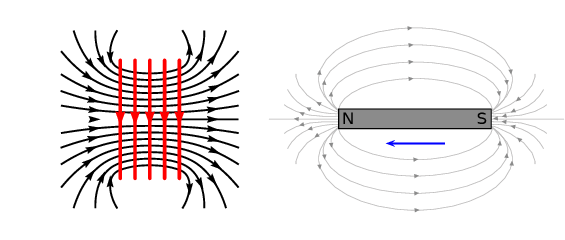
مغناطيس يتحرك نحو ملف: يتغير عدد خطوط المجال التي تخترقه فيتولد تيار.
A magnet moving towards a coil: the number of field lines passing through it changes so a current is produced.
ماذا نتعلم من تجربة فرداي؟
What do we learn from Faraday’s experiment?
- لا تيار والمغناطيس ساكن حتى لو كان قريبًا جدًّا أو قويًّا: المهم هو التغير في التدفق وليس وجود المجال.No current while the magnet is at rest, however near or strong it is: what matters is the change of the flux, not the presence of the field.
- تزداد القوة المحركة المستحثة بزيادة سرعة تحريك المغناطيس، وبزيادة شدته، وبزيادة عدد لفات الملف.The induced emf increases with the speed of the magnet, with its strength and with the number of turns of the coil.
- ينعكس اتجاه التيار عند الإبعاد بدل التقريب، وعند تبديل القطب المواجه للملف.The direction of the current reverses when retreating instead of approaching and when the pole facing the coil is swapped.
- يمكن تحريك الملف والمغناطيس ساكن: المهم هو الحركة النسبية بينهما.The coil may be moved while the magnet is at rest: what matters is the relative motion.
🧪 تجربة 1: تجربة فرداي: حرّك المغناطيس وسجّل التيار المستحث
🧪 Experiment 1: Faraday’s experiment: move the magnet and record the induced current
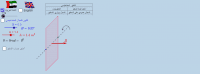
اسحب المغناطيس بالفأرة (أو بإصبعك) نحو الملف وبعيدًا عنه. يرسم المسجّل البياني أسفل المشهد القوة المحركة المستحثة لحظة بلحظة: نبضة موجبة عند التقريب وسالبة عند الإبعاد، ويعود الخط إلى الصفر حين تتوقف. لاحظ القطب المستحث على وجه الملف وسهم قوة لنز التي تقاوم حركتك، واتجاه التيار الدائر في الملف. جرّب بعدها التحدي. (لا شيء يتحرك إلا بتحريكك أو بضغطك على الأزرار.)
Drag the magnet with the mouse (or your finger) towards the coil and away from it. The strip chart under the scene plots the induced emf moment by moment: a positive pulse when approaching, a negative one when retreating, and the line returns to zero when you stop. Notice the induced pole on the coil face, the arrow of Lenz’s force resisting your motion and the direction of the current circulating in the coil. Then try the challenge. (Nothing moves unless you move it or press the buttons.)
🧭 قاعدة القبضة اليمنى: الملف كمغناطيس كهربائي
🧭 The Right-Hand Grip Rule: a Coil as an Electromagnet
عند مرور تيار في ملف يتحول الملف إلى مغناطيس كهربائي له قطب شمالي عند أحد وجهيه وجنوبي عند الآخر. نحدد القطبين بـ قاعدة القبضة اليمنى: نقبض بأصابع اليد اليمنى حول الملف في اتجاه التيار، فيشير الإبهام إلى اتجاه المجال داخل الملف أي إلى القطب الشمالي.
When a current flows in a coil the coil becomes an electromagnet with a north pole on one face and a south pole on the other. We find the poles with the right-hand grip rule: curl the fingers of the right hand around the coil in the direction of the current and the thumb points along the field inside the coil, that is towards the north pole.
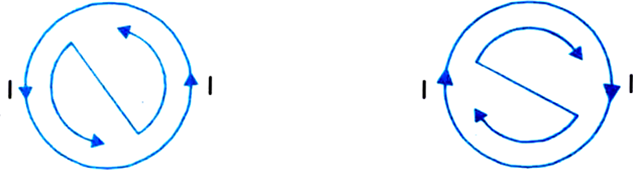
نظرتَ إلى الوجه الشمالي: التيار عكس عقارب الساعة. نظرتَ إلى الوجه الجنوبي: التيار مع عقارب الساعة.
Looking at the north face the current is counterclockwise; looking at the south face it is clockwise.
قاعدة تلخّص الأمر
A rule that sums it up
الوجه الشمالي ⇄ عكس عقارب الساعة والوجه الجنوبي ⇄ مع عقارب الساعة (بشرط أن تنظر إلى الوجه الذي تريد تحديد قطبه). احفظها: ستستعملها في كل مسائل لنز.
North face ⇄ counterclockwise and south face ⇄ clockwise (as long as you look at the face whose pole you want). Memorise it: you will use it in every Lenz problem.
🔎 اتجاه التيار المستحث عند تقريب المغناطيس وإبعاده
🔎 The Direction of the Induced Current as the Magnet Approaches or Retreats
عند تقريب المغناطيس يزداد التدفق، فيتولد في الملف تيار يصنع على وجهه المواجه للمغناطيس قطبًا مماثلًا له فيتنافر معه ويقاوم التقريب. وعند الإبعاد يتناقص التدفق، فيتولد تيار يصنع على الوجه المواجه قطبًا مخالفًا فيتجاذب مع المغناطيس ويقاوم الإبعاد. جرّب الحالات الأربع ثم أجب:
When the magnet approaches the flux increases so the coil produces a current that makes on its face towards the magnet a pole like that of the magnet, so they repel and the approach is opposed. When it retreats the flux decreases so a current appears that makes on that face a pole unlike it, so they attract and the retreat is opposed. Try the four cases then answer:
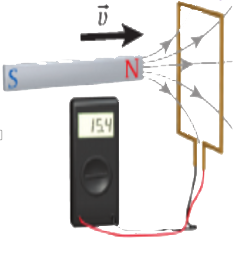
القطب الشمالي يقترب من الملف (الشكل 1).
The north pole approaches the coil (figure 1).
عند تقريب القطب الشمالي للمغناطيس من الملف يكون التيار المستحث (كما يُرى من جهة المغناطيس):
When the north pole of the magnet approaches the coil the induced current (seen from the magnet side) is:
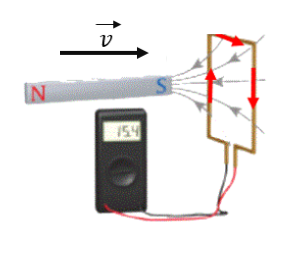
القطب الجنوبي يقترب من الملف (الشكل 2).
The south pole approaches the coil (figure 2).
عند تقريب القطب الجنوبي من الملف يكون التيار المستحث:
When the south pole approaches the coil the induced current is:
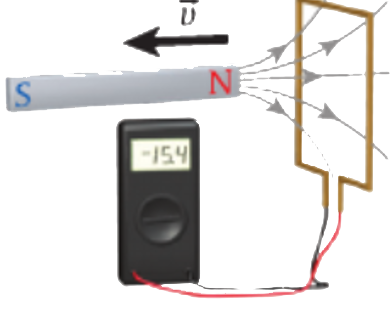
القطب الشمالي يبتعد عن الملف (الشكل 3).
The north pole moves away from the coil (figure 3).
عند إبعاد القطب الشمالي عن الملف يكون التيار المستحث:
When the north pole is moved away from the coil the induced current is:
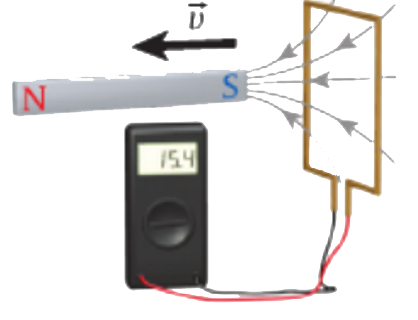
القطب الجنوبي يبتعد عن الملف (الشكل 4).
The south pole moves away from the coil (figure 4).
عند إبعاد القطب الجنوبي عن الملف يكون التيار المستحث:
When the south pole is moved away from the coil the induced current is:
| الحالةCase | التدفقFlux | القطب المستحث على الوجه المقابلInduced pole on the facing face | اتجاه التيار (من جهة المغناطيس)Current direction (from the magnet side) |
|---|---|---|---|
| تقريب القطب NN pole approaching | يزدادincreases | NN | عكس عقارب الساعةcounterclockwise |
| تقريب القطب SS pole approaching | يزدادincreases | SS | مع عقارب الساعةclockwise |
| إبعاد القطب NN pole retreating | يتناقصdecreases | SS | مع عقارب الساعةclockwise |
| إبعاد القطب SS pole retreating | يتناقصdecreases | NN | عكس عقارب الساعةcounterclockwise |
🛑 قانون لنز: لماذا الإشارة السالبة؟
🛑 Lenz’s Law: Why the Minus Sign?
لاحظ العالم هنريش لنز أن التيار المستحث يكون دائمًا في اتجاه ينشئ مجالًا مغناطيسيًّا يعاكس التغير في التدفق الذي سبّبه: إذا كان التدفق يزداد فالمجال المستحث معاكس للمجال الأصلي، وإذا كان يتناقص فالمجال المستحث في اتجاه المجال الأصلي ليعوّض النقص. هذا هو قانون لنز، والإشارة السالبة في \(\varepsilon=-N\dfrac{d\Phi}{dt}\) هي التعبير الرياضي عنه.
Heinrich Lenz observed that the induced current always flows in a direction that creates a magnetic field opposing the change of the flux that caused it: if the flux increases the induced field is opposite to the original field, and if it decreases the induced field is along the original field to make up the loss. This is Lenz’s law, and the minus sign in \(\varepsilon=-N\dfrac{d\Phi}{dt}\) is its mathematical expression.
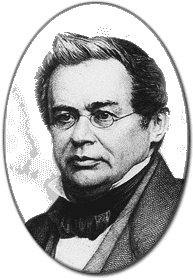
هنريش لنز.
Heinrich Lenz.
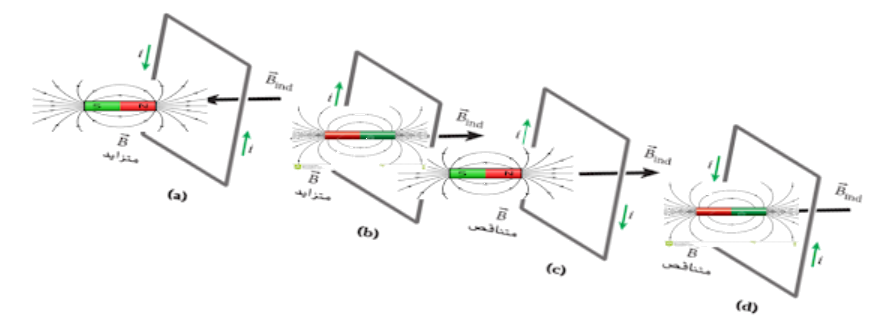
مخطط قانون لنز: المجال المستحث يقاوم التغير في التدفق.
Lenz’s law diagram: the induced field opposes the change of the flux.
لماذا يجب أن يكون الاتجاه معاكسًا؟ (حفظ الطاقة)
Why must the direction be opposing? (conservation of energy)
لو كان التيار المستحث يدعم التغير بدل أن يعاكسه لازداد التدفق أكثر فأكثر فيزداد التيار وهكذا: طاقة من لا شيء! أما حين يعاكس التغير فإن دفع المغناطيس نحو الملف يحتاج إلى شغل ضد التنافر، وهذا الشغل هو الذي يتحول إلى طاقة كهربية ثم إلى حرارة في سلك الملف. فقانون لنز هو حفظ الطاقة في ثوب الحث.
If the induced current supported the change instead of opposing it the flux would grow more and more, the current would grow, and so on: energy from nothing! When it opposes the change, pushing the magnet towards the coil requires work against the repulsion, and this work is what becomes electrical energy and then heat in the coil wire. Lenz’s law is the conservation of energy in the form of induction.
طريقة من أربع خطوات لتحديد اتجاه التيار المستحث
A four-step method for the direction of the induced current
- حدّد اتجاه المجال الأصلي الذي يخترق الحلقة.Find the direction of the original field through the loop.
- هل التدفق يزداد أم يتناقص؟ (قرّب/أبعد، زاد التيار/نقص...).Is the flux increasing or decreasing? (approach/retreat, the current grows/falls...).
- المجال المستحث معاكس للأصلي إن ازداد التدفق، وفي اتجاهه إن تناقص.The induced field is opposite to the original one if the flux increases and along it if it decreases.
- استعمل قاعدة القبضة اليمنى لتجد اتجاه التيار الذي يولّد المجال المستحث.Use the right-hand grip rule to find the current that creates the induced field.
ومن الأمثلة المهمة حلقة قرب سلك مستقيم يمر فيه تيار: المجال المغناطيسي حول السلك يضعف كلما ابتعدنا عنه، فعند تقريب الحلقة من السلك يزداد التدفق، وعند إبعادها يتناقص. تأمل الأشكال الأربعة (A و B و C و D) ثم أجب:
An important example is a loop near a straight wire carrying a current: the magnetic field around the wire weakens with distance so when the loop approaches the wire the flux increases and when it moves away the flux decreases. Study the four figures (A, B, C and D) then answer:
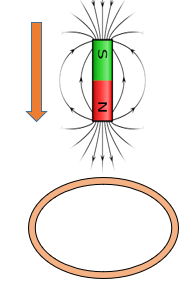
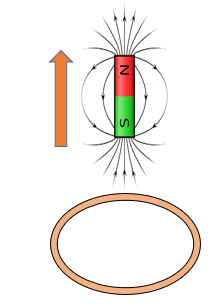
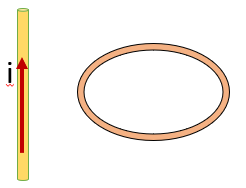
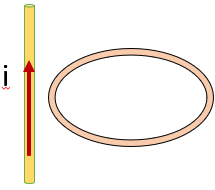
أي الحالات الآتية يتولد فيها تيار مستحث مع عقارب الساعة كما تظهر الحلقة في الشكل؟ (A: تحريك المغناطيس نحو الحلقة، C: تحريك المغناطيس بعيدًا عنها، D: تقريب الحلقة من السلك، B: إبعاد الحلقة عن السلك)
In which of the following cases is an induced current clockwise as the loop appears in the figure? (A: moving the magnet towards the loop, C: moving the magnet away, D: moving the loop towards the wire, B: moving the loop away from the wire)
🔌 ملفان متجاوران: الحث بتغير التيار
🔌 Two Neighbouring Coils: Induction by a Changing Current
لا نحتاج إلى مغناطيس متحرك: الملف الذي يمر فيه تيار هو مغناطيس كهربائي، فإذا تغير تياره تغير مجاله، ومعه التدفق عبر ملف مجاور فيُستحث فيه تيار. في الشكل الملف A موصول ببطارية وريوستات ومفتاح، والملف B موصول بجلفانومتر. عند إغلاق المفتاح يزداد تيار A من الصفر فيزداد التدفق عبر B فيتولد فيه تيار يعاكس الزيادة.
We do not need a moving magnet: a coil carrying a current is an electromagnet, so if its current changes its field changes and so does the flux through a neighbouring coil in which a current is then induced. In the figure coil A is connected to a battery, a rheostat and a switch and coil B to a galvanometer. When the switch is closed the current of A rises from zero so the flux through B increases and a current opposing the increase is induced in it.
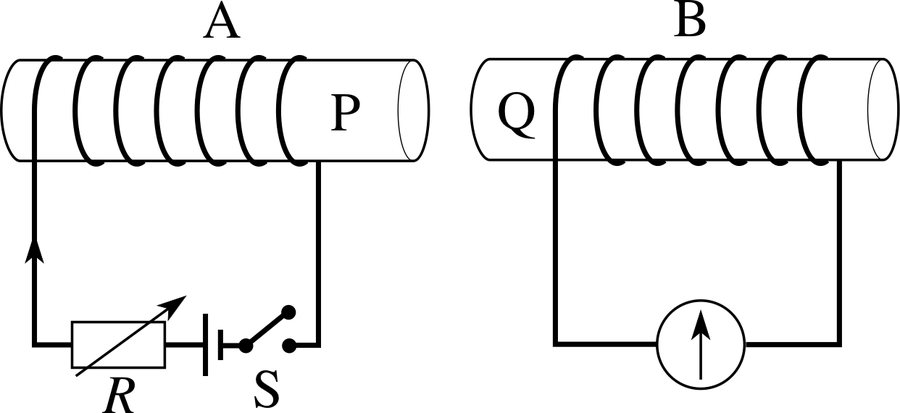
الملف A (بطارية وريوستات ومفتاح) والملف B (جلفانومتر).
Coil A (battery, rheostat and switch) and coil B (galvanometer).
عند إغلاق المفتاح يصبح الطرف P من الملف A قطبًا:
When the switch is closed the end P of coil A becomes a pole:
بعد إغلاق المفتاح مباشرة (يزداد تيار A) يصبح الطرف Q من الملف B قطبًا:
Just after closing the switch (the current of A is rising) the end Q of coil B becomes a pole:
بعد استقرار التيار في A، زدنا مقاومة الريوستات (فنقص تيار A). يصبح الطرف Q قطبًا:
After the current in A settles we increase the rheostat resistance (so the current of A falls). The end Q becomes a pole:
جدول الحالات: ماذا يحدث في الملف B؟
Table of cases: what happens in coil B?
يُقارَن اتجاه التيار اللحظي في B باتجاه التيار في A (الملفان بالوضع نفسه في الشكل). التيار المستحث لحظي، يظهر فقط أثناء التغير.
The direction of the momentary current in B is compared with the current in A (the coils are placed as in the figure). The induced current is momentary and appears only during the change.
| التغير في الدائرة AThe change in circuit A | تأثيره في تدفق BIts effect on the flux of B | تيار B اللحظيThe momentary current in B |
|---|---|---|
| إغلاق المفتاحclosing the switch | يزدادincreases | معاكس لتيار Aopposite to the current in A |
| فتح المفتاحopening the switch | يتناقصdecreases | في اتجاه تيار Ain the direction of the current in A |
| إنقاص المقاومة (يزيد التيار)decreasing the resistance (current rises) | يزدادincreases | معاكس لتيار Aopposite to the current in A |
| زيادة المقاومة (ينقص التيار)increasing the resistance (current falls) | يتناقصdecreases | في اتجاه تيار Ain the direction of the current in A |
| إدخال نواة حديد في Ainserting an iron core in A | يزدادincreases | معاكس لتيار Aopposite to the current in A |
| إخراج نواة الحديدremoving the iron core | يتناقصdecreases | في اتجاه تيار Ain the direction of the current in A |
| ضغط الملف A (يقصر فيقوى مجاله)compressing coil A (it shortens so its field strengthens) | يزدادincreases | معاكس لتيار Aopposite to the current in A |
| شد الملف A وإطالتهstretching coil A | يتناقصdecreases | في اتجاه تيار Ain the direction of the current in A |
📐 التدفق المغناطيسي
📐 The Magnetic Flux
لاحظنا أن عدد خطوط المجال التي تخترق الملف يتغير: يزداد عند التقريب ويقل عند الإبعاد. نسمّي عدد خطوط المجال المغناطيسي التي تجتاز سطحًا ما عموديًّا عليه التدفق المغناطيسي \(\Phi\). وفي مجال منتظم وسطح مستوٍ يعطى بـ:
We saw that the number of field lines passing through the coil changes: it grows when approaching and falls when retreating. The number of magnetic field lines passing perpendicularly through a surface is called the magnetic flux \(\Phi\). For a uniform field and a plane surface it is given by:
📘 التدفق المغناطيسي
📘 The magnetic flux
\[\Phi_B=\vec B\cdot\vec A=BA\cos\theta\]
- \(A\): مساحة السطح (\(\mathrm{m^2}\)) — حوّل \(\mathrm{cm^2}\) إلى \(\mathrm{m^2}\) بالضرب في \(10^{-4}\).\(A\): the surface area (\(\mathrm{m^2}\)) — convert \(\mathrm{cm^2}\) to \(\mathrm{m^2}\) by multiplying by \(10^{-4}\).
- \(B\): شدة المجال بالتسلا (\(\mathrm{T}\)).\(B\): the field strength in tesla (\(\mathrm{T}\)).
- \(\theta\): الزاوية بين المجال والعمودي على السطح (وليس السطح نفسه!).\(\theta\): the angle between the field and the normal to the surface (not the surface itself!).
- وحدة التدفق: الوبر \(\mathrm{Wb}=\mathrm{T\cdot m^2}\).The unit of flux: the weber \(\mathrm{Wb}=\mathrm{T\cdot m^2}\).
لماذا جيب التمام؟
Why a cosine?
المهم هو المركّبة العمودية على السطح من المجال، أي \(B\cos\theta\) (أو \(A\cos\theta\) وهي مساحة مسقط السطح على المستوى العمودي على المجال). لذلك يبلغ التدفق أعظم قيمة عندما يكون المجال عموديًّا على السطح (\(\theta=0\)) وينعدم عندما يوازيه (\(\theta=90^\circ\))، ويصبح سالبًا عندما يخترق السطح من الجهة المعاكسة للعمودي (\(\theta\gt 90^\circ\)).
What matters is the component of the field perpendicular to the surface, \(B\cos\theta\) (or \(A\cos\theta\), the area of the projection of the surface on the plane perpendicular to the field). So the flux is maximum when the field is perpendicular to the surface (\(\theta=0\)) and zero when it is parallel to it (\(\theta=90^\circ\)), and it becomes negative when the field crosses the surface from the side opposite to the normal (\(\theta\gt 90^\circ\)).
🧪 تجربة 2: التدفق المغناطيسي: أدِر الملف بيدك
🧪 Experiment 2: Magnetic flux: rotate the coil with your hand
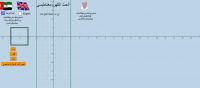
اسحب رأس السهم الأخضر (العمودي على سطح الملف) لتدوير الملف، أو اسحب النقطة البرتقالية على منحنى جيب التمام. الخطوط الحمراء هي الخطوط التي تخترق الملف فعلًا، والشريط الأخضر هو المسقط \(A\cos\theta\) للمساحة على المستوى العمودي على المجال: كلما صغر المسقط قلّ التدفق. ثم جرّب التحدي.
Drag the head of the green arrow (the normal to the coil’s surface) to rotate the coil, or drag the orange point on the cosine curve. The red lines are the lines that really pass through the coil and the green bar is the projection \(A\cos\theta\) of the area on the plane perpendicular to the field: the smaller the projection the smaller the flux. Then try the challenge.
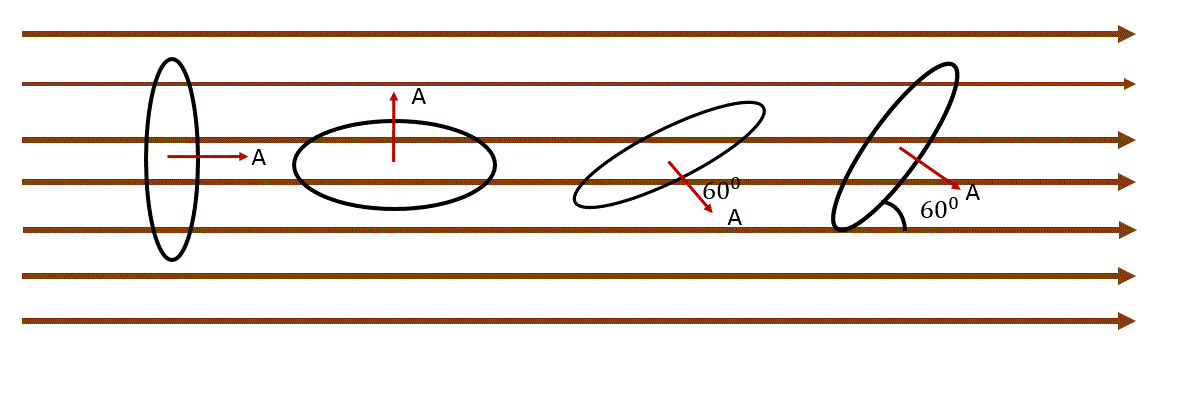
ملف دائري مساحته \(0.1\ \mathrm{m^2}\) في مجال منتظم \(0.3\ \mathrm{T}\) بأربع أوضاع.
A circular coil of area \(0.1\ \mathrm{m^2}\) in a uniform field of \(0.3\ \mathrm{T}\) in four positions.
انتبه: الزاوية مع السطح أم مع العمودي؟
Careful: the angle with the surface or with the normal?
إذا أعطتك المسألة الزاوية بين المجال والسطح فاطرحها من \(90^\circ\) لتحصل على الزاوية \(\theta\) مع العمودي: \(\theta=90^\circ-\varphi\). مثلًا مجال يصنع \(60^\circ\) مع السطح يصنع \(30^\circ\) مع العمودي فيكون \(\Phi=BA\cos30^\circ\) (وليس \(\cos60^\circ\)).
If the problem gives the angle between the field and the surface subtract it from \(90^\circ\) to get the angle \(\theta\) with the normal: \(\theta=90^\circ-\varphi\). For example a field making \(60^\circ\) with the surface makes \(30^\circ\) with the normal so \(\Phi=BA\cos30^\circ\) (not \(\cos60^\circ\)).
نتائج مهمة
Key results
- أكبر تدفق عندما يكون المجال عموديًّا على السطح: \(\Phi_{max}=BA\).Maximum flux when the field is perpendicular to the surface: \(\Phi_{max}=BA\).
- التدفق صفر عندما يوازي المجال السطح.The flux is zero when the field is parallel to the surface.
- الزاوية مع العمودي = \(90^\circ\) − الزاوية مع السطح.The angle with the normal = \(90^\circ\) − the angle with the surface.
ملف دائري مساحة سطحه \(A=0.1\ \mathrm{m^2}\) في مجال منتظم شدته \(B=0.3\ \mathrm{T}\). احسب التدفق في الحالات: (أ) المجال يصنع \(60^\circ\) مع العمودي على السطح، (ب) المجال يصنع \(60^\circ\) مع السطح، (جـ) المجال يوازي السطح، (د) المجال عمودي على السطح.
A circular coil of surface area \(A=0.1\ \mathrm{m^2}\) lies in a uniform field \(B=0.3\ \mathrm{T}\). Find the flux when: (a) the field makes \(60^\circ\) with the normal to the surface, (b) the field makes \(60^\circ\) with the surface, (c) the field is parallel to the surface, (d) the field is perpendicular to the surface.
⚡ قانون فرداي للحث
⚡ Faraday’s Law of Induction
وجد فرداي أن متوسط القوة الدافعة المستحثة في موصل يساوي معدل تغير التدفق المغناطيسي عبر الدائرة بالنسبة للزمن، وأن الإشارة السالبة تعبّر عن قانون لنز. وإن كان الملف من \(N\) لفة متماثلة يخترقها التدفق نفسه فإن القوى المحركة تتجمع:
Faraday found that the average induced emf in a conductor equals the rate of change of the magnetic flux through the circuit, the minus sign expressing Lenz’s law. If the coil has \(N\) identical turns all linked by the same flux the emfs add up:
📘 قانون فرداي
📘 Faraday’s law
\[\varepsilon=-N\,\dfrac{d\Phi_B}{dt}\qquad\Longrightarrow\qquad \varepsilon_{avg}=-N\,\dfrac{\Delta\Phi_B}{\Delta t}\]
ما معنى «معدل التغير»؟ توضيح مهم
What does “rate of change” mean? An important clarification
لاحظ أن القوة المحركة تتوقف على سرعة تغير التدفق وليس على قيمته: ملف فيه تدفق كبير لكنه ثابت لا يولّد شيئًا، وملف تدفقه صغير يتغير بسرعة كبيرة يولّد قوة كبيرة. والمعدل هو ميل منحنى التدفق مع الزمن: ميل ثابت ⇒ ق.د.ك ثابتة، وميل صفر ⇒ ق.د.ك صفر.
Notice that the emf depends on how fast the flux changes, not on its value: a coil with a large but steady flux produces nothing, while a coil with a small flux changing quickly produces a large emf. The rate is the slope of the flux–time graph: a constant slope ⇒ a constant emf and a zero slope ⇒ zero emf.
ثلاثة أسباب لتغير التدفق
Three causes of the flux change
بما أن \(\Phi=BA\cos\theta\) فقد يتغير التدفق لأن \(B\) يتغير، أو لأن \(A\) تتغير، أو لأن \(\theta\) تتغير (دوران الملف). وبقاعدة اشتقاق الضرب:
Since \(\Phi=BA\cos\theta\) the flux may change because \(B\) changes, or \(A\) changes, or \(\theta\) changes (the coil rotates). By the product rule of differentiation:
📘 الحالات الثلاث
📘 The three cases
\[\varepsilon=-N\left[A\cos\theta\,\dfrac{dB}{dt}+B\cos\theta\,\dfrac{dA}{dt}-AB\sin\theta\,\dfrac{d\theta}{dt}\right]\]
- تغير المجال (\(A,\theta\) ثابتتان): \(\varepsilon=-NA\cos\theta\,\dfrac{dB}{dt}\)Changing field (\(A,\theta\) constant): \(\varepsilon=-NA\cos\theta\,\dfrac{dB}{dt}\)
- تغير المساحة (ملف مرن أو متحرك): \(\varepsilon=-NB\cos\theta\,\dfrac{dA}{dt}\)Changing area (a flexible or moving coil): \(\varepsilon=-NB\cos\theta\,\dfrac{dA}{dt}\)
- دوران الملف بسرعة زاوية \(\omega\) (\(\theta=\omega t\)): \(\varepsilon=NAB\omega\sin\omega t\)A rotating coil with angular speed \(\omega\) (\(\theta=\omega t\)): \(\varepsilon=NAB\omega\sin\omega t\)
🧪 تجربة 3: القوة المحركة المستحثة: شاهد السبب وهو يعمل
🧪 Experiment 3: The induced emf: watch the cause at work
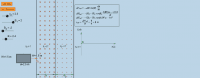
اختر سبب تغير التدفق: تغير B أو تغير A أو دوران الملف. يتغير المشهد العلوي مع الزمن (كثافة المجال أو حجم الحلقة أو زاوية الملف) والرسمان بالأسفل يسجلان \(\Phi\) و\(\varepsilon\). اسحب مؤشر الزمن على أحد الرسمين أو اضغط «شغّل» (عرض بطيء يبدأ بطلبك) ولاحظ أن \(\varepsilon\) هي ميل منحنى \(\Phi\).
Choose the cause of the flux change: changing B, changing A or a rotating coil. The scene above changes with time (field density, loop size or coil angle) and the two graphs below record \(\Phi\) and \(\varepsilon\). Drag the time cursor on either graph or press “Play” (a slow display that starts on your request) and notice that \(\varepsilon\) is the slope of the \(\Phi\) curve.
حلقة دائرية نصف قطرها \(0.2\ \mathrm{m}\) عمودية على مجال مغناطيسي يتغير بالدالة \(B=0.3t^3+2t\) (\(B\) بالتسلا، \(t\) بالثواني). احسب مقدار فرق الجهد المستحث عند الثانية \(t=3\ \mathrm{s}\).
A circular loop of radius \(0.2\ \mathrm{m}\) is perpendicular to a magnetic field varying as \(B=0.3t^3+2t\) (\(B\) in tesla, \(t\) in seconds). Find the magnitude of the induced emf at \(t=3\ \mathrm{s}\).
حلقة مرنة تتعرض لمجال \(0.5\times10^{-4}\ \mathrm{T}\) عمودي على سطحها، فإذا زادت مساحتها بمقدار \(0.1\ \mathrm{m^2}\) خلال \(0.4\ \mathrm{s}\) فما معدل فرق الجهد المستحث؟
A flexible loop is in a field of \(0.5\times10^{-4}\ \mathrm{T}\) perpendicular to its surface. If its area increases by \(0.1\ \mathrm{m^2}\) in \(0.4\ \mathrm{s}\) what is the average induced emf?
ملف مساحته \(0.1\ \mathrm{m^2}\) في مجال منتظم \(0.2\ \mathrm{T}\)، يدور حول محور بسرعة زاوية \(5\ \mathrm{rad/s}\)، وكان سطحه عموديًّا على المجال عند \(t=0\) (أي \(\theta=\omega t\)). احسب فرق الجهد المستحث عند \(t=4\ \mathrm{s}\).
A coil of area \(0.1\ \mathrm{m^2}\) in a uniform field of \(0.2\ \mathrm{T}\) rotates about an axis with angular speed \(5\ \mathrm{rad/s}\) and its surface was perpendicular to the field at \(t=0\) (so \(\theta=\omega t\)). Find the induced emf at \(t=4\ \mathrm{s}\).
ملف من \(200\) لفة مساحته \(50\ \mathrm{cm^2}\) عمودي على مجال تناقص منتظمًا من \(0.5\ \mathrm{T}\) إلى \(0.1\ \mathrm{T}\) خلال \(0.2\ \mathrm{s}\). احسب القوة المحركة المستحثة.
A coil of \(200\) turns and area \(50\ \mathrm{cm^2}\) is perpendicular to a field that falls uniformly from \(0.5\ \mathrm{T}\) to \(0.1\ \mathrm{T}\) in \(0.2\ \mathrm{s}\). Find the induced emf.
ملف دائري مساحته \(0.02\ \mathrm{m^2}\) في مجال \(0.5\ \mathrm{T}\) يصنع \(60^\circ\) مع سطح الملف. التدفق عبره:
A circular coil of area \(0.02\ \mathrm{m^2}\) is in a field of \(0.5\ \mathrm{T}\) making \(60^\circ\) with the surface of the coil. The flux through it is:
ملف يدور بسرعة زاوية ثابتة في مجال منتظم. تكون القوة المحركة المستحثة أعظم ما يمكن عندما يكون مستوى الملف:
A coil rotates at constant angular speed in a uniform field. The induced emf is maximum when the plane of the coil is:
تضاعف عدد لفات ملف مع بقاء معدل تغير التدفق ثابتًا؛ فإن القوة المحركة المستحثة:
The number of turns of a coil is doubled while the rate of change of flux stays constant; the induced emf:
يقول قانون لنز إن التيار المستحث:
Lenz’s law says that the induced current:
🌀 تيارات إيدي (تيارات فوكو)
🌀 Eddy Currents (Foucault Currents)
عندما يتغير التدفق المغناطيسي عبر قطعة موصلة كبيرة (لا سلك ملفوف) تتولد فيها تيارات مستحثة دوّامية تسمى تيارات إيدي أو تيارات فوكو. وبحسب قانون لنز فإن هذه التيارات تولد قوة تعاكس الحركة (فرملة مغناطيسية) وتحوّل الطاقة الحركية إلى حرارة في المعدن.
When the magnetic flux changes through a large conducting piece (not a wound wire) circulating induced currents called eddy currents or Foucault currents are produced in it. According to Lenz’s law they create a force that opposes the motion (magnetic braking) and turn the kinetic energy into heat in the metal.
تجربة البندول: صلب أم مشقوق؟
The pendulum experiment: solid or slotted?
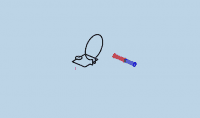
بندول معدني صلب يتأرجح بين قطبي مغناطيس قوي يتوقف بسرعة لأن التدفق يتغير عبر المعدن فتنشأ تيارات إيدي كبيرة تكبح حركته. أما إذا شققنا البندول بفتحات فإن مسارات تيارات إيدي تُقطع فتضعف ويستمر البندول في التأرجح زمنًا أطول. ولهذا تُصنع قلوب المحولات من صفائح رقيقة معزولة بدل كتلة واحدة، لتقليل الفقد بالحرارة.
A solid metal pendulum swinging between the poles of a strong magnet stops quickly because the flux changes through the metal and large eddy currents brake its motion. If the pendulum is slotted the paths of the eddy currents are cut so they weaken and the pendulum keeps swinging for a longer time. This is why transformer cores are made of thin insulated sheets instead of one block, to reduce the heat loss.
تطبيقات تيارات إيدي
Applications of eddy currents
- الفرملة المغناطيسية في القطارات والأفعوانيات: كبح سلس بلا احتكاك.Magnetic braking in trains and roller-coasters: smooth braking without friction.
- مواقد الحث: مجال متردد يولّد تيارات إيدي في قاع الإناء المعدني فيسخن.Induction cookers: an alternating field produces eddy currents in the metal pot which heat it.
- كاشف الفلزات (انظر أدناه) وتخميد حركة الميزان الحساس.The metal detector (see below) and damping the motion of a sensitive balance.
جهاز كشف الفلزات: يتكوّن من ملف إرسال وملف استقبال؛ يمر في ملف الإرسال تيار متردد فيولّد مجالًا متغيرًا يستحث تيارًا في ملف الاستقبال. عند اقتراب قطعة معدنية تُستحث فيها تيارات إيدي تولّد مجالًا معاكسًا (قانون لنز) فيتغير تيار ملف الاستقبال ويصدر الجهاز إشارة صوتية أو ضوئية تدل على وجود المعدن.
The metal detector: it consists of a transmitting coil and a receiving coil; an alternating current in the transmitter produces a changing field that induces a current in the receiver. When a metal piece comes near, eddy currents induced in it create an opposing field (Lenz’s law) so the current of the receiving coil changes and the device gives a sound or light signal showing the presence of metal.
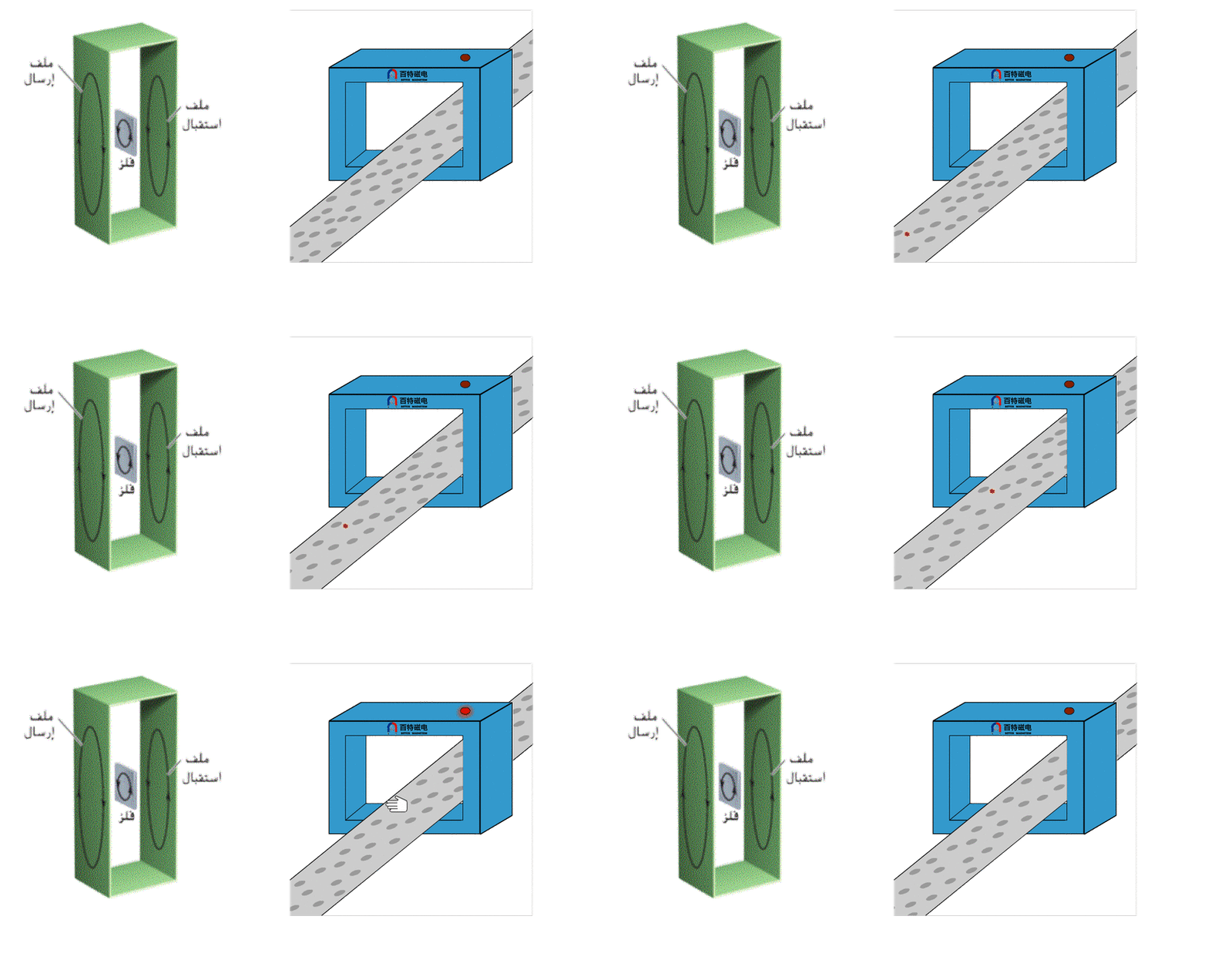
جهاز كشف الفلزات.
The metal detector.
📚 ملخص الدرس
📚 Lesson Summary
| الفكرةIdea | القانونLaw |
|---|---|
| التدفق المغناطيسيMagnetic flux | \(\Phi=BA\cos\theta\ ,\ \theta=90^\circ-\varphi\)\(\Phi=BA\cos\theta\ ,\ \theta=90^\circ-\varphi\) |
| قانون فردايFaraday’s law | \(\varepsilon=-N\dfrac{\Delta\Phi}{\Delta t}\)\(\varepsilon=-N\dfrac{\Delta\Phi}{\Delta t}\) |
| تغير المجالChanging field | \(\varepsilon=-NA\cos\theta\dfrac{dB}{dt}\)\(\varepsilon=-NA\cos\theta\dfrac{dB}{dt}\) |
| تغير المساحةChanging area | \(\varepsilon=-NB\cos\theta\dfrac{dA}{dt}\)\(\varepsilon=-NB\cos\theta\dfrac{dA}{dt}\) |
| ملف يدورA rotating coil | \(\varepsilon=NAB\omega\sin\omega t\)\(\varepsilon=NAB\omega\sin\omega t\) |
| قانون لنزLenz’s law | المجال المستحث يعاكس التغير في التدفقthe induced field opposes the change of the flux |
⚠️ أخطاء شائعة
⚠️ Common mistakes
- استعمال الزاوية مع السطح في \(\cos\theta\) بدل الزاوية مع العمودي.Using the angle with the surface in \(\cos\theta\) instead of the angle with the normal.
- الظن أن التدفق الكبير يعطي قوة محركة كبيرة؛ المهم هو معدل تغيره.Thinking a large flux gives a large emf; what matters is its rate of change.
- نسيان تحويل \(\mathrm{cm^2}\) إلى \(\mathrm{m^2}\) (الضرب في \(10^{-4}\)).Forgetting to convert \(\mathrm{cm^2}\) to \(\mathrm{m^2}\) (multiplying by \(10^{-4}\)).
- الخلط في قانون لنز: المجال المستحث يعاكس التغير لا المجال نفسه (عند نقص التدفق يكون في اتجاهه).Confusing Lenz’s law: the induced field opposes the change, not the field itself (when the flux falls it is along it).
- نسيان \(N\) عدد اللفات في قانون فرداي.Forgetting \(N\), the number of turns, in Faraday’s law.
- اعتبار أن التيار المستحث يستمر والمغناطيس ساكن؛ لا حث دون تغير.Thinking the induced current persists while the magnet is at rest; there is no induction without a change.
🧪 اختبر نفسك: امتحان من 20 سؤالاً
🧪 Test Yourself: a 20-Question Exam
أنهِ الدرس بالاختبار التفاعلي التالي؛ أسئلته تجمع بين الفهم والحساب وتغطي جميع أقسام الدرس.
Finish with the interactive exam below; its questions mix understanding with calculation and cover every section of the lesson.
اختبار الحث الكهرومغناطيسي وقانون فرداي (12A) Electromagnetic Induction and Faraday’s Law (12A) Quiz
20 سؤالاً - التدفق المغناطيسي وقانون فرداي وقانون لنز 20 Questions - magnetic flux, Faraday’s law and Lenz’s law
• عدد الأسئلة: 20 سؤالاً
• مدة الاختبار: 30 دقيقة
• لا يمكنك تغيير إجاباتك أو إعادة الاختبار إلا بعد 24 ساعة من التسليم.
• تأكد من إجاباتك قبل التسليم! 📌 Important Instructions:
• Number of questions: 20 questions
• Quiz duration: 30 minutes
• You cannot change your answers or retake the quiz for 24 hours after submission.
• Make sure of your answers before submitting!
🔗 محاكيات GeoGebra للاستعانة بها عند اللزوم
🔗 GeoGebra Simulations to Use When Needed
اضغط «تشغيل» لتعمل المحاكاة هنا داخل الدرس؛ ويمكن للطالب الرجوع إليها لتجربة الفكرة بطريقة أخرى.
Press “Run” to run the simulation right here inside the lesson; the student can use it to try the idea in another way.