🎯 نواتج التعلم
🎯 Learning Outcomes
بعد دراسة هذا الدرس ستكون قادرًا على أن:
After this lesson you will be able to:
- تعرّف المجال المنتظم وتذكر خصائصه وأن الجهد يتناقص خطيًّا في اتجاهه.Define the uniform field and state its properties and that the potential decreases linearly along its direction.
- تحسب فرق الجهد بين نقطتين \(\Delta V=-E\,d_\parallel\) وتحدد إشارته.Calculate the potential difference between two points \(\Delta V=-E\,d_\parallel\) and determine its sign.
- تفسّر أن النقاط العمودية على المجال لها الجهد نفسه (سطح متساوي الجهد).Explain that the points perpendicular to the field have the same potential (an equipotential surface).
- تحسب الشغل وطاقة الوضع \(U=qV\) وطاقة حركة جسيم مشحون وسرعته بين لوحين.Calculate the work, the potential energy \(U=qV\) and the kinetic energy and speed of a charged particle between two plates.
➡️ المجال الكهربائي المنتظم
➡️ The Uniform Electric Field
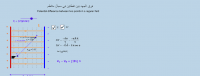
المجال المنتظم ثابت المقدار والاتجاه عند جميع النقاط، وخطوطه مستقيمة متوازية متساوية البعد، كالمجال بين لوحين متوازيين مشحونين بشحنتين متساويتين متعاكستين. في هذا المجال يتناقص الجهد خطيًّا في اتجاه المجال، وتبقى النقاط على المستوى العمودي على المجال بالجهد نفسه.
The uniform field is constant in magnitude and direction at all points, and its lines are straight, parallel and equally spaced, like the field between two parallel plates charged with equal and opposite charges. In this field the potential decreases linearly along the direction of the field, and the points on the plane perpendicular to the field have the same potential.
خصائص المجال المنتظم
Properties of the uniform field
- مقداره ثابت واتجاهه ثابت.Its magnitude is constant and its direction is constant.
- خطوطه مستقيمة متوازية والمسافة بينها متساوية.Its lines are straight and parallel and the distance between them is equal.
- أسطح تساوي الجهد مستويات عمودية على المجال ومتساوية البعد.The equipotential surfaces are planes perpendicular to the field and equally spaced.
📉 فرق الجهد في المجال المنتظم
📉 The Potential Difference in a Uniform Field
فرق الجهد بين نقطتين يُعرَّف بأنه الشغل المبذول لنقل شحنة اختبار موجبة بينهما مقسومًا على مقدارها. وفي المجال المنتظم تكون القوة ثابتة \(F=qE\) فيكون الشغل على الإزاحة \(d_\parallel\) في اتجاه المجال \(W=qEd_\parallel\):
The potential difference between two points is defined as the work done to move a positive test charge between them divided by its magnitude. In the uniform field the force is constant \(F=qE\) so the work on the displacement \(d_\parallel\) along the field is \(W=qEd_\parallel\):
📌 فرق الجهد
📌 The potential difference
\[\Delta V_{AB}=V_B-V_A=-\frac{W_{A\to B}}{q}=-E\,d_{\parallel}=-E\,d\cos\theta\]
قراءة الإشارة
Reading the sign
- الحركة مع المجال: الجهد يقل (\(\Delta V\lt 0\)).Motion along the field: the potential decreases (\(\Delta V\lt 0\)).
- الحركة عكس المجال: الجهد يزداد (\(\Delta V\gt 0\)).Motion against the field: the potential increases (\(\Delta V\gt 0\)).
- الحركة عموديًّا على المجال: \(\Delta V=0\).Motion perpendicular to the field: \(\Delta V=0\).
مجال منتظم \(E=500\ \mathrm{V/m}\) في اتجاه \(+x\). أوجد \(\Delta V_{AB}\) عندما ينتقل الجسيم من \(x_A=2\ \mathrm{cm}\) إلى \(x_B=10\ \mathrm{cm}\).
A uniform field \(E=500\ \mathrm{V/m}\) in the \(+x\) direction. Find \(\Delta V_{AB}\) when the particle moves from \(x_A=2\ \mathrm{cm}\) to \(x_B=10\ \mathrm{cm}\).
🧪 تجربة 1: فرق الجهد بين نقطتين
🧪 Experiment 1: The Potential Difference Between Two Points
نضع نقطتين في مجال منتظم ونقرأ جهد كلٍّ منهما وفرق الجهد.
We put two points in a uniform field and read the potential of each and the potential difference.
🛠️ خطوات العمل
🛠️ Procedure
- اضبط \(E=500\), \(x_A=2\), \(x_B=10\ \mathrm{cm}\) وتحقق من \(-40\ \mathrm V\).Set \(E=500\), \(x_A=2\), \(x_B=10\ \mathrm{cm}\) and check \(-40\ \mathrm V\).
- حرّك \(B\) رأسيًّا وراقب الجهد.Move \(B\) vertically and watch the potential.
- بدّل مكاني \(A\) و\(B\).Swap the positions of \(A\) and \(B\).
🧪 تجربة 1: فرق الجهد بين نقطتين في مجال منتظم (كمحاكاة GeoGebra)
🧪 Experiment 1: The Potential Difference Between Two Points in a Uniform Field (like the GeoGebra applet)
مجال منتظم نحو اليمين وجهد \(100\ \mathrm V\) عند \(x=0\). حدّد موضعي النقطتين \(A\) و\(B\) وراقب \(\Delta V_{AB}=-E\,d_\parallel\) وتأثير الإزاحة العمودية.
A uniform field toward the right and a potential \(100\ \mathrm V\) at \(x=0\). Set the positions of the two points \(A\) and \(B\) and watch \(\Delta V_{AB}=-E\,d_\parallel\) and the effect of the perpendicular displacement.
🔎 ماذا نلاحظ؟ وما الاستنتاج؟
🔎 What do we observe? What is the conclusion?
- الإزاحة العمودية على المجال لا تغيّر الجهد.The displacement perpendicular to the field does not change the potential.
- عكس اتجاه الحركة يعكس إشارة \(\Delta V\).Reversing the direction of the motion reverses the sign of \(\Delta V\).
\(\Delta V=-E\,d_\parallel\).
\(\Delta V=-E\,d_\parallel\).
في مجال منتظم، عند الحركة عموديًّا على اتجاه المجال يكون فرق الجهد:
In a uniform field, when moving perpendicular to the direction of the field the potential difference is:
📐 إزاحة بزاوية
📐 A Displacement at an Angle
إذا لم تكن الإزاحة \(d\) على امتداد المجال فنستعمل مركبتها على اتجاه المجال: \(d_\parallel=d\cos\theta\). والجهد دالة حالة، فلا يعتمد فرقه على المسار بل على الموضعين فقط.
If the displacement \(d\) is not along the field we use its component along the direction of the field: \(d_\parallel=d\cos\theta\). The potential is a function of state, so its difference does not depend on the path but only on the two positions.
ينتقل جسيم \(10\ \mathrm{cm}\) بزاوية \(60^\circ\) مع مجال منتظم \(E=500\ \mathrm{V/m}\). أوجد فرق الجهد.
A particle moves \(10\ \mathrm{cm}\) at an angle \(60^\circ\) with a uniform field \(E=500\ \mathrm{V/m}\). Find the potential difference.
🧪 تجربة 2: إزاحة بزاوية على المجال
🧪 Experiment 2: A Displacement at an Angle to the Field
نغيّر الزاوية والمسافة ونقرأ فرق الجهد.
We change the angle and the distance and read the potential difference.
🛠️ خطوات العمل
🛠️ Procedure
- اضبط \(\theta=0\) ثم \(90^\circ\) ثم \(180^\circ\).Set \(\theta=0\) then \(90^\circ\) then \(180^\circ\).
- غيّر \(d\) وراقب التناسب.Change \(d\) and watch the proportion.
🧪 تجربة 2: إزاحة بزاوية على المجال
🧪 Experiment 2: A Displacement at an Angle to the Field
ننتقل مسافة \(d\) بزاوية \(\theta\) على اتجاه المجال. المهم هو المركبة \(d\cos\theta\) على المجال: \(\Delta V=-Ed\cos\theta\).
We move a distance \(d\) at an angle \(\theta\) to the direction of the field. What matters is the component \(d\cos\theta\) along the field: \(\Delta V=-Ed\cos\theta\).
🔎 ماذا نلاحظ؟ وما الاستنتاج؟
🔎 What do we observe? What is the conclusion?
- \(\theta=0\): أكبر هبوط، \(90^\circ\): صفر، \(180^\circ\): أكبر ارتفاع.\(\theta=0\): the greatest drop, \(90^\circ\): zero, \(180^\circ\): the greatest rise.
- فرق الجهد يتناسب طرديًّا مع \(E\) و\(d\) و\(\cos\theta\).The potential difference is directly proportional to \(E\), \(d\) and \(\cos\theta\).
\(\Delta V=-Ed\cos\theta\).
\(\Delta V=-Ed\cos\theta\).
🔋 المجال بين لوحين وحركة الشحنة
🔋 The Field Between Two Plates and the Motion of a Charge
بين لوحين متوازيين فرق الجهد بينهما \(\Delta V\) والمسافة \(d\) يكون المجال \(E=\Delta V/d\). وتتسارع الشحنة المتروكة فيه بتسارع ثابت \(a=|q|E/m\)، وتكتسب طاقة حركة \(K=|q|\Delta V\).
Between two parallel plates with a potential difference \(\Delta V\) and a distance \(d\) the field is \(E=\Delta V/d\). A charge released in it accelerates with a constant acceleration \(a=|q|E/m\), and gains a kinetic energy \(K=|q|\Delta V\).
📌 الطاقة والسرعة
📌 The energy and the speed
\[E=\frac{\Delta V}{d}\qquad,\qquad K=|q|\,\Delta V\qquad,\qquad v=\sqrt{\frac{2|q|\Delta V}{m}}\]
إلكترون يتسارع من السكون بين لوحين \(\Delta V=200\ \mathrm V\). أوجد طاقته وسرعته.
An electron accelerates from rest between two plates \(\Delta V=200\ \mathrm V\). Find its energy and speed.
🧪 تجربة 3: جسيم مشحون بين لوحين
🧪 Experiment 3: A Charged Particle Between Two Plates
نطلق إلكترونًا أو بروتونًا ونقرأ الطاقة والسرعة وزمن العبور.
We release an electron or a proton and read the energy, the speed and the transit time.
🛠️ خطوات العمل
🛠️ Procedure
- اضبط \(E=5\ \mathrm{kV/m}\) و\(d=4\ \mathrm{cm}\) واضغط «أطلق».Set \(E=5\ \mathrm{kV/m}\) and \(d=4\ \mathrm{cm}\) and press “Release”.
- بدّل إلى بروتون وقارن السرعة والزمن.Switch to a proton and compare the speed and the time.
- ضاعف \(E\) وراقب السرعة.Double \(E\) and watch the speed.
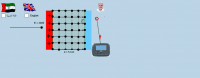
🧪 تجربة 3: جسيم مشحون بين لوحين (كمحاكاة GeoGebra)
🧪 Experiment 3: A Charged Particle Between Two Plates (like the GeoGebra applet)
جسيم يُترك بين لوحين متوازيين: يكتسب طاقة حركة \(K=|q|\Delta V\) وسرعة \(v=\sqrt{2K/m}\). اضغط «أطلق» لتشاهد الحركة.
A particle released between two parallel plates: it gains a kinetic energy \(K=|q|\Delta V\) and a speed \(v=\sqrt{2K/m}\). Press “Release” to watch the motion.
🔎 ماذا نلاحظ؟ وما الاستنتاج؟
🔎 What do we observe? What is the conclusion?
- الطاقة متساوية للإلكترون والبروتون عند \(\Delta V\) نفسه لكن سرعة الإلكترون أكبر بكثير لخفة كتلته.The energy is equal for the electron and the proton at the same \(\Delta V\) but the speed of the electron is much greater because of its light mass.
- مضاعفة \(E\) تزيد السرعة بالعامل \(\sqrt2\) فقط.Doubling \(E\) increases the speed by the factor \(\sqrt2\) only.
\(K=|q|Ed\) و\(v=\sqrt{2K/m}\).
\(K=|q|Ed\) and \(v=\sqrt{2K/m}\).
🔔 طاقة الوضع الكهربائية
🔔 The Electric Potential Energy
طاقة وضع شحنة \(q\) عند نقطة جهدها \(V\) هي \(U=qV\). والشغل الذي يبذله المجال عند الانتقال من \(A\) إلى \(B\) يساوي النقص في طاقة الوضع: \(W=-\Delta U=-q\,\Delta V\). ولذلك تتحرك الشحنة الموجبة تلقائيًّا نحو الجهد الأقل والسالبة نحو الجهد الأعلى لتنقص طاقة وضعها.
The potential energy of a charge \(q\) at a point of potential \(V\) is \(U=qV\). The work done by the field when moving from \(A\) to \(B\) equals the decrease in the potential energy: \(W=-\Delta U=-q\,\Delta V\). So a positive charge moves spontaneously toward the lower potential and a negative one toward the higher potential to decrease its potential energy.
شحنة \(5\ \mathrm{nC}\) عند نقطة جهدها \(60\ \mathrm V\) ثم انتقلت إلى نقطة جهدها \(20\ \mathrm V\). أوجد التغير في طاقة وضعها والشغل الذي يبذله المجال.
A charge \(5\ \mathrm{nC}\) is at a point of potential \(60\ \mathrm V\) then moved to a point of potential \(20\ \mathrm V\). Find the change in its potential energy and the work done by the field.
🧪 تجربة 4: طاقة الوضع في المجال المنتظم
🧪 Experiment 4: The Potential Energy in the Uniform Field
نرسم \(U(x)\) لشحنة موجبة ثم سالبة.
We draw \(U(x)\) for a positive and then a negative charge.
🛠️ خطوات العمل
🛠️ Procedure
- اضبط شحنة موجبة وحرّك \(x\).Set a positive charge and move \(x\).
- اجعل الشحنة سالبة وقارن الميل.Make the charge negative and compare the slope.
🧪 تجربة 4: طاقة الوضع لشحنة في مجال منتظم
🧪 Experiment 4: The Potential Energy of a Charge in a Uniform Field
تتغير طاقة الوضع \(U=qV\) خطيًّا مع الموضع. غيّر إشارة الشحنة وراقب الميل: تنقص للموجبة باتجاه المجال وتزداد للسالبة.
The potential energy \(U=qV\) changes linearly with the position. Change the sign of the charge and watch the slope: it decreases for the positive one along the field and increases for the negative one.
🔎 ماذا نلاحظ؟ وما الاستنتاج؟
🔎 What do we observe? What is the conclusion?
- ميل \(U(x)\) يساوي \(-qE\): سالب للموجبة وموجب للسالبة.The slope of \(U(x)\) equals \(-qE\): negative for the positive charge and positive for the negative one.
- عند \(x\) متساو تكون \(U\) متعاكسة الإشارة للشحنتين المتساويتين مقدارًا.At the same \(x\) the values of \(U\) have opposite signs for two charges of equal magnitude.
\(U=qV\) و\(W=-\Delta U\).
\(U=qV\) and \(W=-\Delta U\).
شحنة موجبة تُترك في مجال كهربائي منتظم تتحرك نحو:
A positive charge released in a uniform electric field moves toward:
🚀 تطبيقات
🚀 Applications
أين نستعمل المجال المنتظم؟
Where do we use the uniform field?
- المكثفات ذات الألواح المتوازية وتخزين الطاقة.Parallel-plate capacitors and storing energy.
- تسريع الإلكترونات في أنابيب الأشعة وأجهزة الذبذبات.Accelerating electrons in ray tubes and oscilloscopes.
- الطابعات النفّاثة التي تحرف قطرات الحبر المشحونة بمجال منتظم.Inkjet printers that deflect the charged ink drops with a uniform field.
⚠️ أخطاء شائعة
⚠️ Common Mistakes
تجنّب هذه الأخطاء
Avoid these mistakes
- أخذ \(d\) كاملة بدل مركبتها على المجال \(d\cos\theta\).Taking the whole \(d\) instead of its component along the field \(d\cos\theta\).
- نسيان الإشارة السالبة في \(\Delta V=-Ed_\parallel\).Forgetting the negative sign in \(\Delta V=-Ed_\parallel\).
- خلط وحدات cm و m أو V/m و N/C.Mixing the units cm and m or V/m and N/C.
- الظن أن الجهد يتغير على السطح العمودي على المجال.Thinking that the potential changes on the surface perpendicular to the field.
📚 ملخص
📚 Summary
أهم ما تعلمناه
Key points
- المجال المنتظم: ثابت المقدار والاتجاه، والجهد يتناقص خطيًّا باتجاهه.The uniform field: constant in magnitude and direction, and the potential decreases linearly along it.
- \(\Delta V=-E\,d\cos\theta\) وصفر على السطح العمودي على المجال.\(\Delta V=-E\,d\cos\theta\) and zero on the surface perpendicular to the field.
- \(E=\Delta V/d\) بين لوحين، و\(K=|q|\Delta V\) و\(v=\sqrt{2K/m}\).\(E=\Delta V/d\) between two plates, and \(K=|q|\Delta V\) and \(v=\sqrt{2K/m}\).
- \(U=qV\) و\(W=-\Delta U\): الموجبة نحو الجهد الأقل والسالبة نحو الأعلى.\(U=qV\) and \(W=-\Delta U\): the positive toward the lower potential and the negative toward the higher.
🧪 اختبر نفسك: امتحان من 20 سؤالاً
🧪 Test Yourself: a 20-Question Exam
أنهِ الدرس بالاختبار التفاعلي التالي؛ أسئلته تجمع بين الفهم والحساب وتغطي جميع أقسام الدرس.
Finish with the interactive exam below; its questions mix understanding with calculation and cover every section of the lesson.
اختبار الجهد الكهربائي في مجال منتظم Electric Potential in a Uniform Field Quiz
20 سؤالاً - فرق الجهد والمجال المنتظم والشغل 20 Questions - potential difference, the uniform field and work
• عدد الأسئلة: 20 سؤالاً
• مدة الاختبار: 30 دقيقة
• لا يمكنك تغيير إجاباتك أو إعادة الاختبار إلا بعد 24 ساعة من التسليم.
• تأكد من إجاباتك قبل التسليم! 📌 Important Instructions:
• Number of questions: 20 questions
• Quiz duration: 30 minutes
• You cannot change your answers or retake the quiz for 24 hours after submission.
• Make sure of your answers before submitting!
🔗 محاكيات GeoGebra للاستعانة بها عند اللزوم
🔗 GeoGebra Simulations to Use When Needed
اضغط «تشغيل» لتعمل المحاكاة هنا داخل الدرس؛ ويمكن للطالب الرجوع إليها لتجربة الفكرة بطريقة أخرى.
Press “Run” to run the simulation right here inside the lesson; the student can use it to try the idea in another way.