فعل الحقل المغناطيسي في التيار الكهربائي
The Effect of the Magnetic Field on Electric Current
📋 خطوات التجربة
📋 Experiment Steps
- أصل دارة أنبوب توليد الأشعة المهبطية.
- أغلق الدارة لتتولّد حزمةٌ إلكترونية في أنبوب الأشعة المهبطية، وألاحظ شكل مسار الحزمة الإلكترونية.
- أقرّب القطب الشمالي لمغناطيس من الحزمة، وأراقب مسار الحزمة الإلكترونية، ماذا ألاحظ؟
- أقرّب القطب الجنوبي للمغناطيس، ماذا ألاحظ؟
- Connect the cathode-ray tube circuit.
- Close the circuit so an electron beam forms in the tube, and observe the shape of its path.
- Bring a magnet’s north pole near the beam, and watch the path. What do I observe?
- Bring the south pole near it instead. What do I observe?
🔍 النتائج والتفسير
🔍 Results and Interpretation
يؤثّر المجال المغناطيسي في الجسيمات المشحونة المتحركة بقوة مغناطيسية، حيث تغيّر هذه القوّة من مسار حركة هذه الجسيمات. تتغير شدة الانحراف تبعاً لجهة الحقل المغناطيسي وشدته.
العوامل المؤثرة في شدة القوة المغناطيسية:
- مقدار الشحنة q
- شدة الحقل B
- سرعة الشحنة v
- الزاوية بين السرعة والحقل (sinθ)
A magnetic field exerts a magnetic force on moving charged particles, and this force changes their path. The amount of deflection depends on the field’s strength and direction.
Factors affecting the magnetic force’s strength:
- The charge magnitude q
- The field strength B
- The charge’s speed v
- The angle between the velocity and the field (sinθ)
✋ قاعدة اليد اليمنى: الإبهام باتجاه سرعة الشحنة، والأصابع باتجاه المجال، فتكون القوة باتجاه عمودي خارج من راحة الكف — هذا إذا كانت الشحنة موجبة، أما إذا كانت الشحنة سالبة فنستخدم اليد اليسرى.
✋ Right-hand rule: point the thumb along the charge’s velocity, and the fingers along the field; the force points perpendicular, out of the palm — this is for a positive charge. For a negative charge, use the left hand instead.
⚡ محاكاة: أنبوب الأشعة المهبطية
⚡ Simulation: The Cathode-Ray Tube
محاكاة ثلاثية الأبعاد لحركة الإلكترونات: غيّر شدة المجال B وسرعة الإلكترون v وزاوية القذف θ واختر القطب المُقارِب، وراقب كيف ينحرف مسار الحزمة الإلكترونية في الزمن الحقيقي.
A pseudo-3D simulation of electron motion: change the field strength B, the electron speed v, and the launch angle θ, choose which pole is brought near, and watch the beam’s path deflect in real time.
⬅️ الإلكترونات تنطلق من اليسار إلى اليمين. غيّر الأقطاب والمعاملات ولاحظ الانحراف في الزمن الحقيقي.➡️ Electrons launch from left to right. Change the poles and parameters and watch the real-time deflection.
✅ ⊗ (داخل الصفحة): انحراف الإلكترونات للأسفل.
✅ ⊙ (خارج الصفحة): انحراف الإلكترونات للأعلى.
🧾 القوة المغناطيسية:
✅ ⊗ (into the page): electrons deflect downward.
✅ ⊙ (out of the page): electrons deflect upward.
🧾 The magnetic force:
يزداد نصف قطر الانحناء وضوحًا كلما زادت المقادير \(q, B, v, \sin\theta\).
🖐️ قاعدة اليد لشحنة سالبة: تشير الأصابع باتجاه المجال المغناطيسي، وبما أن الشحنة سالبة نستخدم كف اليد اليسرى، فيكون الإبهام باتجاه السرعة وتكون القوة خارجة من راحة الكف.
The curvature becomes more visible as \(q, B, v, \sin\theta\) increase.
🖐️ Hand rule for a negative charge: fingers point along the field, and since the charge is negative we use the left palm, with the thumb along the velocity — the force points out of the palm.

بتطبيق قاعدة اليد اليمنى (الشحنة موجبة): الإبهام باتجاه سرعة البروتون، والأصابع باتجاه المجال (من N إلى S)، فتكون راحة الكف — وبالتالي القوة — متجهة نحو الأسفل.
By the right-hand rule (positive charge): thumb along the proton’s velocity, fingers along the field (from N to S), so the palm — and hence the force — points downward.

المسار المستقيم (2) لا بدّ أن يكون للنترون (متعادل، القوة المغناطيسية معدومة عليه). للجسيمين المشحونين: اتجاها الانحراف متعاكسان لأن شحنتيهما متعاكستان في الإشارة، ويتوافق ذلك مع المسار (1) للبروتون والمسار (3) للإلكترون حسب اتجاه الانحناء المرسوم.
The straight path (2) must belong to the neutron (neutral, so the magnetic force on it is zero). For the two charged particles, the deflection directions are opposite because their charges have opposite signs, matching path (1) for the proton and path (3) for the electron based on the drawn curvature.
دراسة حركة جسيم مشحون في مجال مغناطيسي منتظم
Studying a Charged Particle’s Motion in a Uniform Magnetic Field

تُقذف جسيمات مشحونة بسرعة ثابتة وبشكل عمودي على مجال منتظم. الشحنة المقذوفة عموديًا على المجال تتأثر بقوة مغناطيسية تغيّر اتجاه حركتها — ولكن لماذا تتّخذ مسارًا دائريًا؟
Charged particles are launched at a constant speed, perpendicular to a uniform field. A charge launched perpendicular to the field feels a magnetic force that changes its direction of motion — but why does it trace a circular path?
القوة ثابتة المقدار لأن الشحنة ثابتة والمجال منتظم ثابت والسرعة ثابتة المقدار:
The force has constant magnitude because the charge, the (uniform) field, and the speed are all constant:
القوة والسرعة والمجال، كل منها يعامد الآخر — وهذه هي شروط الحركة الدائرية المنتظمة، لذلك يتّخذ الجسيم مسارًا دائريًا.
The force, the velocity, and the field are each mutually perpendicular — exactly the condition for uniform circular motion — so the particle follows a circular path.


معلومات مفيدة: استنتاج نصف قطر المسار
Useful Information: Deriving the Path Radius
من خلال قانون القوة المركزية للحركة الدائرية وقانون القوة المغناطيسية المؤثرة على شحنة:
From the centripetal-force law for circular motion and the magnetic force law on a charge:
في هذه المحاكاة سوف ندرس جسيمًا مشحونًا مقذوفًا بشكل عمودي على مجال مغناطيسي منتظم، ونلاحظ كيف يتغيّر نصف قطر المسار بتغيّر العوامل المؤثرة عليه:
In this simulation, we study a charged particle launched perpendicular to a uniform magnetic field, and observe how the path radius changes with each controlling factor:
بنك أسئلة إضافي
Additional Question Bank
من قانون الحركة الدائرية: \(qvB=\dfrac{mv^2}{r}\Rightarrow r=\dfrac{m}{qB}v\). بما أن \(m,q,B\) ثابتة، فإن \(r\propto v\) (علاقة خطية طردية تمر بالأصل).
From the circular-motion law: \(qvB=\dfrac{mv^2}{r}\Rightarrow r=\dfrac{m}{qB}v\). Since \(m,q,B\) are constant, \(r\propto v\) — a direct linear relation through the origin.
الحقل الكهربائي بوحدة \(N/C\)، والحقل المغناطيسي بوحدة \(T=N/(A\cdot m)\). بالقسمة: \(\dfrac{N/C}{N/(A\cdot m)}=\dfrac{A\cdot m}{C}\)، وبما أن \(A=C/s\)، فإن الناتج \(=m/s\) (وحدة سرعة).
The electric field is in \(N/C\), the magnetic field in \(T=N/(A\cdot m)\). Dividing: \(\dfrac{N/C}{N/(A\cdot m)}=\dfrac{A\cdot m}{C}\), and since \(A=C/s\), the result is \(m/s\) — a unit of speed.
القوة المغناطيسية \(F=qvB\) عمودية دائمًا على السرعة، فلا تبذل شغلًا (لا تغيّر مقدار السرعة) بل تغيّر الاتجاه فقط. مع ثبات مقدار السرعة، تكون الحركة دائرية منتظمة.
The magnetic force \(F=qvB\) is always perpendicular to the velocity, so it does no work (does not change the speed’s magnitude), only its direction. With constant speed, the motion is uniform circular.
"حامل الحركة" هو اتجاه السرعة. القوة المغناطيسية العمودية على السرعة تغيّر الاتجاه فقط دون أن تغيّر مقدار السرعة (لا تبذل شغلًا).
The “direction of motion” is the velocity’s direction. The magnetic force, being perpendicular to the velocity, changes only the direction, never the speed’s magnitude (it does no work).
دخل بروتون ونترون وإلكترون منطقة مجال منتظم وبنفس السرعة وبشكل عمودي على المجال. أحد الإجابات التالية تعبّر بشكل صحيح عن حركة الجسيمات الثلاثة:
A proton, a neutron, and an electron enter a uniform field region with the same speed, perpendicular to the field. Which answer correctly describes the three particles’ motion:
| Electron | Neutron | Proton | |
|---|---|---|---|
| يرسم مسارًا دائريًا صغيرًاSmall circle | يتابع مسارًا مستقيمًاStraight path | يرسم مسارًا دائريًا كبيرًاLarge circle | A |
| يتابع مسارًا مستقيمًاStraight path | يرسم مسارًا دائريًا كبيرًاLarge circle | يرسم مسارًا دائريًا صغيرًاSmall circle | B |
| يرسم مسارًا دائريًا كبيرًاLarge circle | يرسم مسارًا دائريًا صغيرًاSmall circle | يتابع مسارًا مستقيمًاStraight path | C |
| يرسم مسارًا لولبيًاHelical path | يرسم مسارًا لولبيًاHelical path | يرسم مسارًا لولبيًاHelical path | D |
\(r=\dfrac{mv}{qB}\). النترون متعادل \((q=0)\) فمساره مستقيم. للسرعة والشحنة المتساويتين بالمقدار، \(r\propto m\): البروتون أثقل بكثير من الإلكترون فيرسم دائرة كبيرة، والإلكترون (أخف بكثير) يرسم دائرة صغيرة. هذا يطابق الخيار A.
\(r=\dfrac{mv}{qB}\). The neutron is neutral \((q=0)\), so its path is straight. For equal speed and charge magnitude, \(r\propto m\): the proton (much heavier) traces a large circle, and the electron (much lighter) traces a small circle. This matches choice A.

الدوران بجهتين متعاكستين يعني أن إشارتَي الشحنتين متعاكستان. وبما أن \(r=\dfrac{mv}{qB}\) و m وq متساويتان بالمقدار، فإن نصف القطر الأكبر (كما في الشكل) يقابل السرعة الأكبر — أي أن الجسيم صاحب المسار الأوسع له \(v_2>v_1\).
Opposite rotation senses mean the two charges have opposite signs. Since \(r=\dfrac{mv}{qB}\) with m and |q| equal, the larger radius (as shown) corresponds to the larger speed — the particle with the wider path has \(v_2>v_1\).
حتى يبقى المسار أفقيًا، يجب أن توازن القوة المغناطيسية وزن البروتون: \(qvB = mg \Rightarrow v=\dfrac{mg}{qB}=\dfrac{1.67\times10^{-27}\times9.8}{1.6\times10^{-19}\times3\times10^{-5}}\approx3.4\times10^{-3}\;m/s\)
For the path to stay horizontal, the magnetic force must balance the proton’s weight: \(qvB = mg \Rightarrow v=\dfrac{mg}{qB}=\dfrac{1.67\times10^{-27}\times9.8}{1.6\times10^{-19}\times3\times10^{-5}}\approx3.4\times10^{-3}\;m/s\)
ملفا هلمهولتز: كيف نحصل على مجال منتظم؟
Helmholtz Coils: How Do We Get a Uniform Field?
«أنا العالِم هيرمان هلمهولتز» — إن المجال المغناطيسي الناتج عن حلقة واحدة غير منتظم، بينما تتطلّب تطبيقاتنا مجالًا منتظمًا.
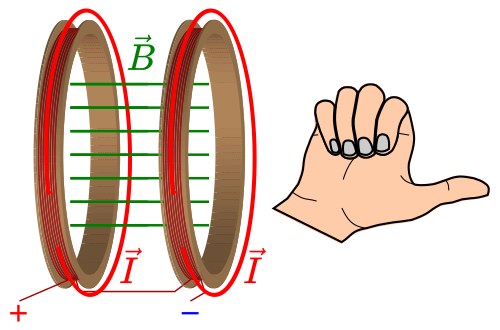
وجدت أنه في المنطقة المحصورة بين ملفَّين دائريين متوازيين يمرّ بهما نفس التيار، يتشكّل مجال شبه منتظم، وكلما قاربنا بين الملفين ازدادت المساحة التي يكون فيها المجال منتظمًا.
ولو قرّبنا الحلقات أكثر وزدنا عدد اللفات، نحصل على مجال منتظم أوسع — وهذا بالضبط ما يُعرف بالملف اللولبي.
“I am the scientist Hermann von Helmholtz” — the field produced by a single loop is non-uniform, while our applications need a uniform field.
I found that in the region between two parallel circular coils carrying the same current, a nearly-uniform field forms, and bringing the coils closer together widens the region of uniformity.
Bringing the loops even closer together and increasing the number of turns gives an even wider uniform field — which is exactly what a solenoid is.
نشاط: محاكاة خطوط المجال لملفات متحدة المحور
Activity: Simulating Field Lines for Coaxial Coils
اختر عدد الملفات (واحد، اثنان، ثلاثة، أو أربعة)، وغيّر النسبة a/R (البعد بين الملفين مقسومًا على نصف القطر)، ثم مرّر الفأرة أو انقر داخل الرسم لرؤية اتجاه ومقدار المجال عند أي نقطة:
Choose the number of coils (one, two, three, or four), change the ratio a/R (the separation between coils divided by the radius), then hover or click inside the drawing to see the field’s direction and magnitude at any point:
حرّك الفأرة أو انقر داخل الرسم لعرض شعاع المجال ومقداره B عند تلك النقطة.
Move the mouse or click inside the drawing to display the field vector and its magnitude B at that point.

عند قذف جسيم مشحون بسرعة ثابتة وبشكل عمودي على مجال منتظم، يتّخذ مسارًا دائريًا. اقذف جسيمًا في مركز ملف هلمهولتز وبشكل عمودي، وراقب المسار الدائري — هذا يؤكّد أن المجال في مركز هلمهولتز منتظم. لا تنسَ أن تجعل الزاوية بين المجال والسرعة 90° بجعل زاوية القذف 0.0 باتجاه محور x.
When a charged particle is launched at a constant speed, perpendicular to a uniform field, it traces a circular path. Launch a particle at the Helmholtz coils’ center, perpendicular to the field, and watch the circular path — confirming the field at the center is uniform. Remember to keep the angle between the field and the velocity at 90° by setting the launch angle to 0.0 along the x-axis.
القوة المغناطيسية على سلك يحمل تيارًا
The Magnetic Force on a Current-Carrying Wire
إذا كان لدينا سلك موصل يمرّ به تيار، والسلك خاضع لمجال مغناطيسي لا يوازي طوله، فإن السلك يتأثر بقوة لها مقدار واتجاه.
If a current-carrying wire is placed in a magnetic field that is not parallel to its length, the wire feels a force with both magnitude and direction.
حيث: I شدة التيار المار في السلك، L طول السلك الموجود ضمن المجال، B شدة المجال المغناطيسي، θ الزاوية بين السلك والمجال.
Where: I is the current in the wire, L is the length of wire inside the field, B is the field strength, θ is the angle between the wire and the field.
لتحديد الاتجاه، نستخدم قاعدة كف اليد اليمنى كما في الصورة:
To find the direction, we use the right-hand palm rule as shown:

في هذه المحاكاة، تُبذل قوة لورنتز من مجال مغناطيسي لمغناطيس حدوة حصان على سلك على شكل أرجوحة يمرّ به تيار مستمر:
- افتح كفّك واجعل الأصابع باتجاه المجال.
- الإبهام باتجاه التيار الاصطلاحي (من القطب الموجب للبطارية إلى السالب).
- القوة خارجة من راحة الكف.
In this simulation, the Lorentz force from a horseshoe magnet’s field acts on a swinging current-carrying wire:
- Open your palm with the fingers pointing along the field.
- The thumb points along the conventional current (from the battery’s positive terminal to the negative).
- The force comes out of the palm.
📌 ملاحظات:
- بعض الكليات تستخدم قاعدة الأصابع الثلاثة لليد اليمنى: السبابة اتجاه المجال، والإبهام اتجاه التيار، والوسطى اتجاه القوة.
- وفي كليات أخرى يُستخدم اليد اليسرى تعبيرًا عن التيار الإلكتروني (عكس اتجاه التيار الاصطلاحي)، والقوة المغناطيسية المؤثرة على سلك يمرّ به تيار إلكتروني.
📌 Notes:
- Some conventions use the three-finger right-hand rule: index finger for the field, thumb for the current, middle finger for the force.
- Other conventions use the left hand to represent electron current (opposite the conventional current) and the magnetic force on a wire carrying that electron current.

السلك موازٍ للمجال، أي \(\theta=0°\Rightarrow\sin\theta=0\): \(F=ILB\sin\theta=8\times0.5\times0.4\times0=0\).
The wire is parallel to the field, so \(\theta=0°\Rightarrow\sin\theta=0\): \(F=ILB\sin\theta=8\times0.5\times0.4\times0=0\).

\(\theta=90°\Rightarrow\sin\theta=1\): \(F=ILB=8\times0.5\times0.4=1.6\;N\). الاتجاه بتطبيق قاعدة اليد اليمنى على معطيات الشكل: نحو الأعلى.
\(\theta=90°\Rightarrow\sin\theta=1\): \(F=ILB=8\times0.5\times0.4=1.6\;N\). By the right-hand rule applied to the figure: upward.
⚡ عجلة بارلو
⚡ Barlow’s Wheel
مثال تاريخي (1822) على تحويل الطاقة الكهربائية إلى طاقة حركية دورانية بواسطة القوة المغناطيسية على تيار (قوة لابلاس).
A historical (1822) example of converting electrical energy into rotational kinetic energy via the magnetic force on a current (the Laplace force).

🔋 دائرة كهربائية بسيطة (بدون رموز مجال — المجال ثابت للداخل)🔋 A simple circuit (field symbols omitted — the field is fixed, pointing inward)
🔎 شرح تجربة عجلة بارلو
🔎 Explaining Barlow’s Wheel
هذه العجلة تُبرز تحوّل الطاقة الكهربائية إلى طاقة حركية دورانية بواسطة قوى لابلاس (القوة الكهرمغناطيسية).
- مصدر التيار (البطارية) يغذّي المحور المركزي للعجلة، ويسري التيار عبر أحد أضلاعها حتى يصل إلى حوض الزئبق السفلي، ثم يعود إلى البطارية.
- المجال المغناطيسي ثابت وموجّه إلى داخل الصفحة (⊗) ويغطي منطقة العجلة.
- عند مرور التيار في الضلع المغمور جزئيًا في الزئبق، يتعامد التيار مع المجال، فتتولّد قوة عمودية عليهما معًا (وفق قاعدة فلمنج لليد اليسرى — أو اليمنى للتيار الاصطلاحي).
- هذه القوة تسبّب دوران العجلة في اتجاه يعتمد على قطبية التيار واتجاه المجال. زيادة التيار تزيد السرعة، وعكس اتجاهه يعكس جهة الدوران.
🧪 تُعدّ هذه التجربة من أوائل البراهين العملية على مبدأ عمل المحرك الكهربائي البسيط.
This wheel demonstrates converting electrical energy into rotational kinetic energy via Laplace forces (the electromagnetic force).
- The current source (battery) feeds the wheel’s central axle; the current flows through one spoke down to the mercury pool, then back to the battery.
- The magnetic field is fixed, pointing into the page (⊗), covering the wheel’s region.
- Where the current flows through the spoke partly submerged in the mercury, it is perpendicular to the field, producing a force perpendicular to both (by the left-hand rule — or right-hand for conventional current).
- This force spins the wheel in a direction set by the current’s polarity and the field’s direction. Increasing the current increases the speed, and reversing it reverses the spin direction.
🧪 This experiment is among the earliest practical demonstrations of how a simple electric motor works.
الجلفانومتر
The Galvanometer
جهاز يُستخدم لقياس التيارات المنخفضة جدًا وفروق الجهد الصغيرة، فيعمل عمل الأميتر والفولتميتر في آن واحد. يتكوّن من:
- مجال مغناطيسي (من مغناطيس دائم).
- أسطوانة (إطار) تدور حول محورها، ملفوف عليها سلك.
- إبرة مؤشّر متصلة بالأسطوانة.
- زنبرك (سلك فتل) لإعادة الأسطوانة والمؤشّر إلى وضع الصفر.
في هذه المحاكاة، تعرّف على مكونات الجهاز، وراقب حركة المؤشّر عند مرور تيار، وكيف يُعيده الزنبرك عند انقطاعه:
A device for measuring very small currents and small potential differences, acting as both an ammeter and voltmeter at once. It consists of:
- A magnetic field (from a permanent magnet).
- A rotating coil (frame) wound with wire.
- A pointer needle attached to the coil.
- A spring (torsion wire) that returns the coil and pointer to zero.
In this simulation, explore the device’s components, and watch the pointer move as current flows, and how the spring resets it when current stops:
الجلفانومتر ذو الإطار المتحرك: استنتاج العلاقة بين زاوية الدوران والتيار
The Moving-Coil Galvanometer: Deriving the Angle–Current Relation

الخطوة 1: المبدأ الأساسيStep 1: The Basic Principle
عند تمرير تيار كهربائي في إطار المقياس (الجلفانومتر) الموضوع في مجال مغناطيسي منتظم، يتأثّر الإطار بعزم ازدواج مغناطيسي (عزم دوران) بسبب تفاعل التيار مع المجال، فيدور الإطار حول محوره.
When a current flows in the meter’s coil, placed in a uniform field, the coil feels a magnetic torque from the interaction of the current with the field, causing it to rotate about its axis.
الخطوة 2: ظهور عزم مضادStep 2: A Restoring Torque Appears
الإطار معلّق بسلك رفيع (سلك الفتل). دوران الإطار يؤدي إلى فتل هذا السلك، فينشأ عزم مضاد (عزم التواء) يحاول إعادة الإطار إلى وضعه الأصلي، ويزداد مع زاوية الدوران.
The coil hangs from a thin torsion wire. As the coil rotates, the wire twists, producing a restoring torque that tries to bring the coil back to its original position, growing with the rotation angle.
الخطوة 3: شرط التوازنStep 3: The Equilibrium Condition
يستمر الإطار في الدوران حتى يتساوى العزم المغناطيسي مع عزم الفتل، فيتوقف عند زاوية معيّنة θ:
The coil keeps rotating until the magnetic torque equals the torsion torque, stopping at a certain angle θ:
حيث N عدد لفات الإطار، A مساحته، k ثابت الفتل.
Where N is the number of turns, A the area, k the torsion constant.
الخطوة 4: تقريب الزوايا الصغيرةStep 4: Small-Angle Approximation
في الجلفانومترات الحسّاسة، تكون زاوية الدوران صغيرة جدًا، فيمكن اعتبار \(\cos\theta\approx1\)، فيصبح العزم المغناطيسي \(\tau_m=NBIA\)، وعند التوازن:
In sensitive galvanometers, the rotation angle is very small, so \(\cos\theta\approx1\), giving \(\tau_m=NBIA\), and at equilibrium:
الخطوة 5: استخلاص العلاقة الخطيةStep 5: The Linear Relation
من معادلة التوازن نحصل على العلاقة بين التيار وزاوية الانحراف — علاقة خطية طردية:
From the equilibrium equation we get a direct linear relation between the current and the deflection angle:
الخطوة 6: ثابت الجلفانومتر (G)Step 6: The Galvanometer Constant (G)
يُعرَّف ثابت الجلفانومتر G بأنه التيار اللازم لإنتاج انحراف بمقدار وحدة زاوية واحدة: \(G=\dfrac{k}{NBA}\)، وبالتالي \(I=G\theta\).
The galvanometer constant G is the current needed to produce a unit-angle deflection: \(G=\dfrac{k}{NBA}\), so \(I=G\theta\).
الخطوة 7: الحساسيةStep 7: Sensitivity
الحساسية تعني الحصول على انحراف كبير لأصغر تغيّر في التيار — أي G أصغر. تزداد بـ: تقليل ثابت الفتل k (سلك تعليق أرفع)، أو زيادة N أو B أو A.
Sensitivity means a large deflection for the smallest current change — i.e. a smaller G. It increases with: a smaller torsion constant k (a thinner suspension wire), or a larger N, B, or A.
🔧 جهاز الآفومتر (المقياس المتعدد)
🔧 The Multimeter (Avometer)
الآفومتر (Avometer) أو الملتيميتر (Multimeter) جهاز قياس إلكتروني متعدد الاستخدامات، يقيس عدة كميات كهربائية أساسية، وسُمّي نسبةً إلى الوحدات التي يقيسها: أمبير (A)، فولت (V)، أوم (Ω). يعتمد الجلفانومتر ذو الإطار المتحرك (المشروح أعلاه) في قلب تصميمه.
The avometer or multimeter is a versatile electronic measuring device for several basic electrical quantities, named after the units it measures: Ampere (A), Volt (V), Ohm (Ω). It relies on the moving-coil galvanometer (explained above) at its core.
الاستخدامات الرئيسية
Main Uses
- قياس الجهد المستمر (VDC) والمتردد (VAC).
- قياس التيار المستمر (ADC) والمتردد (AAC، في بعض الموديلات).
- قياس المقاومات الكهربائية (Ω).
- Measuring DC and AC voltage.
- Measuring DC current, and AC current on some models.
- Measuring electrical resistance (Ω).
التماثلي مقابل الرقمي
Analog vs. Digital
التماثلي (Analog): إبرة مؤشِّرة تتحرك على تدريج ورقي — مفيد لمراقبة التغيّرات السريعة، لكن عكس القطبية قد يُتلف الجهاز.
الرقمي (Digital): شاشة LCD تعرض أرقامًا دقيقة — أكثر دقة وسهولة قراءة، ولا يتأثر عادةً بعكس القطبية (يعرض إشارة سالبة بدلًا من ذلك).
⚠️ يجب دائمًا مراعاة توصيل الطرف الأحمر (+) بالنقطة ذات الجهد الأعلى، والأسود (−) بالنقطة الأدنى أو الأرضي.
Analog: a pointer needle moving over a printed scale — useful for watching fast changes, but reversed polarity can damage the meter.
Digital: an LCD screen showing precise numbers — more accurate and easier to read, and usually unaffected by reversed polarity (it just shows a minus sign instead).
⚠️ Always connect the red (+) probe to the higher-potential point and the black (−) probe to the lower-potential or ground point.
ثانيًا: أسئلة مقالية
Part Two: Essay Questions
سؤال 1 (مقالي)Question 1 (Essay)
العزم المغناطيسي على إطار بتيار I في مجال B: \(\tau=NIAB\sin\theta\)، حيث θ الزاوية بين العمودي على مستوى الإطار واتجاه المجال. يكون العزم أكبر ما يمكن عندما \(\sin\theta=1\) أي \(\theta=90°\) (مستوى الإطار موازٍ لخطوط المجال)، ويكون صفرًا عندما \(\sin\theta=0\) أي \(\theta=0°\) أو \(180°\) (مستوى الإطار عمودي على المجال).
The torque on a frame with current I in field B: \(\tau=NIAB\sin\theta\), where θ is the angle between the frame’s normal and the field. Torque is maximum when \(\sin\theta=1\), i.e. \(\theta=90°\) (the frame’s plane parallel to the field lines), and zero when \(\sin\theta=0\), i.e. \(\theta=0°\) or \(180°\) (the frame’s plane perpendicular to the field).
سؤال 2 (مقالي)Question 2 (Essay)
الاستنتاج: القوة المغناطيسية على شحنة تتحرك بسرعة عمودية على المجال: \(F=qvB\) (من قانون قوة لورنتز الأساسي). بإعادة الترتيب: \(B=\dfrac{F}{qv}\) عندما تكون السرعة عمودية على المجال.
تعريف التسلا: هو شدة المجال المغناطيسي الذي يؤثر بقوة مقدارها 1 نيوتن على شحنة مقدارها 1 كولوم تتحرك بسرعة 1 متر/ثانية عمودية عليه: \(1\;T = 1\;\dfrac{N}{C\cdot m/s}\).
Derivation: the magnetic force on a charge moving perpendicular to the field: \(F=qvB\) (from the basic Lorentz force law). Rearranging: \(B=\dfrac{F}{qv}\) when the velocity is perpendicular to the field.
Defining the tesla: it is the field strength that exerts a force of 1 newton on a charge of 1 coulomb moving at 1 m/s perpendicular to it: \(1\;T = 1\;\dfrac{N}{C\cdot m/s}\).
سؤال 3 (مقالي)Question 3 (Essay)
القياس: يعتمد على تأثير عزم ازدواج على ملف (إطار) يسري فيه التيار، موضوع في مجال مغناطيسي. في الجلفانومتر ذي الإطار المتحرك، يكون المجال شعاعيًا بحيث تكون الزاوية بين العمودي والمجال 90° دائمًا، فيصبح \(\tau=NIAB\)، يوازن عزم نابض حلزوني \(\tau=k\theta\). عند الاتزان: \(kθ=NIAB\Rightarrow I=\dfrac{k}{NAB}\theta\) — علاقة خطية.
زيادة الحساسية: زيادة عدد اللفات N، أو شدة المجال B، أو مساحة الملف A؛ وتقليل ثابت الفتل k (سلك تعليق أرفع وأكثر مرونة)؛ ويمكن أيضًا استخدام مرآة ومؤشر ضوئي لتكبير قراءة الانحراف.
Measurement: it relies on the torque on a current-carrying coil placed in a magnetic field. In the moving-coil galvanometer, the field is radial so the angle between the normal and the field is always 90°, giving \(\tau=NIAB\), balanced by a spring’s torque \(\tau=k\theta\). At equilibrium: \(k\theta=NIAB\Rightarrow I=\dfrac{k}{NAB}\theta\) — a linear relation.
Increasing sensitivity: increase the number of turns N, the field B, or the coil area A; decrease the torsion constant k (a thinner, more flexible suspension wire); a mirror-and-light pointer can also magnify the reading.
ثالثًا: حل المسائل
Part Three: Solved Problems
المسألة الأولىProblem One
في تجربة السكتين الكهربائية، تستند ساق نحاسية كتلتها \(16\;g\) إلى سكّتين أفقيّتين، حيث يؤثر في جزئها المتوسط حقل مغناطيسي منتظم شدته \(0.1\;T\)، ويمرّ بها تيار شدته \(40\;A\). طول الساق \(4\;cm\). \((g=9.8\;m/s^2)\) المطلوب:
- حدّد عناصر القوة الكهرطيسية (بالرسم) واحسب شدتها.
- احسب العمل الذي تنجزه القوة الكهرطيسية عندما تنتقل الساق مسافة \(15\;cm\).
- احسب قيمة الزاوية التي يجب إمالة السكتين والدارة بها عن الأفقي حتى تتوازن الساق (بإهمال قوى الاحتكاك)، علمًا أن المجال يبقى ثابت الاتجاه (أفقيًا) عند إمالة السكتين.
In the "sliding rod" experiment, a copper rod of mass \(16\;g\) rests on two horizontal rails. A uniform field of \(0.1\;T\) acts on its middle section, and a current of \(40\;A\) flows through it. The rod’s length is \(4\;cm\). \((g=9.8\;m/s^2)\) Find:
- The elements of the Laplace force (with a sketch) and its magnitude.
- The work done by the Laplace force as the rod moves \(15\;cm\).
- The angle the rails and circuit must be tilted from horizontal for the rod to balance (neglecting friction), given the field stays fixed (horizontal) as the rails tilt.
1) القوة الكهرطيسية عمودية على كل من التيار والمجال (قاعدة اليد اليمنى): \(F=BIL=0.1\times40\times0.04=0.16\;N\)
2) العمل: \(W=F\times d=0.16\times0.15=0.024\;J\)
3) عند إمالة الرصيف بزاوية θ (مع بقاء اتجاه المجال — وبالتالي القوة F — أفقيًا ثابتًا)، يتوازن مركّب وزن الساق على طول المستوى المائل \((mg\sin\theta)\) مع مركّب القوة الأفقية الموازي للمستوى \((F\cos\theta)\):
\(F\cos\theta = mg\sin\theta \;\Rightarrow\; \tan\theta=\dfrac{F}{mg}=\dfrac{0.16}{0.016\times9.8}\approx1.02\;\Rightarrow\;\theta\approx45.6°\)
ملاحظة: المعادلة الشائعة (الخاطئة) \(\sin\theta=F/(mg)\) تُعطي هنا قيمة \(1.02>1\) وهي غير ممكنة رياضيًا — الصيغة الصحيحة لهذا الوضع الهندسي (حيث تبقى F أفقية أثناء إمالة المستوى) هي \(\tan\theta=F/(mg)\).
1) The Laplace force is perpendicular to both the current and the field (right-hand rule): \(F=BIL=0.1\times40\times0.04=0.16\;N\)
2) Work: \(W=F\times d=0.16\times0.15=0.024\;J\)
3) Tilting the rails by θ (with the field — and hence F — staying horizontal), equilibrium requires the gravity component along the incline \((mg\sin\theta)\) to balance the horizontal force’s component along the incline \((F\cos\theta)\):
\(F\cos\theta = mg\sin\theta \;\Rightarrow\; \tan\theta=\dfrac{F}{mg}=\dfrac{0.16}{0.016\times9.8}\approx1.02\;\Rightarrow\;\theta\approx45.6°\)
Note: the common (incorrect) equation \(\sin\theta=F/(mg)\) gives \(1.02>1\) here, which is mathematically impossible — the correct relation for this geometry (F staying horizontal as the plane tilts) is \(\tan\theta=F/(mg)\).
المسألة الثانيةProblem Two
نُعلّق سلكًا نحاسيًا ثخينًا طوله \(60\;cm\) وكتلته \(50\;g\) من طرفه العلوي شاقوليًا، ونغمس طرفه السفلي في حوض زئبق. نمرّر تيارًا شدته \(10\;A\) فينحرف السلك عن الشاقول بزاوية α ثابتة ويتوازن، حيث يؤثّر حقل مغناطيسي منتظم أفقي شدته \(2\times10^{-3}\;T\) على قطعة منه طولها \(4\;cm\) يبعد منتصفها عن نقطة التعليق \(50\;cm\). المطلوب: استنتج العلاقة المحدِّدة لزاوية الانحراف α، ثم احسبها. \((g=9.8\;m/s^2)\)
A thick copper wire of length \(60\;cm\) and mass \(50\;g\) hangs vertically from its top end, with its lower end dipped in a mercury pool. A current of \(10\;A\) is passed through it, deflecting it from vertical by a steady angle α at equilibrium, where a uniform horizontal field of \(2\times10^{-3}\;T\) acts on a \(4\;cm\) segment whose midpoint is \(50\;cm\) from the suspension point. Derive the relation for α, then compute it. \((g=9.8\;m/s^2)\)
القوة المغناطيسية: \(F=BIL=2\times10^{-3}\times10\times0.04=8\times10^{-4}\;N\)
عزمها حول نقطة التعليق: \(\tau_{mag}=F\times d=8\times10^{-4}\times0.5=4\times10^{-4}\;N\cdot m\)
وزن السلك: \(w=mg=0.05\times9.8=0.49\;N\)
عزم الوزن (للانحراف الصغير α، مركز الثقل عند منتصف السلك): \(\tau_{weight}=mg\times\dfrac{L}{2}\sin\alpha=0.49\times0.3\sin\alpha=0.147\sin\alpha\)
بمساواة العزمين عند التوازن: \(0.147\sin\alpha=4\times10^{-4}\;\Rightarrow\;\sin\alpha\approx0.00272\;\Rightarrow\;\alpha\approx0.156°\)
Magnetic force: \(F=BIL=2\times10^{-3}\times10\times0.04=8\times10^{-4}\;N\)
Its torque about the pivot: \(\tau_{mag}=F\times d=8\times10^{-4}\times0.5=4\times10^{-4}\;N\cdot m\)
Weight: \(w=mg=0.05\times9.8=0.49\;N\)
Weight’s torque (small deflection α, center of mass at the wire’s midpoint): \(\tau_{weight}=mg\times\dfrac{L}{2}\sin\alpha=0.49\times0.3\sin\alpha=0.147\sin\alpha\)
Equating the torques at equilibrium: \(0.147\sin\alpha=4\times10^{-4}\;\Rightarrow\;\sin\alpha\approx0.00272\;\Rightarrow\;\alpha\approx0.156°\)
المسألة الثالثةProblem Three
إطار مستطيل الشكل يحتوي 100 لفة من سلك نحاسي معزول، مساحته \(4\;cm^2\)، معلّق بسلك عديم الفتل شاقولي، يقع في حقل مغناطيسي منتظم أفقي شدته \(2\times10^{-4}\;T\)، خطوطه توازي مستوى الإطار الشاقولي. يمرّ في الإطار تيار شدته \(10\;A\). المطلوب:
- احسب عزم الازدواج الكهرطيسي على الإطار لحظة إمرار التيار.
- نستبدل سلك التعليق بسلك فتل شاقولي ثابت فتله K، بحيث يكون مستوى الإطار موازيًا لخطوط المجال، ونمرّر تيارًا شدته \(2\;mA\) فيدور الإطار بزاوية \(30°\) ثم يتوازن (نُهمل تأثير المجال المغناطيسي الأرضي). احسب التدفق المغناطيسي الكلي عبر الإطار عند التوازن، واحسب ثابت الفتل K.
A rectangular frame of 100 turns of insulated copper wire, area \(4\;cm^2\), hangs from a torsion-free vertical wire, in a uniform horizontal field of \(2\times10^{-4}\;T\) whose lines are parallel to the frame’s (vertical) plane. A current of \(10\;A\) flows in it. Find:
- The electromagnetic couple’s torque on the frame the instant the current flows.
- The suspension wire is replaced with a vertical torsion wire of constant K, with the frame’s plane parallel to the field lines. A current of \(2\;mA\) is passed, rotating the frame by \(30°\) before it balances (neglect Earth’s field). Find the total magnetic flux through the frame at equilibrium, and find K.
1) بما أن مستوى الإطار يوازي الحقل، العمودي على المستوى يصنع 90° مع الحقل: \(\tau=NIAB=100\times10\times4\times10^{-4}\times2\times10^{-4}=8\times10^{-5}\;N\cdot m\)
2) بعد الدوران بزاوية 30° عن وضع التوازي، يصنع العمودي على المستوى زاوية 60° مع الحقل:
\(\tau=NI'AB\sin60°=100\times0.002\times4\times10^{-4}\times2\times10^{-4}\times0.866\approx1.386\times10^{-8}\;N\cdot m\)
\(K=\dfrac{\tau}{\theta(rad)}=\dfrac{1.386\times10^{-8}}{\pi/6}\approx2.65\times10^{-8}\;N\cdot m/rad\)
التدفق الكلي عبر الإطار (N لفة): \(\Phi=NBA\cos60°=100\times2\times10^{-4}\times4\times10^{-4}\times0.5=4\times10^{-6}\;Wb\)
1) Since the frame’s plane is parallel to the field, the normal makes 90° with the field: \(\tau=NIAB=100\times10\times4\times10^{-4}\times2\times10^{-4}=8\times10^{-5}\;N\cdot m\)
2) After rotating 30° from the parallel position, the normal makes 60° with the field:
\(\tau=NI'AB\sin60°=100\times0.002\times4\times10^{-4}\times2\times10^{-4}\times0.866\approx1.386\times10^{-8}\;N\cdot m\)
\(K=\dfrac{\tau}{\theta(rad)}=\dfrac{1.386\times10^{-8}}{\pi/6}\approx2.65\times10^{-8}\;N\cdot m/rad\)
Total flux through the N-turn frame: \(\Phi=NBA\cos60°=100\times2\times10^{-4}\times4\times10^{-4}\times0.5=4\times10^{-6}\;Wb\)
المسألة الرابعةProblem Four
قرص بارلو قطره \(20\;cm\) يمرّ به تيار شدته \(5\;A\)، ويخضع لحقل مغناطيسي منتظم أفقي شدته \(2\times10^{-2}\;T\) عمودي على مستوى القرص الشاقولي، فيتأثر القرص بقوة كهرطيسية. المطلوب:
- بيّن بالرسم جهة كل من (القوة، التيار، الحقل).
- احسب محصّلة القوة الكهرطيسية المؤثرة على نصف قطر القرص المغمور جزئيًا في الزئبق.
- احسب عزم القوة الكهرطيسية المؤثرة في القرص حول محوره.
- احسب قيمة الكتلة الواجب تعليقها على طرف نصف قطر أفقي للقرص لمنعه من الدوران.
A Barlow’s wheel of diameter \(20\;cm\) carries a current of \(5\;A\), in a uniform horizontal field of \(2\times10^{-2}\;T\) perpendicular to the wheel’s (vertical) plane, so the wheel feels an electromagnetic force. Find:
- Sketch the directions of the (force, current, field).
- The resultant electromagnetic force on the radius partly submerged in the mercury.
- The torque of the electromagnetic force on the wheel about its axis.
- The mass that must be hung from a horizontal radius to keep the wheel from rotating.
1) التيار شعاعي من المحور إلى الحافة، الحقل أفقي داخل الصفحة، والقوة مماسية (عمودية على القرص، تُنتج عزم دوران).
2) القوة على عنصر طولي \(dr\) من نصف القطر: \(dF=BI\,dr\). بتكامل عناصر القوة من \(0\) إلى \(R=0.1\;m\) (شدة التيار وثابتة على طول نصف القطر): \(F=BIR=2\times10^{-2}\times5\times0.1=0.01\;N\)
3) عزم عنصر القوة حول المحور: \(d\tau=r\,dF=BI\,r\,dr\). بالتكامل من \(0\) إلى \(R\): \(\tau=\dfrac{1}{2}BIR^2=0.5\times2\times10^{-2}\times5\times(0.1)^2=5\times10^{-4}\;N\cdot m\)
4) لمنع الدوران، نعلّق كتلة m عند طرف نصف قطر أفقي (ذراعها R)، فيتوازن عزم ثقلها مع العزم المغناطيسي: \(mgR=\dfrac{1}{2}BIR^2\Rightarrow m=\dfrac{BIR}{2g}=\dfrac{2\times10^{-2}\times5\times0.1}{2\times9.8}\approx5.1\times10^{-4}\;kg\approx0.51\;g\)
1) The current is radial from the axle to the rim, the field is horizontal into the page, and the force is tangential (perpendicular to the disk, producing a torque).
2) The force on a length element \(dr\) of the radius: \(dF=BI\,dr\). Integrating along the radius from \(0\) to \(R=0.1\;m\) (current constant along the radius): \(F=BIR=2\times10^{-2}\times5\times0.1=0.01\;N\)
3) The torque of a force element about the axis: \(d\tau=r\,dF=BI\,r\,dr\). Integrating from \(0\) to \(R\): \(\tau=\dfrac{1}{2}BIR^2=0.5\times2\times10^{-2}\times5\times(0.1)^2=5\times10^{-4}\;N\cdot m\)
4) To prevent rotation, hang a mass m at the end of a horizontal radius (moment arm R), balancing its weight’s torque against the magnetic torque: \(mgR=\dfrac{1}{2}BIR^2\Rightarrow m=\dfrac{BIR}{2g}=\dfrac{2\times10^{-2}\times5\times0.1}{2\times9.8}\approx5.1\times10^{-4}\;kg\approx0.51\;g\)
سؤال إضافيAdditional Question
القوتان الكهربائية \(qE\) والمغناطيسية \(qvB\) متعاكستان على هذه الشحنة. إذا كانت \(v=\dfrac{E}{B}\) تتساوى القوتان وتتعاكسان فتُلغي إحداهما الأخرى، فيتحرك الجسم في خط مستقيم بسرعة ثابتة (مبدأ مرشِّح السرعة). أما إذا انعدم الحقل الكهربائي (\(E=0\))، فتبقى القوة المغناطيسية وحدها فيتحرك الجسم في مسار دائري.
The electric force \(qE\) and magnetic force \(qvB\) oppose each other on this charge. If \(v=\dfrac{E}{B}\), the two forces are equal and opposite, cancelling out, so the body moves in a straight line at constant speed (the principle of a velocity selector). If instead the electric field is zero (\(E=0\)), only the magnetic force remains, and the body moves in a circular path.