🎯 نواتج التعلم
🎯 Learning Outcomes
بعد دراسة هذا الدرس ستكون قادرًا على أن:
After this lesson you will be able to:
- تفسّر نشوء التيار الكهربائي من فرق الجهد وحركة الشحنات في دائرة كاملة وتفرّق بين اتجاه الإلكترونات والتيار الاصطلاحي.Explain how the electric current arises from a potential difference and the motion of charges in a complete circuit and distinguish between the direction of the electrons and the conventional current.
- تعرّف شدة التيار \(I=q/t\) وتحسب القدرة \(P=I\Delta V\) والطاقة الكهربائية والكلفة (kW·h).Define the current \(I=q/t\) and calculate the power \(P=I\Delta V\), the electric energy and the cost (kW·h).
- ترسم الدوائر برموزها وتوصل الأميتر على التوالي والفولتميتر على التوازي.Draw circuits using their symbols and connect the ammeter in series and the voltmeter in parallel.
- تطبّق قانون أوم \(\Delta V=IR\) وتقرأ الرسم البياني \(I\)–\(\Delta V\) وتميّز المواد الأومية وغير الأومية.Apply Ohm’s law \(\Delta V=IR\), read the \(I\)–\(\Delta V\) graph and distinguish ohmic from non-ohmic materials.
- تحسب مقاومة سلك \(R=\rho L/A\) وتفسّر أثر الطول والمساحة والمادة والحرارة.Calculate the resistance of a wire \(R=\rho L/A\) and explain the effect of the length, the area, the material and the temperature.
💬 حوار: من الشحنات الساكنة إلى التيار
💬 Dialogue: From Static Charges to Current
نبدأ بأسئلة تدريجية بين المدرّس والطالب؛ فكّر في كل سؤال ثم اضغط «إظهار الحل» لتقارن إجابتك. ستجد أن فكرة التيار الكهربائي تنبع مما تعرفه عن الشحنات والجهد.
We begin with step-by-step questions between teacher and student. Think about each one, then press “Show Solution” to compare. You will see that the idea of electric current grows out of what you already know about charges and potential.
عند شحن موصل أين تتوضّع الشحنات؟
When a conductor is charged, where do the charges sit?
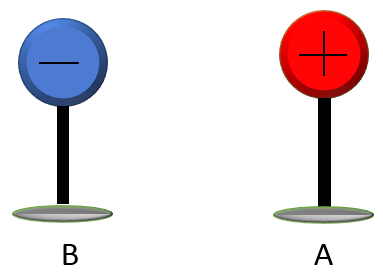
الموصلان B (سالب) وA (موجب) معزولان عن بعضهما.
Conductors B (negative) and A (positive), isolated from each other.
في الشكل: ما نوع جهد كل موصل وأيهما أكبر جهدًا؟
In the figure: what kind of potential does each conductor have and which is higher?
هل تتحرك الشحنات الموجودة على موصل واحد معزول؟
Do the charges on a single isolated conductor move?
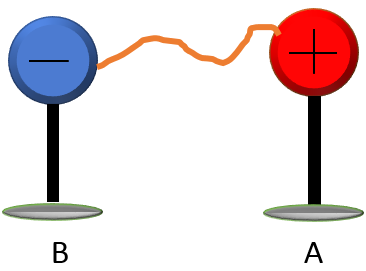
وصلنا الموصلين بسلك معدني.
The two conductors joined by a metal wire.
وُصل الموصلان بسلك معدني. ماذا يحدث للشحنات؟ وما اسم هذا التيار؟
The two conductors are joined by a metal wire. What happens to the charges, and what is this current called?
اعتبر العلماء أن الشحنات الموجبة هي التي تتحرك من الجهد الأعلى إلى الجهد الأدنى. ما اسم هذا التيار؟
Scientists agreed to treat positive charges as moving from high potential to low potential. What is this current called?
ماذا يحدث لحركة الشحنات عندما يتساوى جهد الموصلين؟
What happens to the motion of charges when the two conductors reach the same potential?
ما الأداة التي تُبقي الشحنات في حركة مستمرة في الدائرة الكهربائية؟
Which device keeps the charges moving continuously in an electric circuit?
🧠 الفكرة المحورية
🧠 The Central Idea
فرق الجهد هو السبب، والتيار هو النتيجة. كما يجري الماء في أنبوب من الأعلى ارتفاعًا إلى الأدنى، تجري الشحنات في السلك بوجود فرق جهد. والبطارية تعمل عمل «المضخة» التي تعيد الماء إلى الأعلى فتُبقي الجريان مستمرًا.
Potential difference is the cause and current is the effect. As water flows down a pipe from a higher level to a lower one, charges flow along a wire when a potential difference exists. The battery acts like the “pump” that lifts the water back up so the flow never stops.
💡 الدائرة الكهربائية البسيطة
💡 The Simple Electric Circuit
تتكوّن الدائرة البسيطة من مصدر (بطارية)، وأسلاك توصيل، وحِمل (مصباح مثلًا)، ومفتاح للتحكم. التيار لا يمر إلا في مسار مغلق؛ فعند فتح المفتاح تنقطع الدائرة ويتوقف التيار.
A simple circuit has a source (battery), connecting wires, a load (for example a lamp) and a switch to control it. Current flows only in a closed path; opening the switch breaks the circuit and the current stops.
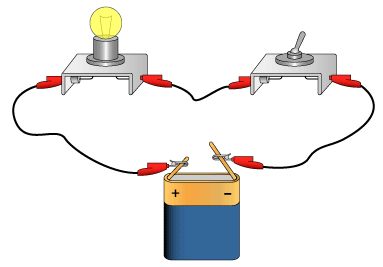
دائرة بسيطة: بطارية + مصباح + مفتاح + أسلاك.
A simple circuit: battery + lamp + switch + wires.
اكتب مكوّنات الدائرة البسيطة في الشكل. هل نفذت الشحنات من الدائرة وتغيّر عددها؟ وما الذي يُفقد منها بعد مرور الزمن؟
List the components of the simple circuit in the figure. Did the charges leave the circuit or change in number? And what is used up as time passes?
⚖️ ما الذي يحدث بالتفصيل عند إغلاق المفتاح؟
⚖️ What Exactly Happens When the Switch Closes?
1) تنشأ في كل الدائرة مجالات كهربائية بسرعة قريبة من سرعة الضوء، فتبدأ الإلكترونات الحرة في كل الأسلاك بالحركة معًا؛ لذلك يضيء المصباح لحظة الإغلاق دون انتظار وصول إلكترون من البطارية.
1) An electric field is set up throughout the circuit at nearly the speed of light, so the free electrons all along the wires start to move together. That is why the lamp lights the instant you close the switch, without waiting for an electron to travel from the battery.
2) سرعة انسياق الإلكترونات نفسها صغيرة جدًا (نحو أجزاء من الميلّيمتر في الثانية)، لكن عددها هائل فيكفي لتيار كبير.
2) The drift speed of the electrons themselves is tiny (about fractions of a millimetre per second), but there are so many of them that a large current results.
3) الفتيلة في المصباح مقاومتها أكبر بكثير من بقية الدائرة، فتسخن حتى تتوهج وتشع ضوءًا.
3) The lamp filament has a far higher resistance than the rest of the circuit, so it heats up until it glows and emits light.
🧪 تجربة 1: الدائرة البسيطة وحركة الشحنات
🧪 Experiment 1: The Simple Circuit and Charge Motion
نغلق الدائرة البسيطة ونراقب الشحنات في الأسلاك كلها معًا ثم نغيّر الجهد والمقاومة لنرى أثرهما في التيار والقدرة.
We close the simple circuit and watch the charges in all the wires together then change the voltage and the resistance to see their effect on the current and the power.
🛠️ خطوات العمل
🛠️ Procedure
- اضغط «المفتاح» لإغلاق الدائرة وراقب حركة الشحنات.Press the “Switch” to close the circuit and watch the motion of the charges.
- اضبط \(\Delta V=6\ \mathrm V\) و\(R=12\ \Omega\) وسجّل التيار ثم ضاعف الجهد.Set \(\Delta V=6\ \mathrm V\) and \(R=12\ \Omega\) and record the current then double the voltage.
- بدّل بين عرض الإلكترونات والتيار الاصطلاحي وقارن الاتجاهين.Toggle between electrons and the conventional current and compare the two directions.
🧪 تجربة 1: الدائرة البسيطة وحركة الشحنات
🧪 Experiment 1: The Simple Circuit and Charge Motion
اضغط «المفتاح» لإغلاق الدائرة. لاحظ حركة الشحنات في كل الأسلاك معًا، ثم غيّر جهد البطارية ومقاومة المصباح وراقب التيار وتوهّج المصباح. بدّل بين عرض الإلكترونات والتيار الاصطلاحي.
Press “Switch” to close the circuit. Watch the charges move in all the wires together, then change the battery voltage and the lamp resistance and watch the current and the lamp’s glow. Toggle between electrons and the conventional current.
🔎 ماذا نلاحظ؟ وما الاستنتاج؟
🔎 What do we observe? What is the conclusion?
- تتحرك الشحنات في الدائرة كلها فور إغلاق المفتاح، وتزداد سرعتها بزيادة التيار.The charges move in the whole circuit as soon as the switch is closed and their speed increases with the current.
- مضاعفة الجهد تضاعف التيار وتجعل القدرة 4 أمثالها.Doubling the voltage doubles the current and makes the power 4 times.
الإلكترونات تتحرك عكس اتجاه التيار الاصطلاحي، وشدة التيار \(I=\Delta V/R\).
The electrons move opposite to the direction of the conventional current, and the current is \(I=\Delta V/R\).
⚡ تحولات الطاقة: كيف تنتج الكهرباء؟
⚡ Energy Transformations: How Is Electricity Produced?
في السدود تتحول الطاقة من شكل إلى آخر: تتحول طاقة الوضع للماء المحتجز إلى طاقة حركية عند سقوطه فتدير التوربين، والتوربين يدير ملفًّا داخل مجال مغناطيسي فينشأ فيه تيار كهربائي (الحث الكهرومغناطيسي). أما البطارية فتحوّل طاقة كيميائية إلى كهربائية.
In dams energy changes from one form to another: the potential energy of stored water becomes kinetic energy as it falls and turns a turbine; the turbine spins a coil inside a magnetic field, which induces an electric current (electromagnetic induction). A battery, by contrast, converts chemical energy into electrical energy.
🔁 سلسلة التحولات في محطة السد
🔁 The Chain of Transformations at a Dam
طاقة الوضع (ماء مرتفع) ← طاقة حركية (ماء يسقط) ← طاقة حركية دورانية (توربين) ← طاقة كهربائية (مولّد) ← ضوء وحرارة وحركة في المنازل.
Potential energy (high water) → kinetic energy (falling water) → rotational kinetic energy (turbine) → electrical energy (generator) → light, heat and motion in homes.
🌊 التيار الكهربائي: معدل تدفق الشحنات
🌊 Electric Current: the Rate of Charge Flow
📜 تعريف التيار الكهربائي
📜 Definition of Electric Current
التيار الكهربائي هو معدل تدفق الشحنات الكهربائية عبر مقطع من موصل؛ والشحنة المتحركة قد تكون إلكترونات (في الفلزات) أو أيونات (في المحاليل).
Electric current is the rate of flow of charge through a cross-section of a conductor; the moving charge may be electrons (in metals) or ions (in solutions).
\[I=\dfrac{q}{t}\]
وحدة شدة التيار في النظام الدولي الأمبير (A): \(1\,A=1\,C/s\) أي كولوم واحد في الثانية.
The SI unit of current is the ampere (A): \(1\,A=1\,C/s\), one coulomb per second.

الشحنات التي تعبر المقطع كل ثانية تحدد شدة التيار.
The charge crossing the section every second sets the current.
تذكير مهم: شحنة الإلكترون الواحد \(e=1.6\times10^{-19}\,C\)، فإذا عبر مقطعًا عدد \(N\) من الإلكترونات كانت الشحنة الكلية \(q=N\,e\). ويُرسم اتجاه التيار الاصطلاحي دائمًا من القطب الموجب للبطارية عبر الدائرة الخارجية إلى القطب السالب.
Remember: one electron carries \(e=1.6\times10^{-19}\,C\), so if \(N\) electrons cross a section the total charge is \(q=N\,e\). The conventional current is always drawn from the positive terminal of the battery, through the external circuit, to the negative terminal.
يمر في سلك تيار شدته \(3\,A\) مدة \(20\,s\). احسب الشحنة التي عبرت مقطع السلك وعدد الإلكترونات.
A wire carries a current of \(3\,A\) for \(20\,s\). Find the charge that crossed its section and the number of electrons.
🔋 القدرة الكهربائية ونقل الطاقة
🔋 Electric Power and Energy Transfer
📜 القدرة الكهربائية
📜 Electric Power
القدرة هي معدل نقل الطاقة (أو معدل تحولها). وحدتها الوات (W) حيث \(1\,W=1\,J/s\).
Power is the rate of energy transfer (or conversion). Its unit is the watt (W), with \(1\,W=1\,J/s\).
\[P=\dfrac{E}{t}=\dfrac{q\,\Delta V}{t}=I\,\Delta V\]
ومنها الطاقة المستهلكة: \(E=P\,t=I\,\Delta V\,t\)
and the energy used: \(E=P\,t=I\,\Delta V\,t\)
🔎 من أين جاءت \(P=I\Delta V\)؟
🔎 Where Does \(P=I\Delta V\) Come From?
عندما تعبر شحنة \(q\) فرق جهد \(\Delta V\) تتغير طاقتها بمقدار \(E=q\,\Delta V\) (تعريف فرق الجهد: الطاقة لكل وحدة شحنة). وبقسمة الطاقة على الزمن: \(P=\dfrac{q\,\Delta V}{t}\) وبما أن \(\dfrac{q}{t}=I\) فإن \(P=I\,\Delta V\).
When a charge \(q\) crosses a potential difference \(\Delta V\) its energy changes by \(E=q\,\Delta V\) (the definition of potential difference: energy per unit charge). Dividing by time: \(P=\dfrac{q\,\Delta V}{t}\), and since \(\dfrac{q}{t}=I\) we get \(P=I\,\Delta V\).
مصباح قدرته \(120\,W\) ويعمل تحت فرق جهد \(220\,V\). ما شدة التيار المار فيه؟
A lamp rated \(120\,W\) works at a potential difference of \(220\,V\). What current flows through it?
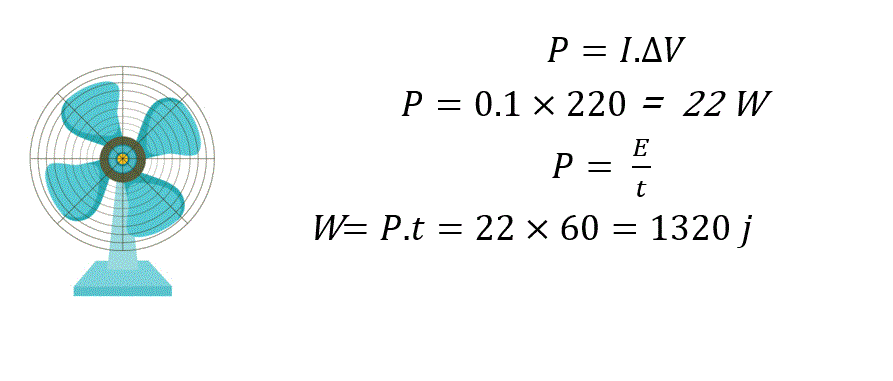
مروحة تعمل تحت فرق جهد \(220\,V\) ويمر بها تيار شدته \(0.1\,A\). ما الطاقة المصروفة خلال دقيقة؟
A fan runs at \(220\,V\) and draws \(0.1\,A\). How much energy does it use in one minute?
💰 الطاقة في الفواتير: الكيلوواط·ساعة
💰 Energy on Bills: the Kilowatt-Hour
تحسب شركات الكهرباء الطاقة بوحدة kWh. \(1\,kWh=1000\,W\times3600\,s=3.6\times10^{6}\,J\). فمدفأة قدرتها \(2\,kW\) تعمل \(3\) ساعات تستهلك \(6\,kWh\).
Electricity companies measure energy in kWh. \(1\,kWh=1000\,W\times3600\,s=3.6\times10^{6}\,J\). A \(2\,kW\) heater running for \(3\) hours uses \(6\,kWh\).
🔌 الرموز التخطيطية للدوائر الكهربائية
🔌 Circuit Symbols
لرسم دائرة نستخدم رموزًا متفقًا عليها بدل رسم الأجهزة الحقيقية. إليك الجدول كاملًا: صورة الجهاز واسمه ورمزه ووظيفته. غطِّ الأعمدة بيدك وحاول تذكرها!
To draw a circuit we use agreed symbols instead of drawing real devices. Here is the full table: the device photo, its name, its symbol and its job. Cover the columns with your hand and try to recall them!
| صورة الجهازDevice | الاسمName | الرمزSymbol | الوظيفةJob |
|---|---|---|---|
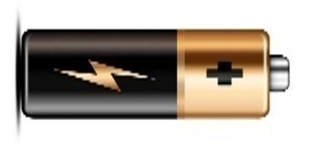 | بطاريةBattery | تحافظ على فرق جهد بين طرفي الدائرة (الخط الطويل هو القطب الموجب).Maintains a potential difference across the circuit (the long line is the positive terminal). | |
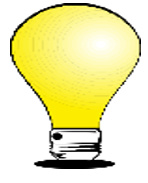 | مصباحLamp | يحوّل الطاقة الكهربائية إلى ضوء وحرارة.Converts electrical energy to light and heat. | |
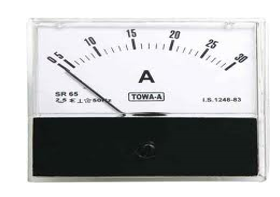 | أميترAmmeter | يقيس شدة التيار؛ يُوصل على التوالي.Measures current; connected in series. | |
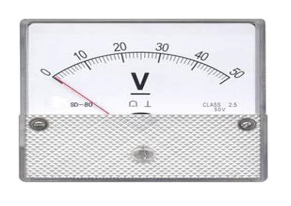 | فولتميترVoltmeter | يقيس فرق الجهد؛ يُوصل على التوازي مع العنصر.Measures potential difference; connected in parallel with the element. | |
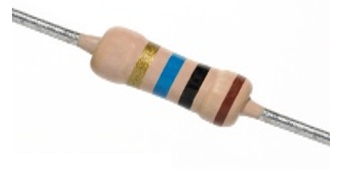 | مقاومةResistor | تعاكس مرور التيار وتحدد قيمته.Opposes the current and sets its value. | |
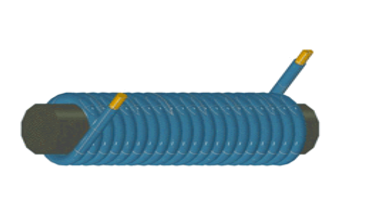 | ملف لولبيCoil (inductor) | سلك ملفوف يولّد مجالًا مغناطيسيًا عند مرور التيار.Wound wire that produces a magnetic field when current flows. | |
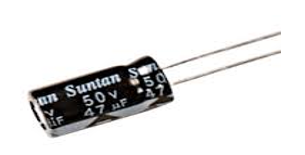 | مكثفCapacitor | يخزّن الشحنة والطاقة الكهربائية.Stores charge and electrical energy. | |
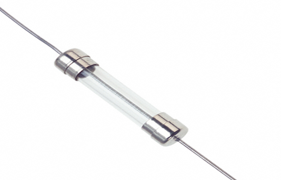 | منصهر (فيوز)Fuse | يحمي الدائرة: ينصهر وينقطع التيار إذا زاد عن حدّه.Protects the circuit: melts and breaks it if the current exceeds its limit. | |
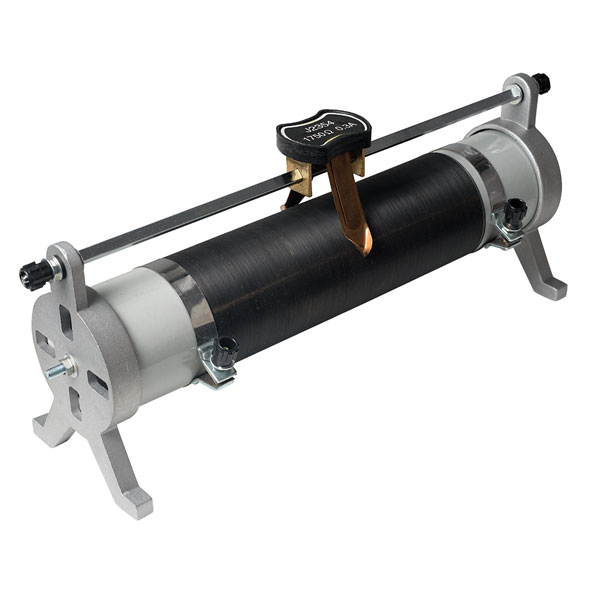 | مقاومة متغيرةVariable resistor (rheostat) | تتغير قيمتها بتحريك المنزلق فتتحكم في التيار.Its value changes as the slider moves, controlling the current. | |
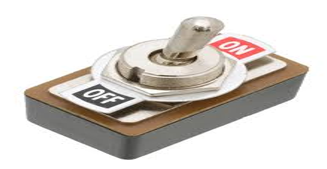 | مفتاحSwitch | يفتح الدائرة أو يغلقها.Opens or closes the circuit. | |
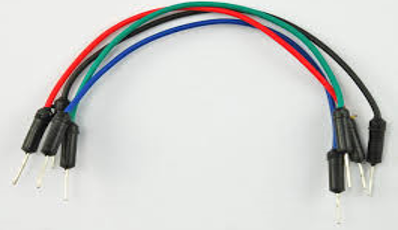 | أسلاك توصيلConnecting wires | توصل العناصر ومقاومتها مهملة عادة.Join the components; their resistance is usually neglected. | |
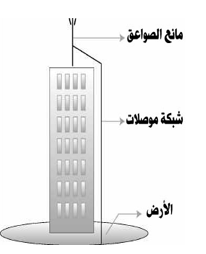 | أرضيEarth (ground) | يوصل الدائرة بالأرض للأمان (كمانع الصواعق).Connects the circuit to the ground for safety (like a lightning rod). |
📏 قاعدة التوصيل: الأميتر والفولتميتر
📏 Wiring Rule: Ammeter and Voltmeter
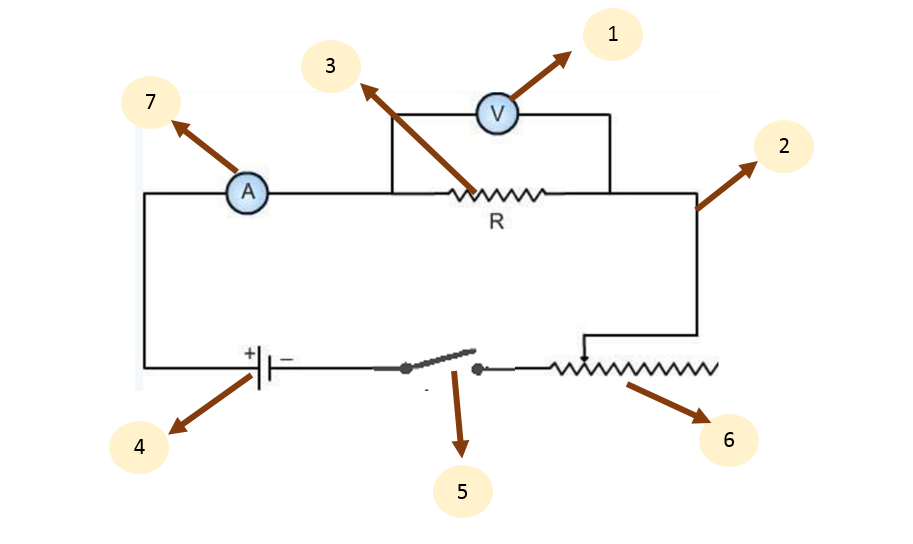
الأميتر مقاومته صغيرة جدًا، يُوصل على التوالي ليمر به نفس تيار العنصر. الفولتميتر مقاومته كبيرة جدًا، يُوصل على التوازي بين طرفي العنصر المراد قياس فرق جهده.
The ammeter has a very small resistance and is connected in series so the element’s current passes through it. The voltmeter has a very large resistance and is connected in parallel across the element whose potential difference is measured.
في الدائرة الآتية اكتب اسم كل جزء من الأجزاء المرقمة 1–7.
In the circuit below name each numbered part 1–7.
📐 قانون أوم
📐 Ohm’s Law
درس العالم الألماني جورج سيمون أوم العلاقة بين شدة التيار وفرق الجهد بين طرفي موصل. وجد أنه عند ثبوت درجة الحرارة تبقى النسبة بين الجهد والتيار ثابتة في الموصلات الأومية.
The German physicist Georg Simon Ohm studied the relation between current and potential difference across a conductor. He found that at constant temperature the ratio of voltage to current stays constant in ohmic conductors.
📜 قانون أوم
📜 Ohm’s Law
فرق الجهد بين طرفي موصل أومي (عند ثبوت درجة حرارته) يتناسب طرديًا مع شدة التيار المار فيه:
The potential difference across an ohmic conductor (at constant temperature) is directly proportional to the current through it:
\[\Delta V=I\,R\qquad R=\dfrac{\Delta V}{I}\]
الثابت \(R\) هو المقاومة الكهربائية وتقاس بالأوم \((\Omega)\) حيث \(1\,\Omega=1\,V/A\).
The constant \(R\) is the electrical resistance, measured in ohms \((\Omega)\), with \(1\,\Omega=1\,V/A\).
🔗 معنى كل رمز
🔗 Meaning of Each Symbol
- الجهد \(\Delta V\) (فولت): الطاقة التي تُعطى لكل كولوم من الشحنة؛ هو «الدافع» الذي يحرّك الشحنات.Voltage \(\Delta V\) (volt): the energy given to each coulomb of charge; it is the “push” that moves the charges.
- التيار \(I\) (أمبير): معدل تدفق الشحنة.Current \(I\) (ampere): the rate of charge flow.
- المقاومة \(R\) (أوم): ممانعة الموصل لمرور التيار.Resistance \(R\) (ohm): how much the conductor opposes the current.
انتبه لصياغة العلاقات: عند ثبوت المقاومة يتناسب \(I\) طرديًا مع \(\Delta V\). وعند ثبوت الجهد يتناسب \(I\) عكسيًا مع \(R\) (مقاومة أكبر ⇒ تيار أصغر). أما \(R\) نفسها فلا تتغير بتغير \(\Delta V\) أو \(I\)؛ فهي صفة للموصل.
Mind the wording: at constant resistance \(I\) is directly proportional to \(\Delta V\). At constant voltage \(I\) is inversely proportional to \(R\) (more resistance ⇒ less current). \(R\) itself does not change when \(\Delta V\) or \(I\) change; it is a property of the conductor.
📈 كيف نقرأ الرسم البياني؟
📈 How to Read the Graph
إذا رسمنا \(I\) على المحور الرأسي و\(\Delta V\) على الأفقي حصلنا على خط مستقيم يمر بالمبدأ للموصل الأومي، وميله \(=\dfrac{\Delta I}{\Delta V}=\dfrac{1}{R}\). فكلما كان الخط أشدّ انحدارًا كانت المقاومة أصغر. وللحصول على \(R\) نأخذ مقلوب الميل: \(R=\dfrac{1}{\text{slope}}\).
If we plot \(I\) on the vertical axis and \(\Delta V\) on the horizontal one, an ohmic conductor gives a straight line through the origin with slope \(=\dfrac{\Delta I}{\Delta V}=\dfrac{1}{R}\). A steeper line means a smaller resistance. To get \(R\) take the reciprocal of the slope: \(R=\dfrac{1}{\text{slope}}\).
🔌 دائرة قانون أوم المتكاملة
🔌 The Complete Ohm’s-Law Circuit
الآن نطبّق القانون في دائرة كاملة كما في المختبر: بطارية، مفتاح، أميتر على التوالي، فولتميتر على التوازي مع المقاومة، ومقاومة متغيرة (ريوستات) نغيّر بها التيار. أغلق المفتاح، حرّك الريوستات وسجّل قراءات الأميتر والفولتميتر، ثم احسب \(R=\Delta V/I\) لكل قراءة وقارنها بقيمة المقاومة.
Now we apply the law in a complete circuit as in the lab: a battery, a switch, an ammeter in series, a voltmeter in parallel with the resistor, and a variable resistor (rheostat) used to change the current. Close the switch, move the rheostat and record the ammeter and voltmeter readings, then compute \(R=\Delta V/I\) for each reading and compare it with the resistor value.
🧪 تجربة 2: دائرة قانون أوم المتكاملة
🧪 Experiment 2: The Complete Ohm’s-Law Circuit
نتحقق من قانون أوم عمليًا: نغيّر التيار بالريوستات ونقرأ الأميتر والفولتميتر ونرسم \(\Delta V\) مع \(I\).
We verify Ohm’s law experimentally: we change the current with the rheostat, read the ammeter and the voltmeter and plot \(\Delta V\) against \(I\).
🛠️ خطوات العمل
🛠️ Procedure
- اضبط \(R=20\ \Omega\) وغيّر الريوستات وسجّل 4 قراءات على الأقل.Set \(R=20\ \Omega\) and change the rheostat and record at least 4 readings.
- احسب \(\Delta V/I\) لكل قراءة وقارنها بقيمة \(R\).Calculate \(\Delta V/I\) for each reading and compare it with the value of \(R\).
- غيّر \(R\) وسجّل قراءات جديدة وقارن ميل الخطين.Change \(R\) and record new readings and compare the slopes of the two lines.
🧪 تجربة 2: دائرة قانون أوم المتكاملة
🧪 Experiment 2: The Complete Ohm’s-Law Circuit
بطارية ومقاومة وريوستات وأميتر على التوالي وفولتميتر على التوازي مع المقاومة. غيّر الريوستات لتغيير التيار وسجّل القراءات عدة مرات وراقب الرسم البياني.
A battery, a resistance, a rheostat, an ammeter in series and a voltmeter in parallel with the resistance. Change the rheostat to change the current, record the readings several times and watch the graph.
🔎 ماذا نلاحظ؟ وما الاستنتاج؟
🔎 What do we observe? What is the conclusion?
- النقاط تقع على خط مستقيم يمر بالأصل، والنسبة \(\Delta V/I\) ثابتة.The points lie on a straight line through the origin and the ratio \(\Delta V/I\) is constant.
- ميل الخط يساوي المقاومة؛ فالمقاومة الأكبر خطها أشد انحدارًا.The slope of the line equals the resistance; a greater resistance has a steeper line.
قانون أوم: \(\Delta V=IR\) للموصلات الأومية، والمقاومة \(R=\Delta V/I\) ثابتة.
Ohm’s law: \(\Delta V=IR\) for ohmic conductors, and the resistance \(R=\Delta V/I\) is constant.
⚠️ المواد الأومية وغير الأومية
⚠️ Ohmic and Non-Ohmic Materials
ينطبق قانون أوم على المواد الأومية التي تكون علاقة \(I\)–\(\Delta V\) فيها خطية (مقاومة معدنية ثابتة الحرارة). أما فتيلة المصباح والصمام الثنائي فهما غير أوميين: يسخن الفتيل بمرور التيار فتزيد مقاومته فينحني الرسم. جرّب ذلك في التجربة بتفعيل خيار «مصباح».
Ohm’s law applies to ohmic materials whose \(I\)–\(\Delta V\) relation is linear (a metal resistor kept at constant temperature). A lamp filament and a diode are non-ohmic: the filament heats as current flows, its resistance rises, and the graph curves. Try it in the experiment by choosing “Lamp”.
موصل أومي وُصل بمصدر فرق جهده \(12\,V\) فمرّ فيه تيار \(0.5\,A\). احسب مقاومته، ثم التيار إذا رفعنا الجهد إلى \(18\,V\).
An ohmic conductor is connected to a \(12\,V\) source and carries \(0.5\,A\). Find its resistance, then the current if the voltage is raised to \(18\,V\).
🧲 العوامل المؤثرة في المقاومة الكهربائية
🧲 Factors Affecting Electrical Resistance
لماذا يقاوم الموصل التيار؟ لأن الإلكترونات الحرة تصطدم أثناء حركتها بأيونات الشبكة البلورية للفلز فتفقد جزءًا من طاقتها على شكل حرارة. وتعتمد مقاومة سلك على أربعة عوامل:
Why does a conductor resist current? Because the moving free electrons collide with the ions of the metal lattice and lose some of their energy as heat. The resistance of a wire depends on four factors:
📋 العوامل الأربعة
📋 The Four Factors
- 📏 الطول \(L\): تزداد المقاومة طرديًا مع الطول (طريق أطول = تصادمات أكثر).📏 Length \(L\): resistance grows in direct proportion to length (a longer path means more collisions).
- 📐 مساحة المقطع \(A\): تقل المقاومة عكسيًا مع زيادة المساحة (ممرات أكثر لمرور الإلكترونات).📐 Cross-sectional area \(A\): resistance falls in inverse proportion to area (more room for the electrons).
- ⚡ نوع المادة (المقاومية \(\rho\)): تختلف باختلاف خواص المادة.⚡ Material (resistivity \(\rho\)): it differs with the properties of the substance.
- 🌡️ درجة الحرارة: تزداد مقاومة الفلزات بارتفاعها (اهتزاز الأيونات أشد = تصادمات أكثر).🌡️ Temperature: the resistance of metals rises with temperature (stronger ion vibration means more collisions).
\[R=\rho\,\dfrac{L}{A}\]
تقاس المقاومية \(\rho\) بوحدة \(\Omega\cdot m\)، وهي صفة للمادة (عند درجة حرارة معينة) ولا تعتمد على طول السلك أو مساحته.
Resistivity \(\rho\) is measured in \(\Omega\cdot m\); it is a property of the material (at a given temperature) and does not depend on the wire’s length or area.
🌡️ أثر الحرارة
🌡️ The Effect of Temperature
للفلزات تقريبًا: \(\rho=\rho_0\,[\,1+\alpha\,(T-T_0)\,]\) حيث \(\alpha\) المعامل الحراري للمقاومية. ومع ثبوت الأبعاد تتغير \(R\) بالطريقة نفسها. ولهذا فإن فتيل المصباح الساخن مقاومته أكبر بكثير منها وهو بارد.
For metals, approximately, \(\rho=\rho_0\,[\,1+\alpha\,(T-T_0)\,]\) where \(\alpha\) is the temperature coefficient of resistivity. With dimensions fixed, \(R\) varies in the same way. This is why a hot lamp filament has a much higher resistance than a cold one.
🧪 تجربة 3: مقاومة السلك
🧪 Experiment 3: The Resistance of a Wire
نغيّر مادة السلك وأبعاده وحرارته لنرى أثر كل عامل في المقاومة \(R=\rho L/A\).
We change the material of the wire, its dimensions and its temperature to see the effect of each factor on the resistance \(R=\rho L/A\).
🛠️ خطوات العمل
🛠️ Procedure
- ابدأ بسلك نحاس \(L=1\ \mathrm m\) و\(d=1\ \mathrm{mm}\) وسجّل \(R\).Start with a copper wire \(L=1\ \mathrm m\) and \(d=1\ \mathrm{mm}\) and record \(R\).
- غيّر عاملًا واحدًا فقط في كل مرة: الطول ثم القطر ثم المادة ثم الحرارة.Change only one factor each time: the length then the diameter then the material then the temperature.
- قارن النسبة بين المقاومة الجديدة والابتدائية.Compare the ratio of the new resistance to the initial one.
🧪 تجربة 3: مقاومة سلك: \(R=\rho L/A\)
🧪 Experiment 3: The Resistance of a Wire: \(R=\rho L/A\)
غيّر نوع مادة السلك وطوله وقطره ودرجة حرارته وراقب مقاومته والرسم البياني لـ \(R\) مع \(L\).
Change the material of the wire, its length, its diameter and its temperature and watch its resistance and the graph of \(R\) against \(L\).
🔎 ماذا نلاحظ؟ وما الاستنتاج؟
🔎 What do we observe? What is the conclusion?
- ضعف الطول يضاعف المقاومة، وضعف القطر يجعلها ربعًا.Doubling the length doubles the resistance and doubling the diameter makes it a quarter.
- النيكروم أكبر مقاومة بكثير من النحاس، وترتفع المقاومة بارتفاع الحرارة في الفلزات.Nichrome has a much greater resistance than copper, and the resistance rises with temperature in metals.
المقاومة تتناسب طرديًا مع الطول وعكسيًا مع المساحة وتعتمد على المادة والحرارة: \(R=\rho L/A\).
The resistance is directly proportional to the length and inversely to the area and depends on the material and the temperature: \(R=\rho L/A\).
جدول مقاميات بعض المواد عند \(20^\circ C\):
Resistivities of some materials at \(20^\circ C\):
| المادةMaterial | \(\rho\;(\Omega\cdot m)\) | الاستخدامUse |
|---|---|---|
| نحاسCopper | \(1.7\times10^{-8}\) | أسلاك المنازل (ناقل ممتاز)House wiring (excellent conductor) |
| ألومنيومAluminium | \(2.8\times10^{-8}\) | خطوط نقل الكهرباءPower transmission lines |
| حديدIron | \(1.0\times10^{-7}\) | هياكل وأسلاك رخيصةFrames and cheap wires |
| تنغستنTungsten | \(5.6\times10^{-8}\) | فتيل المصباح (يتحمل الحرارة العالية)Lamp filaments (withstands high heat) |
| نيكرومNichrome | \(1.1\times10^{-6}\) | عناصر التسخين (مكواة، سخان)Heating elements (iron, heater) |
احسب مقاومة سلك نحاسي طوله \(100\,m\) ومساحة مقطعه \(2.5\,mm^2\) عند \(20^\circ C\) (\(\rho=1.7\times10^{-8}\,\Omega\cdot m\)).
Find the resistance of a copper wire \(100\,m\) long with cross-section \(2.5\,mm^2\) at \(20^\circ C\) (\(\rho=1.7\times10^{-8}\,\Omega\cdot m\)).
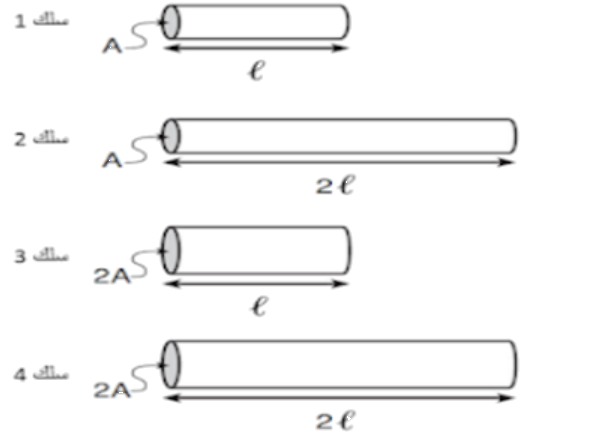
أربعة أسلاك من النوع نفسه وبدرجة الحرارة نفسها.
Four wires of the same material at the same temperature.
أربعة أسلاك من النوع نفسه وبدرجة الحرارة نفسها: (1) طول \(\ell\) ومساحة \(A\)، (2) طول \(2\ell\) ومساحة \(A\)، (3) طول \(\ell\) ومساحة \(2A\)، (4) طول \(2\ell\) ومساحة \(2A\). أيها أقل مقاومة؟
Four wires of the same material and temperature: (1) length \(\ell\), area \(A\); (2) length \(2\ell\), area \(A\); (3) length \(\ell\), area \(2A\); (4) length \(2\ell\), area \(2A\). Which has the least resistance?
🛠️ تطبيقات عملية
🛠️ Practical Applications
أين نستخدم هذه الأفكار؟
Where Do We Use These Ideas?
- 🔌 التحكم في شدة التيار في الدوائر الإلكترونية بالمقاومات والمقاومات المتغيرة.🔌 Controlling current in electronic circuits with resistors and rheostats.
- 💡 توليد الحرارة في الأجهزة (المكواة والسخانات) باستخدام أسلاك نيكروم عالية المقاومية.💡 Producing heat in appliances (irons, heaters) using high-resistivity nichrome wire.
- 🛡️ حماية الدوائر بالمنصهر (الفيوز) من التيار الزائد.🛡️ Protecting circuits from excess current with a fuse.
- 🎛️ المجسّات وأجهزة الاستشعار التي تتغير مقاومتها بالحرارة أو الضوء.🎛️ Sensors whose resistance changes with temperature or light.
- 🏠 التوصيلات المنزلية وشحن البطاريات وإلكترونيات الحاسوب والسيارات الكهربائية.🏠 House wiring, battery charging, computer electronics and electric cars.
📝 ملخص الدرس
📝 Lesson Summary
- الشحنات على موصل معزول تستقر على سطحه الخارجي؛ وبين موصلين مختلفي الجهد تتحرك الإلكترونات من الجهد الأدنى إلى الأعلى (التيار الإلكتروني) والتيار الاصطلاحي عكسها.Charges on an isolated conductor sit on its outer surface; between two conductors at different potentials the electrons move from low to high potential (electron current) and the conventional current is opposite.
- الدائرة البسيطة: بطارية + أسلاك + حِمل + مفتاح؛ الشحنات محفوظة والذي يُستهلك هو طاقة البطارية.A simple circuit: battery + wires + load + switch; charge is conserved and what is used up is the battery’s energy.
- \(I=\dfrac{q}{t}\) بالأمبير، و\(P=\dfrac{E}{t}=I\,\Delta V\) بالوات، و\(E=P\,t\).\(I=\dfrac{q}{t}\) in amperes, \(P=\dfrac{E}{t}=I\,\Delta V\) in watts, and \(E=P\,t\).
- الأميتر على التوالي والفولتميتر على التوازي.The ammeter goes in series and the voltmeter in parallel.
- قانون أوم: \(\Delta V=I\,R\) للموصلات الأومية؛ وميل خط \(I\)–\(\Delta V\) يساوي \(1/R\).Ohm’s law: \(\Delta V=I\,R\) for ohmic conductors; the slope of the \(I\)–\(\Delta V\) line equals \(1/R\).
- \(R=\rho\dfrac{L}{A}\): تزداد بالطول والحرارة (للفلزات) وتقل بالمساحة، وتتغير مع نوع المادة.\(R=\rho\dfrac{L}{A}\): it grows with length and (for metals) temperature, shrinks with area, and changes with the material.
✅ قيّم نفسك
✅ Check Yourself
أين تتوضع الشحنات الفائضة على موصل معزول؟
Where do the excess charges sit on an isolated conductor?
وُصل موصل جهده سالب B بموصل جهده موجب A بسلك. تتحرك الإلكترونات:
A conductor B at negative potential is joined by a wire to A at positive potential. The electrons move:
مصباح \(120\,W\) يعمل على \(220\,V\). شدة التيار تقارب:
A \(120\,W\) lamp runs on \(220\,V\). The current is about:
مروحة \(220\,V\) وتيارها \(0.1\,A\). الطاقة المصروفة في دقيقة:
A fan at \(220\,V\) draws \(0.1\,A\). The energy used in one minute is:
لقياس التيار في عنصر وفرق الجهد بين طرفيه نوصل:
To measure the current in an element and the voltage across it we connect:
أربعة أسلاك من النوع نفسه: أيها أقل مقاومة؟ (1: طول \(\ell\)، مساحة \(A\)) (2: \(2\ell\)، \(A\)) (3: \(\ell\)، \(2A\)) (4: \(2\ell\)، \(2A\))
Four wires of the same material: which has the least resistance? (1: \(\ell\), \(A\)) (2: \(2\ell\), \(A\)) (3: \(\ell\), \(2A\)) (4: \(2\ell\), \(2A\))
في رسم بياني للتيار \(I\) (رأسي) مقابل الجهد \(\Delta V\) (أفقي) لمقاومتين، الخط الأشد انحدارًا يعود إلى المقاومة:
On an \(I\) (vertical) versus \(\Delta V\) (horizontal) graph for two resistors, the steeper line belongs to the resistor with the:
عند رفع درجة حرارة سلك فلزي مع ثبوت أبعاده:
When the temperature of a metal wire rises with its dimensions fixed:
🧪 اختبر نفسك: امتحان من 20 سؤالاً
🧪 Test Yourself: a 20-Question Exam
أنهِ الدرس بالاختبار التفاعلي التالي؛ أسئلته تجمع بين الفهم والحساب وتغطي جميع أقسام الدرس.
Finish with the interactive exam below; its questions mix understanding with calculation and cover every section of the lesson.
اختبار التيار الكهربائي والدوائر الكهربائية Electric Current and Circuits Quiz
20 سؤالاً - التيار والقدرة وقانون أوم والمقاومة 20 Questions - current, power, Ohm’s law and resistance
• عدد الأسئلة: 20 سؤالاً
• مدة الاختبار: 30 دقيقة
• لا يمكنك تغيير إجاباتك أو إعادة الاختبار إلا بعد 24 ساعة من التسليم.
• تأكد من إجاباتك قبل التسليم! 📌 Important Instructions:
• Number of questions: 20 questions
• Quiz duration: 30 minutes
• You cannot change your answers or retake the quiz for 24 hours after submission.
• Make sure of your answers before submitting!
🔗 محاكيات GeoGebra للاستعانة بها عند اللزوم
🔗 GeoGebra Simulations to Use When Needed
اضغط «تشغيل» لتعمل المحاكاة هنا داخل الدرس؛ ويمكن للطالب الرجوع إليها لتجربة الفكرة بطريقة أخرى.
Press “Run” to run the simulation right here inside the lesson; the student can use it to try the idea in another way.