🎯 نواتج التعلم
🎯 Learning Outcomes
بعد دراسة هذا الدرس ستكون قادرًا على أن:
After this lesson you will be able to:
- تميّز الحركة الدورية والحركة الاهتزازية والحركة التوافقية البسيطة، وتعرّف السعة والزمن الدوري والتردد.Tell periodic, oscillatory and simple harmonic motion apart, and define amplitude, period and frequency.
- تطبّق قانون هوك \(F=-kx\) وتحسب ثابت النابض والاستطالة.Apply Hooke's law \(F=-kx\) and find the spring constant and the extension.
- تحسب طاقة الوضع المرنة \(\tfrac12kx^{2}\) وتفسّر تحوّل الطاقة في الحركة التوافقية مع بقاء الطاقة الكلية ثابتة.Calculate the elastic potential energy \(\tfrac12kx^{2}\) and explain the energy conversion in SHM, with the total energy staying constant.
- تحسب الزمن الدوري للبندول البسيط \(T=2\pi\sqrt{L/g}\) وتحدد العوامل المؤثرة فيه.Calculate the period of a simple pendulum \(T=2\pi\sqrt{L/g}\) and tell which factors affect it.
- تعرّف الموجة وتفرّق بين الموجات الميكانيكية والكهرومغناطيسية، وبين العرضية والطولية.Define a wave and tell mechanical from electromagnetic waves, and transverse from longitudinal waves.
- تستخدم العلاقة \(v=\lambda f\) وتعرف ما يعتمد عليه كل من السرعة والتردد والطول الموجي.Use \(v=\lambda f\) and know what the speed, the frequency and the wavelength each depend on.
- تفسّر سلوك الموجات عند الحدود، ومبدأ التراكب والتداخل البنّاء والهدّام، والموجات الواقفة، والانعكاس والانكسار في بعدين.Explain the behaviour of waves at boundaries, the superposition principle with constructive and destructive interference, standing waves, and reflection and refraction in two dimensions.
🔁 الحركة الدورية والاهتزازية
🔁 Periodic and Oscillatory Motion
الحركة الدورية هي كل حركة تكرر نفسها بعد فترة زمنية ثابتة، مثل دوران الأرض حول الشمس وعقرب الساعة ونبض القلب. أما الحركة الاهتزازية فهي حركة دورية يتحرك فيها الجسم ذهابًا وإيابًا حول موضع اتزانه، كجسم معلّق في نابض أو ثقل بندول.
Periodic motion is any motion that repeats itself after a fixed interval of time, like the Earth orbiting the Sun, the hand of a clock or the heartbeat. Oscillatory motion is a periodic motion in which the body moves to and fro about its equilibrium position, like a body hanging on a spring or the bob of a pendulum.
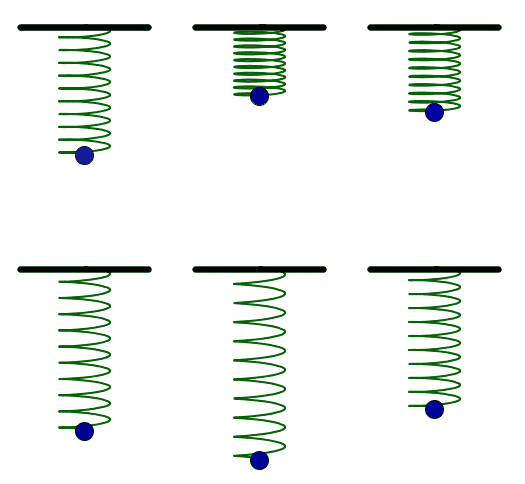
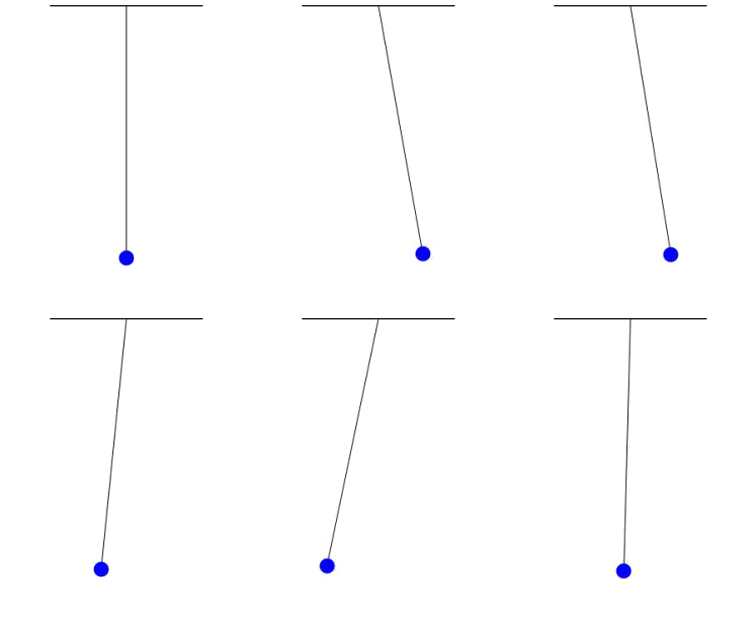
مثالان على الحركة الاهتزازية: نابض معلّق وبندول.
Two examples of oscillatory motion: a hanging spring and a pendulum.
📘 الحركة التوافقية البسيطة (SHM)
📘 Simple harmonic motion (SHM)
هي حركة اهتزازية لجسم في خط مستقيم حول موضع الاتزان، تتناسب فيها قوة الإرجاع طرديًا مع الإزاحة وتعاكسها في الاتجاه (تعيد الجسم دائمًا نحو موضع الاتزان).
It is the oscillation of a body along a straight line about its equilibrium position in which the restoring force is directly proportional to the displacement and opposite to it (it always pulls the body back toward equilibrium).
📏 خصائص الحركة التوافقية البسيطة
📏 Properties of simple harmonic motion
| الكميةQuantity | تعريفهاDefinition | الرمز والوحدةSymbol and unit |
|---|---|---|
| السعةAmplitude | أكبر إزاحة للجسم عن موضع الاتزانThe maximum displacement from the equilibrium position | \(A\ (m)\) |
| الزمن الدوريPeriod | الزمن اللازم لإتمام اهتزازة كاملةThe time for one complete oscillation | \(T\ (s)\) |
| الترددFrequency | عدد الاهتزازات الكاملة في الثانية الواحدةThe number of complete oscillations in one second | \(f\ (Hz=s^{-1})\) |
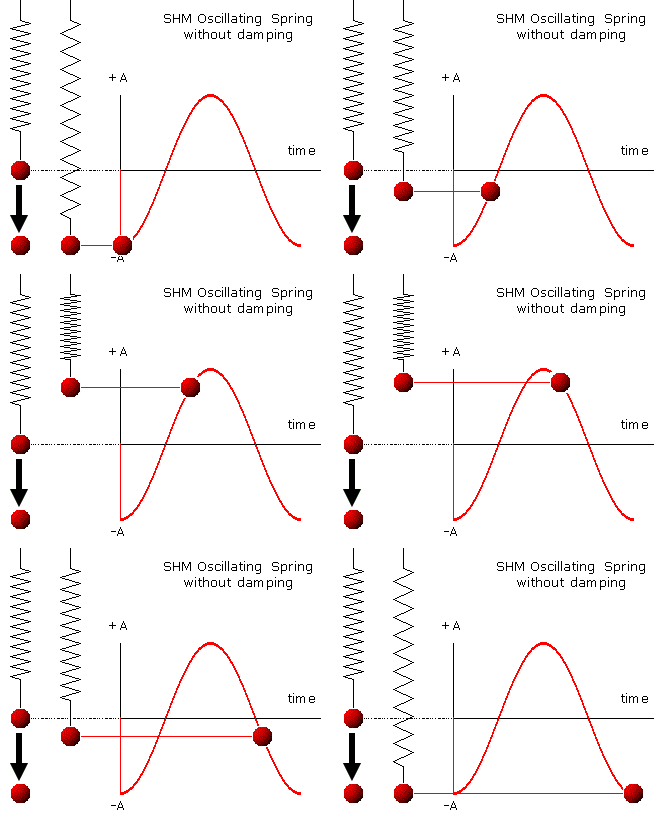
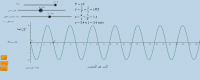
نابض يهتز بسعة \(A\): ينزل إلى \(-A\) ثم يعود، ومنحنى الإزاحة مع الزمن موجة جيبية.
A spring oscillating with amplitude \(A\): it goes down to \(-A\) and back, and the displacement–time curve is a sine wave.
📌 العلاقة بين التردد والزمن الدوري
📌 The relation between frequency and period
\[f=\dfrac{1}{T}\qquad\Longleftrightarrow\qquad T=\dfrac{1}{f}\]
اهتزاز الجسم \(N\) اهتزازة في زمن \(t\) يعطي: \(T=\dfrac{t}{N}\) و\(f=\dfrac{N}{t}\).
If the body makes \(N\) oscillations in a time \(t\): \(T=\dfrac{t}{N}\) and \(f=\dfrac{N}{t}\).
🧠 توضيح إضافي: كيف نقرأ \(A\) و\(T\) من الرسم؟
🧠 Extra explanation: how do we read \(A\) and \(T\) from the graph?
في منحنى الإزاحة مع الزمن: السعة هي أعلى ارتفاع للمنحنى عن محور الزمن (قمة الموجة)، والزمن الدوري هو المسافة الأفقية بين قمتين متتاليتين (أو بين أي نقطتين متتاليتين متماثلتين). عند أقصى إزاحة تكون سرعة الجسم لحظيًا صفرًا لأنه يغيّر اتجاه حركته، وعند مروره بموضع الاتزان تكون سرعته أكبر ما يمكن.
In the displacement–time graph the amplitude is the height of the curve above the time axis (the crest), and the period is the horizontal distance between two successive crests (or any two successive identical points). At maximum displacement the speed is instantly zero because the body reverses its direction, and when it passes the equilibrium position its speed is maximum.
أكمل جسم معلّق بنابض \(30\) اهتزازة كاملة في \(15\ s\). تردد حركته:
A body hanging on a spring makes \(30\) complete oscillations in \(15\ s\). The frequency of its motion is:
أي العبارات التالية صحيحة لجسم يهتز حركة توافقية بسيطة عند مروره بموضع الاتزان؟
Which statement is correct for a body in simple harmonic motion as it passes the equilibrium position?
🔩 قانون هوك
🔩 Hooke's Law
اكتشف العالم الإنجليزي روبرت هوك أن النابض (أو أي جسم مرن) إذا شُوّه تشوهًا صغيرًا فإن مقدار التشوه (الاستطالة أو الانضغاط) يتناسب طرديًا مع القوة المؤثرة، وأن الجسم يعود إلى شكله الأصلي عند زوال القوة.
The English scientist Robert Hooke found that a spring (or any elastic body) that is deformed slightly changes its length (stretches or compresses) by an amount that is directly proportional to the applied force, and that the body returns to its original shape when the force is removed.
📌 قانون هوك (قوة الإرجاع في النابض)
📌 Hooke's law (the restoring force of a spring)
\[F=-k\,x\]
\(x\): الإزاحة عن الوضع الطبيعي (m)، \(k\): ثابت النابض (N/m)، والإشارة السالبة تعني أن قوة الإرجاع عكس اتجاه الإزاحة. إذا أردنا مقدار القوة فقط: \(F=k\,x\) ومنه \(k=\dfrac{F}{x}\) وهو ميل الخط المستقيم في رسم القوة مقابل الإزاحة.
\(x\) is the displacement from the natural position (m) and \(k\) is the spring constant (N/m); the minus sign means the restoring force is opposite to the displacement. For the magnitude only: \(F=k\,x\), so \(k=\dfrac{F}{x}\), the slope of the straight line in the force–displacement graph.
🧠 توضيح إضافي: ماذا يعني ثابت النابض \(k\)؟
🧠 Extra explanation: what does the spring constant \(k\) mean?
\(k\) يقيس قساوة النابض: النابض ذو \(k=200\ N/m\) يحتاج \(200\ N\) ليستطيل \(1\ m\) (أو \(2\ N\) ليستطيل \(1\ cm\)). كلما كبر \(k\) صار النابض أقسى واستطال أقل بالقوة نفسها. ويصح القانون ما دام التشوه صغيرًا (ضمن حد المرونة)؛ وإذا تجاوزنا هذا الحد يتشوّه النابض بصورة دائمة ولا يعود لطوله الأصلي.
\(k\) measures the stiffness of the spring: a spring with \(k=200\ N/m\) needs \(200\ N\) to stretch \(1\ m\) (or \(2\ N\) to stretch \(1\ cm\)). The larger \(k\) is, the stiffer the spring and the less it stretches under the same force. The law holds only while the deformation is small (within the elastic limit); beyond it the spring is permanently deformed and does not return to its original length.
🧪 تجربة 1: قانون هوك: ماذا تفعل الكتلة بالنابض؟
🧪 Experiment 1: Hooke's law: what does the mass do to the spring?
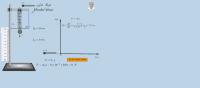
اختر نابضًا (A أو B أو C) وغيّر الكتلة المعلّقة به ثم اضغط «سجّل القراءة». القوة هي الوزن \(F=mg\) والاستطالة تُقرأ من المسطرة. بعد قراءتين على الأقل يظهر الخط المستقيم الذي يمر بنقطة الأصل، وميله هو ثابت النابض \(k\). جرّب النوابض الثلاثة: أيّها الأقسى؟ (استطالته أقل لنفس القوة).
Choose a spring (A, B or C), change the mass hanging from it and press “Record”. The force is the weight \(F=mg\) and the extension is read from the ruler. After at least two readings the straight line through the origin appears; its slope is the spring constant \(k\). Try the three springs: which is the stiffest? (it stretches least for the same force).
ما ثابت زنبرك يستطيل بمقدار \(12\ cm\) عندما يعلّق به جسم وزنه \(24\ N\)؟
What is the spring constant of a spring that stretches by \(12\ cm\) when a body of weight \(24\ N\) hangs from it?
زنبرك ثابته \(k=250\ N/m\) أثّرت عليه قوة شد \(75\ N\). الاستطالة بالسنتيمتر:
A spring of constant \(k=250\ N/m\) is pulled by a force of \(75\ N\). The extension in centimetres is:
⚡ الطاقة في الحركة التوافقية البسيطة
⚡ Energy in Simple Harmonic Motion
عندما نشدّ النابض أو نضغطه نبذل شغلًا يُخزَّن فيه على شكل طاقة وضع مرنة. وعندما يهتز الجسم المعلّق به تتحول هذه الطاقة إلى طاقة حركة ثم تعود إلى طاقة وضع، وهكذا.
When we stretch or compress a spring we do work that is stored in it as elastic potential energy. When the body attached to it oscillates, this energy converts to kinetic energy and back to potential energy, again and again.
📌 معادلات الطاقة (بإهمال الاحتكاك)
📌 The energy equations (no friction)
\[PE=\dfrac12\,k\,x^{2}\]
\[ME=KE+PE=\dfrac12\,k\,A^{2}\]
\[KE=\dfrac12\,k\,(A^{2}-x^{2})\]
الطاقة الكلية \(ME\) ثابتة وتتناسب مع مربع السعة \(A^{2}\) ومع \(k\).
The total energy \(ME\) is constant and proportional to the square of the amplitude \(A^{2}\) and to \(k\).
| الموضعPosition | السرعةSpeed | \(KE\)\(KE\) | \(PE\)\(PE\) |
|---|---|---|---|
| \(x=\pm A\) أقصى إزاحة\(x=\pm A\) maximum displacement | صفرzero | 0 | \(ME\) |
| \(x=0\) موضع الاتزان\(x=0\) equilibrium | أكبر ما يمكنmaximum | \(ME\) | 0 |
| بين الموضعينin between | متوسطةintermediate | \(KE=ME-PE\) | \(PE=ME-KE\) |
🧠 توضيح إضافي: السرعة العظمى والزمن الدوري للنابض
🧠 Extra explanation: the maximum speed and the period of a spring
عند موضع الاتزان \(PE=0\) فتكون \(\tfrac12mv_{max}^{2}=\tfrac12kA^{2}\) ومنه \(v_{max}=A\sqrt{k/m}\). ويُثبَت أن الزمن الدوري لكتلة \(m\) على نابض ثابته \(k\) هو:
At equilibrium \(PE=0\), so \(\tfrac12mv_{max}^{2}=\tfrac12kA^{2}\) and therefore \(v_{max}=A\sqrt{k/m}\). It can be shown that the period of a mass \(m\) on a spring of constant \(k\) is:
\[T=2\pi\sqrt{\dfrac{m}{k}}\]
لاحظ أن \(T\) لا يعتمد على السعة: يزداد بزيادة الكتلة ويقل بزيادة قساوة النابض. مثال: \(m=0.5\ kg\) و\(k=50\ N/m\) يعطي \(T=2\pi\sqrt{0.5/50}=0.63\ s\).
Notice that \(T\) does not depend on the amplitude: it grows with the mass and shrinks as the spring gets stiffer. Example: \(m=0.5\ kg\) and \(k=50\ N/m\) give \(T=2\pi\sqrt{0.5/50}=0.63\ s\).
🧪 تجربة 2: الطاقة في الحركة التوافقية البسيطة
🧪 Experiment 2: Energy in simple harmonic motion
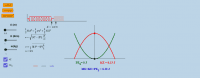
كتلة على نابض أفقي أملس. غيّر السعة \(A\) وثابت النابض \(k\) والكتلة \(m\) ثم اضغط «شغّل». الرسم السفلي يعرض الطاقات بدلالة الإزاحة: طاقة الوضع (البرتقالي) قطع مكافئ، والحركية (الأخضر) قطع مكافئ مقلوب، ومجموعهما (البنفسجي) مستقيم أفقي ثابت. استخدم أزرار «أقصى إزاحة» و«موضع الاتزان» لتتوقف عند نقاط معينة.
A mass on a smooth horizontal spring. Change the amplitude \(A\), the spring constant \(k\) and the mass \(m\), then press “Run”. The lower graph shows the energies against displacement: potential energy (orange) is a parabola, kinetic (green) an inverted parabola, and their sum (purple) a constant horizontal line. Use the “maximum displacement” and “equilibrium” buttons to stop at particular points.
ينضغط زنبرك ثابته \(k=144\ N/m\) بمقدار \(16.5\ cm\). طاقة الوضع المرنة المخزنة فيه:
A spring of constant \(k=144\ N/m\) is compressed by \(16.5\ cm\). The elastic potential energy stored in it is:
زنبرك ثابته \(180\ N/m\) خُزّنت فيه طاقة وضع مرنة \(3.6\ J\). مقدار انضغاطه:
A spring of constant \(180\ N/m\) stores \(3.6\ J\) of elastic potential energy. Its compression is:
إذا ضوعفت سعة جسم يهتز حركة توافقية بسيطة فإن طاقته الحركية عند موضع الاتزان:
If the amplitude of a body in simple harmonic motion is doubled, its kinetic energy at the equilibrium position:
🕰️ البندول البسيط
🕰️ The Simple Pendulum
البندول البسيط ثقل صغير (كتلة نقطية) معلّق بخيط مهمل الكتلة وغير قابل للتمدد، طرفه الآخر مثبت. عند إزاحته زاوية \(\theta\) عن الوضع الرأسي وتركه يتأرجح حول وضع الاتزان.
A simple pendulum is a small bob (a point mass) hanging from a massless, inextensible string whose other end is fixed. It is displaced by an angle \(\theta\) from the vertical and released, and swings about the equilibrium position.
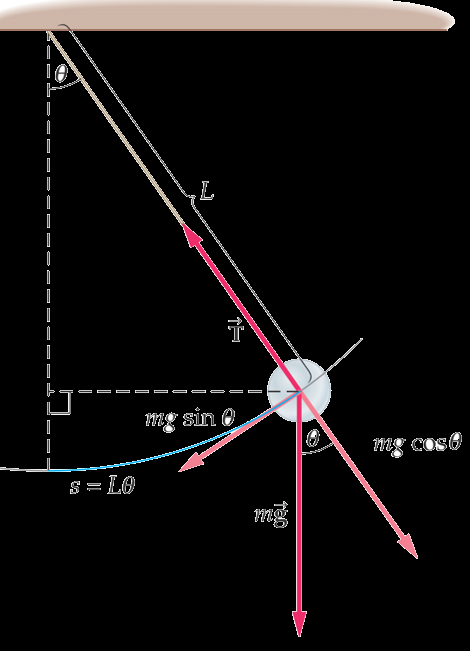
القوة المرجِعة هي المركبة \(mg\sin\theta\) المماسية للقوس، أما المركبة \(mg\cos\theta\) فتوازن الشد في الخيط.
The restoring force is the component \(mg\sin\theta\) tangent to the arc, while the component \(mg\cos\theta\) balances the tension in the string.
📌 قوة الإرجاع والزمن الدوري
📌 The restoring force and the period
\[F=-mg\sin\theta\]
عندما تكون الزاوية أقل من \(15^{\circ}\) يكون \(\sin\theta\approx\theta\) (بالراديان) فتتناسب القوة مع الإزاحة ويصبح الاهتزاز توافقيًا بسيطًا، والزمن الدوري:
When the angle is less than \(15^{\circ}\), \(\sin\theta\approx\theta\) (in radians), so the force is proportional to the displacement and the oscillation is simple harmonic, with period:
\[T=2\pi\sqrt{\dfrac{L}{g}}\]
🧠 توضيح إضافي: ما الذي يؤثر في الزمن الدوري للبندول؟
🧠 Extra explanation: what affects the period of a pendulum?
- الطول \(L\): \(T\propto\sqrt{L}\)؛ مضاعفة الطول أربع مرات تضاعف الزمن الدوري مرتين.Length \(L\): \(T\propto\sqrt{L}\); making the length four times as large doubles the period.
- تسارع الجاذبية \(g\): \(T\propto1/\sqrt g\)؛ البندول نفسه أبطأ على القمر (\(g\) أصغر).Gravitational acceleration \(g\): \(T\propto1/\sqrt g\); the same pendulum is slower on the Moon (smaller \(g\)).
- لا يعتمد على كتلة الثقل ولا (للزوايا الصغيرة) على السعة.It does not depend on the mass of the bob or (for small angles) on the amplitude.
ولهذا يُستخدم البندول في قياس \(g\): نقيس \(T\) و\(L\) ثم \(g=\dfrac{4\pi^{2}L}{T^{2}}\)؛ وهو ما تفعله التجربة التالية بميل الخط المستقيم لـ \(T^{2}\) مقابل \(L\).
This is why a pendulum is used to measure \(g\): we measure \(T\) and \(L\) and then \(g=\dfrac{4\pi^{2}L}{T^{2}}\); the next experiment does exactly that with the slope of the straight line of \(T^{2}\) against \(L\).
🧪 تجربة 3: البندول البسيط: الزمن الدوري والطول
🧪 Experiment 3: The simple pendulum: the period and the length
غيّر طول الخيط وزاوية الإزاحة الابتدائية ثم اضغط «شغّل». يقيس البرنامج الزمن الدوري \(T\) من لحظتي مرور متتاليتين بالوضع الرأسي. اضغط «سجّل (L, T)» لأربعة أطوال مختلفة على الأقل (بزاوية \(15^{\circ}\) أو أقل) فيظهر الخط المستقيم لـ \(T^{2}\) مقابل \(L\) ويحسب البرنامج \(g\) من ميله. لاحظ أن الكتلة لا تظهر في أي مكان! وجرّب زاوية \(60^{\circ}\) لترى أن الزمن يزداد قليلًا.
Change the string length and the initial angle, then press “Run”. The program measures the period \(T\) from two successive passes through the vertical. Press “Record (L, T)” for at least four different lengths (at \(15^{\circ}\) or less) and the straight line of \(T^{2}\) against \(L\) appears; the program computes \(g\) from its slope. Notice that the mass does not appear anywhere! Try \(60^{\circ}\) to see the period grow slightly.
بندول بسيط طوله \(1\ m\) في مكان \(g=9.81\ m/s^{2}\). زمنه الدوري تقريبًا:
A simple pendulum of length \(1\ m\) is in a place where \(g=9.81\ m/s^{2}\). Its period is about:
الزمن الدوري للبندول البسيط يعتمد على:
The period of a simple pendulum depends on:
🌊 الأمواج الميكانيكية
🌊 Mechanical Waves
الموجة اضطراب ينقل الطاقة خلال المادة أو الفضاء دون أن تنتقل جزيئات المادة نفسها مع الموجة. والوسط هو المادة التي تنتقل خلالها الموجة. والموجة الميكانيكية تحتاج إلى وسط مادي لتنتقل مثل الموجات الصوتية وموجات الماء وموجات الحبل؛ فلا تنتقل الموجات الصوتية عبر الفراغ، بخلاف الموجات الكهرومغناطيسية (كالضوء) التي لا تحتاج إلى وسط.
A wave is a disturbance that carries energy through matter or space without the particles of the matter travelling with the wave. The medium is the material through which the wave travels. A mechanical wave needs a material medium to travel, like sound waves, water waves and rope waves; sound cannot travel through a vacuum, unlike electromagnetic waves (such as light), which need no medium.
🧠 توضيح إضافي: لماذا لا تنتقل المادة مع الموجة؟
🧠 Extra explanation: why does matter not travel with the wave?
عندما تمر موجة ميكانيكية في وسط فإن كل جسيم منه يهتز حركة توافقية بسيطة حول موضع اتزانه ثم يُحرّك الجسيم المجاور له. مثال: عندما تنتقل موجة على سطح بحيرة فإن ورقة شجر عائمة ترتفع وتنخفض في مكانها تقريبًا ولا تُحمل مع الموجة؛ الذي يتحرك للأمام هو الاضطراب (الطاقة) وليس الماء.
When a mechanical wave passes through a medium each of its particles performs simple harmonic motion about its equilibrium position and then sets the neighbouring particle in motion. For example, when a wave crosses a lake a floating leaf rises and falls in roughly the same place and is not carried along; what moves forward is the disturbance (the energy), not the water.
↕️ الموجة العرضية
↕️ The transverse wave
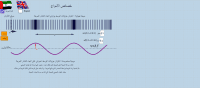
الموجة العرضية تهتز فيها جسيمات الوسط عموديًا على اتجاه انتشار الموجة. في الشكل: تهتز الكرات للأعلى وللأسفل بينما تنتقل الموجة أفقيًا من اليسار إلى اليمين. أعلى نقطة تسمى قمة وأخفض نقطة قاع. أمثلة: موجات الحبل، والضوء.
In a transverse wave the particles of the medium vibrate perpendicular to the direction in which the wave travels. In the figure the balls move up and down while the wave travels horizontally from left to right. The highest point is a crest and the lowest a trough. Examples: waves on a rope, and light.
موجة عرضية: الجسيمات تهتز رأسيًا والموجة تنتقل أفقيًا.
A transverse wave: the particles move vertically and the wave travels horizontally.
↔️ الموجة الطولية
↔️ The longitudinal wave
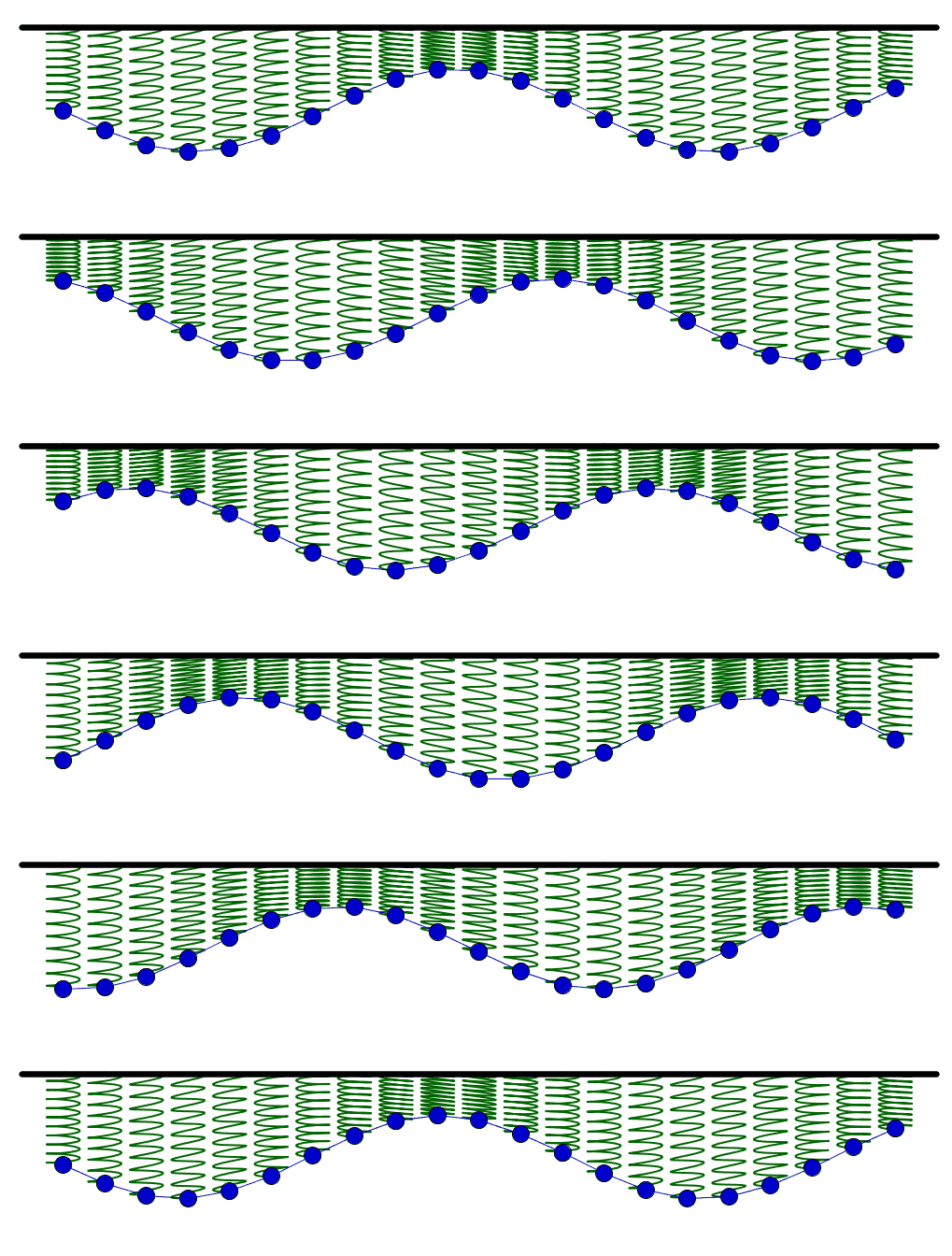
الموجة الطولية تهتز فيها جسيمات الوسط بالتوازي مع اتجاه انتشار الموجة ذهابًا وإيابًا. تتكوّن فيها مناطق تقارب الجسيمات تسمى تضاغطات ومناطق تباعد تسمى تخلخلات. مثال: الصوت في الهواء، والموجة المنتقلة على نابض مضغوط.
In a longitudinal wave the particles vibrate parallel to the direction of travel, back and forth. Regions where particles are close together are compressions and regions where they are far apart are rarefactions. Examples: sound in air, and a wave travelling along a compressed spring.

موجة طولية: تتناوب مناطق التضاغط والتخلخل وتهتز الجسيمات أفقيًا.
A longitudinal wave: compressions and rarefactions alternate and the particles move horizontally.
🧠 توضيح إضافي: الموجات السطحية (موجات الماء)
🧠 Extra explanation: surface waves (water waves)
عند سطح الماء تكون الموجة مزيجًا من الموجتين: تتحرك جزيئات الماء في مسارات دائرية تقريبًا، فتهتز أحيانًا موازية لاتجاه انتشار الموجة وأحيانًا عمودية عليه. ولذلك لا تُصنَّف موجات سطح الماء عرضية صرفة ولا طولية صرفة. وتقل سعة هذه الحركة الدائرية مع العمق حتى تنعدم تقريبًا في الأعماق. جرّب التجربة التالية، ويمكنك أيضًا استخدام محاكاة GeoGebra في نهاية الصفحة.
At the surface of water the wave is a mixture of both kinds: the water particles move in roughly circular paths, so they sometimes move parallel to the direction of travel and sometimes perpendicular to it. That is why water surface waves are neither purely transverse nor purely longitudinal. The size of this circular motion decreases with depth until it almost vanishes. Try the next experiment, and you can also use the GeoGebra simulation at the end of the page.
🧪 تجربة 4: موجة الماء السطحية: مدارات دائرية
🧪 Experiment 4: The water surface wave: circular orbits
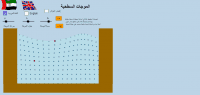
شاهد كيف تتحرك جزيئات الماء عند مرور موجة على السطح: كل جزيء يدور في دائرة تقريبًا (الدوائر الحمراء تعرض ثلاثة أعماق مختلفة لجزيء واحد)، فيهتز أحيانًا موازيًا لاتجاه انتشار الموجة وأحيانًا عموديًا عليه، ولا ينتقل مع الموجة. غيّر الطول الموجي والسعة ولاحظ أن المدارات تصغر بسرعة مع العمق.
Watch how the water particles move as a wave passes along the surface: each one travels in roughly a circle (the red circles show three different depths for the same column), so it moves sometimes parallel to the direction of travel and sometimes perpendicular to it, and is not carried along with the wave. Change the wavelength and the amplitude and notice that the orbits shrink quickly with depth.
🧪 تجربة 5: الموجة المنتقلة: عرضية وطولية
🧪 Experiment 5: The travelling wave: transverse and longitudinal
بدّل بين الموجة العرضية والطولية، وغيّر التردد والطول الموجي والسعة. تابع الجسيم الأحمر: في العرضية يهتز عموديًا على اتجاه الانتشار، وفي الطولية يهتز على امتداده، وفي الحالتين لا ينتقل مع الموجة بل تنتقل الطاقة فقط. سرعة الموجة تُحسب من \(v=\lambda f\).
Switch between the transverse and the longitudinal wave, and change the frequency, the wavelength and the amplitude. Follow the red particle: in the transverse wave it moves perpendicular to the direction of travel, in the longitudinal wave along it, and in both cases it does not travel with the wave; only the energy does. The wave speed is found from \(v=\lambda f\).
أي الموجات التالية موجة طولية؟
Which of the following waves is a longitudinal wave?
📏 خصائص الموجة والمصطلحات
📏 Wave Properties and Terms
تُعرَّف خصائص الموجة بالطريقة نفسها التي تُعرَّف بها خصائص اهتزاز جسيمات الوسط:
The properties of a wave are defined the same way as those of the vibration of the particles of the medium:
| الكميةQuantity | المعنىMeaning | الرمز والوحدةSymbol and unit |
|---|---|---|
| الزمن الدوريPeriod | الزمن اللازم لاهتزازة كاملةThe time for one complete vibration | \(T\ (s)\) |
| الترددFrequency | عدد الاهتزازات في الثانيةThe number of vibrations per second | \(f\ (Hz)\) |
| السعةAmplitude | أقصى إزاحة عن موضع الاتزانThe maximum displacement from equilibrium | \(A\ (m)\) |
| الطول الموجيWavelength | المسافة بين قمتين متتاليتين (أو أي نقطتين متتاليتين متفقتين في الطور)The distance between two successive crests (or any two successive points in phase) | \(\lambda\ (m)\) |
📌 العلاقة الأساسية للموجة
📌 The fundamental wave relation
\[v=\lambda\,f\qquad\Longleftrightarrow\qquad \lambda=\dfrac{v}{f}\]
في زمن دوري واحد \(T\) تتقدم الموجة مسافة قدرها طول موجة واحد، فتكون \(v=\dfrac{\lambda}{T}=\lambda f\).
In one period \(T\) the wave advances one wavelength, so \(v=\dfrac{\lambda}{T}=\lambda f\).
🧠 توضيح إضافي: من يحدد السرعة ومن يحدد التردد؟
🧠 Extra explanation: what fixes the speed and what fixes the frequency?
- سرعة الموجة يحددها الوسط الذي تنتقل فيه (وليس تردد الموجة ولا طولها الموجي).The speed of the wave is fixed by the medium it travels in (not by its frequency or wavelength).
- تردد الموجة يحدده المصدر الذي يولّدها ولا يتغير عند انتقال الموجة من وسط إلى آخر.The frequency of the wave is fixed by the source that produces it and does not change when the wave passes from one medium to another.
- الطول الموجي يعتمد على الاثنين: \(\lambda=v/f\). فإذا دخلت الموجة وسطًا تقل فيه سرعتها يقل طولها الموجي بالنسبة نفسها وبقي ترددها ثابتًا.The wavelength depends on both: \(\lambda=v/f\). If the wave enters a medium where it is slower, its wavelength shrinks in the same proportion while its frequency stays the same.
مصدر يولّد موجة تردد \(5\ Hz\) وطولها الموجي \(0.4\ m\). سرعة الموجة:
A source produces a wave of frequency \(5\ Hz\) and wavelength \(0.4\ m\). The speed of the wave is:
عندما تنتقل موجة من وسط إلى آخر تقل فيه سرعتها، أي الكميات التالية تبقى ثابتة؟
When a wave passes into a medium in which it is slower, which of the following stays constant?
🚧 الموجات عند الحدود
🚧 Waves at Boundaries
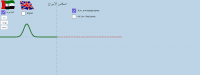
عندما تصل الموجة إلى حدّ (نقطة يتغير عندها الوسط) يحدث ثلاثة أشياء: ينتقل جزء من الموجة إلى الوسط الجديد (انتقال)، وينعكس جزء آخر إلى الوسط الأول (انعكاس)، ويُمتص جزء من الطاقة. وسرعة النبضة المنعكسة تساوي سرعة النبضة الساقطة لأنها ما زالت في الوسط نفسه.
When a wave reaches a boundary (a point where the medium changes) three things happen: part of the wave passes into the new medium (transmission), another part is sent back into the first medium (reflection), and some of the energy is absorbed. The reflected pulse has the same speed as the incident one because it is still in the same medium.
📘 قاعدة الانعكاس على الحبل
📘 The rule of reflection on a rope
- عند طرف ثابت أو عند الانتقال إلى وسط أثقل (أكبر كثافة) تنعكس النبضة مقلوبة (انقلاب في الطور).At a fixed end, or when passing into a heavier (denser) medium, the pulse is reflected inverted (a phase reversal).
- عند طرف حر أو عند الانتقال إلى وسط أخف (أقل كثافة) تنعكس النبضة معتدلة بالاتجاه نفسه.At a free end, or when passing into a lighter (less dense) medium, the pulse is reflected upright in the same direction.
في الحالتين تكون سعة النبضة المنعكسة أصغر من الساقطة لأن جزءًا من الطاقة انتقل أو امتُص.
In both cases the reflected pulse has a smaller amplitude than the incident one because some of the energy was transmitted or absorbed.
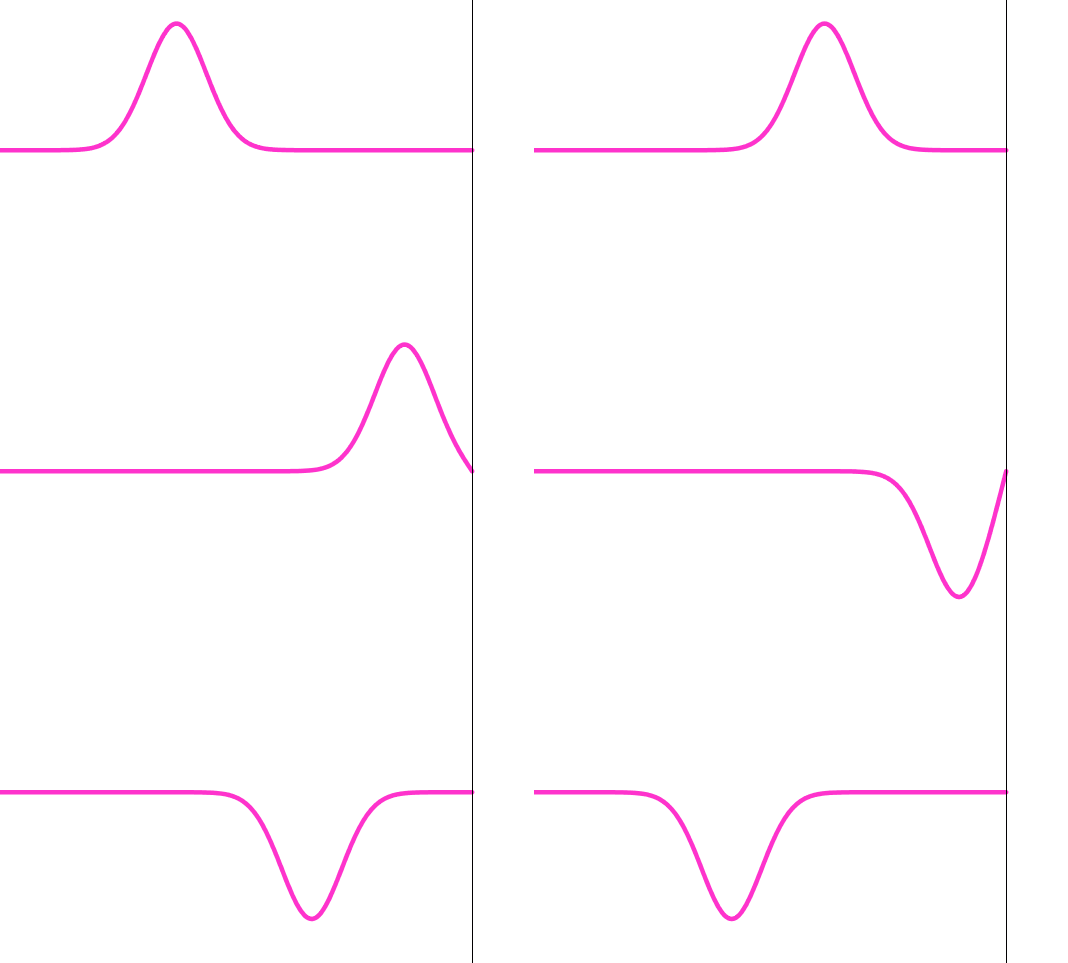
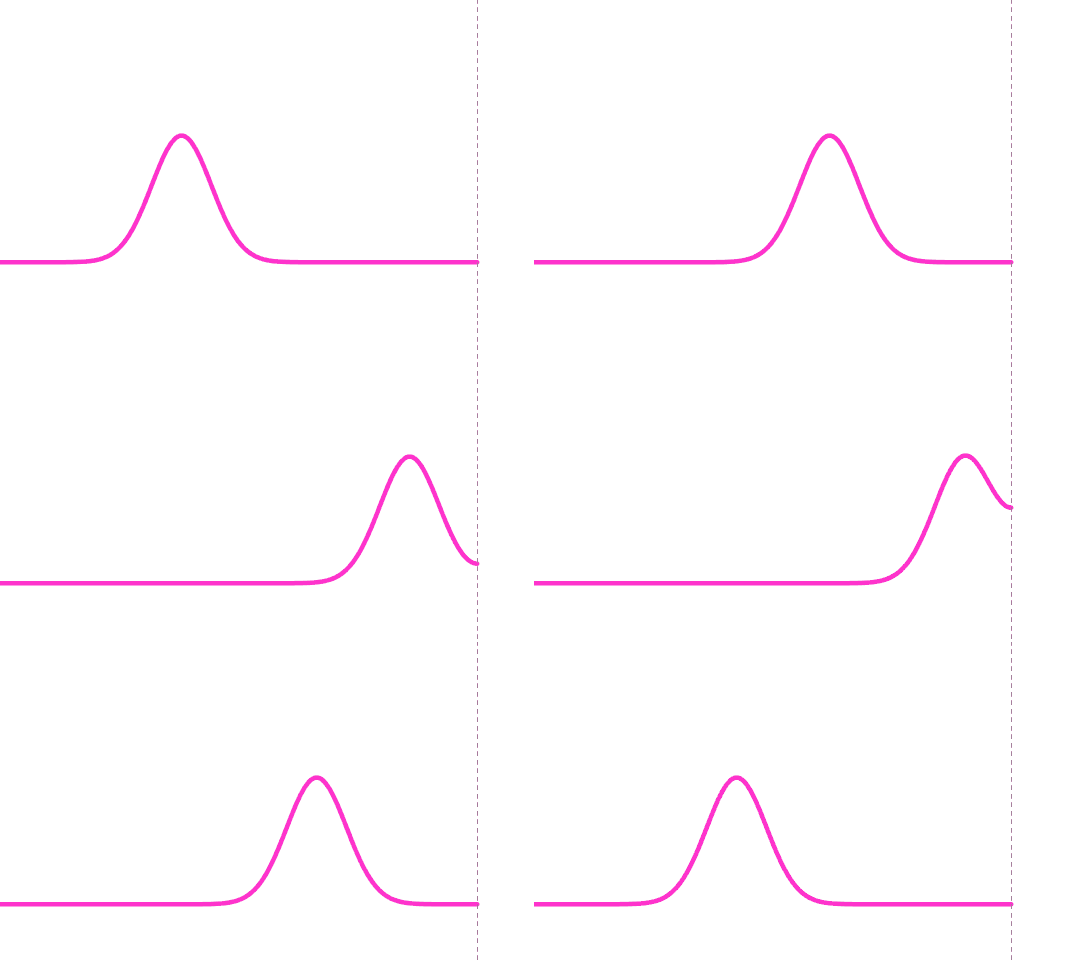
يسار: انعكاس عن طرف ثابت (نبضة مقلوبة). يمين: انعكاس عن طرف حر (نبضة معتدلة).
Left: reflection from a fixed end (inverted pulse). Right: reflection from a free end (upright pulse).
نبضة على حبل تنعكس عن طرفه المثبّت في الجدار. النبضة المنعكسة:
A pulse on a rope reflects from its end fixed to a wall. The reflected pulse is:
🤝 التراكب والتداخل
🤝 Superposition and Interference
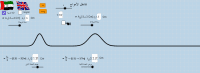
عندما تتداخل موجتان أو أكثر في الوسط نفسه في الوقت نفسه نسمي ذلك تداخل الموجات. تمر النبضتان إحداهما عبر الأخرى وتتابع كل منهما طريقها وكأن شيئًا لم يحدث، وهذا مبدأ الاستقلالية، ويظهر التأثير فقط أثناء التقائهما.
When two or more waves overlap in the same medium at the same time we call it wave interference. The two pulses pass through each other and each continues as if nothing had happened, which is the principle of independence; the effect appears only while they overlap.
📘 مبدأ التراكب
📘 The superposition principle
إزاحة الوسط عند أي نقطة أثناء التقاء عدة موجات تساوي المجموع الجبري لإزاحات الموجات الفردية عند تلك النقطة: \(y=y_1+y_2+\dots\)
The displacement of the medium at any point while several waves overlap equals the algebraic sum of the displacements of the individual waves at that point: \(y=y_1+y_2+\dots\)
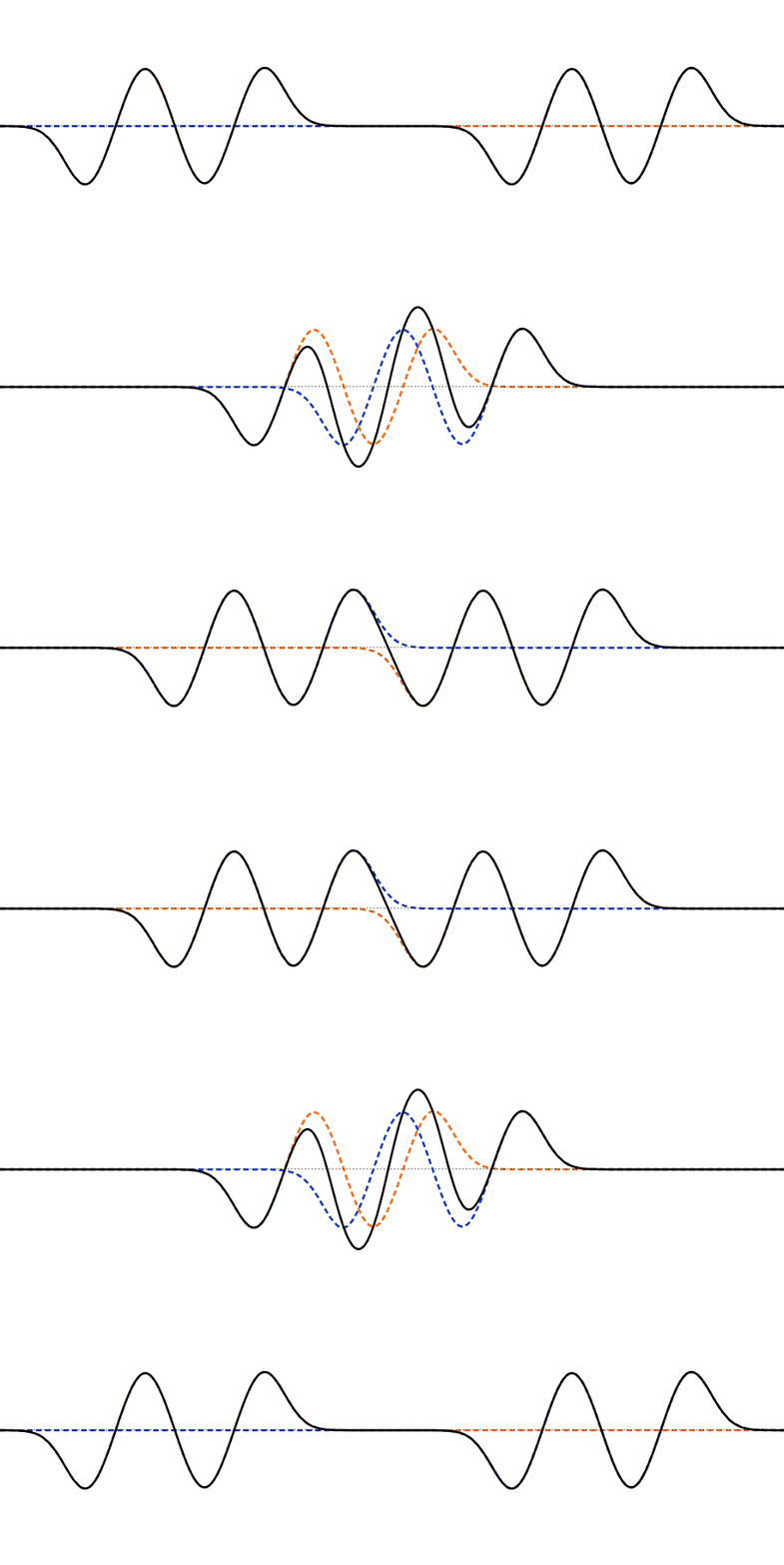
الخطوط المنقطة الملونة تمثل النبضتين الأصليتين، والخط الأسود هو الشكل الفعلي (مجموعهما) الذي نراه.
The coloured dotted lines are the original pulses and the black line is the actual shape (their sum) that we see.
| الحالةCase | فرق الطورPhase difference | السعة الناتجةResultant amplitude |
|---|---|---|
| تداخل بنّاء (قمة مع قمة)Constructive (crest meets crest) | \(0^{\circ}\) (في الطور)\(0^{\circ}\) (in phase) | \(A_1+A_2\)\(A_1+A_2\) |
| تداخل هدّام (قمة مع قاع)Destructive (crest meets trough) | \(180^{\circ}\) (عكس الطور)\(180^{\circ}\) (opposite phase) | \(|A_1-A_2|\) وتنعدم إذا تساوتا\(|A_1-A_2|\), zero if they are equal |
🧠 توضيح إضافي: ماذا يحدث للطاقة في التداخل الهدّام؟
🧠 Extra explanation: what happens to the energy in destructive interference?
عندما تلغي موجتان بعضهما لحظيًا لا تختفي طاقتهما: في تلك اللحظة تكون الطاقة كلها طاقة حركة للجسيمات (الوسط مستقيم لكنه في حالة حركة)، ثم تعود الموجتان فتظهران من جديد بعد أن تتجاوز كل منهما الأخرى.
When two waves momentarily cancel, their energy does not vanish: at that instant it is all kinetic energy of the particles (the medium is straight but still moving), and the two waves emerge again after passing through each other.
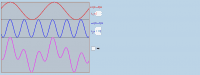
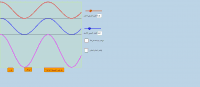
🧪 تجربة 6: تراكب موجتين: التداخل البنّاء والهدّام
🧪 Experiment 6: Superposition of two waves: constructive and destructive interference
موجتان متماثلتان في التردد والطول الموجي، الأولى (الحمراء) والثانية (الزرقاء). غيّر فرق الطور بينهما وسعة الثانية، وشاهد الموجة الناتجة (البنفسجية) وهي المجموع الجبري لإزاحتي الموجتين في كل نقطة (مبدأ التراكب). جرّب الأزرار: في الطور (0°) وعكس الطور (180°) وربع دورة (90°).
Two waves of the same frequency and wavelength, the first (red) and the second (blue). Change the phase difference and the amplitude of the second, and watch the resultant wave (purple), the algebraic sum of the two displacements at every point (the superposition principle). Try the buttons: in phase (0°), opposite phase (180°) and a quarter cycle (90°).
تداخلت موجتان متفقتان في الطور سعة الأولى \(3\ cm\) وسعة الثانية \(2\ cm\). سعة الموجة الناتجة:
Two waves in phase, of amplitudes \(3\ cm\) and \(2\ cm\), interfere. The amplitude of the resultant wave is:
🎸 الموجات الواقفة
🎸 Standing Waves
عندما تتحرك موجتان متماثلتان في الطول الموجي في اتجاهين متعاكسين في الوسط نفسه (مثل موجة وانعكاسها على وتر) فإن تراكبهما ينتج موجة واقفة، وتسمى كذلك لأنها لا تتحرك في اتجاه أي من الموجتين. بعض نقاطها لا تتحرك أبدًا وتسمى العقد، والنقاط التي تهتز بأكبر سعة تسمى البطون. والمسافة بين عقدتين متتاليتين (أو بطنين) تساوي نصف طول موجي.
When two waves of the same wavelength move in opposite directions in the same medium (such as a wave and its reflection on a string) their superposition produces a standing wave, so called because it does not move in the direction of either wave. Some of its points never move and are called nodes; the points that vibrate with the largest amplitude are antinodes. The distance between two successive nodes (or antinodes) is half a wavelength.
في وتر مثبّت من طرفيه توجد دائمًا عقدة عند كل طرف، ولا تتكوّن موجة واقفة إلا لأطوال موجية معينة. يسمى كل نمط اهتزاز توافقيًا:
On a string fixed at both ends there is always a node at each end, and standing waves form only for certain wavelengths. Each vibration pattern is called a harmonic:
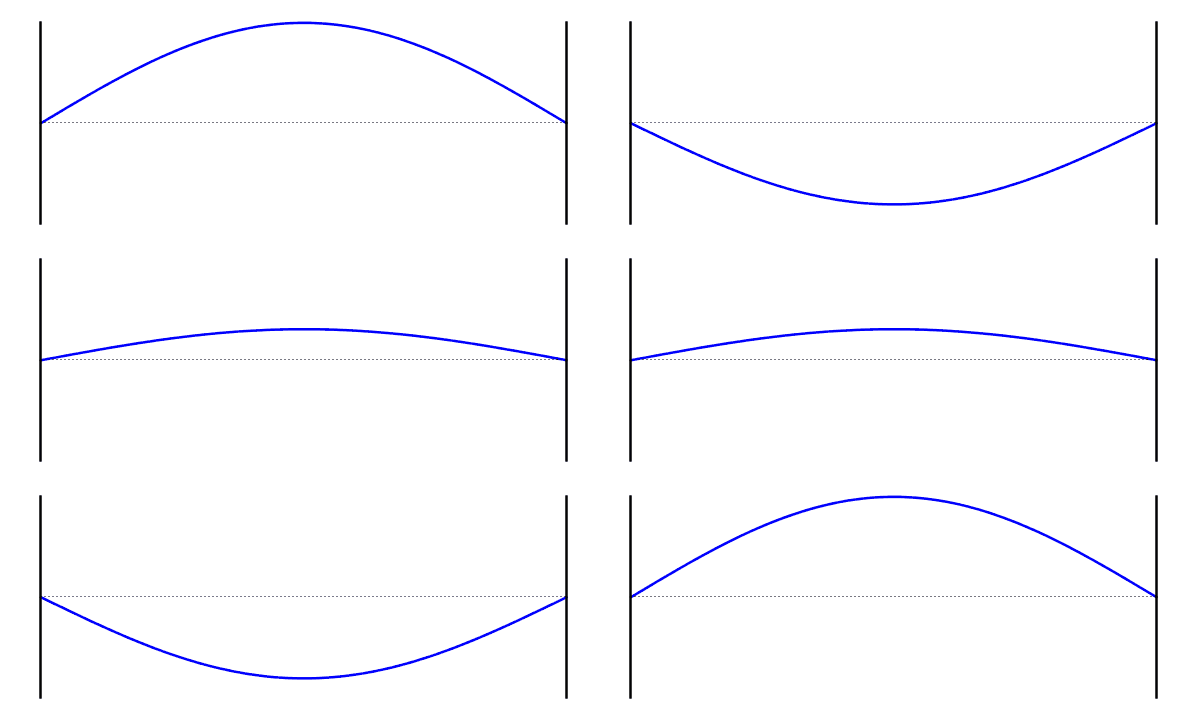
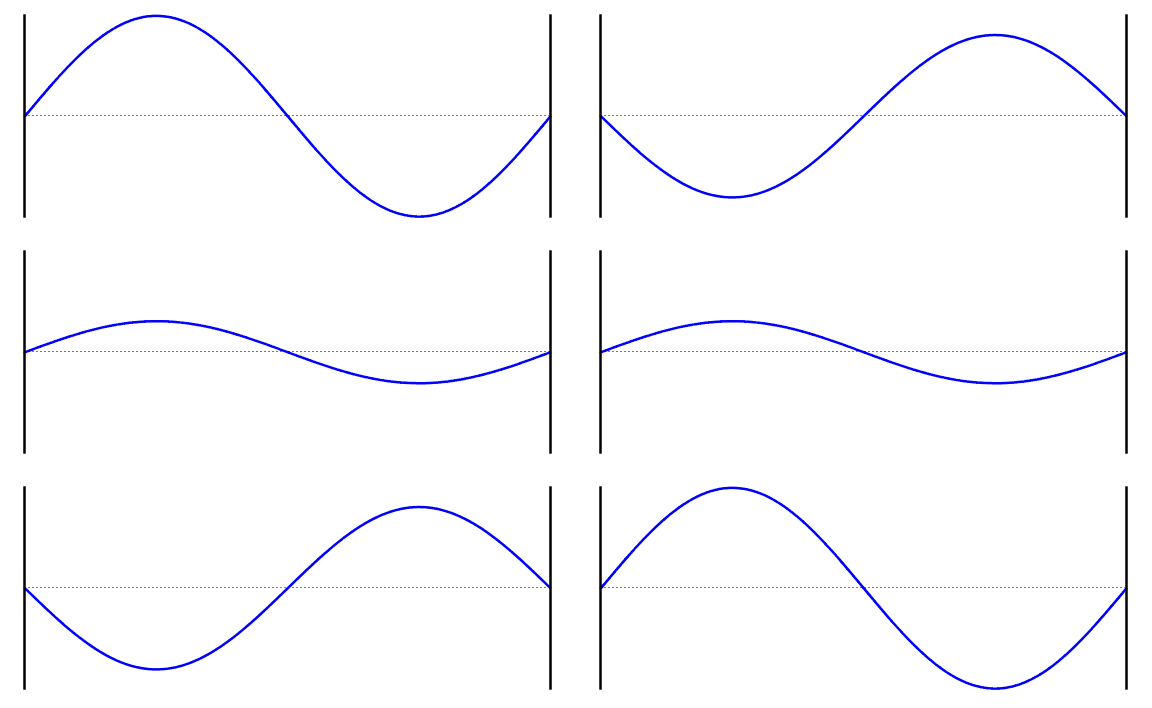
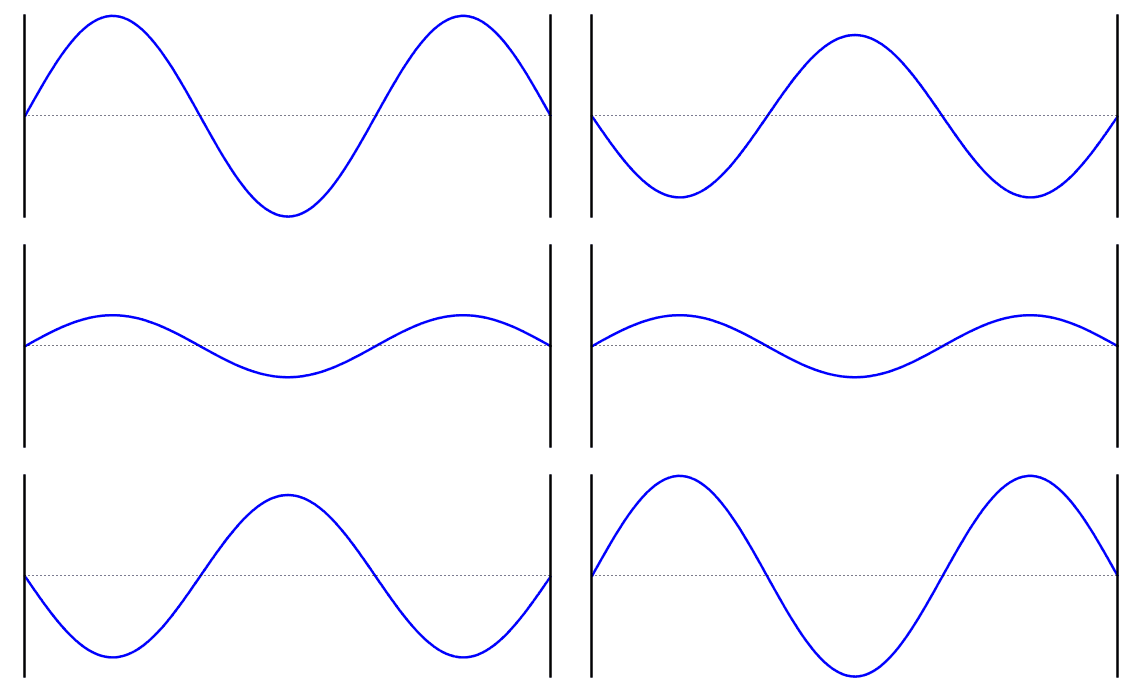
التوافقيات الأول والثاني والثالث على وتر مثبّت من طرفيه.
The first, second and third harmonics on a string fixed at both ends.
| التوافقيHarmonic | عدد القطعSegments | الطولLength | الطول الموجيWavelength | الترددFrequency |
|---|---|---|---|---|
| الأول (الأساسي)First (fundamental) | 1 | \(L=\dfrac{\lambda}{2}\) | \(\lambda=2L\) | \(f_0\) |
| الثانيSecond | 2 | \(L=\lambda\) | \(\lambda=L\) | \(2f_0\) |
| الثالثThird | 3 | \(L=\dfrac{3\lambda}{2}\) | \(\lambda=\dfrac{2L}{3}\) | \(3f_0\) |
📌 الصيغة العامة للتوافقي رقم \(n\)
📌 The general formula for the \(n\)th harmonic
\[L=n\,\dfrac{\lambda_n}{2}\ ,\qquad \lambda_n=\dfrac{2L}{n}\ ,\qquad f_n=\dfrac{v}{\lambda_n}=n\,\dfrac{v}{2L}=n\,f_0\]
\(n=1,2,3,\dots\): عدد البطون \(n\) وعدد العقد \(n+1\) (بما فيها الطرفان). والتردد الأساسي \(f_0=\dfrac{v}{2L}\).
\(n=1,2,3,\dots\): the number of antinodes is \(n\) and of nodes \(n+1\) (including the two ends). The fundamental frequency is \(f_0=\dfrac{v}{2L}\).
🧪 تجربة 7: الموجة الواقفة على وتر
🧪 Experiment 7: A standing wave on a string
وتر مثبّت من طرفيه. اختر رتبة التوافقي \(n\) وغيّر طول الوتر وسرعة الموجة فيه. لاحظ أن العقد (الدوائر الحمراء) ثابتة، وعددها \(n+1\) (طرفان وما بينهما)، وعدد البطون \(n\)، وأن التردد يساوي \(n\) مرة التردد الأساسي.
A string fixed at both ends. Choose the harmonic number \(n\) and change the length of the string and the wave speed in it. Notice that the nodes (red circles) stay fixed, there are \(n+1\) of them (the two ends and those between), the number of antinodes is \(n\), and the frequency is \(n\) times the fundamental frequency.
وتر طوله \(0.6\ m\) مثبّت من طرفيه وسرعة الموجة فيه \(240\ m/s\). التردد الأساسي:
A string of length \(0.6\ m\) is fixed at both ends and the wave speed in it is \(240\ m/s\). The fundamental frequency is:
في الموجة الواقفة النقاط التي لا تتحرك تسمى:
In a standing wave the points that do not move are called:
💧 الموجات في بعدين
💧 Waves in Two Dimensions
عند سقوط حصاة في بركة يُدفع الماء للأسفل ثم يرتد للأعلى فتنتشر حلقات متحدة المركز نحو الخارج. مقدمة الموجة هي الخط الذي يصل بين النقاط التي بلغها الاضطراب بالطور نفسه (الحلقات البيضاء). والمسافة بين مقدمتي موجة متتاليتين هي الطول الموجي. وتنتشر الموجة في كل الاتجاهات، واتجاه الانتشار (الشعاع) دائمًا عمودي على مقدمة الموجة.
When a pebble drops into a pond the water is pushed down and then rebounds, and concentric rings spread outward. A wavefront is the line joining the points reached by the disturbance in the same phase (the white rings). The distance between two successive wavefronts is the wavelength. The wave spreads in all directions, and the direction of travel (the ray) is always perpendicular to the wavefront.

الحلقات البيضاء مقدمات الموجة والسوداء القيعان، والمسافة بين حلقتين بيضاوين متتاليتين هي الطول الموجي.
The white rings are wavefronts and the black ones troughs; the distance between two successive white rings is the wavelength.
🪞 انعكاس الموجات في بعدين
🪞 Reflection of waves in two dimensions
عندما تصطدم الموجة بحاجز ينعكس جزء منها إلى الوسط الأصلي. نرسم العمود المقام على السطح عند نقطة السقوط، ونقيس زاويتين منه: زاوية السقوط \(\theta_i\) بين الشعاع الساقط والعمود، وزاوية الانعكاس \(\theta_r\) بين الشعاع المنعكس والعمود.
When a wave strikes a barrier part of it is reflected back into the original medium. We draw the normal to the surface at the point of incidence and measure two angles from it: the angle of incidence \(\theta_i\) between the incident ray and the normal, and the angle of reflection \(\theta_r\) between the reflected ray and the normal.
📘 قانون الانعكاس
📘 The law of reflection
\[\theta_i=\theta_r\]
الشعاع الساقط والشعاع المنعكس والعمود تقع جميعها في مستوى واحد، وهذا ما يحدث عند ارتداد موجات الماء عن جانب البركة.
The incident ray, the reflected ray and the normal all lie in one plane; this is what happens when water waves bounce off the side of a pond.
🔀 انكسار الموجات في بعدين
🔀 Refraction of waves in two dimensions
انكسار الموجة هو انحرافها عن مسارها عندما تنتقل من وسط إلى آخر بزاوية غير قائمة على الحد بينهما، وسببه تغيّر سرعتها في الوسط الجديد (بينما يبقى ترددها ثابتًا). وفي الضوء نعبّر عن سرعته في الوسط بمعامل الانكسار \(n=c/v\)، ويُحسب الانكسار بقانون سنل:
Refraction is the bending of a wave when it passes from one medium to another at an angle other than 90° to the boundary; it is caused by the change of the wave's speed in the new medium (its frequency stays constant). For light we describe its speed in a medium by the refractive index \(n=c/v\), and the refraction is calculated with Snell's law:
📌 قانون سنل
📌 Snell's law
\[n_1\sin\theta_1=n_2\sin\theta_2\]
عند الانتقال إلى وسط معامل انكساره أكبر (سرعة الموجة فيه أقل) تنكسر الموجة مقتربة من العمود؛ وعند الانتقال إلى وسط معامله أقل تنكسر مبتعدة عن العمود. مثال: ضوء من الهواء (\(n=1\)) إلى الماء (\(n=1.33\)) بزاوية سقوط \(40^{\circ}\): \(\sin\theta_2=\dfrac{\sin40^{\circ}}{1.33}=0.483\Rightarrow\theta_2\approx28.9^{\circ}\) أي أقرب إلى العمود.
On entering a medium of larger refractive index (where the wave is slower) the wave bends toward the normal; on entering one of smaller index it bends away from the normal. Example: light from air (\(n=1\)) into water (\(n=1.33\)) at an angle of incidence of \(40^{\circ}\): \(\sin\theta_2=\dfrac{\sin40^{\circ}}{1.33}=0.483\Rightarrow\theta_2\approx28.9^{\circ}\), closer to the normal.
ضوء ينتقل من الهواء (\(n=1\)) إلى زجاج (\(n=1.5\)) بزاوية سقوط \(30^{\circ}\). زاوية الانكسار:
Light passes from air (\(n=1\)) into glass (\(n=1.5\)) at an angle of incidence of \(30^{\circ}\). The angle of refraction is:
موجة ماء تصطدم بجدار بزاوية سقوط \(35^{\circ}\). زاوية انعكاسها:
A water wave strikes a wall at an angle of incidence of \(35^{\circ}\). Its angle of reflection is:
📋 ملخص الدرس
📋 Lesson Summary
| الموضوعTopic | القانونLaw |
|---|---|
| التردد والزمن الدوريFrequency and period | \(f=\dfrac1T\) |
| قانون هوكHooke's law | \(F=-kx\) |
| طاقة الوضع المرنة والطاقة الكليةElastic potential and total energy | \(PE=\tfrac12kx^{2},\ ME=\tfrac12kA^{2}\) |
| زمن نابضPeriod of a spring | \(T=2\pi\sqrt{m/k}\) |
| زمن بندول بسيطPeriod of a simple pendulum | \(T=2\pi\sqrt{L/g}\) |
| الموجةThe wave | \(v=\lambda f\) |
| الموجة الواقفة على وترStanding wave on a string | \(\lambda_n=\dfrac{2L}{n},\ f_n=n\dfrac{v}{2L}\) |
| الانعكاس والانكسارReflection and refraction | \(\theta_i=\theta_r\ ,\ n_1\sin\theta_1=n_2\sin\theta_2\) |
🧪 اختبر نفسك: امتحان من 20 سؤالاً
🧪 Test Yourself: a 20-Question Exam
أنهِ الدرس بالاختبار التفاعلي التالي؛ أسئلته تجمع بين الفهم والحساب وتغطي جميع أقسام الدرس.
Finish with the interactive exam below; its questions mix understanding with calculation and cover every section of the lesson.
اختبار الاهتزازات والأمواج Vibrations and Waves Quiz
20 سؤالاً - الحركة التوافقية وقانون هوك والبندول وخصائص الأمواج والتداخل والموجات الواقفة 20 Questions - SHM, Hooke's Law, the Pendulum, Wave Properties, Interference and Standing Waves
• عدد الأسئلة: 20 سؤالاً
• مدة الاختبار: 30 دقيقة
• لا يمكنك تغيير إجاباتك أو إعادة الاختبار إلا بعد 24 ساعة من التسليم.
• تأكد من إجاباتك قبل التسليم! 📌 Important Instructions:
• Number of questions: 20 questions
• Quiz duration: 30 minutes
• You cannot change your answers or retake the quiz for 24 hours after submission.
• Make sure of your answers before submitting!
🔗 محاكيات GeoGebra للاستعانة بها عند اللزوم
🔗 GeoGebra Simulations to Use When Needed
اضغط «تشغيل» لتعمل المحاكاة هنا داخل الدرس؛ ويمكن للطالب الرجوع إليها لتجربة الفكرة بطريقة أخرى.
Press “Run” to run the simulation right here inside the lesson; the student can use it to try the idea in another way.