🎯 نواتج التعلم
🎯 Learning Outcomes
بعد دراسة هذا الدرس ستكون قادرًا على أن:
After this lesson you will be able to:
- تعرّف مركز الكتلة ومركز الثقل وتفرّق بينهما وتشرح علاقتهما بالاتزان.Define the centre of mass and the centre of gravity, distinguish between them and explain their relation to balance.
- تعيّن مركز كتلة جسم مستوٍ عمليًا بطريقة الخط الشاقولي (الراسيا).Find the centre of mass of a flat body experimentally with the plumb-line method.
- تحسب موقع مركز كتلة نظام من جسيمين أو أكثر \(\vec R=\sum m_i\vec r_i/M\) في بُعدين.Calculate the position of the centre of mass of a system of two or more particles \(\vec R=\sum m_i\vec r_i/M\) in two dimensions.
- تحسب مركز كتلة جسم مركّب أو مقصوص بطريقة الجمع أو الطرح.Calculate the centre of mass of a composite or cut-out body by addition or subtraction.
- تحسب سرعة مركز الكتلة وكمية حركته \(\vec P=M\vec V=\sum\vec p_i\).Calculate the velocity of the centre of mass and its momentum \(\vec P=M\vec V=\sum\vec p_i\).
📍 مركز الكتلة ومركز الثقل
📍 Centre of Mass and Centre of Gravity
📘 التعريف
📘 Definitions
- مركز الكتلة: النقطة من الجسم (أو النظام) التي نتخيل أن كتلته كلها متركزة فيها عند دراسة حركته الانتقالية.Centre of mass: the point of the body (or system) at which we imagine all its mass to be concentrated when studying its translational motion.
- مركز الثقل: النقطة التي يؤثر فيها وزن الجسم كله، أي نقطة تأثير الجاذبية على الجسم.Centre of gravity: the point at which the whole weight of the body acts, i.e. the point where gravity acts on the body.
وعندما يكون مجال الجاذبية منتظمًا على الجسم (كما في الأجسام المألوفة على الأرض) ينطبق مركز الثقل على مركز الكتلة، ولذلك يُستعملان بمعنى واحد في هذا الدرس.
When the gravitational field is uniform over the body (as for ordinary objects on Earth) the centre of gravity coincides with the centre of mass, so they are used with the same meaning in this lesson.
💡 شرح إضافي: الاتزان ونقطة الارتكاز
💡 Extra explanation: balance and the pivot
إذا دعمنا الجسم عند مركز كتلته فإن الوزن يؤثر في نقطة الدعم نفسها فيكون عزمه حولها صفرًا، فيتزن الجسم ويبقى في توازن. لذلك يمكن موازنة مطرقة على إصبع عند نقطة معينة هي مركز كتلتها (قريبة من رأسها الثقيل). وقد يقع مركز الكتلة خارج الجسم نفسه كما في الحلقة أو حدوة الحصان.
If we support the body at its centre of mass, the weight acts at the support point itself so its torque about it is zero and the body stays balanced. This is why a hammer can be balanced on a finger at a certain point, its centre of mass (near its heavy head). The centre of mass can lie outside the body itself as in a ring or a horseshoe.
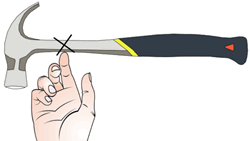
نقطة اتزان المطرقة على الإصبع هي مركز كتلتها.
The balance point of the hammer on the finger is its centre of mass.
تعيين مركز الكتلة عمليًا: الخط الشاقولي
Finding the centre of mass experimentally: the plumb line
لجسم مستوٍ غير منتظم: نعلّقه من نقطة ما ونرسم الخط الرأسي (خيط الراسيا) المارّ بنقطة التعليق، فيمر مركز الكتلة بهذا الخط لأن الجسم يستقر حين يكون مركز كتلته أسفل نقطة التعليق مباشرة. نكرر من نقطة أخرى، فتكون نقطة تقاطع الخطين هي مركز الكتلة (الثقل).
For an irregular flat body: hang it from some point and draw the vertical line (the plumb-line thread) through the suspension point; the centre of mass lies on this line because the body rests when its centre of mass is directly below the suspension point. Repeat from another point, and the intersection of the lines is the centre of mass (gravity).
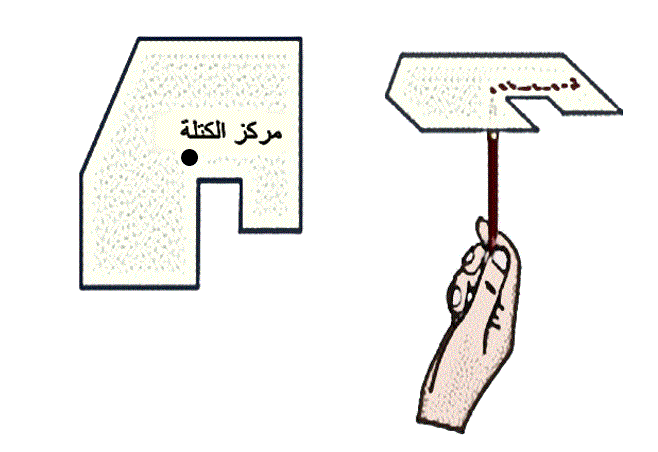
تعليق لوح غير منتظم: مركز الكتلة عند تقاطع الخطوط الرأسية.
Hanging an irregular plate: the centre of mass is at the intersection of the vertical lines.
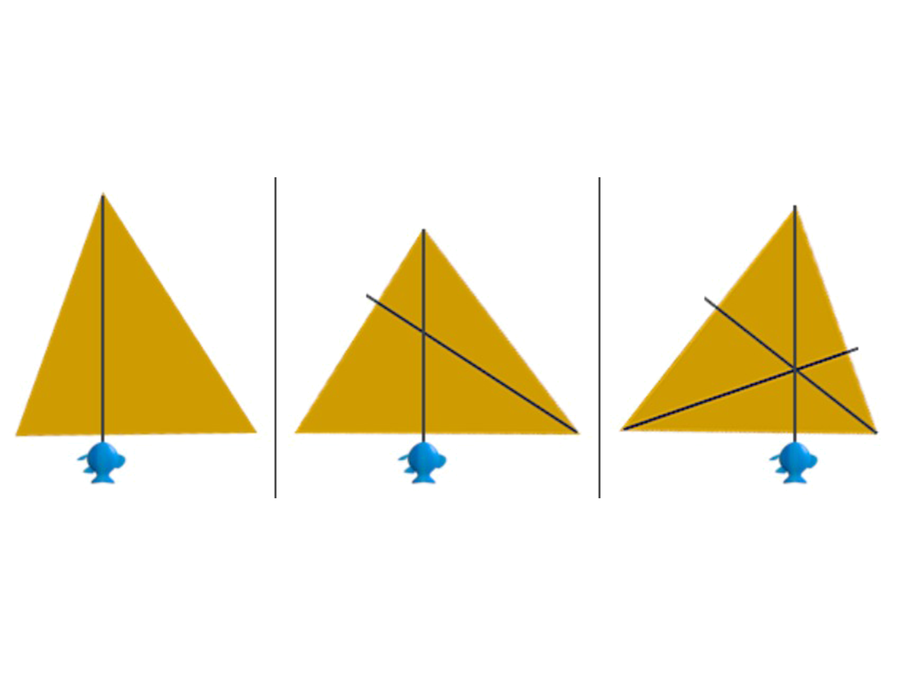
في المثلث المنتظم تتقاطع الخطوط الرأسية عند نقطة تقاطع متوسطاته.
In a uniform triangle the vertical lines meet at the intersection of its medians.
📘 الأجسام المنتظمة الكثافة
📘 Bodies of uniform density
إذا كانت الكثافة الكتلية ثابتة فإن مركز الكتلة يقع في المركز الهندسي للجسم:
If the mass density is constant the centre of mass is at the geometric centre of the body:
- القضيب المنتظم: في منتصفه. المستطيل والمربع: عند تقاطع القطرين. القرص والكرة: في المركز.A uniform rod: at its midpoint. A rectangle or square: at the intersection of the diagonals. A disc or a sphere: at the centre.
- المثلث: عند تقاطع متوسطاته، وهو على بُعد ثلث الارتفاع من القاعدة.A triangle: at the intersection of its medians, at one third of the height from the base.
حركة مركز الكتلة
Motion of the centre of mass
إذا خضع جسم صلب لقوى خارجية محصلتها صفر توجد دائمًا نقطة واحدة فيه حركتها مستقيمة منتظمة، هي مركز الكتلة، حتى لو دار الجسم حولها (كمطرقة تُقذف وهي تدور).
If a rigid body is acted on by external forces whose resultant is zero there is always one point of it that moves uniformly in a straight line: the centre of mass, even if the body spins around it (like a hammer thrown while spinning).
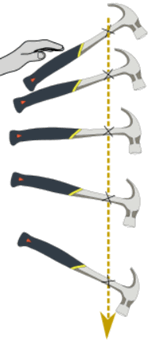
المطرقة تدور لكن مركز كتلتها يتحرك على خط مستقيم (الخط المتقطع).
The hammer spins but its centre of mass moves along a straight line (the dashed line).
💡 شرح إضافي: لماذا مركز الكتلة مهم؟
💡 Extra explanation: why is the centre of mass important?
لأن حركة أي جسم معقد (يدور ويهتز) تتحلل إلى حركة مركز كتلته كأنه جسيم واحد كتلته \(M\) تؤثر فيه محصلة القوى الخارجية \(\vec F_{ext}=M\vec A_{cm}\)، مضافًا إليها دورانه حول هذا المركز. وهذا يفسر لماذا يتبع مركز كتلة قاذف يقفز في الهواء (أو مطرقة مقذوفة) مسارًا قطعًا مكافئًا مهما كانت حركة أجزائه الداخلية، والقوى الداخلية لا تغيّر حركة مركز الكتلة.
Because the motion of any complicated body (spinning and vibrating) splits into the motion of its centre of mass as if it were a single particle of mass \(M\) acted on by the resultant of the external forces \(\vec F_{ext}=M\vec A_{cm}\), plus its rotation about this centre. This explains why the centre of mass of a diver (or of a thrown hammer) follows a parabola whatever the internal motion of its parts, and internal forces do not change the motion of the centre of mass.
مركز الثقل هو:
The centre of gravity is:
عند تعليق لوح غير منتظم من نقطتين مختلفتين يكون مركز كتلته عند:
When an irregular plate is hung from two different points its centre of mass is at:
مركز كتلة قرص منتظم الكثافة يقع:
The centre of mass of a uniform disc is:
⚖️ مركز الكتلة المشترك لجسمين أو أكثر
⚖️ The Common Centre of Mass of Two or More Bodies
إذا كانت الكتلتان متساويتين يقع مركز الكتلة المشترك في منتصف المسافة بين مركزي كتلتيهما.
If the two masses are equal the common centre of mass is at the midpoint between their centres of mass.
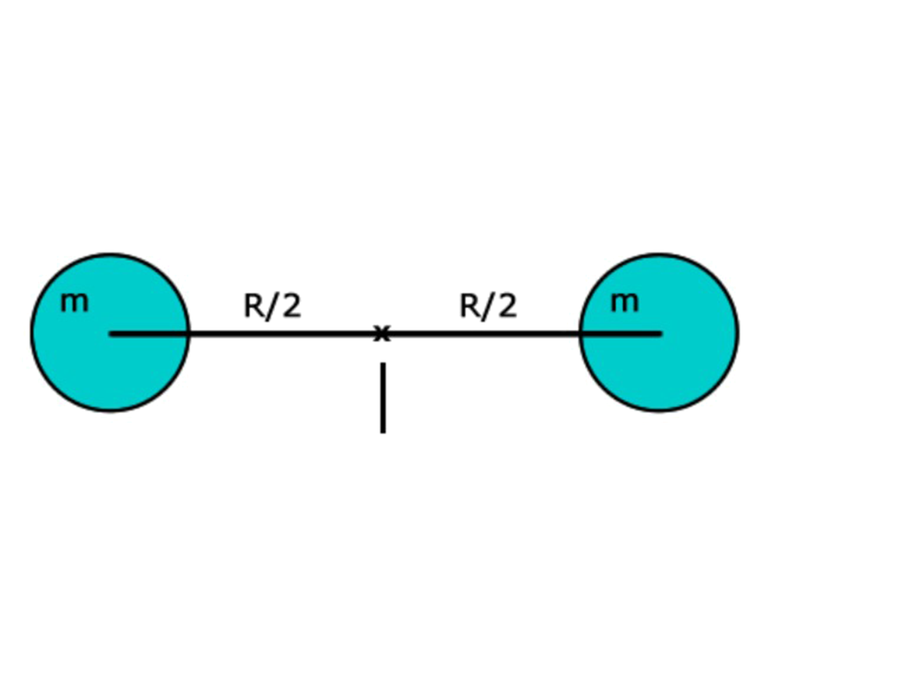
كتلتان متساويتان: مركز الكتلة في المنتصف على بُعد \(R/2\) من كل منهما.
Two equal masses: the centre of mass is at the midpoint, \(R/2\) from each.
وإذا كانتا غير متساويتين يقع مركز الكتلة أقرب إلى الكتلة الأكبر.
If they are unequal the centre of mass is closer to the larger mass.
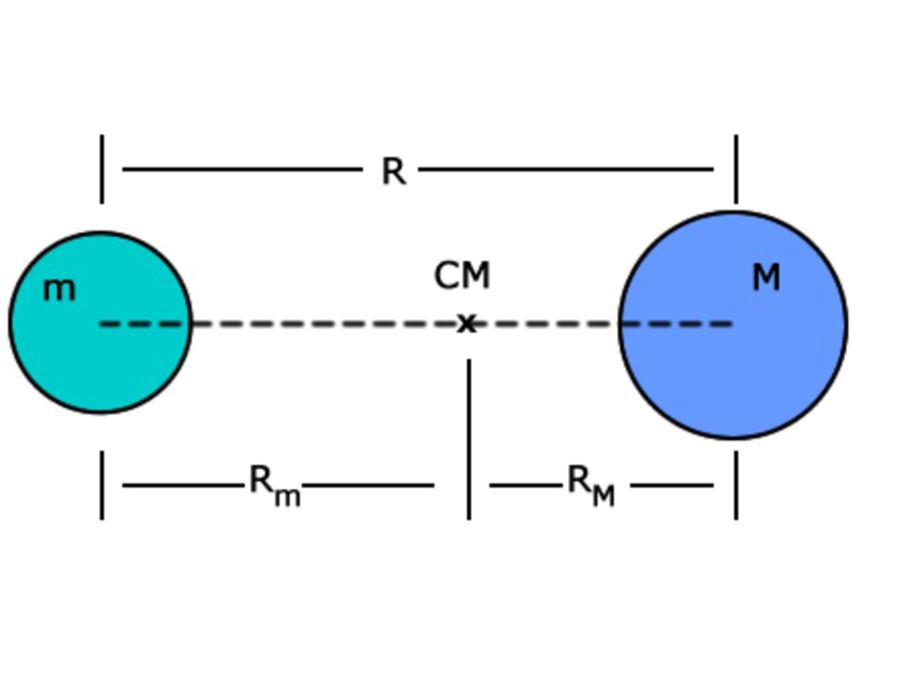
كتلتان غير متساويتين: مركز الكتلة CM أقرب إلى \(M\) الأكبر.
Two unequal masses: the centre of mass CM is closer to the larger \(M\).
📘 موقع مركز الكتلة لنظام جسيمات
📘 Position of the centre of mass of a system
\[\vec R=\dfrac{m_1\vec r_1+m_2\vec r_2}{m_1+m_2}\qquad\vec R=\dfrac{\sum m_i\vec r_i}{M}\]
حيث \(\vec R\) متجه موقع مركز كتلة النظام، و\(\vec r_1\) و\(\vec r_2\) متجها موقعي الكتلتين، و\(M=\sum m_i\) الكتلة الكلية. وبالمركبات في بُعدين أو ثلاثة أبعاد:
where \(\vec R\) is the position vector of the centre of mass of the system, \(\vec r_1\) and \(\vec r_2\) are the position vectors of the two masses and \(M=\sum m_i\) is the total mass. In components, in two or three dimensions:
\[X=\dfrac{\sum m_ix_i}{M}\qquad Y=\dfrac{\sum m_iy_i}{M}\qquad Z=\dfrac{\sum m_iz_i}{M}\]
💡 شرح إضافي: كيف أتحقق من نتيجتي؟
💡 Extra explanation: how do I check my result?
(1) مركز الكتلة يقع دائمًا بين الجسمين (داخل أصغر شكل محدب يحوي الكتل) وعلى الخط الواصل بينهما لجسمين. (2) يقترب من الكتلة الأكبر: لكتلتين على مسافة \(R\) يبعد عن \(m\) مسافة \(R_m=\dfrac{M R}{m+M}\) وعن \(M\) مسافة \(R_M=\dfrac{m R}{m+M}\)، أي إن المسافتين تتناسبان عكسيًا مع الكتلتين: \(m R_m=M R_M\). (3) اختيار نقطة الأصل بحرية: مركز الكتلة نقطة فيزيائية لا تتغير، وإنما تتغير إحداثياتها بتغير الأصل.
(1) The centre of mass always lies between the bodies (inside the smallest convex shape containing the masses) and, for two bodies, on the line joining them. (2) It is closer to the larger mass: for two masses a distance \(R\) apart it is at \(R_m=\dfrac{M R}{m+M}\) from \(m\) and \(R_M=\dfrac{m R}{m+M}\) from \(M\), so the distances are inversely proportional to the masses: \(m R_m=M R_M\). (3) You may choose the origin freely: the centre of mass is a physical point that does not change; only its coordinates change with the origin.
ثلاث كتل نقطية: \(5\ \mathrm{kg}\) عند \((0,\,1)\) و\(2\ \mathrm{kg}\) عند \((2,\,1)\) و\(10\ \mathrm{kg}\) عند \((1,\,0)\) (الإحداثيات بالمتر). أوجد مركز كتلة النظام.
Three point masses: \(5\ \mathrm{kg}\) at \((0,\,1)\), \(2\ \mathrm{kg}\) at \((2,\,1)\) and \(10\ \mathrm{kg}\) at \((1,\,0)\) (coordinates in metres). Find the centre of mass of the system.
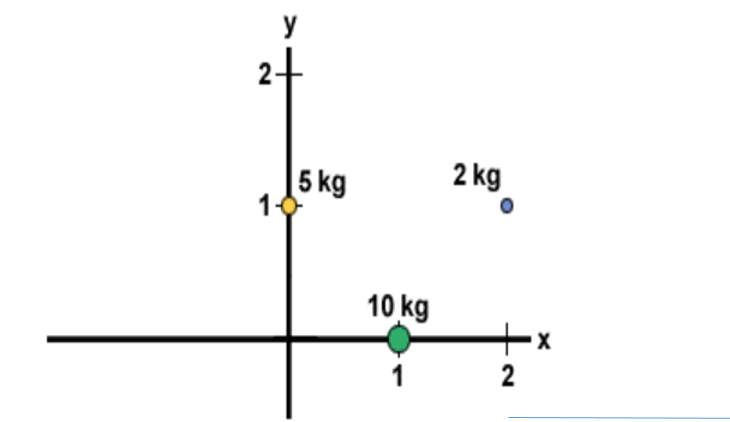
الكتل الثلاث للمثال 1 في المستوى.
The three masses of Example 1 in the plane.
كتلتان على المحور \(x\): \(3\ \mathrm{kg}\) عند \(x=0\) و\(1\ \mathrm{kg}\) عند \(x=8\ \mathrm{m}\). أين مركز كتلتهما؟ وما بُعده عن كل كتلة؟
Two masses on the \(x\)-axis: \(3\ \mathrm{kg}\) at \(x=0\) and \(1\ \mathrm{kg}\) at \(x=8\ \mathrm{m}\). Where is their centre of mass? And how far is it from each mass?
🧪 تجربة 1: مركز كتلة جسمين والاتزان على نقطة ارتكاز
🧪 Experiment 1: The centre of mass of two bodies and balance on a pivot
كتلتان على ساق خفيفة. غيّر الكتلتين وموضعيهما وراقب مركز الكتلة \(X=\dfrac{m_1x_1+m_2x_2}{m_1+m_2}\) (المثلث الأحمر). حرّك نقطة الارتكاز: تتزن الساق أفقيًا فقط عندما تكون نقطة الارتكاز تحت مركز الكتلة تمامًا، وإلا تميل نحو الجهة التي عزمها أكبر. احسب \(X\) وتحقق.
Two masses on a light rod. Change the masses and their positions and watch the centre of mass \(X=\dfrac{m_1x_1+m_2x_2}{m_1+m_2}\) (the red triangle). Move the pivot: the rod balances horizontally only when the pivot is exactly under the centre of mass, otherwise it tilts toward the side with the larger torque. Calculate \(X\) and check.
🧪 تجربة 2: مركز كتلة ثلاث كتل في المستوى
🧪 Experiment 2: The centre of mass of three masses in a plane
اسحب الكتل الثلاث (بالماوس أو الإصبع) على الشبكة؛ تلتصق بأقرب نقطة صحيحة. غيّر مقاديرها، ثم احسب \(X=\dfrac{\sum m_ix_i}{\sum m_i}\) و\(Y=\dfrac{\sum m_iy_i}{\sum m_i}\) وتحقق، ثم اضغط «أظهر الحل» لترى مركز الكتلة \(G\). لاحظ أنه يقع داخل المثلث ويقترب من الكتلة الأكبر.
Drag the three masses (with the mouse or a finger) on the grid; they snap to the nearest whole point. Change their values, then calculate \(X=\dfrac{\sum m_ix_i}{\sum m_i}\) and \(Y=\dfrac{\sum m_iy_i}{\sum m_i}\) and check, then press “Show the solution” to see the centre of mass \(G\). Notice that it lies inside the triangle and closer to the largest mass.
كتلتان متساويتان تفصل بينهما مسافة \(6\ \mathrm{m}\). بُعد مركز الكتلة عن كل منهما:
Two equal masses are \(6\ \mathrm{m}\) apart. The distance of the centre of mass from each is:
\(2\ \mathrm{kg}\) عند \(x=1\ \mathrm{m}\) و\(6\ \mathrm{kg}\) عند \(x=5\ \mathrm{m}\). مركز الكتلة عند:
\(2\ \mathrm{kg}\) at \(x=1\ \mathrm{m}\) and \(6\ \mathrm{kg}\) at \(x=5\ \mathrm{m}\). The centre of mass is at:
مركز كتلة نظام من كتلتين غير متساويتين يكون:
The centre of mass of a system of two unequal masses is:
🪵 مركز كتلة الأجسام المركّبة والمقصوصة
🪵 The Centre of Mass of Composite and Cut-Out Bodies
لجسم مركّب من أجزاء منتظمة نعدّ كل جزء كتلة نقطية موضوعة في مركزه الهندسي وكتلتها تتناسب مع مساحته (للألواح المتجانسة السُّمك). وللجسم المقصوص نستعمل الطرح: الجسم الكامل ناقص الجزء المقصوص.
For a composite body made of uniform parts we treat each part as a point mass placed at its geometric centre, with a mass proportional to its area (for plates of uniform thickness). For a cut-out body we use subtraction: the full body minus the removed part.
📘 طريقتا الجمع والطرح
📘 The addition and subtraction methods
\[X=\dfrac{\sum A_ix_i}{\sum A_i}\qquad\text{(addition)}\]
\[X=\dfrac{A_{full}x_{full}-A_{cut}x_{cut}}{A_{full}-A_{cut}}\qquad\text{(subtraction)}\]
والمعادلتان نفسهما في \(Y\). يجب أن تكون سماكة اللوح وكثافته ثابتتين.
and the same for \(Y\). The thickness and density of the plate must be constant.
قطعة مربعة من الخشب الرقائقي ضلعها \(4\ \mathrm{m}\) قُصّ منها مستطيل طوله \(3\ \mathrm{m}\) وعرضه \(2\ \mathrm{m}\) من منتصف الحافة العليا كما في الشكل. أوجد مركز كتلة القطعة المتبقية.
A square piece of plywood of side \(4\ \mathrm{m}\) has a rectangle of length \(3\ \mathrm{m}\) and width \(2\ \mathrm{m}\) cut out of the middle of its top edge as in the figure. Find the centre of mass of the remaining piece.
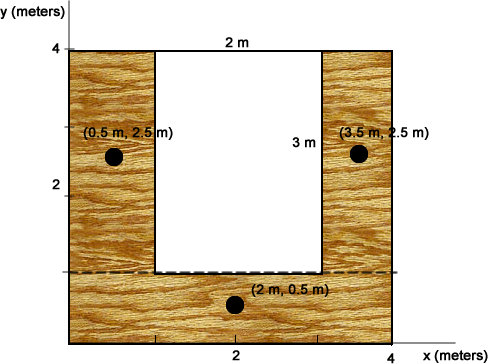
لوح الخشب الرقائقي بعد قص المستطيل، مع مراكز القطع الثلاث.
The plywood after cutting the rectangle, with the centres of the three pieces.
🧪 تجربة 3: مركز كتلة لوح مقصوص
🧪 Experiment 3: The centre of mass of a plate with a cut-out
لوح خشبي مربع (ضلعه \(4\ \mathrm{m}\)، كثافته منتظمة) قُصّ منه مستطيل. نحسب مركز كتلته بطريقة الطرح: نعامل اللوح الكامل جسمًا موضوعًا في مركزه، والمقصوص جسمًا «كتلته سالبة». غيّر عرض المقصوص وارتفاعه وموضعه (يلتصق بالحافة العليا)، ثم احسب \(X\) و\(Y\) وتحقق. جرّب \(a=2\) و\(b=3\) والإزاحة 1 كما في مثال الدرس.
A square wooden plate (side \(4\ \mathrm{m}\), uniform density) has a rectangle cut out. We find its centre of mass by subtraction: the full plate is a body at its centre and the cut-out is a body of “negative mass”. Change the width and height of the cut-out and its position (it touches the top edge), then calculate \(X\) and \(Y\) and check. Try \(a=2\), \(b=3\) and offset 1 as in the lesson example.
💡 شرح إضافي: لماذا ينزاح المركز بعيدًا عن المقصوص؟
💡 Extra explanation: why does the centre move away from the cut-out?
عند قص جزء من اللوح نُزيل كتلة من جهة معينة فيصبح التوزيع أثقل في الجهة المقابلة فينزاح مركز الكتلة نحوها. ففي المثال انخفض \(Y\) من \(2\ \mathrm{m}\) (مركز اللوح الكامل) إلى \(1.7\ \mathrm{m}\) لأن المقصوص كان في الأعلى، وبقي \(X=2\ \mathrm{m}\) لأن المقصوص يقع في المنتصف أفقيًا فالشكل متماثل حول المحور \(x=2\ \mathrm{m}\).
When a part of the plate is cut out we remove mass from one side, so the distribution is heavier on the opposite side and the centre of mass moves toward it. In the example \(Y\) fell from \(2\ \mathrm{m}\) (the centre of the full plate) to \(1.7\ \mathrm{m}\) because the cut-out was at the top, while \(X=2\ \mathrm{m}\) stayed because the cut-out is in the middle horizontally so the shape is symmetric about \(x=2\ \mathrm{m}\).
قُصّ جزء من أعلى لوح منتظم فإن مركز كتلته:
A part is cut from the top of a uniform plate, so its centre of mass:
لوح مربع ضلعه \(4\ \mathrm{m}\) مركزه عند \((2,2)\). قُصّ منه مستطيل مساحته \(6\ \mathrm{m^2}\) مركزه \((2,\,2.5)\). قيمة \(Y\) لمركز الكتلة الجديد:
A square plate of side \(4\ \mathrm{m}\) has its centre at \((2,2)\). A rectangle of area \(6\ \mathrm{m^2}\) with centre \((2,\,2.5)\) is cut out. The \(Y\) of the new centre of mass is:
🏃 كمية حركة مركز الكتلة
🏃 Momentum of the Centre of Mass
كمية الحركة هي حاصل ضرب الكتلة في متجه السرعة \(\vec p=m\vec v\) ووحدتها \(\mathrm{kg\cdot m/s}\). ولحساب كمية حركة مركز الكتلة نحتاج سرعته، وهي مشتقة موقعه بالنسبة للزمن:
Momentum is the product of the mass and the velocity vector \(\vec p=m\vec v\) and its unit is \(\mathrm{kg\cdot m/s}\). To find the momentum of the centre of mass we need its velocity, which is the derivative of its position with respect to time:
📘 سرعة مركز الكتلة وكمية حركته
📘 Velocity and momentum of the centre of mass
\[\vec V=\dfrac{d\vec R}{dt}=\dfrac{d}{dt}\!\left(\dfrac1M\sum m_i\vec r_i\right)=\dfrac1M\sum m_i\dfrac{d\vec r_i}{dt}=\dfrac1M\sum m_i\vec v_i=\dfrac1M\sum\vec p_i\]
وتصبح كمية الحركة الكلية للنظام (أو لمركز كتلته):
and the total momentum of the system (or of its centre of mass) becomes:
\[\vec P=M\vec V=\sum\vec p_i\]
💡 شرح إضافي: القوى الداخلية والخارجية
💡 Extra explanation: internal and external forces
بمفاضلة \(\vec P=M\vec V\) نحصل على \(\dfrac{d\vec P}{dt}=M\vec A_{cm}=\vec F_{ext}\): الذي يغيّر كمية حركة النظام هو القوى الخارجية فقط، أما القوى الداخلية بين أجزائه فتتساوى وتتعاكس (قانون نيوتن الثالث) فتلغي بعضها ولا تغيّر \(\vec P\). لذلك إذا كانت \(\vec F_{ext}=0\) بقيت كمية الحركة ثابتة (حفظ كمية الحركة) وتحرك مركز الكتلة بسرعة ثابتة.
Differentiating \(\vec P=M\vec V\) we get \(\dfrac{d\vec P}{dt}=M\vec A_{cm}=\vec F_{ext}\): only the external forces change the momentum of the system, while the internal forces between its parts are equal and opposite (Newton's third law) so they cancel and do not change \(\vec P\). Therefore if \(\vec F_{ext}=0\) the momentum stays constant (conservation of momentum) and the centre of mass moves with constant velocity.
نظام من جسمين: الأول كتلته \(4.00\ \mathrm{kg}\) عند \((5.00,\,3.00)\ \mathrm{m}\) وسرعته \((2.00,\,5.00)\ \mathrm{m/s}\)، والثاني كتلته \(2.00\ \mathrm{kg}\) عند \((2.00,\,6.00)\ \mathrm{m}\) وسرعته \((2.00,\,2.00)\ \mathrm{m/s}\). حدّد موقع مركز الكتلة وسرعته.
A system of two bodies: the first has mass \(4.00\ \mathrm{kg}\) at \((5.00,\,3.00)\ \mathrm{m}\) with velocity \((2.00,\,5.00)\ \mathrm{m/s}\), the second has mass \(2.00\ \mathrm{kg}\) at \((2.00,\,6.00)\ \mathrm{m}\) with velocity \((2.00,\,2.00)\ \mathrm{m/s}\). Find the position and the velocity of the centre of mass.
| البياناتData | الجسم الأولBody 1 | الجسم الثانيBody 2 | مركز الكتلةCentre of mass |
|---|---|---|---|
| متجه الموقعposition vector | \(\vec r_1(5\,,\,3)\ \mathrm{m}\)\(\vec r_1(5\,,\,3)\ \mathrm{m}\) | \(\vec r_2(2\,,\,6)\ \mathrm{m}\)\(\vec r_2(2\,,\,6)\ \mathrm{m}\) | \(\vec R(4\,,\,4)\ \mathrm{m}\)\(\vec R(4\,,\,4)\ \mathrm{m}\) |
| متجه السرعةvelocity vector | \(\vec v_1(2\,,\,5)\ \mathrm{m/s}\)\(\vec v_1(2\,,\,5)\ \mathrm{m/s}\) | \(\vec v_2(2\,,\,2)\ \mathrm{m/s}\)\(\vec v_2(2\,,\,2)\ \mathrm{m/s}\) | \(\vec V(2\,,\,4)\ \mathrm{m/s}\)\(\vec V(2\,,\,4)\ \mathrm{m/s}\) |
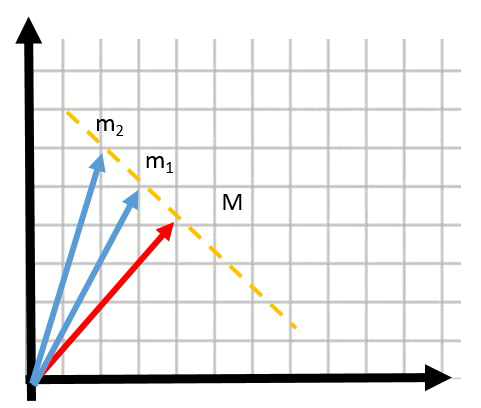
متجها موقع الجسمين ومتجه موقع مركز الكتلة \(M\) (يقع على الخط الواصل بينهما).
The position vectors of the two bodies and of the centre of mass \(M\) (it lies on the line joining them).
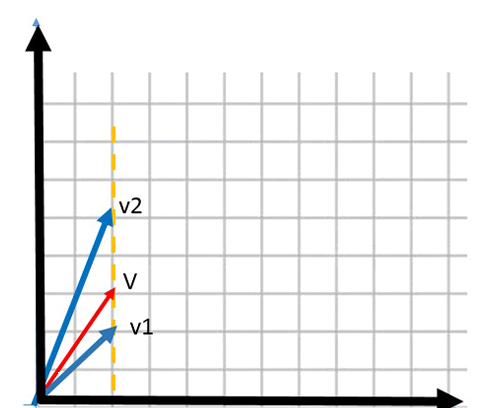
متجها السرعة \(v_1\) و\(v_2\) ومتجه سرعة مركز الكتلة \(V\).
The velocity vectors \(v_1\), \(v_2\) and the velocity \(V\) of the centre of mass.
احسب كمية الحركة الكلية لنظام المثال السابق بطريقتين.
Find the total momentum of the system in the previous example in two ways.
نظام كتلته الكلية \(6\ \mathrm{kg}\) تؤثر فيه قوة خارجية محصلتها \(12\ \mathrm{N}\) باتجاه \(+x\) (والقوى الداخلية تتبادل بين أجزائه). احسب تسارع مركز كتلته.
A system of total mass \(6\ \mathrm{kg}\) is acted on by an external resultant force of \(12\ \mathrm{N}\) in the \(+x\) direction (and the internal forces are exchanged between its parts). Find the acceleration of its centre of mass.
سرعة مركز كتلة نظام تعطى بالعلاقة:
The velocity of the centre of mass of a system is given by:
كمية حركة مركز كتلة نظام تساوي:
The momentum of the centre of mass of a system equals:
جسمان: \(2\ \mathrm{kg}\) بسرعة \(+3\ \mathrm{m/s}\) و\(4\ \mathrm{kg}\) بسرعة \(-3\ \mathrm{m/s}\) على خط واحد. سرعة مركز الكتلة:
Two bodies: \(2\ \mathrm{kg}\) at \(+3\ \mathrm{m/s}\) and \(4\ \mathrm{kg}\) at \(-3\ \mathrm{m/s}\) on one line. The velocity of the centre of mass is:
أي القوى تغيّر كمية حركة نظام من الأجسام؟
Which forces change the momentum of a system of bodies?
نظام كتلته \(6\ \mathrm{kg}\) تؤثر فيه قوة خارجية \(18\ \mathrm{N}\). تسارع مركز كتلته:
A system of mass \(6\ \mathrm{kg}\) is acted on by an external force of \(18\ \mathrm{N}\). The acceleration of its centre of mass is:
📚 ملخص الدرس
📚 Lesson Summary
| المفهومConcept | العلاقةRelation |
|---|---|
| مركز الكتلة لنظامCentre of mass of a system | \(\vec R=\dfrac{\sum m_i\vec r_i}{M}\ ;\ X=\dfrac{\sum m_ix_i}{M}\ ,\ Y=\dfrac{\sum m_iy_i}{M}\)\(\vec R=\dfrac{\sum m_i\vec r_i}{M}\ ;\ X=\dfrac{\sum m_ix_i}{M}\ ,\ Y=\dfrac{\sum m_iy_i}{M}\) |
| جسمانTwo bodies | \(m\,R_m=M\,R_M\)\(m\,R_m=M\,R_M\) |
| جسم مقصوصCut-out body | \(X=\dfrac{A_{full}x_{full}-A_{cut}x_{cut}}{A_{full}-A_{cut}}\)\(X=\dfrac{A_{full}x_{full}-A_{cut}x_{cut}}{A_{full}-A_{cut}}\) |
| سرعة مركز الكتلةVelocity of the centre of mass | \(\vec V=\dfrac{\sum m_i\vec v_i}{M}\)\(\vec V=\dfrac{\sum m_i\vec v_i}{M}\) |
| كمية الحركةMomentum | \(\vec P=M\vec V=\sum\vec p_i\ ;\ \vec F_{ext}=M\vec A_{cm}\)\(\vec P=M\vec V=\sum\vec p_i\ ;\ \vec F_{ext}=M\vec A_{cm}\) |
⚠️ أخطاء شائعة
⚠️ Common mistakes
- حساب مركز الكتلة كمتوسط عادي للمواضع دون الوزن بالكتل \(m_i\).Calculating the centre of mass as a plain average of the positions without weighting by the masses \(m_i\).
- الظن أن مركز الكتلة يجب أن يقع داخل الجسم دائمًا؛ قد يقع خارجه (حلقة).Thinking that the centre of mass must always lie inside the body; it can lie outside (a ring).
- عند الطرح نسيان أن الجزء المقصوص كتلته سالبة (الإشارة الخاطئة).When subtracting, forgetting that the cut-out part has a negative mass (a wrong sign).
- جمع السرعات مباشرة بدل الوزن بالكتل عند حساب سرعة مركز الكتلة.Adding the velocities directly instead of weighting by the masses when calculating the velocity of the centre of mass.
- اعتبار القوى الداخلية مؤثرة في حركة مركز الكتلة؛ المؤثر هو القوى الخارجية.Considering internal forces as affecting the motion of the centre of mass; only external forces do.
🧪 اختبر نفسك: امتحان من 20 سؤالاً
🧪 Test Yourself: a 20-Question Exam
أنهِ الدرس بالاختبار التفاعلي التالي؛ أسئلته تجمع بين الفهم والحساب وتغطي جميع أقسام الدرس.
Finish with the interactive exam below; its questions mix understanding with calculation and cover every section of the lesson.
اختبار الأجسام الجاسئة: مركز الكتلة ومركز الثقل Rigid Bodies: Centre of Mass and Gravity Quiz
20 سؤالاً - مركز الكتلة ومركز الثقل وكمية حركة مركز الكتلة 20 Questions - Centre of Mass, Centre of Gravity and Momentum of the Centre of Mass
• عدد الأسئلة: 20 سؤالاً
• مدة الاختبار: 30 دقيقة
• لا يمكنك تغيير إجاباتك أو إعادة الاختبار إلا بعد 24 ساعة من التسليم.
• تأكد من إجاباتك قبل التسليم! 📌 Important Instructions:
• Number of questions: 20 questions
• Quiz duration: 30 minutes
• You cannot change your answers or retake the quiz for 24 hours after submission.
• Make sure of your answers before submitting!
🔗 محاكيات GeoGebra للاستعانة بها عند اللزوم
🔗 GeoGebra Simulations to Use When Needed
اضغط «تشغيل» لتعمل المحاكاة هنا داخل الدرس؛ ويمكن للطالب الرجوع إليها لتجربة الفكرة بطريقة أخرى.
Press “Run” to run the simulation right here inside the lesson; the student can use it to try the idea in another way.