🎯 نواتج التعلم
🎯 Learning Outcomes
بعد دراسة هذا الدرس ستكون قادرًا على أن:
After this lesson you will be able to:
- تعرّف الآلة البسيطة وتعدّد أنواعها: الرافعة والبكرة والعجلة والمحور والبرغي والأسفين والمستوى المائل.Define a simple machine and list its types: the lever, pulley, wheel and axle, screw, wedge and inclined plane.
- تحسب الفائدة الميكانيكية الفعلية \(MA=F_r/F_e\) والمثالية \(IMA=d_e/d_r\).Calculate the actual mechanical advantage \(MA=F_r/F_e\) and the ideal one \(IMA=d_e/d_r\).
- تحسب كفاءة الآلة \(e=W_o/W_i\times100\) وتفسّر سبب كونها أقل من 100%.Calculate the efficiency \(e=W_o/W_i\times100\) and explain why it is below 100%.
- تميّز أنواع الرافعة الثلاثة وتحسب شرط الاتزان \(F_e d_e=F_r d_r\).Distinguish the three classes of lever and apply the balance condition \(F_e d_e=F_r d_r\).
- تحلّل الآلة المركبة بضرب فوائد الآلات المكوّنة لها (مثل الدراجة).Analyse a compound machine by multiplying the advantages of its parts (such as the bicycle).
⚙️ ما هي الآلة البسيطة؟
⚙️ What Is a Simple Machine?
الآلة البسيطة أداة تُدار بالقوة البشرية أو بمحرك وتسهّل إنجاز العمل؛ وهي جهاز ذو أجزاء متحركة قليلة أو بلا أجزاء متحركة، يُستخدم لتعديل اتجاه القوة أو مقدارها أو المسافة التي تتحركها.
A simple machine is a tool operated by human power or by a motor that makes work easier; it is a device with few or no moving parts used to change the direction or the magnitude of a force or the distance it moves.
💡 فكرة أساسية
💡 A key idea
الآلة لا تخلق طاقة: ما تربحه في القوة تخسره في المسافة. لذلك قد نستخدم قوة صغيرة لرفع حمل كبير، لكن على مسافة أطول. والشغل المبذول لا يقل أبدًا عن الشغل الناتج.
A machine does not create energy: what it gains in force it loses in distance. So we may use a small force to lift a big load but over a longer distance. The input work is never less than the output work.
🪢 البكرة
🪢 The Pulley
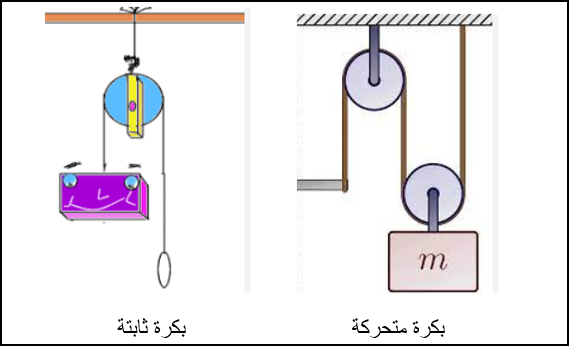
بكرة ثابتة (يسار) وبكرة متحركة (يمين).
A fixed pulley (left) and a movable pulley (right).
البكرة عجلة محزّزة يمرّ بها حبل. البكرة الثابتة تغيّر اتجاه القوة فقط (تسمح برفع الحمل بالسحب نحو الأسفل دون ثني الظهر) وفائدتها الميكانيكية 1. أما البكرة المتحركة وأنظمة البكرات فكلما زاد عدد الحبال الحاملة للحمل \(n\) قلّت قوة الجهد:
A pulley is a grooved wheel over which a rope passes. A fixed pulley only changes the direction of the force (it lets us lift a load by pulling downward without bending the back) and its mechanical advantage is 1. With a movable pulley or a pulley system, the more ropes \(n\) support the load the smaller the effort:
📌 البكرات
📌 Pulleys
\[IMA=n,\qquad F_e=\frac{F_r}{n}\ \ (\text{ideal}),\qquad d_e=n\,d_r\]
في البكرة الثابتة \(n=1\)، وفي المتحركة الواحدة \(n=2\). ثمن تقليل القوة \(n\) مرة هو سحب الحبل مسافة أكبر \(n\) مرة.
A fixed pulley has \(n=1\) and a single movable pulley \(n=2\). The price of reducing the force \(n\) times is pulling the rope \(n\) times farther.
🧪 جرّب بنفسك: البكرات
🧪 Try It Yourself: Pulleys
🧪 تجربة 2: البكرات: عدد الحبال الحاملة والشغل
🧪 Experiment 2: Pulleys: the Number of Supporting Ropes and the Work
اختر نظام البكرات وعدد الحبال الحاملة \(n\) ثم اضغط «اسحب الحبل». لاحظ أن قوة الجهد تقل \(n\) مرة بينما مسافة سحب الحبل تزداد \(n\) مرة، فلا يتغير الشغل (إلا بسبب الاحتكاك).
Choose the pulley system and the number of supporting ropes \(n\) then press “Pull the rope”. Notice the effort drops \(n\) times while the rope is pulled \(n\) times farther, so the work does not change (except for friction).
ما الفائدة الميكانيكية للبكرة الثابتة؟
What is the mechanical advantage of a fixed pulley?
يُرفع حمل وزنه \(800\ \mathrm N\) بنظام بكرات تحمله 4 حبال. أوجد قوة الجهد المثالية والمسافة التي يُسحب بها الحبل لرفع الحمل \(2\ \mathrm m\).
A load of \(800\ \mathrm N\) is lifted with a pulley system supported by 4 ropes. Find the ideal effort and the length of rope pulled to raise the load \(2\ \mathrm m\).
⚖️ الرافعة
⚖️ The Lever
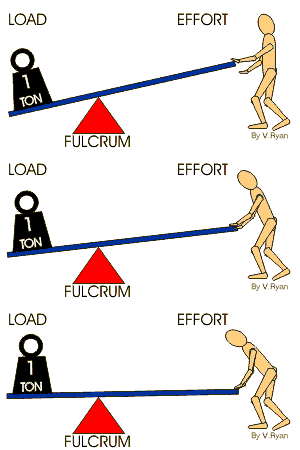
الرافعة: الحمل ونقطة الارتكاز والجهد.
A lever: load, fulcrum and effort.
الرافعة قضيب صلب يدور حول نقطة ثابتة تسمى نقطة الارتكاز. تُستخدم لتقليل قوة الجهد اللازمة لإنجاز شغل معيّن ولرفع الأحمال الثقيلة. وكلما اقتربت نقطة الارتكاز من الحمل احتجنا إلى قوة جهد أقل لأن ذراع الجهد يصبح أطول.
A lever is a rigid bar that rotates about a fixed point called the fulcrum. It is used to reduce the effort force needed to do a given amount of work and to lift heavy loads. The closer the fulcrum is to the load the smaller the effort needed because the effort arm becomes longer.
📌 شرط الاتزان
📌 The balance condition
\[F_e\,d_e=F_r\,d_r\ \Rightarrow\ IMA=\frac{d_e}{d_r}=\frac{F_r}{F_e}\]
\(d_e\) ذراع الجهد و\(d_r\) ذراع الحمل (البعد العمودي لكل قوة عن نقطة الارتكاز).
\(d_e\) is the effort arm and \(d_r\) the load arm (the perpendicular distance of each force from the fulcrum).
| النوعClass | موضع نقطة الارتكازFulcrum | الفائدة الميكانيكيةMechanical advantage | أمثلةExamples |
|---|---|---|---|
| الأولFirst | بين الجهد والحملbetween effort and load | أكبر من 1 أو أصغر أو تساويهاgreater than, less than or equal to 1 | الميزان ذو الكفتين، المقص، العتلةbalance scale, scissors, crowbar |
| الثانيSecond | في الطرف، والحمل بين الجهد والارتكازat the end, with the load between | دائمًا أكبر من 1always greater than 1 | عربة اليد، كسارة البندق، فتاحة الزجاجاتwheelbarrow, nutcracker, bottle opener |
| الثالثThird | في الطرف، والجهد بين الحمل والارتكازat the end, with the effort between | دائمًا أقل من 1always less than 1 | الملقط، صنارة الصيد، الساعدtweezers, fishing rod, forearm |
🧪 جرّب بنفسك: الرافعة
🧪 Try It Yourself: the Lever
🧪 تجربة 1: الرافعة: وازن الحمل واكتشف الأنواع الثلاثة
🧪 Experiment 1: The Lever: Balance the Load and Discover the Three Classes
اختر نوع الرافعة وحرّك الموضع والحمل وقوة الجهد. تتوازن الرافعة عندما \(F_e\,d_e=F_r\,d_r\). اضغط «احسب قوة الاتزان» لتضبط الجهد تلقائيًا ثم غيّر الأذرع لترى كيف تتغير الفائدة الميكانيكية.
Choose the lever class and move the position, the load and the effort. The lever balances when \(F_e\,d_e=F_r\,d_r\). Press “Compute the balancing force” to set the effort automatically, then change the arms to see how the mechanical advantage changes.
رافعة ذراع جهدها \(40\ \mathrm{cm}\) وذراع حملها \(10\ \mathrm{cm}\). أوجد فائدتها الميكانيكية المثالية، والقوة اللازمة لرفع حمل \(200\ \mathrm N\).
A lever has an effort arm of \(40\ \mathrm{cm}\) and a load arm of \(10\ \mathrm{cm}\). Find its ideal mechanical advantage and the force needed to lift a \(200\ \mathrm N\) load.
أي الآلات التالية رافعة من النوع الأول؟
Which of the following is a first-class lever?
أي مما يلي مثال على الرافعة من النوع الثاني؟
Which of the following is a second-class lever?
🎡 العجلة والمحور
🎡 The Wheel and Axle
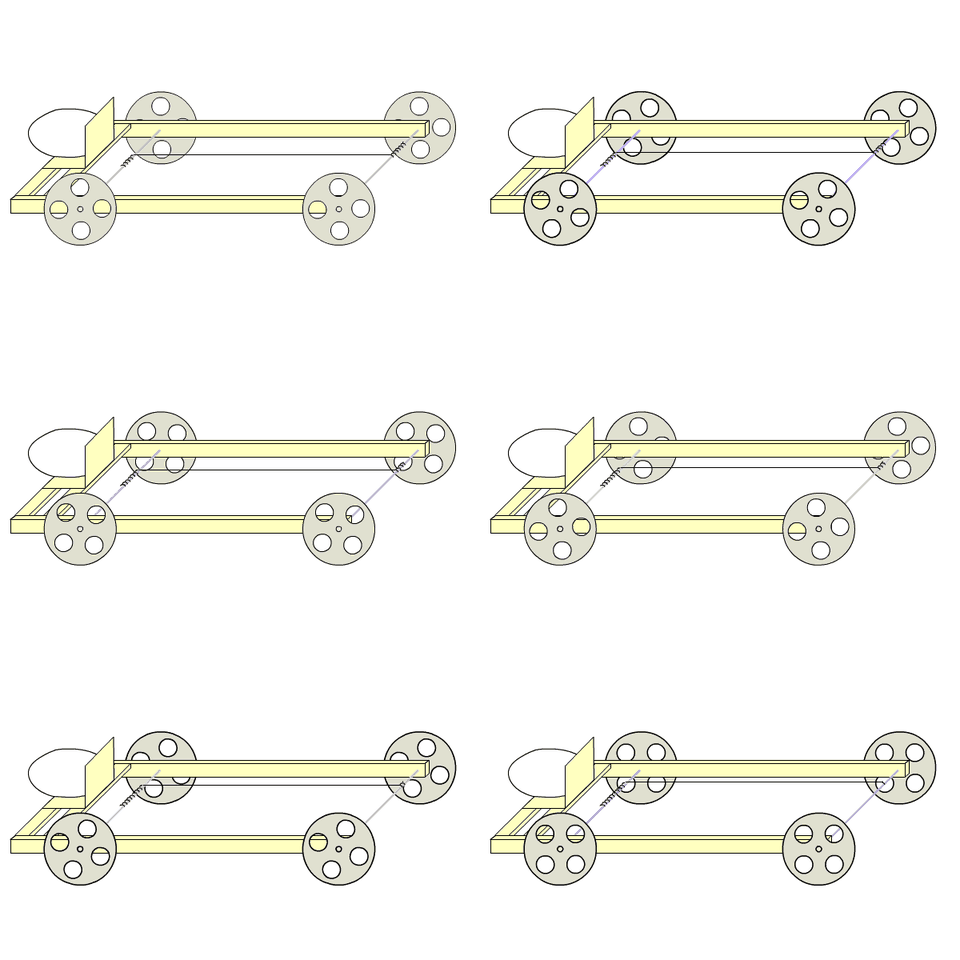
العجلة والمحور: أسطوانتان متحدتا المحور تدوران معًا.
Wheel and axle: two coaxial cylinders turning together.
آلة بسيطة من أسطوانتين (أو حلقتين) متحدتي المحور، إحداهما داخل الأخرى، تدوران معًا حول المركز نفسه. وهي رافعة دائرية: القوة المؤثرة عند الحافة الخارجية (نصف قطر \(R\)) تقابل قوة عند المحور (نصف قطر \(r\)):
A simple machine of two coaxial cylinders (or rings), one inside the other, turning together about the same centre. It is a circular lever: the force acting at the outer rim (radius \(R\)) corresponds to a force at the axle (radius \(r\)):
📌 العجلة والمحور
📌 Wheel and axle
\[IMA=\frac{d_e}{d_r}=\frac{R_{\text{where effort acts}}}{R_{\text{where load acts}}}\]
إذا أثّر الجهد عند الأسطوانة الكبيرة كان \(IMA\gt 1\) (المقود، مفتاح الصنبور)، وإن أثّر عند الصغيرة كان \(IMA\lt 1\) (دولاب الدراجة تدفعه السلسلة) فتكسب السرعة والمسافة.
If the effort acts on the larger cylinder then \(IMA\gt 1\) (steering wheel, tap handle); if it acts on the smaller one then \(IMA\lt 1\) (a bicycle wheel pushed by the chain) and speed and distance are gained.
🔩 البرغي والأسفين
🔩 The Screw and the Wedge
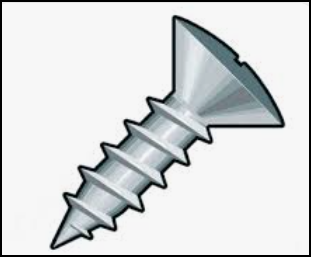
البرغي: مستوى مائل ملفوف حول أسطوانة.
A screw: an inclined plane wrapped around a cylinder.
البرغي سطح مائل ملفوف حول أسطوانة على شكل لولبي. لا يستطيع تثبيت نفسه في الجسم دون احتكاك، ويمكن إدخاله أو انتزاعه بقوة صغيرة (عزم صغير على المقبض). المسافة بين خيطين متتاليين تسمى الخطوة \(p\)، ويقطع المقبض في الدورة الواحدة محيط دائرة \(2\pi r\) فيتقدم البرغي مسافة \(p\) فقط: \(IMA=2\pi r/p\).
A screw is an inclined plane wrapped around a cylinder in a spiral. It cannot hold itself in a body without friction, and it can be driven in or removed with a small force (a small torque on the handle). The distance between two successive threads is the pitch \(p\); in one turn the handle travels a circumference \(2\pi r\) while the screw advances only \(p\): \(IMA=2\pi r/p\).
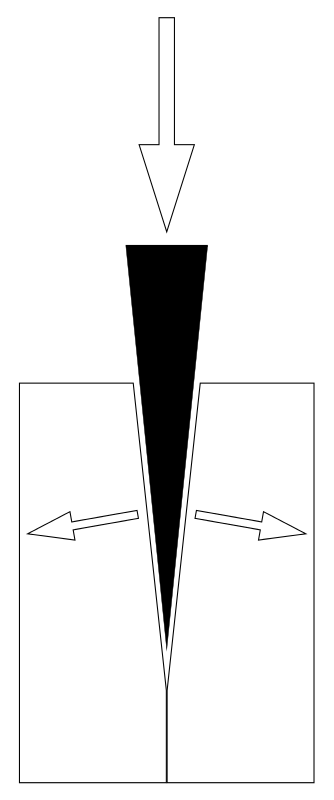
الأسفين جسم مثلثي حاد كالسكين.
A wedge: a sharp triangular object such as a knife.
الأسفين جسم حاد على شكل مثلث (سكين، فأس، صخرة حادة) يساعد على شقّ الأجسام وفصلها: يحوّل قوة الجهد إلى قوتين على جانبيه عموديتين تقريبًا على سطحيه المائلين، وهو مستويان مائلان متقابلان. \(IMA=L/t\): الطول إلى السمك.
A wedge is a sharp triangular object (knife, axe, sharp rock) that splits or separates objects: it converts the effort into two forces on its sides, roughly perpendicular to its two inclined faces; it is two inclined planes back to back. \(IMA=L/t\): length over thickness.
🧪 جرّب بنفسك: الأسفين والبرغي
🧪 Try It Yourself: the Wedge and the Screw
🧪 تجربة 5: الأسفين والبرغي: سطوح مائلة متنكّرة
🧪 Experiment 5: The Wedge and the Screw: Inclined Planes in Disguise
اختر الأسفين أو البرغي وغيّر أبعاده. الأسفين \(IMA=L/t\) والبرغي \(IMA=2\pi r/p\). اضغط «شغّل» لترى الحركة، وغيّر الكفاءة والحمل لتعرف قوة الجهد.
Choose the wedge or the screw and change its dimensions. The wedge has \(IMA=L/t\) and the screw \(IMA=2\pi r/p\). Press “Run” to see the motion, and change the efficiency and the load to find the effort.
برغي خطوته \(2\ \mathrm{mm}\) ونصف قطر مقبضه \(1.5\ \mathrm{cm}\). أوجد فائدته الميكانيكية المثالية.
A screw has a pitch of \(2\ \mathrm{mm}\) and a handle radius of \(1.5\ \mathrm{cm}\). Find its ideal mechanical advantage.
📐 المستوى المائل
📐 The Inclined Plane
المستوى المائل منحدر يقلّل القوة اللازمة لرفع الجسم: بدل رفعه رأسيًا مسافة \(h\) ندفعه أو نسحبه على المنحدر مسافة \(L\) أطول. وللمستوى الأملس:
An inclined plane is a ramp that reduces the force needed to raise an object: instead of lifting it vertically a height \(h\) we push or pull it along the ramp a longer distance \(L\). For a smooth plane:
📌 المستوى المائل
📌 The inclined plane
\[F_e=W\sin\theta,\qquad IMA=\frac{L}{h}=\frac1{\sin\theta}\]
مع الاحتكاك: \(F_e=W(\sin\theta+\mu\cos\theta)\). كلما قلّ الميل زادت الفائدة المثالية وقلّت القوة (على مسافة أطول).
With friction: \(F_e=W(\sin\theta+\mu\cos\theta)\). The gentler the slope the greater the ideal advantage and the smaller the force (over a longer distance).
🧪 جرّب بنفسك: المستوى المائل
🧪 Try It Yourself: the Inclined Plane
🧪 تجربة 3: المستوى المائل: الزاوية والاحتكاك والكفاءة
🧪 Experiment 3: The Inclined Plane: the Angle, Friction and Efficiency
غيّر زاوية المستوى والارتفاع والكتلة ومعامل الاحتكاك ثم اضغط «ادفع الصندوق». المستوى الأقل ميلًا يحتاج قوة أقل ولكنه أطول؛ ويظهر شريطا الشغل المبذول والناتج لترى أثر الاحتكاك.
Change the angle, the height, the mass and the friction coefficient then press “Push the box”. A gentler plane needs less force but is longer; the bars of input and output work show the effect of friction.
في المستوى المائل: ماذا يحدث للفائدة الميكانيكية عندما يزداد طول المستوى مع بقاء الارتفاع ثابتًا؟
For an inclined plane: what happens to the mechanical advantage when the length increases while the height stays constant?
يُدفع صندوق وزنه \(500\ \mathrm N\) على مستوى أملس طوله \(5\ \mathrm m\) إلى ارتفاع \(1\ \mathrm m\). أوجد قوة الدفع المثالية والفائدة الميكانيكية المثالية.
A box of weight \(500\ \mathrm N\) is pushed up a smooth plane \(5\ \mathrm m\) long to a height of \(1\ \mathrm m\). Find the ideal effort and the ideal mechanical advantage.
📊 الفائدة الميكانيكية والكفاءة
📊 Mechanical Advantage and Efficiency
يُبذل على الآلة شغل مبذول \(W_i\)، وتُنجز الآلة شغلًا ناتجًا \(W_o\). القوة التي يؤثر بها الشخص تسمى قوة الجهد \(F_e\) والقوة التي تنتجها الآلة قوة المقاومة \(F_r\). والمسافتان \(d_e\) و\(d_r\) هما ما يتحركه الجهد والحمل.
Work \(W_i\) is done on the machine (input work) and the machine does output work \(W_o\). The force a person applies is the effort \(F_e\) and the force the machine produces is the resistance \(F_r\). The distances \(d_e\) and \(d_r\) are those moved by the effort and the load.
📌 القوانين
📌 The laws
\[MA=\frac{F_r}{F_e}\qquad\text{(actual)}\]
\[W_i\ge W_o,\qquad \text{ideal: }F_e d_e=F_r d_r\ \Rightarrow\ IMA=\frac{d_e}{d_r}\]
\[e=\frac{W_o}{W_i}\times100=\frac{F_r d_r}{F_e d_e}\times100=\frac{MA}{IMA}\times100\]
الآلة المثالية (بلا احتكاك) كفاءتها 100% و\(MA=IMA\). والآلة الفعلية \(MA\lt IMA\) والكفاءة أقل من 100% لأن جزءًا من الشغل يضيع احتكاكًا. الفائدة الميكانيكية بلا وحدة لأنها نسبة بين قوتين.
An ideal (frictionless) machine has 100% efficiency and \(MA=IMA\). A real machine has \(MA\lt IMA\) and an efficiency below 100% because some of the work is lost to friction. Mechanical advantage has no unit because it is a ratio of two forces.
دولاب دراجة نصف قطره \(40\ \mathrm{cm}\) ونصف قطر ناقل الحركة \(4\ \mathrm{cm}\). سُحبت السلسلة أفقيًا بقوة \(80\ \mathrm N\) وكانت الفائدة الميكانيكية الفعلية \(0.09\). أوجد: الفائدة المثالية، وقوة المقاومة، والكفاءة.
A bicycle wheel has a radius of \(40\ \mathrm{cm}\) and the drive gear has a radius of \(4\ \mathrm{cm}\). The chain was pulled horizontally with \(80\ \mathrm N\) and the actual mechanical advantage was \(0.09\). Find: the ideal advantage, the resistance force and the efficiency.
رُفع حمل وزنه \(600\ \mathrm N\) إلى ارتفاع \(2\ \mathrm m\) على مستوى مائل طوله \(6\ \mathrm m\) بقوة \(250\ \mathrm N\). أوجد الشغل المبذول والناتج والكفاءة.
A load of \(600\ \mathrm N\) is raised \(2\ \mathrm m\) on an inclined plane \(6\ \mathrm m\) long with a force of \(250\ \mathrm N\). Find the input work, the output work and the efficiency.
إذا كانت قوة الدخل على آلة \(20\ \mathrm N\) وقوة الخرج \(80\ \mathrm N\) فالفائدة الميكانيكية الفعلية:
If the input force on a machine is \(20\ \mathrm N\) and the output force is \(80\ \mathrm N\), the actual mechanical advantage is:
وحدة قياس الفائدة الميكانيكية:
The unit of mechanical advantage is:
🚲 الآلة المركبة
🚲 The Compound Machine
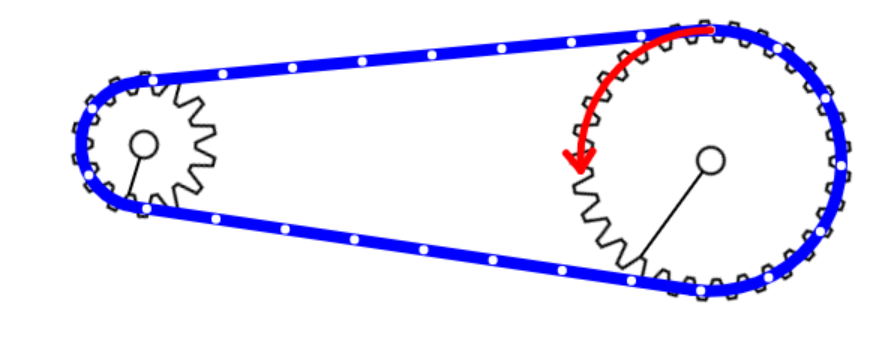
السلسلة والترسان في الدراجة.
The chain and sprockets of a bicycle.
تتكوّن الآلة المركبة من آلتين بسيطتين أو أكثر تعملان معًا، وتُنقل القوة من إحداها إلى الأخرى، مثل الدراجة (الدواسة والترس الأمامي، ثم الترس الخلفي والعجلة). تُضرب فوائد الآلات المكوّنة:
A compound machine consists of two or more simple machines working together, with the force passed from one to the next, such as the bicycle (the pedal and front sprocket, then the rear sprocket and the wheel). The advantages of the parts are multiplied:
📌 الآلة المركبة
📌 The compound machine
\[MA_{tot}=MA_{\text{front}}\times MA_{\text{rear}}\]
\[IMA_{tot}=IMA_{\text{front}}\times IMA_{\text{rear}}=\frac{L_c}{R_f}\times\frac{r_r}{R_w}\]
الكفاءة الكلية \(e_{tot}=e_1\times e_2\) لأن الشغل الناتج من الآلة الأولى هو الشغل المبذول على الثانية.
The total efficiency is \(e_{tot}=e_1\times e_2\) because the output work of the first machine is the input work of the second.
🧪 جرّب بنفسك: الدراجة
🧪 Try It Yourself: the Bicycle
🧪 تجربة 4: الدراجة: الآلة المركبة والعجلة والمحور
🧪 Experiment 4: The Bicycle: a Compound Machine and the Wheel and Axle
الدراجة آلتان بسيطتان: الدواسة مع الترس الأمامي، ثم الترس الخلفي مع العجلة. غيّر الأبعاد واضغط «أدر الدواسة دورة» لترى المسافة المقطوعة وكيف تتضاعف الفائدتان.
The bicycle is two simple machines: the pedal with the front sprocket, then the rear sprocket with the wheel. Change the dimensions and press “Turn the pedal one revolution” to see the distance covered and how the two advantages multiply.
في دراجة: ذراع الدواسة \(17\ \mathrm{cm}\)، ونصف قطر الترس الأمامي \(10\ \mathrm{cm}\)، والخلفي \(4\ \mathrm{cm}\)، ونصف قطر العجلة \(35\ \mathrm{cm}\). أوجد \(IMA\) الكلية وكم دورة تدور العجلة لكل دورة دواسة.
On a bicycle the pedal crank is \(17\ \mathrm{cm}\), the front sprocket radius \(10\ \mathrm{cm}\), the rear \(4\ \mathrm{cm}\) and the wheel radius \(35\ \mathrm{cm}\). Find the total \(IMA\) and how many times the wheel turns for one pedal revolution.
🧪 تدرّب: مسائل عشوائية
🧪 Practice: Random Problems
🧪 تجربة 6: تدريب: مسائل الفائدة الميكانيكية والكفاءة
🧪 Experiment 6: Practice: Mechanical Advantage and Efficiency Problems
مسائل عشوائية بأرقام مختلفة. احسب واكتب الجواب ثم اضغط «تحقّق».
Random problems with different numbers. Work it out, enter the answer and press “Check”.
🧪 اختبر نفسك: امتحان من 20 سؤالاً
🧪 Test Yourself: a 20-Question Exam
أنهِ الدرس بالاختبار التفاعلي التالي؛ أسئلته تجمع بين الفهم والحساب وتغطي جميع أقسام الدرس.
Finish with the interactive exam below; its questions mix understanding with calculation and cover every section of the lesson.
اختبار الآلات البسيطة والمركبة Simple and Compound Machines Quiz
20 سؤالاً - الرافعة والبكرة والمستوى المائل والأسفين والبرغي، الفائدة الميكانيكية والكفاءة والآلة المركبة 20 Questions - the lever, pulley, inclined plane, wedge and screw, mechanical advantage, efficiency and the compound machine
• عدد الأسئلة: 20 سؤالاً
• مدة الاختبار: 30 دقيقة
• لا يمكنك تغيير إجاباتك أو إعادة الاختبار إلا بعد 24 ساعة من التسليم.
• تأكد من إجاباتك قبل التسليم! 📌 Important Instructions:
• Number of questions: 20 questions
• Quiz duration: 30 minutes
• You cannot change your answers or retake the quiz for 24 hours after submission.
• Make sure of your answers before submitting!