🎯 نواتج التعلم
🎯 Learning Outcomes
بعد دراسة هذا الدرس ستكون قادرًا على أن:
After this lesson you will be able to:
- تحسب الطاقة والقدرة الكهربائية في مقاوم بالعلاقات \(P=I\Delta V=I^2R=\Delta V^2/R\) و\(E=Pt\).Calculate the electric energy and power in a resistor using \(P=I\Delta V=I^2R=\Delta V^2/R\) and \(E=Pt\).
- تفسّر كيف تتحول الطاقة الكهربائية إلى حرارة (تأثير جول) وتحسب القدرة الضائعة في الأسلاك.Explain how electric energy turns into heat (Joule heating) and calculate the power lost in the wires.
- تعلّل لماذا تُنقل الطاقة بجهد عالٍ وتيار منخفض لتقليل الفقد \(P_{loss}=I^2R\).Explain why energy is transmitted at a high voltage and a low current to reduce the loss \(P_{loss}=I^2R\).
- تذكر خصائص الموصلات فائقة التوصيل وتطبيقاتها.State the properties of superconductors and their applications.
- تحسب الطاقة بالكيلووات ساعة والتكلفة المدفوعة للطاقة الكهربائية.Calculate the energy in kilowatt-hours and the cost paid for the electric energy.
⚡ الطاقة والقدرة الكهربائية
⚡ Electric Energy and Power
عند تطبيق فرق جهد في دائرة تبذل القوة المحركة الكهربائية للبطارية شغلًا على الشحنات فتعطيها طاقة كهربائية. تُصرف هذه الطاقة في المقاومات: فمرور التيار يرفع درجة حرارة المقاوم نتيجة تصادم حاملات الشحنة بذرات المقاوم المهتزة، فتفقد الشحنات جزءًا من طاقتها داخل المقاوم وتتحول إلى حرارة.
When a potential difference is applied in a circuit, the battery’s emf does work on the charges and gives them electrical energy. This energy is spent in the resistors: the current raises the resistor’s temperature because the charge carriers collide with the resistor’s vibrating atoms, so the charges lose part of their energy inside the resistor, turned into heat.
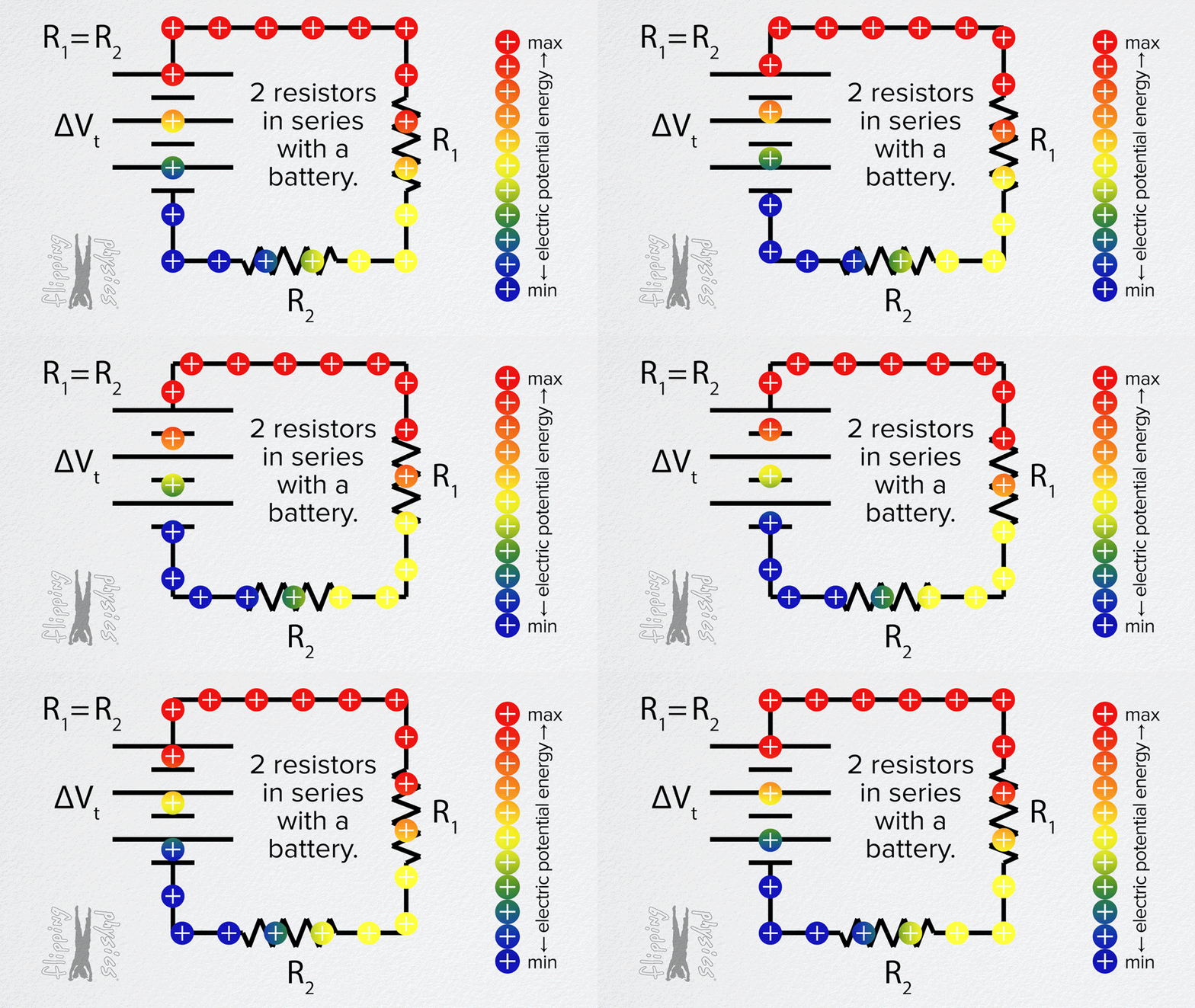
قراءة الشكل: تكتسب الشحنات طاقة في البطارية (من الأزرق إلى الأحمر) وتفقدها تدريجيًا في المقاومات.
Reading the figure: charges gain energy in the battery (blue to red) and lose it step by step in the resistors.
📜 اشتقاق قوانين القدرة
📜 Deriving the Power Laws
الطاقة التي تكتسبها الشحنة \(q\) عبر فرق الجهد \(\Delta V\) هي \(E=q\,\Delta V\)، والقدرة معدل صرف الطاقة:
The energy gained by a charge \(q\) across a potential difference \(\Delta V\) is \(E=q\,\Delta V\), and power is the rate of spending energy:
\[P=\frac{E}{t}=\frac{q\,\Delta V}{t}=I\,\Delta V\]
وبتطبيق قانون أوم \(I=\dfrac{\Delta V}{R}\) أو \(\Delta V=IR\):
Applying Ohm’s law \(I=\dfrac{\Delta V}{R}\) or \(\Delta V=IR\):
\[P=\frac{E}{t}=I\,\Delta V=\frac{\Delta V^2}{R}=I^2R\]
وحدة القدرة الواط \(W=J/s\)، والطاقة \(E=P\,t\) بالجول عندما يكون الزمن بالثواني.
The unit of power is the watt \(W=J/s\), and energy \(E=P\,t\) is in joules when time is in seconds.
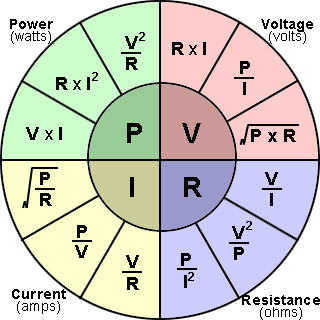
عجلة تلخّص العلاقات بين \(P\) و\(V\) و\(I\) و\(R\): اختر الكمية في الوسط واقرأ كل صيغ حسابها.
A wheel summarizing the relations among \(P\), \(V\), \(I\) and \(R\): pick the quantity in the center and read all the formulas that give it.
🧪 تجربة 1: القدرة والطاقة في مقاوم أومي
🧪 Experiment 1: Power and Energy in an Ohmic Resistor
غيّر فرق الجهد والمقاومة والزمن ولاحظ التيار والقدرة والطاقة. يتوهج الملف بحسب القدرة.
Change the voltage, resistance and time and watch the current, power and energy. The coil glows according to the power.
التكلفة محسوبة بسعر \(0.3\) درهم لكل \(kWh\). جرّب مضاعفة الجهد: تتضاعف القدرة أربع مرات.
Cost uses \(0.3\) dirham per \(kWh\). Try doubling the voltage: the power becomes four times larger.
سخان كهربائي مقاومته \(25\,\Omega\) ويعمل تحت فرق جهد \(220\,V\)، فإن قدرة السخان تعادل:
An electric heater of resistance \(25\,\Omega\) operates at \(220\,V\). Its power is:
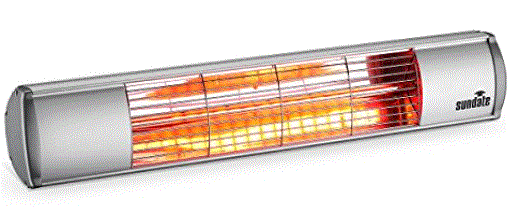
سخان كهربائي: تتحول الطاقة الكهربائية فيه إلى حرارة.
An electric heater: its electrical energy is turned into heat.
مصباح كهربائي مقاومته \(20\,\Omega\) ويصرف طاقة \(1200\,J\) خلال دقيقة واحدة، فإن شدة التيار المار في المصباح تعادل:
A lamp of resistance \(20\,\Omega\) consumes \(1200\,J\) in one minute. The current through the lamp is:
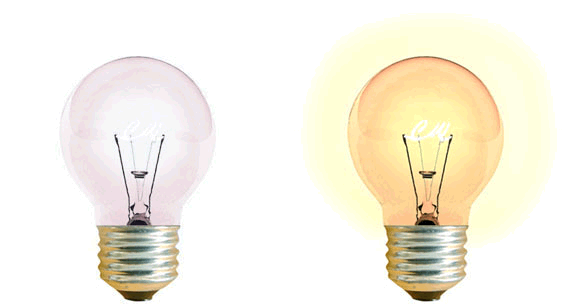
مصباح متوهج: يحوّل جزءًا صغيرًا من الطاقة إلى ضوء والباقي حرارة.
An incandescent lamp: it turns a small part of the energy into light and the rest into heat.
🔌 نقل الطاقة الكهربائية وتقليل الفقد
🔌 Power Transmission and Reducing Losses
توجد محطات التوليد عادةً خارج المدينة، وتُنقل الطاقة منها عبر شبكة أسلاك. يحدث ضياع للطاقة أثناء النقل بسبب مقاومة الأسلاك، فهناك قدرة مفقودة تتحول إلى حرارة. وبقانون الحفاظ: \(P_{sent}=P_{loss}+P_{received}\).
Generating stations are usually outside cities, and the energy travels through a network of wires. Some energy is wasted on the way because of the wires’ resistance, so there is a lost power turned into heat. By conservation: \(P_{sent}=P_{loss}+P_{received}\).
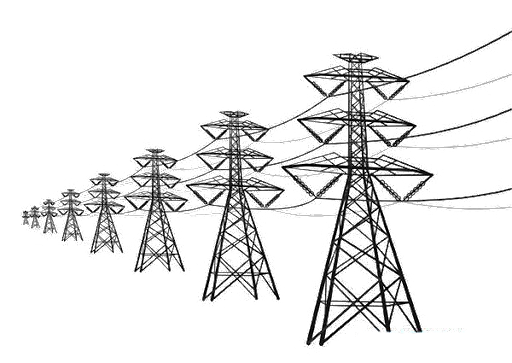
خطوط نقل الطاقة الكهربائية من محطة التوليد إلى المدن.
Power lines carrying electric energy from the generating station to cities.
📜 القدرة الضائعة في الأسلاك
📜 Power Lost in the Wires
\[P_{loss}=\frac{E}{t}=I^2R\]
لتقليل الطاقة الضائعة يجب تقليل التيار \(I\) أو تقليل المقاومة \(R\). والتيار يدخل مربعًا، فتخفيضه أكثر فعالية.
To reduce the lost energy we must reduce the current \(I\) or the resistance \(R\). Since the current enters squared, reducing it is more effective.
السلك السميك المستخدم لنقل التيار إلى منزل مقاومته \(0.20\,\Omega\) لكل \(1\,km\). منزل في مزرعة يتصل مباشرة بمحطة تبعد \(3.5\,km\). ما المقاومة الكلية للأسلاك؟ وما القدرة الضائعة إذا مرّ فيها تيار \(20\,A\)؟
The thick wire carrying current to a house has a resistance of \(0.20\,\Omega\) per \(1\,km\). A farm house is connected directly to a station \(3.5\,km\) away. What is the wires’ total resistance? What power is lost if \(20\,A\) flows?
1️⃣ أولًا: تخفيض المقاومة
1️⃣ First: Reduce the Resistance
- أسلاك ذات مساحة مقطع كبيرة لأن \(R\propto\dfrac1A\).Wires with a large cross-section because \(R\propto\dfrac1A\).
- أسلاك ذات مقاومية نوعية منخفضة مثل النحاس أو الألمنيوم.Wires with a low resistivity such as copper or aluminium.
- لكنها أغلى وأثقل وتحتاج دعامات أقوى، فهذا الحل محدود.But they are costlier, heavier and need stronger supports, so this solution is limited.
2️⃣ ثانيًا: تقليل شدة التيار
2️⃣ Second: Reduce the Current
بما أن \(P=I\,\Delta V\) فإن رفع الجهد مع بقاء القدرة المنقولة ثابتة يقلل التيار، فتقل الطاقة الضائعة \(I^2R\) كثيرًا. لذلك تُستخدم المحولات:
Since \(P=I\,\Delta V\), raising the voltage while the transmitted power stays the same reduces the current, so the lost power \(I^2R\) falls greatly. This is why transformers are used:
- عند المحطة: محول رافع للجهد خافض للتيار.At the station: a step-up transformer (voltage up, current down).
- عند المدينة: محول خافض للجهد رافع للتيار ليصبح الجهد آمنًا للاستخدام.At the city: a step-down transformer (voltage down, current up) to make the voltage safe for use.
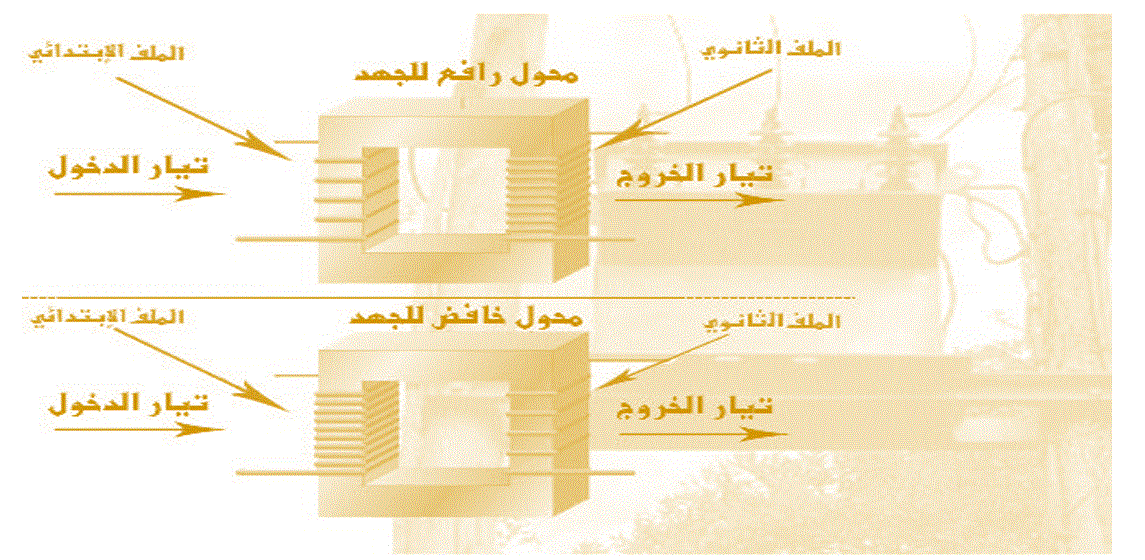
محول رافع للجهد (أعلى) ومحول خافض للجهد (أسفل).
A step-up transformer (top) and a step-down transformer (bottom).
🧪 تجربة 2: لماذا نرفع الجهد في خطوط النقل؟
🧪 Experiment 2: Why Raise the Voltage on Transmission Lines?
نُرسل قدرة ثابتة \(100\,MW\) عبر خط مقاومته الكلية \(10\,\Omega\). اختر جهد النقل ولاحظ التيار والقدرة الضائعة والكفاءة.
We send a fixed power of \(100\,MW\) through a line of total resistance \(10\,\Omega\). Choose the transmission voltage and watch the current, the lost power and the efficiency.
فسّر كيف يقلل رفع الجهد في خطوط النقل من تحول الطاقة إلى حرارة.
Explain how raising the voltage on transmission lines reduces the conversion of energy into heat.
🧊 الموصلات فائقة التوصيل
🧊 Superconductors
الموصل فائق التوصيل مادة تنعدم مقاومتها الكهربائية عندما تُبرَّد إلى ما دون درجة حرارة حرجة مميزة لها، فيمر التيار فيها دون أي فقد للطاقة.
A superconductor is a material whose electrical resistance vanishes when it is cooled below its characteristic critical temperature, so current flows in it with no energy loss.
| الخاصيةProperty | التوضيحExplanation |
|---|---|
| مقاومة صفريةZero resistance | \(R=0\) فلا فقد للطاقة أثناء التوصيل.\(R=0\), so no energy is lost during conduction. |
| درجات حرارة منخفضةLow temperatures | تلزم عادةً درجات حرارة منخفضة جدًا (أقل من نحو \(100\,K\) أو \(-173^\circ C\) في الأنواع الأعلى حرارة، وأقل من ذلك كثيرًا في المعادن التقليدية).Very low temperatures are usually needed (below about \(100\,K\) or \(-173^\circ C\) for the higher-temperature types, far lower for conventional metals). |
| تيارات كبيرة جدًاVery large currents | تحمل تيارات هائلة (حتى حد حرج تفقد بعده الخاصية).They carry enormous currents (up to a critical limit beyond which the property is lost). |
| لا حرارة مولَّدةNo heat generated | \(P=I^2R=0\) فلا تتحول الطاقة إلى حرارة.\(P=I^2R=0\), so no energy is turned into heat. |
🔬 لماذا لا يوجد فقد؟
🔬 Why Is There No Loss?
معدل تحويل الطاقة في موصل عادي \(P=I\,\Delta V\)، وفي الموصل الفائق لا ينشأ فرق جهد على طرفيه مهما كان التيار (\(\Delta V=IR=0\))، فيمكنه توصيل الكهرباء دون تحول إلى طاقة حرارية.
The rate of energy conversion in an ordinary conductor is \(P=I\,\Delta V\); in a superconductor no potential difference develops across it whatever the current (\(\Delta V=IR=0\)), so it conducts with no conversion into heat.
🏥 تطبيقات
🏥 Applications
- التصوير بالرنين المغناطيسي (MRI): مغناطيسات قوية من ملفات فائقة التوصيل لتصوير دقيق للجسم.Magnetic resonance imaging (MRI): powerful magnets from superconducting coils give detailed images of the body.
- نقل الطاقة: قد تنقل كابلات فائقة التوصيل الكهرباء إلى المدن من محطات بعيدة دون فقد يُذكر.Power transmission: superconducting cables could carry electricity to cities from distant plants with almost no loss.
ما مقدار المقاومة في الموصل فائق التوصيل؟
What is the resistance of a superconductor?
💰 التكلفة المدفوعة للطاقة
💰 The Cost of Electric Energy
تحاسب شركة الكهرباء الزبائن على الطاقة المصروفة \(E=Pt\). ولكي لا تكون الأرقام فلكية تحسبها بوحدة الكيلووات ساعة:
The electricity company charges customers for the energy used \(E=Pt\). To avoid astronomical numbers it measures energy in kilowatt-hours:
📜 الكيلووات ساعة والتكلفة
📜 The Kilowatt-Hour and the Cost
\[E(kWh)=P(kW)\times t(h)\]
\[1\,kWh=1000\,W\times3600\,s=3.6\times10^{6}\,J\]
وتحدّد الشركة سعر الوحدة (مثلًا في الإمارات نحو \(0.3\) درهم لكل \(kWh\)):
The company sets a price per unit (for example about \(0.3\) dirham per \(kWh\) in the UAE):
\[\text{Cost}=E(kWh)\times\text{price of }1\,kWh\]
مكيف هواء يمر به تيار \(10\,A\) ويعمل تحت فرق جهد \(220\,V\). احسب التكلفة المدفوعة لعمله شهرًا كاملًا (30 يومًا) علمًا بأنه يعمل \(15\) ساعة يوميًا وسعر \(1\,kWh\) يعادل \(0.3\) درهم.
An air conditioner draws \(10\,A\) at \(220\,V\). Find the cost of running it for a whole month (30 days) if it works \(15\) hours a day and \(1\,kWh\) costs \(0.3\) dirham.
يمر في سخان كهربائي تيار شدته \(15.0\,A\) من مصدر \(120\,V\)، ويُشغَّل في المتوسط \(5.0\,h\) كل يوم. (أ) ما مقدار القدرة التي يستخدمها؟ (ب) ما الطاقة بوحدة \(kWh\) التي يستهلكها في 30 يومًا؟ (ج) إذا كان سعر \(kWh\) هو \(0.30\) درهم فكم يتكلف تشغيله 30 يومًا؟
An electric heater draws \(15.0\,A\) from a \(120\,V\) source and is on for an average of \(5.0\,h\) a day. (a) How much power does it use? (b) How much energy in \(kWh\) does it use in 30 days? (c) If \(1\,kWh\) costs \(0.30\) dirham, what does it cost to run for 30 days?
ساعة رقمية مقاومتها \(12000\,\Omega\) متصلة بمأخذ كهرباء \(115\,V\). (أ) كم التيار الذي تسحبه؟ (ب) كم القدرة التي تستخدمها؟ (ج) إذا كان سعر \(kWh\) هو \(0.30\) درهم فكم يتكلف تشغيلها 30 يومًا؟
A digital clock of resistance \(12000\,\Omega\) is connected to a \(115\,V\) outlet. (a) What current does it draw? (b) What power does it use? (c) If \(1\,kWh\) costs \(0.30\) dirham, what does it cost to run it for 30 days?
بطارية سيارة تُنتج \(55\,A\) عند \(12\,V\) لمدة \(1.0\,h\)، وتتطلب \(1.3\) ضعف الطاقة لإعادة الشحن بسبب كفاءتها الأقل من المثالية. كم المدة اللازمة لشحنها بتيار \(7.5\,A\)؟ افترض أن فولتية الشحن هي نفسها فولتية التفريغ.
A car battery delivers \(55\,A\) at \(12\,V\) for \(1.0\,h\) and needs \(1.3\) times as much energy to recharge because its efficiency is less than ideal. How long does it take to charge it with \(7.5\,A\)? Assume the charging voltage equals the discharging voltage.
📝 ملخص الدرس
📝 Lesson Summary
- \(P=\dfrac{E}{t}=I\,\Delta V=\dfrac{\Delta V^2}{R}=I^2R\) و \(E=Pt\).\(P=\dfrac{E}{t}=I\,\Delta V=\dfrac{\Delta V^2}{R}=I^2R\) and \(E=Pt\).
- \(1\,kWh=3.6\times10^{6}\,J\) والتكلفة \(=\) الطاقة بالـ \(kWh\) \(\times\) سعر الوحدة.\(1\,kWh=3.6\times10^{6}\,J\) and cost \(=\) energy in \(kWh\) \(\times\) unit price.
- فقد القدرة في الأسلاك \(I^2R\): نقلله بأسلاك أكبر مساحة وأقل مقاومية، والأفضل برفع الجهد لتقليل التيار.The lost power in wires is \(I^2R\): reduce it with larger-area, lower-resistivity wires, and best of all by raising the voltage to reduce the current.
- المحول الرافع عند المحطة والخافض عند المدينة.A step-up transformer at the station and a step-down one at the city.
- الموصل فائق التوصيل مقاومته صفر دون درجة حرارة حرجة فلا فقد للطاقة.A superconductor has zero resistance below a critical temperature, so no energy is lost.
🧪 اختبر نفسك: امتحان من 20 سؤالاً
🧪 Test Yourself: a 20-Question Exam
أنهِ الدرس بالاختبار التفاعلي التالي؛ أسئلته بمستوى متوسط وعالٍ وتجمع بين الفهم والحساب.
Finish with the interactive exam below; its questions are of medium and high difficulty and mix understanding with calculation.
اختبار استخدام الطاقة الكهربائية Using Electric Energy Quiz
20 سؤالاً - القدرة والطاقة، الكيلووات ساعة والتكلفة، نقل الطاقة، والموصلات فائقة التوصيل 20 Questions - Power and Energy, kWh and Cost, Power Transmission, and Superconductors
• عدد الأسئلة: 20 سؤالاً
• مدة الاختبار: 30 دقيقة
• لا يمكنك تغيير إجاباتك أو إعادة الاختبار إلا بعد 24 ساعة من التسليم.
• تأكد من إجاباتك قبل التسليم! 📌 Important Instructions:
• Number of questions: 20 questions
• Quiz duration: 30 minutes
• You cannot change your answers or retake the quiz for 24 hours after submission.
• Make sure of your answers before submitting!
🔗 محاكيات GeoGebra للاستعانة بها عند اللزوم
🔗 GeoGebra Simulations to Use When Needed
اضغط «تشغيل» لتعمل المحاكاة هنا داخل الدرس؛ ويمكن للطالب الرجوع إليها لتجربة الفكرة بطريقة أخرى.
Press “Run” to run the simulation right here inside the lesson; the student can use it to try the idea in another way.