🎯 نواتج التعلم
🎯 Learning Outcomes
بعد دراسة هذا الدرس ستكون قادرًا على أن:
After this lesson you will be able to:
- تذكر سرعة الضوء وتفسّر الانتشار المستقيم وتكوّن الظل وشبه الظل.State the speed of light and explain rectilinear propagation and the formation of umbra and penumbra.
- تميّز بين الأجسام المضيئة والمستضاءة وبين الشفافة وشبه الشفافة والمعتمة.Distinguish luminous from illuminated bodies and transparent, translucent and opaque ones.
- تعرّف التدفق الضوئي وشدة الإضاءة والاستضاءة وتحسبها وتطبّق قانون التربيع العكسي.Define luminous flux, luminous intensity and illuminance, calculate them and apply the inverse-square law.
- تفسّر الحيود وتحليل الضوء إلى ألوانه ومزج الأضواء والأصباغ ورؤية الأجسام بألوانها.Explain diffraction, the splitting of light into colours, the mixing of lights and pigments and the seeing of coloured objects.
- تطبّق قانون مالوس للاستقطاب وتحسب انزياح دوبلر للضوء.Apply Malus’s law for polarization and calculate the Doppler shift of light.
💡 ما هو الضوء؟
💡 What Is Light?
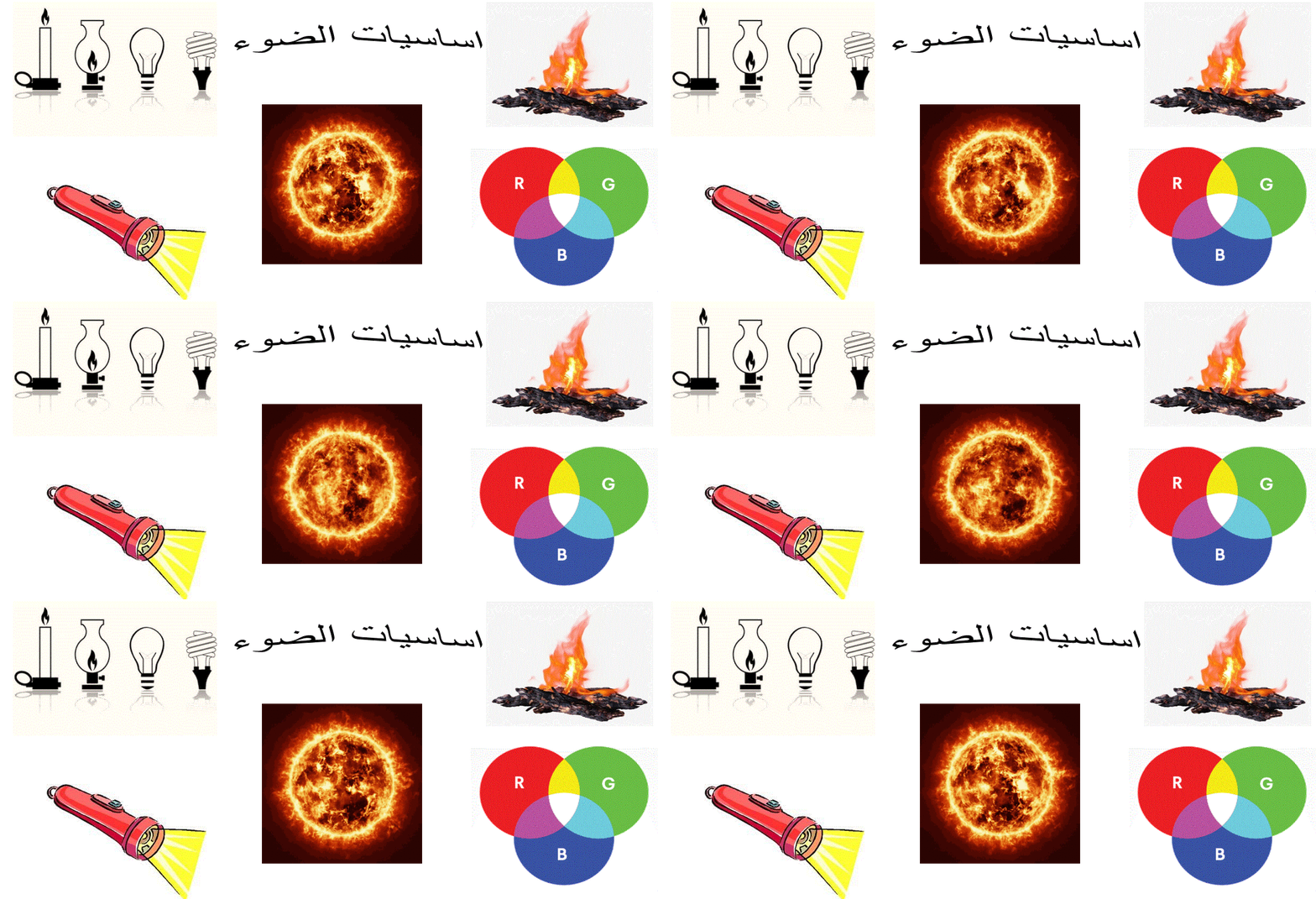
مصادر ضوئية متنوعة: مصابيح وشمس ونار ومصباح يدوي.
Various light sources: lamps, the sun, fire and a torch.
الضوء شكل من أشكال الطاقة يمكن للعين البشرية أن تراه، وهو موجة كهرومغناطيسية. ينتقل في الفراغ بسرعة ثابتة \(c\approx3\times10^8\ \mathrm{m/s}\) (أي نحو \(300\,000\ \mathrm{km/s}\))، وهي أسرع سرعة معروفة في الكون؛ ولهذا يصلنا ضوء الشمس بعد نحو \(8.3\) دقائق فقط من أن يغادرها.
Light is a form of energy that the human eye can see, and it is an electromagnetic wave. It travels in vacuum at a constant speed \(c\approx3\times10^8\ \mathrm{m/s}\) (about \(300\,000\ \mathrm{km/s}\)), the fastest speed known in the universe; this is why sunlight reaches us only about \(8.3\) minutes after leaving the Sun.
🔎 زيادة شرح: مَن يرسل الضوء ومَن يعكسه؟
🔎 More explanation: who emits light and who reflects it?
أجسام مضيئة تصدر الضوء بنفسها مثل الشمس والنار واليراع (اليراعة) والمصباح. أجسام مستضاءة لا تصدر ضوءًا بل تعكس ضوء غيرها مثل القمر والكتاب والأشجار. نحن نرى القمر ليلًا لأنه يعكس ضوء الشمس، لا لأنه يضيء.
Luminous bodies emit light themselves such as the Sun, fire, the firefly and the lamp. Illuminated bodies do not emit light but reflect the light of others such as the Moon, the book and the trees. We see the Moon at night because it reflects sunlight, not because it shines.
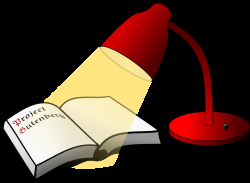
المصباح جسم مضيء، والكتاب جسم مستضاء يعكس ضوء المصباح إلى أعيننا.
The lamp is a luminous body; the book is an illuminated body reflecting the lamp’s light to our eyes.
| نوع الجسمKind of body | ما يفعله بالضوءWhat it does to light | أمثلةExamples |
|---|---|---|
| شفافTransparent | يسمح بمرور الضوء كله تقريبًا فنرى الأشياء خلفه بوضوحlets almost all the light through so we see things behind it clearly | الزجاج الصافي، الهواءclear glass, air |
| شبه شفاف (نصف شفاف)Translucent | يمرّر جزءًا من الضوء ويشتّته فلا نرى ما خلفه بوضوحpasses part of the light and scatters it so we do not see clearly behind it | الزجاج الخشن، الورق الزيتيfrosted glass, oiled paper |
| معتمOpaque | لا يمرّر أي جزء من الضوء (يمتصه أو يعكسه)passes no light at all (absorbs or reflects it) | الكتاب، الخشب، المعادنa book, wood, metals |
أي مما يأتي جسم مستضاء وليس مضيئًا؟
Which of the following is an illuminated body, not a luminous one?
➖ انتشار الضوء في خطوط مستقيمة
➖ Light Travels in Straight Lines
ينتشر الضوء في خطوط مستقيمة ما دام يسير في وسط واحد متجانس. والدليل: عندما نسلّط الضوء على لوح معدني يظهر خلفه ظل للوح؛ ولو كان الضوء يسير في خطوط منحنية لتسرّب خلف اللوح ولم يظهر ظل واضح. كذلك تمرّ الأشعة بثقبين متقابلين في حاجزين فقط إذا كان الثقبان والمصدر على استقامة واحدة. وبهذه الخاصية نفهم عمل الكاميرا ذات الثقب والعين ونرسم الأشعة بخطوط مستقيمة.
Light travels in straight lines as long as it moves in a single uniform medium. The evidence: when we shine light on a metal plate a shadow of the plate appears behind it; if light travelled along curved paths it would leak behind the plate and no clear shadow would appear. Likewise rays pass through two aligned holes in two barriers only if the holes and the source are in a straight line. With this property we understand the pinhole camera and the eye and draw rays as straight lines.
🧪 تجربة 1: الظل والانتشار المستقيم للضوء
🧪 Experiment 1: Shadows and the straight-line travel of light
اضغط «أضئ المصدر». الأشعة الأربعة الحدّية تسير في خطوط مستقيمة وتصنع على الحاجز ظلًّا. بمصدر نقطي (حجمه صفر) يكون الظل حادًّا، وبمصدر ممتد تظهر منطقة معتمة تمامًا (الظل) تحيط بها منطقة مضاءة جزئيًا (شبه الظل). غيّر حجم المصدر وموضع الجسم لتلاحظ.
Press “Switch the source on”. The four boundary rays travel in straight lines and make a shadow on the screen. With a point source (size zero) the shadow is sharp; with an extended source a completely dark region (the umbra) appears surrounded by a partly lit region (the penumbra). Change the source size and the object position to see.
📝 ماذا نتعلم من التجربة؟
📝 What do we learn from the experiment?
الظل (الأمبرا) منطقة لا يصلها أي ضوء من المصدر. شبه الظل منطقة يصلها ضوء من جزء من المصدر فقط. المصدر النقطي لا يكوّن شبه ظل. وكلما كبر المصدر أو اقترب الجسم من الحاجز زاد شبه الظل. (الكسوف والخسوف مثالان للظل وشبه الظل.)
The umbra is a region that receives no light from the source. The penumbra is a region that receives light from part of the source only. A point source gives no penumbra. The larger the source or the closer the object to the screen the larger the penumbra. (Eclipses are examples of umbra and penumbra.)
مصدر ضوئي نقطي يضيء جسمًا معتمًا؛ الظل على الحاجز:
A point light source illuminates an opaque object; the shadow on the screen:
🔆 التدفق الضوئي
🔆 Luminous Flux
المصابيح المختلفة تُصدر كميات مختلفة من الضوء. نسمّي مقدار الضوء الصادر من المنبع في كل الاتجاهات (عدد الأشعة الصادرة) التدفق الضوئي ويرمز له بالرمز \(\Phi\) (أو \(P\))، ووحدته اللومن \((\mathrm{lm})\).
Different lamps emit different amounts of light. We call the amount of light emitted by a source in all directions (the number of rays emitted) the luminous flux, denoted \(\Phi\) (or \(P\)), with the unit lumen \((\mathrm{lm})\).
💡 زيادة شرح: القدرة الكهربائية ليست التدفق الضوئي
💡 More explanation: electric power is not luminous flux
قدرة المصباح (واط) هي الطاقة الكهربائية التي يستهلكها كل ثانية، أما التدفق الضوئي (لومن) فهو ما يصدره من ضوء مرئي. النسبة بينهما الكفاءة الضوئية (لومن/واط): نحو \(13\) للمتوهج و\(17\) للهالوجين و\(60\) للفلورسنت المدمج و\(80\) أو أكثر لـ LED. لذلك يعطي مصباح LED قدرته \(10\ \mathrm{W}\) ضوءًا يقارب مصباحًا متوهجًا قدرته \(60\ \mathrm{W}\) ويُهدر طاقة أقل على شكل حرارة.
A lamp’s power (watt) is the electrical energy it uses each second, while the luminous flux (lumen) is the visible light it emits. Their ratio is the luminous efficacy (lm/W): about \(13\) for a filament lamp, \(17\) for halogen, \(60\) for a compact fluorescent and \(80\) or more for an LED. So a \(10\ \mathrm{W}\) LED gives about as much light as a \(60\ \mathrm{W}\) filament lamp and wastes less energy as heat.
🧪 تجربة 2: المصابيح والتدفق الضوئي وشدة الإضاءة
🧪 Experiment 2: Lamps, luminous flux and luminous intensity
اختر نوع المصباح وقدرته وبعد السطح عنه ثم اضغط «شغّل المصباح». التدفق الضوئي \(\Phi\) بوحدة اللومن (lm) هو «كمية الضوء» الصادرة، ويساوي القدرة × الكفاءة الضوئية (lm/W). ثم تُحسب شدة الإضاءة \(I=\Phi/4\pi\) (كانديلا) والاستضاءة \(E=\Phi/4\pi d^2\) (لوكس). لاحظ أن مصباح LED بقدرة صغيرة يعطي تدفقًا يقارب المتوهّج الكبير.
Choose the lamp type, its power and the surface distance, then press “Switch the lamp on”. The luminous flux \(\Phi\) in lumen (lm) is the “amount of light” emitted: power × luminous efficacy (lm/W). Then the luminous intensity \(I=\Phi/4\pi\) (candela) and the illuminance \(E=\Phi/4\pi d^2\) (lux) follow. Notice that a low-power LED gives a flux comparable to a big filament lamp.
📏 الاستضاءة وقانون التربيع العكسي
📏 Illuminance and the Inverse-Square Law
عندما نشعل شمعة نرى ضوءها من جميع الجهات لأن الضوء ينتشر على شكل أمواج كروية في كل الاتجاهات. على بُعد \(r\) من المصدر يتوزع التدفق نفسه على سطح كرة مساحته \(4\pi r^2\). نسمّي التدفق الضوئي الساقط على وحدة المساحة الاستضاءة \(E\)، ووحدتها اللوكس \((\mathrm{lx}=\mathrm{lm/m^2})\).
When we light a candle we see its light from all sides because light spreads as spherical waves in all directions. At a distance \(r\) from the source the same flux is spread over a sphere of area \(4\pi r^2\). The luminous flux falling on a unit area is called the illuminance \(E\), with the unit lux \((\mathrm{lx}=\mathrm{lm/m^2})\).
📌 قانون الاستضاءة
📌 The illuminance law
\[E=\dfrac{\Phi}{4\pi r^{2}}\]
الاستضاءة تتناسب طرديًا مع التدفق الضوئي وعكسيًا مع مربع البعد عن المصدر. إذا تضاعف البعد صارت الاستضاءة الربع؛ وإذا صار ثلاثة أمثاله صارت التسع. وهذا القانون لمصدر نقطي يشعّ بالتساوي في جميع الاتجاهات وعلى سطح عمودي على الأشعة.
The illuminance is directly proportional to the luminous flux and inversely proportional to the square of the distance from the source. If the distance doubles the illuminance becomes a quarter; if it triples it becomes a ninth. This holds for a point source radiating equally in all directions and a surface perpendicular to the rays.
🧪 تجربة 3: علاقة الاستضاءة بالبعد: قانون التربيع العكسي
🧪 Experiment 3: Illuminance against distance: the inverse-square law
غيّر التدفق \(\Phi\) والبعد \(d\) واقرأ الاستضاءة. اضغط «سجّل القياس» لإضافة صف إلى الجدول (كما في ورقة التجربة) وكرّر لعدة أبعاد: ستجد أن \(E\cdot d^2\) ثابت وأن النقاط في الرسم (\(E\) مع \(1/d^2\)) تقع على مستقيم يمر بالأصل ميله \(\Phi/4\pi\).
Change the flux \(\Phi\) and the distance \(d\) and read the illuminance. Press “Record the reading” to add a row to the table (like the experiment sheet) and repeat for several distances: you will find that \(E\cdot d^2\) is constant and that the points of the graph (\(E\) against \(1/d^2\)) lie on a straight line through the origin with slope \(\Phi/4\pi\).
تعليمات تجربة الجدول: ثبّت التدفق \(\Phi\) عند قيمة (مثلًا \(1000\ \mathrm{lm}\)) وغيّر البعد \(d\) خمس مرات، وسجّل في كل مرة الاستضاءة، ثم احسب \(d^2\) و\(1/d^2\). ارسم \(E\) مع \(1/d^2\) فتحصل على مستقيم يمر بالأصل ميله \(\Phi/4\pi\).
Instructions for the table experiment: fix the flux \(\Phi\) at one value (say \(1000\ \mathrm{lm}\)) and change the distance \(d\) five times, recording the illuminance each time, then calculate \(d^2\) and \(1/d^2\). Plot \(E\) against \(1/d^2\) and you get a straight line through the origin with slope \(\Phi/4\pi\).
أمثلة محلولة
Worked Examples
مصدر ضوئي تدفقه \(300\ \mathrm{lm}\). ما الاستضاءة على سطح يبعد عنه \(0.5\ \mathrm{m}\)؟
A light source has a luminous flux of \(300\ \mathrm{lm}\). What is the illuminance on a surface \(0.5\ \mathrm{m}\) away?
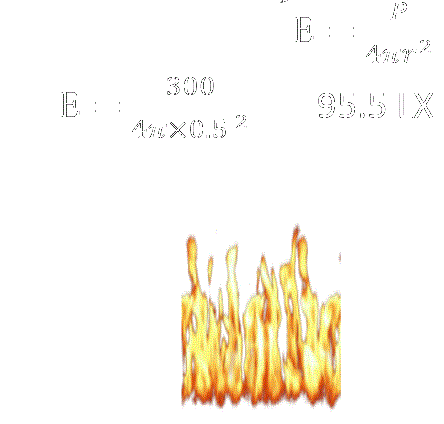
الحل المصوّر للمثال 1: \(E=95.5\ \mathrm{lx}\).
The illustrated solution of example 1: \(E=95.5\ \mathrm{lx}\).
في الشكل يقف المراقب \(A\) على بعد \(2\ \mathrm{m}\) من المصباح، ويقف المراقب \(B\) خلفه على بعد \(4\ \mathrm{m}\) من \(A\) (أي \(6\ \mathrm{m}\) من المصباح). ما نسبة سطوع الضوء الذي يراه \(A\) إلى ما يراه \(B\)؟
In the figure observer \(A\) stands \(2\ \mathrm{m}\) from the lamp and observer \(B\) stands behind \(A\) at \(4\ \mathrm{m}\) from \(A\) (that is \(6\ \mathrm{m}\) from the lamp). What is the ratio of the brightness seen by \(A\) to that seen by \(B\)?
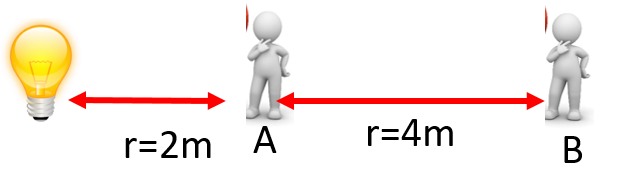
شكل المثال 2: \(r_A=2\ \mathrm{m}\) و\(r_B=6\ \mathrm{m}\).
Figure of example 2: \(r_A=2\ \mathrm{m}\) and \(r_B=6\ \mathrm{m}\).
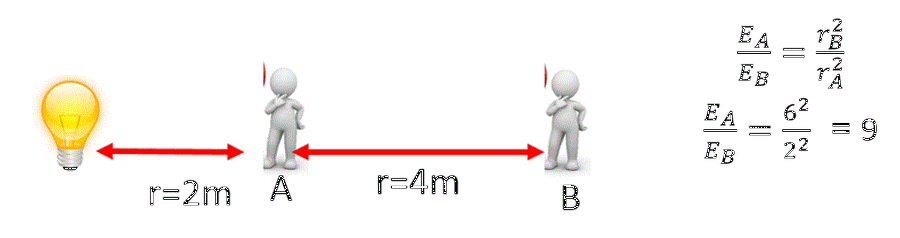
الحل المصوّر للمثال 2.
The illustrated solution of example 2.
مصباح بين المراقبين \(A\) و\(B\) على استقامة واحدة؛ \(B\) على بعد \(4\ \mathrm{m}\) منه. إذا كانت استضاءة \(A\) أربعة أمثال استضاءة \(B\) فعلى أي بعد من المصباح يقف \(A\)؟
A lamp lies between observers \(A\) and \(B\) on one line; \(B\) is \(4\ \mathrm{m}\) from it. If the illuminance at \(A\) is four times that at \(B\), how far from the lamp is \(A\)?
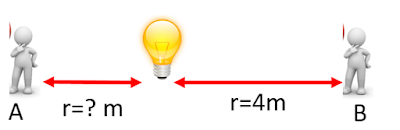
شكل المثال 3.
Figure of example 3.
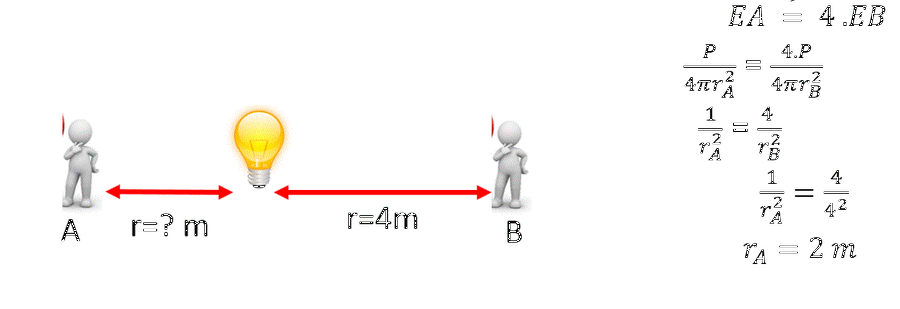
الحل المصوّر للمثال 3.
The illustrated solution of example 3.
إذا زاد البعد عن مصدر نقطي من \(1\ \mathrm{m}\) إلى \(3\ \mathrm{m}\) فإن الاستضاءة تصبح:
If the distance from a point source increases from \(1\ \mathrm{m}\) to \(3\ \mathrm{m}\) the illuminance becomes:
🕯️ شدة الإضاءة
🕯️ Luminous Intensity
شدة الإضاءة \(I\) كمية فيزيائية تقيس «قوة» الضوء الصادر من منبع في اتجاه معيّن؛ أي هي التدفق الضوئي الصادر في كل وحدة زاوية صلبة (ستراديان). وحدتها الكانديلا \((\mathrm{cd})\) وهي إحدى الوحدات الأساسية في النظام الدولي (SI).
Luminous intensity \(I\) is a physical quantity measuring the “strength” of the light a source emits in a particular direction; it is the luminous flux emitted per unit solid angle (steradian). Its unit is the candela \((\mathrm{cd})\), one of the base units of the SI system.
📌 المصدر المتناظر
📌 The isotropic source
المصدر المتناظر يُشعّ بالشدة نفسها في كل الاتجاهات (والمصابيح المتوهجة العادية قريبة من ذلك). الزاوية الصلبة الكلية حول نقطة هي \(4\pi\ \mathrm{sr}\)، فيكون:
An isotropic source radiates with the same intensity in all directions (ordinary filament lamps are close to this). The total solid angle around a point is \(4\pi\ \mathrm{sr}\), so:
\[I=\dfrac{\Phi}{4\pi}\qquad\Rightarrow\qquad E=\dfrac{I}{r^{2}}\]
مصباح متوهج (مصدر شبه متناظر) تدفقه الضوئي الكلي \(\Phi=1256\ \mathrm{lm}\). احسب شدة إضاءته، ثم الاستضاءة على بعد \(2\ \mathrm{m}\).
A filament lamp (a nearly isotropic source) has a total luminous flux \(\Phi=1256\ \mathrm{lm}\). Find its luminous intensity and then the illuminance at \(2\ \mathrm{m}\).
وحدة قياس شدة الإضاءة هي:
The unit of luminous intensity is:
| الكميةQuantity | الرمزSymbol | الوحدةUnit | العلاقةRelation |
|---|---|---|---|
| التدفق الضوئيLuminous flux | \(\Phi\)\(\Phi\) | لومن lmlumen lm | كمية الضوء الكليةtotal amount of light |
| شدة الإضاءةLuminous intensity | \(I\)\(I\) | كانديلا cdcandela cd | \(I=\Phi/4\pi\)\(I=\Phi/4\pi\) |
| الاستضاءةIlluminance | \(E\)\(E\) | لوكس lxlux lx | \(E=\Phi/4\pi r^2=I/r^2\)\(E=\Phi/4\pi r^2=I/r^2\) |
〰️ حيود الضوء
〰️ Diffraction of Light
الحيود هو انحراف اتجاه انتشار الموجة عندما تجتاز فتحات ضيقة أو حواف حواجز. والحيود ظاهرة تخص الموجات فقط؛ فلمّا حاد الضوء عن مساره عرفنا أنه موجة.
Diffraction is the change in direction of a wave’s propagation when it passes narrow openings or the edges of barriers. Diffraction is a phenomenon of waves only; since light bends around obstacles we know that it is a wave.
ولكن حيود الضوء صعب الملاحظة لأن طوله الموجي صغير جدًا (من \(400\) إلى \(700\ \mathrm{nm}\))؛ فلكي يحيد يجب أن يكون عرض الفتحة أو سُمك الحاجز قريبًا من الطول الموجي. أما الصوت (طوله الموجي أمتار) فيحيد بسهولة حول زوايا الأبواب.
But diffraction of light is hard to notice because its wavelength is very small (\(400\) to \(700\ \mathrm{nm}\)); for it to bend, the width of the opening or the thickness of the barrier must be close to the wavelength. Sound (with wavelengths of metres) bends easily around door corners.
🧪 تجربة 7: حيود الضوء في شق ضيق
🧪 Experiment 7: Diffraction of light by a narrow slit
اضغط «حرّك الموجات»: موجات مستوية تصل إلى الحاجز فتعبر الشق وتنتشر خلفه. كلما ضاق الشق نسبة إلى الطول الموجي زاد انتشار الموجة (الحيود). تحدد الزاوية \(\theta\) لأول نقطة معتمة العلاقة \(\sin\theta=\lambda/a\). ولأن \(\lambda\) للضوء صغير جدًا (~\(500\ \mathrm{nm}\)) يصعب ملاحظة حيوده إلا بشقوق ضيقة جدًا.
Press “Move the waves”: plane waves reach the barrier, cross the slit and spread behind it. The narrower the slit relative to the wavelength the more the wave spreads (diffraction). The angle \(\theta\) of the first dark point follows \(\sin\theta=\lambda/a\). Since the wavelength of light is so small (~\(500\ \mathrm{nm}\)) its diffraction is only noticeable with very narrow slits.
نلاحظ حيود الضوء بوضوح عندما يمرّ في فتحة:
We notice the diffraction of light clearly when it passes a slit:
🌈 الألوان
🌈 Colours
الضوء الأبيض يتكوّن من سبعة ألوان هي ألوان الطيف: الأحمر، البرتقالي، الأصفر، الأخضر، الأزرق، النيلي، البنفسجي. لكل لون طول موجي مختلف؛ أكبرها طولًا موجيًا الأحمر وأقلها البنفسجي. وعندما يدخل الضوء الأبيض منشورًا زجاجيًا تنتقل ألوانه فيه بسرعات مختلفة (لكل لون معامل انكسار مختلف) فتنكسر بزوايا مختلفة وتتفرق إلى ألوان الطيف. تُسمى هذه الظاهرة التفرق (التحليل اللوني).
White light is made up of seven colours, the colours of the spectrum: red, orange, yellow, green, blue, indigo, violet. Each colour has a different wavelength; red has the longest wavelength and violet the shortest. When white light enters a glass prism its colours travel in it at different speeds (each colour has a different refractive index) so they refract at different angles and spread out into the colours of the spectrum. This phenomenon is called dispersion.
🧪 تجربة 4: المنشور الزجاجي: تحليل الضوء الأبيض
🧪 Experiment 4: The glass prism: splitting white light
اضغط «ألقِ الضوء» ليسقط شعاع أبيض على المنشور. لكل لون معامل انكسار مختلف (يزداد كلما قصر الطول الموجي) فينحرف البنفسجي أكثر من الأحمر. غيّر زاوية رأس المنشور وزاوية السقوط، أو اختر لونًا واحدًا لترى أن اللون المفرد لا يتفرق.
Press “Shine the light” so a white beam falls on the prism. Each colour has a different refractive index (it grows as the wavelength shortens) so violet bends more than red. Change the prism’s apex angle and the angle of incidence, or choose a single colour to see that a single colour does not split.
الألوان الأساسية للضوء
The Primary Colours of Light
الألوان الأساسية للضوء ثلاثة: الأحمر والأخضر والأزرق. عند خلطها بنسب متساوية تعطي الضوء الأبيض، وخلط كل اثنين منها يعطي لونًا ثانويًا: أحمر + أخضر = أصفر، أحمر + أزرق = أرجواني، أزرق + أخضر = سماوي. وهذا الخلط الجمعي لأن كل ضوء يضيف طاقة جديدة.
The primary colours of light are three: red, green and blue. Mixed in equal proportions they give white light, and mixing any two gives a secondary colour: red + green = yellow, red + blue = magenta, blue + green = cyan. This is additive mixing because each light adds new energy.
الألوان الأساسية للأصباغ
The Primary Colours of Pigments
الألوان الأساسية للأصباغ ثلاثة: السماوي والأرجواني والأصفر. عند خلطها بنسب متساوية تعطي اللون الأسود، وكل اثنين منها يعطيان: أرجواني + أصفر = أحمر، أرجواني + سماوي = أزرق، أصفر + سماوي = أخضر. وهذا الخلط الطرحي لأن كل صبغ يمتص (يطرح) جزءًا من الضوء الساقط.
The primary colours of pigments are three: cyan, magenta and yellow. Mixed in equal proportions they give black, and any two give: magenta + yellow = red, magenta + cyan = blue, yellow + cyan = green. This is subtractive mixing because each pigment absorbs (subtracts) part of the incident light.
🧪 تجربة 5: خلط الأضواء الملونة وخلط الأصباغ
🧪 Experiment 5: Mixing coloured lights and mixing pigments
اختر نوع الخلط ثم شغّل أو أطفئ كل لون من الثلاثة بالأزرار. الأضواء (أحمر، أخضر، أزرق) تُجمع فتعطي ألوانًا أفتح حتى الأبيض. الأصباغ (سماوي، أرجواني، أصفر) تمتص ما تمتصه كل منها فتعطي ألوانًا أغمق حتى الأسود.
Choose the kind of mixing then switch each of the three colours on or off with the buttons. Lights (red, green, blue) add up to give lighter colours up to white. Pigments (cyan, magenta, yellow) each absorb their share so they give darker colours down to black.
جرّب: أحمر + أخضر = أصفر، أحمر + أزرق = أرجواني، أزرق + أخضر = سماوي (أضواء)؛ أرجواني + أصفر = أحمر، أرجواني + سماوي = أزرق، أصفر + سماوي = أخضر (أصباغ).Try: red + green = yellow, red + blue = magenta, blue + green = cyan (lights); magenta + yellow = red, magenta + cyan = blue, yellow + cyan = green (pigments).
عند خلط الضوء الأحمر مع الضوء الأخضر بنسبتين متساويتين نحصل على الضوء:
Mixing red light with green light in equal proportions gives:
كيف نرى الأجسام بألوانها؟
How Do We See Objects in Their Colours?
👁️ خطوات رؤية اللون
👁️ Steps of seeing colour
- مصدر الضوء (الشمس أو المصباح) يبعث ضوءًا يحوي ألوان الطيف المختلفة.The light source (the Sun or a lamp) emits light containing the different colours of the spectrum.
- عندما يسقط الضوء على جسم يمتص بعض الألوان ويعكس البعض الآخر.When the light falls on an object it absorbs some colours and reflects others.
- اللون الذي نراه هو اللون المنعكس إلى أعيننا.The colour we see is the colour reflected to our eyes.
- الجسم الأحمر يمتص كل الألوان ويعكس الأحمر فقط تحت الضوء الأبيض؛ الأسود يمتص الكل فلا يعكس شيئًا؛ والأبيض يعكس الكل.A red object absorbs all colours and reflects only red under white light; a black object absorbs everything and reflects nothing; a white object reflects everything.
وعند تسليط ضوء ملوّن على جسم ملوّن يمكنه أن يعكس فقط ما يوجد في الضوء الساقط: جسم أحمر تحت ضوء أخضر لا يجد ما يعكسه فيبدو أسود، وجسم أصفر (يعكس الأحمر والأخضر) تحت ضوء أحمر يبدو أحمر.
When coloured light is shone on a coloured object it can reflect only what is present in the incident light: a red object under green light finds nothing to reflect so it looks black, and a yellow object (reflecting red and green) under red light looks red.
🧪 تجربة 6: كيف نرى لون الجسم؟ جسم ملوّن تحت ضوء ملوّن
🧪 Experiment 6: How do we see an object’s colour? A coloured object under coloured light
اختر لون الجسم ولون الضوء المسلَّط عليه. الجسم يعكس من الضوء الساقط ما يتفق مع لونه ويمتص الباقي، فنرى اللون المنعكس فقط. توقّع النتيجة أولًا ثم اضغط «تحقق».
Choose the colour of the object and the colour of the light shone on it. The object reflects those parts of the incident light that match its colour and absorbs the rest, so we see the reflected colour only. Predict the result first then press “Check”.
جسم أحمر يُسلَّط عليه ضوء أزرق نقي؛ يبدو الجسم:
A red object is lit by pure blue light; it looks:
↔️ الاستقطاب
↔️ Polarization
الاستقطاب خاصية تصف اتجاه اهتزاز المجال الكهربائي للموجة الكهرومغناطيسية (وهي موجة مستعرضة). الضوء الطبيعي غير مستقطب يهتز في جميع الاتجاهات المتعامدة على اتجاه الانتشار، أما الضوء المستقطب فيهتز في اتجاه واحد محدد. والاستقطاب يخص الموجات المستعرضة فقط (ولا يحدث للصوت لأنه موجة طولية).
Polarization is a property describing the direction of vibration of the electric field of an electromagnetic wave (a transverse wave). Natural light is unpolarized: it vibrates in all directions perpendicular to the direction of propagation, whereas polarized light vibrates in one fixed direction. Polarization concerns transverse waves only (it does not occur for sound, a longitudinal wave).
نموذج الحبل: عندما يكون اهتزاز الحبل موازيًا للشق يعبر الحبل من الشق، وعندما يكون متعامدًا مع الشق لا يعبر.
The rope model: when the rope vibrates parallel to the slit it passes through the slit, and when it vibrates perpendicular to the slit it does not pass.
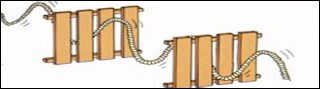
الاهتزاز موازٍ للشق: تعبر.
Vibration parallel to the slit: it passes.
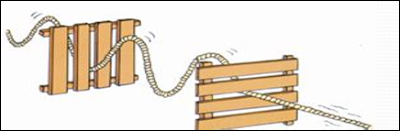
الاهتزاز متعامد مع الشق: لا تعبر.
Vibration perpendicular to the slit: it is blocked.
طرق الاستقطاب
Ways of Polarizing Light
| الطريقةMethod | الفكرةThe idea |
|---|---|
| الامتصاص (مرشحات بولارويد)Absorption (polaroid filters) | سلاسل جزيئات طويلة تمتص الاهتزاز الموازي لها وتمرّر المتعامد عليها؛ كما في النظارات الشمسية.long molecular chains absorb vibrations parallel to them and pass the perpendicular ones; as in sunglasses. |
| الانعكاسReflection | الضوء المنعكس عن سطح غير معدني (زجاج، ماء) يصبح مستقطبًا جزئيًا؛ وعند زاوية بروستر يصبح مستقطبًا كليًا ويكون الشعاع المنعكس عموديًا على المنكسر.light reflected from a non-metallic surface (glass, water) becomes partly polarized; at Brewster’s angle it is completely polarized and the reflected ray is perpendicular to the refracted ray. |
| الانكسار المزدوجDouble refraction | بلورات كالكالسيت لها معاملا انكسار فيتفرق الضوء إلى شعاعين مستقطبين متعامدين (عادي وغير عادي).crystals such as calcite have two refractive indices so the light splits into two perpendicularly polarized rays (ordinary and extraordinary). |
| التشتتScattering | ضوء السماء المتشتت من جزيئات الهواء مستقطب جزئيًا، وأعلى درجة عند \(90^\circ\) عن الشمس.sky light scattered by air molecules is partly polarized, most at \(90^\circ\) from the Sun. |
قانون مالوس
Malus’s Law
عندما يمر ضوء غير مستقطب عبر مستقطب تهبط شدته إلى النصف \(I_1=I_0/2\) ويصبح مستقطبًا في اتجاه محور المستقطب. إذا وُضع بعده مرشح ثانٍ (محلّل) يصنع محوره زاوية \(\theta\) مع المحور الأول نفذت الشدة:
When unpolarized light passes through a polarizer its intensity falls to half, \(I_1=I_0/2\), and it becomes polarized along the polarizer’s axis. If a second filter (analyzer) is placed after it with its axis at an angle \(\theta\) to the first axis the intensity that passes is:
📌 قانون مالوس
📌 Malus’s law
\[I=I_1\cos^2\theta\]
\(\theta=0^\circ\) أو \(180^\circ\) (محوران متوازيان): \(I=I_1\) أقصى شدة. \(\theta=90^\circ\) (متعامدان): \(I=0\) ظلام تام. \(\theta=60^\circ\): \(\cos^260^\circ=0.25\) فيمرّ الربع. وبين الصفر و\(90^\circ\) تتراوح الشدة بين \(0\) و\(I_1\).
\(\theta=0^\circ\) or \(180^\circ\) (parallel axes): \(I=I_1\), the maximum. \(\theta=90^\circ\) (perpendicular): \(I=0\), complete darkness. \(\theta=60^\circ\): \(\cos^260^\circ=0.25\) so a quarter passes. Between \(0\) and \(90^\circ\) the intensity lies between \(0\) and \(I_1\).
🧪 تجربة 8: الاستقطاب وقانون مالوس
🧪 Experiment 8: Polarization and Malus’s law
ضوء غير مستقطب يمر بمستقطب أول فتهبط شدته إلى النصف \(I_1=I_0/2\) ويصبح مستقطبًا. المحلّل الأخير يمرّر منه \(I=I_1\cos^2\theta\). اضغط «دوّر المحلّل» أو حرّك شريطه؛ ثم أضف مستقطبًا أوسط بين المتعامدين لتعيد الضوء بعد أن كان مظلمًا.
Unpolarized light passes the first polarizer so its intensity falls to half \(I_1=I_0/2\) and it becomes polarized. The final analyzer passes \(I=I_1\cos^2\theta\). Press “Rotate the analyzer” or move its slider; then add a middle polarizer between the crossed ones to bring the light back after it was dark.
ضوء غير مستقطب شدته \(I_0\) يسقط على مستقطبين محوراهما متعامدان. أُدخل بينهما مستقطب ثالث يصنع محوره زاوية \(30^\circ\) مع محور الأول. احسب الشدة بعد المستقطب الأوسط وبعد الأخير.
Unpolarized light of intensity \(I_0\) falls on two polarizers with perpendicular axes. A third polarizer is inserted between them with its axis at \(30^\circ\) to the first one’s axis. Find the intensity after the middle polarizer and after the last one.
ضوء مستقطب شدته \(I\) يسقط على محلّل محوره يصنع \(60^\circ\) مع اتجاه الاستقطاب. الشدة النافذة:
Polarized light of intensity \(I\) falls on an analyzer whose axis makes \(60^\circ\) with the polarization direction. The transmitted intensity is:
🚀 الحركة النسبية والضوء: تأثير دوبلر
🚀 Relative Motion and Light: the Doppler Effect
إذا تحرّك مصدر الصوت أو المستمع تغيّر تردد الصوت المسموع، وهذا صحيح للضوء أيضًا. عندما يتحرك مصدر الضوء بالنسبة للمراقب يتغير التردد (والطول الموجي) الملاحَظ: إذا اقترب المصدر ازداد التردد وقصر الطول الموجي (انزياح نحو الأزرق)، وإذا ابتعد انخفض التردد وطال الطول الموجي (انزياح نحو الأحمر).
If a sound source or the listener moves, the frequency of the sound heard changes, and this is true for light too. When a light source moves relative to the observer the observed frequency (and wavelength) changes: if the source approaches the frequency rises and the wavelength shortens (blueshift), and if it recedes the frequency falls and the wavelength lengthens (redshift).
🔎 الفرق بين دوبلر الضوء ودوبلر الصوت
🔎 The difference between light and sound Doppler
الصوت يحتاج وسطًا ماديًا، فيعتمد الانزياح على حركة المصدر والمراقب كلٌّ بالنسبة للوسط (وللرياح تأثير). أما الضوء فلا يحتاج وسطًا وسرعته ثابتة للجميع، فلا يهم إلا السرعة النسبية بين المصدر والمراقب، ولا تؤثر الرياح.
Sound needs a material medium so the shift depends on the motion of the source and the observer each relative to the medium (and wind matters). Light needs no medium and its speed is the same for everyone, so only the relative speed between the source and the observer matters, and wind has no effect.
📌 القوانين (للسرعات الصغيرة \(v\ll c\))
📌 The formulas (for small speeds \(v\ll c\))
\[f_{obs}=f\left(1\pm\dfrac{v}{c}\right),\qquad \Delta\lambda=\lambda_{obs}-\lambda=\mp\lambda\dfrac{v}{c}\]
نستخدم الإشارة العليا (\(+\) في التردد و\(-\) في الطول الموجي) إذا تحرّكا أحدهما نحو الآخر، والسفلى إذا ابتعدا. هذه التقريبات تصحّ حين تكون \(v\) صغيرة جدًا مقارنة بـ \(c\).
Use the upper sign (\(+\) for frequency and \(-\) for wavelength) if they move towards each other and the lower sign if they move apart. These approximations hold when \(v\) is very small compared with \(c\).
🧪 تجربة 9: تأثير دوبلر في الضوء: الانزياح الأحمر والأزرق
🧪 Experiment 9: The Doppler effect of light: redshift and blueshift
يتحرك مصدر ضوئي طوله الموجي \(\lambda\) بسرعة \(v\) (بالكيلومتر في الثانية؛ سرعة الضوء \(c\approx300000\ \mathrm{km/s}\)) نحو المراقب أو مبتعدًا عنه. اضغط «حرّك المصدر» وراقب انزياح الخط الطيفي: \(\lambda_{obs}=\lambda(1\mp v/c)\) (الإشارة − للاقتراب). تأثير صغير في السرعات المألوفة لكنه كبير للمجرات البعيدة.
A light source of wavelength \(\lambda\) moves at speed \(v\) (in kilometres per second; the speed of light is \(c\approx300000\ \mathrm{km/s}\)) towards the observer or away from them. Press “Move the source” and watch the spectral line shift: \(\lambda_{obs}=\lambda(1\mp v/c)\) (minus for approach). The effect is tiny at everyday speeds but large for distant galaxies.
مصدر ضوء طوله الموجي \(600\ \mathrm{nm}\) يقترب من مراقب بسرعة \(3000\ \mathrm{km/s}\). احسب الطول الموجي الملاحَظ ونوع الانزياح. (\(c=3\times10^5\ \mathrm{km/s}\)).
A light source of wavelength \(600\ \mathrm{nm}\) approaches an observer at \(3000\ \mathrm{km/s}\). Find the observed wavelength and the kind of shift. (\(c=3\times10^5\ \mathrm{km/s}\)).
مجرة تبتعد عنا، فإن خطوط طيفها:
A galaxy is moving away from us; the lines of its spectrum are:
📚 ملخص الدرس
📚 Lesson Summary
| الفكرةIdea | القاعدةRule |
|---|---|
| سرعة الضوءSpeed of light | \(c\approx3\times10^8\ \mathrm{m/s}\)\(c\approx3\times10^8\ \mathrm{m/s}\) |
| التدفق الضوئيLuminous flux | \(\Phi\) بوحدة اللومن lm\(\Phi\) in lumen lm |
| الاستضاءةIlluminance | \(E=\dfrac{\Phi}{4\pi r^2}=\dfrac{I}{r^2}\ (\mathrm{lx})\)\(E=\dfrac{\Phi}{4\pi r^2}=\dfrac{I}{r^2}\ (\mathrm{lx})\) |
| شدة الإضاءةLuminous intensity | \(I=\dfrac{\Phi}{4\pi}\ (\mathrm{cd})\)\(I=\dfrac{\Phi}{4\pi}\ (\mathrm{cd})\) |
| حيود الضوءDiffraction | يظهر عندما يقارب عرض الفتحة الطول الموجي: \(\sin\theta=\lambda/a\)appears when the slit width is near the wavelength: \(\sin\theta=\lambda/a\) |
| ألوان الضوء / الأصباغColours of light / pigments | أحمر أخضر أزرق (جمعي) / سماوي أرجواني أصفر (طرحي)red green blue (additive) / cyan magenta yellow (subtractive) |
| قانون مالوسMalus’s law | \(I=I_1\cos^2\theta,\ I_1=I_0/2\)\(I=I_1\cos^2\theta,\ I_1=I_0/2\) |
| دوبلر للضوءDoppler of light | \(\lambda_{obs}=\lambda(1\mp v/c)\)\(\lambda_{obs}=\lambda(1\mp v/c)\) |
⚠️ أخطاء شائعة
⚠️ Common mistakes
- الخلط بين القدرة (واط) والتدفق الضوئي (لومن): المصباح الأعلى قدرة ليس بالضرورة الأكثر ضوءًا.Confusing power (watt) with luminous flux (lumen): a higher-power lamp is not necessarily brighter.
- نسيان تربيع البعد في قانون الاستضاءة.Forgetting to square the distance in the illuminance law.
- الظن أن الضوء يحيد بسهولة؛ حيوده صغير لأن طوله الموجي صغير جدًا.Thinking light diffracts easily; its diffraction is small because its wavelength is very small.
- الخلط بين الخلط الجمعي للأضواء والطرحي للأصباغ (أحمر + أخضر = أصفر في الضوء لكن أصفر + سماوي = أخضر في الأصباغ).Confusing additive mixing of lights with subtractive mixing of pigments (red + green = yellow for light but yellow + cyan = green for pigments).
- نسيان أن الضوء غير المستقطب تهبط شدته إلى النصف عند المستقطب الأول قبل تطبيق \(\cos^2\theta\).Forgetting that unpolarized light falls to half at the first polarizer before applying \(\cos^2\theta\).
🧪 اختبر نفسك: امتحان من 20 سؤالاً
🧪 Test Yourself: a 20-Question Exam
أنهِ الدرس بالاختبار التفاعلي التالي؛ أسئلته تجمع بين الفهم والحساب وتغطي جميع أقسام الدرس.
Finish with the interactive exam below; its questions mix understanding with calculation and cover every section of the lesson.
اختبار أساسيات الضوء Fundamentals of Light Quiz
20 سؤالاً - التدفق الضوئي والاستضاءة، الحيود، الألوان، الاستقطاب ودوبلر 20 Questions - luminous flux and illuminance, diffraction, colours, polarization and Doppler
• عدد الأسئلة: 20 سؤالاً
• مدة الاختبار: 30 دقيقة
• لا يمكنك تغيير إجاباتك أو إعادة الاختبار إلا بعد 24 ساعة من التسليم.
• تأكد من إجاباتك قبل التسليم! 📌 Important Instructions:
• Number of questions: 20 questions
• Quiz duration: 30 minutes
• You cannot change your answers or retake the quiz for 24 hours after submission.
• Make sure of your answers before submitting!
🔗 محاكيات GeoGebra للاستعانة بها عند اللزوم
🔗 GeoGebra Simulations to Use When Needed
اضغط «تشغيل» لتعمل المحاكاة هنا داخل الدرس؛ ويمكن للطالب الرجوع إليها لتجربة الفكرة بطريقة أخرى.
Press “Run” to run the simulation right here inside the lesson; the student can use it to try the idea in another way.