🎯 نواتج التعلم
🎯 Learning Outcomes
بعد هذه التجربة ستكون قادرًا على أن:
After this experiment you will be able to:
- تحلّل السرعة الابتدائية لمقذوف بزاوية إلى مركبتين: \(v_{0x}=v_0\cos\theta\) و\(v_{0y}=v_0\sin\theta\).Resolve the initial velocity of a projectile at an angle into two components: \(v_{0x}=v_0\cos\theta\) and \(v_{0y}=v_0\sin\theta\).
- تحسب زمن الطيران وأقصى ارتفاع والمدى الأفقي.Calculate the time of flight, the maximum height and the horizontal range.
- تفسّر لماذا تعطي الزاويتان المتتامتان المدى نفسه وأن أكبر مدى عند \(45^\circ\).Explain why the two complementary angles give the same range and why the greatest range is at \(45^\circ\).
🎬 شاهد الفيديو
🎬 Watch the Video
🏀 ما هو المقذوف بزاوية؟
🏀 What Is a Projectile at an Angle?
المقذوف بزاوية جسم يُقذف بسرعة ابتدائية \(v_0\) تصنع زاوية \(\theta\) مع الأفقي، ثم يتحرك تحت تأثير الجاذبية فقط (بإهمال مقاومة الهواء). كما في المقذوف الأفقي، نحلل الحركة إلى حركتين مستقلتين: أفقية بسرعة ثابتة ورأسية بتسارع \(-g\). مساره قطع مكافئ.
A projectile at an angle is a body thrown with an initial speed \(v_0\) making an angle \(\theta\) with the horizontal, then it moves under gravity alone (neglecting air resistance). As in the horizontal projectile, we resolve the motion into two independent motions: a horizontal one with constant speed and a vertical one with acceleration \(-g\). Its path is a parabola.
📌 مركبتا السرعة الابتدائية
📌 The components of the initial velocity
\[v_{0x}=v_0\cos\theta\qquad,\qquad v_{0y}=v_0\sin\theta\]
| الاتجاهDirection | المعادلاتEquations |
|---|---|
| أفقي (محور x)Horizontal (x axis) | \(v_x=v_0\cos\theta\ ,\ x=v_0\cos\theta\cdot t\) |
| رأسي (محور y)Vertical (y axis) | \(v_y=v_0\sin\theta-gt\ ,\ y=h+v_0\sin\theta\cdot t-\tfrac12gt^2\) |
📐 الكميات المهمة
📐 The Important Quantities
📌 القوانين
📌 The laws
\[t_{up}=\frac{v_{0y}}{g}\quad,\quad H=h+\frac{v_{0y}^2}{2g}\quad,\quad T=\frac{v_{0y}+\sqrt{v_{0y}^2+2gh}}{g}\quad,\quad R=v_{0x}T\]
عند القذف من الأرض والعودة إلى مستواها (\(h=0\))
Throwing from the ground and returning to its level (\(h=0\))
- \(T=\dfrac{2v_0\sin\theta}{g}\) و\(H=\dfrac{v_0^2\sin^2\theta}{2g}\) و\(R=\dfrac{v_0^2\sin2\theta}{g}\).\(T=\dfrac{2v_0\sin\theta}{g}\), \(H=\dfrac{v_0^2\sin^2\theta}{2g}\) and \(R=\dfrac{v_0^2\sin2\theta}{g}\).
- عند أعلى نقطة \(v_y=0\) وتبقى \(v_x\) ثابتة، والسرعة هناك \(v_0\cos\theta\) أفقية.At the top \(v_y=0\) and \(v_x\) stays constant, so the speed there is \(v_0\cos\theta\), horizontal.
- عند العودة إلى مستوى القذف تكون السرعة \(v_0\) بالمقدار نفسه، والزاوية نفسها تحت الأفق.On returning to the launching level the speed is again \(v_0\), at the same angle below the horizontal.
قُذفت كرة من الأرض بسرعة \(20\ \mathrm{m/s}\) بزاوية \(30^\circ\) فوق الأفقي. أوجد زمن الطيران وأقصى ارتفاع والمدى (\(g=9.8\ \mathrm{m/s^2}\)).
A ball is thrown from the ground with a speed of \(20\ \mathrm{m/s}\) at \(30^\circ\) above the horizontal. Find the time of flight, the maximum height and the range (\(g=9.8\ \mathrm{m/s^2}\)).
🧪 جرّب بنفسك: مسار المقذوف
🧪 Try It Yourself: the Path of the Projectile
🧪 تجربة 1: المقذوف بزاوية (كمحاكاة GeoGebra)
🧪 Experiment 1: Projectile at an Angle (like the GeoGebra applet)
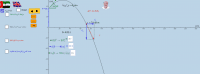
تُقذف كرة من ارتفاع \(h\) بسرعة \(v_0\) وبزاوية \(\theta\) فوق الأفقي. غيّر القيم الثلاث وفعّل مربعات إظهار المركبات ثم اضغط «بدء» وراقب المسار وأقصى ارتفاع والمدى.
A ball is thrown from a height \(h\) with speed \(v_0\) at an angle \(\theta\) above the horizontal. Change the three values and tick the boxes that show the components then press “Start” and watch the path, the maximum height and the range.
عند أعلى نقطة في مسار مقذوف بزاوية (بإهمال الهواء):
At the top of the path of a projectile at an angle (neglecting the air):
↗️ الزاويتان المتتامتان وأفضل زاوية
↗️ Complementary Angles and the Best Angle
المدى \(R=\dfrac{v_0^2\sin2\theta}{g}\) يعتمد على \(\sin2\theta\). لذلك يتساوى المدى لزاويتين مجموعهما \(90^\circ\) (مثل \(30^\circ\) و\(60^\circ\))، لكن الزاوية الأكبر تعطي ارتفاعًا وزمن طيران أكبر. ويبلغ المدى أكبر قيمة \(R_{max}=v_0^2/g\) عند \(\theta=45^\circ\). (هذا صحيح عندما يكون مستوى البداية والنهاية واحدًا؛ ومن حافة مرتفعة تكون الزاوية المثلى أقل من \(45^\circ\).)
The range \(R=\dfrac{v_0^2\sin2\theta}{g}\) depends on \(\sin2\theta\). Hence the range is equal for two angles whose sum is \(90^\circ\) (such as \(30^\circ\) and \(60^\circ\)), but the larger angle gives a greater height and time of flight. The range is greatest \(R_{max}=v_0^2/g\) at \(\theta=45^\circ\). (This is true when the start and the end are at the same level; from a raised edge the best angle is less than \(45^\circ\).)
🧪 تجربة 2: الزاويتان المتتامتان وأكبر مدى
🧪 Experiment 2: Complementary Angles and the Greatest Range
تُقذف كرتان من الأرض بالسرعة نفسها: الأولى بزاوية \(\theta\) والثانية بالزاوية المتممة \(90^\circ-\theta\). المسار الرمادي المتقطع يمثل زاوية \(45^\circ\).
Two balls are thrown from the ground with the same speed: the first at an angle \(\theta\) and the second at the complementary angle \(90^\circ-\theta\). The dashed grey path represents the angle \(45^\circ\).
قُذف حجر من حافة جرف ارتفاعه \(40\ \mathrm m\) بسرعة \(30\ \mathrm{m/s}\) بزاوية \(30^\circ\) فوق الأفقي. أوجد زمن الطيران والمدى وأقصى ارتفاع عن الأرض (\(g=9.8\ \mathrm{m/s^2}\)).
A stone is thrown from the edge of a cliff \(40\ \mathrm m\) high with a speed of \(30\ \mathrm{m/s}\) at \(30^\circ\) above the horizontal. Find the time of flight, the range and the maximum height above the ground (\(g=9.8\ \mathrm{m/s^2}\)).
بأي زاوية يجب أن تُقذف كرة بسرعة \(30\ \mathrm{m/s}\) من الأرض لتحقق أكبر مدى؟ وما هذا المدى؟
At what angle must a ball be thrown with a speed of \(30\ \mathrm{m/s}\) from the ground to achieve the greatest range? And what is this range?
🎲 تدرّب على المسائل
🎲 Practice Problems
🧪 تجربة 3: تدرّب: المدى وأقصى ارتفاع
🧪 Experiment 3: Practice: Range and Maximum Height
مسائل عشوائية للمقذوف من الأرض: أدخل المدى وأقصى ارتفاع ثم اضغط «تحقّق».
Random problems on a projectile from the ground: enter the range and the maximum height then press “Check”.
قُذف مقذوفان بالسرعة نفسها بزاويتين \(25^\circ\) و\(65^\circ\) من الأرض. أيّ العبارات صحيحة؟
Two projectiles are thrown with the same speed at \(25^\circ\) and \(65^\circ\) from the ground. Which statement is correct?
🚀 تطبيقات
🚀 Applications
أين نصادف المقذوفات؟
Where do we meet projectiles?
- كرة القدم والسلة ودفع الجلة والقفز الطويل: اختيار زاوية الانطلاق المناسبة.Football, basketball, shot put and the long jump: choosing the proper launching angle.
- المدفعية والنوافير: تقدير المدى والارتفاع.Artillery and fountains: estimating the range and the height.
- تصميم نوافير المياه وخراطيم الإطفاء لاختيار الزاوية التي تصل إلى هدف بعيد.Designing water fountains and fire hoses so that the angle reaches a distant target.
⚠️ أخطاء شائعة
⚠️ Common Mistakes
تجنّب هذه الأخطاء
Avoid these mistakes
- استعمال \(v_0\) كاملة في المعادلة الأفقية أو الرأسية بدل مركبتها.Using the whole \(v_0\) in the horizontal or vertical equation instead of its component.
- الظن أن السرعة صفر عند أعلى نقطة؛ المركبة الرأسية فقط صفر.Thinking that the speed is zero at the top; only the vertical component is zero.
- استعمال قانون المدى \(v_0^2\sin2\theta/g\) عندما لا يكون مستوى النهاية هو مستوى البداية.Using the range law \(v_0^2\sin2\theta/g\) when the end level is not the starting level.
📚 ملخص
📚 Summary
أهم ما تعلمناه
Key points
- الحركتان الأفقية (ثابتة السرعة) والرأسية (تسارع \(-g\)) مستقلتان وتتمان في الزمن نفسه.The horizontal (constant speed) and vertical (acceleration \(-g\)) motions are independent and take the same time.
- \(T=2v_0\sin\theta/g\) و\(H=v_0^2\sin^2\theta/2g\) و\(R=v_0^2\sin2\theta/g\) من الأرض إلى الأرض.\(T=2v_0\sin\theta/g\), \(H=v_0^2\sin^2\theta/2g\) and \(R=v_0^2\sin2\theta/g\) from the ground back to the ground.
- زاويتان مجموعهما \(90^\circ\) تعطيان المدى نفسه، وأكبر مدى عند \(45^\circ\).Two angles whose sum is \(90^\circ\) give the same range, and the greatest range is at \(45^\circ\).
🔗 محاكيات GeoGebra للاستعانة بها عند اللزوم
🔗 GeoGebra Simulations to Use When Needed
اضغط «تشغيل» لتعمل المحاكاة هنا داخل الدرس؛ ويمكن للطالب الرجوع إليها لتجربة الفكرة بطريقة أخرى.
Press “Run” to run the simulation right here inside the lesson; the student can use it to try the idea in another way.