🎯 نواتج التعلم
🎯 Learning Outcomes
بعد هذه التجربة ستكون قادرًا على أن:
After this experiment you will be able to:
- تفرّق بين مزج الأضواء (جمع) ومزج الأصباغ (طرح) وتذكر الألوان الأساسية والثانوية لكل منهما.Distinguish mixing lights (addition) from mixing pigments (subtraction) and name the primary and secondary colours of each.
- تتنبأ بنتيجة مزج لونين أو ثلاثة ألوان ضوئية أو صباغية.Predict the result of mixing two or three coloured lights or pigments.
- تحدد الألوان المتتامة وتفسّر لماذا ترى الأجسام بألوانها.Identify complementary colours and explain why we see objects in their colours.
🎬 شاهد الفيديو
🎬 Watch the Video
🌈 الضوء واللون
🌈 Light and Colour
الضوء إشعاع كهرومغناطيسي، ويُقصد بالضوء عادة الضوء المرئي الذي تتراوح أطواله الموجية بين \(400\ \mathrm{nm}\) و\(700\ \mathrm{nm}\) تقريبًا؛ فالبنفسجي أقصر الأطوال المرئية والأحمر أطولها. وعيننا تحس باللون بثلاثة أنواع من الخلايا المخروطية أكثر حساسية للأحمر والأخضر والأزرق، ولذلك يكفي مزج هذه الألوان الثلاثة بشدات مناسبة لنرى أي لون تقريبًا.
Light is electromagnetic radiation, and “light” usually means visible light whose wavelengths range from about \(400\ \mathrm{nm}\) to \(700\ \mathrm{nm}\); violet is the shortest visible wavelength and red the longest. Our eye senses colour with three kinds of cone cells most sensitive to red, green and blue, so mixing these three colours with suitable intensities is enough to see almost any colour.
💡 مزج الأضواء (الجمع الضوئي RGB)
💡 Mixing Lights (Additive RGB)
يمكن تشكيل الضوء الأبيض من أضواء ملوّنة بطريقة تُسمى جمع الألوان، وهي المستخدمة في شاشات التلفاز والهواتف. الألوان الأساسية الضوئية: الأحمر والأخضر والأزرق؛ وتداخلها بشدة مناسبة يعطي الأبيض، ومزج كل لونين منها يعطي لونًا ثانويًا:
White light can be formed from coloured lights by a process called colour addition, which is used in television and phone screens. The primary light colours are red, green and blue; overlapping them with a suitable intensity gives white, and mixing any two of them gives a secondary colour:
| المكوّناتComponents | النتيجةResult | المعادلةEquation |
|---|---|---|
| أحمر + أخضرRed + Green | أصفرYellow | \(R+G=Y\)\(R+G=Y\) |
| أخضر + أزرقGreen + Blue | سماويCyan | \(G+B=C\)\(G+B=C\) |
| أزرق + أحمرBlue + Red | أرجوانيMagenta | \(B+R=M\)\(B+R=M\) |
| أحمر + أخضر + أزرقRed + Green + Blue | أبيضWhite | \(R+G+B=W\)\(R+G+B=W\) |
🎨 مزج الأصباغ (الطرح الصباغي CMY)
🎨 Mixing Pigments (Subtractive CMY)
الأصباغ مواد كيميائية أو طبيعية لها ثلاثة ألوان أساسية: السماوي والأرجواني والأصفر. الصبغ لا يُصدر ضوءًا بل يمتص بعض الأضواء من الضوء الأبيض الساقط عليه ويعكس الباقي، فكلما أضفنا صبغًا امتُصّ المزيد من الضوء وصار اللون أغمق، ولهذا يسمى هذا النموذج «طرحيًا»:
Pigments are chemical or natural materials with three primary colours: cyan, magenta and yellow. A pigment does not emit light but absorbs some of the lights of the white light falling on it and reflects the rest, so every pigment we add absorbs more light and the colour gets darker, which is why this model is called “subtractive”:
| المكوّناتComponents | النتيجةResult | المعادلةEquation |
|---|---|---|
| سماوي + أرجوانيCyan + Magenta | أزرقBlue | \(C+M=B\)\(C+M=B\) |
| أرجواني + أصفرMagenta + Yellow | أحمرRed | \(M+Y=R\)\(M+Y=R\) |
| أصفر + سماويYellow + Cyan | أخضرGreen | \(Y+C=G\)\(Y+C=G\) |
| سماوي + أرجواني + أصفرCyan + Magenta + Yellow | أسود (تقريبًا)Black (approximately) | \(C+M+Y\approx K\)\(C+M+Y\approx K\) |
💡 شرح إضافي: لماذا يعطي الأصفر + السماوي أخضر؟
💡 Extra explanation: why do yellow + cyan give green?
الصبغ الأصفر يمتص الأزرق ويعكس الأحمر والأخضر، والصبغ السماوي يمتص الأحمر ويعكس الأخضر والأزرق. عند وضعهما معًا يُمتص الأزرق (بالأصفر) والأحمر (بالسماوي) ولا يبقى إلا الأخضر. وبالمثل: السماوي + الأرجواني يمتصان الأحمر والأخضر فيبقى الأزرق، والأرجواني + الأصفر يمتصان الأخضر والأزرق فيبقى الأحمر، وكل الثلاثة تمتص كل الأضواء تقريبًا فيبقى الأسود.
The yellow pigment absorbs blue and reflects red and green, and the cyan pigment absorbs red and reflects green and blue. Together blue is absorbed (by the yellow) and red (by the cyan) and only green remains. Similarly: cyan + magenta absorb red and green so blue remains, magenta + yellow absorb green and blue so red remains, and all three absorb almost all the lights so black remains.
رياضيًا (بمقياس نسبي من \(0\) إلى \(1\)): ألوان الأصباغ هي متممات ألوان الضوء: \(C=1-R,\ M=1-G,\ Y=1-B\).
Mathematically (on a relative scale from \(0\) to \(1\)): the pigment colours are the complements of the light colours: \(C=1-R,\ M=1-G,\ Y=1-B\).
🧪 تجربة 1: مزج الأضواء ومزج الأصباغ
🧪 Experiment 1: Mixing lights and mixing pigments
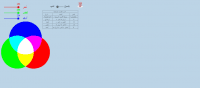
اختر الأضواء (RGB: أحمر وأخضر وأزرق) أو الأصباغ (CMY: سماوي وأرجواني وأصفر)، وغيّر شدة كل لون من 0 إلى 255، وراقب لون منطقة التداخل. في مزج الأضواء تُجمع الشدات (نموذج جمعي) فيعطي الأحمر والأخضر والأزرق معًا اللون الأبيض؛ وفي مزج الأصباغ يمتص كل صبغ بعض الأضواء (نموذج طرحي) فيعطي السماوي والأرجواني والأصفر معًا اللون الأسود تقريبًا.
Choose lights (RGB: red, green, blue) or pigments (CMY: cyan, magenta, yellow), change the intensity of each from 0 to 255 and watch the colour of the overlapping regions. In mixing lights the intensities add (additive model) so red, green and blue together give white; in mixing pigments each pigment absorbs some of the light (subtractive model) so cyan, magenta and yellow together give approximately black.
⚪ الألوان المتتامة
⚪ Complementary Colours
الألوان المتتامة هي الألوان التي إذا تراكبت (كأضواء) أنتجت الضوء الأبيض:
Complementary colours are colours that, when superposed (as lights), give white light:
| اللونColour | متممهIts complement | الجمعThe sum |
|---|---|---|
| أصفرYellow | أزرقBlue | \(R+G+B=W\)\(R+G+B=W\) |
| سماويCyan | أحمرRed | \(G+B+R=W\)\(G+B+R=W\) |
| أرجوانيMagenta | أخضرGreen | \(B+R+G=W\)\(B+R+G=W\) |
🍎 لماذا نرى الأجسام بألوانها؟
🍎 Why Do We See Objects in Their Colours?
سطح الجسم يعكس بعض الأطوال الموجية من الضوء الساقط عليه ويمتص الباقي، والعين ترى الأطوال المنعكسة. التفاحة حمراء لأن سطحها يعكس الأحمر ويمتص بقية الألوان. ولذلك يتغير مظهر الجسم بتغير الضوء الساقط عليه:
The surface of an object reflects some of the wavelengths of the light falling on it and absorbs the rest, and the eye sees the reflected wavelengths. An apple is red because its surface reflects red and absorbs the other colours. So the appearance of an object changes with the light falling on it:
| الجسمThe object | الضوء الساقطThe incident light | ما يراه الناظرWhat the observer sees |
|---|---|---|
| تفاحة حمراءa red apple | أبيضwhite | أحمرred |
| تفاحة حمراءa red apple | أخضر أو أزرقgreen or blue | أسود (لا ضوء أحمر ينعكس)black (no red light to reflect) |
| ورقة بيضاءa white sheet | أحمرred | أحمر (تعكس كل الألوان)red (it reflects all colours) |
| قميص أزرقa blue shirt | أحمرred | أسودblack |
✍️ أمثلة محلولة
✍️ Worked Examples
سُلّط ضوء أصفر وضوء أزرق معًا على شاشة بيضاء. ما لون التراكب؟
A yellow light and a blue light are shone together on a white screen. What is the colour of the overlap?
ما لون الخليط عند مزج صبغ أصفر وصبغ سماوي؟ فسّر.
What is the colour of a mixture of a yellow pigment and a cyan pigment? Explain.
تفاحة حمراء وُضعت في غرفة مضاءة بضوء أزرق فقط. بأي لون تبدو؟
A red apple is placed in a room lit by blue light only. What colour does it look?
يمر ضوء أبيض في مرشح أصفر (يمرر الأحمر والأخضر) ثم في مرشح سماوي (يمرر الأخضر والأزرق). ما لون الضوء الخارج؟
White light passes through a yellow filter (passing red and green) and then a cyan filter (passing green and blue). What is the colour of the emerging light?
مزج الأضواء الثلاثة الأحمر والأخضر والأزرق بشدات كاملة يعطي:
Mixing the three lights red, green and blue at full intensities gives:
مزج الأصباغ الثلاثة السماوي والأرجواني والأصفر بشدات كاملة يعطي تقريبًا:
Mixing the three pigments cyan, magenta and yellow at full intensities gives approximately:
ضوء أخضر + ضوء أزرق =
Green light + blue light =
متمم اللون السماوي (ضوئيًا) هو:
The complement of cyan (as light) is:
قميص أحمر يُضاء بضوء أخضر فقط يبدو:
A red shirt lit by green light only looks:
📚 ملخص
📚 Summary
| النموذجModel | الألوان الأساسيةPrimary colours | الأبيض/الأسودWhite/black |
|---|---|---|
| الجمع (أضواء)Additive (lights) | R G BR G B | كلها ← أبيضall → white |
| الطرح (أصباغ)Subtractive (pigments) | C M YC M Y | كلها ← أسودall → black |
⚠️ أخطاء شائعة
⚠️ Common mistakes
- الظن أن الأصفر لون أساسي للضوء؛ هو ثانوي (أحمر + أخضر)، أما الأصفر الأساسي فللأصباغ.Thinking that yellow is a primary colour of light; it is secondary (red + green), while yellow is primary for pigments.
- الخلط بين نتيجة مزج الأضواء ومزج الأصباغ: أخضر + أحمر ضوئيًا أصفر، لكن أصفر + سماوي صباغيًا أخضر.Confusing the result of mixing lights with mixing pigments: green + red lights give yellow but yellow + cyan pigments give green.
- الاعتقاد بأن الجسم «يملك» لونه مستقلًا عن الضوء؛ لونه ما يعكسه من الضوء الساقط.Believing that an object “has” its colour independently of the light; its colour is what it reflects of the incident light.
🔗 محاكيات GeoGebra للاستعانة بها عند اللزوم
🔗 GeoGebra Simulations to Use When Needed
اضغط «تشغيل» لتعمل المحاكاة هنا داخل الدرس؛ ويمكن للطالب الرجوع إليها لتجربة الفكرة بطريقة أخرى.
Press “Run” to run the simulation right here inside the lesson; the student can use it to try the idea in another way.