🎯 نواتج التعلم
🎯 Learning Outcomes
بعد هذه التجربة ستكون قادرًا على أن:
After this experiment you will be able to:
- ترسم محصلة متجهين بطريقة الرأس إلى الذيل (مثلث المتجهات).Draw the resultant of two vectors by the head-to-tail method (the vector triangle).
- تحسب مقدار المحصلة بقانون جيب التمام واتجاهها بقانون الجيب.Calculate the magnitude of the resultant by the law of cosines and its direction by the law of sines.
- تعرف الحالات الخاصة: متوازيان ومتعاكسان ومتعامدان، وأن الجمع إبدالي.Know the special cases: parallel, opposite and perpendicular, and that addition is commutative.
🎬 شاهد الفيديو
🎬 Watch the Video
📐 طريقة الرأس إلى الذيل
📐 The Head-to-Tail Method
لجمع المتجهين \(\vec A\) و\(\vec B\): نرسم \(\vec A\) أولًا، ثم نرسم \(\vec B\) بحيث يبدأ ذيله من رأس \(\vec A\) (محافظين على مقدار كل منهما واتجاهه). المحصلة \(\vec R=\vec A+\vec B\) هي المتجه الذي يبدأ من ذيل \(\vec A\) وينتهي عند رأس \(\vec B\)، فيكوّن المتجهان والمحصلة مثلثًا. وتعطي الطريقة النتيجة نفسها لو بدأنا بـ \(\vec B\) (الجمع إبدالي \(\vec A+\vec B=\vec B+\vec A\))، وتكوّن مع الترتيبين معًا متوازي أضلاع.
To add the vectors \(\vec A\) and \(\vec B\): we draw \(\vec A\) first, then draw \(\vec B\) so that its tail starts at the head of \(\vec A\) (keeping the magnitude and direction of each). The resultant \(\vec R=\vec A+\vec B\) is the vector that starts at the tail of \(\vec A\) and ends at the head of \(\vec B\), so the two vectors and the resultant form a triangle. The method gives the same result if we start with \(\vec B\) (addition is commutative \(\vec A+\vec B=\vec B+\vec A\)), and with both orders together it forms a parallelogram.
🧮 حساب المحصلة
🧮 Calculating the Resultant
إذا كانت \(\alpha\) الزاوية بين المتجهين (وهما ذيلًا إلى ذيل) فإن الزاوية الداخلية للمثلث \(180^\circ-\alpha\):
If \(\alpha\) is the angle between the vectors (tail to tail) then the interior angle of the triangle is \(180^\circ-\alpha\):
📌 مقدار المحصلة واتجاهها
📌 The magnitude and the direction of the resultant
\[R=\sqrt{A^2+B^2+2AB\cos\alpha}\]
\[\frac{\sin\beta}{B}=\frac{\sin\alpha}{R}\quad\Rightarrow\quad\beta=\tan^{-1}\frac{B\sin\alpha}{A+B\cos\alpha}\]
| الحالةCase | الزاوية \(\alpha\)The angle \(\alpha\) | المحصلة \(R\)The resultant \(R\) |
|---|---|---|
| اتجاه واحدSame direction | \(0^\circ\) | \(A+B\) |
| متعاكسانOpposite | \(180^\circ\) | \(|A-B|\) |
| متعامدانPerpendicular | \(90^\circ\) | \(\sqrt{A^2+B^2}\) |
🧪 جرّب بنفسك: المثلث
🧪 Try It Yourself: the Triangle
🧪 تجربة 1: مثلث المتجهات: جمع متجهين رأسًا بذيل
🧪 Experiment 1: The Vector Triangle: Adding Two Vectors Head to Tail
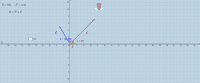
غيّر مقداري المتجهين \(A\) و\(B\) والزاوية \(\alpha\) بينهما وراقب المثلث الذي يتكوّن عند رسم \(B\) من رأس \(A\)، والمحصلة \(R\) من ذيل \(A\) إلى رأس \(B\)، وقيمتيها بقانوني جيب التمام والجيب.
Change the magnitudes of the vectors \(A\) and \(B\) and the angle \(\alpha\) between them and watch the triangle that forms when \(B\) is drawn from the head of \(A\), and the resultant \(R\) from the tail of \(A\) to the head of \(B\), with its values from the laws of cosines and sines.
متجهان \(A=6\) و\(B=4\) والزاوية بينهما \(60^\circ\). أوجد المحصلة مقدارًا واتجاهًا بالنسبة إلى \(A\).
Two vectors \(A=6\) and \(B=4\) with an angle of \(60^\circ\) between them. Find the resultant in magnitude and direction relative to \(A\).
متجهان \(A=3\) و\(B=4\) متعامدان. أوجد المحصلة.
Two perpendicular vectors \(A=3\) and \(B=4\). Find the resultant.
متجهان مقدارهما \(5\) و\(5\) والزاوية بينهما \(180^\circ\). مقدار المحصلة:
Two vectors of magnitudes \(5\) and \(5\) with \(180^\circ\) between them. The magnitude of the resultant:
🎲 تدرّب على المسائل
🎲 Practice Problems
🧪 تجربة 2: تدرّب: المحصلة بمثلث المتجهات
🧪 Experiment 2: Practice: the Resultant by the Vector Triangle
مسائل عشوائية: أدخل مقدار المحصلة وزاويتها مع المتجه الأول ثم اضغط «تحقّق».
Random problems: enter the magnitude of the resultant and its angle with the first vector then press “Check”.
عند جمع متجهين بطريقة الرأس إلى الذيل، المحصلة هي المتجه من:
When adding two vectors by the head-to-tail method the resultant is the vector from:
⚠️ أخطاء شائعة
⚠️ Common Mistakes
تجنّب هذه الأخطاء
Avoid these mistakes
- وصل رأس المتجه الأول برأس الثاني بدل رأس الأول بذيل الثاني.Joining the head of the first vector to the head of the second instead of the head of the first to the tail of the second.
- الخلط بين الزاوية \(\alpha\) بين المتجهين ذيلًا بذيل والزاوية الداخلية \(180^\circ-\alpha\) للمثلث.Confusing the angle \(\alpha\) between the vectors tail to tail with the interior angle \(180^\circ-\alpha\) of the triangle.
- جمع المقدارين \(A+B\) إلا في حالة الاتجاه الواحد.Adding the magnitudes \(A+B\) except in the case of the same direction.
📚 ملخص
📚 Summary
أهم ما تعلمناه
Key points
- الرأس إلى الذيل: \(\vec R\) من ذيل الأول إلى رأس الثاني، والجمع إبدالي.Head to tail: \(\vec R\) from the tail of the first to the head of the second, and addition is commutative.
- \(R=\sqrt{A^2+B^2+2AB\cos\alpha}\) و\(\sin\beta/B=\sin\alpha/R\).\(R=\sqrt{A^2+B^2+2AB\cos\alpha}\) and \(\sin\beta/B=\sin\alpha/R\).
🔗 محاكيات GeoGebra للاستعانة بها عند اللزوم
🔗 GeoGebra Simulations to Use When Needed
اضغط «تشغيل» لتعمل المحاكاة هنا داخل الدرس؛ ويمكن للطالب الرجوع إليها لتجربة الفكرة بطريقة أخرى.
Press “Run” to run the simulation right here inside the lesson; the student can use it to try the idea in another way.