🎯 نواتج التعلم
🎯 Learning Outcomes
بعد هذه التجربة ستكون قادرًا على أن:
After this experiment you will be able to:
- تجد مقدار محصلة متجهين متعامدين بنظرية فيثاغورس.Find the magnitude of the resultant of two perpendicular vectors with Pythagoras’ theorem.
- تحدّد اتجاه المحصلة بالزاوية \(\theta=\tan^{-1}(B/A)\).Find the direction of the resultant by the angle \(\theta=\tan^{-1}(B/A)\).
- تحلّل متجهًا إلى مركبتين متعامدتين وتطبّق ذلك على قارب يعبر نهرًا.Resolve a vector into two perpendicular components and apply this to a boat crossing a river.
🎬 شاهد الفيديو
🎬 Watch the Video
📐 المتجهان المتعامدان
📐 Two Perpendicular Vectors
إذا كان المتجهان \(A\) و\(B\) متعامدين فإنهما يكوّنان مع المحصلة \(R\) مثلثًا قائمًا: المتجهان ضلعا القائمة والمحصلة هي الوتر. لذلك نحسب المقدار بنظرية فيثاغورس والاتجاه بالمثلثات.
If the vectors \(A\) and \(B\) are perpendicular they form with the resultant \(R\) a right triangle: the two vectors are the legs and the resultant is the hypotenuse. So the magnitude comes from Pythagoras’ theorem and the direction from trigonometry.
📘 القوانين
📘 The laws
\[R=\sqrt{A^2+B^2}\qquad \tan\theta=\dfrac{B}{A}\ \Rightarrow\ \theta=\tan^{-1}\dfrac{B}{A}\]
\[A=R\cos\theta\qquad B=R\sin\theta\qquad (\text{التحليل})\]
💡 ملاحظات
💡 Notes
- الزاوية \(\theta\) تُقاس من اتجاه \(A\) إلى \(R\).The angle \(\theta\) is measured from the direction of \(A\) to \(R\).
- \(R\) دائمًا أكبر من كل من \(A\) و\(B\) ولكن أقل من \(A+B\).\(R\) is always larger than each of \(A\) and \(B\) but smaller than \(A+B\).
- ثلاثيات فيثاغورس المألوفة: \(3,4,5\) و\(5,12,13\) و\(8,15,17\).Common Pythagorean triples: \(3,4,5\), \(5,12,13\) and \(8,15,17\).
🧪 تجربة 1: اسحب المتجهين المتعامدين
🧪 Experiment 1: Drag the two perpendicular vectors
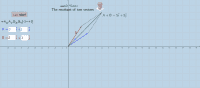
في وضع «اجمع» اسحب رأس \(A\) أفقيًّا ورأس \(B\) رأسيًّا فتظهر المحصلة \(R\) ومقدارها وزاويتها. في وضع «حلّل» اسحب رأس \(R\) في أي اتجاه لترى مركبتيه. ثم جرّب تطبيق القارب الذي يعبر نهرًا. (لا شيء يتحرك من تلقاء نفسه.)
In “Add” mode drag the head of \(A\) horizontally and the head of \(B\) vertically to see the resultant \(R\), its magnitude and its angle. In “Resolve” mode drag the head of \(R\) in any direction to see its components. Then try the boat application crossing a river. (Nothing moves by itself.)
🧪 تجربة 2: حاسبة: محصلة متجهين متعامدين
🧪 Experiment 2: Calculator: the resultant of two perpendicular vectors
مسألة جديدة في كل مرة (ثلاثيات فيثاغورس والقارب). أدخل الجواب.
A new problem every time (Pythagorean triples and the boat). Enter the answer.
✍️ أمثلة محلولة
✍️ Worked Examples
قوتان متعامدتان \(A=3\ \mathrm{N}\) و\(B=4\ \mathrm{N}\). احسب مقدار المحصلة واتجاهها.
Two perpendicular forces \(A=3\ \mathrm{N}\) and \(B=4\ \mathrm{N}\). Find the magnitude and direction of the resultant.
سرعة قارب \(8\ \mathrm{m/s}\) عموديًّا على تيار نهر \(6\ \mathrm{m/s}\). احسب سرعته بالنسبة للشاطئ.
A boat speed of \(8\ \mathrm{m/s}\) perpendicular to a river current of \(6\ \mathrm{m/s}\). Find its speed relative to the bank.
في المثال السابق إذا كان عرض النهر \(80\ \mathrm{m}\) فكم يستغرق العبور وكم ينجرف القارب؟
In the previous example if the river is \(80\ \mathrm{m}\) wide how long is the crossing and how far does the boat drift?
حلّل قوة \(20\ \mathrm{N}\) تصنع \(30^\circ\) مع الأفقي إلى مركبتين.
Resolve a \(20\ \mathrm{N}\) force at \(30^\circ\) to the horizontal into components.
محصلة متجهين متعامدين \(6\) و\(8\):
The resultant of two perpendicular vectors \(6\) and \(8\):
زاوية المحصلة مع \(A\) تعطى بـ:
The angle of the resultant with \(A\) is given by:
قارب يتجه عموديًّا على تيار النهر. ما الذي يحدد زمن العبور؟
A boat heads perpendicular to the current. What determines the crossing time?
إذا كان \(A=B\) فإن زاوية المحصلة مع \(A\):
If \(A=B\) the angle of the resultant with \(A\) is:
📚 ملخص
📚 Summary
| الكميةQuantity | القانونLaw |
|---|---|
| المقدارMagnitude | \(R=\sqrt{A^2+B^2}\)\(R=\sqrt{A^2+B^2}\) |
| الاتجاهDirection | \(\theta=\tan^{-1}(B/A)\)\(\theta=\tan^{-1}(B/A)\) |
| المركبتانComponents | \(A=R\cos\theta,\ B=R\sin\theta\)\(A=R\cos\theta,\ B=R\sin\theta\) |
⚠️ أخطاء شائعة
⚠️ Common mistakes
- جمع المقدارين مباشرة \(A+B\) بدل فيثاغورس.Adding the magnitudes directly \(A+B\) instead of using Pythagoras.
- قلب النسبة في الزاوية: \(\tan^{-1}(A/B)\).Inverting the ratio in the angle: \(\tan^{-1}(A/B)\).
- نسيان ضبط الآلة الحاسبة على الدرجات.Forgetting to set the calculator to degrees.
🔗 محاكيات GeoGebra للاستعانة بها عند اللزوم
🔗 GeoGebra Simulations to Use When Needed
اضغط «تشغيل» لتعمل المحاكاة هنا داخل الدرس؛ ويمكن للطالب الرجوع إليها لتجربة الفكرة بطريقة أخرى.
Press “Run” to run the simulation right here inside the lesson; the student can use it to try the idea in another way.