🎯 نواتج التعلم
🎯 Learning Outcomes
بعد هذه التجربة ستكون قادرًا على أن:
After this experiment you will be able to:
- تستنتج تجريبيًا أن التسارع يتناسب عكسيًا مع الكتلة عند ثبات القوة المحرّكة \(a\propto\dfrac1M\).Deduce experimentally that the acceleration is inversely proportional to the mass when the driving force is constant \(a\propto\dfrac1M\).
- تقرأ الرسمين \(a\)–\(M\) (منحنى هابط) و\(a\)–\(\dfrac1M\) (خط مستقيم ميله \(F\)) وتستنتج القوة من الميل.Read the \(a\)–\(M\) graph (a falling curve) and the \(a\)–\(\dfrac1M\) graph (a straight line of slope \(F\)) and deduce the force from the slope.
- تحسب تسارع نظام العربة والثقل المعلّق وقوة الشد عند تغيير الكتلة.Calculate the acceleration of the cart-and-hanging-weight system and the tension when the mass changes.
🎬 شاهد الفيديو
🎬 Watch the Video
⚖️ الكتلة والتسارع بثبات القوة
⚖️ Mass and Acceleration at a Constant Force
في هذه التجربة نُبقي القوة المحرّكة ثابتة وهي وزن الثقل المعلّق \(F=m_2g\)، ونغيّر الكتلة الكلية \(M=m_1+m_2\) بإضافة كتل إلى العربة. ثم نقيس التسارع. (ملاحظة: القوة المحرّكة ثابتة، أما قوة الشد في الخيط \(F_T=m_1a\) فتتغير مع الكتلة لأن التسارع يتغير.)
In this experiment we keep the driving force constant: it is the weight of the hanging mass \(F=m_2g\), and we change the total mass \(M=m_1+m_2\) by adding masses to the cart. Then we measure the acceleration. (Note: the driving force is constant but the tension in the string \(F_T=m_1a\) changes with the mass because the acceleration changes.)
📘 المعادلات
📘 The equations
\[m_2g-F_T=m_2a\qquad F_T=m_1a\]
\[a=\dfrac{m_2\,g}{m_1+m_2}=\dfrac{F}{M}\qquad a\propto\dfrac1M\qquad F=a\,M=\text{constant}\]
💡 شرح إضافي
💡 Extra explanation
- إذا تضاعفت الكتلة الكلية \(M\) نصف التسارع (العلاقة عكسية)، ولذلك يكون حاصل الضرب \(a\times M\) ثابتًا ويساوي القوة \(F\).If the total mass \(M\) doubles the acceleration halves (an inverse relation), so the product \(a\times M\) is constant and equals the force \(F\).
- رسم \(a\)–\(M\) منحنى هابط (قطع زائد)؛ ولتحويله إلى خط مستقيم نرسم \(a\) مع \(\dfrac1M\) فنحصل على خط يمر بالأصل ميله \(F\).The \(a\)–\(M\) graph is a falling curve (a hyperbola); to make it a straight line we plot \(a\) against \(\dfrac1M\) and get a line through the origin of slope \(F\).
- نستعمل \(g=10\ \mathrm{m/s^2}\) كما في المحاكاة الأصلية (\(m_2=0.2\ \mathrm{kg}\) يعطي \(F=2\ \mathrm{N}\)) ونهمل الاحتكاك.We use \(g=10\ \mathrm{m/s^2}\) as in the original simulation (\(m_2=0.2\ \mathrm{kg}\) gives \(F=2\ \mathrm{N}\)) and neglect the friction.
🧪 تجربة 1: غيّر الكتلة بثبات القوة وسجّل التسارع
🧪 Experiment 1: Change the mass at a constant force and record the acceleration
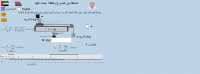
القوة المحرّكة ثابتة \(F=m_2g\) (اختر قيمتها) ونغيّر الكتلة الكلية \(M\) بإضافة كتل إلى العربة. اضغط «اترك العربة» (أو حرّك مؤشر الزمن) لترى الحركة، ثم «سجّل» لإضافة نقطة \((M,a)\). يظهر رسم \(a\)–\(M\) (منحنى) ورسم \(a\)–\(1/M\) (خط مستقيم ميله \(F\)). لا شيء يتحرك من تلقاء نفسه.
The driving force is constant \(F=m_2g\) (choose its value) and we change the total mass \(M\) by adding masses to the cart. Press “Release the cart” (or move the time slider) to see the motion, then “Record” to add a point \((M,a)\). The \(a\)–\(M\) graph (a curve) and the \(a\)–\(1/M\) graph (a straight line of slope \(F\)) appear. Nothing moves by itself.
🧪 تجربة 2: حاسبة: الكتلة والتسارع
🧪 Experiment 2: Calculator: the mass and the acceleration
مسألة جديدة في كل مرة على نظام العربة والثقل (\(g=10\ \mathrm{m/s^2}\)). احسب القيم الثلاث ثم اضغط «صحّح».
A new problem every time on the cart-and-weight system (\(g=10\ \mathrm{m/s^2}\)). Calculate the three values and press “Check”.
🛠️ تطبيقات عملية
🛠️ Practical applications
- السيارات الفارغة والمحمّلة: بالقوة نفسها تتسارع الفارغة أكثر.Empty and loaded cars: with the same force the empty one accelerates more.
- الدراجات: راكبان يحتاجان قوة أكبر للتسارع نفسه.Bicycles: two riders need a greater force for the same acceleration.
- الصواريخ: يزداد التسارع بتناقص الكتلة مع احتراق الوقود.Rockets: the acceleration increases as the mass decreases while the fuel burns.
✍️ أمثلة محلولة
✍️ Worked Examples
بقيم المحاكاة الأصلية: \(m_2=0.2\ \mathrm{kg}\) و\(M=8\ \mathrm{kg}\) (\(g=10\ \mathrm{m/s^2}\)). احسب القوة والتسارع وقوة الشد.
With the values of the original simulation: \(m_2=0.2\ \mathrm{kg}\) and \(M=8\ \mathrm{kg}\) (\(g=10\ \mathrm{m/s^2}\)). Calculate the force, the acceleration and the tension.
بالقوة نفسها (\(2\ \mathrm{N}\)) أُنقصت الكتلة الكلية من \(8\) إلى \(4\ \mathrm{kg}\). كيف يتغير التسارع؟
With the same force (\(2\ \mathrm{N}\)) the total mass is decreased from \(8\) to \(4\ \mathrm{kg}\). How does the acceleration change?
رسم \(a\)–\(\dfrac1M\) خط يمر بالأصل وبالنقطة \((\dfrac1M=0.2\ \mathrm{kg^{-1}},\ a=0.5\ \mathrm{m/s^2})\). ما القوة المحرّكة؟
The \(a\)–\(\dfrac1M\) graph is a line through the origin and the point \((\dfrac1M=0.2\ \mathrm{kg^{-1}},\ a=0.5\ \mathrm{m/s^2})\). What is the driving force?
ثقل معلّق \(0.5\ \mathrm{kg}\) يشدّ عربة \(m_1=2\ \mathrm{kg}\). احسب التسارع وقوة الشد (\(g=10\)).
A hanging weight of \(0.5\ \mathrm{kg}\) pulls a cart \(m_1=2\ \mathrm{kg}\). Calculate the acceleration and the tension (\(g=10\)).
عند ثبات القوة إذا تضاعفت الكتلة الكلية فإن التسارع:
At a constant force if the total mass doubles the acceleration:
ميل رسم \(a\)–\(\dfrac1M\) يساوي:
The slope of the \(a\)–\(\dfrac1M\) graph equals:
حاصل ضرب \(a\times M\) عند ثبات القوة:
The product \(a\times M\) at a constant force is:
قوة الشد في خيط العربة والثقل مقارنةً بوزن الثقل:
The tension in the string of the cart and the weight compared with the weight of the hanging mass is:
📚 ملخص
📚 Summary
| المفهومConcept | العلاقةRelation |
|---|---|
| التسارعAcceleration | \(a=\dfrac{F}{M}\)\(a=\dfrac{F}{M}\) |
| عند ثبات FAt constant F | \(a\propto\dfrac1M\)\(a\propto\dfrac1M\) |
| ميل a–1/MSlope of a–1/M | \(F\)\(F\) |
| الشدTension | \(F_T=m_1a\)\(F_T=m_1a\) |
⚠️ أخطاء شائعة
⚠️ Common mistakes
- إهمال كتلة الثقل المعلّق في الكتلة الكلية.Neglecting the hanging mass in the total mass.
- اعتبار قوة الشد تساوي وزن الثقل.Taking the tension to be equal to the weight of the hanging mass.
- الظن بأن العلاقة بين \(a\) و\(M\) خطية؛ هي عكسية.Thinking the relation between \(a\) and \(M\) is linear; it is inverse.
🔗 محاكيات GeoGebra للاستعانة بها عند اللزوم
🔗 GeoGebra Simulations to Use When Needed
اضغط «تشغيل» لتعمل المحاكاة هنا داخل الدرس؛ ويمكن للطالب الرجوع إليها لتجربة الفكرة بطريقة أخرى.
Press “Run” to run the simulation right here inside the lesson; the student can use it to try the idea in another way.