🎯 نواتج التعلم
🎯 Learning Outcomes
بعد هذه التجربة ستكون قادرًا على أن:
After this experiment you will be able to:
- تنص على قانون نيوتن الأول (قانون القصور الذاتي) وتفسّر الجسم الساكن والجسم المتحرك بسرعة ثابتة.State Newton’s first law (the law of inertia) and explain a body at rest and a body moving at constant velocity.
- تحسب القوة المحصلة وتحدد متى تكون الحالة اتزانًا \(\sum\vec F=0\).Calculate the net force and decide when the state is equilibrium \(\sum\vec F=0\).
- تفسّر ظواهر القصور الذاتي (الاندفاع للأمام عند الفرملة) وتربط القصور بالكتلة.Explain phenomena of inertia (lurching forward when braking) and relate inertia to mass.
🎬 شاهد الفيديو
🎬 Watch the Video
🧱 قانون نيوتن الأول (القصور الذاتي)
🧱 Newton’s First Law (Inertia)
ينص قانون نيوتن الأول على أن الجسم الساكن يبقى ساكنًا، والجسم المتحرك يبقى متحركًا بسرعة ثابتة في خط مستقيم، ما لم تؤثر عليه قوة محصلة خارجية. فالقوة ليست لازمة لاستمرار الحركة، بل لتغيير السرعة (تسارع). ميل الجسم إلى مقاومة تغيّر حالته الحركية يسمى القصور الذاتي، وتقيسه الكتلة: كلما زادت كتلة الجسم زاد قصوره.
Newton’s first law states that a body at rest stays at rest, and a body in motion stays in motion at constant velocity along a straight line, unless an external net force acts on it. A force is not needed to keep a body moving, but to change its velocity (an acceleration). The tendency of a body to resist a change in its state of motion is called inertia, and it is measured by the mass: the greater the mass of a body the greater its inertia.
📘 القوة المحصلة والاتزان
📘 The net force and equilibrium
\[\sum\vec F=0\ \Longleftrightarrow\ \vec a=0\ \Longleftrightarrow\ \vec v=\text{constant}\]
\[\sum F=F_{applied}-f\qquad f_{max}=\mu\,m\,g\]
الاتزان الساكن: \(v=0\) و\(\sum F=0\). الاتزان الحركي: \(v\) ثابتة غير صفرية و\(\sum F=0\) (القوة المؤثرة تساوي الاحتكاك).
Static equilibrium: \(v=0\) and \(\sum F=0\). Dynamic equilibrium: a constant non-zero \(v\) and \(\sum F=0\) (the applied force equals the friction).
💡 شرح إضافي
💡 Extra explanation
- الاحتكاك قوة تقاوم الحركة: لذلك نحتاج دفعة مستمرة لإبقاء جسم يتحرك بسرعة ثابتة على الأرض؛ وعلى سطح أملس تمامًا يستمر دون دفع.Friction is a force that opposes the motion: that is why we need a continuous push to keep a body moving at constant speed on the ground; on a perfectly smooth surface it continues without any push.
- عندما تفرمل الحافلة فجأة يندفع الركاب للأمام لأن أجسامهم تميل إلى الاستمرار بسرعتها السابقة.When a bus brakes suddenly the passengers lurch forward because their bodies tend to keep their previous velocity.
- الجسم الساكن بقوة دفع صغيرة قد يبقى ساكنًا: الاحتكاك السكوني يوازن القوة حتى القيمة العظمى \(\mu m g\).A body at rest under a small push may stay at rest: the static friction balances the force up to the maximum value \(\mu m g\).
🧪 تجربة 1: الشاحنة والصندوق: ماذا يحدث للصندوق عندما تتحرك الشاحنة أو تفرمل؟
🧪 Experiment 1: The truck and the box: what happens to the box when the truck speeds up or brakes?
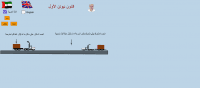
صندوق موضوع على صندوق شاحنة (الاحتكاك بينهما \(\mu\)). نشاهد من الخارج: عندما تتسارع الشاحنة بسرعة كبيرة يبقى الصندوق متخلّفًا للخلف، وعندما تفرمل بقوة يندفع الصندوق للأمام — لأنه يميل إلى الاحتفاظ بحالته الحركية (القصور الذاتي). وإذا كان الاحتكاك كافيًا يتحرك الصندوق مع الشاحنة. اختر مثالًا جاهزًا أو غيّر التسارع والاحتكاك، ثم حرّك مؤشر الزمن أو اضغط «شغّل» (لا شيء يتحرك من تلقاء نفسه).
A box rests on the bed of a truck (the friction between them is \(\mu\)). We watch from outside: when the truck speeds up strongly the box stays behind, and when it brakes hard the box lurches forward — because it tends to keep its state of motion (inertia). If the friction is enough the box moves with the truck. Choose a ready example or change the acceleration and the friction, then move the time slider or press “Play” (nothing moves by itself).
🧪 تجربة 2: هل تحتاج الحركة إلى قوة؟ جرّب القوى والاحتكاك
🧪 Experiment 2: Does motion need a force? Try the forces and the friction
صندوق على سطح أفقي: اختر السرعة الابتدائية \(v_0\) والقوة المؤثرة \(F\) ومعامل الاحتكاك \(\mu\) والكتلة \(m\) (\(g=10\ \mathrm{m/s^2}\)). تظهر القوى بأسهم والقوة المحصلة \(\sum F\). جرّب الأمثلة الجاهزة: صندوق ساكن، حركة على سطح أملس، قوة تساوي الاحتكاك. حرّك مؤشر الزمن أو اضغط «شغّل» (لا تبدأ الحركة من تلقاء نفسها).
A box on a horizontal surface: choose the initial velocity \(v_0\), the applied force \(F\), the friction coefficient \(\mu\) and the mass \(m\) (\(g=10\ \mathrm{m/s^2}\)). The forces appear as arrows and the net force \(\sum F\). Try the ready examples: a box at rest, motion on a smooth surface, a force equal to the friction. Move the time slider or press “Play” (the motion never starts by itself).
🧪 تجربة 3: حاسبة: القوة المحصلة والتسارع
🧪 Experiment 3: Calculator: the net force and the acceleration
صندوق يتحرك نحو الأمام (\(g=10\ \mathrm{m/s^2}\)). احسب قوة الاحتكاك والقوة المحصلة والسرعة بعد الزمن المعطى ثم اضغط «صحّح». لاحظ حالة الاتزان عندما تتساوى القوة والاحتكاك.
A box moves forward (\(g=10\ \mathrm{m/s^2}\)). Calculate the friction force, the net force and the velocity after the given time then press “Check”. Notice the equilibrium case when the force equals the friction.
🛠️ تطبيقات عملية
🛠️ Practical applications
- أحزمة الأمان ومساند الرأس: تحمي من الاندفاع بسبب القصور الذاتي عند التوقف المفاجئ.Seat belts and headrests: they protect from the lurch caused by inertia in a sudden stop.
- نفض الغبار: نضرب السجادة فتتحرك وتبقى ذرات الغبار متأخرة فتسقط.Shaking off dust: we hit the carpet so it moves while the dust particles lag behind and fall.
- المركبات الفضائية: تستمر بالحركة بعد إطفاء المحركات في الفضاء.Spacecraft: they keep moving after the engines are switched off in space.
✍️ أمثلة محلولة
✍️ Worked Examples
صندوق كتلته \(5\ \mathrm{kg}\) يتحرك بسرعة \(3\ \mathrm{m/s}\) على سطح معامل احتكاكه \(0.2\) ويُدفع بقوة \(10\ \mathrm{N}\) (\(g=10\ \mathrm{m/s^2}\)). ماذا يحدث لسرعته؟
A \(5\ \mathrm{kg}\) box moves at \(3\ \mathrm{m/s}\) on a surface of friction coefficient \(0.2\) and is pushed with a force of \(10\ \mathrm{N}\) (\(g=10\ \mathrm{m/s^2}\)). What happens to its velocity?
جسم يتحرك بسرعة \(4\ \mathrm{m/s}\) على سطح أملس تمامًا بلا قوى أفقية. ما إزاحته في \(5\ \mathrm{s}\)؟
A body moves at \(4\ \mathrm{m/s}\) on a perfectly smooth surface with no horizontal force. What is its displacement in \(5\ \mathrm{s}\)?
صندوق \(2\ \mathrm{kg}\) ساكن على سطح معامله \(0.3\) دُفع بقوة \(5\ \mathrm{N}\). هل يتحرك؟ وكم قوة الاحتكاك؟
A \(2\ \mathrm{kg}\) box at rest on a surface of coefficient \(0.3\) is pushed with \(5\ \mathrm{N}\). Does it move? What is the friction force?
فسّر اندفاع الركاب للأمام عند فرملة حافلة بقانون نيوتن الأول.
Explain with Newton’s first law why the passengers lurch forward when a bus brakes.
جسم يتحرك بسرعة ثابتة في خط مستقيم. القوة المحصلة عليه:
A body moves at constant velocity along a straight line. The net force on it is:
الكمية التي تقيس القصور الذاتي لجسم هي:
The quantity that measures the inertia of a body is:
كرة تتدحرج على سطح أملس تمامًا بلا قوى مؤثرة. ماذا يحدث لها؟
A ball rolls on a perfectly smooth surface with no acting forces. What happens to it?
أي من التالي يمثل اتزانًا؟
Which of the following represents equilibrium?
📚 ملخص
📚 Summary
| الحالةState | القوة المحصلةNet force | الحركةMotion |
|---|---|---|
| اتزان ساكنStatic equilibrium | \(\sum F=0\)\(\sum F=0\) | v = 0v = 0 |
| اتزان حركيDynamic equilibrium | \(\sum F=0\)\(\sum F=0\) | v ثابتةconstant v |
| قوة محصلة غير صفريةA non-zero net force | \(\sum F\ne0\)\(\sum F\ne0\) | تسارعacceleration |
⚠️ أخطاء شائعة
⚠️ Common mistakes
- الظن بأن الحركة تحتاج دائمًا إلى قوة؛ الحاجة للقوة لتغيير السرعة أو لمواجهة الاحتكاك.Thinking that motion always needs a force; the force is needed to change the velocity or to overcome friction.
- الخلط بين القصور الذاتي والقوة؛ القصور خاصية للجسم وليس قوة.Confusing inertia with a force; inertia is a property of the body and not a force.
- نسيان الاحتكاك عند حساب القوة المحصلة.Forgetting the friction when calculating the net force.
🔗 محاكيات GeoGebra للاستعانة بها عند اللزوم
🔗 GeoGebra Simulations to Use When Needed
اضغط «تشغيل» لتعمل المحاكاة هنا داخل الدرس؛ ويمكن للطالب الرجوع إليها لتجربة الفكرة بطريقة أخرى.
Press “Run” to run the simulation right here inside the lesson; the student can use it to try the idea in another way.