🎯 نواتج التعلم
🎯 Learning Outcomes
بعد هذه التجربة ستكون قادرًا على أن:
After this experiment you will be able to:
- تنصّ على قانون بويل: عند ثبات درجة الحرارة وكمية الغاز يتناسب ضغط الغاز عكسيًا مع حجمه.State Boyle’s law: at constant temperature and amount of gas, the pressure of the gas is inversely proportional to its volume.
- تطبّق \(P_1V_1=P_2V_2\) في حل المسائل بوحدات متسقة.Apply \(P_1V_1=P_2V_2\) in solving problems with consistent units.
- تمثّل القانون بيانيًا: \(P\)–\(V\) قطع زائد و\(P\)–\(1/V\) خط مستقيم يمرّ بالأصل.Represent the law graphically: \(P\)–\(V\) is a hyperbola and \(P\)–\(1/V\) is a straight line through the origin.
- تفسّر القانون بنظرية الحركة وتتحقق من ثبات \(PV\) من قياسات.Explain the law with the kinetic theory and verify that \(PV\) is constant from measurements.
🎬 شاهد الفيديو
🎬 Watch the Video
💨 قانون بويل
💨 Boyle’s Law
اكتشف العالم روبرت بويل سنة 1662 أن ضغط كمية معيّنة من الغاز يزداد كلما ضُغط في حجم أصغر عند ثبات درجة الحرارة. وقانون بويل: عند ثبات درجة الحرارة وكمية الغاز يتناسب الضغط عكسيًا مع الحجم، أي أن حاصل ضربهما ثابت.
The scientist Robert Boyle discovered in 1662 that the pressure of a given amount of gas increases as it is compressed into a smaller volume at a constant temperature. Boyle’s law: at constant temperature and amount of gas the pressure is inversely proportional to the volume, that is their product is constant.
📌 القانون
📌 The law
\[PV=k\qquad,\qquad P_1V_1=P_2V_2\qquad,\qquad P_2=P_1\frac{V_1}{V_2}\]
حقائق مهمة
Important facts
- درجة الحرارة وكمية الغاز ثابتتان (عملية «تساوي درجة الحرارة»).The temperature and the amount of gas are constant (an “isothermal” process).
- نضاعف الضغط عند إنقاص الحجم إلى النصف، ونقسمه على ثلاثة عند مضاعفة الحجم ثلاث مرات.The pressure doubles when the volume is halved, and is divided by three when the volume is tripled.
- الضغط مطلق وليس ضغط المقياس، والوحدات متسقة (kPa·L أو atm·L).The pressure is absolute, not the gauge pressure, and the units are consistent (kPa·L or atm·L).
- الرسم \(P\)–\(V\) قطع زائد، والرسم \(P\)–\(1/V\) خط مستقيم يمرّ بالأصل.The \(P\)–\(V\) graph is a hyperbola and the \(P\)–\(1/V\) graph is a straight line through the origin.
🧩 لماذا يزداد الضغط بالضغط؟
🧩 Why Does the Pressure Increase When Compressed?
عند تصغير الحجم تصبح الجزيئات أكثر ازدحامًا، فتصطدم بجدران الوعاء أكثر مرّات في الثانية (دون أن تزداد سرعتها لأن الحرارة ثابتة)، فيزداد الضغط. وبما أن عدد الاصطدامات في وحدة الزمن يتناسب عكسيًا مع الحجم، يتناسب الضغط عكسيًا مع الحجم.
When the volume is reduced the molecules become more crowded so they hit the walls of the container more times per second (without increasing their speed because the temperature is constant), so the pressure increases. Since the number of collisions per unit time is inversely proportional to the volume, the pressure is inversely proportional to the volume.
📌 العلاقة الشاملة (الغاز المثالي)
📌 The general relation (ideal gas)
\[PV=nRT\ \Rightarrow\ PV=\left(nRT\right)=k\ ,\quad R=8.314\ \mathrm{J/(mol\cdot K)}\]
| القانونLaw | الثابتConstant | العلاقةRelation |
|---|---|---|
| بويلBoyle | الحرارة \(T\)the temperature \(T\) | \(PV=k\) |
| شارلCharles | الضغط \(P\)the pressure \(P\) | \(V/T=k\) |
| جي لوساكGay-Lussac | الحجم \(V\)the volume \(V\) | \(P/T=k\) |
🧪 الغاز تحت مكبس
🧪 Gas Under a Piston
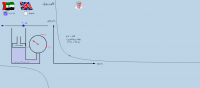
هذه التجربة تحاكي تطبيق GeoGebra «قانون بويل»: غاز في أسطوانة بمكبس، ومؤشر ضغط يتحرك عند تغيير الحجم، ورسم بياني للضغط مقابل الحجم.
This experiment simulates the GeoGebra applet “Boyle’s law”: a gas in a cylinder with a piston, a pressure gauge that moves when the volume changes, and a graph of the pressure against the volume.
🛠️ خطوات العمل
🛠️ Procedure
- اضبط \(V=10\ \mathrm L\) و\(T=300\ \mathrm K\) وسجّل \(P\) (نحو \(100\ \mathrm{kPa}\)).Set \(V=10\ \mathrm L\) and \(T=300\ \mathrm K\) and record \(P\) (about \(100\ \mathrm{kPa}\)).
- أنقص \(V\) خطوة بعد خطوة وسجّل \(P\) و\(PV\) في كل مرة.Decrease \(V\) step by step and record \(P\) and \(PV\) each time.
- اضغط «حرّك الجزيئات» عند حجم صغير وعند حجم كبير وقارن ازدحامها.Press “Move the molecules” at a small and at a large volume and compare their crowding.
- غيّر \(T\) وراقب انتقال المنحنى إلى أعلى.Change \(T\) and watch the curve move up.
🧪 تجربة 1: الغاز تحت مكبس: الضغط والحجم (كمحاكاة GeoGebra)
🧪 Experiment 1: Gas Under a Piston: Pressure and Volume (like the GeoGebra applet)
غاز محبوس في أسطوانة تضغطه بمكبس يدوي عند درجة حرارة ثابتة. حرّك شريط الحجم \(V\) وراقب مؤشر الضغط \(P\) والمنحنى البياني، وغيّر درجة الحرارة لترى منحنى آخر.
A gas is trapped in a cylinder and compressed with a manual piston at a constant temperature. Move the volume slider \(V\) and watch the pressure gauge \(P\) and the graph, and change the temperature to see another curve.
🔍 ماذا نلاحظ؟
🔍 What do we observe?
- عند إنقاص \(V\) إلى النصف يتضاعف \(P\) وحاصل الضرب \(PV\) ثابت.When \(V\) is halved \(P\) doubles and the product \(PV\) is constant.
- الرسم \(P\)–\(V\) منحنى هابط (قطع زائد)، والرسم \(P\)–\(1/V\) خط مستقيم يمرّ بالأصل.The \(P\)–\(V\) graph is a falling curve (hyperbola) and the \(P\)–\(1/V\) graph is a straight line through the origin.
- رفع الحرارة يزيد قيمة الثابت فيرتفع المنحنى كله.Raising the temperature increases the value of the constant so the whole curve moves up.
غاز ضغطه \(100\ \mathrm{kPa}\) وحجمه \(10\ \mathrm L\) ضُغط إلى \(5\ \mathrm L\) عند درجة حرارة ثابتة. ما ضغطه الجديد؟
A gas at \(100\ \mathrm{kPa}\) and \(10\ \mathrm L\) is compressed to \(5\ \mathrm L\) at a constant temperature. What is its new pressure?
إذا زاد حجم غاز إلى ثلاثة أمثاله عند حرارة ثابتة فإن ضغطه:
If the volume of a gas becomes three times at a constant temperature its pressure:
⚖️ مقارنة حالتين
⚖️ Comparing Two States
نكتب \(P_1V_1=P_2V_2\) بشرط أن يكون الضغطان بالوحدة نفسها، والحجمان بالوحدة نفسها، والحرارة وكمية الغاز ثابتتين.
We write \(P_1V_1=P_2V_2\) provided that the two pressures are in the same unit, the two volumes are in the same unit and the temperature and the amount of gas are constant.
🛠️ خطوات العمل
🛠️ Procedure
- ثبّت \(P_1\) و\(V_1\) ثم اجعل \(V_2=V_1/2\) وراقب \(P_2\).Fix \(P_1\) and \(V_1\) then make \(V_2=V_1/2\) and watch \(P_2\).
- اجعل \(V_2\gt V_1\) (تمدّد) ولاحظ نقصان الضغط.Make \(V_2\gt V_1\) (expansion) and notice that the pressure decreases.
- احسب \(P_2\) بنفسك وأدخل الناتج في «اختبر نفسك».Calculate \(P_2\) yourself and enter the result in “Test yourself”.
🧪 تجربة 2: مقارنة حالتين لغاز بحرارة ثابتة
🧪 Experiment 2: Comparing Two States of a Gas at Constant Temperature
اضبط الضغط والحجم في الحالة 1 ثم غيّر الحجم في الحالة 2 وراقب الضغط الجديد \(P_2=P_1V_1/V_2\).
Set the pressure and the volume in state 1 then change the volume in state 2 and watch the new pressure \(P_2=P_1V_1/V_2\).
🔍 ماذا نلاحظ؟
🔍 What do we observe?
- النسبة \(P_2/P_1\) تساوي \(V_1/V_2\) (مقلوب نسبة الحجمين).The ratio \(P_2/P_1\) equals \(V_1/V_2\) (the reciprocal of the ratio of the volumes).
- حاصل الضرب \(P_1V_1\) يساوي \(P_2V_2\) دائمًا.The product \(P_1V_1\) is always equal to \(P_2V_2\).
محقنة تحوي \(60\ \mathrm{mL}\) من الهواء عند الضغط الجوي \(101.3\ \mathrm{kPa}\). ضُغط المكبس حتى صار الحجم \(20\ \mathrm{mL}\). ما الضغط الجديد؟
A syringe contains \(60\ \mathrm{mL}\) of air at the atmospheric pressure \(101.3\ \mathrm{kPa}\). The piston is pressed until the volume becomes \(20\ \mathrm{mL}\). What is the new pressure?
فقاعة هواء حجمها \(2\ \mathrm{cm^3}\) عند قاع بحيرة حيث الضغط \(300\ \mathrm{kPa}\) ارتفعت إلى السطح حيث الضغط \(100\ \mathrm{kPa}\) (بحرارة ثابتة). ما حجمها؟
An air bubble of volume \(2\ \mathrm{cm^3}\) at the bottom of a lake where the pressure is \(300\ \mathrm{kPa}\) rises to the surface where the pressure is \(100\ \mathrm{kPa}\) (at constant temperature). What is its volume?
📈 التحقق بيانيًا
📈 Verifying Graphically
الرسم \(P\) مقابل \(V\) منحنى (قطع زائد) يصعب التحقق منه بالعين. لذلك نرسم \(P\) مقابل \(1/V\) فنحصل على خط مستقيم يمرّ بنقطة الأصل، وميله \(=PV\). وإذا انحرفت النقاط عن الخط بدا ذلك واضحًا.
The graph of \(P\) against \(V\) is a curve (a hyperbola) that is hard to verify by eye. So we plot \(P\) against \(1/V\) and obtain a straight line passing through the origin whose slope \(=PV\). If the points deviate from the line this appears clearly.
🛠️ خطوات العمل
🛠️ Procedure
- اختر حجمًا واضغط «سجّل القياس» (كرّر لأربعة أحجام مختلفة على الأقل).Choose a volume and press “Record the measurement” (repeat for at least four different volumes).
- لاحظ أن النقاط تقع على خط مستقيم في الرسم \(P\)–\(1/V\).Notice that the points lie on a straight line in the \(P\)–\(1/V\) graph.
- اقرأ متوسط \(PV\) وأدخل قيمة الثابت في «اختبر نفسك».Read the mean of \(PV\) and enter the value of the constant in “Test yourself”.
🧪 تجربة 3: التحقق من ثبات PV من قياسات
🧪 Experiment 3: Verifying That PV Is Constant from Measurements
نقيس ضغط الغاز عند عدة أحجام وحرارة ثابتة ثم نرسم \(P\) مقابل \(1/V\): خط مستقيم يمرّ بالأصل وميله هو الثابت \(PV\).
We measure the pressure of the gas at several volumes and a constant temperature then plot \(P\) against \(1/V\): a straight line through the origin whose slope is the constant \(PV\).
🔍 ماذا نلاحظ؟
🔍 What do we observe?
- القياسات العملية فيها انحرافات صغيرة، لذلك نأخذ المتوسط أو ميل أفضل خط مستقيم.Real measurements have small deviations so we take the mean or the slope of the best straight line.
- قيمة الثابت \(PV=nRT\) تساوي \(0.4\times8.314\times300\approx998\ \mathrm{kPa\cdot L}\) في هذه التجربة.The value of the constant \(PV=nRT\) equals \(0.4\times8.314\times300\approx998\ \mathrm{kPa\cdot L}\) in this experiment.
أسطوانة غوص حجمها \(10\ \mathrm L\) وضغط الهواء فيها \(200\ \mathrm{atm}\). كم لترًا يشغل هذا الهواء عند \(1\ \mathrm{atm}\) وحرارة ثابتة؟
A diving cylinder of volume \(10\ \mathrm L\) contains air at a pressure of \(200\ \mathrm{atm}\). What volume does this air occupy at \(1\ \mathrm{atm}\) and a constant temperature?
أي رسم بياني يعطي خطًّا مستقيمًا يمرّ بنقطة الأصل في قانون بويل؟
Which graph gives a straight line passing through the origin in Boyle’s law?
🎲 تدرّب على المسائل
🎲 Practice Problems
🧪 تجربة 4: تدرّب: قانون بويل
🧪 Experiment 4: Practice: Boyle’s Law
مسائل عشوائية: أوجد الثابت \(PV\) ثم الضغط الجديد.
Random problems: find the constant \(PV\) then the new pressure.
🚀 تطبيقات
🚀 Applications
أين نلاحظ قانون بويل؟
Where do we notice Boyle’s law?
- المحقنة: سحب المكبس يزيد الحجم فينخفض الضغط فيدخل السائل.The syringe: pulling the piston increases the volume so the pressure decreases and the liquid enters.
- التنفس: عند توسّع الصدر يزداد حجم الرئتين فينخفض الضغط فيدخل الهواء.Breathing: when the chest expands the volume of the lungs increases so the pressure decreases and air enters.
- الغوّاصون: يتضاعف ضغط الماء كل 10 m تقريبًا فيجب أن يزفر الغواص أثناء الصعود لأن حجم الهواء في الرئتين يزداد.Divers: the pressure of water increases about every 10 m so a diver must exhale while ascending because the volume of the air in the lungs increases.
- فقاعات الغاز التي تكبر أثناء ارتفاعها من قاع الماء.Gas bubbles that grow while rising from the bottom of the water.
⚠️ أخطاء شائعة
⚠️ Common Mistakes
تجنّب هذه الأخطاء
Avoid these mistakes
- الظن أن الضغط يتناسب طرديًا مع الحجم؛ العلاقة عكسية.Thinking that the pressure is directly proportional to the volume; the relation is inverse.
- تطبيق القانون مع تغيّر درجة الحرارة؛ القانون للحرارة الثابتة.Applying the law while the temperature changes; the law is for a constant temperature.
- خلط الوحدات (kPa مع atm أو mL مع L).Mixing the units (kPa with atm or mL with L).
- استعمال ضغط المقياس بدل الضغط المطلق.Using the gauge pressure instead of the absolute pressure.
📚 ملخص
📚 Summary
أهم ما تعلمناه
Key points
- عند ثبات الحرارة وكمية الغاز: \(P\propto1/V\) أي \(P_1V_1=P_2V_2\).At constant temperature and amount of gas: \(P\propto1/V\), that is \(P_1V_1=P_2V_2\).
- الرسم \(P\)–\(V\) قطع زائد، والرسم \(P\)–\(1/V\) خط مستقيم يمرّ بالأصل ميله \(PV\).The \(P\)–\(V\) graph is a hyperbola and the \(P\)–\(1/V\) graph is a straight line through the origin with slope \(PV\).
- السبب: تصغير الحجم يزيد عدد اصطدامات الجزيئات بالجدران في الثانية فيزداد الضغط.The reason: reducing the volume increases the number of collisions of the molecules with the walls per second so the pressure increases.
🔗 محاكيات GeoGebra للاستعانة بها عند اللزوم
🔗 GeoGebra Simulations to Use When Needed
اضغط «تشغيل» لتعمل المحاكاة هنا داخل الدرس؛ ويمكن للطالب الرجوع إليها لتجربة الفكرة بطريقة أخرى.
Press “Run” to run the simulation right here inside the lesson; the student can use it to try the idea in another way.