🎯 نواتج التعلم
🎯 Learning Outcomes
بعد هذه التجربة ستكون قادرًا على أن:
After this experiment you will be able to:
- تسمّي أجزاء مخطط الانعكاس: الشعاع الساقط، الشعاع المنعكس، العمود على السطح، زاويتا السقوط والانعكاس، السطح العاكس.Name the parts of a reflection diagram: the incident ray, the reflected ray, the normal, the angles of incidence and reflection, and the reflecting surface.
- تقيس زاويتي السقوط والانعكاس من العمود وتستنتج قانون الانعكاس \(\theta_i=\theta_r\).Measure the angles of incidence and reflection from the normal and deduce the law of reflection \(\theta_i=\theta_r\).
- تحسب الزاوية بين الشعاعين وتحسب دوران الشعاع المنعكس عند تدوير المرآة.Calculate the angle between the two rays and the rotation of the reflected ray when the mirror is rotated.
🎬 شاهد الفيديو
🎬 Watch the Video
🔦 أجزاء مخطط الانعكاس
🔦 The Parts of a Reflection Diagram
عندما يسقط شعاع ضوئي على سطح عاكس يرتد عنه، وتسمى هذه الظاهرة الانعكاس. نصف الظاهرة بالرموز التالية (المرقّمة في المخطط أدناه):
When a light ray falls on a reflecting surface it bounces back, and this phenomenon is called reflection. We describe it using the following parts (numbered in the diagram below):
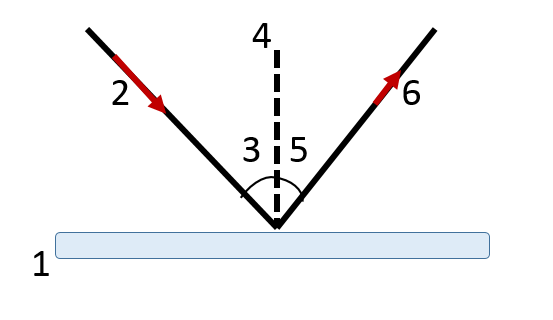
مخطط الانعكاس: 1 السطح العاكس، 2 الشعاع الساقط، 3 زاوية السقوط، 4 العمود على السطح، 5 زاوية الانعكاس، 6 الشعاع المنعكس.
The reflection diagram: 1 the reflecting surface, 2 the incident ray, 3 the angle of incidence, 4 the normal, 5 the angle of reflection, 6 the reflected ray.
📘 قانون الانعكاس
📘 The law of reflection
(1) الشعاع الساقط والشعاع المنعكس والعمود على السطح عند نقطة السقوط تقع في مستوى واحد.
(1) The incident ray, the reflected ray and the normal at the point of incidence lie in one plane.
(2) زاوية السقوط تساوي زاوية الانعكاس:
(2) The angle of incidence equals the angle of reflection:
\[\theta_i=\theta_r\]
💡 شرح إضافي
💡 Extra explanation
- الزاويتان \(\theta_i\) و\(\theta_r\) تُقاسان من العمود على السطح (لا من السطح نفسه): \(\theta_i\) بين الشعاع الساقط والعمود، و\(\theta_r\) بين الشعاع المنعكس والعمود.The angles \(\theta_i\) and \(\theta_r\) are measured from the normal to the surface (not from the surface itself): \(\theta_i\) between the incident ray and the normal, and \(\theta_r\) between the reflected ray and the normal.
- الزاوية بين الشعاعين الساقط والمنعكس \(=2\theta_i\)، والزاوية بين الشعاع الساقط والسطح \(=90^\circ-\theta_i\).The angle between the incident and the reflected rays \(=2\theta_i\), and the angle between the incident ray and the surface \(=90^\circ-\theta_i\).
- إذا سقط الشعاع عموديًا (\(\theta_i=0\)) عاد على نفسه. وإذا عكسنا اتجاه الشعاع المنعكس عاد من الطريق نفسه (مبدأ انعكاس الضوء).If the ray falls along the normal (\(\theta_i=0\)) it returns along itself. If the direction of the reflected ray is reversed it retraces its path (reversibility of light).
- عند تدوير المرآة بزاوية \(\alpha\) والشعاع الساقط ثابت يدور الشعاع المنعكس بزاوية \(2\alpha\).If the mirror is rotated by an angle \(\alpha\) while the incident ray stays fixed, the reflected ray rotates by \(2\alpha\).
- الانعكاس على سطح أملس منتظم يُعطي أشعة منعكسة متوازية، وعلى سطح خشن منتشر تتفرق الأشعة، لكن كل شعاع يطيع القانون عند نقطة سقوطه.Reflection from a smooth surface is regular and gives parallel reflected rays; from a rough surface it is diffuse and the rays scatter, but every ray obeys the law at its own point of incidence.
🧪 تجربة 1: أرسل شعاعًا وقس زاويتي السقوط والانعكاس
🧪 Experiment 1: Send a ray and measure the angles of incidence and reflection
يسقط شعاع ضوئي (أحمر) على سطح عاكس عند نقطة، فينعكس (أزرق) والعمود على السطح (خط متقطع). الزاويتان \(\theta_i\) و\(\theta_r\) تُقاسان من العمود وتتساويان دائمًا. يتحرك الشعاع تلقائيًا؛ أو غيّر زاوية السقوط بالمؤشر، أو اختر وضع تدوير المرآة مع بقاء الشعاع الساقط ثابتًا فتجد أن الشعاع المنعكس يدور ضعف زاوية المرآة. اضغط «سجّل القراءة» لتملأ الجدول وتتحقق بنفسك.
A light ray (red) falls on a reflecting surface at a point and is reflected (blue), and the normal to the surface is the dashed line. The angles \(\theta_i\) and \(\theta_r\) are measured from the normal and are always equal. The ray moves automatically; or change the angle of incidence with the slider, or choose the rotate the mirror mode while the incident ray stays fixed and you will find that the reflected ray rotates twice the angle of the mirror. Press “Record the reading” to fill the table and check it yourself.
🧪 تجربة 2: سمِّ أجزاء المخطط
🧪 Experiment 2: Name the parts of the diagram
اكتب رقم كل جزء من أجزاء مخطط الانعكاس كما في الشكل، ثم اضغط «صحّح».
Choose the number of each part of the reflection diagram as in the figure, then press “Check”.
🛠️ تطبيقات عملية
🛠️ Practical applications
- المرايا والبريسكوب: تغيير اتجاه الضوء بتدوير مرآة بزاوية محسوبة.Mirrors and the periscope: changing the direction of light by turning a mirror through a calculated angle.
- عاكسات الطرق والدراجات: تعيد الضوء إلى مصدره.Road and bicycle reflectors: they send the light back toward its source.
- رؤية الأجسام: نرى الأجسام بسبب الانعكاس المنتشر للضوء عن أسطحها.Seeing objects: we see objects because of the diffuse reflection of light from their surfaces.
✍️ أمثلة محلولة
✍️ Worked Examples
سقط شعاع على مرآة مستوية بزاوية سقوط \(35^\circ\). احسب زاوية الانعكاس، والزاوية بين الشعاعين، والزاوية بين الشعاع الساقط والسطح.
A ray falls on a plane mirror with an angle of incidence of \(35^\circ\). Calculate the angle of reflection, the angle between the two rays and the angle between the incident ray and the surface.
الزاوية بين الشعاعين الساقط والمنعكس \(80^\circ\). ما زاوية السقوط؟
The angle between the incident and the reflected rays is \(80^\circ\). What is the angle of incidence?
شعاع ساقط ثابت على مرآة مستوية. دُوّرت المرآة \(12^\circ\). بأي زاوية يدور الشعاع المنعكس؟
A fixed ray falls on a plane mirror. The mirror is rotated by \(12^\circ\). By what angle does the reflected ray rotate?
يصنع شعاع ضوئي زاوية \(25^\circ\) مع سطح مرآة مستوية. احسب زاوية السقوط والزاوية بين الشعاعين.
A light ray makes an angle of \(25^\circ\) with the surface of a plane mirror. Calculate the angle of incidence and the angle between the two rays.
تُقاس زاويتا السقوط والانعكاس بين الشعاع و:
The angles of incidence and reflection are measured between the ray and:
سقط شعاع عموديًا على مرآة مستوية. يرتد:
A ray falls along the normal on a plane mirror. It is reflected:
سقط شعاع على مرآة بزاوية سقوط \(50^\circ\). الزاوية بين الشعاعين الساقط والمنعكس:
A ray falls on a mirror with an angle of incidence of \(50^\circ\). The angle between the incident and reflected rays is:
عند الانعكاس عن سطح خشن (انعكاس منتشر):
In reflection from a rough surface (diffuse reflection):
📚 ملخص
📚 Summary
| المفهومConcept | العلاقةRelation |
|---|---|
| قانون الانعكاسLaw of reflection | \(\theta_i=\theta_r\)\(\theta_i=\theta_r\) |
| الزاوية بين الشعاعينAngle between the rays | \(2\theta_i\)\(2\theta_i\) |
| الزاوية مع السطحAngle with the surface | \(90^\circ-\theta_i\)\(90^\circ-\theta_i\) |
| تدوير المرآة بزاوية \(\alpha\)Rotating the mirror by \(\alpha\) | يدور الشعاع المنعكس \(2\alpha\)the reflected ray rotates \(2\alpha\) |
⚠️ أخطاء شائعة
⚠️ Common mistakes
- قياس زاوية السقوط من سطح المرآة بدل العمود.Measuring the angle of incidence from the mirror surface instead of the normal.
- نسيان أن الشعاعين والعمود في مستوى واحد.Forgetting that the two rays and the normal lie in one plane.
- الخلط بين الزاوية بين الشعاعين (\(2\theta_i\)) وزاوية السقوط (\(\theta_i\)).Confusing the angle between the rays (\(2\theta_i\)) with the angle of incidence (\(\theta_i\)).
🔗 محاكيات GeoGebra للاستعانة بها عند اللزوم
🔗 GeoGebra Simulations to Use When Needed
اضغط «تشغيل» لتعمل المحاكاة هنا داخل الدرس؛ ويمكن للطالب الرجوع إليها لتجربة الفكرة بطريقة أخرى.
Press “Run” to run the simulation right here inside the lesson; the student can use it to try the idea in another way.