🎯 نواتج التعلم
🎯 Learning Outcomes
بعد هذه التجربة ستكون قادرًا على أن:
After this experiment you will be able to:
- تذكر نص قانون أوم وتكتبه بالصيغة \(V=IR\).State Ohm’s law and write it as \(V=IR\).
- تقيس فرق الجهد والتيار وتسجّلهما في جدول وترسم العلاقة بينهما.Measure the potential difference and the current, record them in a table and plot their relation.
- تجد المقاومة من ميل الخط المستقيم \(V\)–\(I\).Find the resistance from the slope of the \(V\)–\(I\) straight line.
🎬 شاهد الفيديو
🎬 Watch the Video
⚡ قانون أوم
⚡ Ohm’s Law
عند ثبوت درجة الحرارة يتناسب فرق الجهد \(V\) بين طرفي موصل فلزي طرديًا مع شدة التيار \(I\) المار فيه. ثابت التناسب هو المقاومة \(R\) وتقاس بالأوم \(\Omega\).
At constant temperature the potential difference \(V\) across a metallic conductor is directly proportional to the current \(I\) through it. The constant of proportionality is the resistance \(R\), measured in ohms \(\Omega\).
📘 القانون
📘 The law
\[V=IR\qquad I=\dfrac{V}{R}\qquad R=\dfrac{V}{I}\]
💡 ملاحظات
💡 Notes
- العلاقة بين \(V\) و\(I\) خط مستقيم يمر بنقطة الأصل، وميله يساوي \(R\).The relation between \(V\) and \(I\) is a straight line through the origin, its slope equals \(R\).
- الموصل الذي يحقق القانون يُسمى أوميًّا (كالسلك الفلزي عند ثبات درجة حرارته).A conductor that obeys the law is called ohmic (like a metallic wire at constant temperature).
- الفولتميتر يُوصل على التوازي والأميتر على التوالي.The voltmeter is connected in parallel and the ammeter in series.
🧪 تجربة 1: التحقق من قانون أوم
🧪 Experiment 1: Verifying Ohm’s law
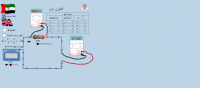
اختر مقاومة (معلومة أو مجهولة) وغيّر فرق الجهد \(V\)، ثم اضغط «سجّل القراءة» لإضافة \((I,V)\) إلى الجدول والرسم. بعد نقطتين أو أكثر اضغط «ارسم الخط» لتجد المقاومة من الميل. (لا شيء يتحرك من تلقاء نفسه.)
Choose a resistor (known or unknown) and change the potential difference \(V\), then press “Record reading” to add \((I,V)\) to the table and the graph. After two or more points press “Draw the line” to find the resistance from the slope. (Nothing moves by itself.)
🧪 تجربة 2: حاسبة قانون أوم
🧪 Experiment 2: Ohm’s law calculator
مسألة جديدة في كل مرة. احسب المطلوب ثم اضغط «صحّح».
A new problem every time. Calculate the required value and press “Check”.
✍️ أمثلة محلولة
✍️ Worked Examples
مقاومة \(20\ \Omega\) موصولة ببطارية \(12\ \mathrm{V}\). احسب التيار.
A \(20\ \Omega\) resistor is connected to a \(12\ \mathrm{V}\) battery. Calculate the current.
مرّ تيار \(0.5\ \mathrm{A}\) في مقاومة فكان فرق الجهد \(8\ \mathrm{V}\). احسب \(R\).
A current of \(0.5\ \mathrm{A}\) flows in a resistor with a potential difference of \(8\ \mathrm{V}\). Calculate \(R\).
ما فرق الجهد اللازم لتمرير \(2\ \mathrm{A}\) في مقاومة \(15\ \Omega\)؟
What potential difference is needed to pass \(2\ \mathrm{A}\) through a \(15\ \Omega\) resistor?
في رسم \(V\)–\(I\) مرّ الخط بالنقطتين \((0.2\ \mathrm{A},\,3\ \mathrm{V})\) و\((0.6\ \mathrm{A},\,9\ \mathrm{V})\). احسب المقاومة.
In a \(V\)–\(I\) graph the line passes through \((0.2\ \mathrm{A},\,3\ \mathrm{V})\) and \((0.6\ \mathrm{A},\,9\ \mathrm{V})\). Calculate the resistance.
إذا تضاعف فرق الجهد على مقاومة ثابتة فإن التيار:
If the potential difference across a constant resistor doubles, the current:
ميل الخط البياني \(V\)–\(I\) يساوي:
The slope of the \(V\)–\(I\) graph equals:
وحدة المقاومة:
The unit of resistance is:
يُوصل الفولتميتر مع المقاومة على:
The voltmeter is connected with the resistor in:
📚 ملخص
📚 Summary
| الكميةQuantity | القانونLaw |
|---|---|
| فرق الجهدPotential difference | \(V=IR\)\(V=IR\) |
| التيارCurrent | \(I=V/R\)\(I=V/R\) |
| المقاومةResistance | \(R=V/I\)\(R=V/I\) |
⚠️ أخطاء شائعة
⚠️ Common mistakes
- توصيل الأميتر على التوازي مع المقاومة.Connecting the ammeter in parallel with the resistor.
- نسيان تحويل mA إلى A قبل الحساب.Forgetting to convert mA to A before calculating.
- الخلط بين ميل الخط \(V\)–\(I\) (وهو \(R\)) وميل الخط \(I\)–\(V\) (وهو \(1/R\)).Confusing the slope of the \(V\)–\(I\) line (\(R\)) with that of the \(I\)–\(V\) line (\(1/R\)).
🔗 محاكيات GeoGebra للاستعانة بها عند اللزوم
🔗 GeoGebra Simulations to Use When Needed
اضغط «تشغيل» لتعمل المحاكاة هنا داخل الدرس؛ ويمكن للطالب الرجوع إليها لتجربة الفكرة بطريقة أخرى.
Press “Run” to run the simulation right here inside the lesson; the student can use it to try the idea in another way.