🎯 نواتج التعلم
🎯 Learning Outcomes
بعد هذه التجربة ستكون قادرًا على أن:
After this experiment you will be able to:
- تحلّل دائرة فيها مصباح \(R_1\) على التوازي مع مقاومة متغيرة \(R_2\) ويتصلان على التوالي مع مقاومة متغيرة \(R_3\).Analyse a circuit in which a bulb \(R_1\) is in parallel with a variable resistor \(R_2\) and both are in series with a variable resistor \(R_3\).
- تحسب جهد المصباح وتياره وقدرته \(P_1=\dfrac{V_1^2}{R_1}\) وتربط السطوع بالقدرة.Calculate the voltage of the bulb, its current and its power \(P_1=\dfrac{V_1^2}{R_1}\) and relate the brightness to the power.
- تتوقع كيف يتغير سطوع المصباح عند زيادة \(R_2\) أو \(R_3\) أو جهد المصدر.Predict how the brightness of the bulb changes when \(R_2\), \(R_3\) or the source voltage is increased.
🎬 شاهد الفيديو
🎬 Watch the Video
💡 المصباح والمقاومتان المتغيرتان
💡 The Bulb and the Two Variable Resistors
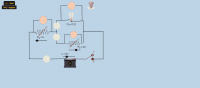
في الدائرة: المصباح \(R_1\) على التوازي مع \(R_2\)، والمجموعة على التوالي مع \(R_3\) والمصدر \(V\). يتحدد سطوع المصباح بقدرته \(P_1=\dfrac{V_1^2}{R_1}=I_1^2R_1\) حيث \(V_1\) الجهد على المجموعة المتوازية. نحسب بالخطوات: المقاومة المتوازية، ثم الكلية، ثم التيار الكلي، ثم جهد المجموعة المتوازية.
In the circuit the bulb \(R_1\) is in parallel with \(R_2\), and the combination is in series with \(R_3\) and the source \(V\). The brightness of the bulb is decided by its power \(P_1=\dfrac{V_1^2}{R_1}=I_1^2R_1\) where \(V_1\) is the voltage across the parallel combination. We calculate step by step: the parallel resistance, then the total resistance, then the total current, then the voltage of the parallel combination.
📘 خطوات الحساب
📘 The steps of calculation
\[R_p=\dfrac{R_1R_2}{R_1+R_2}\qquad R_t=R_3+R_p\qquad I=\dfrac{V}{R_t}\]
\[V_1=I\,R_p\qquad I_1=\dfrac{V_1}{R_1}\qquad I_2=\dfrac{V_1}{R_2}\qquad P_1=\dfrac{V_1^2}{R_1}\]
💡 كيف يتغير السطوع؟
💡 How does the brightness change?
- زيادة \(R_2\): تزداد \(R_p\) فيزداد نصيبها من الجهد \(V_1\) (تقسيم الجهد) فيزداد سطوع المصباح (ويقل التيار الكلي قليلًا).Increasing \(R_2\): \(R_p\) increases so its share of the voltage \(V_1\) increases (voltage division) and the bulb becomes brighter (while the total current decreases a little).
- زيادة \(R_3\): يقل \(V_1\) فيخفت المصباح، وإذا أصبحت \(R_3=0\) فإن \(V_1=V\) ويصل السطوع أقصاه \(P_1=\dfrac{V^2}{R_1}\).Increasing \(R_3\): \(V_1\) decreases so the bulb dims, and if \(R_3=0\) then \(V_1=V\) and the brightness reaches its maximum \(P_1=\dfrac{V^2}{R_1}\).
- زيادة \(V\): تزداد جميع الجهود والتيارات ويزداد السطوع (تناسب مع \(V^2\)).Increasing \(V\): all the voltages and currents increase and the brightness increases (proportional to \(V^2\)).
- نفترض أن مقاومة المصباح ثابتة \(R_1=10\ \Omega\).We assume that the resistance of the bulb is constant \(R_1=10\ \Omega\).
🧪 تجربة 1: غيّر المقاومتين المتغيرتين وراقب سطوع المصباح
🧪 Experiment 1: Change the two variable resistors and watch the brightness of the bulb
المصباح \(R_1=10\ \Omega\) على التوازي مع \(R_2\)، والمجموعة على التوالي مع \(R_3\) والمصدر. حرّك المؤشرات (القيم الأولى هي قيم المحاكاة الأصلية: \(V=6.7\ \mathrm{V}\) و\(R_2=33\) و\(R_3=9\ \Omega\)) ولاحظ تغيّر التيارات وجهد المصباح وقدرته وتوهّجه. يوضح الرسمان كيف تتغير القدرة \(P_1\) مع \(R_3\) ومع \(R_2\). لا يتغير شيء قبل أن تحرّك أنت.
The bulb \(R_1=10\ \Omega\) is in parallel with \(R_2\) and the combination is in series with \(R_3\) and the source. Move the sliders (the first values are those of the original simulation: \(V=6.7\ \mathrm{V}\), \(R_2=33\) and \(R_3=9\ \Omega\)) and watch the currents, the voltage of the bulb, its power and its glow change. The two graphs show how the power \(P_1\) changes with \(R_3\) and with \(R_2\). Nothing changes before you move something.
🧪 تجربة 2: حاسبة: سطوع المصباح
🧪 Experiment 2: Calculator: the brightness of the bulb
مسألة جديدة في كل مرة (\(R_1=10\ \Omega\)). احسب القيم الثلاث ثم اضغط «صحّح».
A new problem every time (\(R_1=10\ \Omega\)). Calculate the three values and press “Check”.
🛠️ تطبيقات عملية
🛠️ Practical applications
- مخفّت الإضاءة (Dimmer): مقاومة متغيرة على التوالي لتغيير سطوع المصباح.A light dimmer: a variable resistor in series to change the brightness of the bulb.
- تحكم بشدة الصوت والإنارة في الأجهزة: مقسّم جهد بمقاومة متغيرة.Control of the volume and the lighting in devices: a voltage divider with a variable resistor.
- اختبارات الدوائر: التنبؤ بتأثير تغيير مقاومة في فرع على بقية الدائرة.Circuit tests: predicting the effect of changing a resistance in a branch on the rest of the circuit.
✍️ أمثلة محلولة
✍️ Worked Examples
بقيم المحاكاة الأصلية: \(V=6.7\ \mathrm{V}\) و\(R_1=10\ \Omega\) و\(R_2=33\ \Omega\) و\(R_3=9\ \Omega\). احسب تيار المصباح وقدرته.
With the values of the original simulation: \(V=6.7\ \mathrm{V}\), \(R_1=10\ \Omega\), \(R_2=33\ \Omega\) and \(R_3=9\ \Omega\). Calculate the current of the bulb and its power.
للدائرة نفسها زيدت \(R_2\) إلى \(100\ \Omega\). كيف تغيّر السطوع؟
For the same circuit \(R_2\) is increased to \(100\ \Omega\). How did the brightness change?
للدائرة الأصلية جُعلت \(R_3=0\). ما أقصى قدرة للمصباح؟
For the original circuit \(R_3\) is made \(0\). What is the maximum power of the bulb?
ما تأثير فتح الفرع \(R_2\) (\(R_2\to\infty\)) في سطوع المصباح؟
What is the effect of opening the branch \(R_2\) (\(R_2\to\infty\)) on the brightness of the bulb?
عند زيادة \(R_3\) (على التوالي) فإن سطوع المصباح:
When \(R_3\) (in series) is increased the brightness of the bulb:
عند زيادة \(R_2\) (على التوازي مع المصباح) فإن سطوعه:
When \(R_2\) (in parallel with the bulb) is increased its brightness:
قدرة المصباح تُحسب من:
The power of the bulb is calculated from:
أقصى سطوع للمصباح (لجهد المصدر \(V\)) يحدث عندما:
The maximum brightness of the bulb (for a source voltage \(V\)) occurs when:
📚 ملخص
📚 Summary
| الخطوةStep | القانونLaw |
|---|---|
| المتوازيةParallel | \(R_p=\dfrac{R_1R_2}{R_1+R_2}\)\(R_p=\dfrac{R_1R_2}{R_1+R_2}\) |
| الكليةTotal | \(R_t=R_3+R_p\)\(R_t=R_3+R_p\) |
| جهد المصباحBulb voltage | \(V_1=V\dfrac{R_p}{R_t}\)\(V_1=V\dfrac{R_p}{R_t}\) |
| القدرةPower | \(P_1=\dfrac{V_1^2}{R_1}\)\(P_1=\dfrac{V_1^2}{R_1}\) |
⚠️ أخطاء شائعة
⚠️ Common mistakes
- استعمال \(V\) المصدر بدل \(V_1\) في قدرة المصباح.Using the source voltage \(V\) instead of \(V_1\) in the power of the bulb.
- نسيان أن \(R_2\) تؤثر في المصباح رغم أنها في فرع آخر.Forgetting that \(R_2\) affects the bulb although it is in another branch.
- حساب المقاومة الكلية بجمع المقاومات الثلاث مباشرة.Calculating the total resistance by adding the three resistances directly.
🔗 محاكيات GeoGebra للاستعانة بها عند اللزوم
🔗 GeoGebra Simulations to Use When Needed
اضغط «تشغيل» لتعمل المحاكاة هنا داخل الدرس؛ ويمكن للطالب الرجوع إليها لتجربة الفكرة بطريقة أخرى.
Press “Run” to run the simulation right here inside the lesson; the student can use it to try the idea in another way.