🎯 نواتج التعلم
🎯 Learning Outcomes
بعد هذه التجربة ستكون قادرًا على أن:
After this experiment you will be able to:
- ترسم الأشعة الرئيسية الثلاثة للعدسة المحدبة والمقعرة وتحدّد بها موضع الصورة.Draw the three principal rays for convex and concave lenses and use them to locate the image.
- تحدّد صفات الصورة (حقيقية أو افتراضية، معتدلة أو مقلوبة، مكبّرة أو مصغّرة) لكل موضع للجسم.State the properties of the image (real or virtual, upright or inverted, magnified or diminished) for every position of the object.
- تحسب موضع الصورة والتكبير بقانون العدسات الرقيقة \(\dfrac1f=\dfrac1u+\dfrac1v\).Calculate the image position and the magnification with the thin-lens equation \(\dfrac1f=\dfrac1u+\dfrac1v\).
🎬 شاهد الفيديو
🎬 Watch the Video
🔍 العدسات الرقيقة
🔍 Thin Lenses
العدسة قطعة شفافة تنكسر فيها الأشعة. العدسة المحدبة (محدبة الوجهين) أسمك في الوسط وتجمّع الأشعة الموازية في بؤرتها \(F\)، والعدسة المقعرة أرقّ في الوسط وتفرّق الأشعة الموازية فتبدو صادرة من بؤرتها. للعدسة بؤرتان متماثلتان على جانبيها \(F\) و\(F'\) تبعد كل منهما \(f\) عن مركزها البصري، ومركز التكور \(2F\) على بعد \(2f\).
A lens is a transparent piece in which rays are refracted. A convex lens (convex on both faces) is thicker in the middle and converges parallel rays at its focus \(F\); a concave lens is thinner in the middle and diverges parallel rays so they seem to come from its focus. A lens has two symmetric foci \(F\) and \(F'\) on both sides, each at a distance \(f\) from its optical centre, and the centre of curvature \(2F\) at \(2f\).
📘 الأشعة الرئيسية وقانون العدسات
📘 The principal rays and the lens equation
(1) شعاع موازٍ للمحور ينكسر مارًّا بالبؤرة \(F'\) (المحدبة) أو كأنه صادر من \(F\) (المقعرة). (2) شعاع مار بالبؤرة \(F\) (أو متجه نحوها) ينكسر موازيًا للمحور. (3) شعاع يمر بمركز العدسة لا ينحرف.
(1) A ray parallel to the axis is refracted through the focus \(F'\) (convex) or as if it came from \(F\) (concave). (2) A ray through the focus \(F\) (or aimed at it) is refracted parallel to the axis. (3) A ray through the centre of the lens is not deviated.
\[\dfrac1f=\dfrac1u+\dfrac1v\qquad m=\dfrac{h_i}{h_o}=-\dfrac vu\qquad P=\dfrac1f\ (\text{in diopters when }f\text{ is in m})\]
الاصطلاح: \(u\gt 0\) أمام العدسة، \(v\gt 0\) صورة حقيقية في الجهة الأخرى و\(v\lt 0\) افتراضية في جهة الجسم، \(f\gt 0\) للمحدبة و\(f\lt 0\) للمقعرة، و\(m\gt 0\) معتدلة.
Sign convention: \(u\gt 0\) in front of the lens, \(v\gt 0\) a real image on the other side and \(v\lt 0\) a virtual one on the side of the object, \(f\gt 0\) for a convex lens and \(f\lt 0\) for a concave one, and \(m\gt 0\) upright.
📋 صفات الصورة حسب موضع الجسم
📋 Image Properties by Object Position
| العدسةLens | موضع الجسمObject position | صفات الصورةImage properties |
|---|---|---|
| محدبةConvex | أبعد من \(2f\)beyond \(2f\) | حقيقية مقلوبة مصغّرة بين \(F'\) و\(2F'\)real, inverted, diminished, between \(F'\) and \(2F'\) |
| محدبةConvex | عند \(2f\)at \(2f\) | حقيقية مقلوبة مساوية للجسم عند \(2F'\)real, inverted, same size, at \(2F'\) |
| محدبةConvex | بين \(f\) و\(2f\)between \(f\) and \(2f\) | حقيقية مقلوبة مكبّرة خلف \(2F'\)real, inverted, magnified, beyond \(2F'\) |
| محدبةConvex | عند \(F\)at \(F\) | لا تتكون صورة (أشعة منكسرة متوازية، الصورة في اللانهاية)no image (the refracted rays are parallel, the image is at infinity) |
| محدبةConvex | بين \(F\) والعدسةbetween \(F\) and the lens | افتراضية معتدلة مكبّرة في جهة الجسم (العدسة المكبّرة)virtual, upright, magnified, on the side of the object (the magnifying glass) |
| مقعرةConcave | أي موضعany position | افتراضية معتدلة مصغّرة في جهة الجسم بين العدسة و\(F\)virtual, upright, diminished, on the side of the object between the lens and \(F\) |
🧪 تجربة 1: ارسم الصورة في العدسة المحدبة والمقعرة
🧪 Experiment 1: Draw the image in convex and concave lenses
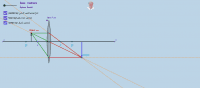
اختر نوع العدسة وحرّك الجسم (يتحرك تلقائيًا): ينكسر الشعاع الموازي للمحور مارًّا ببؤرة العدسة، والشعاع المار بالبؤرة ينكسر موازيًا للمحور، والشعاع المار بمركز العدسة لا ينحرف، وتتقاطع الأشعة (أو امتداداتها المنقّطة) عند رأس الصورة. راقب صفات الصورة عند \(2f\) و\(f\)، وجرّب العدسة المكبّرة بوضع الجسم داخل البعد البؤري.
Choose the type of lens and move the object (it moves automatically): the ray parallel to the axis is refracted through the focus of the lens, the ray through the focus is refracted parallel to the axis, the ray through the centre of the lens is not deviated, and the rays (or their dotted extensions) meet at the tip of the image. Watch the properties of the image at \(2f\) and \(f\) and try the magnifying glass by putting the object inside the focal length.
🧪 تجربة 2: أكمل جدول صفات الصورة
🧪 Experiment 2: Complete the table of image properties
اختر صفات الصورة لكل نوع عدسة وموضع جسم ثم اضغط «تحقق من الإجابات». استعن بالتجربة أعلاه.
Choose the properties of the image for each lens type and object position then press “Check answers”. Use the experiment above to help.
🛠️ تطبيقات عملية
🛠️ Practical applications
- العدسة المكبّرة: محدبة يوضع الجسم داخل بعدها البؤري فتُرى صورة معتدلة مكبّرة.The magnifying glass: a convex lens with the object inside its focal length gives an upright, magnified image.
- آلة التصوير والعين: عدسة محدبة تكوّن صورة حقيقية مقلوبة مصغّرة على الفيلم أو الشبكية.The camera and the eye: a convex lens forms a real, inverted, diminished image on the film or the retina.
- النظارات: المحدبة لعلاج طول النظر والمقعرة لعلاج قصر النظر.Spectacles: convex for long sight and concave for short sight.
✍️ أمثلة محلولة
✍️ Worked Examples
عدسة محدبة بعدها البؤري \(15\ \mathrm{cm}\). جسم على بعد \(20\ \mathrm{cm}\) منها. أوجد موضع الصورة والتكبير وصفاتها.
A convex lens has a focal length of \(15\ \mathrm{cm}\). An object is \(20\ \mathrm{cm}\) from it. Find the image position, the magnification and its properties.
عدسة محدبة \(f=10\ \mathrm{cm}\) استُعملت كعدسة مكبّرة والجسم على بعد \(6\ \mathrm{cm}\). أوجد موضع الصورة والتكبير.
A convex lens \(f=10\ \mathrm{cm}\) is used as a magnifying glass with the object \(6\ \mathrm{cm}\) away. Find the image position and the magnification.
عدسة مقعرة بعدها البؤري \(20\ \mathrm{cm}\) (\(f=-20\ \mathrm{cm}\)). جسم على بعد \(30\ \mathrm{cm}\). أوجد الصورة.
A concave lens has a focal length of \(20\ \mathrm{cm}\) (\(f=-20\ \mathrm{cm}\)). An object is \(30\ \mathrm{cm}\) away. Find the image.
وُضعت شاشة على بعد \(20\ \mathrm{cm}\) من عدسة محدبة فتكوّنت عليها صورة حقيقية مساوية للجسم. ما بعدها البؤري وقدرتها؟
A screen is placed \(20\ \mathrm{cm}\) from a convex lens and a real image of the same size as the object forms on it. Find its focal length and power.
جسم على بعد \(2f\) من عدسة محدبة. صورته:
An object is at \(2f\) from a convex lens. Its image is:
صورة جسم في عدسة مقعرة تكون دائمًا:
The image of an object in a concave lens is always:
تعمل العدسة المحدبة كعدسة مكبّرة عندما يكون الجسم:
A convex lens acts as a magnifying glass when the object is:
قدرة عدسة بعدها البؤري \(25\ \mathrm{cm}\):
The power of a lens of focal length \(25\ \mathrm{cm}\) is:
📚 ملخص
📚 Summary
| الكميةQuantity | القانونLaw |
|---|---|
| قانون العدساتLens equation | \(\dfrac1f=\dfrac1u+\dfrac1v\)\(\dfrac1f=\dfrac1u+\dfrac1v\) |
| التكبيرMagnification | \(m=-\dfrac vu=\dfrac{h_i}{h_o}\)\(m=-\dfrac vu=\dfrac{h_i}{h_o}\) |
| القدرةPower | \(P=\dfrac1f\ (\mathrm{D})\)\(P=\dfrac1f\ (\mathrm{D})\) |
| الصورة الافتراضيةVirtual image | \(v\lt 0\)\(v\lt 0\) |
⚠️ أخطاء شائعة
⚠️ Common mistakes
- الظن بأن العدسة المقعرة قد تكوّن صورة حقيقية؛ صورتها افتراضية دائمًا.Thinking a concave lens may form a real image; its image is always virtual.
- نسيان إشارة \(f\) السالبة للعدسة المقعرة في القانون.Forgetting the negative sign of \(f\) for a concave lens in the equation.
- استعمال البعد البؤري بالسنتيمتر في \(P=\dfrac1f\)؛ يجب أن يكون بالمتر لنحصل على الديوبتر.Using the focal length in centimetres in \(P=\dfrac1f\); it must be in metres to obtain diopters.
🔗 محاكيات GeoGebra للاستعانة بها عند اللزوم
🔗 GeoGebra Simulations to Use When Needed
اضغط «تشغيل» لتعمل المحاكاة هنا داخل الدرس؛ ويمكن للطالب الرجوع إليها لتجربة الفكرة بطريقة أخرى.
Press “Run” to run the simulation right here inside the lesson; the student can use it to try the idea in another way.