🎯 نواتج التعلم
🎯 Learning Outcomes
بعد هذه التجربة ستكون قادرًا على أن:
After this experiment you will be able to:
- تفسّر لماذا يتساوى فرق الجهد على الفروع المتوازية.Explain why the potential difference is equal across parallel branches.
- تحسب تيار كل فرع والتيار الكلي والمقاومة المكافئة.Calculate each branch current, the total current and the equivalent resistance.
- تتوقع أثر إضافة فرع أو فصله على التيار الكلي وعلى تيار الفروع الأخرى.Predict the effect of adding or removing a branch on the total current and the other branches.
🎬 شاهد الفيديو
🎬 Watch the Video
🔀 دائرة التوازي
🔀 The Parallel Circuit
في دائرة التوازي تتصل أطراف المقاومات بنقطتين مشتركتين، فيكون لكل مقاومة فرع مستقل للتيار. يتساوى فرق الجهد على كل فرع ويساوي جهد البطارية، وينقسم التيار الكلي عند نقطة التفرع بين الفروع بحسب مقاومة كل فرع.
In a parallel circuit the ends of the resistors are connected to two common points so each resistor has its own independent branch. The potential difference across every branch is equal to the battery voltage and the total current divides at the junction among the branches according to each branch’s resistance.
📘 القوانين
📘 The laws
\[V_1=V_2=V\qquad I=I_1+I_2\qquad I_1=\dfrac{V}{R_1},\ \ I_2=\dfrac{V}{R_2}\]
\[\dfrac{1}{R_{eq}}=\dfrac{1}{R_1}+\dfrac{1}{R_2}\ \Rightarrow\ R_{eq}=\dfrac{R_1R_2}{R_1+R_2}\qquad \dfrac{I_1}{I_2}=\dfrac{R_2}{R_1}\]
💡 ملاحظات
💡 Notes
- المقاومة المكافئة أقل من أصغر مقاومة في الدائرة، وإضافة فرع تُنقصها فيزداد التيار الكلي.The equivalent resistance is less than the smallest resistor and adding a branch reduces it so the total current increases.
- فصل فرع لا يغيّر تيار الفروع الأخرى لأن جهد كل فرع ثابت.Removing a branch does not change the other branches’ currents because every branch voltage is constant.
- أجهزة المنزل موصولة على التوازي لتأخذ كل منها جهد المصدر كاملًا ولتعمل باستقلال.Household devices are connected in parallel so each gets the full source voltage and works independently.
🧪 تجربة 1: دائرة التوازي: قِس بنفسك
🧪 Experiment 1: Parallel circuit: measure it yourself
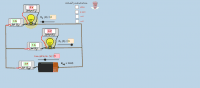
1) أغلق المفتاح لتتحرك الشحنات وتتفرع عند الوصلة. 2) اضغط على المقاومة R₂ (أو زر الفرع) لتوصيل الفرع الثاني أو فصله ولاحظ أن تيار الفرع الأول لا يتغير. 3) اسحب مسبارَي الفولتميتر إلى نقاط الدائرة A, T1, B1, T2, B2, H. 4) قارن قراءات الأميترات الثلاثة.
1) Close the switch so the charges move and split at the junction. 2) Click the resistor R₂ (or the branch button) to connect or disconnect the second branch and notice that the first branch current does not change. 3) Drag the two voltmeter probes to the circuit points A, T1, B1, T2, B2, H. 4) Compare the readings of the three ammeters.
🧪 تجربة 2: حاسبة: مقاومتان على التوازي
🧪 Experiment 2: Calculator: two resistors in parallel
مسألة جديدة في كل مرة. احسب تيار كل فرع والتيار الكلي.
A new problem every time. Calculate each branch current and the total current.
✍️ أمثلة محلولة
✍️ Worked Examples
\(R_1=20\ \Omega\) و\(R_2=30\ \Omega\) على التوازي مع بطارية \(12\ \mathrm{V}\). احسب \(I_1\) و\(I_2\) و\(I\) و\(R_{eq}\).
\(R_1=20\ \Omega\) and \(R_2=30\ \Omega\) in parallel with a \(12\ \mathrm{V}\) battery. Find \(I_1\), \(I_2\), \(I\) and \(R_{eq}\).
مصباحان متماثلان \(10\ \Omega\) على التوازي مع \(6\ \mathrm{V}\). احسب التيار الكلي.
Two identical \(10\ \Omega\) lamps in parallel with \(6\ \mathrm{V}\). Find the total current.
\(R_1=15\ \Omega\) مع \(9\ \mathrm{V}\). أُضيف فرع \(R_2=45\ \Omega\) على التوازي. ما تيار \(R_1\) بعد الإضافة؟ وما التيار الكلي؟
\(R_1=15\ \Omega\) with \(9\ \mathrm{V}\). A branch \(R_2=45\ \Omega\) is added in parallel. What is the current of \(R_1\) after adding it, and the total current?
ما المقاومة المكافئة لمقاومتين \(6\ \Omega\) و\(12\ \Omega\) على التوازي؟
What is the equivalent resistance of \(6\ \Omega\) and \(12\ \Omega\) in parallel?
في دائرة التوازي يتساوى على كل الفروع:
In a parallel circuit the following is equal on all branches:
التيار الكلي في دائرة التوازي يساوي:
The total current in a parallel circuit equals:
عند إضافة فرع جديد على التوازي فإن المقاومة المكافئة:
When a new branch is added in parallel the equivalent resistance:
أي الفرعين يمر فيه تيار أكبر؟
Which branch carries the larger current?
📚 ملخص
📚 Summary
| الكميةQuantity | القانونLaw |
|---|---|
| فرق الجهدVoltage | \(V_1=V_2=V\)\(V_1=V_2=V\) |
| التيار الكليTotal current | \(I=I_1+I_2\)\(I=I_1+I_2\) |
| المقاومة المكافئةEquivalent resistance | \(\dfrac{1}{R_{eq}}=\dfrac{1}{R_1}+\dfrac{1}{R_2}\)\(\dfrac{1}{R_{eq}}=\dfrac{1}{R_1}+\dfrac{1}{R_2}\) |
⚠️ أخطاء شائعة
⚠️ Common mistakes
- جمع المقاومات مباشرة لإيجاد \(R_{eq}\) على التوازي.Adding the resistors directly to find \(R_{eq}\) in parallel.
- نسيان مقلوب الناتج في \(1/R_{eq}\).Forgetting to invert the result of \(1/R_{eq}\).
- الظن أن التيار يتساوى في الفروع: الذي يتساوى هو الجهد.Thinking the currents are equal in the branches: it is the voltage that is equal.
🔗 محاكيات GeoGebra للاستعانة بها عند اللزوم
🔗 GeoGebra Simulations to Use When Needed
اضغط «تشغيل» لتعمل المحاكاة هنا داخل الدرس؛ ويمكن للطالب الرجوع إليها لتجربة الفكرة بطريقة أخرى.
Press “Run” to run the simulation right here inside the lesson; the student can use it to try the idea in another way.