🎯 نواتج التعلم
🎯 Learning Outcomes
بعد هذه التجربة ستكون قادرًا على أن:
After this experiment you will be able to:
- ترسم خطوط المجال لشحنة نقطية موجبة وسالبة وتحدد اتجاهها.Draw the field lines of a positive and a negative point charge and determine their direction.
- تستنتج قواعد رسم خطوط المجال: لا تتقاطع، وتتجه المماسات إلى اتجاه المجال، وتدل الكثافة على شدته.Deduce the rules of drawing field lines: they never cross, the tangent gives the direction of the field, and the density shows its strength.
- ترسم خطوط المجال لشحنتين متشابهتين أو مختلفتين وتعيّن نقطة انعدام المجال.Draw the field lines of two like or unlike charges and locate the point where the field vanishes.
- تحسب شدة المجال \(E=\dfrac{k|q|}{r^2}\) والمجال المنتظم بين لوحين \(E=\dfrac{V}{d}\).Calculate the field \(E=\dfrac{k|q|}{r^2}\) and the uniform field between two plates \(E=\dfrac{V}{d}\).
- تحسب القوة على شحنة في مجال \(F=qE\).Calculate the force on a charge in a field \(F=qE\).
🎬 شاهد الفيديو
🎬 Watch the Video
🎬 شاهد الفيديو
🎬 Watch the Video
❓ السؤال الذي تجيب عنه التجربة
❓ The Question That the Experiment Answers
كيف نرى مجالًا لا نراه؟ وكيف نعرف اتجاه القوة التي يؤثر بها على شحنة وضعناها فيه؟ اخترع الفيزيائي البريطاني مايكل فاراداي فكرة خطوط المجال لتمثيل المجال بصريًّا: خطوط وهمية ترسم اتجاه المجال في كل نقطة، وتعطينا صورة واضحة عن قوته وشكله.
How do we see a field that we cannot see? And how do we know the direction of the force it exerts on a charge placed in it? The British physicist Michael Faraday introduced the idea of field lines to represent the field visually: imaginary lines that show the direction of the field at each point and give a clear picture of its strength and shape.
🧭 قواعد رسم خطوط المجال
🧭 The Rules for Drawing Field Lines
القواعد الأساسية
The basic rules
- تبدأ الخطوط من الشحنة الموجبة وتنتهي عند السالبة (أو تمتد إلى ما لا نهاية).Lines start at a positive charge and end at a negative one (or extend to infinity).
- اتجاه الخط عند أي نقطة هو اتجاه المجال عندها (وهو اتجاه القوة على شحنة موجبة موضوعة فيها).The direction of a line at any point is the direction of the field there (which is the direction of the force on a positive charge placed there).
- لا تتقاطع خطوط المجال أبدًا، لأن المجال له اتجاه واحد عند كل نقطة.Field lines never cross, because the field has one direction at each point.
- كثافة الخطوط (التقارب) تدل على شدة المجال: حيث تتقارب الخطوط يكون المجال أقوى.The density of the lines (how close they are) shows the strength of the field: where the lines are closer the field is stronger.
⚡ شحنة نقطية: شدة المجال والخطوط
⚡ A Point Charge: Field Strength and the Lines
الشحنة النقطية \(q\) تنتج مجالًا شدته \(E=\dfrac{k|q|}{r^2}\) على بعد \(r\) منها، واتجاهه خارجًا من الموجبة وداخلًا إلى السالبة. وعدد الخطوط المرتبطة بالشحنة يتناسب مع \(|q|\)، لذلك تزداد كثافة الخطوط كلما اقتربنا منها بسبب تناقص \(1/r^2\). في التجربة 1 تقيس \(E\) بالدائرة المتقطعة وتلاحظ هذا التناقص.
A point charge \(q\) produces a field of strength \(E=\dfrac{k|q|}{r^2}\) at distance \(r\), directed outward from a positive charge and inward toward a negative one. The number of lines attached to the charge is proportional to \(|q|\), so the density of the lines increases as we approach it because of the \(1/r^2\) decrease. In Experiment 1 you measure \(E\) with the dashed circle and observe this decrease.
📘 القوانين
📘 The laws
\[E=\frac{k|q|}{r^{2}},\qquad k=8.99\times10^{9}\ \mathrm{N\,m^2/C^2}\]
\[\vec F=q\vec E\]
🧪 التجربة 1: خطوط المجال لشحنة نقطية
🧪 Experiment 1: Field Lines of a Point Charge
🛠️ خطوات العمل
🛠️ Procedure
- اختر الشحنة السالبة وراقب اتجاه الخطوط: هل تدخل إلى الشحنة أم تخرج منها؟Choose the negative charge and watch the direction of the lines: do they enter the charge or leave it?
- بدّل إلى الموجبة وقارن: ما الذي انعكس؟Switch to positive and compare: what has reversed?
- زد \(|q|\) وراقب عدد الخطوط دون أن يتغير شكلها.Increase \(|q|\) and watch the number of lines without changing their shape.
- حرّك الدائرة المتقطعة إلى أبعد وسجّل \(E\) مرتين: كم مرة تقل عندما تتضاعف المسافة؟Move the dashed circle farther and record \(E\) twice: how many times does it drop when the distance doubles?
🧪 تجربة 1: خطوط المجال لشحنة نقطية
🧪 Experiment 1: Field Lines of a Point Charge
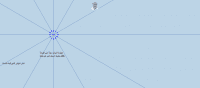
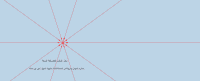
اختر إشارة الشحنة وكميتها وعدد الخطوط، ثم حرّك الدائرة المتقطعة لتقيس شدة المجال عند بعد \(r\). الخطوط تخرج من الموجبة وتدخل إلى السالبة.
Choose the sign and the size of the charge and the number of lines, then move the dashed circle to measure the field strength at a distance \(r\). Lines leave a positive charge and enter a negative one.
🔍 ماذا نلاحظ؟
🔍 What do we observe?
- عند مضاعفة \(r\) تقل \(E\) إلى الربع، لأن \(E\propto1/r^2\).When \(r\) doubles \(E\) falls to a quarter, because \(E\propto1/r^2\).
- الخطوط تشبه الأشعة الخارجة من مركز كروي، وهي متماثلة في كل الاتجاهات.The lines look like rays leaving a sphere’s centre, symmetric in every direction.
- شحنة سالبة قوية تجذب الخطوط إليها بالكثافة نفسها التي تخرج بها من موجبة مماثلة، لكن الاتجاه معكوس.A strong negative charge draws the lines in with the same density that a similar positive charge sends them out, but the direction is reversed.
🔀 شحنتان: التشابه والاختلاف
🔀 Two Charges: Like and Unlike
عند وجود شحنتين يكون المجال الكلي هو المجموع المتجهي لمجالي الشحنتين عند كل نقطة. لشحنتين متشابهتين تتنافر الخطوط ولا تربط بينهما، ويكون المجال صفرًا عند المنتصف إذا تساوتا. ولشحنتين مختلفتين تخرج الخطوط من الموجبة وتدخل إلى السالبة، ويتجمع المجالان بين الشحنتين فيكون المجال عند المنتصف أكبر ما يمكن.
With two charges the total field is the vector sum of the two fields at each point. For like charges the lines repel and do not connect them, and the field is zero at the midpoint if they are equal. For unlike charges the lines leave the positive one and enter the negative one, and the two fields add up between them, so the field at the midpoint is at its largest.
🧪 تجربة 2: تخطيط المجال لشحنتين
🧪 Experiment 2: Field Map of Two Charges
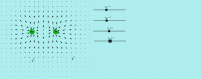
اختر شحنتين متشابهتين أو مختلفتين وغيّر قيمتهما والمسافة بينهما، وراقب شكل الخطوط ومجالها عند المنتصف.
Choose two like or unlike charges, change their values and the distance between them, and watch the shape of the lines and the field at the midpoint.
🔍 ماذا نلاحظ؟
🔍 What do we observe?
- بين شحنتين متشابهتين تنحني الخطوط بعيدًا عن الخط الواصل بينهما، وعند المنتصف يتلاشى المجال.Between two like charges the lines bend away from the line joining them, and at the midpoint the field vanishes.
- بين شحنتين مختلفتين تكون الخطوط متقاربة قرب الخط الواصل، أي أن المجال قوي هناك.Between two unlike charges the lines are close together near the joining line, meaning the field is strong there.
- الشحنة الأكبر مقدارًا تصدر خطوطًا أكثر، ويكون مجالها أقوى قرب الشحنة نفسها.The larger charge emits more lines, and its field is stronger near itself.
📐 المجال المنتظم بين لوحين
📐 The Uniform Field Between Two Plates
لوحان متوازيان مشحونان بشحنتين متساويتين ومتعاكستين يولّدان بينهما مجالًا منتظمًا: خطوط متوازية ومتساوية البعد، شدتها \(E=\dfrac{V}{d}\)، حيث \(V\) فرق الجهد بين اللوحين و\(d\) البعد بينهما. وخارج اللوحين يضعف المجال كثيرًا، لذلك نهمل حافتيهما عند الحساب.
Two parallel plates with equal and opposite charges produce a uniform field between them: parallel and equally spaced lines whose strength is \(E=\dfrac{V}{d}\), where \(V\) is the potential difference between the plates and \(d\) the gap between them. Outside the plates the field is much weaker, so we neglect their edges in the calculation.
🧪 تجربة 3: المجال المنتظم بين لوحين
🧪 Experiment 3: The Uniform Field Between Two Plates
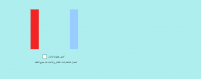
لوحان متوازيان مشحونان بشحنتين متساويتين ومتعاكستين. غيّر الجهد والبعد، وراقب أن الخطوط متوازية ومتساوية البعد.
Two parallel plates with equal and opposite charges. Change the voltage and the gap, and watch that the lines are parallel and equally spaced.
🔍 ماذا نلاحظ؟
🔍 What do we observe?
- إذا ضاعف الجهد وبقي البعد فإن \(E\) يتضاعف.If the voltage doubles and the gap stays the same, \(E\) doubles.
- إذا زاد البعد وبقي الجهد فإن \(E\) يقل.If the gap increases and the voltage stays the same, \(E\) decreases.
⚖️ القوة على شحنة في المجال
⚖️ The Force on a Charge in a Field
الشحنة \(q_0\) الموضوعة في مجال \(\vec E\) تتأثر بقوة \(\vec F=q_0\vec E\). إذا كانت \(q_0\) موجبة فالقوة في اتجاه المجال، وإذا كانت سالبة فالقوة عكسه. وهذا ما يجعل المجال وسيلة لوصف التأثير قبل وضع أي شحنة.
A charge \(q_0\) placed in a field \(\vec E\) feels the force \(\vec F=q_0\vec E\). If \(q_0\) is positive the force is in the direction of the field, and if it is negative the force is opposite to it. This is what makes the field a way to describe the influence before any charge is placed.
🎲 التجربة 4: تدرّب
🎲 Experiment 4: Practice
🧪 تجربة 4: تدرّب: شدة المجال والقوة
🧪 Experiment 4: Practice: Field Strength and Force
شحنة نقطية معلومة وبعد معلوم. احسب شدة المجال عند النقطة، ثم القوة على شحنة اختبار \(2\ \mu\mathrm C\) موضوعة فيها.
A known point charge and a known distance. Calculate the field strength at the point, then the force on a test charge \(2\ \mu\mathrm C\) placed there.
✍️ أمثلة محلولة
✍️ Worked Examples
شحنة نقطية \(q=+4\ \mu\mathrm C\). أوجد شدة المجال على بعد \(20\ \mathrm{cm}\) منها، واتجاهه.
A point charge \(q=+4\ \mu\mathrm C\). Find the field strength at \(20\ \mathrm{cm}\) from it, and its direction.
شحنة \(q=-2\ \mu\mathrm C\) على بعد \(10\ \mathrm{cm}\) من نقطة. أوجد شدة المجال عندها واتجاهه.
A charge \(q=-2\ \mu\mathrm C\) is \(10\ \mathrm{cm}\) from a point. Find the field strength there and its direction.
بين لوحين فرق جهده \(100\ \mathrm V\) والبعد بينهما \(2\ \mathrm{cm}\). أوجد شدة المجال المنتظم بينهما وقوة على إلكترون فيه.
Two plates have a potential difference \(100\ \mathrm V\) and a gap of \(2\ \mathrm{cm}\). Find the uniform field between them and the force on an electron in it.
شحنتان \(+3\ \mu\mathrm C\) و\(+3\ \mu\mathrm C\) على بعد \(30\ \mathrm{cm}\). أوجد شدة المجال عند منتصف الخط الواصل بينهما.
Two charges \(+3\ \mu\mathrm C\) and \(+3\ \mu\mathrm C\) are \(30\ \mathrm{cm}\) apart. Find the field at the midpoint of the line joining them.
شحنتان \(+2\ \mu\mathrm C\) و\(-2\ \mu\mathrm C\) على بعد \(20\ \mathrm{cm}\). أوجد شدة المجال عند المنتصف.
Two charges \(+2\ \mu\mathrm C\) and \(-2\ \mu\mathrm C\) are \(20\ \mathrm{cm}\) apart. Find the field at the midpoint.
🛠️ تطبيقات عملية
🛠️ Practical Applications
أين تظهر خطوط المجال؟
Where do field lines appear?
- الترسيب الكهروستاتيكي في مرشحات الغبار: تُوجَّه الجسيمات المشحونة نحو الألواح بخطوط المجال.Electrostatic precipitators in dust filters: charged particles are guided toward the plates along the field lines.
- المكثفات: الصفيحتان المشحونتان تولدان مجالًا منتظمًا يخزّن الطاقة.Capacitors: the two charged plates produce a uniform field that stores energy.
- أنابيب الصور القديمة والمسرّعات: تُوجَّه الإلكترونات بمجال منتظم بين لوحين.Old picture tubes and accelerators: electrons are steered by a uniform field between two plates.
- الكهرباء الجوية: يتكون مجال قوي بين السحب والأرض، ويتبعه البرق.Atmospheric electricity: a strong field forms between clouds and the ground, and lightning follows.
⚠️ أخطاء شائعة
⚠️ Common Mistakes
تجنّب هذه الأخطاء
Avoid these mistakes
- رسم خطوط المجال تبدأ من السالبة؛ الخطوط تخرج من الموجبة وتدخل إلى السالبة.Drawing lines that start at a negative charge; lines leave the positive charge and enter the negative one.
- الظن أن الخطوط مسارات تسلكها الشحنة؛ هي تمثيل للمجال، والشحنة قد تتحرك بطريقة أخرى.Thinking the lines are paths that the charge follows; they represent the field, and a charge may move in another way.
- الظن أن المجال يساوي صفرًا حيث تبدو الخطوط متقاطعة؛ الخطوط لا تتقاطع أصلًا، والمجال يتلاشى فقط عند النقاط التي تُلغي فيها المجالات بعضها.Thinking that the field is zero where the lines seem to cross; lines never cross, and the field vanishes only at points where the individual fields cancel each other.
- نسيان تحويل \(\mu\mathrm C\) إلى \(\mathrm C\) و\(\mathrm{cm}\) إلى \(\mathrm m\) في \(E=k|q|/r^2\).Forgetting to convert \(\mu\mathrm C\) to \(\mathrm C\) and \(\mathrm{cm}\) to \(\mathrm m\) in \(E=k|q|/r^2\).
📚 ملخص
📚 Summary
أهم ما تعلمناه
Key points
- خطوط المجال تخرج من الموجبة وتدخل إلى السالبة، ولا تتقاطع، وكثافتها تدل على شدة المجال.Field lines leave a positive charge and enter a negative one, never cross, and their density shows the field strength.
- \(E=\dfrac{k|q|}{r^2}\) للشحنة النقطية، و\(E=\dfrac{V}{d}\) للمجال المنتظم بين لوحين.\(E=\dfrac{k|q|}{r^2}\) for a point charge, and \(E=\dfrac{V}{d}\) for the uniform field between two plates.
- المجال الكلي لعدة شحنات هو المجموع المتجهي لمجالاتها، و\(\vec F=q\vec E\).The total field of several charges is the vector sum of their fields, and \(\vec F=q\vec E\).
🔗 محاكيات GeoGebra للاستعانة بها عند اللزوم
🔗 GeoGebra Simulations to Use When Needed
اضغط «تشغيل» لتعمل المحاكاة هنا داخل الدرس؛ ويمكن للطالب الرجوع إليها لتجربة الفكرة بطريقة أخرى.
Press “Run” to run the simulation right here inside the lesson; the student can use it to try the idea in another way.