🎯 نواتج التعلم
🎯 Learning Outcomes
بعد هذه التجربة ستكون قادرًا على أن:
After this experiment you will be able to:
- تفسّر حيود الضوء عند شق ضيق بمبدأ هيغنز وتحدد متى يظهر بوضوح.Explain the diffraction of light at a narrow slit with Huygens’ principle and decide when it is clearly seen.
- تطبّق شرط الأهداب المعتمة \(W\sin\theta=m\lambda\) وتحسب مواضعها.Apply the condition of the dark fringes \(W\sin\theta=m\lambda\) and calculate their positions.
- تحسب عرض الهدبة المركزية \(2X=\dfrac{2\lambda L}{W}\) وتتنبأ بتأثير تغيير \(W\) و\(L\) و\(\lambda\).Calculate the width of the central fringe \(2X=\dfrac{2\lambda L}{W}\) and predict the effect of changing \(W\), \(L\) and \(\lambda\).
🎬 شاهد الفيديو
🎬 Watch the Video
🌊 ما الحيود؟
🌊 What Is Diffraction?
الحيود هو انحناء الموجة وانتشارها خلف حافة عائق أو عند مرورها في فتحة ضيقة. للضوء طبيعة موجية، وعندما يمر في شق عرضه قريب من طوله الموجي لا يسير في خطوط مستقيمة فقط بل يتوزع على حاجز خلف الشق بنمط من الأهداب المضيئة والمعتمة. ويفسره مبدأ هيغنز: كل نقطة على مقدمة الموجة داخل الشق مصدر لموجات ثانوية دائرية، وتتداخل هذه الموجات (تداخل بناء وهدّام) على الحاجز.
Diffraction is the bending and spreading of a wave behind the edge of an obstacle or as it passes through a narrow opening. Light has a wave nature, and when it passes through a slit whose width is close to its wavelength it does not only travel in straight lines but spreads on a screen behind the slit with a pattern of bright and dark fringes. It is explained by Huygens’ principle: every point of the wavefront inside the slit is a source of circular secondary wavelets, and these wavelets interfere (constructively and destructively) on the screen.
📘 الأهداب المعتمة وعرض الهدبة المركزية
📘 The dark fringes and the width of the central fringe
\[W\sin\theta=m\lambda\qquad(m=1,2,3,\ldots)\]
\[X=\dfrac{\lambda L}{W}\ \ (\text{first dark fringe})\qquad 2X=\dfrac{2\lambda L}{W}\]
حيث \(W\) عرض الشق، \(L\) بعد الشق عن الحاجز، \(\lambda\) الطول الموجي، و\(X\) بُعد أول هدبة معتمة عن مركز الهدبة المركزية (للزوايا الصغيرة \(\sin\theta\approx\tan\theta\approx\dfrac{y}{L}\)). ومواضع المعتم رقم \(m\): \(y_m=\dfrac{m\lambda L}{W}\).
where \(W\) is the slit width, \(L\) the distance from the slit to the screen, \(\lambda\) the wavelength and \(X\) the distance of the first dark fringe from the centre of the central fringe (for small angles \(\sin\theta\approx\tan\theta\approx\dfrac{y}{L}\)). The position of the dark fringe number \(m\) is \(y_m=\dfrac{m\lambda L}{W}\).
💡 شرح إضافي: من أين جاء شرط المعتم \(W\sin\theta=m\lambda\)؟
💡 Extra explanation: where does the dark-fringe condition \(W\sin\theta=m\lambda\) come from?
نقسم الشق إلى نصفين. موجتان ثانويتان من نقطتين تبعدان \(\dfrac W2\) إحداهما عن الأخرى (واحدة من كل نصف) فرق مسارهما \(\dfrac W2\sin\theta\). إذا كان هذا الفرق \(\dfrac\lambda2\) تلغي كل موجة من النصف الأول موجة من النصف الثاني (تداخل هدّام) فتنعدم الشدة كلها عند \(W\sin\theta=\lambda\)؛ وبتقسيم الشق إلى 4 أجزاء ثم 6 ... نحصل على \(W\sin\theta=2\lambda,3\lambda\ldots\) أي \(m\lambda\). والتوزيع الكامل للشدة \(I=I_0\left(\dfrac{\sin\beta}{\beta}\right)^2\) حيث \(\beta=\dfrac{\pi W\sin\theta}{\lambda}\) (هذا ما يرسمه الرسم السفلي): الهدبة المركزية أعرض مرتين من أي هدبة ثانوية، وشدة أول هدبة ثانوية نحو \(4.7\%\) فقط من المركزية.
Divide the slit into two halves. Two wavelets from points \(\dfrac W2\) apart (one from each half) have a path difference \(\dfrac W2\sin\theta\). If this difference is \(\dfrac\lambda2\) every wavelet from the first half cancels one from the second half (destructive interference) so the whole intensity vanishes at \(W\sin\theta=\lambda\); dividing the slit into 4 parts, then 6 … gives \(W\sin\theta=2\lambda,3\lambda\ldots\), i.e. \(m\lambda\). The complete intensity distribution is \(I=I_0\left(\dfrac{\sin\beta}{\beta}\right)^2\) with \(\beta=\dfrac{\pi W\sin\theta}{\lambda}\) (this is what the lower graph shows): the central fringe is twice as wide as any secondary fringe, and the intensity of the first secondary fringe is only about \(4.7\%\) of the central one.
🧪 تجربة 1: حيود الضوء من شق مفرد
🧪 Experiment 1: Diffraction of light from a single slit
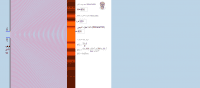
يمر ضوء أحادي الطول الموجي \(\lambda\) في شق عرضه \(W\) فيتوزع على حاجز يبعد \(L\) عن الشق: هدبة مركزية ساطعة تحيط بها أهداب أقل سطوعًا تفصلها أهداب معتمة. تُحسب مواضع الأهداب المعتمة من \(W\sin\theta=m\lambda\) (\(m=1,2,3\ldots\))، وعرض الهدبة المركزية \(2X=\dfrac{2\lambda L}{W}\). غيّر \(W\) و\(L\) و\(\lambda\) وراقب كيف يتسع النمط أو يضيق. (الرسم العلوي توضيحي غير مقيّس؛ الرسم السفلي لشدة الإضاءة مقيّس.)
Monochromatic light of wavelength \(\lambda\) passes through a slit of width \(W\) and spreads on a screen at a distance \(L\): a bright central fringe surrounded by weaker fringes separated by dark fringes. The positions of the dark fringes follow \(W\sin\theta=m\lambda\) (\(m=1,2,3\ldots\)) and the width of the central fringe is \(2X=\dfrac{2\lambda L}{W}\). Change \(W\), \(L\) and \(\lambda\) and see how the pattern widens or narrows. (The upper drawing is schematic and not to scale; the lower intensity graph is to scale.)
| التغييرChange | عرض الهدبة المركزية \(2X\)Width of the central fringe \(2X\) |
|---|---|
| تضييق الشق (\(W\) أصغر)narrowing the slit (smaller \(W\)) | يزداد: النمط يتسعincreases: the pattern widens |
| زيادة الطول الموجي \(\lambda\) (نحو الأحمر)increasing the wavelength \(\lambda\) (toward red) | يزدادincreases |
| زيادة بعد الحاجز \(L\)increasing the screen distance \(L\) | يزداد طرديًاincreases proportionally |
| شق واسع جدًا (\(W\gg\lambda\))a very wide slit (\(W\gg\lambda\)) | يضيق جدًا: ظل حاد تقريبًا، لا يظهر الحيودbecomes very narrow: an almost sharp shadow, no visible diffraction |
💡 شرح إضافي: لماذا لا نرى حيود الضوء في الحياة اليومية؟
💡 Extra explanation: why do we not see the diffraction of light in daily life?
الحيود يظهر بوضوح عندما يكون حجم الفتحة أو العائق قريبًا من الطول الموجي. الضوء المرئي طوله الموجي \(400-700\ \mathrm{nm}\) أي نحو \(10^{-7}\ \mathrm{m}\)، أما الأبواب والنوافذ فأكبر منه ملايين المرات، فتكون زاوية الحيود \(\theta\approx\dfrac\lambda W\) صغيرة جدًا فنرى ظلالًا حادة. أما الصوت (\(\lambda\) من \(\mathrm{cm}\) إلى \(\mathrm{m}\)) فيحيد عند الأبواب ونسمعه خلف الجدران. وقد استعمل العلماء نمط الحيود/التداخل لقياس أحجام الجسيمات وتراكيب البلورات.
Diffraction is clearly seen when the size of the opening or obstacle is close to the wavelength. The wavelength of visible light is \(400-700\ \mathrm{nm}\), about \(10^{-7}\ \mathrm{m}\), while doors and windows are millions of times larger, so the diffraction angle \(\theta\approx\dfrac\lambda W\) is tiny and we see sharp shadows. Sound (\(\lambda\) from \(\mathrm{cm}\) to \(\mathrm{m}\)) does diffract at doors and we hear it behind walls. Scientists use diffraction/interference patterns to measure particle sizes and crystal structures.
✍️ أمثلة محلولة
✍️ Worked Examples
يسقط ضوء طوله الموجي \(550\ \mathrm{nm}\) على شق عرضه \(900\ \mu\mathrm{m}\) وبُعد الحاجز \(200\ \mathrm{cm}\) (قيم الأداة الأصلية). احسب عرض الهدبة المركزية.
Light of wavelength \(550\ \mathrm{nm}\) falls on a slit \(900\ \mu\mathrm{m}\) wide and the screen is \(200\ \mathrm{cm}\) away (the values of the original applet). Calculate the width of the central fringe.
شق عرضه \(0.1\ \mathrm{mm}\) يسقط عليه ضوء \(500\ \mathrm{nm}\). احسب زاوية أول هدبة معتمة.
A slit \(0.1\ \mathrm{mm}\) wide is illuminated by light of \(500\ \mathrm{nm}\). Calculate the angle of the first dark fringe.
أُضيء شق بضوء \(600\ \mathrm{nm}\) فظهرت هدبة مركزية عرضها \(4\ \mathrm{mm}\) على حاجز يبعد \(2\ \mathrm{m}\). ما عرض الشق؟
A slit is illuminated by light of \(600\ \mathrm{nm}\) and a central fringe \(4\ \mathrm{mm}\) wide appears on a screen \(2\ \mathrm{m}\) away. What is the width of the slit?
في مثال الأداة الأصلية احسب بُعد الهدبة المعتمة الثانية عن مركز النمط.
In the original applet’s example calculate the distance of the second dark fringe from the centre of the pattern.
عند تضييق الشق مع بقاء بقية القيم فإن عرض الهدبة المركزية:
When the slit is narrowed with the other values unchanged the width of the central fringe:
أي لون ضوء يعطي هدبة مركزية أعرض (الشق والحاجز ثابتان)؟
Which colour of light gives a wider central fringe (the slit and screen unchanged)?
شرط ظهور هدبة معتمة في حيود الشق المفرد:
The condition for a dark fringe in single-slit diffraction:
يظهر الحيود بوضوح عندما يكون عرض الفتحة:
Diffraction is clearly seen when the width of the opening is:
📚 ملخص
📚 Summary
| المفهومConcept | القانونLaw |
|---|---|
| الأهداب المعتمةDark fringes | \(W\sin\theta=m\lambda\ ,\ y_m=\dfrac{m\lambda L}{W}\)\(W\sin\theta=m\lambda\ ,\ y_m=\dfrac{m\lambda L}{W}\) |
| عرض الهدبة المركزيةWidth of the central fringe | \(2X=\dfrac{2\lambda L}{W}\)\(2X=\dfrac{2\lambda L}{W}\) |
| توزيع الشدةIntensity | \(I=I_0\left(\dfrac{\sin\beta}{\beta}\right)^2\)\(I=I_0\left(\dfrac{\sin\beta}{\beta}\right)^2\) |
⚠️ أخطاء شائعة
⚠️ Common mistakes
- الخلط بين عرض الهدبة المركزية \(2X\) وبُعد أول معتم \(X\) (نصف العرض).Confusing the width of the central fringe \(2X\) with the distance of the first dark fringe \(X\) (half the width).
- نسيان تحويل الوحدات: \(\mathrm{nm}\) و\(\mu\mathrm{m}\) و\(\mathrm{cm}\) إلى المتر.Forgetting to convert \(\mathrm{nm}\), \(\mu\mathrm{m}\) and \(\mathrm{cm}\) to metres.
- استعمال شرط التداخل البنّاء \(m\lambda\) للمضيء في الشق المفرد؛ \(m\lambda\) هنا هي للمعتم.Using \(m\lambda\) as a bright-fringe condition in the single slit; here \(m\lambda\) is for the dark fringes.
🔗 محاكيات GeoGebra للاستعانة بها عند اللزوم
🔗 GeoGebra Simulations to Use When Needed
اضغط «تشغيل» لتعمل المحاكاة هنا داخل الدرس؛ ويمكن للطالب الرجوع إليها لتجربة الفكرة بطريقة أخرى.
Press “Run” to run the simulation right here inside the lesson; the student can use it to try the idea in another way.