🎯 نواتج التعلم
🎯 Learning Outcomes
بعد هذه التجربة ستكون قادرًا على أن:
After this experiment you will be able to:
- تحسب طاقة الوضع \(PE=mgh\) والطاقة الحركية \(KE=\tfrac12mv^2\) والطاقة الميكانيكية \(E=KE+PE\).Calculate the potential energy \(PE=mgh\), the kinetic energy \(KE=\tfrac12mv^2\) and the mechanical energy \(E=KE+PE\).
- تفسّر ثبات الطاقة الميكانيكية لجسم يسقط وتحسب سرعته من حفظ الطاقة.Explain the constancy of the mechanical energy of a falling body and calculate its speed from energy conservation.
- تقارن الحل بحفظ الطاقة بالحل بالمعادلات الحركية.Compare the energy solution with the kinematic equations solution.
🎬 شاهد الفيديو
🎬 Watch the Video
🔋 الطاقة الميكانيكية ومبدأ حفظها
🔋 Mechanical Energy and Its Conservation
عندما يسقط جسم سقوطًا حرًا (بإهمال مقاومة الهواء) فالقوة الوحيدة المؤثرة فيه وزنه، وهو قوة محافظة. لذلك تتحول طاقة الوضع إلى طاقة حركية بالمقدار نفسه، ويبقى مجموعهما — الطاقة الميكانيكية — ثابتًا:
When a body falls freely (air resistance neglected) the only force on it is its weight, a conservative force. So the potential energy turns into kinetic energy by the same amount and their sum — the mechanical energy — stays constant:
📘 حفظ الطاقة الميكانيكية
📘 Conservation of mechanical energy
\[E=KE+PE=\tfrac12mv^2+mgy=\text{constant}\]
\[\tfrac12mv_0^2+mgh_0=\tfrac12mv^2+mgy\ \Rightarrow\ v=\sqrt{v_0^2+2g\,(h_0-y)}\]
عند الارتطام بالأرض (\(y=0\)): \(v=\sqrt{v_0^2+2gh_0}\). وللسقوط من السكون: \(v=\sqrt{2gh_0}\).
On hitting the ground (\(y=0\)): \(v=\sqrt{v_0^2+2gh_0}\). For a fall from rest: \(v=\sqrt{2gh_0}\).
💡 شرح إضافي: لماذا لا تؤثر الكتلة في السرعة؟ وماذا عن مقاومة الهواء؟
💡 Extra explanation: why does the mass not affect the speed? And what about air resistance?
الكتلة تظهر في \(KE\) و\(PE\) معًا فتُختصر من المعادلة: جسمان مختلفا الكتلة يسقطان من الارتفاع نفسه يصلان بالسرعة نفسها، لكن الأثقل يملك طاقة أكبر (جرّب تغيير الكتلة: ترتفع الأعمدة ولا تتغير السرعة). أما في الحياة الواقعية فمقاومة الهواء قوة غير محافظة تحوّل جزءًا من الطاقة إلى حرارة، فلا تبقى الطاقة الميكانيكية ثابتة وتكون سرعة السقوط من ارتفاع كبير (مثل \(400\ \mathrm{m}\)) أقل بكثير مما تعطيه المعادلة (تقترب من «السرعة الحدية»). التجربة تعمل في الفراغ المثالي.
The mass appears in both \(KE\) and \(PE\) so it cancels from the equation: two bodies of different masses falling from the same height reach the ground with the same speed, but the heavier one has more energy (try changing the mass: the bars rise but the speed does not change). In real life air resistance is a non-conservative force that turns part of the energy into heat, so the mechanical energy is not constant and the speed of a fall from a great height (such as \(400\ \mathrm{m}\)) is much less than the equation gives (it approaches the “terminal speed”). The experiment works in an ideal vacuum.
🧪 تجربة 1: سقوط جسم: تحول طاقة الوضع إلى طاقة حركية
🧪 Experiment 1: A falling body: potential energy turns into kinetic energy
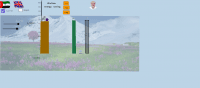
يُترك جسم كتلته \(m\) من ارتفاع \(h_0\) (أو يُقذف رأسيًا بسرعة \(v_0\)). أثناء حركته يعمل وزنه شغلًا فتتناقص طاقة الوضع \(PE=mgy\) وتزداد الطاقة الحركية \(KE=\tfrac12mv^2\) بالمقدار نفسه، فتبقى الطاقة الميكانيكية \(E=KE+PE\) ثابتة (نهمل مقاومة الهواء). اضغط «بدء» وراقب أعمدة \(PE\) و\(KE\) و\(E\) ومعادلات الحركة، ثم قارن السرعة المحسوبة من حفظ الطاقة بالسرعة المحسوبة من \(v=v_0-gt\).
A body of mass \(m\) is released from a height \(h_0\) (or thrown vertically with a speed \(v_0\)). During its motion its weight does work so the potential energy \(PE=mgy\) decreases and the kinetic energy \(KE=\tfrac12mv^2\) increases by the same amount, so the mechanical energy \(E=KE+PE\) stays constant (air resistance is neglected). Press “Start” and watch the bars \(PE\), \(KE\) and \(E\) and the equations of motion, then compare the speed calculated from energy conservation with the speed from \(v=v_0-gt\).
⚖️ طريقتان للحل
⚖️ Two Ways to Solve
| حفظ الطاقةEnergy conservation | المعادلات الحركيةKinematic equations |
|---|---|
| \(v=\sqrt{v_0^2+2gh_0}\)\(v=\sqrt{v_0^2+2gh_0}\) | \(t=\dfrac{v_f-v_0}{-g}\ ,\ v=v_0-gt\)\(t=\dfrac{v_f-v_0}{-g}\ ,\ v=v_0-gt\) |
| لا تحتاج الزمنdoes not need the time | تعطي الزمن والموضع في كل لحظةgives the time and the position at every instant |
✍️ أمثلة محلولة
✍️ Worked Examples
جسم كتلته \(10\ \mathrm{kg}\) يُترك من السكون من ارتفاع \(400\ \mathrm{m}\) (قيم الأداة الأصلية). احسب الطاقة الميكانيكية وسرعته وزمن سقوطه عند الأرض.
A body of mass \(10\ \mathrm{kg}\) is released from rest from a height of \(400\ \mathrm{m}\) (the values of the original applet). Calculate its mechanical energy, its speed and the time of fall at the ground.
في المثال السابق احسب \(PE\) و\(KE\) والسرعة عندما يكون ارتفاعه \(100\ \mathrm{m}\).
In the previous example calculate \(PE\), \(KE\) and the speed when its height is \(100\ \mathrm{m}\).
عند أي ارتفاع تتساوى \(KE\) و\(PE\) في سقوط من السكون من ارتفاع \(h_0\)؟ وما السرعة عندئذ لـ \(h_0=400\ \mathrm{m}\)؟
At what height are \(KE\) and \(PE\) equal in a fall from rest from a height \(h_0\)? And what is the speed then for \(h_0=400\ \mathrm{m}\)?
قُذف حجر إلى الأسفل بسرعة \(20\ \mathrm{m/s}\) من ارتفاع \(50\ \mathrm{m}\). احسب سرعته عند الأرض.
A stone is thrown downward at \(20\ \mathrm{m/s}\) from a height of \(50\ \mathrm{m}\). Calculate its speed at the ground.
قُذفت كرة رأسيًا إلى الأعلى بسرعة \(20\ \mathrm{m/s}\) من الأرض. ما أقصى ارتفاع تصل إليه؟
A ball is thrown vertically upward at \(20\ \mathrm{m/s}\) from the ground. What maximum height does it reach?
جسم يسقط سقوطًا حرًا (بإهمال الهواء). أي كمية تبقى ثابتة؟
A body falls freely (air neglected). Which quantity stays constant?
جسمان كتلتاهما \(m\) و\(2m\) يسقطان من الارتفاع نفسه من السكون. عند الأرض:
Two bodies of masses \(m\) and \(2m\) fall from rest from the same height. At the ground:
إذا تضاعف ارتفاع السقوط من السكون فإن سرعة الارتطام:
If the height of a fall from rest doubles the impact speed:
عند منتصف ارتفاع السقوط من السكون تكون:
At the middle of the height of a fall from rest:
📚 ملخص
📚 Summary
| المفهومConcept | القانونLaw |
|---|---|
| الطاقة الميكانيكيةMechanical energy | \(E=KE+PE=\tfrac12mv^2+mgy\)\(E=KE+PE=\tfrac12mv^2+mgy\) |
| السرعة من حفظ الطاقةSpeed from energy | \(v=\sqrt{v_0^2+2g(h_0-y)}\)\(v=\sqrt{v_0^2+2g(h_0-y)}\) |
⚠️ أخطاء شائعة
⚠️ Common mistakes
- الاعتقاد بأن الجسم الأثقل يصل أسرع في الفراغ؛ السرعة لا تتوقف على الكتلة.Believing that the heavier body arrives faster in a vacuum; the speed does not depend on the mass.
- أخذ \(h\) من نقطة غير الأرض دون الانتباه إلى أن \(PE\) تعتمد على مستوى الإسناد (لكن الفرق في \(PE\) لا يعتمد عليه).Measuring \(h\) from a point other than the ground without noticing that \(PE\) depends on the reference level (but the change in \(PE\) does not).
- إهمال مقاومة الهواء في سقوط من ارتفاع كبير جدًا.Neglecting air resistance in a fall from a very great height.
🔗 محاكيات GeoGebra للاستعانة بها عند اللزوم
🔗 GeoGebra Simulations to Use When Needed
اضغط «تشغيل» لتعمل المحاكاة هنا داخل الدرس؛ ويمكن للطالب الرجوع إليها لتجربة الفكرة بطريقة أخرى.
Press “Run” to run the simulation right here inside the lesson; the student can use it to try the idea in another way.