🎯 نواتج التعلم
🎯 Learning Outcomes
بعد هذه التجربة ستكون قادرًا على أن:
After this experiment you will be able to:
- تعرّف الجهد الكهربائي عند نقطة بأنه الشغل لكل وحدة شحنة موجبة لنقلها من اللانهاية إلى النقطة.Define the electric potential at a point as the work per unit positive charge to bring it from infinity to that point.
- تحسب الجهد عند نقطة لشحنة نقطية، ولعدة شحنات بجمع الجهود جمعًا جبريًا.Calculate the potential at a point due to a point charge, and due to several charges by adding the potentials algebraically.
- تفرّق بين الجهد (كمية قياسية) والمجال (كمية متجهة).Distinguish potential (a scalar) from the field (a vector).
- تحسب طاقة وضع شحنة اختبار، والشغل المبذول بين نقطتين.Calculate the potential energy of a test charge and the work done between two points.
🎬 شاهد الفيديو
🎬 Watch the Video
🔍 الفكرة في صورة
🔍 The Idea in a Picture
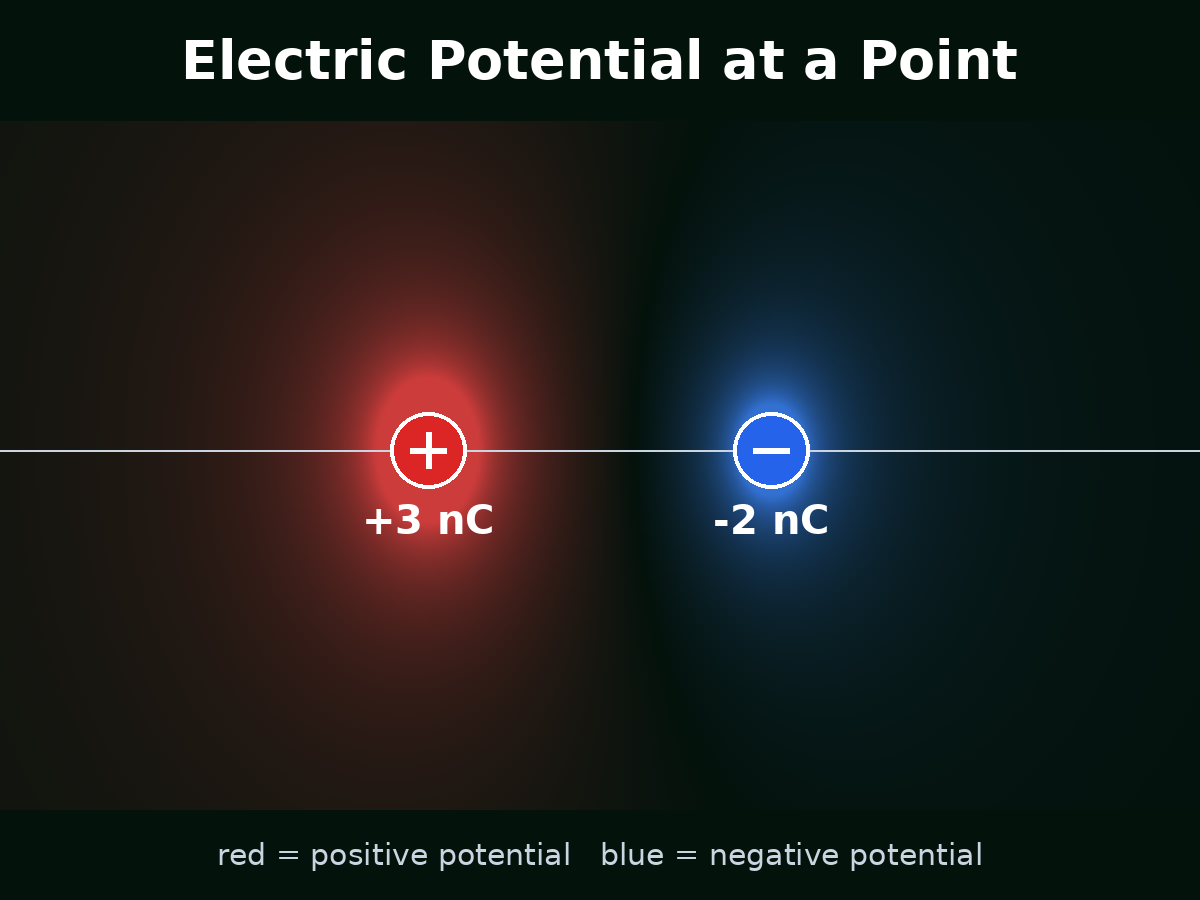
⚡ تعريف الجهد وحسابه
⚡ Definition and Calculation
الجهد عند نقطة هو الشغل الذي يبذله المجال لنقل وحدة الشحنات الموجبة من اللانهاية إلى تلك النقطة، أو هو الشغل الذي نبذله ضد المجال. وحدته الفولت \(\mathrm{V}=\mathrm{J/C}\).
The potential at a point is the work per unit positive charge that is needed to bring it from infinity to that point, against the field. Its unit is the volt \(\mathrm{V}=\mathrm{J/C}\).
📘 قوانين الجهد
📘 Potential laws
\[V=k\dfrac{q}{r}\qquad(\text{point charge})\]
\[V=\sum_i k\dfrac{q_i}{r_i}\qquad(\text{several charges})\]
\[U=q_0V\qquad(\text{potential energy of a test charge } q_0)\]
\[W_{AB}=q_0\,(V_A-V_B)\]
حيث \(k=9\times10^9\ \mathrm{N\,m^2/C^2}\)، و\(q\) الشحنة بإشارتها، و\(r\) المسافة من الشحنة إلى النقطة. في التجربة نكتب \(V=9\,\dfrac{q\,(\mathrm{nC})}{r\,(\mathrm{m})}\) فنحصل على الجهد بالفولت.
where \(k=9\times10^9\ \mathrm{N\,m^2/C^2}\), \(q\) is the charge with its sign and \(r\) is the distance from the charge to the point. In the experiment we write \(V=9\,\dfrac{q\,(\mathrm{nC})}{r\,(\mathrm{m})}\) which gives the potential in volts.
💡 شرح إضافي: لماذا يُجمع الجهد جمعًا جبريًا بينما يُجمع المجال اتجاهيًا؟
💡 Extra explanation: why are potentials added algebraically while fields are added as vectors?
الجهد كمية قياسية: لا يحمل اتجاهًا، بل إشارة فقط. لذلك يكفي أن نجمع إسهام كل شحنة بإشارتها. أما المجال فكمية متجهة، لذلك يجب أن نجمع مركباته الأفقية والرأسية. هذا هو سبب أن حساب الجهد عند نقطة أسهل بكثير من حساب المجال.
Potential is a scalar: it has no direction, only a sign. So we simply add the contribution of each charge with its sign. The field is a vector, so its components must be added. This is why the potential at a point is much easier to calculate than the field.
💡 شرح إضافي: لماذا تكون الإشارة مهمة؟
💡 Extra explanation: why does the sign matter?
الشحنة الموجبة تعطي جهدًا موجبًا، والسالبة تعطي جهدًا سالبًا. لذلك قد تلغي شحنة سالبة جزءًا من جهد شحنة موجبة قريبة. وطاقة وضع شحنة اختبار \(q_0\) تأخذ إشارة \(V\)، فإذا كانت \(q_0\) موجبة تكون طاقتها موجبة قرب الشحنة الموجبة، وإذا كانت سالبة تكون طاقتها سالبة هناك.
A positive charge gives a positive potential and a negative charge gives a negative potential. So a negative charge can cancel part of the potential of a nearby positive charge. The potential energy \(U=q_0V\) takes the sign of \(V\) and of \(q_0\).
🧪 التجربة التفاعلية: الجهد وحركة الشحنة
🧪 Interactive Experiment: Potential and the Motion of a Charge
اسحب الشحنتين \(q_1\) و\(q_2\) والنقطة \(P\) والنقطة \(S\) بالفأرة أو باللمس. الخطوط المتقطعة هي خطوط تساوي الجهد، والأسهم هي المجال الذي يكون عموديًا عليها دائمًا. اضغط «تشغيل» لتتحرك شحنة الاختبار الخضراء من \(S\) تحت تأثير المجال، وتتابع طاقتها الحركية \(K\) وطاقة وضعها \(U\).
Drag the charges \(q_1\) and \(q_2\), the point \(P\) and the start point \(S\) with the mouse or touch. The dashed lines are equipotential lines, and the arrows are the field, which is always perpendicular to them. Press Start to release the green test charge from \(S\) under the field, and follow its kinetic energy \(K\) and potential energy \(U\).
ملاحظة: حركة الشحنة وقيم \(K\) و\(U\) مكبّرة بعامل ثابت لتظهر بوضوح على الشاشة. المهم أن المجموع \(K+U\) يبقى ثابتًا.
Note: the motion and the values of \(K\) and \(U\) are scaled by a fixed factor so they are visible on screen. What matters is that the sum \(K+U\) stays constant.
🧪 خريطة الجهد والمجال وحركة شحنة الاختبار
🧪 Potential map, field and motion of a test charge
✍️ أمثلة محلولة
✍️ Worked Examples
احسب الجهد على بُعد \(0.5\ \mathrm{m}\) من شحنة نقطية \(q=+2\ \mathrm{nC}\) في الهواء.
Calculate the potential at \(0.5\ \mathrm{m}\) from a point charge \(q=+2\ \mathrm{nC}\) in air.
شحنة \(+4\ \mathrm{nC}\) عند الأصل، وشحنة \(-2\ \mathrm{nC}\) عند \(x=3\ \mathrm{m}\). احسب الجهد عند النقطة \(A\) على بُعد \(1\ \mathrm{m}\) من الأصل على المحور \(x\)، ثم احسب الجهد عند \(B\) عند \(x=2\ \mathrm{m}\).
A charge \(+4\ \mathrm{nC}\) is at the origin and a charge \(-2\ \mathrm{nC}\) is at \(x=3\ \mathrm{m}\). Calculate the potential at \(A\), \(1\ \mathrm{m}\) from the origin on the \(x\)-axis, and at \(B\), \(x=2\ \mathrm{m}\).
في المثال السابق تُنقل شحنة اختبار \(q_0=+2\ \mathrm{nC}\) من \(A\) إلى \(B\). احسب الشغل الذي يبذله المجال، وطاقة الوضع عند \(A\) وعند \(B\).
In the previous example a test charge \(q_0=+2\ \mathrm{nC}\) is moved from \(A\) to \(B\). Calculate the work done by the field and the potential energy at \(A\) and at \(B\).
📚 ملخص
📚 Summary
| المفهومConcept | القانون أو النتيجةLaw or result |
|---|---|
| جهد شحنة نقطيةPotential of a point charge | \(V=k\dfrac{q}{r}\)\(V=k\dfrac{q}{r}\) |
| عدة شحناتSeveral charges | \(V=\sum k\dfrac{q_i}{r_i}\) جمع جبري\(V=\sum k\dfrac{q_i}{r_i}\) algebraic sum |
| طاقة الوضعPotential energy | \(U=q_0V\)\(U=q_0V\) |
| الشغل بين نقطتينWork between two points | \(W_{AB}=q_0(V_A-V_B)\)\(W_{AB}=q_0(V_A-V_B)\) |
⚠️ أخطاء شائعة
⚠️ Common mistakes
- جمع الجهود كمتجهات؛ الجهد كمية قياسية تُجمع جبريًا بإشاراتها.Adding potentials as vectors; potential is a scalar and is added algebraically with its signs.
- نسيان إشارة الشحنة عند حساب \(V\)، فتُحسب الشحنة السالبة كأنها موجبة.Forgetting the sign of the charge, so a negative charge is treated as positive.
- الخلط بين المسافة من الشحنة الأولى والمسافة من النقطة إلى الشحنة الثانية؛ كل شحنة لها مسافتها الخاصة.Mixing up the distances: each charge has its own distance to the point.
- الظن أن الجهد صفر حيث المجال صفر؛ الجهد قد يكون صفرًا أو غير صفر حيث المجال معدوم، والعكس ممكن أيضًا.Thinking that potential is zero wherever the field is zero; the two are independent, and potential can be nonzero where the field is zero.
🧠 اختبر نفسك
🧠 Test Yourself
أي العبارات الآتية صحيحة عن الجهد الكهربائي؟
Which statement about electric potential is correct?
شحنة \(+1\ \mathrm{nC}\) على بُعد \(1\ \mathrm{m}\) منها. ما الجهد عند النقطة؟
A charge \(+1\ \mathrm{nC}\) is at a distance of \(1\ \mathrm{m}\) from a point. What is the potential at the point?
🔗 محاكاة GeoGebra للاستعانة بها عند اللزوم
🔗 GeoGebra Simulation to Use When Needed
اضغط «تشغيل» لتعمل المحاكاة هنا داخل الدرس؛ ويمكن للطالب الرجوع إليها لتجربة الفكرة بطريقة أخرى.
Press “Run” to run the simulation right here inside the lesson; the student can use it to try the idea in another way.