🎯 نواتج التعلم
🎯 Learning Outcomes
بعد هذه التجربة ستكون قادرًا على أن:
After this experiment you will be able to:
- تحلّل وزن جسم على مستوى مائل إلى مركّبتين: \(mg\sin\theta\) موازية للمستوى و\(mg\cos\theta\) عمودية عليه.Resolve the weight of a body on an inclined plane into two components: \(mg\sin\theta\) parallel to the plane and \(mg\cos\theta\) perpendicular to it.
- تحسب تسارع جسم ينزلق على مستوى أملس \(a=g\sin\theta\) وسرعته وزمنه.Calculate the acceleration of a body sliding on a smooth plane \(a=g\sin\theta\), its velocity and its time.
- تبيّن أن الطاقة الميكانيكية \(M_E=K_E+P_E\) تبقى ثابتة وأن \(P_E\) تتحول إلى \(K_E\).Show that the mechanical energy \(M_E=K_E+P_E\) stays constant and that \(P_E\) changes into \(K_E\).
🎬 شاهد الفيديو
🎬 Watch the Video
📐 المستوى المائل الأملس
📐 The Smooth Inclined Plane
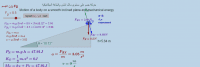
جسم كتلته \(m\) على مستوى مائل أملس يميل بزاوية \(\theta\) عن الأفق. تؤثر فيه قوتان فقط: وزنه \(F_g=mg\) إلى أسفل، والقوة العمودية \(N\) من المستوى. نحلّل الوزن إلى مركّبتين: موازية للمستوى \(F_{gx}=mg\sin\theta\) (تسبب الانزلاق)، وعمودية عليه \(F_{gy}=mg\cos\theta\) (توازنها \(N\)). فيكون \(N=mg\cos\theta\).
A body of mass \(m\) is on a smooth inclined plane inclined at an angle \(\theta\) to the horizontal. Only two forces act on it: its weight \(F_g=mg\) downward and the normal force \(N\) from the plane. We resolve the weight into two components: parallel to the plane \(F_{gx}=mg\sin\theta\) (it causes the sliding) and perpendicular to it \(F_{gy}=mg\cos\theta\) (balanced by \(N\)). So \(N=mg\cos\theta\).
📘 القوانين
📘 The laws
\[F_{gx}=mg\sin\theta\qquad F_{gy}=mg\cos\theta\qquad N=mg\cos\theta\]
\[a=\dfrac{F_{gx}}{m}=g\sin\theta\qquad v=at\qquad s=\tfrac12at^2\]
\[P_E=mgh\qquad K_E=\tfrac12mv^2\qquad M_E=K_E+P_E=\text{constant}\qquad v=\sqrt{2gh}\]
💡 شرح إضافي: حفظ الطاقة الميكانيكية
💡 Extra explanation: conservation of mechanical energy
- على المستوى الأملس القوة العمودية \(N\) لا تبذل شغلًا (عمودية على الحركة)، والوزن قوة محافظة، لذلك \(M_E\) ثابتة.On the smooth plane the normal force \(N\) does no work (it is perpendicular to the motion) and the weight is a conservative force, so \(M_E\) is constant.
- عند البداية (من السكون) \(K_E=0\) و\(M_E=P_E=mgh\)، وعند القاع \(P_E=0\) و\(K_E=mgh\) فتكون \(v=\sqrt{2gh}\) لا تعتمد على الزاوية ولا على الكتلة.At the start (from rest) \(K_E=0\) and \(M_E=P_E=mgh\), and at the bottom \(P_E=0\) and \(K_E=mgh\) so \(v=\sqrt{2gh}\) does not depend on the angle or the mass.
- الزاوية الأكبر تعطي تسارعًا أكبر وزمنًا أقل، لكن السرعة عند القاع واحدة للارتفاع نفسه.A greater angle gives a greater acceleration and a shorter time, but the speed at the bottom is the same for the same height.
- نستعمل \(g=9.8\ \mathrm{m/s^2}\) كما في المحاكاة الأصلية.We use \(g=9.8\ \mathrm{m/s^2}\) as in the original simulation.
🧪 تجربة 1: اترك الجسم ينزلق وراقب القوى والطاقة
🧪 Experiment 1: Let the body slide and watch the forces and the energy
اختر الزاوية \(\theta\) والكتلة \(m\) وطول المستوى \(L\) (يبدأ الجسم من السكون عند القمة، \(g=9.8\ \mathrm{m/s^2}\)). تظهر مركّبتا الوزن والقوة العمودية، ويتحول عمود \(P_E\) إلى \(K_E\) بينما \(M_E\) ثابتة. اضغط «اترك الجسم» أو حرّك مؤشر الزمن (لا شيء يتحرك من تلقاء نفسه).
Choose the angle \(\theta\), the mass \(m\) and the length of the plane \(L\) (the body starts from rest at the top, \(g=9.8\ \mathrm{m/s^2}\)). The two components of the weight and the normal force appear, and the \(P_E\) bar changes into \(K_E\) while \(M_E\) stays constant. Press “Release the body” or move the time slider (nothing moves by itself).
🧪 تجربة 2: حاسبة: المستوى المائل الأملس
🧪 Experiment 2: Calculator: the smooth inclined plane
مسألة جديدة في كل مرة (\(g=9.8\ \mathrm{m/s^2}\)). احسب القيم الثلاث ثم اضغط «صحّح».
A new problem every time (\(g=9.8\ \mathrm{m/s^2}\)). Calculate the three values and press “Check”.
🛠️ تطبيقات عملية
🛠️ Practical applications
- المزلقات والتزلج: سرعة الوصول للقاع تتحدد بارتفاع البداية.Slides and skiing: the speed at the bottom is decided by the starting height.
- الأفعوانية (الأفعوانيات): تحوّل طاقة الوضع إلى حركة.Roller coasters: they change potential energy into motion.
- المنحدرات في المختبر: تُستعمل لتخفيف التسارع وقياسه بدقة.Ramps in the lab: used to reduce the acceleration and measure it accurately.
✍️ أمثلة محلولة
✍️ Worked Examples
بقيم المحاكاة الأصلية: وزن الجسم \(8.5\ \mathrm{N}\) والزاوية \(18.12^\circ\) و\(g=9.8\). احسب مركّبتي الوزن والتسارع.
With the values of the original simulation: the weight of the body \(8.5\ \mathrm{N}\), the angle \(18.12^\circ\) and \(g=9.8\). Calculate the two components of the weight and the acceleration.
للمثال السابق ارتفاع نقطة البداية \(5.64\ \mathrm{m}\) (\(m\approx0.867\ \mathrm{kg}\)). احسب \(P_E\) و\(M_E\) والسرعة عند القاع.
For the previous example the starting height is \(5.64\ \mathrm{m}\) (\(m\approx0.867\ \mathrm{kg}\)). Calculate \(P_E\), \(M_E\) and the speed at the bottom.
جسم \(2\ \mathrm{kg}\) ينزلق من السكون مسافة \(10\ \mathrm{m}\) على مستوى أملس زاويته \(30^\circ\). أوجد التسارع والسرعة النهائية والزمن.
A \(2\ \mathrm{kg}\) body slides from rest a distance of \(10\ \mathrm{m}\) on a smooth plane of angle \(30^\circ\). Find the acceleration, the final velocity and the time.
جسمان ينزلقان من ارتفاع \(5\ \mathrm{m}\) على مستويين أملسين زاويتاهما \(30^\circ\) و\(60^\circ\). قارن سرعتيهما عند القاع.
Two bodies slide from a height of \(5\ \mathrm{m}\) down two smooth planes of angles \(30^\circ\) and \(60^\circ\). Compare their speeds at the bottom.
تسارع جسم ينزلق على مستوى أملس زاويته \(\theta\):
The acceleration of a body sliding on a smooth plane of angle \(\theta\) is:
الطاقة الميكانيكية لجسم ينزلق على مستوى أملس:
The mechanical energy of a body sliding on a smooth plane:
السرعة عند قاع مستوى أملس ارتفاعه \(h\) (من السكون):
The speed at the bottom of a smooth plane of height \(h\) (from rest):
القوة العمودية على جسم على مستوى مائل أملس تساوي:
The normal force on a body on a smooth inclined plane equals:
📚 ملخص
📚 Summary
| الكميةQuantity | القانونLaw |
|---|---|
| المركّبة الموازيةParallel component | \(mg\sin\theta\)\(mg\sin\theta\) |
| المركّبة العموديةPerpendicular component | \(mg\cos\theta\)\(mg\cos\theta\) |
| التسارعAcceleration | \(a=g\sin\theta\)\(a=g\sin\theta\) |
| الطاقة الميكانيكيةMechanical energy | \(M_E=K_E+P_E=mgh\)\(M_E=K_E+P_E=mgh\) |
| سرعة القاعSpeed at the bottom | \(v=\sqrt{2gh}\)\(v=\sqrt{2gh}\) |
⚠️ أخطاء شائعة
⚠️ Common mistakes
- الخلط بين \(\sin\theta\) و\(\cos\theta\) في المركّبتين.Confusing \(\sin\theta\) and \(\cos\theta\) in the two components.
- الظن بأن القوة العمودية تساوي \(mg\) على المستوى المائل.Thinking the normal force equals \(mg\) on the inclined plane.
- استعمال طول المستوى بدل الارتفاع الرأسي في \(P_E=mgh\).Using the length of the plane instead of the vertical height in \(P_E=mgh\).
🔗 محاكيات GeoGebra للاستعانة بها عند اللزوم
🔗 GeoGebra Simulations to Use When Needed
اضغط «تشغيل» لتعمل المحاكاة هنا داخل الدرس؛ ويمكن للطالب الرجوع إليها لتجربة الفكرة بطريقة أخرى.
Press “Run” to run the simulation right here inside the lesson; the student can use it to try the idea in another way.