🎯 نواتج التعلم
🎯 Learning Outcomes
بعد هذه التجربة ستكون قادرًا على أن:
After this experiment you will be able to:
- تحسب مجال شحنة نقطية عند نقطة، وتحدد اتجاهه بحسب إشارة الشحنة.Calculate the field of a point charge at a point and find its direction from the sign of the charge.
- تجمع مجالات عدة شحنات عند نقطة جمعًا اتجاهيًا بالمركبات.Add the fields of several charges at a point as vectors using components.
- تحدد المسافة بين كل شحنة والنقطة، وتستخدمها لحساب مجال كل شحنة.Find the distance between each charge and the point, and use it to calculate each charge's field.
- تحسب القوة على شحنة اختبار موضوعة عند النقطة من المجال المحصل.Calculate the force on a test charge placed at the point from the net field.
🎬 شاهد الفيديو
🎬 Watch the Video
🔍 الفكرة في صورة
🔍 The Idea in a Picture
⚡ المجال الناتج عن شحنة نقطية
⚡ The Field of a Point Charge
الشحنة الموجبة تُنشئ مجالًا يبتعد عنها، والسالبة مجالًا يتجه نحوها. مقدار المجال يتناقص بمربع المسافة، وهو كمية متجهة لها مقدار واتجاه.
A positive charge creates a field pointing away from it, and a negative charge a field pointing toward it. The magnitude falls off with the square of the distance; the field is a vector with a magnitude and a direction.
📘 قوانين التراكب
📘 Superposition laws
\[\vec E_i=k\dfrac{q_i}{r_i^{2}}\,\hat r_i\]
\[\vec E=\sum_i\vec E_i,\qquad E_x=\sum_i E_{i,x},\qquad E_y=\sum_i E_{i,y}\]
\[|\vec E|=\sqrt{E_x^{2}+E_y^{2}},\qquad \vec F=q_0\vec E\]
حيث \(\hat r_i\) متجه وحدة من الشحنة \(q_i\) إلى النقطة، و\(k=9\times10^9\ \mathrm{N\,m^2/C^2}\). في التجربة نكتب \(E=9\,\dfrac{q\,(\mathrm{nC})}{r^2\,(\mathrm{m^2})}\) بالفولت لكل متر.
where \(\hat r_i\) is the unit vector from charge \(q_i\) to the point, and \(k=9\times10^9\ \mathrm{N\,m^2/C^2}\). In the experiment we write \(E=9\,\dfrac{q\,(\mathrm{nC})}{r^2\,(\mathrm{m^2})}\) in volts per metre.
💡 شرح إضافي: لماذا نجمع المجالات بالمركبات ولا نجمع المقادير؟
💡 Extra explanation: why add the fields by components rather than by magnitude?
المجال كمية متجهة، واتجاهه يختلف من شحنة لأخرى. إذا كان مجالان متعامدين مقدار كل منهما \(3\) فمحصلتهما \(\sqrt{3^2+3^2}\approx4.2\) وليست \(6\). لذلك نجمع المركبات الأفقية معًا والرأسية معًا، ثم نحسب المقدار من مركبتي المحصلة.
The field is a vector and its direction changes from one charge to another. If two perpendicular fields each have magnitude \(3\), their resultant is \(\sqrt{3^2+3^2}\approx4.2\), not \(6\). So we add the horizontal components together and the vertical components together, then compute the magnitude from the components of the resultant.
💡 شرح إضافي: لماذا قد يكون المجال صفرًا عند نقطة؟
💡 Extra explanation: why can the field be zero at a point?
إذا تساوى مقدار مجالين واتجاههما متعاكسان تمامًا، فإن محصلتهما صفر. مثال ذلك نقطة المنتصف بين شحنتين موجبتين متساويتين. أما الجهد فلا يكون صفرًا هناك، وهذا فرق مهم بين المجال والجهد.
If two fields have equal magnitudes and point in exactly opposite directions, their resultant is zero. An example is the midpoint between two equal positive charges. The potential there is not zero, which is an important difference between the field and the potential.
🧪 التجربة التفاعلية: خطوة بخطوة
🧪 Interactive Experiment: Step by Step
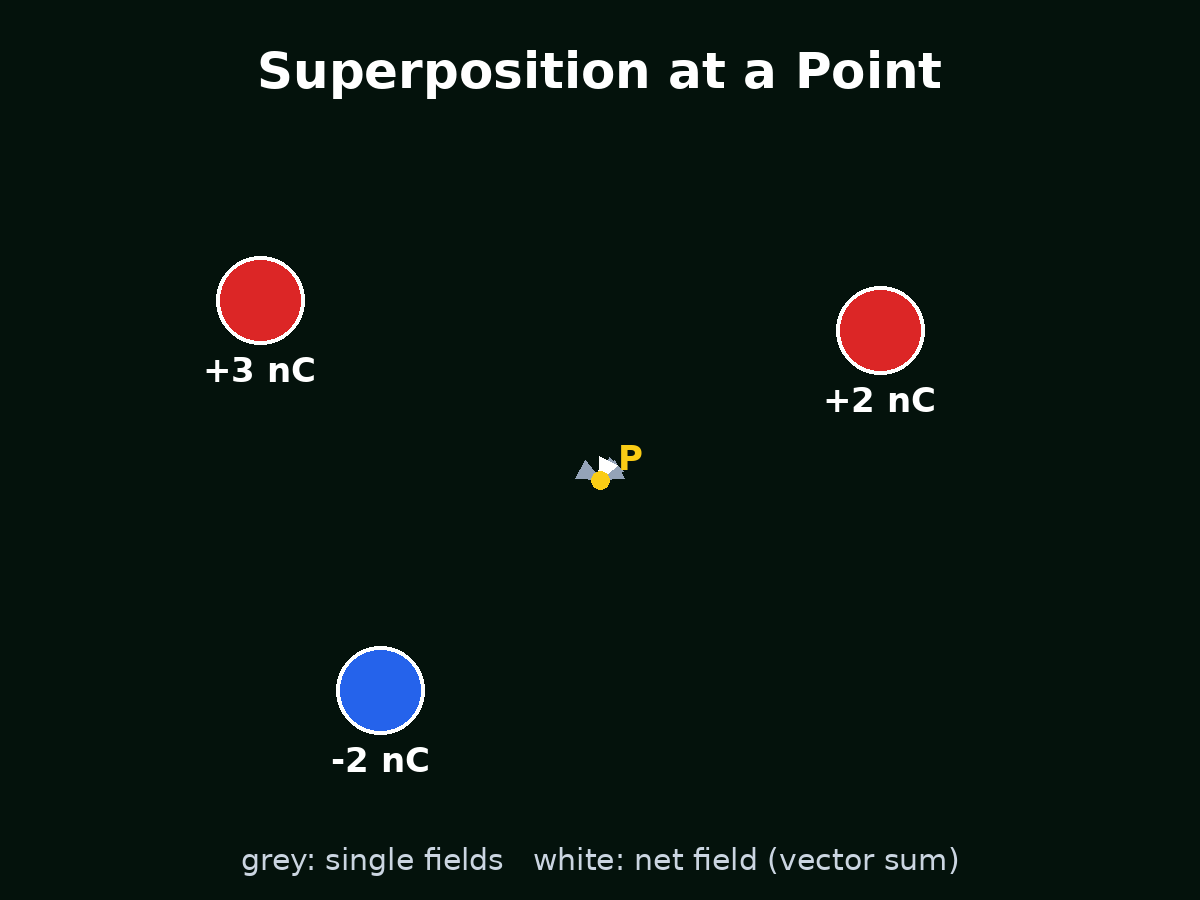
اسحب الشحنات الثلاث بالفأرة أو باللمس، وغيّر قيمها. ثم اتبع الأزرار بالترتيب: أولًا مجال كل شحنة عند \(P\) مع اتجاهه، ثم مركبات كل مجال، وأخيرًا المحصلة.
Drag the three charges with the mouse or touch, and change their values. Then follow the buttons in order: first the field of each charge at \(P\) with its direction, then the components of each field, and finally the resultant.
➕ تراكب المجالات الكهربائية عند نقطة
➕ Superposition of electric fields at a point
✍️ أمثلة محلولة
✍️ Worked Examples
شحنتان موجبتان متساويتان \(q=+3\ \mathrm{nC}\) عند \(x=0\) و\(x=4\ \mathrm{m}\). احسب المجال المحصل عند النقطة \(P\) عند \(x=2\ \mathrm{m}\) على المحور نفسه.
Two equal positive charges \(q=+3\ \mathrm{nC}\) are at \(x=0\) and \(x=4\ \mathrm{m}\). Find the net field at the point \(P\) at \(x=2\ \mathrm{m}\) on the same axis.
شحنة \(q_1=+4\ \mathrm{nC}\) عند الأصل، وشحنة \(q_2=-2\ \mathrm{nC}\) عند \((3,0)\ \mathrm{m}\). احسب المجال المحصل عند \(P=(0,3)\ \mathrm{m}\): مركبتيه ومقداره واتجاهه.
A charge \(q_1=+4\ \mathrm{nC}\) is at the origin and \(q_2=-2\ \mathrm{nC}\) is at \((3,0)\ \mathrm{m}\). Find the net field at \(P=(0,3)\ \mathrm{m}\): its components, magnitude and direction.
ضع شحنة اختبار \(q_0=+2\ \mathrm{nC}\) عند \(P\) في المثال السابق. ما القوة المؤثرة فيها واتجاهها؟
Place a test charge \(q_0=+2\ \mathrm{nC}\) at \(P\) in the previous example. What is the force on it and its direction?
📚 ملخص
📚 Summary
| المفهومConcept | القانون أو النتيجةLaw or result |
|---|---|
| مجال شحنة نقطيةField of a point charge | \(E=k\dfrac{q}{r^2}\) في اتجاه الابتعاد (للموجبة) والاقتراب (للسالبة)\(E=k\dfrac{q}{r^2}\), away from a positive charge and toward a negative one |
| المحصلةNet field | \(\vec E=\sum\vec E_i\) بجمع المركبات\(\vec E=\sum\vec E_i\), by adding components |
| مقدار المحصلةMagnitude of the net field | \(|E|=\sqrt{E_x^2+E_y^2}\)\(|E|=\sqrt{E_x^2+E_y^2}\) |
| القوة على شحنة اختبارForce on a test charge | \(\vec F=q_0\vec E\)\(\vec F=q_0\vec E\) |
⚠️ أخطاء شائعة
⚠️ Common mistakes
- جمع مقادير المجالات بدل جمعها اتجاهيًا؛ المحصلة لا تساوي مجموع المقادير إلا إذا كانت المتجهات في اتجاه واحد.Adding the magnitudes instead of the vectors; the net field equals the sum of magnitudes only when all the vectors point the same way.
- نسيان أن المسافة \(r\) تُقاس من كل شحنة إلى النقطة، لا من الأصل.Forgetting that \(r\) is measured from each charge to the point, not from the origin.
- الخلط بين اتجاه المجال للشحنة السالبة (نحوها) واتجاهه للموجبة (بعيدًا عنها).Mixing up the direction of the field of a negative charge (toward it) with that of a positive charge (away from it).
- الظن أن المجال صفر حيث الجهد صفر؛ الكميتان مختلفتان.Thinking the field is zero wherever the potential is zero; the two quantities are different.
🧠 اختبر نفسك
🧠 Test Yourself
كيف نجد المجال المحصل عند نقطة تؤثر فيها عدة شحنات؟
How do we find the net field at a point affected by several charges?
شحنتان موجبتان متساويتان. عند منتصف المسافة بينهما، ما المجال؟
Two equal positive charges are placed apart. At the midpoint between them, what is the field?
🔗 محاكاة GeoGebra للاستعانة بها عند اللزوم
🔗 GeoGebra Simulation to Use When Needed
اضغط «تشغيل» لتعمل المحاكاة هنا داخل الدرس؛ ويمكن للطالب الرجوع إليها لتجربة الفكرة بطريقة أخرى.
Press “Run” to run the simulation right here inside the lesson; the student can use it to try the idea in another way.