🎯 نواتج التعلم
🎯 Learning Outcomes
بعد هذه التجربة ستكون قادرًا على أن:
After this experiment you will be able to:
- تحلّل متجهًا إلى مركبتين متعامدتين: \(V_x=V\cos\theta\) و\(V_y=V\sin\theta\).Resolve a vector into two perpendicular components: \(V_x=V\cos\theta\) and \(V_y=V\sin\theta\).
- تعيد تركيب المتجه من مركبتيه: \(V=\sqrt{V_x^2+V_y^2}\).Rebuild the vector from its components: \(V=\sqrt{V_x^2+V_y^2}\).
- تحلّل متجهًا على محورين مدارين، وتطبّق ذلك على وزن جسم على مستوى مائل.Resolve a vector along two rotated axes and apply this to the weight of a body on an incline.
🎬 شاهد الفيديو
🎬 Watch the Video
📐 تحليل المتجه
📐 Resolving a Vector
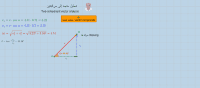
تحليل المتجه هو إيجاد متجهين متعامدين مجموعهما يساوي المتجه الأصلي، ويُسميان مركبتيه. نسقط من رأس المتجه عمودين على المحورين، فتكون المركبتان ضلعي مستطيل قطره المتجه. المحوران قد يكونان أفقيًّا ورأسيًّا، أو موازيًا للمستوى المائل وعموديًّا عليه.
Resolving a vector means finding two perpendicular vectors whose sum is the original vector; they are called its components. We drop perpendiculars from the tip of the vector onto the two axes so the components are the sides of a rectangle whose diagonal is the vector. The axes may be horizontal and vertical, or parallel and perpendicular to an incline.
📘 القوانين
📘 The laws
\[V_x=V\cos\theta\qquad V_y=V\sin\theta\qquad V=\sqrt{V_x^2+V_y^2}\qquad \tan\theta=\dfrac{V_y}{V_x}\]
\[\text{على مستوى مائل زاويته }\varphi:\quad W_{\parallel}=W\sin\varphi\qquad W_{\perp}=W\cos\varphi\]
💡 ملاحظات
💡 Notes
- الزاوية \(\theta\) تُقاس من المحور الذي تُحسب مركبته بـ \(\cos\theta\).The angle \(\theta\) is measured from the axis whose component uses \(\cos\theta\).
- عند \(\theta=0\) تكون \(V_x=V\) و\(V_y=0\)، وعند \(\theta=90^\circ\) العكس.At \(\theta=0\) \(V_x=V\) and \(V_y=0\); at \(\theta=90^\circ\) the opposite.
- إشارة المركبة تحدد اتجاهها على المحور (ربع الزاوية).The sign of a component gives its direction on the axis (the quadrant of the angle).
🧪 تجربة 1: حلّل المتجه بالسحب
🧪 Experiment 1: Resolve the vector by dragging
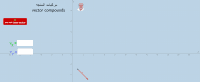
اسحب رأس المتجه \(V\) (الأحمر) أو غيّر المقدار والزاوية، فتظهر المركبتان على المحورين مع خطوط الإسقاط. اختر المحورين: أفقي ورأسي، أو محورين مدارين بزاوية تختارها، أو تطبيق مستوى مائل (وزن جسم). فعّل «أعد التركيب» لترى المركبتين تشكلان المتجه. (لا شيء يتحرك من تلقاء نفسه.)
Drag the head of the vector \(V\) (red) or change the magnitude and the angle and the components appear on the axes with projection lines. Choose the axes: horizontal and vertical, rotated axes at an angle you choose, or the incline application (a body’s weight). Turn on “Rebuild” to see the components form the vector. (Nothing moves by itself.)
🧪 تجربة 2: حاسبة: تحليل المتجه
🧪 Experiment 2: Calculator: resolving a vector
مسألة جديدة في كل مرة. أدخل الجواب.
A new problem every time. Enter the answer.
✍️ أمثلة محلولة
✍️ Worked Examples
قوة \(50\ \mathrm{N}\) تصنع \(30^\circ\) مع الأفقي. احسب مركبتيها الأفقية والرأسية.
A \(50\ \mathrm{N}\) force at \(30^\circ\) to the horizontal. Find its horizontal and vertical components.
مركبتا متجه \(V_x=12\) و\(V_y=16\). احسب مقداره وزاويته.
The components of a vector are \(V_x=12\) and \(V_y=16\). Find its magnitude and angle.
صندوق وزنه \(100\ \mathrm{N}\) على مستوى مائل زاويته \(37^\circ\). احسب مركبتي وزنه.
A box weighing \(100\ \mathrm{N}\) sits on a \(37^\circ\) incline. Find the components of its weight.
يُسحب صندوق بقوة \(40\ \mathrm{N}\) بحبل يصنع \(60^\circ\) مع الأفق. أي مركبة تحرّكه أفقيًّا؟
A box is pulled by a \(40\ \mathrm{N}\) force by a rope at \(60^\circ\) above the horizontal. Which component moves it horizontally?
المركبة الأفقية لمتجه مقداره \(V\) وزاويته \(\theta\) مع الأفقي:
The horizontal component of a vector of magnitude \(V\) at an angle \(\theta\) to the horizontal:
عند \(\theta=90^\circ\) تكون المركبة الأفقية:
At \(\theta=90^\circ\) the horizontal component is:
مركبة وزن جسم الموازية لمستوى مائل زاويته \(\varphi\):
The component of a body’s weight parallel to an incline of angle \(\varphi\):
\(V_x=3\) و\(V_y=4\) فإن \(V=\)
\(V_x=3\) and \(V_y=4\) so \(V=\)
📚 ملخص
📚 Summary
| الكميةQuantity | القانونLaw |
|---|---|
| المركبة الأفقيةHorizontal component | \(V_x=V\cos\theta\)\(V_x=V\cos\theta\) |
| المركبة الرأسيةVertical component | \(V_y=V\sin\theta\)\(V_y=V\sin\theta\) |
| المقدارMagnitude | \(V=\sqrt{V_x^2+V_y^2}\)\(V=\sqrt{V_x^2+V_y^2}\) |
⚠️ أخطاء شائعة
⚠️ Common mistakes
- الخلط بين \(\cos\) و\(\sin\) حسب الزاوية المقيسة من الأفقي أو الرأسي.Mixing up \(\cos\) and \(\sin\) depending on the angle measured from the horizontal or the vertical.
- جمع المركبتين جمعًا عاديًّا بدل فيثاغورس.Adding the components arithmetically instead of using Pythagoras.
- نسيان ضبط الآلة الحاسبة على الدرجات.Forgetting to set the calculator to degrees.
🔗 محاكيات GeoGebra للاستعانة بها عند اللزوم
🔗 GeoGebra Simulations to Use When Needed
اضغط «تشغيل» لتعمل المحاكاة هنا داخل الدرس؛ ويمكن للطالب الرجوع إليها لتجربة الفكرة بطريقة أخرى.
Press “Run” to run the simulation right here inside the lesson; the student can use it to try the idea in another way.