🎯 نواتج التعلم
🎯 Learning Outcomes
بعد هذه التجربة ستكون قادرًا على أن:
After this experiment you will be able to:
- تصف تجربة ميليكان وأجزاءها وفكرة اتزان قطرة الزيت بين لوحين.Describe Millikan’s experiment, its parts and the idea of balancing an oil drop between two plates.
- تستعمل \(qE=mg\) و\(E=V/d\) لحساب شحنة القطرة \(q=\dfrac{mgd}{V}\).Use \(qE=mg\) and \(E=V/d\) to calculate the charge of the drop \(q=\dfrac{mgd}{V}\).
- تحسب نصف قطر القطرة وكتلتها من سرعتها الحدية بقانون ستوكس.Calculate the radius and the mass of the drop from its terminal speed using Stokes’ law.
- تستنتج أن الشحنة مكمّاة \(q=ne\) وتعيّن قيمة الشحنة الأولية \(e\) من بيانات عدة قطرات.Conclude that charge is quantized \(q=ne\) and determine the value of the elementary charge \(e\) from the data of several drops.
🎬 شاهد الفيديو
🎬 Watch the Video
🎬 شاهد الفيديو
🎬 Watch the Video
❓ السؤال الذي تجيب عنه التجربة
❓ The Question That the Experiment Answers
هل يمكن أن تكون شحنة جسم أي قيمة نشاء، أم أنها تأتي في «حزم» صغيرة لا تتجزأ؟ وما مقدار أصغر حزمة؟ في عام 1909 صمّم الفيزيائي الأمريكي روبرت ميليكان وتلميذه هارفي فليتشر تجربة ذكية لمعرفة ذلك: علّقا قطرات زيت مجهرية مشحونة في الهواء بين لوحين وقاسا شحنة كل قطرة. وبهذه التجربة نال ميليكان جائزة نوبل عام 1923.
Can the charge of a body be any value we like, or does it come in small indivisible “packets”? And what is the size of the smallest packet? In 1909 the American physicist Robert Millikan and his student Harvey Fletcher designed a clever experiment to find out: they suspended microscopic charged oil drops in air between two plates and measured the charge of each drop. For this experiment Millikan received the Nobel Prize in 1923.
🛠️ كيف يعمل الجهاز؟
🛠️ How Does the Apparatus Work?
أجزاء الجهاز
The parts of the apparatus
- بخّاخ يرشّ قطرات زيت صغيرة جدًّا (نصف قطر القطرة نحو \(1\ \mu\mathrm m\)) فتكتسب شحنة بالاحتكاك.An atomizer sprays very small oil drops (the radius of a drop is about \(1\ \mu\mathrm m\)) which gain a charge by friction.
- لوحان معدنيان أفقيان بينهما مسافة \(d\) وفرق جهد \(V\) يعطي مجالًا منتظمًا \(E=V/d\) رأسيًّا.Two horizontal metal plates a distance \(d\) apart with a potential difference \(V\) give a uniform vertical field \(E=V/d\).
- مجهر صغير لرؤية قطرة واحدة ومتابعة حركتها بين خطين مدرّجين.A small microscope to see one drop and follow its motion between two graduated lines.
- مصدر أشعة سينية لتأيين الهواء فتتغير شحنة القطرة بإلكترون واحد أو أكثر في كل مرة.An X-ray source to ionize the air so the charge of the drop changes by one electron or more each time.
⚖️ شرط الاتزان وحساب الشحنة
⚖️ The Balance Condition and Calculating the Charge
على القطرة قوتان فقط: وزنها \(mg\) نحو الأسفل والقوة الكهربائية \(qE\) نحو الأعلى (إذا كانت إشارة الشحنة مناسبة لاتجاه المجال). نغيّر الجهد حتى تتوقف القطرة عن الحركة؛ عندئذ تتساوى القوتان فنجد الشحنة. أما الكتلة فلا نقيسها مباشرة بل نحسبها من نصف القطر الذي نجده من سرعة السقوط بدون مجال.
Only two forces act on the drop: its weight \(mg\) downward and the electric force \(qE\) upward (if the sign of the charge suits the direction of the field). We change the voltage until the drop stops moving; then the two forces are equal and we find the charge. The mass is not measured directly but calculated from the radius that we get from the speed of falling without a field.
📘 القوانين
📘 The laws
\[qE=mg,\quad E=\frac{V}{d}\ \Rightarrow\ q=\frac{mgd}{V}\]
\[v_t=\frac{2\rho g r^{2}}{9\eta}\ \Rightarrow\ r=\sqrt{\frac{9\eta v_t}{2\rho g}}\]
\[m=\tfrac43\pi r^{3}\rho,\qquad q=ne,\quad e=1.602\times10^{-19}\ \mathrm C\]
| الرمزSymbol | المعنىMeaning | القيمة / الوحدةValue / unit |
|---|---|---|
| \(\rho\)\(\rho\) | كثافة الزيتThe density of the oil | \(886\ \mathrm{kg/m^3}\)\(886\ \mathrm{kg/m^3}\) |
| \(\eta\)\(\eta\) | لزوجة الهواءThe viscosity of air | \(1.8\times10^{-5}\ \mathrm{Pa\,s}\)\(1.8\times10^{-5}\ \mathrm{Pa\,s}\) |
| \(d\)\(d\) | المسافة بين اللوحينThe distance between the plates | \(1.0\ \mathrm{cm}\)\(1.0\ \mathrm{cm}\) |
| \(e\)\(e\) | الشحنة الأوليةThe elementary charge | \(1.602\times10^{-19}\ \mathrm C\)\(1.602\times10^{-19}\ \mathrm C\) |
🌬️ لماذا نحتاج قانون ستوكس؟
🌬️ Why Do We Need Stokes’ Law?
القطرة الصغيرة تسقط في الهواء فتتعرض لقوة احتكاك لزج \(6\pi\eta rv\) تزداد مع السرعة حتى تتساوى مع الوزن، فتسقط بعدها بسرعة ثابتة تسمى السرعة الحدية: \(6\pi\eta rv_t=mg\). نقيس \(v_t\) بتوقيت سقوط القطرة بين خطين، ومنها نجد \(r\) ثم الكتلة \(m\). ولاحظ أن \(v_t\) تتناسب مع \(r^2\): قطرة نصف قطرها ضعف الأخرى تسقط أسرع أربع مرات.
The small drop falling in air is acted on by a viscous drag force \(6\pi\eta rv\) which increases with the speed until it equals the weight, after which it falls at a constant speed called the terminal speed: \(6\pi\eta rv_t=mg\). We measure \(v_t\) by timing the fall of the drop between two lines, and from it we find \(r\) then the mass \(m\). Notice that \(v_t\) is proportional to \(r^2\): a drop of twice the radius falls four times faster.
🧪 التجربة 1: علّق القطرة
🧪 Experiment 1: Suspend the Drop
🛠️ خطوات العمل
🛠️ Procedure
- زد الجهد الأساسي حتى تنقلب حركة القطرة من السقوط إلى الصعود (يتحول اللون إلى الذهبي).Increase the coarse voltage until the motion of the drop changes from falling to rising (the colour turns golden).
- ارجع قليلًا واستعمل الضبط الدقيق حتى تتوقف القطرة وتتحول إلى الأخضر.Go back a little and use the fine adjustment until the drop stops and turns green.
- سجّل الجهد واحسب الشحنة \(q=mgd/V\) باستعمال الكتلة المعروضة.Record the voltage and calculate the charge \(q=mgd/V\) using the displayed mass.
- اضغط «قطرة جديدة» وكرّر مع قطرة أخرى وقارن الجهد والشحنة.Press “New drop” and repeat with another drop and compare the voltage and the charge.
🧪 تجربة 1: علّق قطرة الزيت
🧪 Experiment 1: Suspend the Oil Drop
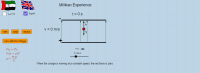
قطرة زيت مشحونة بين لوحين. اضبط الجهد (منزلق كبير لضبط تقريبي وآخر دقيق) حتى تتساوى القوة الكهربائية \(qE\) مع الوزن \(mg\) فتتوقف القطرة. ثم احسب شحنتها.
A charged oil drop between two plates. Adjust the voltage (a big slider for a rough setting and a fine one) until the electric force \(qE\) equals the weight \(mg\) and the drop stops. Then calculate its charge.
🔍 ماذا نلاحظ؟
🔍 What do we observe?
- عند \(qE\lt mg\) تسقط القطرة، وعند \(qE\gt mg\) تصعد، وعند التساوي تتوقف.When \(qE\lt mg\) the drop falls, when \(qE\gt mg\) it rises, and when they are equal it stops.
- يختلف الجهد من قطرة لأخرى لأن الكتلة والشحنة تختلفان.The voltage differs from one drop to another because the mass and the charge differ.
- قطرة أكبر شحنة تحتاج جهدًا أصغر لتعليقها.A drop with a larger charge needs a smaller voltage to suspend it.
📊 التجربة 2: اكتشف تكميم الشحنة
📊 Experiment 2: Discover the Quantization of Charge
هذه هي الفكرة التي جعلت ميليكان مشهورًا. قاس شحنات مئات القطرات فوجد أنها ليست قيمًا عشوائية: كل الشحنات مضاعفات صحيحة لقيمة صغيرة واحدة. فإذا قسمنا كل شحنة على \(e\) الصحيحة حصلنا على أعداد صحيحة \(n=1,2,3,\dots\). في المحاكاة تجد \(e\) بتجربة قيم مختلفة حتى تقع كل النقاط على الخطوط.
This is the idea that made Millikan famous. He measured the charges of hundreds of drops and found that they are not random values: all the charges are integer multiples of one small value. So if we divide each charge by the right \(e\) we get integers \(n=1,2,3,\dots\). In the simulation you find \(e\) by trying different values until all the points lie on the lines.
🧪 تجربة 2: اكتشف تكميم الشحنة
🧪 Experiment 2: Discover the Quantization of Charge
قِس شحنات عدة قطرات (كما فعل ميليكان) وضعها على محور واحد. ثم حرّك قيمة \(e\) المختبَرة حتى تقع كل النقاط على مضاعفاتها: هذه قيمة الشحنة الأولية.
Measure the charges of several drops (as Millikan did) and place them on one axis. Then move the tested value of \(e\) until all the points lie on its multiples: this is the value of the elementary charge.
🔍 ماذا نلاحظ؟
🔍 What do we observe?
- النقاط تتجمّع في «عناقيد» عند مضاعفات قيمة واحدة بدل أن تنتشر باستمرار على المحور.The points gather in “clusters” at multiples of one value instead of spreading continuously on the axis.
- إذا اخترت قيمة \(e\) نصف الحقيقية تقع النقاط أيضًا على الخطوط، لكن بعض الخطوط تكون فارغة؛ لذلك نأخذ أكبر قيمة تعمل.If you choose \(e\) as half the true value the points also lie on the lines, but some lines are empty; so we take the largest value that works.
- كلما زاد عدد القطرات صار الاستنتاج أوثق.The more drops the stronger the conclusion.
🌧️ التجربة 3: نصف القطر من زمن السقوط
🌧️ Experiment 3: The Radius from the Fall Time
نغلق المجال فتسقط القطرة بسرعتها الحدية. نقيس الزمن \(t\) لقطع المسافة \(1\ \mathrm{mm}\) فتكون \(v_t=10^{-3}/t\)، ثم \(r=\sqrt{\dfrac{9\eta v_t}{2\rho g}}\). في المحاكاة تمر الأزمنة بسرعة أكبر خمس مرات لتوفير وقتك.
We switch the field off so the drop falls at its terminal speed. We measure the time \(t\) to cover \(1\ \mathrm{mm}\) so \(v_t=10^{-3}/t\), then \(r=\sqrt{\dfrac{9\eta v_t}{2\rho g}}\). In the simulation the time passes five times faster to save your time.
🧪 تجربة 3: قانون ستوكس: نصف القطر من زمن السقوط
🧪 Experiment 3: Stokes’ Law: The Radius from the Fall Time
لا نستطيع رؤية نصف قطر القطرة مباشرة، فنغلق المجال ونقيس زمن سقوطها \(1\ \mathrm{mm}\) بسرعتها الحدية، ثم نحسب \(r\) من قانون ستوكس.
We cannot see the radius of the drop directly, so we switch the field off and measure its time of falling \(1\ \mathrm{mm}\) at its terminal speed, then calculate \(r\) from Stokes’ law.
🔍 ماذا نلاحظ؟
🔍 What do we observe?
- القطرة الأكبر تسقط في زمن أقصر بكثير: ضعف نصف القطر يعطي ربع الزمن.The larger drop falls in a much shorter time: twice the radius gives a quarter of the time.
- المنحنى على اليمين قطع مكافئ \(v\propto r^2\).The curve on the right is a parabola \(v\propto r^2\).
- بعد حساب \(r\) نجد الكتلة \(m=\tfrac43\pi r^3\rho\) ثم نستعملها في التجربة 1.After calculating \(r\) we find the mass \(m=\tfrac43\pi r^3\rho\) then use it in Experiment 1.
🎲 التجربة 4: تدرّب
🎲 Experiment 4: Practice
🧪 تجربة 4: تدرّب: شحنة القطرة
🧪 Experiment 4: Practice: The Charge of the Drop
مسائل عشوائية: قطرة زيت معلّقة؛ احسب شحنتها وعدد الإلكترونات الفائضة عليها.
Random problems: a suspended oil drop; calculate its charge and the number of excess electrons on it.
✍️ أمثلة محلولة
✍️ Worked Examples
علّقت قطرة زيت كتلتها \(1.63\times10^{-15}\ \mathrm{kg}\) بجهد \(500\ \mathrm V\) بين لوحين المسافة بينهما \(1.0\ \mathrm{cm}\). أوجد شحنتها وعدد الإلكترونات الفائضة.
An oil drop of mass \(1.63\times10^{-15}\ \mathrm{kg}\) was suspended with \(500\ \mathrm V\) between two plates \(1.0\ \mathrm{cm}\) apart. Find its charge and the number of excess electrons.
سقطت قطرة زيت بدون مجال بسرعة حدية \(1.0\times10^{-4}\ \mathrm{m/s}\). أوجد نصف قطرها وكتلتها (\(\eta=1.8\times10^{-5}\), \(\rho=886\)).
An oil drop fell without a field at a terminal speed of \(1.0\times10^{-4}\ \mathrm{m/s}\). Find its radius and mass (\(\eta=1.8\times10^{-5}\), \(\rho=886\)).
قطرة كتلتها \(3.3\times10^{-15}\ \mathrm{kg}\) وعليها ثلاثة إلكترونات فائضة. ما الجهد اللازم لتعليقها بين لوحين بينهما \(1.0\ \mathrm{cm}\)؟
A drop of mass \(3.3\times10^{-15}\ \mathrm{kg}\) has three excess electrons. What voltage is needed to suspend it between two plates \(1.0\ \mathrm{cm}\) apart?
قاس ميليكان شحنات خمس قطرات (بوحدة \(10^{-19}\ \mathrm C\)): \(3.2\), \(4.8\), \(8.0\), \(6.4\), \(1.6\). ما أكبر قيمة \(e\) تجعلها كلها مضاعفات صحيحة؟
Millikan measured the charges of five drops (in units of \(10^{-19}\ \mathrm C\)): \(3.2\), \(4.8\), \(8.0\), \(6.4\), \(1.6\). What is the largest value of \(e\) that makes them all integer multiples?
قطرة معلّقة في مجال \(E=2.0\times10^{5}\ \mathrm{V/m}\) وعليها ثلاثة إلكترونات فائضة. ما كتلتها؟
A drop is suspended in a field \(E=2.0\times10^{5}\ \mathrm{V/m}\) and has three excess electrons. What is its mass?
🚀 أهمية التجربة وتطبيقاتها
🚀 The Importance of the Experiment and Its Applications
لماذا هذه التجربة مهمة؟
Why is this experiment important?
- أول قياس دقيق للشحنة الأولية \(e\)، ومنه حُسبت كتلة الإلكترون من نسبة \(e/m\) التي قاسها طومسون.The first accurate measurement of the elementary charge \(e\), and from it the mass of the electron was calculated from the ratio \(e/m\) that Thomson measured.
- أثبتت أن الشحنة الكهربائية مكمّاة وليست متصلة.It proved that electric charge is quantized and not continuous.
- تُستعمل فكرتها في الغرف الغبارية وأجهزة قياس الجسيمات الدقيقة وفي دراسات الكواركات ذات الشحنات الكسرية.Its idea is used in dusty chambers, in instruments measuring tiny particles and in studies of quarks with fractional charges.
⚠️ أخطاء شائعة
⚠️ Common Mistakes
تجنّب هذه الأخطاء
Avoid these mistakes
- نسيان تحويل \(d=1\ \mathrm{cm}\) إلى \(0.01\ \mathrm m\) في \(q=mgd/V\).Forgetting to convert \(d=1\ \mathrm{cm}\) to \(0.01\ \mathrm m\) in \(q=mgd/V\).
- الظن أن القطرة لا تتحرك فتكون القوة المحصلة صفرًا لكنها قد تتحرك بسرعة ثابتة فقط (السرعة الحدية)؛ التعليق يعني أنها ساكنة.Thinking that a zero net force means the drop does not move; it may move at a constant speed only (terminal speed); suspension means it is at rest.
- استعمال نصف القطر في \(m=\tfrac43\pi r^3\rho\) بالميكرومتر دون تحويله إلى المتر.Using the radius in \(m=\tfrac43\pi r^3\rho\) in micrometres without converting it to metres.
- إهمال أن \(n\) يجب أن يكون عددًا صحيحًا؛ إن لم يكن كذلك فراجع الحسابات.Neglecting that \(n\) must be an integer; if it is not, recheck the calculations.
📚 ملخص
📚 Summary
أهم ما تعلمناه
Key points
- عند تعليق القطرة \(qE=mg\) ومنه \(q=\dfrac{mgd}{V}\).At suspension \(qE=mg\) and from it \(q=\dfrac{mgd}{V}\).
- نحسب الكتلة من نصف القطر الذي نجده بقانون ستوكس \(r=\sqrt{\dfrac{9\eta v_t}{2\rho g}}\).We calculate the mass from the radius found with Stokes’ law \(r=\sqrt{\dfrac{9\eta v_t}{2\rho g}}\).
- كل الشحنات مضاعفات صحيحة \(q=ne\) مع \(e=1.602\times10^{-19}\ \mathrm C\): الشحنة مكمّاة.All charges are integer multiples \(q=ne\) with \(e=1.602\times10^{-19}\ \mathrm C\): charge is quantized.
🔗 محاكيات GeoGebra للاستعانة بها عند اللزوم
🔗 GeoGebra Simulations to Use When Needed
اضغط «تشغيل» لتعمل المحاكاة هنا داخل الدرس؛ ويمكن للطالب الرجوع إليها لتجربة الفكرة بطريقة أخرى.
Press “Run” to run the simulation right here inside the lesson; the student can use it to try the idea in another way.