🎯 نواتج التعلم
🎯 Learning Outcomes
بعد هذه التجربة ستكون قادرًا على أن:
After this experiment you will be able to:
- تفرّق بين القوة المحركة الكهربائية \(E\) وجهد الطرفين \(V\).Distinguish the electromotive force \(E\) from the terminal voltage \(V\).
- تطبّق \(V=E-Ir\) و\(I=\dfrac{E}{R+r}\) وتحسب \(r\) من قياسين.Apply \(V=E-Ir\) and \(I=\dfrac{E}{R+r}\) and calculate \(r\) from two measurements.
- تجد \(E\) و\(r\) من الخط البياني \(V\) مع \(I\) (التقاطع والميل) وتحسب القدرة المفقودة والكفاءة.Find \(E\) and \(r\) from the \(V\)–\(I\) graph (intercept and slope) and calculate the lost power and the efficiency.
🎬 شاهد الفيديو
🎬 Watch the Video
🔋 القوة المحركة والمقاومة الداخلية
🔋 The EMF and the Internal Resistance
القوة المحركة الكهربائية \(E\) هي الجهد الكلي الذي توفره البطارية عند عدم مرور تيار (الدائرة مفتوحة)؛ وتمثل الطاقة التي تمنحها لكل كولوم من الشحنة. وللبطارية مقاومة داخلية \(r\) بسبب المواد الكيميائية داخلها، فإذا مرّ تيار \(I\) فُقد جزء من الجهد داخل البطارية نفسها بمقدار \(Ir\)، فيكون جهد الطرفين أقل من \(E\):
The electromotive force \(E\) is the total voltage the battery supplies when no current flows (open circuit); it represents the energy it gives to each coulomb of charge. A battery also has an internal resistance \(r\) due to the chemicals inside it, so when a current \(I\) flows part of the voltage is lost inside the battery itself by \(Ir\), and the terminal voltage is smaller than \(E\):
📘 قوانين البطارية الحقيقية
📘 The laws of a real battery
\[E=V_R+V_r=IR+Ir\ \Rightarrow\ V=E-Ir\]
\[I=\dfrac{E}{R+r}\qquad r=\dfrac{E-V}{I}\]
\[P_{total}=EI=I^2R+I^2r\qquad\eta=\dfrac{I^2R}{EI}=\dfrac{R}{R+r}\]
💡 شرح إضافي: كيف نقيس \(r\) وما معنى الخط البياني؟
💡 Extra explanation: how do we measure \(r\) and what does the graph mean?
بقياسين: الفولتميتر عبر البطارية والمفتاح مفتوح يقرأ \(E\) (لا تيار فلا هبوط داخلي)، وعند الإغلاق يقرأ \(V\) والتيار \(I=\dfrac{V}{R}\)، ومنهما \(r=\dfrac{E-V}{I}\). في الأداة الأصلية: \(E=6\ \mathrm{V}\) و\(V=5.8\ \mathrm{V}\) و\(R=10\ \Omega\) فيكون \(I=0.58\ \mathrm{A}\) و\(r=\dfrac{0.2}{0.58}\approx0.34\ \Omega\). بالخط البياني: نغيّر \(R\) ونسجّل أزواج \((I,V)\) فنحصل على خط مستقيم من \(V=E-rI\): يقطع محور \(V\) عند \(E\) وميله \(-r\)، وهذه الطريقة أدق لأنها تستعمل عدة قياسات. ولاحظ أن \(r\) تتغير مع عمر البطارية: كلما زادت قلّت كفاءتها وسخنت أكثر.
With two measurements: the voltmeter across the battery with the switch open reads \(E\) (no current so no internal drop), and when the switch is closed it reads \(V\) and the current is \(I=\dfrac{V}{R}\), from which \(r=\dfrac{E-V}{I}\). In the original applet: \(E=6\ \mathrm{V}\), \(V=5.8\ \mathrm{V}\) and \(R=10\ \Omega\) so \(I=0.58\ \mathrm{A}\) and \(r=\dfrac{0.2}{0.58}\approx0.34\ \Omega\). With the graph: we change \(R\) and record pairs \((I,V)\) and get a straight line from \(V=E-rI\): it cuts the \(V\) axis at \(E\) and its slope is \(-r\); this method is more accurate because it uses several measurements. Notice that \(r\) changes with the age of the battery: the larger it is the lower the efficiency and the more the battery heats.
🧪 تجربة 1: قِس القوة المحركة والمقاومة الداخلية لبطارية
🧪 Experiment 1: Measure the EMF and the internal resistance of a battery
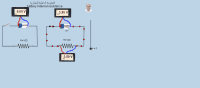
كل بطارية قوتها المحركة \(E\) ومقاومتها الداخلية \(r\) على التوالي. في الدائرة المفتوحة (يسارًا) لا يمر تيار فيقرأ الفولتميتر \(E\). وفي الدائرة المغلقة (يمينًا) يمر \(I=\dfrac{E}{R+r}\) فيهبط جهد الطرفين \(V=E-Ir\) (الفرق \(Ir\) يضيع داخل البطارية). اجعل \(r\) مجهولة كما في الأداة الأصلية واحسبها \(r=\dfrac{E-V}{I}\)، ثم غيّر \(R\) وسجّل عدة نقاط \((I,V)\): تقع على خط مستقيم يقطع محور \(V\) عند \(E\) وميله \(-r\). (التجربة متحركة: تتحرك الشحنات بسرعة تتناسب مع التيار.)
Every battery has an emf \(E\) and an internal resistance \(r\) in series. In the open circuit (left) no current flows so the voltmeter reads \(E\). In the closed circuit (right) a current \(I=\dfrac{E}{R+r}\) flows and the terminal voltage drops to \(V=E-Ir\) (the difference \(Ir\) is lost inside the battery). Keep \(r\) unknown as in the original applet and find it from \(r=\dfrac{E-V}{I}\), then change \(R\) and record several points \((I,V)\): they lie on a straight line that cuts the \(V\) axis at \(E\) with slope \(-r\). (The experiment is animated: the charges move at a speed proportional to the current.)
🛠️ تطبيقات عملية
🛠️ Practical applications
- تسخين البطاريات: عند سحب تيار كبير تُفقد قدرة حرارية \(I^2r\) داخلها.Battery heating: when a large current is drawn a thermal power \(I^2r\) is lost inside it.
- هبوط الجهد تحت الحمل: في السيارة ينخفض جهد البطارية لحظة تشغيل المحرك لأن تيار البدء كبير.Voltage drop under load: in a car the battery voltage falls when the engine starts because the starting current is large.
- تصميم الدوائر: تُختار بطاريات ذات \(r\) صغيرة للأجهزة الكثيرة الاستهلاك مثل الكاميرات.Circuit design: batteries with a small \(r\) are chosen for high-drain devices such as cameras.
- فحص البطاريات: قياس \(r\) يبيّن مدى تلف البطارية.Testing batteries: measuring \(r\) shows how worn the battery is.
✍️ أمثلة محلولة
✍️ Worked Examples
بطارية قوتها المحركة \(6\ \mathrm{V}\) قرأ فولتميتر عبرها \(5.8\ \mathrm{V}\) عند توصيلها بمقاومة \(10\ \Omega\) (قيم الأداة الأصلية). احسب التيار والمقاومة الداخلية.
A battery with an emf of \(6\ \mathrm{V}\) gives a voltmeter reading of \(5.8\ \mathrm{V}\) across it when connected to a \(10\ \Omega\) resistor (the values of the original applet). Calculate the current and the internal resistance.
بطارية \(E=12\ \mathrm{V}\) و\(r=0.5\ \Omega\) موصولة بمقاومة \(R=4\ \Omega\). احسب التيار وجهد الطرفين والكفاءة.
A battery \(E=12\ \mathrm{V}\) and \(r=0.5\ \Omega\) is connected to a resistor \(R=4\ \Omega\). Calculate the current, the terminal voltage and the efficiency.
خط بياني لبطارية يمرّ بالنقطتين \((I,V)=(1\ \mathrm{A},\ 5.6\ \mathrm{V})\) و\((3\ \mathrm{A},\ 4.8\ \mathrm{V})\). احسب \(E\) و\(r\).
The graph of a battery passes through the points \((I,V)=(1\ \mathrm{A},\ 5.6\ \mathrm{V})\) and \((3\ \mathrm{A},\ 4.8\ \mathrm{V})\). Calculate \(E\) and \(r\).
ما أكبر تيار تعطيه بطارية \(E=6\ \mathrm{V}\) و\(r=0.4\ \Omega\) عند وصلها بسلك مقاومته مهملة (دائرة قصر)؟ ولماذا هو خطر؟
What is the largest current that a battery \(E=6\ \mathrm{V}\) and \(r=0.4\ \Omega\) gives when its terminals are joined by a wire of negligible resistance (a short circuit)? Why is it dangerous?
عند فتح الدائرة يقرأ الفولتميتر عبر البطارية:
When the circuit is open the voltmeter across the battery reads:
عند إغلاق الدائرة يكون جهد الطرفين \(V\) مقارنة بـ \(E\):
When the circuit is closed the terminal voltage \(V\) compared with \(E\) is:
إذا زادت المقاومة الخارجية \(R\) (مع ثبات \(E\) و\(r\)) فإن جهد الطرفين:
If the external resistance \(R\) increases (with \(E\) and \(r\) fixed) the terminal voltage:
ميل الخط البياني بين \(V\) (رأسي) و\(I\) (أفقي) لبطارية يساوي:
The slope of the graph of \(V\) (vertical) against \(I\) (horizontal) for a battery equals:
📚 ملخص
📚 Summary
| المفهومConcept | القانونLaw |
|---|---|
| جهد الطرفينTerminal voltage | \(V=E-Ir\)\(V=E-Ir\) |
| التيارCurrent | \(I=\dfrac{E}{R+r}\)\(I=\dfrac{E}{R+r}\) |
| المقاومة الداخليةInternal resistance | \(r=\dfrac{E-V}{I}\ ,\ \text{slope}=-r\)\(r=\dfrac{E-V}{I}\ ,\ \text{slope}=-r\) |
| الكفاءةEfficiency | \(\eta=\dfrac{R}{R+r}\)\(\eta=\dfrac{R}{R+r}\) |
⚠️ أخطاء شائعة
⚠️ Common mistakes
- الاعتقاد بأن جهد الطرفين يساوي \(E\) دائمًا؛ هذا فقط عند عدم مرور تيار.Believing that the terminal voltage always equals \(E\); this is only when no current flows.
- نسيان \(r\) في حساب التيار: \(I=\dfrac{E}{R+r}\) وليس \(\dfrac{E}{R}\).Forgetting \(r\) in the current: \(I=\dfrac{E}{R+r}\) and not \(\dfrac{E}{R}\).
- استعمال جهد الطرفين \(V\) بدل \(E\) في المعادلة \(E=I(R+r)\).Using the terminal voltage \(V\) instead of \(E\) in the equation \(E=I(R+r)\).
🔗 محاكيات GeoGebra للاستعانة بها عند اللزوم
🔗 GeoGebra Simulations to Use When Needed
اضغط «تشغيل» لتعمل المحاكاة هنا داخل الدرس؛ ويمكن للطالب الرجوع إليها لتجربة الفكرة بطريقة أخرى.
Press “Run” to run the simulation right here inside the lesson; the student can use it to try the idea in another way.