🎯 نواتج التعلم
🎯 Learning Outcomes
بعد هذه التجربة ستكون قادرًا على أن:
After this experiment you will be able to:
- تطبّق قانون جاوس لحساب المجال عند نقطة قريبة من صفيحة لا نهائية مشحونة.Apply Gauss's law to find the field near an infinite charged sheet.
- تفرّق بين المجال الناتج عن صفيحة موصلة وآخر ناتج عن صفيحة غير موصلة.Distinguish between the field of a conducting sheet and that of an insulating sheet.
- تحسب المحصلة عند نقطة بين صفيحتين أو خارجهما باستخدام مبدأ التراكب.Find the net field at a point between or outside two sheets using superposition.
🎬 شاهد الفيديو
🎬 Watch the Video
⚡ صفيحة لا نهائية وقانون جاوس
⚡ An infinite sheet and Gauss's law
نختار سطح جاوس أسطوانيًا يخترق الصفيحة عموديًا، وبحيث يكون جزءاه المتقابلان على جهتي الصفيحة. بسبب التماثل يكون المجال عموديًا على الصفيحة ومقداره ثابت على القاعدتين، والتدفق عبر السطح الجانبي للأسطوانة صفر لأن المجال موازٍ له.
We choose a cylindrical Gaussian surface that passes through the sheet perpendicularly, with its two bases on either side of the sheet. By symmetry the field is perpendicular to the sheet and has the same magnitude on both bases, and the flux through the curved side is zero because the field is parallel to it.
📘 المجال عند صفيحة لا نهائية
📘 The field of an infinite sheet
\[\oint\vec E\cdot d\vec A=2EA=\dfrac{\sigma A}{\varepsilon_0}\quad\Rightarrow\quad E=\dfrac{\sigma}{2\varepsilon_0}\]
حيث \(\sigma\) كثافة الشحنة السطحية للصفيحة العازلة الموزعة عليها، و\(A\) مساحة قاعدة الأسطوانة. المجال على كل جهة \(\sigma/2\varepsilon_0\)، ويتجه بعيدًا عن الصفيحة إذا كانت موجبة، ونحوها إذا كانت سالبة.
where \(\sigma\) is the surface charge density spread over an insulating sheet, and \(A\) is the area of each base of the cylinder. The field on each side is \(\sigma/2\varepsilon_0\), pointing away from the sheet if positive and towards it if negative.
💡 شرح إضافي: لماذا يكون المجال للصفيحة الموصلة \(\sigma/\varepsilon_0\)؟
💡 Extra explanation: why is the field of a conducting sheet \(\sigma/\varepsilon_0\)?
في الصفيحة الموصلة تتوزع الشحنة على سطحيها، ولكل سطح كثافة \(\sigma\). مجال كل سطح يتصل بمجال الشحنة السطحية وحدها، فيكون عند الخارج \(\sigma/\varepsilon_0\) بعيدًا عن السطح، وداخل مادة الموصل يكون المجال صفرًا، لأن الشحنات الحرة تتحرك حتى يصبح المجال صفرًا.
In a conducting sheet the charge lies on its two surfaces, each with density \(\sigma\). The field just outside each face is \(\sigma/\varepsilon_0\) pointing away from it, while inside the metal the field is zero, because free charges move until the field vanishes.
💡 شرح إضافي: كيف نجمع مجالي صفيحتين؟
💡 Extra explanation: how do we add the fields of two sheets?
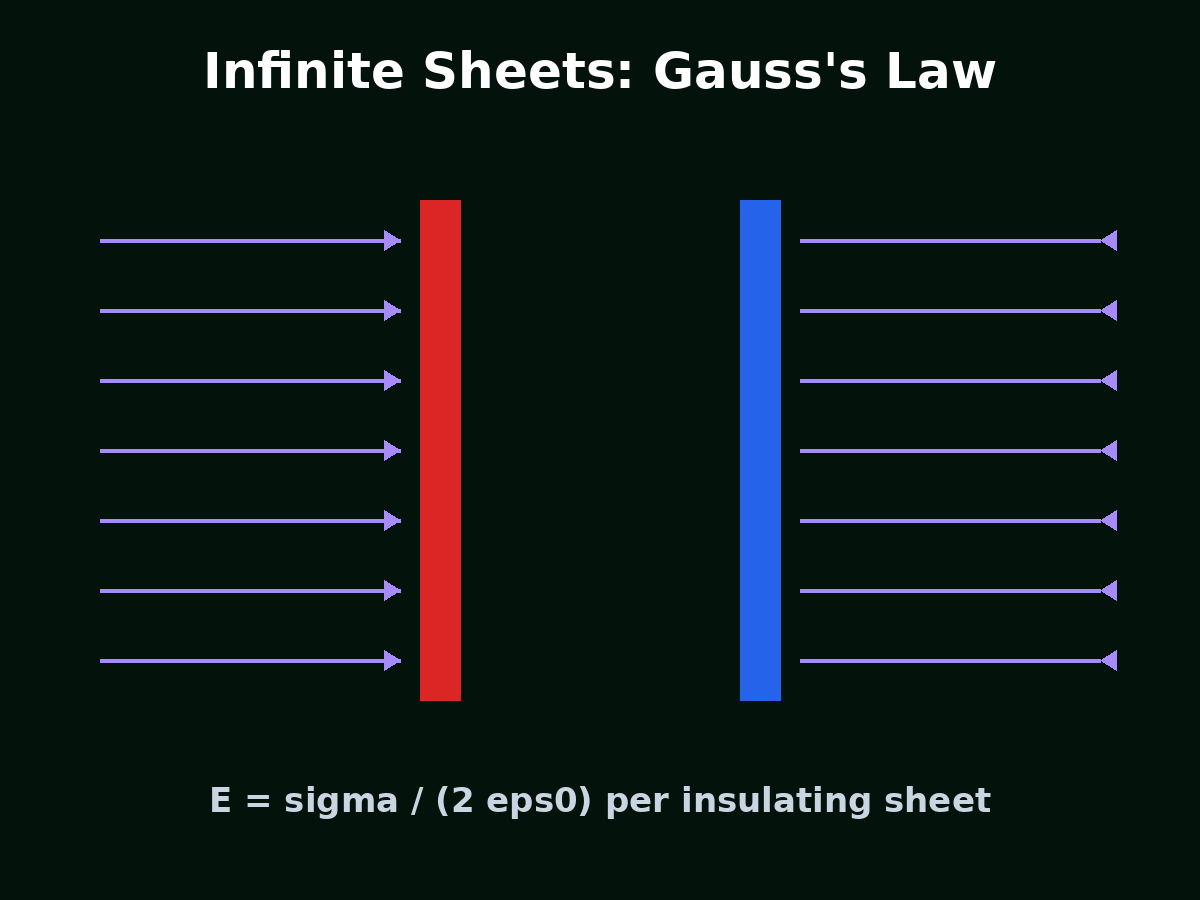
المجالات متجهات، فنجمعها بمراعاة الاتجاه. بين الصفيحتين المتعاكستين في الشحنة يتجمع المجالان في الاتجاه نفسه، وخارجهما يتعاكسان فيلغي بعضهما بعضًا إن تساوى المقداران. وبين صفيحتين متشابهتين يتعاكس المجالان بين الصفيحتين، ويتجمعان خارجهما.
Fields are vectors, so we add them with their directions. Between two sheets of opposite charge the two fields point the same way; outside them they cancel if their magnitudes are equal. Between two sheets of like charge the fields oppose each other between them, and add up outside.
🧪 التجربة التفاعلية: صفيحتان لا نهائيتان
🧪 Interactive Experiment: Two Infinite Sheets
غيّر كثافتي الشحنة والمسافة بين الصفيحتين، وحرّك النقطة P بالفأرة أو باللمس، وراقب الأسهم. اختر بين الصفيحة الموصلة والعازلة لترى الفرق في القيمة. اللون الأحمر للشحنة الموجبة والأزرق للسالبة.
Change the two charge densities and the separation, drag the point P with the mouse or touch, and watch the arrows. Choose between conducting and insulating sheets to see the difference. Red is positive and blue is negative.
➖ المجال الناتج عن صفيحتين لا نهائيتين
➖ The field of two infinite sheets
✍️ أمثلة محلولة
✍️ Worked Examples
صفيحة عازلة لا نهائية كثافة شحنتها \(\sigma=2\times10^{-6}\ \mathrm{C/m^2}\). احسب المجال على أحد جانبيها.
An infinite insulating sheet has a charge density \(\sigma=2\times10^{-6}\ \mathrm{C/m^2}\). Find the field on one of its sides.
صفيحتان لا نهائيتان متوازيتان كثافتا شحنتيهما \(\sigma_1=+10\ \mu\mathrm{C/m^2}\) و\(\sigma_2=-1\ \mu\mathrm{C/m^2}\)، وهما صفيحتان موصلتان. احسب المجال عند نقطة بينهما، وعند نقطة خارجهما على يسار الصفيحة الموجبة.
Two parallel infinite conducting sheets have charge densities \(\sigma_1=+10\ \mu\mathrm{C/m^2}\) and \(\sigma_2=-1\ \mu\mathrm{C/m^2}\). Find the field at a point between them, and at a point outside them to the left of the positive sheet.
لماذا يكون المجال داخل مادة صفيحة موصلة مشحونة صفرًا؟
Why is the field inside the material of a charged conducting sheet zero?
📚 ملخص
📚 Summary
| الحالةCase | المجالField |
|---|---|
| صفيحة غير موصلة (على كل جانب)Insulating sheet (each side) | \(E=\sigma/2\varepsilon_0\) |
| صفيحة موصلة (خارج كل سطح)Conducting sheet (outside each face) | \(E=\sigma/\varepsilon_0\) |
| داخل مادة الموصلInside the conductor | \(E=0\) |
| صفيحتان: المحصلةTwo sheets: net field | مجموع المتجهاتvector sum |
⚠️ أخطاء شائعة
⚠️ Common mistakes
- جمع مقادير المجالات دون مراعاة اتجاهها.Adding the magnitudes of the fields without considering their directions.
- استخدام \(\sigma/\varepsilon_0\) للصفيحة العازلة؛ القيمة \(\sigma/2\varepsilon_0\) هي للصفيحة العازلة على كل جانب.Using \(\sigma/\varepsilon_0\) for an insulating sheet; \(\sigma/2\varepsilon_0\) applies to an insulating sheet on each side.
- الظن أن المجال داخل الصفيحة الموصلة غير صفر.Thinking the field inside a conducting sheet is not zero.
🧠 اختبر نفسك
🧠 Test Yourself
المجال الناتج عن صفيحة عازلة لا نهائية كثافة شحنتها \(\sigma\) على جانب واحد يساوي:
The field of an infinite insulating sheet of density \(\sigma\) on one side equals:
بين صفيحتين متشابهتين في الشحنة (موجبتين)، ماذا يحدث للمجالين بينهما؟
Between two like-charged (positive) sheets, what happens to the two fields between them?
🔗 محاكاة GeoGebra للاستعانة بها عند اللزوم
🔗 GeoGebra Simulation to Use When Needed
اضغط «تشغيل» لتعمل المحاكاة هنا داخل الدرس؛ ويمكن للطالب الرجوع إليها لتجربة الفكرة بطريقة أخرى.
Press “Run” to run the simulation right here inside the lesson; the student can use it to try the idea in another way.