🎯 نواتج التعلم
🎯 Learning Outcomes
بعد هذه التجربة ستكون قادرًا على أن:
After this experiment you will be able to:
- تحدد اتجاه المجال المغناطيسي داخل الملف اللولبي بقاعدة اليد اليمنى.Find the direction of the field inside a solenoid using the right-hand rule.
- تفسّر لماذا يكون المجال منتظمًا داخل الملف الطويل وضعيفًا خارجه.Explain why the field is uniform inside a long solenoid and weak outside it.
- تحسب المجال في مركز الملف: \(B=\mu_0\dfrac{NI}{L}\).Calculate the field at the centre of the solenoid: \(B=\mu_0\dfrac{NI}{L}\).
- تتحقق من أثر عدد اللفات وشدة التيار وطول الملف على المجال.Verify how the number of turns, the current and the length affect the field.
🎬 شاهد الفيديو
🎬 Watch the Video
🔍 الفكرة في صورة
🔍 The Idea in a Picture
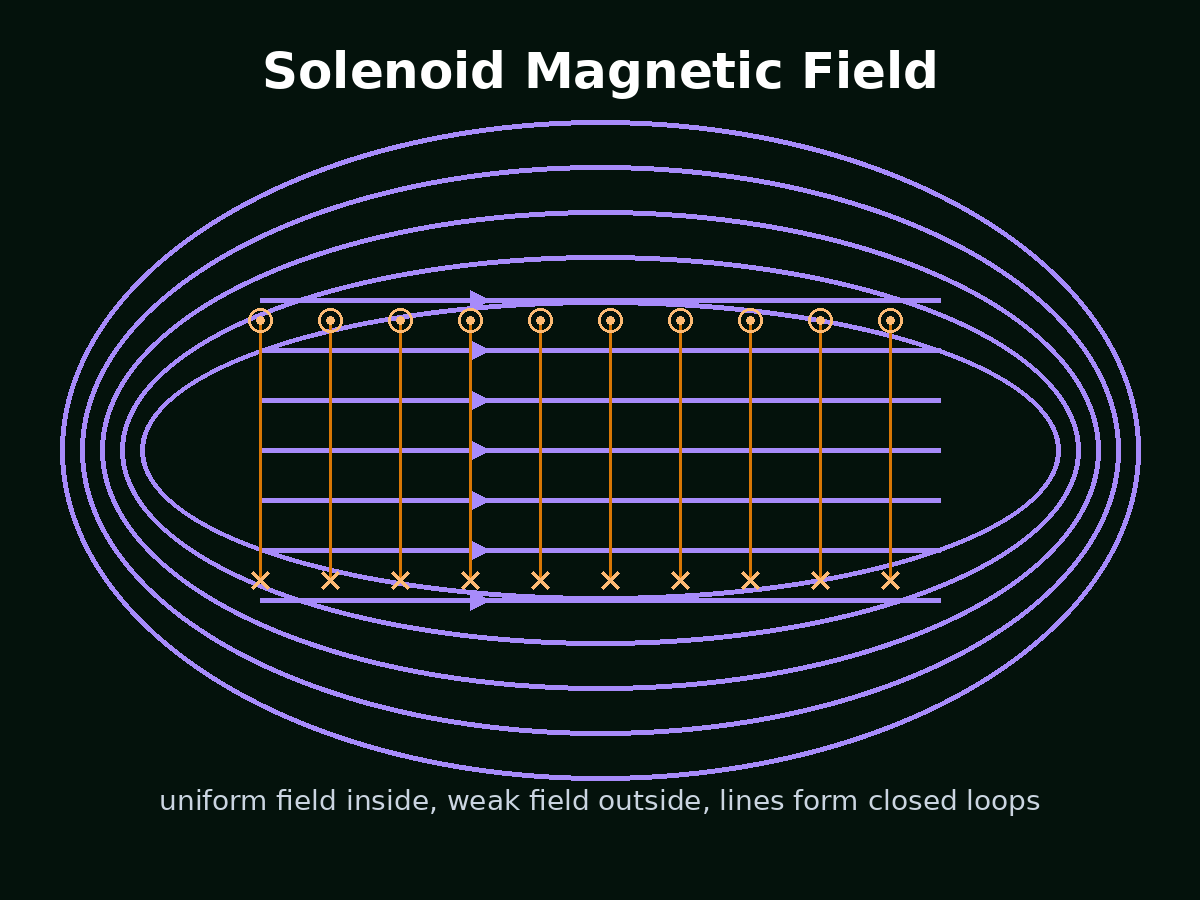
⚡ المجال داخل الملف اللولبي
⚡ The field inside a solenoid
الملف اللولبي سلك ملفوف على شكل حلقات متجاورة. كل حلقة تُنشئ مجالًا، ومحصلة هذه المجالات داخل الملف الطويل تكون منتظمة وتتجه على محور الملف. ويتحدد اتجاهه بقاعدة اليد اليمنى: اجعل أصابع اليد اليمنى تشير إلى اتجاه التيار حول الملف، فيشير الإبهام إلى اتجاه المجال داخله.
A solenoid is a wire wound as closely spaced loops. Each loop produces a field, and their sum inside a long solenoid is uniform and points along the axis. Its direction is given by the right-hand rule: curl the fingers of the right hand in the direction of the current around the solenoid, and the thumb points in the direction of the field inside it.
📘 المجال في مركز الملف الطويل
📘 The field at the centre of a long solenoid
\[B=\mu_0\,\dfrac{N}{L}\,I=\mu_0\,n\,I\]
حيث \(\mu_0=4\pi\times10^{-7}\ \mathrm{T\,m/A}\)، و\(N\) عدد اللفات، و\(L\) طول الملف، و\(n=N/L\) عدد اللفات لكل متر، و\(I\) شدة التيار. وإذا وُضعت نواة من مادة حديدية فإن المجال يتضاعف تقريبًا بمقدار \(\mu_r\).
where \(\mu_0=4\pi\times10^{-7}\ \mathrm{T\,m/A}\), \(N\) is the number of turns, \(L\) the length, \(n=N/L\) the number of turns per metre, and \(I\) the current. With an iron core the field is multiplied by about \(\mu_r\).
💡 شرح إضافي: لماذا يكون الحساب تقريبيًا عند أطراف الملف؟
💡 Extra explanation: why is the calculation approximate near the ends?
القانون \(B=\mu_0 nI\) يفترض أن الملف طويل جدًا مقارنة بقطره. في الملف القصير يقل المجال عند المركز قليلًا، ويقل أكثر عند الأطراف، لأن الحلقات عند الطرف تجد حلقات أقل تساعدها. لذلك تُعرض في التجربة القيمتان: القيمة بالقانون، والقيمة المحسوبة فعلًا من الحلقات.
The formula \(B=\mu_0 nI\) assumes the solenoid is very long compared with its radius. For a shorter solenoid the field at the centre is somewhat smaller, and smaller still at the ends, because loops near an end have fewer loops to support them. So the experiment shows both values: the formula value, and the value actually computed from the loops.
💡 شرح إضافي: لماذا يكون المجال خارج الملف ضعيفًا؟
💡 Extra explanation: why is the field outside the solenoid weak?
خارج الملف تتعاكس اتجاهات مجالات الحلقات المختلفة، فتلغي بعضها جزئيًا. أما داخل الملف فتتجمع المجالات في الاتجاه نفسه. لهذا يكون المجال داخل الملف قويًا ومنتظمًا، وخارجه ضعيفًا.
Outside the solenoid the fields of different loops point in opposite directions and partly cancel. Inside, the fields add up in the same direction. This is why the field inside is strong and uniform, and outside it is weak.
🧪 التجربة التفاعلية: مقطع في الملف اللولبي
🧪 Interactive Experiment: A Section Through the Solenoid
الملف متصل ببطارية ومفتاح. عند غلق المفتاح يمر التيار فيتولد المجال، والدائرتان على الملف تمثلان مقطع الحلقات: النقطة (●) تعني أن التيار يخرج من الصفحة نحوك، والإشارة (×) تعني أنه يدخل الصفحة. اضغط «① خطوط المجال» لترى الخطوط تغلق نفسها، وحرّك البوصلة لترى اتجاه المجال عند موضعها. غيّر التيار وعدد اللفات وطول الملف لترى أثرها في المجال.
The circles on the coil represent a section through the loops: a dot (●) means the current comes out of the page toward you, and a cross (×) means it goes into the page. Press “① Field lines” to see the lines form closed loops, and drag the compass to see the field direction at its position. Change the current, the number of turns and the length to see their effect on the field.
ملاحظة: الشكل مقطع ثنائي البعد يُظهر الحلقات عند مواقعها، ويُحسب المجال من الحلقات نفسها.
Note: the drawing is a two-dimensional section showing the loops at their positions, and the field is computed from those same loops.
🧲 المجال المغناطيسي لملف حامل للتيار
🧲 The magnetic field of a current-carrying solenoid
✍️ أمثلة محلولة
✍️ Worked Examples
ملف لولبي طوله \(0.5\ \mathrm{m}\) وعدد لفاته \(1000\)، يمر فيه تيار \(2\ \mathrm{A}\). احسب المجال في مركزه.
A solenoid of length \(0.5\ \mathrm{m}\) with \(1000\) turns carries a current of \(2\ \mathrm{A}\). Find the field at its centre.
في المثال السابق، إذا ضوعف التيار وقُسّم الطول على اثنين مع بقاء عدد اللفات، فما المجال الجديد؟
In the previous example, if the current is doubled and the length is halved with the same number of turns, what is the new field?
وُضعت نواة من الحديد داخل الملف في المثال الأول، فازداد المجال نحو \(1000\) ضعف تقريبًا. هل هذا منطقي؟ وما الذي تمثله النفاذية؟
An iron core is placed inside the solenoid of Example 1, and the field grows by about \(1000\) times. Is this reasonable? What does the permeability represent?
📚 ملخص
📚 Summary
| المفهومConcept | القانون أو النتيجةLaw or result |
|---|---|
| المجال في المركزField at the centre | \(B=\mu_0 nI\) |
| اتجاه المجال داخل الملفDirection inside | قاعدة اليد اليمنى، على محور الملفright-hand rule, along the axis |
| داخل الملف الطويلInside a long solenoid | منتظم وقويuniform and strong |
| خارج الملفOutside | ضعيف وغير منتظمweak and non-uniform |
| أثر النواة الحديديةIron core | \(B=\mu_0\mu_r nI\) |
⚠️ أخطاء شائعة
⚠️ Common mistakes
- استخدام \(N\) بدل \(n=N/L\) في القانون؛ المهم عدد اللفات لكل متر.Using \(N\) instead of \(n=N/L\); what matters is the number of turns per metre.
- الظن أن المجال خارج الملف مساويًا للمجال داخله؛ المجال خارجه ضعيف جدًا.Thinking the field outside equals the field inside; outside it is very weak.
- الخلط بين اتجاه التيار حول الملف واتجاه المجال داخله؛ يُستخدم الإبهام بعد لف الأصابع مع التيار.Mixing the direction of the current around the coil with the field inside; the thumb is used after the fingers follow the current.
- نسيان أن القانون تقريبي للملف الطويل، وأنه في الملف القصير يكون المجال عند المركز أصغر قليلًا.Forgetting that the formula is approximate for a long solenoid; for a short one the centre field is slightly smaller.
🧠 اختبر نفسك
🧠 Test Yourself
عند مضاعفة عدد اللفات مع بقاء الطول والتيار ثابتين، ماذا يحدث للمجال في مركز الملف؟
When the number of turns is doubled with the length and current fixed, what happens to the field at the centre?
أين يكون المجال المغناطيسي منتظمًا وقويًا؟
Where is the magnetic field uniform and strong?
🔗 محاكاة GeoGebra للاستعانة بها عند اللزوم
🔗 GeoGebra Simulation to Use When Needed
اضغط «تشغيل» لتعمل المحاكاة هنا داخل الدرس؛ ويمكن للطالب الرجوع إليها لتجربة الفكرة بطريقة أخرى.
Press “Run” to run the simulation right here inside the lesson; the student can use it to try the idea in another way.