🎯 نواتج التعلم
🎯 Learning Outcomes
بعد هذه التجربة ستكون قادرًا على أن:
After this experiment you will be able to:
- تفسّر لماذا تتحرك الشحنات الحرة داخل الموصل عند وضعه في مجال خارجي.Explain why free charges move inside a conductor placed in an external field.
- تفسّر لماذا تنعدم المحصلة الكهربائية داخل الموصل في حالة التوازن الكهروستاتيكي.Explain why the net electric field inside a conductor is zero in electrostatic equilibrium.
- تحدد مواقع الشحنات المستحثة على سطح الموصل.Locate the induced charges on the surface of the conductor.
🎬 شاهد الفيديو
🎬 Watch the Video
⚡ الموصل في المجال الكهربائي
⚡ A conductor in an electric field
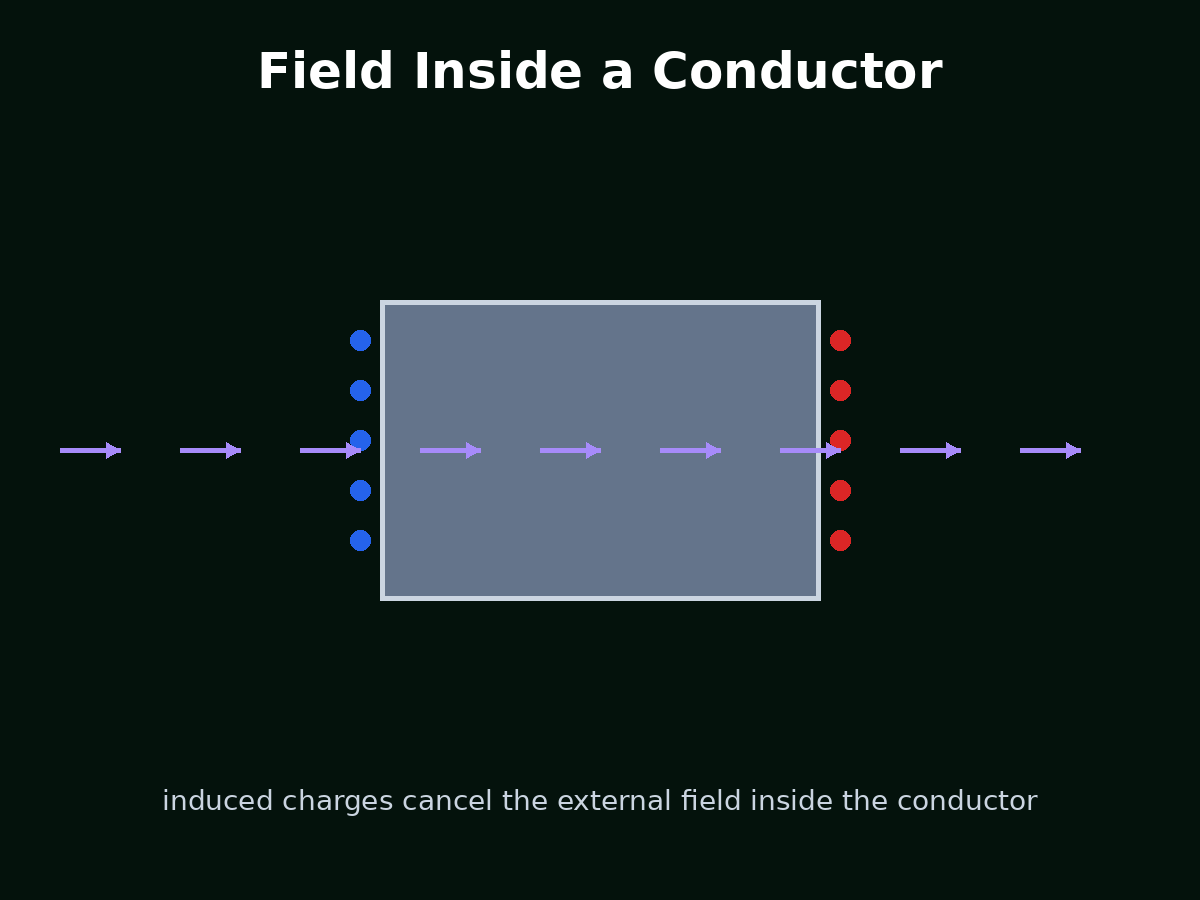
عند وضع موصل داخل مجال كهربائي تتأثر الشحنات الحرة فيه بقوة المجال فتتحرك: الشحنات السالبة (الإلكترونات) عكس اتجاه المجال، والموجبة مع اتجاهه. فتتجمع الشحنات على السطحين المتقابلين، ويتولد مجال داخلي يعاكس المجال الخارجي، حتى تصبح المحصلة داخل الموصل صفرًا.
When a conductor is placed in an electric field, the free charges in it feel the force of the field and move: negative charges (electrons) move against the field, and positive ones move along it. The charges collect on two opposite surfaces, creating an internal field that opposes the external one, until the net field inside the conductor is zero.
📘 الموصل في حالة التوازن
📘 The conductor at equilibrium
\[\vec E_{\text{in}}=\vec E_0+\vec E_{\text{induced}}=0\qquad\Rightarrow\qquad|\vec E_{\text{induced}}|=E_0\]
حيث \(\vec E_0\) المجال الخارجي، و\(\vec E_{\text{induced}}\) المجال الناتج عن الشحنات المستحثة على السطح. في حالة التوازن الكهروستاتيكي تكون الشحنات ساكنة، ولا يوجد مجال داخل الموصل.
where \(\vec E_0\) is the external field and \(\vec E_{\text{induced}}\) is the field of the induced surface charges. At electrostatic equilibrium the charges are at rest, and there is no field inside the conductor.
| الظاهرةPhenomenon | التفسيرExplanation | النتيجةResult |
|---|---|---|
| موصل معزولAn isolated conductor | الشحنات الحرة قادرة على الحركة داخل الموصلFree charges can move inside the conductor | أي مجال داخلي يحرك الشحنات حتى يختفيAny internal field moves the charges until it vanishes |
| وضعه في مجال خارجيPlacing it in an external field | تتحرك الشحنات الحرة تحت تأثير المجالFree charges move under the influence of the field | تتوزع الشحنات على السطح لتولد مجالًا معاكسًاCharges distribute on the surface to produce an opposing field |
| استقطاب الشحناتPolarisation | تتجمع الشحنات السالبة على جانب والموجبة على الجانب الآخرNegative charges gather on one side and positive ones on the other | ينشأ مجال داخلي معاكس للمجال الخارجيAn internal field opposing the external field arises |
| محصلة المجال داخل الموصلNet field inside the conductor | يتساوى المجال الخارجي مع المجال المستحثThe external field equals the induced field | المحصلة داخل الموصل صفرThe net field inside is zero |
| التوازن الكهروستاتيكيElectrostatic equilibrium | تصبح القوة على الشحنات داخل الموصل صفرًاThe force on the charges inside becomes zero | يتوقف تدفق الشحناتThe flow of charges stops |
💡 الخلاصة
💡 Conclusion
المجال الكهربائي داخل موصل في حالة التوازن الكهروستاتيكي يساوي صفرًا دائمًا، سواء كان الموصل صلبًا أو مجوفًا. وهذه الخاصية أساس فهم التأريض والحماية الكهربائية، فالقفص المعدني يحمي ما بداخله من المجال الخارجي.
In electrostatic equilibrium the electric field inside a conductor is always zero, whether the conductor is solid or hollow. This property is the basis of earthing and electrical shielding: a metal cage protects what is inside it from an external field.
💡 شرح إضافي: لماذا تبقى الشحنات المستحثة على السطح؟
💡 Extra explanation: why do the induced charges stay on the surface?
الشحنات الزائدة في الموصل تتنافر فيما بينها، فتتجه إلى أبعد مكان ممكن، أي إلى السطح. وإذا كانت هناك أي شحنة داخل الموصل فإن المجال الناتج عنها يحرك الشحنات حتى تصل إلى السطح.
Excess charges in a conductor repel one another and move as far apart as possible, that is, to the surface. If any charge were inside, its field would move the free charges until they reached the surface.
🧪 التجربة التفاعلية: موصل في مجال خارجي
🧪 Interactive Experiment: A Conductor in an External Field
اضغط «تشغيل» لترى الإلكترونات (الزرقاء) تتحرك عكس المجال الخارجي وتتجمع على اليسار، فتظهر شحنات مستحثة: سالبة على اليسار وموجبة على اليمين. يتولد مجال مستحث (أحمر متقطع) يعاكس المجال الخارجي، فتقل المحصلة داخل الموصل (الأخضر) حتى تصبح صفرًا.
Press “Start” to see the electrons (blue) move against the external field and collect on the left, leaving induced charges: negative on the left and positive on the right. An induced field (dashed red) opposes the external one, so the net field inside the conductor (green) decreases until it is zero.
🔩 كرة موصلة في مجال كهربائي خارجي
🔩 A conducting sphere in an external field
الصورة: الشحنات الموجبة (+) ثابتة في مكانها، والإلكترونات (•) تهتز حرارياً. عند تشغيل المجال تتحرك الإلكترونات عكسه فيظهر مجال مستحث معاكس.
The positive ions (+) stay fixed, and the electrons (•) jiggle thermally. When the field is switched on, the electrons move against it and an opposing induced field appears.
✍️ أمثلة محلولة
✍️ Worked Examples
موصل مصمت موضوع في مجال خارجي \(E_0=500\ \mathrm{N/C}\). ما المجال المستحث داخل الموصل عند التوازن، وما المحصلة داخله؟
A solid conductor is placed in an external field \(E_0=500\ \mathrm{N/C}\). What is the induced field inside the conductor at equilibrium, and what is the net field inside it?
موصل مجوف (تجويف داخله فارغ) وُضع في مجال خارجي. هل يوجد مجال داخل التجويف؟ ولماذا؟
A hollow conductor (with an empty cavity) is placed in an external field. Is there a field inside the cavity? Why?
لماذا يجب ألا يقف الإنسان داخل سيارة معدنية أثناء العاصفة الرعدية ليكون آمنًا؟ وما الذي يحميه؟
Why is a person inside a metal car safe during a thunderstorm, and what protects them?
🧠 اختبر نفسك
🧠 Test Yourself
ما المجال الكهربائي داخل موصل في حالة التوازن الكهروستاتيكي؟
What is the electric field inside a conductor at electrostatic equilibrium?
أين تتوزع الشحنات الزائدة على موصل مشحون في حالة التوازن؟
Where are the excess charges on a charged conductor distributed at equilibrium?
🔗 محاكاة GeoGebra للاستعانة بها عند اللزوم
🔗 GeoGebra Simulation to Use When Needed
اضغط «تشغيل» لتعمل المحاكاة هنا داخل الدرس؛ ويمكن للطالب الرجوع إليها لتجربة الفكرة بطريقة أخرى.
Press “Run” to run the simulation right here inside the lesson; the student can use it to try the idea in another way.