🎯 نواتج التعلم
🎯 Learning Outcomes
بعد هذه التجربة ستكون قادرًا على أن:
After this experiment you will be able to:
- تحسب مقدار القوة بين كل شحنتين بقانون كولوم \(F=k\dfrac{|q_1||q_2|}{r^2}\).Calculate the magnitude of the force between every two charges with Coulomb’s law \(F=k\dfrac{|q_1||q_2|}{r^2}\).
- تحدد اتجاه كل قوة (تنافر أو تجاذب) وتعطيها إشارة على المحور.Find the direction of each force (repulsion or attraction) and give it a sign on the axis.
- تطبّق مبدأ التراكب لإيجاد القوة المحصلة على شحنة تتأثر بعدة شحنات، على خط مستقيم وفي المستوى بطريقة المركبات.Apply the superposition principle to find the net force on a charge acted on by several charges, on a line and in a plane by the components method.
- تجد نقطة الاتزان التي تنعدم عندها القوة المحصلة وتفسّر موضعها.Find the equilibrium point where the net force vanishes and explain its position.
- توظّف التماثل لتبسيط المسائل.Use symmetry to simplify problems.
🎬 شاهد الفيديو
🎬 Watch the Video
❓ لماذا لا يكفي قانون كولوم وحده؟
❓ Why Is Coulomb’s Law Not Enough Alone?
يعطينا قانون كولوم القوة بين شحنتين فقط. لكن في الذرة والبلورة والدارة تتأثر الشحنة الواحدة بعدد كبير من الشحنات في اللحظة نفسها. فكيف نجد القوة الكلية عليها؟ الجواب: مبدأ التراكب. وهذه التجربة تتيح لك أن ترى القوى المنفردة والمحصلة معًا وأن تتحكم في كل شحنة.
Coulomb’s law gives us the force between only two charges. But in an atom, a crystal or a circuit one charge is acted on by many charges at the same instant. So how do we find the total force on it? The answer: the superposition principle. This experiment lets you see the individual and the net forces together and control every charge.
⚡ مبدأ التراكب
⚡ The Superposition Principle
عندما تؤثر عدة شحنات في شحنة واحدة في الوقت نفسه، تؤثر كل شحنة فيها بقوتها كأن الشحنات الأخرى غير موجودة. نحسب كل قوة وحدها بقانون كولوم، ثم نجمع هذه القوى جمعًا متجهيًا فنحصل على القوة المحصلة.
When several charges act on one charge at the same time, each charge exerts its own force on it as if the other charges were not there. We calculate each force alone with Coulomb’s law, then we add these forces as vectors to get the net force.
📘 القوانين
📘 The laws
\[F=k\frac{|q_1||q_2|}{r^{2}},\quad k=8.99\times10^{9}\ \mathrm{N\,m^2/C^2}\]
\[\vec F_{net}=\vec F_{1}+\vec F_{2}+\vec F_{3}+\cdots\]
\[F_{x}=\sum F\cos\theta,\quad F_{y}=\sum F\sin\theta,\quad F_{net}=\sqrt{F_x^{2}+F_y^{2}}\]
🧭 كيف تحدد اتجاه كل قوة؟ (أهم خطوة)
🧭 How Do You Find the Direction of Each Force? (the Most Important Step)
لا تضع إشارة الشحنة في قانون كولوم؛ القانون يعطي المقدار فقط. أما الاتجاه فتحدده بالرسم: الشحنتان المتشابهتان تتنافران (القوة على الشحنة تدفعها بعيدًا عن الأخرى)، والمختلفتان تتجاذبان (القوة تسحبها نحوها). على خط مستقيم نختار اتجاه اليمين \(+x\) فتكون القوة نحو اليمين موجبة ونحو اليسار سالبة، ثم نجمع جبريًّا.
Do not put the sign of the charge in Coulomb’s law; the law gives only the magnitude. The direction is decided with a drawing: like charges repel (the force on a charge pushes it away from the other) and unlike charges attract (the force pulls it toward the other). On a line we choose the right as \(+x\), so a force toward the right is positive and toward the left is negative, then we add algebraically.
| الشحنة المؤثرة تقعThe acting charge is | تنافر (متشابهتان)Repulsion (like) | تجاذب (مختلفتان)Attraction (unlike) |
|---|---|---|
| يمين الهدفTo the right of the target | نحو اليسار \((-)\)To the left \((-)\) | نحو اليمين \((+)\)To the right \((+)\) |
| يسار الهدفTo the left of the target | نحو اليمين \((+)\)To the right \((+)\) | نحو اليسار \((-)\)To the left \((-)\) |
💡 لماذا لا نجمع المقادير مباشرة؟
💡 Why Do We Not Add the Magnitudes Directly?
القوة كمية متجهة: قوتان \(3\ \mathrm N\) و\(5\ \mathrm N\) محصلتهما \(8\ \mathrm N\) إذا كانتا في الاتجاه نفسه، و\(2\ \mathrm N\) إذا كانتا متعاكستين، و\(\sqrt{3^2+5^2}\approx5.83\ \mathrm N\) إذا كانتا متعامدتين. وإذا لم تكن الشحنات على خط واحد حلّلنا كل قوة إلى \(F_x=F\cos\theta\) و\(F_y=F\sin\theta\) وجمعنا المركبات كلًّا على حدة.
Force is a vector quantity: two forces \(3\ \mathrm N\) and \(5\ \mathrm N\) give a resultant \(8\ \mathrm N\) if they are in the same direction, \(2\ \mathrm N\) if they are opposite, and \(\sqrt{3^2+5^2}\approx5.83\ \mathrm N\) if they are perpendicular. If the charges are not on one line we resolve every force into \(F_x=F\cos\theta\) and \(F_y=F\sin\theta\) and add the components separately.
⚖️ القانون الثالث لنيوتن: فحص سريع لحلك
⚖️ Newton’s Third Law: A Quick Check of Your Solution
القوة التي تؤثر بها \(q_2\) على \(q_1\) تساوي في المقدار وتعاكس في الاتجاه القوة التي تؤثر بها \(q_1\) على \(q_2\): \(\vec F_{12}=-\vec F_{21}\). لذلك فإن مجموع القوى المحصلة على الشحنات كلها معًا يساوي صفرًا. وهذا فحص ممتاز لنتائجك: اجمع القوى المحصلة على الشحنات الثلاث في التجربة 1 تجد المجموع صفرًا دائمًا. في هذه الصفحة \(F_{ij}\) هي القوة على الشحنة \(i\) بسبب الشحنة \(j\)، و\(F_i\) هي المحصلة على الشحنة \(i\).
The force exerted by \(q_2\) on \(q_1\) equals in magnitude and opposes in direction the force exerted by \(q_1\) on \(q_2\): \(\vec F_{12}=-\vec F_{21}\). So the sum of the net forces on all the charges together equals zero. This is an excellent check of your results: add the net forces on the three charges in Experiment 1 and you always find zero. On this page \(F_{ij}\) is the force on charge \(i\) due to charge \(j\), and \(F_i\) is the net force on charge \(i\).
🧪 التجربة 1: ثلاث شحنات على خط مستقيم
🧪 Experiment 1: Three Charges on a Straight Line
🛠️ خطوات العمل
🛠️ Procedure
- اختر الشحنة الهدف \(q_2\) وراقب القوتين المنفردتين (أسهم صغيرة بألوان مختلفة) والمحصلة (السهم الأخضر).Choose the target charge \(q_2\) and watch the two individual forces (small arrows of different colours) and the net force (the green arrow).
- غيّر إشارة إحدى الشحنات وانظر كيف ينقلب اتجاه القوة المرتبطة بها.Change the sign of one of the charges and see how the direction of its force reverses.
- قرّب إحدى الشحنات من الهدف إلى نصف المسافة: تتضاعف قوتها أربع مرات.Bring one charge to half the distance from the target: its force becomes four times larger.
- اجمع المحصلات الثلاث في خانات القراءة: تجد المجموع صفرًا.Add the three net forces in the read boxes: you find the sum is zero.
🧪 تجربة 1: ثلاث شحنات على خط مستقيم: القوة المحصلة على كل شحنة
🧪 Experiment 1: Three Charges on a Line: The Net Force on Each Charge
غيّر مقدار وإشارة كل شحنة وموضعها على المحور، واختر الشحنة الهدف: ترى القوة المنفردة من كل شحنة (أسهم صغيرة) والمحصلة على كل شحنة (سهم أخضر كبير). اليمين موجب.
Change the magnitude, the sign and the position of each charge on the axis and choose the target charge: you see the individual force of each charge (small arrows) and the net force on every charge (the big green arrow). Right is positive.
🔍 ماذا نلاحظ؟
🔍 What do we observe?
- اجعل \(q_2=0\): تختفي كل القوى عليها ومنها، وتبقى قوة واحدة بين \(q_1\) و\(q_3\) متساوية ومتعاكسة.Make \(q_2=0\): all forces on it and from it vanish, and one force remains between \(q_1\) and \(q_3\), equal and opposite.
- اعكس إشارات الشحنات الثلاث معًا: لا تتغير أي قوة، لأن نوع التفاعل بين كل شحنتين لم يتغير.Reverse the signs of all three charges together: no force changes, because the kind of interaction between every two charges has not changed.
- مجموع المحصلات صفر دائمًا (القانون الثالث لنيوتن).The sum of the net forces is always zero (Newton’s third law).
📐 التجربة 2: القوة المحصلة في المستوى
📐 Experiment 2: The Net Force in a Plane
حين لا تقع الشحنات على خط واحد لا يكفي الجمع الجبري. نحلّل كل قوة إلى مركبتين ثم نجمع المركبات: \(F_x=F_{1x}+F_{2x}\) و\(F_y=F_{1y}+F_{2y}\)، ونحصل على المقدار \(F_{net}=\sqrt{F_x^2+F_y^2}\) والزاوية \(\theta=\tan^{-1}(F_y/F_x)\). في المحاكاة تحرّك شحنة الهدف فتتغير الاتجاهات والمركبات لحظيًا.
When the charges are not on a line the algebraic addition is not enough. We resolve each force into two components then add the components: \(F_x=F_{1x}+F_{2x}\) and \(F_y=F_{1y}+F_{2y}\), and we get the magnitude \(F_{net}=\sqrt{F_x^2+F_y^2}\) and the angle \(\theta=\tan^{-1}(F_y/F_x)\). In the simulation you move the target charge and the directions and components change instantly.
🧪 تجربة 2: القوة المحصلة في المستوى: طريقة المركبات
🧪 Experiment 2: The Net Force in a Plane: The Components Method
مصدران ثابتان \(q_1,q_2\) وشحنة هدف \(q_0\) تسحبها بالفأرة (أو بإصبعك) في أي مكان: ترى \(F_1\) و\(F_2\) والمحصلة ومركبتيها \(F_x,F_y\).
Two fixed sources \(q_1,q_2\) and a target charge \(q_0\) that you drag anywhere with the mouse (or your finger): you see \(F_1\), \(F_2\), the resultant and its components \(F_x,F_y\).
🔍 ماذا نلاحظ؟
🔍 What do we observe?
- على العمود المنصف بين مصدرين متماثلين تتلاشى المركبتان الأفقيتان والمحصلة رأسية.On the perpendicular bisector between two like sources the horizontal components cancel and the resultant is vertical.
- على العمود المنصف بين مصدرين متعاكسين تتلاشى المركبتان الرأسيتان والمحصلة أفقية.On the perpendicular bisector between two opposite sources the vertical components cancel and the resultant is horizontal.
- القوة المحصلة قد تكون أصغر من إحدى القوتين وقد تكون أكبر منهما بحسب الزاوية بينهما.The net force may be smaller than one of the two forces or larger than both, depending on the angle between them.
🎯 التجربة 3: أين تنعدم القوة المحصلة؟ (نقطة الاتزان)
🎯 Experiment 3: Where Is the Net Force Zero? (The Equilibrium Point)
نضع شحنتين ثابتتين \(q_1\) عند \(x=0\) و\(q_2\) عند \(x=d\) ونبحث عن موضع لشحنة ثالثة تنعدم عنده القوة المحصلة عليها. نساوي مقداري القوتين: \(\dfrac{|q_1|}{x^2}=\dfrac{|q_2|}{(x-d)^2}\)، وتُحذف \(q_3\) و\(k\) من الطرفين، فلا يعتمد الموضع على مقدار الشحنة الثالثة ولا على إشارتها.
We put two fixed charges \(q_1\) at \(x=0\) and \(q_2\) at \(x=d\) and look for a position for a third charge where the net force on it vanishes. We equate the magnitudes of the two forces: \(\dfrac{|q_1|}{x^2}=\dfrac{|q_2|}{(x-d)^2}\), and \(q_3\) and \(k\) cancel from both sides, so the position depends neither on the magnitude of the third charge nor on its sign.
📍 أين تقع النقطة؟
📍 Where is the point?
- شحنتان متشابهتان: النقطة بينهما وأقرب إلى الشحنة الأصغر مقدارًا: \(x=d\dfrac{\sqrt{|q_1|}}{\sqrt{|q_1|}+\sqrt{|q_2|}}\).Two like charges: the point is between them and closer to the smaller charge: \(x=d\dfrac{\sqrt{|q_1|}}{\sqrt{|q_1|}+\sqrt{|q_2|}}\).
- شحنتان مختلفتان: النقطة خارجهما على جهة الشحنة الأصغر مقدارًا (بينهما تكون القوتان في الاتجاه نفسه فلا تلغي إحداهما الأخرى).Two unlike charges: the point is outside them on the side of the smaller charge (between them the two forces have the same direction so they cannot cancel).
- شحنتان مختلفتان متساويتان في المقدار: لا توجد نقطة اتزان على المحور.Two unlike charges equal in magnitude: there is no equilibrium point on the axis.
🧪 تجربة 3: أين تنعدم القوة المحصلة؟ نقطة الاتزان
🧪 Experiment 3: Where Is the Net Force Zero? The Equilibrium Point
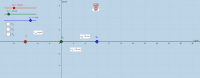
شحنتان ثابتتان \(q_1\) عند \(0\) و\(q_2\) عند \(30\ \mathrm{cm}\). حرّك شحنة ثالثة على المحور وراقب الرسم البياني للقوة المحصلة: النقطة التي يقطع فيها المنحنى خط الصفر هي نقطة الاتزان.
Two fixed charges \(q_1\) at \(0\) and \(q_2\) at \(30\ \mathrm{cm}\). Move a third charge along the axis and watch the graph of the net force: the point where the curve crosses the zero line is the equilibrium point.
🔍 ماذا نلاحظ؟
🔍 What do we observe?
- المنحنى ينفصل عند موضعي الشحنتين لأن القوة تكبر جدًّا قربهما (\(1/r^2\)).The curve is broken at the positions of the two charges because the force becomes very large near them (\(1/r^2\)).
- حين تبدّل إشارة إحدى الشحنتين ينتقل صفر المنحنى من بينهما إلى خارجهما.When you change the sign of one charge the zero of the curve moves from between them to outside them.
- تغيير \(q_3\) يغيّر ارتفاع المنحنى فقط ولا يحرّك نقطة الصفر.Changing \(q_3\) changes only the height of the curve and does not move the zero point.
🔷 التجربة 4: التماثل
🔷 Experiment 4: Symmetry
وزّعنا \(n\) شحنة متساوية بانتظام على رؤوس مضلّع منتظم ووضعنا شحنة في مركزه. القوى المنفردة متساوية في المقدار وموزعة بزوايا متساوية فتلغي بعضها: المحصلة صفر. وإذا حذفنا شحنة بقيت قوة المقابلة لها وحدها \(kqq_0/R^2\)، وإذا عكسنا إشارتها صارت المحصلة \(2kqq_0/R^2\) لأن إلغاء قوة الشحنة الأصلية يحتاج إلى قوة مساوية لها يُضاف إليها قوة الشحنة المعكوسة.
We distributed \(n\) equal charges equally on the vertices of a regular polygon and put a charge at its centre. The individual forces are equal in magnitude and spread at equal angles so they cancel: the net force is zero. If we remove a charge the force of the opposite one remains alone \(kqq_0/R^2\), and if we reverse its sign the net force becomes \(2kqq_0/R^2\) because cancelling the force of the original charge needs an equal force to which the force of the reversed charge is added.
🧪 تجربة 4: التماثل: القوة على الشحنة المركزية
🧪 Experiment 4: Symmetry: The Force on the Central Charge
شحنات متساوية موزعة بانتظام على دائرة وشحنة في مركزها. غيّر عدد الشحنات، ثم احذف شحنة أو اعكس إشارتها وراقب القوة المحصلة.
Equal charges equally spaced on a circle and a charge at its centre. Change the number of charges, then remove one charge or reverse its sign and watch the net force.
✍️ أمثلة محلولة
✍️ Worked Examples
ثلاث شحنات على المحور \(x\): \(q_1=+2\ \mu\mathrm C\) عند \(x=-6\ \mathrm{cm}\)، و\(q_3=-1.5\ \mu\mathrm C\) عند \(x=-2\ \mathrm{cm}\)، و\(q_2=-1.6\ \mu\mathrm C\) عند \(x=3.4\ \mathrm{cm}\). احسب القوة المحصلة على كل شحنة.
Three charges on the \(x\) axis: \(q_1=+2\ \mu\mathrm C\) at \(x=-6\ \mathrm{cm}\), \(q_3=-1.5\ \mu\mathrm C\) at \(x=-2\ \mathrm{cm}\) and \(q_2=-1.6\ \mu\mathrm C\) at \(x=3.4\ \mathrm{cm}\). Calculate the net force on each charge.
ثلاث شحنات على المحور \(x\): \(q_1=+5\ \mu\mathrm C\) عند \(x=0\)، و\(q_2=+3\ \mu\mathrm C\) عند \(x=0.2\ \mathrm m\)، و\(q_3=-2\ \mu\mathrm C\) عند \(x=0.5\ \mathrm m\). أوجد القوة المحصلة على \(q_2\).
Three charges on the \(x\) axis: \(q_1=+5\ \mu\mathrm C\) at \(x=0\), \(q_2=+3\ \mu\mathrm C\) at \(x=0.2\ \mathrm m\) and \(q_3=-2\ \mu\mathrm C\) at \(x=0.5\ \mathrm m\). Find the net force on \(q_2\).
شحنة \(q=+2\ \mu\mathrm C\) عند نقطة الأصل، وشحنة \(q_A=+6\ \mu\mathrm C\) عند \((0.3,\,0)\ \mathrm m\)، وشحنة \(q_B=-4\ \mu\mathrm C\) عند \((0,\,0.4)\ \mathrm m\). أوجد مقدار القوة المحصلة على \(q\) واتجاهها.
A charge \(q=+2\ \mu\mathrm C\) is at the origin, a charge \(q_A=+6\ \mu\mathrm C\) at \((0.3,\,0)\ \mathrm m\) and a charge \(q_B=-4\ \mu\mathrm C\) at \((0,\,0.4)\ \mathrm m\). Find the magnitude and direction of the net force on \(q\).
شحنتان \(q_1=+4\ \mu\mathrm C\) عند \(x=0\) و\(q_2=+1\ \mu\mathrm C\) عند \(x=30\ \mathrm{cm}\). أين توضع شحنة ثالثة لتنعدم القوة المحصلة عليها؟
Two charges \(q_1=+4\ \mu\mathrm C\) at \(x=0\) and \(q_2=+1\ \mu\mathrm C\) at \(x=30\ \mathrm{cm}\). Where should a third charge be placed so that the net force on it vanishes?
أربع شحنات متساوية \(+3\ \mu\mathrm C\) على رؤوس مربع طول ضلعه \(20\ \mathrm{cm}\) وشحنة \(q_0=+2\ \mu\mathrm C\) في مركزه. ما القوة المحصلة على \(q_0\)؟ وماذا لو حُذفت إحدى الشحنات؟
Four equal charges \(+3\ \mu\mathrm C\) on the vertices of a square of side \(20\ \mathrm{cm}\) and a charge \(q_0=+2\ \mu\mathrm C\) at its centre. What is the net force on \(q_0\)? And what if one charge is removed?
🛠️ تطبيقات عملية
🛠️ Practical Applications
أين يظهر مبدأ التراكب؟
Where does superposition appear?
- البلورات الأيونية (مثل ملح الطعام): كل أيون يتأثر بمحصلة قوى جميع الأيونات حوله، وهذه المحصلة تحدد ثبات البلورة.Ionic crystals (such as table salt): each ion is acted on by the resultant of the forces of all the ions around it, and this resultant determines the stability of the crystal.
- مصائد الأيونات: تُرتَّب شحنات حول أيون بحيث تنعدم القوة المحصلة عليه في نقطة معينة فيبقى محصورًا فيها.Ion traps: charges are arranged around an ion so that the net force on it vanishes at a certain point and it stays confined there.
- الذرات متعددة الإلكترونات: كل إلكترون يتأثر بجذب النواة وتنافر بقية الإلكترونات معًا.Atoms with many electrons: each electron is acted on by the attraction of the nucleus and the repulsion of the other electrons together.
- طابعات الحبر النفاث والمرشحات الكهروستاتيكية: تُوجَّه القطرات المشحونة بحقول ناتجة عن عدة أقطاب.Inkjet printers and electrostatic filters: charged droplets are guided by fields produced by several electrodes.
⚠️ أخطاء شائعة
⚠️ Common Mistakes
تجنّب هذه الأخطاء
Avoid these mistakes
- وضع إشارة الشحنة في قانون كولوم ثم الحيرة في اتجاه الناتج؛ استعمل المقادير فقط وحدّد الاتجاه بالرسم.Putting the sign of the charge in Coulomb’s law then being confused about the direction of the result; use magnitudes only and find the direction with a drawing.
- جمع المقادير جمعًا عدديًّا بدل الجمع المتجهي.Adding the magnitudes arithmetically instead of vectorially.
- نسيان تحويل المسافة إلى متر والشحنة إلى كولوم (\(1\ \mu\mathrm C=10^{-6}\ \mathrm C\)).Forgetting to convert the distance to metres and the charge to coulombs (\(1\ \mu\mathrm C=10^{-6}\ \mathrm C\)).
- الظن أن الشحنة الوسطى لا تتأثر لأن الشحنتين على جانبيها؛ التأثر يلغي فقط إذا تساوت القوتان في المقدار وتعاكستا.Thinking that the middle charge is not affected because the two charges are on its sides; the effect cancels only if the two forces are equal in magnitude and opposite.
📚 ملخص
📚 Summary
أهم ما تعلمناه
Key points
- \(F=k|q_1q_2|/r^2\) للمقدار، والاتجاه بالرسم: تنافر للمتشابهتين وتجاذب للمختلفتين.\(F=k|q_1q_2|/r^2\) for the magnitude, and the direction by a drawing: repulsion for like charges and attraction for unlike ones.
- \(\vec F_{net}=\sum\vec F_i\) جمعًا متجهيًّا؛ على خط مستقيم جمعًا جبريًّا بإشارات، وفي المستوى بالمركبات.\(\vec F_{net}=\sum\vec F_i\) as a vector sum; on a line algebraically with signs, and in a plane by components.
- نقطة الاتزان: \(|q_1|/x^2=|q_2|/(x-d)^2\) ولا تعتمد على الشحنة الثالثة.The equilibrium point: \(|q_1|/x^2=|q_2|/(x-d)^2\) and it does not depend on the third charge.
- التماثل يلغي القوى ويبسّط الحل.Symmetry cancels forces and simplifies the solution.
🔗 محاكيات GeoGebra للاستعانة بها عند اللزوم
🔗 GeoGebra Simulations to Use When Needed
اضغط «تشغيل» لتعمل المحاكاة هنا داخل الدرس؛ ويمكن للطالب الرجوع إليها لتجربة الفكرة بطريقة أخرى.
Press “Run” to run the simulation right here inside the lesson; the student can use it to try the idea in another way.