🎯 نواتج التعلم
🎯 Learning Outcomes
بعد هذه التجربة ستكون قادرًا على أن:
After this experiment you will be able to:
- تتعرف أجزاء القدمة ذات الورنية واستعمالاتها في قياس الأطوال الخارجية والداخلية والأعماق.Identify the parts of the vernier caliper and its uses for external, internal and depth measurements.
- تقرأ القدمة بدقة \(0.1\ \mathrm{mm}\): قراءة المقياس الرئيسي قبل صفر الورنية + رقم الخط المنطبق × \(0.1\).Read the caliper to \(0.1\ \mathrm{mm}\): the main-scale reading before the zero of the vernier + the number of the coinciding line × \(0.1\).
- تحدّد خطأ الصفر وتصحّح القراءة به، وتحسب ثابت الورنية (أصغر قراءة).Find the zero error and correct the reading with it, and calculate the vernier constant (the least count).
🎬 شاهد الفيديو
🎬 Watch the Video
📏 القدمة ذات الورنية
📏 The Vernier Caliper
القدمة ذات الورنية أداة لقياس الأطوال بدقة أكبر من المسطرة. تتكون من مقياس رئيسي مدرّج بالمليمتر على ساق ثابتة، ومقياس ورنية منزلق، وفكّين للقياس الخارجي (قطر كرة أو أسطوانة)، وفكّين صغيرين علويين للقياس الداخلي (قطر أنبوب من الداخل)، وساق عمق للقياس العميق، وبرغي لتثبيت الورنية.
The vernier caliper is a tool for measuring lengths more precisely than a ruler. It consists of a main scale graduated in millimetres on a fixed beam, a sliding vernier scale, two jaws for external measurements (the diameter of a ball or a cylinder), two small upper jaws for internal measurements (the inside diameter of a tube), a depth rod for depths, and a locking screw.
📘 ثابت الورنية وطريقة القراءة
📘 The vernier constant and how to read
في الورنية 10 أقسام تساوي 9 قسم من المقياس الرئيسي (\(9\ \mathrm{mm}\)) أي كل قسم ورنية \(0.9\ \mathrm{mm}\). فيكون ثابت الورنية (أصغر قراءة):
The vernier has 10 divisions that equal 9 divisions of the main scale (\(9\ \mathrm{mm}\)), so each vernier division is \(0.9\ \mathrm{mm}\). The vernier constant (least count) is:
\[\text{vernier constant}=1\ \mathrm{mm}-0.9\ \mathrm{mm}=0.1\ \mathrm{mm}\]
\[\text{reading}=\text{main-scale reading}+\left(\text{number of the coinciding line}\times0.1\ \mathrm{mm}\right)\]
\[\text{true length}=\text{reading}-\text{zero error}\]
💡 خطوات القراءة وخطأ الصفر
💡 Steps of reading and the zero error
- الخطوة 1: اقرأ على المقياس الرئيسي آخر خط (بالمليمتر) يقع على يسار صفر الورنية.Step 1: read on the main scale the last line (in millimetres) to the left of the zero of the vernier.
- الخطوة 2: ابحث في الورنية عن الخط الذي ينطبق تمامًا على أي خط في المقياس الرئيسي، وليكن رقمه \(k\).Step 2: find the line of the vernier that coincides exactly with any line of the main scale; let its number be \(k\).
- الخطوة 3: القراءة \(=\) الرئيسي \(+\ k\times0.1\ \mathrm{mm}\).Step 3: the reading \(=\) main \(+\ k\times0.1\ \mathrm{mm}\).
- خطأ الصفر: أغلق الفكّين، فإذا لم يطابق صفر الورنية صفر الرئيسي فهناك خطأ. إذا كان الصفر إلى يمين صفر الرئيسي والخط \(k\) ينطبق فالخطأ موجب \(+k\times0.1\)، وإذا كان إلى اليسار فالخطأ سالب \(-(10-k)\times0.1\).Zero error: close the jaws; if the zero of the vernier does not coincide with the zero of the main scale there is an error. If the zero is to the right of the main zero and line \(k\) coincides the error is positive \(+k\times0.1\); if it is to the left the error is negative \(-(10-k)\times0.1\).
- الطول الصحيح \(=\) القراءة \(-\) خطأ الصفر (بإشارته).The true length \(=\) reading \(-\) zero error (with its sign).
🧪 تجربة 1: قِس الجسم بالقدمة ذات الورنية
🧪 Experiment 1: Measure the object with the vernier caliper
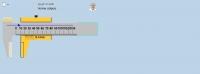
يتحرك الفك المنزلق ليطبق على جسم عرضه \(w\)؛ الشكل العلوي للقدمة كاملة والسفلي مكبّر عند صفر الورنية. اقرأ الرقم على المقياس الرئيسي قبل صفر الورنية، ثم ابحث عن خط الورنية المنطبق على خط رئيسي (مظلّل بالأحمر) فتضيف رقمه × \(0.1\ \mathrm{mm}\). اضغط «جسم جديد للتدرّب» لتخفى القراءة فتقرأها بنفسك وتتحقق، وغيّر خطأ الصفر لترى كيف يتغير الطول الصحيح.
The sliding jaw moves to grip an object of width \(w\); the upper picture shows the whole caliper and the lower one is zoomed at the zero of the vernier. Read the number on the main scale before the zero of the vernier, then find the vernier line that coincides with a main line (shaded red) and add its number × \(0.1\ \mathrm{mm}\). Press “New object to practise” so the reading is hidden and you read it yourself and check, and change the zero error to see how the true length changes.
🧪 تجربة 2: حاسبة: قراءات مكتوبة
🧪 Experiment 2: Calculator: written readings
مسألة جديدة في كل مرة تعتمد على قراءات مكتوبة (من دون صورة). احسب القيم الثلاث ثم اضغط «صحّح».
A new problem every time based on written readings (without a picture). Calculate the three values and press “Check”.
🛠️ تطبيقات عملية
🛠️ Practical applications
- قياس القطر الخارجي: لكرة أو سلك أو أسطوانة بين الفكّين الكبيرين.External diameter: of a ball, a wire or a cylinder between the two large jaws.
- قياس القطر الداخلي: لأنبوب أو ثقب بالفكّين الصغيرين العلويين.Internal diameter: of a tube or a hole with the two small upper jaws.
- قياس العمق: لثقب أو وعاء بساق العمق.Depth: of a hole or a container with the depth rod.
✍️ أمثلة محلولة
✍️ Worked Examples
قرأ طالب قدمة ذات ورنية (ثابتها \(0.1\ \mathrm{mm}\)): آخر خط رئيسي قبل صفر الورنية \(24\ \mathrm{mm}\) والخط السادس من الورنية ينطبق على خط رئيسي. ما قراءة القدمة؟
A student reads a vernier caliper (constant \(0.1\ \mathrm{mm}\)): the last main line before the zero of the vernier is \(24\ \mathrm{mm}\) and the sixth vernier line coincides with a main line. What is the reading?
عند إغلاق الفكّين كان خطأ الصفر \(+0.3\ \mathrm{mm}\). قراءة القدمة لقطر أسطوانة \(35.7\ \mathrm{mm}\). ما القطر الصحيح؟
When the jaws were closed the zero error was \(+0.3\ \mathrm{mm}\). The caliper reading for the diameter of a cylinder is \(35.7\ \mathrm{mm}\). What is the true diameter?
عند إغلاق الفكّين وقع صفر الورنية يسار صفر الرئيسي وانطبق الخط الثامن. ما خطأ الصفر؟ وما الطول الصحيح إذا كانت القراءة \(12.5\ \mathrm{mm}\)؟
When the jaws were closed the zero of the vernier fell to the left of the main zero and the eighth line coincided. What is the zero error? What is the true length if the reading is \(12.5\ \mathrm{mm}\)?
ورنية فيها 20 قسمًا تساوي \(19\ \mathrm{mm}\) من المقياس الرئيسي. احسب ثابتها.
A vernier has 20 divisions equal to \(19\ \mathrm{mm}\) of the main scale. Calculate its constant.
ثابت الورنية (أصغر قراءة) في القدمة ذات 10 أقسام ورنية تساوي \(9\ \mathrm{mm}\):
The vernier constant (least count) of a caliper with 10 vernier divisions equal to \(9\ \mathrm{mm}\) is:
رئيسي \(5\ \mathrm{mm}\) والخط الثالث من الورنية ينطبق. القراءة:
Main reading \(5\ \mathrm{mm}\) and the third vernier line coincides. The reading is:
إذا كان خطأ الصفر موجبًا فإن الطول الصحيح:
If the zero error is positive the true length is:
نقيس القطر الداخلي لأنبوب بـ:
The inside diameter of a tube is measured with:
📚 ملخص
📚 Summary
| المفهومConcept | القاعدةRule |
|---|---|
| ثابت الورنيةVernier constant | \(1\ \mathrm{mm}-0.9\ \mathrm{mm}=0.1\ \mathrm{mm}\)\(1\ \mathrm{mm}-0.9\ \mathrm{mm}=0.1\ \mathrm{mm}\) |
| القراءةReading | رئيسي + (رقم الخط المنطبق × 0.1)main + (coinciding line number × 0.1) |
| خطأ الصفر الموجبPositive zero error | \(+k\times0.1\)\(+k\times0.1\) |
| خطأ الصفر السالبNegative zero error | \(-(10-k)\times0.1\)\(-(10-k)\times0.1\) |
| الطول الصحيحTrue length | القراءة − خطأ الصفرreading − zero error |
⚠️ أخطاء شائعة
⚠️ Common mistakes
- قراءة المقياس الرئيسي عند الخط المنطبق بدل آخر خط يسار صفر الورنية.Reading the main scale at the coinciding line instead of the last line to the left of the vernier zero.
- نسيان تصحيح خطأ الصفر أو عكس إشارته.Forgetting to correct the zero error or reversing its sign.
- اعتبار القراءة بالسنتيمتر؛ المقياس الرئيسي بالمليمتر.Taking the reading in centimetres; the main scale is in millimetres.
🔗 محاكيات GeoGebra للاستعانة بها عند اللزوم
🔗 GeoGebra Simulations to Use When Needed
اضغط «تشغيل» لتعمل المحاكاة هنا داخل الدرس؛ ويمكن للطالب الرجوع إليها لتجربة الفكرة بطريقة أخرى.
Press “Run” to run the simulation right here inside the lesson; the student can use it to try the idea in another way.