🎯 نواتج التعلم
🎯 Learning Outcomes
بعد هذه التجربة ستكون قادرًا على أن:
After this experiment you will be able to:
- تصف الحركة بسرعة ثابتة وتطبّق معادلة الموقع \(x=x_0+vt\).Describe motion at constant velocity and apply the position equation \(x=x_0+vt\).
- تفسّر الرسمين البيانيين للموقع والزمن (الميل = السرعة) وللسرعة والزمن (المساحة = الإزاحة).Interpret the position–time graph (slope = velocity) and the velocity–time graph (area = displacement).
- تحوّل بين \(\mathrm{m/s}\) و\(\mathrm{km/h}\) وتحسب الموقع والزمن من معطيات الحركة.Convert between \(\mathrm{m/s}\) and \(\mathrm{km/h}\) and calculate the position and the time from the data of the motion.
🎬 شاهد الفيديو
🎬 Watch the Video
🚗 الحركة بسرعة ثابتة
🚗 Motion at Constant Velocity
يتحرك الجسم بسرعة ثابتة عندما يقطع إزاحات متساوية في أزمنة متساوية على خط مستقيم دون تغيّر في مقدار سرعته ولا اتجاهها. فتكون السرعة المتجهة \(v=\dfrac{\Delta x}{\Delta t}\) ثابتة والتسارع \(a=0\).
A body moves at constant velocity when it covers equal displacements in equal times along a straight line without any change in the magnitude or the direction of its velocity. The velocity \(v=\dfrac{\Delta x}{\Delta t}\) is then constant and the acceleration is \(a=0\).
📘 معادلات الحركة بسرعة ثابتة
📘 Equations of motion at constant velocity
\[x(t)=x_0+v\,t\qquad v=\dfrac{\Delta x}{\Delta t}=\text{constant}\qquad a=0\]
\[\Delta x=x-x_0=v\,t\qquad 1\ \mathrm{m/s}=3.6\ \mathrm{km/h}\]
حيث \(x_0\) الموقع الابتدائي (m)، \(v\) السرعة المتجهة (m/s) وإشارتها تدل على الاتجاه، \(t\) الزمن (s). والمسافة \(d=|v|\,t\) عندما لا يتغير الاتجاه.
Here \(x_0\) is the initial position (m), \(v\) the velocity (m/s) whose sign gives the direction, and \(t\) the time (s). The distance is \(d=|v|\,t\) when the direction does not change.
💡 تفسير الرسمين البيانيين
💡 Interpreting the two graphs
- الموقع–الزمن: خط مستقيم يبدأ من \(x_0\)؛ ميله هو السرعة \(v\). كلما زاد الميل زادت السرعة، والميل السالب يعني حركة باتجاه معاكس.Position–time: a straight line starting at \(x_0\); its slope is the velocity \(v\). The steeper the line the greater the speed, and a negative slope means motion in the opposite direction.
- السرعة–الزمن: خط أفقي عند القيمة \(v\) لأن السرعة لا تتغير؛ والمساحة تحته (مستطيل) \(=v\,t\) تساوي الإزاحة.Velocity–time: a horizontal line at the value \(v\) because the velocity does not change; the area under it (a rectangle) \(=v\,t\) equals the displacement.
- الحركة والرسمان وجدول البيانات تعبّر عن المعلومة الفيزيائية نفسها؛ سجّل نقاطًا في الجدول وتحقّق أن \(\dfrac{\Delta x}{\Delta t}\) ثابت.The motion, the two graphs and the data table express the same physical information; record points in the table and check that \(\dfrac{\Delta x}{\Delta t}\) is constant.
🧪 تجربة 1: حرّك السيارة وراقب الموقع والسرعة والرسمين البيانيين
🧪 Experiment 1: Move the car and watch the position, the velocity and the two graphs
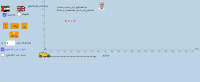
اختر السرعة \(v\) والموقع الابتدائي \(x_0\) ثم حرّك مؤشر الزمن \(t\) بيدك أو اضغط «شغّل» ليتحرك الزمن (لا تبدأ الحركة من تلقاء نفسها). تتحرك السيارة على الخط، وتُرسم النقطة على رسم الموقع–الزمن (ميله \(=v\)) وعلى رسم السرعة–الزمن (المساحة المظلّلة \(=\) الإزاحة). اضغط «سجّل» لإضافة صف إلى الجدول وتحقق أن \(\Delta x/\Delta t\) ثابت.
Choose the velocity \(v\) and the initial position \(x_0\) then move the time slider \(t\) with your hand or press “Play” to let the time run (the motion never starts by itself). The car moves along the line, and the point is drawn on the position–time graph (its slope \(=v\)) and on the velocity–time graph (the shaded area \(=\) the displacement). Press “Record” to add a row to the table and check that \(\Delta x/\Delta t\) is constant.
🧪 تجربة 2: حاسبة التحقق: حلّ المسألة ثم صحّح
🧪 Experiment 2: Checker: solve the problem and check
مسألة جديدة في كل مرة. احسب القيم الثلاث ثم اضغط «صحّح».
A new problem every time. Calculate the three values and press “Check”.
🛠️ تطبيقات عملية
🛠️ Practical applications
- السفر على الطرق السريعة: تقدير زمن الرحلة \(t=\dfrac{d}{v}\) عند سرعة ثابتة.Travelling on highways: estimating the trip time \(t=\dfrac dv\) at a constant speed.
- الأحزمة الناقلة والسلالم المتحركة: تتحرك بسرعة ثابتة تقريبًا.Conveyor belts and escalators: they move at an almost constant speed.
- الضوء والصوت في وسط ثابت: ينتشران بسرعة ثابتة في الوسط نفسه.Light and sound in a fixed medium: they travel at a constant speed in the same medium.
✍️ أمثلة محلولة
✍️ Worked Examples
سيارة تتحرك بسرعة ثابتة \(3\ \mathrm{m/s}\) من الموقع \(x_0=0\). أين تكون بعد \(12\ \mathrm{s}\)؟ وما سرعتها بـ \(\mathrm{km/h}\)؟
A car moves at a constant velocity of \(3\ \mathrm{m/s}\) from the position \(x_0=0\). Where is it after \(12\ \mathrm{s}\)? What is its speed in \(\mathrm{km/h}\)?
جسم يبدأ من \(x_0=-5\ \mathrm{m}\) بسرعة \(2\ \mathrm{m/s}\). أوجد موقعه بعد \(10\ \mathrm{s}\) والزمن الذي يصل فيه إلى \(x=25\ \mathrm{m}\).
A body starts from \(x_0=-5\ \mathrm{m}\) with a velocity of \(2\ \mathrm{m/s}\). Find its position after \(10\ \mathrm{s}\) and the time at which it reaches \(x=25\ \mathrm{m}\).
رسم بياني للموقع والزمن لجسم يمر بالنقطتين \((0\ \mathrm{s},\ 4\ \mathrm{m})\) و\((6\ \mathrm{s},\ 28\ \mathrm{m})\). أوجد سرعته ومعادلة موقعه.
A position–time graph of a body passes through the points \((0\ \mathrm{s},\ 4\ \mathrm{m})\) and \((6\ \mathrm{s},\ 28\ \mathrm{m})\). Find its velocity and the equation of its position.
جدول لحركة جسم: \(t=0,3,6,9\ \mathrm{s}\) و\(x=0,12,24,36\ \mathrm{m}\). هل السرعة ثابتة؟ وكم تساوي؟
A table of a body’s motion: \(t=0,3,6,9\ \mathrm{s}\) and \(x=0,12,24,36\ \mathrm{m}\). Is the velocity constant? What is it?
ميل الخط في الرسم البياني للموقع والزمن يمثل:
The slope of the line in the position–time graph represents:
الرسم البياني للسرعة والزمن لحركة بسرعة ثابتة هو:
The velocity–time graph of motion at constant velocity is:
المساحة تحت الرسم البياني للسرعة والزمن تساوي:
The area under the velocity–time graph equals:
سرعة سيارة \(72\ \mathrm{km/h}\) تساوي:
A car speed of \(72\ \mathrm{km/h}\) equals:
📚 ملخص
📚 Summary
| المفهومConcept | العلاقةRelation |
|---|---|
| معادلة الموقعPosition equation | \(x=x_0+vt\)\(x=x_0+vt\) |
| السرعةVelocity | \(v=\dfrac{\Delta x}{\Delta t}=\text{constant}\)\(v=\dfrac{\Delta x}{\Delta t}=\text{constant}\) |
| ميل الموقع–الزمنSlope of x–t | السرعةthe velocity |
| مساحة السرعة–الزمنArea under v–t | الإزاحةthe displacement |
| التحويلConversion | \(\mathrm{km/h}=3.6\times\mathrm{m/s}\)\(\mathrm{km/h}=3.6\times\mathrm{m/s}\) |
⚠️ أخطاء شائعة
⚠️ Common mistakes
- نسيان الموقع الابتدائي \(x_0\) والقول \(x=vt\) دائمًا.Forgetting the initial position \(x_0\) and always writing \(x=vt\).
- الخلط بين الموقع والمسافة والإزاحة.Confusing the position with the distance and the displacement.
- قسمة \(\mathrm{km/h}\) على 3.6 أو ضربها بدل العكس عند التحويل.Dividing or multiplying by 3.6 the wrong way when converting.
🔗 محاكيات GeoGebra للاستعانة بها عند اللزوم
🔗 GeoGebra Simulations to Use When Needed
اضغط «تشغيل» لتعمل المحاكاة هنا داخل الدرس؛ ويمكن للطالب الرجوع إليها لتجربة الفكرة بطريقة أخرى.
Press “Run” to run the simulation right here inside the lesson; the student can use it to try the idea in another way.