🎯 نواتج التعلم
🎯 Learning Outcomes
بعد هذه التجربة ستكون قادرًا على أن:
After this experiment you will be able to:
- تصف الحركة المنتظمة (سرعة ثابتة في كل مرحلة) وتطبّق \(x=v\,t\) على كل مرحلة.Describe uniform motion (a constant velocity in each stage) and apply \(x=v\,t\) to every stage.
- ترسم رسمي الموقع–الزمن والسرعة–الزمن لحركة من عدة مراحل (تقدّم، وقوف، رجوع) وتقرؤهما.Draw and read the position–time and velocity–time graphs of a motion of several stages (going forward, standing, coming back).
- تفرّق بين المسافة والإزاحة وبين السرعة المتوسطة (القياسية) والسرعة المتجهة المتوسطة.Distinguish between the distance and the displacement, and between the average speed and the average velocity.
🎬 شاهد الفيديو
🎬 Watch the Video
🛤️ الحركة المنتظمة على مراحل
🛤️ Uniform Motion in Stages
الحركة المنتظمة هي الحركة بسرعة ثابتة في خط مستقيم: يقطع الجسم إزاحات متساوية في أزمنة متساوية فيكون \(\Delta x=v\,t\). وقد تتكوّن رحلة من عدة مراحل كل منها منتظمة بسرعة مختلفة (قد تكون صفرًا أو سالبة)، فيكون رسم الموقع–الزمن خطوطًا مستقيمة متصلة بميول مختلفة، ورسم السرعة–الزمن خطوطًا أفقية بمستويات مختلفة.
Uniform motion is motion at constant velocity along a straight line: the body covers equal displacements in equal times so \(\Delta x=v\,t\). A trip may consist of several stages, each uniform with a different velocity (possibly zero or negative); the position–time graph is then connected straight lines with different slopes and the velocity–time graph is horizontal lines at different levels.
📘 المسافة والإزاحة والسرعة المتوسطة
📘 Distance, displacement and average velocity
\[\Delta x_i=v_i\,t_i\qquad \Delta x=\sum\Delta x_i\qquad d=\sum|\Delta x_i|\]
\[\text{average speed}=\dfrac{d}{t_{total}}\qquad \text{average velocity}=\dfrac{\Delta x}{t_{total}}\]
💡 شرح إضافي
💡 Extra explanation
- مرحلة السكون: \(v=0\) فالخط أفقي في رسم الموقع (الموقع ثابت).A stage of rest: \(v=0\) so the line is horizontal in the position graph (the position is constant).
- مرحلة الرجوع: \(v\lt 0\) فالخط يهبط؛ الإزاحة تنقص لكن المسافة تزداد دائمًا.A stage of coming back: \(v\lt 0\) so the line goes down; the displacement decreases but the distance always increases.
- السرعة المتوسطة القياسية تساوي المسافة الكلية ÷ الزمن الكلي ولا تساوي بالضرورة متوسط السرعات، وقد تختلف عن مقدار السرعة المتجهة المتوسطة.The average speed is the total distance ÷ the total time and is not necessarily the mean of the speeds, and it may differ from the magnitude of the average velocity.
- الإزاحة الكلية هي المساحة المجبرية تحت رسم السرعة–الزمن (المساحة فوق المحور موجبة وتحته سالبة).The total displacement is the algebraic area under the velocity–time graph (the area above the axis is positive and below it negative).
🧪 تجربة 1: ابنِ رحلة من ثلاث مراحل منتظمة
🧪 Experiment 1: Build a trip of three uniform stages
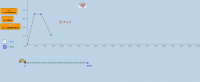
لكل مرحلة سرعة ثابتة \(v_i\) ومدة \(t_i\) (ويمكن أن تكون السرعة صفرًا أو سالبة). تتصل الخطوط المستقيمة في رسم الموقع–الزمن، وتظهر الخطوط الأفقية في رسم السرعة–الزمن. حرّك مؤشر الزمن (أو «شغّل») لتتحرك السيارة، وراقب الإزاحة والمسافة والسرعة المتوسطة. اضغط على أحد الأمثلة الجاهزة أو غيّر المؤشرات بنفسك. لا شيء يتحرك من تلقاء نفسه.
Each stage has a constant velocity \(v_i\) and a duration \(t_i\) (the velocity may be zero or negative). The straight lines connect in the position–time graph and horizontal lines appear in the velocity–time graph. Move the time slider (or “Play”) to move the car and watch the displacement, the distance and the average speed. Press one of the ready examples or change the sliders yourself. Nothing moves by itself.
🧪 تجربة 2: حاسبة: رحلة من ثلاث مراحل
🧪 Experiment 2: Calculator: a trip of three stages
مسألة جديدة في كل مرة. احسب الإزاحة والمسافة والسرعة المتوسطة القياسية ثم اضغط «صحّح».
A new problem every time. Calculate the displacement, the distance and the average speed then press “Check”.
🛠️ تطبيقات عملية
🛠️ Practical applications
- رحلة الحافلة: سير ثم توقف في محطة ثم عودة.A bus trip: driving, stopping at a station and coming back.
- تمارين الجري: مراحل هرولة وراحة وعدو.Running training: stages of jogging, rest and sprinting.
- الأحزمة الناقلة: مراحل تحميل وانتظار وتفريغ.Conveyor belts: stages of loading, waiting and unloading.
✍️ أمثلة محلولة
✍️ Worked Examples
جسم يتحرك \(4\ \mathrm{s}\) بسرعة \(3\ \mathrm{m/s}\) ثم يقف \(4\ \mathrm{s}\) ثم يعود \(6\ \mathrm{s}\) بسرعة \(-1\ \mathrm{m/s}\). أوجد الإزاحة والمسافة.
A body moves for \(4\ \mathrm{s}\) at \(3\ \mathrm{m/s}\), stops for \(4\ \mathrm{s}\), then comes back for \(6\ \mathrm{s}\) at \(-1\ \mathrm{m/s}\). Find the displacement and the distance.
للمثال السابق: احسب السرعة المتوسطة القياسية والسرعة المتجهة المتوسطة (الزمن الكلي \(14\ \mathrm{s}\)).
For the previous example: calculate the average speed and the average velocity (total time \(14\ \mathrm{s}\)).
رسم الموقع–الزمن: من \((0,0)\) إلى \((5\ \mathrm{s},\ 20\ \mathrm{m})\) ثم أفقي حتى \(8\ \mathrm{s}\) ثم إلى \((12\ \mathrm{s},\ 0)\). أوجد سرعة كل مرحلة.
A position–time graph: from \((0,0)\) to \((5\ \mathrm{s},\ 20\ \mathrm{m})\), then horizontal until \(8\ \mathrm{s}\), then to \((12\ \mathrm{s},\ 0)\). Find the velocity of each stage.
متى تكون السرعة المتوسطة القياسية مساوية لمقدار السرعة المتجهة المتوسطة؟
When is the average speed equal to the magnitude of the average velocity?
رسم الموقع–الزمن لجسم ساكن هو:
The position–time graph of a body at rest is:
جسم قطع \(10\ \mathrm{m}\) إلى الأمام ثم \(4\ \mathrm{m}\) إلى الخلف. المسافة والإزاحة:
A body moves \(10\ \mathrm{m}\) forward then \(4\ \mathrm{m}\) backward. The distance and the displacement are:
رسم السرعة–الزمن لمرحلة رجوع بسرعة منتظمة هو خط أفقي:
The velocity–time graph of a stage of coming back at uniform speed is a horizontal line:
السرعة المتوسطة القياسية =
The average speed =
📚 ملخص
📚 Summary
| المفهومConcept | القاعدةRule |
|---|---|
| كل مرحلةEach stage | \(\Delta x_i=v_it_i\)\(\Delta x_i=v_it_i\) |
| الإزاحةDisplacement | \(\sum\Delta x_i\)\(\sum\Delta x_i\) |
| المسافةDistance | \(\sum|\Delta x_i|\)\(\sum|\Delta x_i|\) |
| السرعة المتوسطةAverage speed | \(\dfrac{d}{t_{total}}\)\(\dfrac{d}{t_{total}}\) |
⚠️ أخطاء شائعة
⚠️ Common mistakes
- جمع الإزاحات بإشاراتها عند حساب المسافة؛ المسافة تجمع القيم المطلقة.Adding the displacements with their signs when finding the distance; the distance adds the absolute values.
- حساب السرعة المتوسطة بمتوسط السرعتين فقط دون أخذ الأزمنة بالحسبان.Finding the average speed as the mean of the speeds without considering the times.
- اعتبار مرحلة السكون ضمن الحركة بسرعة غير صفرية.Treating a stage of rest as motion with a non-zero velocity.
🔗 محاكيات GeoGebra للاستعانة بها عند اللزوم
🔗 GeoGebra Simulations to Use When Needed
اضغط «تشغيل» لتعمل المحاكاة هنا داخل الدرس؛ ويمكن للطالب الرجوع إليها لتجربة الفكرة بطريقة أخرى.
Press “Run” to run the simulation right here inside the lesson; the student can use it to try the idea in another way.