🎯 نواتج التعلم
🎯 Learning Outcomes
بعد هذه التجربة ستكون قادرًا على أن:
After this experiment you will be able to:
- تعرّف الاتزان والقوى المتلاقية وشرطي الاتزان الانتقالي.Define equilibrium and concurrent forces and the two conditions of translational equilibrium.
- تحلّل كل قوة إلى مركّبتين وتطبّق \(\Sigma F_x=0\) و\(\Sigma F_y=0\).Resolve each force into two components and apply \(\Sigma F_x=0\) and \(\Sigma F_y=0\).
- تحسب الشدّ في سلكين يحملان جسمًا معلّقًا.Calculate the tension in two cables that carry a hanging body.
- تجد القوة المتزنة لقوتين، وتفسّر مثلث القوى المغلق.Find the balancing force of two forces and interpret the closed force triangle.
🎬 شاهد الفيديو
🎬 Watch the Video
⚖️ ما الاتزان؟
⚖️ What is Equilibrium?
الاتزان حالة يكون فيها الجسم ساكنًا أو متحركًا بسرعة ثابتة في خط مستقيم؛ أي أن تسارعه صفر لأن محصلة القوى المؤثرة فيه تساوي صفرًا. والقوى المتلاقية هي القوى التي تلتقي خطوط عملها في نقطة واحدة، فيمكن اعتبار الجسم نقطة مادية تؤثر فيها هذه القوى.
Equilibrium is a state in which a body is at rest or moving with constant velocity in a straight line; that is, its acceleration is zero because the net force on it is zero. Concurrent forces are forces whose lines of action meet at one point, so the body can be treated as a point on which these forces act.
شروط الاتزان
Conditions of equilibrium
- الاتزان الانتقالي: \(\Sigma F_x=0\) و\(\Sigma F_y=0\).Translational equilibrium: \(\Sigma F_x=0\) and \(\Sigma F_y=0\).
- الاتزان الدوراني: \(\Sigma\tau=0\)؛ وفي القوى المتلاقية يتحقق تلقائيًا لأن خطوط عملها تمر بنقطة واحدة فلا عزم حولها.Rotational equilibrium: \(\Sigma\tau=0\); for concurrent forces it is satisfied automatically because their lines of action pass through one point so they have no torque about it.
📐 تحليل القوى إلى مركّبات
📐 Resolving the Forces into Components
القوة \(F\) التي تصنع زاوية \(\theta\) مع المحور الأفقي لها مركّبتان: أفقية \(F_x=F\cos\theta\) ورأسية \(F_y=F\sin\theta\). نحلّل كل القوى ثم نجمع مركّبات كل محور على حدة ونساويها بالصفر.
A force \(F\) making an angle \(\theta\) with the horizontal axis has two components: a horizontal one \(F_x=F\cos\theta\) and a vertical one \(F_y=F\sin\theta\). We resolve all the forces then add the components of each axis separately and equate each sum to zero.
| القوةForce | المركبة الأفقية \(F_x\)Horizontal component \(F_x\) | المركبة الرأسية \(F_y\)Vertical component \(F_y\) |
|---|---|---|
| قوة \(F\) بزاوية \(\theta\) مع الأفقيA force \(F\) at an angle \(\theta\) to the horizontal | \(F\cos\theta\) | \(F\sin\theta\) |
| \(F_1=50\ \mathrm N,\ \theta=30^\circ\) | \(50\cos30^\circ\approx43.3\ \mathrm N\) | \(50\sin30^\circ=25\ \mathrm N\) |
📌 معادلتا الاتزان
📌 The two equilibrium equations
\[\Sigma F_x=F_{1x}+F_{2x}+\cdots+F_{nx}=0\]
\[\Sigma F_y=F_{1y}+F_{2y}+\cdots+F_{ny}=0\]
🪢 جسم معلّق بسلكين
🪢 A Body Hanging from Two Cables
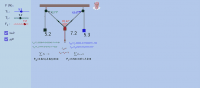
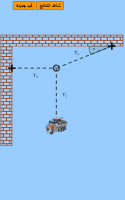
يؤثر في الحلقة (نقطة التقاء السلكين) ثلاث قوى متلاقية: الشدّان \(T_1\) و\(T_2\) والوزن \(W=mg\) للأسفل. بتطبيق شرطي الاتزان على المحورين نحصل على معادلتين نحلّهما معًا:
Three concurrent forces act on the ring (the meeting point of the two cables): the tensions \(T_1\) and \(T_2\) and the weight \(W=mg\) downward. Applying the two equilibrium conditions on the axes we obtain two equations that we solve together:
📌 الشدّان بدلالة الوزن
📌 The tensions in terms of the weight
\[T_1\cos\theta_1=T_2\cos\theta_2\qquad,\qquad T_1\sin\theta_1+T_2\sin\theta_2=W\]
\[T_1=\frac{W\cos\theta_2}{\sin(\theta_1+\theta_2)}\qquad,\qquad T_2=\frac{W\cos\theta_1}{\sin(\theta_1+\theta_2)}\]
جسم كتلته \(10\ \mathrm{kg}\) معلّق بسلكين يصنع الأيسر \(60^\circ\) والأيمن \(30^\circ\) مع الأفقي. أوجد الشدّ في كل سلك. (\(g=9.8\))
A \(10\ \mathrm{kg}\) body hangs from two cables, the left making \(60^\circ\) and the right \(30^\circ\) with the horizontal. Find the tension in each cable. (\(g=9.8\))
🧪 جرّب بنفسك: السلكان ومثلث القوى
🧪 Try It Yourself: the Cables and the Force Triangle
🧪 تجربة 1: جسم معلّق بسلكين: الشدّ في السلكين
🧪 Experiment 1: A Body Hanging from Two Cables: the Tension in the Cables
يتعلق جسم كتلته \(m\) بسلكين يميلان على الأفقي بزاويتين \(\theta_1\) و\(\theta_2\). غيّر الكتلة والزاويتين وراقب الشدّين ومثلث القوى المغلق وتحقّق من شرطي الاتزان.
A body of mass \(m\) hangs from two cables inclined to the horizontal at angles \(\theta_1\) and \(\theta_2\). Change the mass and the two angles and watch the two tensions, the closed force triangle and check the two equilibrium conditions.
جسم معلّق بسلكين متناظرين (الزاويتان متساويتان). ماذا تقول عن الشدّين؟
A body hangs from two symmetric cables (equal angles). What can you say about the two tensions?
➕ القوة المتزنة والمثلث المغلق
➕ The Balancing Force and the Closed Triangle
إذا أثّرت قوتان في جسم، فلكي يتزن يلزم قوة ثالثة تساوي محصلتهما مقدارًا وتعاكسها اتجاهًا: \(\vec F_3=-(\vec F_1+\vec F_2)\)؛ وتسمّى القوة المتزنة. وإذا رسمنا القوى الثلاث رأسًا برأس انغلق المثلث عند الاتزان.
If two forces act on a body then to balance it we need a third force equal to their resultant in magnitude and opposite in direction: \(\vec F_3=-(\vec F_1+\vec F_2)\); it is called the balancing force (the equilibrant). If we draw the three forces head to tail the triangle closes at equilibrium.
تؤثر في نقطة القوتان \(F_1=30\ \mathrm N\) بزاوية \(30^\circ\) و\(F_2=40\ \mathrm N\) بزاوية \(150^\circ\). أوجد القوة المتزنة.
The forces \(F_1=30\ \mathrm N\) at \(30^\circ\) and \(F_2=40\ \mathrm N\) at \(150^\circ\) act on a point. Find the balancing force.
🧪 تجربة 2: أوجد القوة المتزنة
🧪 Experiment 2: Find the Balancing Force
تؤثر قوتان \(F_1\) و\(F_2\) في نقطة. اضبط القوة الثالثة \(F_3\) (المقدار والزاوية) حتى يتزن الجسم، أو اضغط «أظهر القوة المتزنة» لترى الحل ثم جرّب مسألة جديدة.
Two forces \(F_1\) and \(F_2\) act on a point. Adjust the third force \(F_3\) (magnitude and angle) until the body is balanced, or press “Show the balancing force” to see the solution then try a new problem.
أي العبارات تعبّر عن اتزان جسم تحت تأثير قوى متلاقية؟
Which statement expresses the equilibrium of a body under concurrent forces?
🏗️ تطبيقات عملية
🏗️ Practical Applications
أين نستفيد من الاتزان؟
Where do we use equilibrium?
- تصميم الجسور المعلّقة وحساب شدّ الكوابل.Designing suspension bridges and calculating the cable tensions.
- الرافعات وأنظمة البكرات في المصاعد.Cranes and the pulley systems in elevators.
- أنظمة التعليق في السيارات وتصميم الأثاث والمباني.Suspension systems in cars and the design of furniture and buildings.
- الطب الحيوي: تقويم العظام بالأوزان والبكرات.Biomedicine: orthopaedic traction with weights and pulleys.
⚠️ أخطاء شائعة
⚠️ Common Mistakes
تجنّب هذه الأخطاء
Avoid these mistakes
- نسيان تحليل القوة المائلة قبل الجمع.Forgetting to resolve the oblique force before adding.
- الخلط بين زاوية السلك مع الأفقي وزاويته مع الرأسي.Confusing the angle of the cable with the horizontal and with the vertical.
- افتراض تساوي الشدّين دائمًا؛ يتساويان فقط عند تناظر الزاويتين.Assuming the two tensions are always equal; they are equal only when the angles are symmetric.
- إهمال الوزن \(W=mg\) في معادلة المحور الرأسي.Neglecting the weight \(W=mg\) in the vertical-axis equation.
📚 ملخص
📚 Summary
أهم ما تعلمناه
Key points
- الاتزان الانتقالي: \(\Sigma F_x=0\) و\(\Sigma F_y=0\)؛ والقوى تكوّن مثلثًا أو مضلعًا مغلقًا.Translational equilibrium: \(\Sigma F_x=0\) and \(\Sigma F_y=0\); the forces form a closed triangle or polygon.
- نحلّل كل قوة: \(F_x=F\cos\theta\) و\(F_y=F\sin\theta\).We resolve each force: \(F_x=F\cos\theta\) and \(F_y=F\sin\theta\).
- القوة المتزنة \(\vec F=-\Sigma\vec F\) للقوى الأخرى.The balancing force \(\vec F=-\Sigma\vec F\) of the other forces.
🔗 محاكيات GeoGebra للاستعانة بها عند اللزوم
🔗 GeoGebra Simulations to Use When Needed
اضغط «تشغيل» لتعمل المحاكاة هنا داخل الدرس؛ ويمكن للطالب الرجوع إليها لتجربة الفكرة بطريقة أخرى.
Press “Run” to run the simulation right here inside the lesson; the student can use it to try the idea in another way.