🎯 نواتج التعلم
🎯 Learning Outcomes
بعد هذه التجربة ستكون قادرًا على أن:
After this experiment you will be able to:
- تحسب القوة المغناطيسية على شحنة متحركة: \(F=|q|vB\sin\theta\).Calculate the magnetic force on a moving charge: \(F=|q|vB\sin\theta\).
- تحسب القوة على سلك يحمل تيارًا داخل مجال: \(F=ILB\sin\theta\).Calculate the force on a wire carrying a current in a field: \(F=ILB\sin\theta\).
- تحدد اتجاه القوة بين سلكين متوازيين، وتحسب قوتهما لكل وحدة طول.Find the direction of the force between two parallel wires, and calculate it per unit length.
- تفرّق بين تجاذب القطبين المختلفين وتنافر المتشابهين.Distinguish between the attraction of unlike poles and the repulsion of like poles.
🎬 شاهد الفيديو
🎬 Watch the Video
🔍 الفكرة في صورة
🔍 The Idea in a Picture
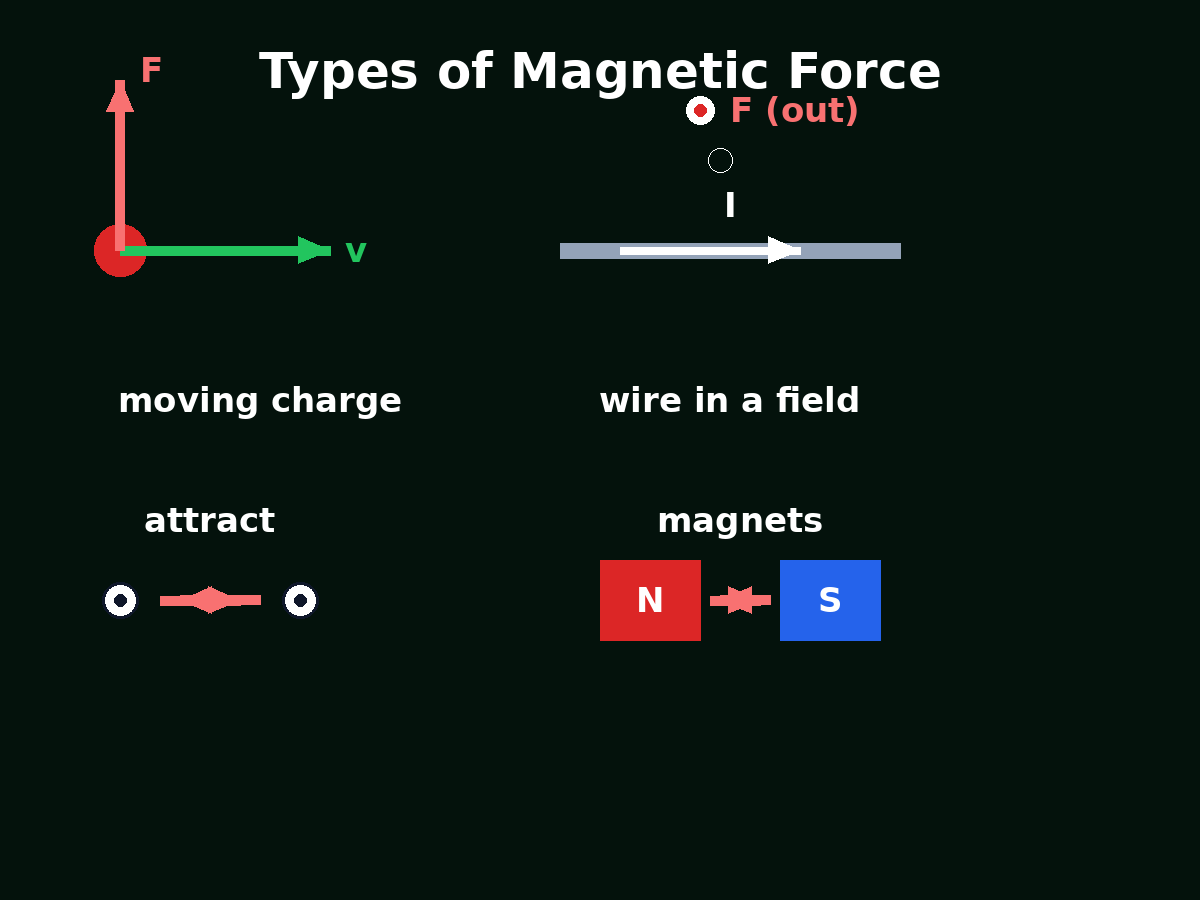
⚡ القوة على شحنة متحركة
⚡ The force on a moving charge
الشحنة المتحركة داخل مجال مغناطيسي تتأثر بقوة لورنتز. هذه القوة تتعامد على السرعة وعلى المجال معًا، ولذلك تغيّر اتجاه السرعة دون أن تغيّر مقدارها.
A moving charge in a magnetic field feels the Lorentz force. This force is perpendicular to both the velocity and the field, so it changes the direction of the velocity without changing its magnitude.
📘 القوة على شحنة متحركة
📘 The force on a moving charge
\[\vec F=q\,\vec v\times\vec B,\qquad F=|q|\,v\,B\sin\theta\]
حيث \(\theta\) الزاوية بين السرعة والمجال. عندما تكون \(\theta=90^\circ\) تكون القوة أكبر ما يمكن، وعندما تكون \(\theta=0^\circ\) أو \(180^\circ\) تنعدم القوة.
where \(\theta\) is the angle between the velocity and the field. At \(\theta=90^\circ\) the force is largest, and at \(\theta=0^\circ\) or \(180^\circ\) it vanishes.
💡 شرح إضافي: لماذا لا تبذل القوة المغناطيسية شغلًا؟
💡 Extra explanation: why does the magnetic force do no work?
الشغل يساوي القوة في الإزاحة في اتجاهها. والقوة عمودية على السرعة دائمًا، أي عمودية على الإزاحة، فالشغل صفر، ولا تتغير طاقة الحركية. لذلك يدور الجسيم في مسار دائري بسرعة ثابتة المقدار.
Work is the force times the displacement along it. The force is always perpendicular to the velocity, hence to the displacement, so the work is zero and the kinetic energy does not change. That is why the particle moves in a circle at constant speed.
⚡ القوة على سلك يحمل تيارًا
⚡ The force on a current-carrying wire
السلك الذي يحمل تيارًا داخل مجال مغناطيسي يتأثر بقوة، لأن الشحنات المتحركة داخله تتأثر بقوى لورنتز. ويعتمد مقدار القوة على التيار وطول السلك وشدة المجال والزاوية بينهما.
A wire carrying a current in a magnetic field feels a force, because the moving charges inside it feel the Lorentz force. Its size depends on the current, the length of the wire, the field and the angle between them.
📘 القوة على السلك
📘 The force on the wire
\[\vec F=I\,\vec L\times\vec B,\qquad F=ILB\sin\theta\]
حيث \(\vec L\) متجه طول السلك في اتجاه التيار، و\(\theta\) الزاوية بين السلك والمجال. القوة عمودية على السلك وعلى المجال معًا.
where \(\vec L\) is the length vector along the current and \(\theta\) is the angle between the wire and the field. The force is perpendicular to both the wire and the field.
💡 شرح إضافي: لماذا يكون \(\sin\theta\) وليس \(\cos\theta\)؟
💡 Extra explanation: why \(\sin\theta\) and not \(\cos\theta\)?
المركبة من المجال التي تعطي قوة هي المركبة العمودية على السلك، أي \(B\sin\theta\). المركبة الموازية للسلك لا تعطي قوة. لذلك إذا كان السلك موازيًا للمجال (\(\theta=0\)) فلا توجد قوة، وإذا كان متعامدًا عليه (\(\theta=90^\circ\)) فالقوة أكبر ما يمكن.
Only the component of the field perpendicular to the wire produces a force, which is \(B\sin\theta\). The component parallel to the wire produces none. So if the wire is parallel to the field (\(\theta=0\)) there is no force, and if it is perpendicular (\(\theta=90^\circ\)) the force is largest.
⚡ القوة بين سلكين متوازيين
⚡ The force between two parallel wires
كل سلك يحمل تيارًا يُنشئ مجالًا حوله، والسلك الثاني يقع داخل هذا المجال فيتأثر بقوة. إذا كان التياران في الاتجاه نفسه يتجاذب السلكان، وإذا كانا في اتجاهين متعاكسين يتنافران.
Each wire carrying a current creates a field around it, and the other wire lies in this field and feels a force. If the currents flow in the same direction the wires attract; if they flow in opposite directions they repel.
📘 القوة لكل وحدة طول
📘 The force per unit length
\[\dfrac{F}{L}=\dfrac{\mu_0 I_1 I_2}{2\pi d}=2\times10^{-7}\,\dfrac{I_1 I_2}{d}\ \ \mathrm{N/m}\]
حيث \(d\) المسافة بين السلكين. القوة على كل سلك متساوية في المقدار ومتعاكسة في الاتجاه مع القوة على الآخر، كما في قانون نيوتن الثالث.
where \(d\) is the distance between the wires. The force on each wire is equal in size and opposite in direction to the force on the other, as in Newton's third law.
💡 شرح إضافي: لماذا تُعرّف الأمبير بهذه العلاقة؟
💡 Extra explanation: why is the ampere defined with this relation?
القوة بين سلكين متوازيين يمكن قياسها بدقة، لذلك تُعرّف الأمبير بأنه التيار الثابت الذي يجعل القوة بين سلكين متوازيين طولهما متر واحد وبعدهما متر واحد تساوي \(2\times10^{-7}\ \mathrm{N}\).
The force between two parallel wires can be measured precisely, so the ampere is defined as the steady current that makes the force between two parallel wires of one metre length, one metre apart, equal to \(2\times10^{-7}\ \mathrm{N}\).
⚡ القوة بين المغناطيسين
⚡ The force between two magnets
القطبان المختلفان يتجاذبان، والمتشابهان يتنافران. وتضعف هذه القوة بسرعة مع زيادة المسافة بين القطبين.
Unlike poles attract and like poles repel. This force weakens quickly as the distance between the poles increases.
💡 شرح إضافي: كيف نربط بين القوى الأربع؟
💡 Extra explanation: how do the four forces connect?
كل هذه القوى تنتج عن حركة الشحنات أو عن المجال الذي تُنشئه. قوة الشحنة المتحركة وقوة السلك هما الأساس، وقوة السلكين المتوازيين نتيجة لتأثير سلك في مجال سلك آخر. أما قوة المغناطيسين فهي تأثير المجالين المغناطيسيين للمغناطيسين في بعضهما.
All these forces come from moving charges or from the field they create. The force on a moving charge and on a wire form the basis; the force between two parallel wires is a wire acting in the field of another wire. The force between two magnets is the interaction of the fields of the two magnets.
🧪 التجربة التفاعلية: أنواع القوة المغناطيسية
🧪 Interactive Experiment: Types of Magnetic Force
اختر النوع من الأزرار، ثم غيّر القيم بالمنزلقات، وراقب اتجاه القوة ومقدارها والقانون المستخدم.
Choose a type with the buttons, change the values with the sliders, and watch the direction and the size of the force and the law used.
🧪 التجربة التفاعلية: أنواع القوة المغناطيسية
🧪 Interactive Experiment: Types of Magnetic Force
اختر النوع من الأزرار: قوة على شحنة متحركة، أو قوة على سلك يمر فيه تيار، أو قوة بين سلكين متوازيين، أو قوة بين مغناطيسين. غيّر القيم بالمنزلقات، وراقب اتجاه القوة ومقدارها.
Choose a type with the buttons: a force on a moving charge, a force on a wire carrying a current, a force between two parallel wires, or a force between two magnets. Change the values with the sliders and watch the direction and the size of the force.
ملاحظة: الرموز ⊙ تعني أن الاتجاه خارج الصفحة نحوك، و⊗ تعني داخل الصفحة بعيدًا عنك.
Note: ⊙ means the direction is out of the page toward you, and ⊗ means into the page away from you.
🧲 القوة المغناطيسية: اختر النوع وحرّك
🧲 The magnetic force: choose a type and move
✍️ أمثلة محلولة
✍️ Worked Examples
بروتون يتحرك بسرعة \(2\times10^{6}\ \mathrm{m/s}\) عموديًا على مجال \(0.5\ \mathrm{T}\). احسب القوة المغناطيسية عليه.
A proton moves at \(2\times10^{6}\ \mathrm{m/s}\) perpendicular to a field of \(0.5\ \mathrm{T}\). Find the magnetic force on it.
سلك طوله \(0.5\ \mathrm{m}\) يحمل تيارًا \(4\ \mathrm{A}\) داخل مجال \(0.2\ \mathrm{T}\)، والزاوية بين السلك والمجال \(30^\circ\). احسب القوة على السلك.
A wire \(0.5\ \mathrm{m}\) long carries a current of \(4\ \mathrm{A}\) in a field of \(0.2\ \mathrm{T}\), with an angle of \(30^\circ\) between the wire and the field. Find the force on the wire.
سلكان متوازيان متباعدان \(10\ \mathrm{cm}\) يحمل كل منهما تيارًا \(5\ \mathrm{A}\) في الاتجاه نفسه. احسب القوة لكل متر من طول كل سلك، وحدد نوعها.
Two parallel wires \(10\ \mathrm{cm}\) apart each carry \(5\ \mathrm{A}\) in the same direction. Find the force per metre of length on each wire, and state its type.
📚 ملخص
📚 Summary
| الحالةCase | القانونLaw | ملاحظةNote |
|---|---|---|
| شحنة متحركةMoving charge | \(F=|q|vB\sin\theta\) | لا تبذل شغلًاdoes no work |
| سلك يحمل تيارًاCurrent-carrying wire | \(F=ILB\sin\theta\) | عمودية على السلك والمجالperpendicular to the wire and the field |
| سلكان متوازيانParallel wires | \(F/L=2\times10^{-7}I_1I_2/d\) | تجاذب إن تماثل الاتجاه، وتنافر إن اختلفattract if the same direction, repel if opposite |
| مغناطيسانTwo magnets | تضعف مع المسافةweakens with distance | المختلفان يتجاذبان، والمتشابهان يتنافرانunlike poles attract, like poles repel |
⚠️ أخطاء شائعة
⚠️ Common mistakes
- الظن أن القوة المغناطيسية تبذل شغلًا على الشحنة المتحركة؛ القوة عمودية على السرعة فلا تغيّر طاقتها.Thinking the magnetic force does work on a moving charge; the force is perpendicular to the velocity, so it does not change its energy.
- استخدام \(\cos\theta\) بدل \(\sin\theta\) في قانون السلك.Using \(\cos\theta\) instead of \(\sin\theta\) in the wire law.
- الخلط بين اتجاهي التيارين في السلكين: الاتجاه نفسه يعني تجاذبًا، والمتعاكس يعني تنافرًا.Mixing up the directions of the currents: the same direction means attraction, opposite means repulsion.
- نسيان تحويل السنتيمتر إلى متر في قانون السلكين المتوازيين.Forgetting to convert centimetres to metres in the parallel-wires law.
🧠 اختبر نفسك
🧠 Test Yourself
شحنة تتحرك بسرعة موازية لمجال مغناطيسي. ما القوة المغناطيسية عليها؟
A charge moves with a velocity parallel to a magnetic field. What is the magnetic force on it?
سلكان متوازيان يحمل كل منهما تيارًا في اتجاهين متعاكسين. ماذا يحدث بينهما؟
Two parallel wires each carry a current in opposite directions. What happens between them?
🔗 محاكاة GeoGebra للاستعانة بها عند اللزوم
🔗 GeoGebra Simulation to Use When Needed
اضغط «تشغيل» لتعمل المحاكاة هنا داخل الدرس؛ ويمكن للطالب الرجوع إليها لتجربة الفكرة بطريقة أخرى.
Press “Run” to run the simulation right here inside the lesson; the student can use it to try the idea in another way.