🔬 بنك الأسئلة: المدخل إلى علم الفيزياء
🔬 Question Bank: Introduction to Physics
الترميز العلمي، الوحدات الأساسية، الكثافة والحجم المُزاح، النسبة المئوية للخطأ، الدقة والضبط، هامش الخطأ، الأرقام المعنوية وقواعدها، التحليل البعدي، والعلاقات البيانية
Scientific Notation, Base Units, Density and Displaced Volume, Percent Error, Accuracy and Precision, Margin of Error, Significant Figures and Their Rules, Dimensional Analysis, and Graph Relationships
⏱️ 37 سؤال اختيار من متعدد بتصحيح فوري، ومسألتان محلولتان بالكامل⏱️ 37 multiple-choice questions with instant feedback, plus 2 fully-solved problems
\[1\,\star\]
أحد وحدات القياس التالية ليست من الوحدات الأساسية في النظام الدولي:Which of the following is NOT an SI base unit (quantity)?
درجة الحرارةTemperature
التيار الكهربائيElectric current
الطولLength
السرعةSpeed
الحلSolution
📌 الوحدات الأساسية السبع هي: المتر، الكيلوجرام، الثانية، كلفن، الأمبير، الشمعة، والمول. أما السرعة \((m/s)\) فهي كمية مشتقة (طول÷زمن) وليست أساسية.
✅ السرعة
📌 The seven base units are: meter, kilogram, second, kelvin, ampere, candela, and mole. Speed \((m/s)\) is a derived quantity (length÷time), not a base one.
✅ Speed
\[2\,\star\star\]
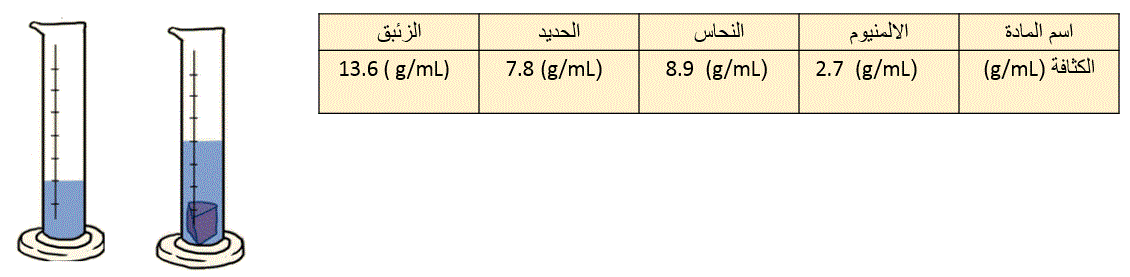
عينة من مادة مجهولة كتلتها \(50\,g\) وُضعت داخل مخبار مدرَّج يحتوي على \(40\,mL\) من الماء، فارتفع منسوب الماء إلى \(45.6\,mL\). فإن المادة المجهولة هي:A sample of unknown material with mass \(50\,g\) was placed in a graduated cylinder containing \(40\,mL\) of water, raising the water level to \(45.6\,mL\). The unknown material is:
الألومنيومAluminum
النحاسCopper
الحديدIron
الزئبقMercury
الحلSolution
📌 الحجم المُزاح (حجم العينة): \(V=45.6-40=5.6\,mL\)
📌 الكثافة: \(\rho=\dfrac{m}{V}=\dfrac{50}{5.6}\approx8.93\,g/mL\)
✅ هذه القيمة قريبة جدًا من كثافة النحاس (8.9 g/mL) في الجدول
📌 Displaced volume (sample volume): \(V=45.6-40=5.6\,mL\)
📌 Density: \(\rho=\dfrac{m}{V}=\dfrac{50}{5.6}\approx8.93\,g/mL\)
✅ Very close to copper's density (8.9 g/mL) in the table
\[3\,\star\star\]
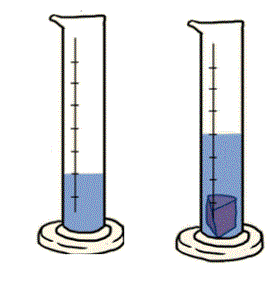
عينة من الألومنيوم كتلتها \(30\,g\) وكثافتها \(2.7\,g/mL\) وُضعت داخل مخبار مدرَّج يحتوي على \(30\,mL\) من الماء. فإن الحجم النهائي لمنسوب الماء يعادل:An aluminum sample with mass \(30\,g\) and density \(2.7\,g/mL\) is placed in a graduated cylinder containing \(30\,mL\) of water. The final water level equals:
\(48.2\,mL\)\(48.2\,mL\)
\(41.1\,mL\)\(41.1\,mL\)
\(47.3\,mL\)\(47.3\,mL\)
\(45.5\,mL\)\(45.5\,mL\)
الحلSolution
📌 حجم عينة الألومنيوم: \(V=\dfrac{m}{\rho}=\dfrac{30}{2.7}\approx11.11\,mL\)
📌 الحجم النهائي: \(30+11.11\approx41.1\,mL\)
✅ 41.1 mL
📌 Volume of the aluminum sample: \(V=\dfrac{m}{\rho}=\dfrac{30}{2.7}\approx11.11\,mL\)
📌 Final level: \(30+11.11\approx41.1\,mL\)
✅ 41.1 mL
\[4\,\star\star\]
قلم رصاص طوله \(13.7\,cm\)، طُلب من أحد الطلاب قياس طوله بالمسطرة، فكان القياس الذي أجراه يعادل \(13.9\,cm\). فإن النسبة المئوية للخطأ في محاولته:A pencil is \(13.7\,cm\) long. A student measured it with a ruler and got \(13.9\,cm\). The percent error in the student's measurement is:

\(1.46\%\)\(1.46\%\)
\(3.12\%\)\(3.12\%\)
\(2.17\%\)\(2.17\%\)
\(1.96\%\)\(1.96\%\)
الحلSolution
📌 نسبة الخطأ المئوية: \(\%\text{error}=\dfrac{|13.9-13.7|}{13.7}\times100\approx1.46\%\)
✅ 1.46%
📌 Percent error: \(\%\text{error}=\dfrac{|13.9-13.7|}{13.7}\times100\approx1.46\%\)
✅ 1.46%
\[5\,\star\]
أي مما يلي يساوي \(5\,km\)؟Which of the following equals \(5\,km\)?
\(5\times10^3\,cm\)\(5\times10^3\,cm\)
\(5\times10^5\,cm\)\(5\times10^5\,cm\)
\(5\times10^4\,cm\)\(5\times10^4\,cm\)
\(5\times10^6\,cm\)\(5\times10^6\,cm\)
الحلSolution
📌 التحويل: \(5\,km=5\times10^3\,m\times\dfrac{10^2\,cm}{m}=5\times10^5\,cm\)
✅ \(5\times10^5\,cm\)
📌 Conversion: \(5\,km=5\times10^3\,m\times\dfrac{10^2\,cm}{m}=5\times10^5\,cm\)
✅ \(5\times10^5\,cm\)
\[6\,\star\]
أي مما يلي يساوي \(5\,\mu s\)؟Which of the following equals \(5\,\mu s\)?
\(5\times10^{-6}\,s\)\(5\times10^{-6}\,s\)
\(5\times10^{-3}\,s\)\(5\times10^{-3}\,s\)
\(5\times10^{-5}\,s\)\(5\times10^{-5}\,s\)
\(5\times10^{-4}\,s\)\(5\times10^{-4}\,s\)
الحلSolution
📌 بما أن \(\mu=10^{-6}\): \(5\,\mu s=5\times10^{-6}\,s\)
✅ \(5\times10^{-6}\,s\)
📌 Since \(\mu=10^{-6}\): \(5\,\mu s=5\times10^{-6}\,s\)
✅ \(5\times10^{-6}\,s\)
\[7\,\star\]
الزمن اللازم لسقوط جسم من ارتفاع \(2\,m\) يعادل \(t=0.64\,s\). قاس أربعة طلاب زمن السقوط، وكل طالب أجرى القياس ثلاث مرات، فكانت نتائجهم كما يلي. أحد القياسات التالية دقيق ومضبوط:The time for an object to fall from \(2\,m\) equals \(t=0.64\,s\). Four students each measured the fall time three times, with results below. Which measurement is both accurate and precise?
| الطالبStudent | القياسات (s)Measurements (s) |
|---|---|
| أحمدAhmed | 0.75 , 0.76 , 0.77 |
| ماجدMajed | 0.68 , 0.51 , 0.95 |
| يوسفYousef | 0.64 , 0.65 , 0.63 |
| طارقTariq | 0.78 , 0.551 , 0.35 |
قياسات أحمدAhmed's measurements
قياسات طارقTariq's measurements
قياسات ماجدMajed's measurements
قياسات يوسفYousef's measurements
الحلSolution
📌 أحمد: قيم متقاربة (مضبوطة) لكن متوسطها 0.76 بعيد عن 0.64 (غير دقيقة).
📌 ماجد وطارق: قيمهما متباعدة جدًا (غير مضبوطة) ومتوسطاهما بعيدان عن 0.64 (غير دقيقة).
📌 يوسف: قيمه متقاربة جدًا (0.63–0.65، مضبوطة) ومتوسطه \(0.64\,s\) يطابق القيمة الحقيقية تمامًا (دقيقة).
✅ قياسات يوسف — دقيقة ومضبوطة معًا
📌 Ahmed: values are close together (precise) but their average 0.76 is far from 0.64 (not accurate).
📌 Majed and Tariq: their values are very spread out (not precise) and their averages are far from 0.64 (not accurate).
📌 Yousef: values are very close together (0.63–0.65, precise) and their average \(0.64\,s\) exactly matches the true value (accurate).
✅ Yousef's measurements — both accurate and precise
\[8\,\star\]
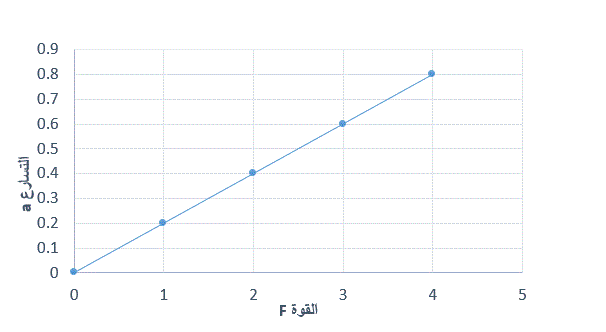
الخط البياني التالي يمثل العلاقة بين التسارع والقوة. فإن ميل الخط البياني يعادل:The following graph represents the relationship between acceleration and force. The slope of the graph equals:
\(0.1\)\(0.1\)
\(0.2\)\(0.2\)
\(0.3\)\(0.3\)
\(0.4\)\(0.4\)
الحلSolution
📌 الميل: الخط يمر من نقطة الأصل ويصل إلى \((F=4,\,a=0.8)\)، إذًا \(m=\dfrac{0.8-0}{4-0}=0.2\)
✅ 0.2
📌 Slope: the line passes through the origin and reaches \((F=4,\,a=0.8)\), so \(m=\dfrac{0.8-0}{4-0}=0.2\)
✅ 0.2
\[9\,\star\]
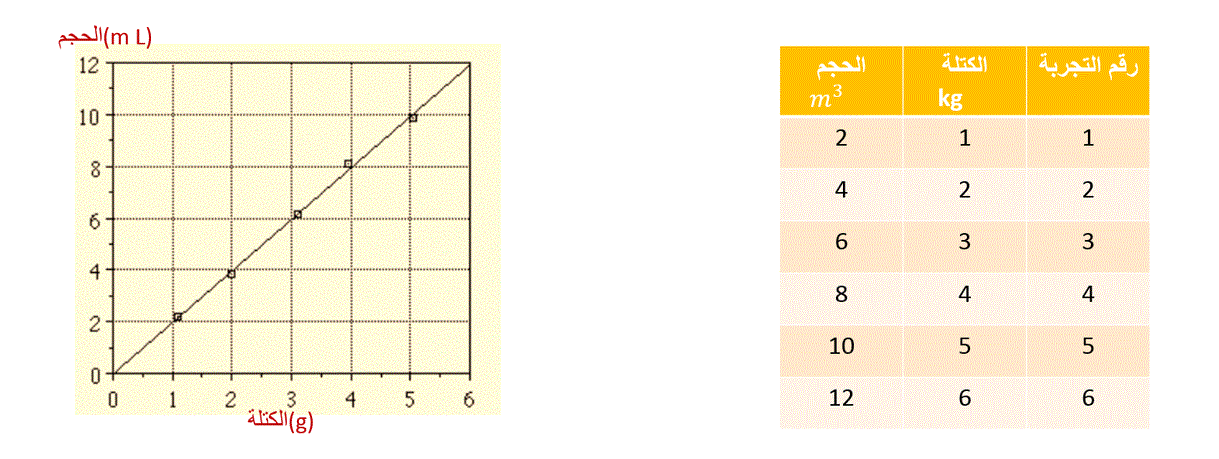
تمت دراسة العلاقة بين الحجم والكتلة لمجموعة كتل مختلفة من نفس المادة، فتم الحصول على القيم التالية ورُسم الخط البياني بين الكتلة والحجم. من خلال ميل الخط البياني، فإن كثافة المادة تعادل:The relationship between volume and mass was studied for different masses of the same material, giving the values below, plotted as mass vs. volume. From the slope of the graph, the material's density equals:
\(2\,g/mL\)\(2\,g/mL\)
\(0.4\,g/mL\)\(0.4\,g/mL\)
\(0.8\,g/mL\)\(0.8\,g/mL\)
\(0.5\,g/mL\)\(0.5\,g/mL\)
الحلSolution
📌 ميل الخط البياني (الحجم/الكتلة): من الجدول، كل زيادة 1 بالكتلة تقابلها زيادة 2 بالحجم، إذًا \(m_{slope}=\dfrac{\Delta V}{\Delta m}=2\)
📌 الكثافة هي مقلوب هذا الميل: \(\rho=\dfrac{m}{V}=\dfrac{1}{m_{slope}}=\dfrac{1}{2}=0.5\,g/mL\)
✅ 0.5 g/mL
📌 Graph slope (volume/mass): from the table, each +1 in mass gives +2 in volume, so \(m_{slope}=\dfrac{\Delta V}{\Delta m}=2\)
📌 Density is the inverse of this slope: \(\rho=\dfrac{m}{V}=\dfrac{1}{m_{slope}}=0.5\,g/mL\)
✅ 0.5 g/mL
\[10\,\star\]
أي مما يلي يساوي \(5\,km\)؟Which of the following equals \(5\,km\)?
\(5\times10^4\,cm\)\(5\times10^4\,cm\)
\(5\times10^5\,cm\)\(5\times10^5\,cm\)
\(5\times10^3\,cm\)\(5\times10^3\,cm\)
\(5\times10^6\,cm\)\(5\times10^6\,cm\)
الحلSolution
📌 التحويل: \(5\,km=5\times10^3\,m\times\dfrac{10^2\,cm}{m}=5\times10^5\,cm\)
✅ \(5\times10^5\,cm\)
📌 Conversion: \(5\,km=5\times10^3\,m\times\dfrac{10^2\,cm}{m}=5\times10^5\,cm\)
✅ \(5\times10^5\,cm\)
\[11\,\star\]
الأرقام التالية تم قياسها بأدوات. أحد الأرقام التالية يتكون من أربعة أرقام معنوية:The following numbers were measured with instruments. Which number has four significant figures?
\(0.0079\)\(0.0079\)
\(2020\)\(2020\)
\(9900\)\(9900\)
\(0.7850\)\(0.7850\)
الحلSolution
📌 نفحص كل عدد: \(0.0079\) → رقمان (7,9). \(2020\) → ثلاثة (2,0,2). \(9900\) → رقمان (9,9). \(0.7850\) → أربعة (7,8,5,0) لأن الصفر بعد الفاصلة العشرية معنوي.
✅ 0.7850
📌 Checking each: \(0.0079\) → 2 figures. \(2020\) → 3 figures. \(9900\) → 2 figures. \(0.7850\) → 4 figures, since the trailing zero after the decimal point is significant.
✅ 0.7850
\[12\,\star\]
باستخدام قواعد الأرقام المعنوية والترميز العلمي، فإن ناتج الضرب التالي: \(50.4\times310=\)Using significant figure and scientific notation rules: \(50.4\times310=\)
\(15.6\times10^3\)\(15.6\times10^3\)
\(1.5\times10^4\)\(1.5\times10^4\)
\(15.62\times10^3\)\(15.62\times10^3\)
\(1.6\times10^4\)\(1.6\times10^4\)
الحلSolution
📌 الناتج الدقيق: \(50.4\times310=15{,}624\)
📌 التقريب: العدد 310 له رقمان معنويان فقط، فيُقرَّب الجواب إلى رقمين معنويين.
✅ \(1.6\times10^4\)
📌 Exact product: \(50.4\times310=15{,}624\)
📌 Rounding: 310 has only 2 significant figures, so the answer rounds to 2 significant figures.
✅ \(1.6\times10^4\)
\[13\,\star\]
باستخدام قواعد الأرقام المعنوية، أوجد ناتج: \(5.63+15.1+14=\)Using significant figure rules, find: \(5.63+15.1+14=\)
\(34.73\)\(34.73\)
\(35\)\(35\)
\(34.7\)\(34.7\)
\(34\)\(34\)
الحلSolution
📌 المجموع الدقيق: \(5.63+15.1+14=34.73\)
📌 التقريب: العدد 14 بلا منازل عشرية، فيُقرَّب الجواب إلى عدد صحيح.
✅ 35
📌 Exact sum: \(5.63+15.1+14=34.73\)
📌 Rounding: 14 has no decimal places, so the answer rounds to a whole number.
✅ 35
\[14\,\star\]
جهاز الجلفانوميتر في الشكل أدناه يُستخدم لقياس شدة التيار وفرق الجهد، والآن يُستخدم لقياس شدة التيار. فإن قراءة الجهاز مع هامش الخطأ:The galvanometer below measures current and voltage; it's now being used to measure current. The reading with its margin of error is:
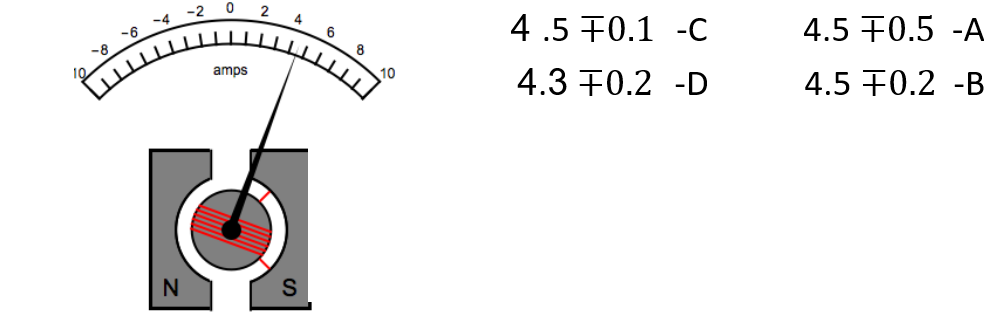
\(4.5\pm0.5\)\(4.5\pm0.5\)
\(4.5\pm0.2\)\(4.5\pm0.2\)
\(4.5\pm0.1\)\(4.5\pm0.1\)
\(4.3\pm0.2\)\(4.3\pm0.2\)
الحلSolution
📌 القراءة: يشير المؤشر قريبًا من القيمة 4.5 على المدرج.
📌 هامش الخطأ: أصغر تدريجة على الجهاز تساوي 1، فهامش الخطأ \(=1\div2=0.5\)
✅ \(4.5\pm0.5\)
📌 Reading: the needle points near the value 4.5 on the scale.
📌 Margin of error: the smallest division is 1, so the margin \(=1\div2=0.5\)
✅ \(4.5\pm0.5\)
\[15\,\star\]
تُقدَّر القوة بوحدة النيوتن، وهي تعادل بالوحدات الأساسية \(N=\dfrac{kg\cdot m}{s^2}\). أي العلاقات التالية تعبّر بشكل صحيح عن محصلة القوى المؤثرة على جسم باستخدام التحليل البعدي؟Force is measured in newtons, equal in base units to \(N=\dfrac{kg\cdot m}{s^2}\). Which relation correctly expresses the net force on a body, using dimensional analysis?
\(F=\dfrac{a}{m}\)\(F=\dfrac{a}{m}\)
\(F=m.a\)\(F=m.a\)
\(F=m+a\)\(F=m+a\)
\(F=\dfrac{m}{a}\)\(F=\dfrac{m}{a}\)
الحلSolution
📌 بالتحليل البعدي: \([kg]\times[m/s^2]=[kg\cdot m/s^2]=[N]\)، فقط \(F=m.a\) يُعطي الوحدة الصحيحة للقوة.
✅ \(F=m.a\)
📌 By dimensional analysis: \([kg]\times[m/s^2]=[N]\); only \(F=m.a\) gives the correct unit for force.
✅ \(F=m.a\)
\[16\,\star\]
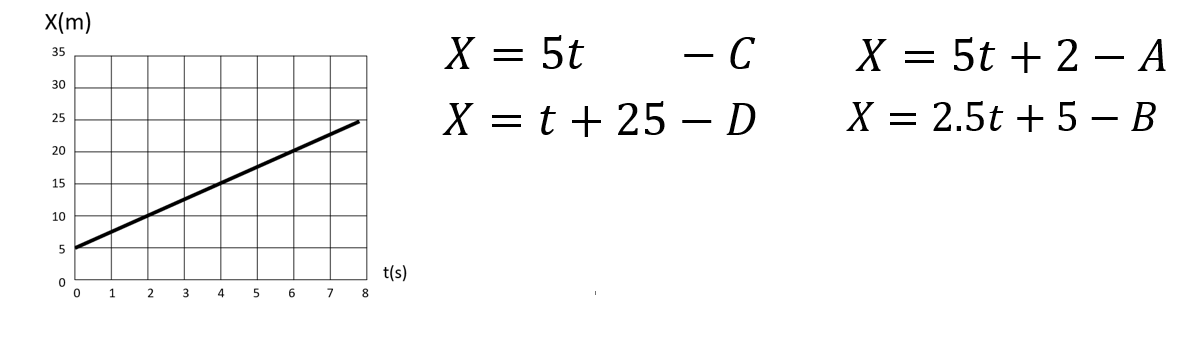
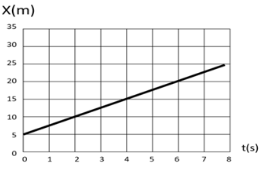
أحد المعادلات التالية تعبّر بشكل صحيح عن الخط البياني أدناه:Which of the following equations correctly represents the graph below?
\(X=5t+2\)\(X=5t+2\)
\(X=2.5t+5\)\(X=2.5t+5\)
\(X=5t\)\(X=5t\)
\(X=t+25\)\(X=t+25\)
الحلSolution
📌 نقطة تقاطع المحور الرأسي: عند \(t=0\)، \(X=5\)، إذًا \(b=5\)
📌 الميل: \(m=\dfrac{25-5}{8-0}=2.5\)
✅ \(X=2.5t+5\)
📌 Vertical-axis intercept: at \(t=0\), \(X=5\), so \(b=5\)
📌 Slope: \(m=\dfrac{25-5}{8-0}=2.5\)
✅ \(X=2.5t+5\)
\[17\,\star\]
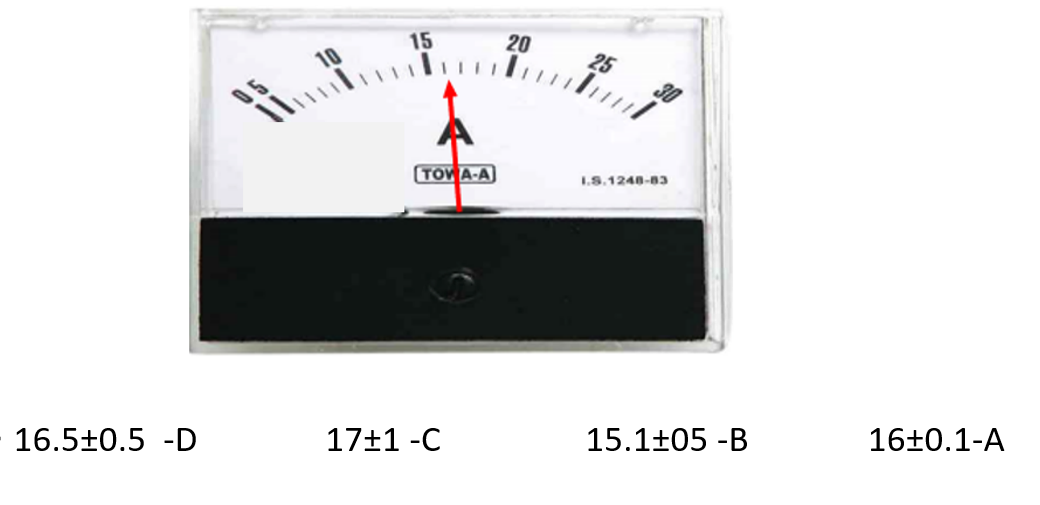
الجهاز الموجود في الشكل هو أميتر، ويُستخدم لقياس شدة التيار. فإن القراءة الصحيحة للتيار محدَّدًا هامش الخطأ:The instrument shown is an ammeter, used to measure current. The correct reading with its margin of error is:
\(16\pm0.1\)\(16\pm0.1\)
\(15.1\pm0.5\)\(15.1\pm0.5\)
\(17\pm1\)\(17\pm1\)
\(16.5\pm0.5\)\(16.5\pm0.5\)
الحلSolution
📌 القراءة: يشير المؤشر بين التدريجتين 16 و17، أقرب لمنتصف المسافة بينهما، أي 16.5.
📌 هامش الخطأ: أصغر تدريجة على الجهاز تساوي 1، فهامش الخطأ \(=1\div2=0.5\)
✅ \(16.5\pm0.5\)
📌 Reading: the needle points between divisions 16 and 17, near their midpoint, i.e. 16.5.
📌 Margin of error: the smallest division is 1, so the margin \(=1\div2=0.5\)
✅ \(16.5\pm0.5\)
\[18\,\star\]
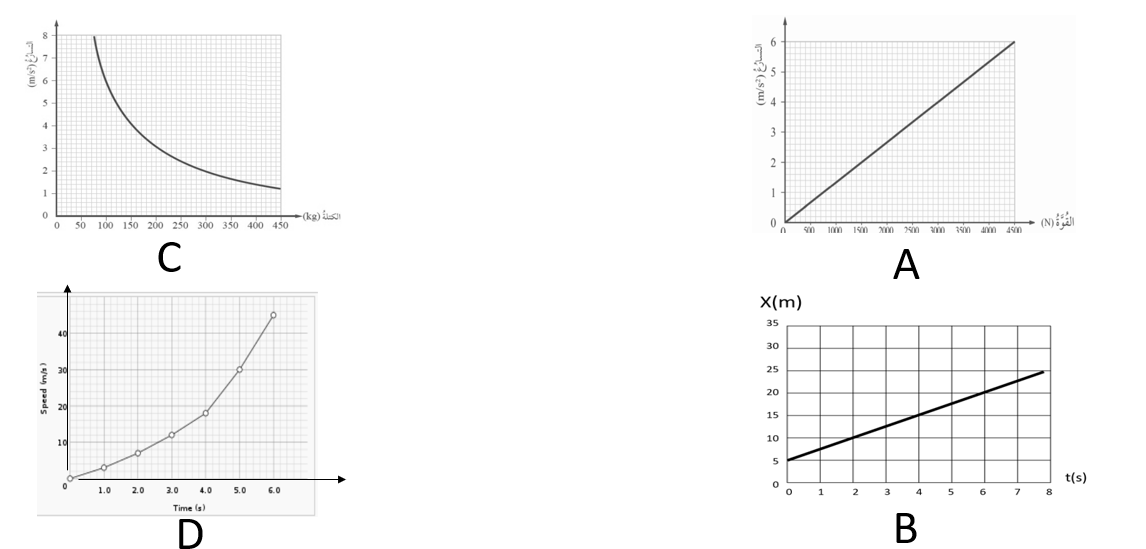
أحد الخطوط البيانية التالية قد يمثل علاقة عكسية:Which of the following graphs could represent an inverse relationship?
AA
BB
CC
DD
الحلSolution
📌 العلاقة العكسية: منحنى متناقص يقترب من المحورين دون أن يلامسهما (يشبه القطع الزائد)؛ هذا هو شكل الخط C بالضبط، بينما A طردية وB خطية وD تربيعية متزايدة.
✅ C
📌 Inverse relationship: a decreasing curve approaching both axes without touching them (hyperbola-like); this matches graph C exactly, while A is direct, B is linear, and D is an increasing quadratic.
✅ C
\[19\,\star\]
استُخدمت مسطرة لقياس أطوال ثلاث قطع من القماش، فنتجت الأطوال التالية: \(22.45\,cm,\;12.4676\,cm,\;55.7\,cm\). باستخدام قواعد الأرقام المعنوية في الجمع، فإن الطول الكلي لهذه القطع يعادل:A ruler was used to measure three pieces of fabric: \(22.45\,cm,\;12.4676\,cm,\;55.7\,cm\). Using significant-figure addition rules, the total length equals:
\(90.6176\,cm\)\(90.6176\,cm\)
\(90.6\,cm\)\(90.6\,cm\)
\(90.61\,cm\)\(90.61\,cm\)
\(90\,cm\)\(90\,cm\)
الحلSolution
📌 المجموع الدقيق: \(22.45+12.4676+55.7=90.6176\,cm\)
📌 التقريب: العدد 55.7 له منزلة عشرية واحدة فقط (الأقل)، فيُقرَّب الجواب إلى منزلة عشرية واحدة.
✅ 90.6 cm
📌 Exact sum: \(22.45+12.4676+55.7=90.6176\,cm\)
📌 Rounding: 55.7 has only 1 decimal place (the fewest), so the answer rounds to 1 decimal place.
✅ 90.6 cm
\[20\,\star\]
أحد الكميات التالية لا تمثّل رقمًا معنويًا في قياسها:Which of the following is NOT represented by a significant-figure measurement?
زمن سقوط قلمTime for a pen to fall
طول قلمLength of a pen
حجم كوب ماءVolume of a cup of water
عدد طلاب الصف العاشرNumber of 10th-grade students
الحلSolution
📌 القاعدة: الرقم المعنوي يُقاس بواسطة جهاز قياس. الزمن والطول والحجم جميعها تُقاس بأجهزة (ساعة، مسطرة، مخبار مدرج)، أما عدد الطلاب فهو عدّ مباشر وليس قياسًا بجهاز.
✅ عدد طلاب الصف العاشر
📌 Rule: a significant figure is measured with an instrument. Time, length, and volume are all measured with instruments (stopwatch, ruler, graduated cylinder), while the number of students is a direct count, not an instrument measurement.
✅ Number of 10th-grade students
\[21\,\star\]
أحد الترتيبات التالية هو الترتيب الصحيح لخطوات المنهج العلمي:Which of the following is the correct order of the scientific method?
جمع المعلومات – تحليل البيانات – وضع الفرضيةGather information – analyze data – form hypothesis
اختبار الفرضية – وضع الفرضية – استخلاص النتائجTest hypothesis – form hypothesis – draw conclusions
جمع المعلومات – وضع الفرضية – استخلاص النتائجGather information – form hypothesis – draw conclusions
وضع الفرضية – جمع المعلومات – استخلاص النتائجForm hypothesis – gather information – draw conclusions
الحلSolution
📌 المنهج العلمي: يبدأ بجمع المعلومات والملاحظات، ثم صياغة فرضية تفسّرها، ثم اختبارها واستخلاص النتائج.
✅ جمع المعلومات – وضع الفرضية – استخلاص النتائج
📌 The scientific method: starts with gathering information and observations, then forming a hypothesis to explain them, then testing it and drawing conclusions.
✅ Gather information – form hypothesis – draw conclusions
\[22\,\star\]
هي عبارة تصف شيئًا يحدث في الطبيعة ويبدو أنه صحيح في جميع الأحوال:A statement describing something that happens in nature and appears to be true in all cases is called:
الفرضية العلميةScientific hypothesis
النظرية العلميةScientific theory
النماذجModels
القانون العلميScientific law
الحلSolution
📌 الفرق: القانون العلمي يصف "ماذا" يحدث في الطبيعة وثبت صحته في جميع الحالات المُختبرة، بينما النظرية العلمية تُفسِّر "لماذا" يحدث ذلك.
✅ القانون العلمي
📌 The difference: a scientific law describes "what" happens in nature and has held true in all tested cases, while a scientific theory explains "why" it happens.
✅ Scientific law
\[23\,\star\star\star\]
قاس طالب تسارع الجاذبية الأرضية في المختبر فحصل على \(9.6\,m/s^2\) بينما القيمة المقبولة \(9.8\,m/s^2\). فإن النسبة المئوية للخطأ تعادل:A student measured the acceleration due to gravity in the lab as \(9.6\,m/s^2\) while the accepted value is \(9.8\,m/s^2\). The percent error is:
\(0.20\%\)\(0.20\%\)
\(20\%\)\(20\%\)
\(2.0\%\)\(2.0\%\)
\(4.0\%\)\(4.0\%\)
الحلSolution
📌 قانون النسبة المئوية للخطأ: \(\%\,error=\dfrac{|\text{measured}-\text{accepted}|}{\text{accepted}}\times100\)
📌 التعويض: \(\dfrac{|9.6-9.8|}{9.8}\times100=\dfrac{0.2}{9.8}\times100\approx2.0\%\)
✅ \(2.0\%\)
📌 Percent error formula: \(\%\,error=\dfrac{|\text{measured}-\text{accepted}|}{\text{accepted}}\times100\)
📌 Substitution: \(\dfrac{|9.6-9.8|}{9.8}\times100=\dfrac{0.2}{9.8}\times100\approx2.0\%\)
✅ \(2.0\%\)
\[24\,\star\star\star\]
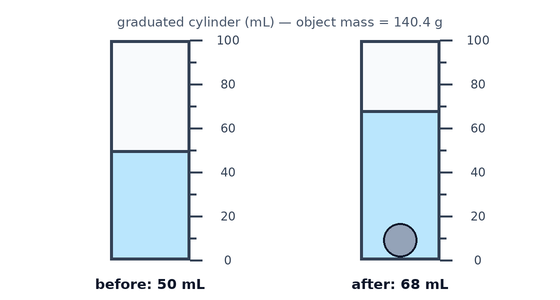
وُضع جسم كتلته \(140.4\,g\) في مخبار مدرَّج يحتوي على \(50\,mL\) من الماء فارتفع المنسوب كما في الشكل. فإن كثافة الجسم:An object of mass \(140.4\,g\) is placed in a graduated cylinder containing \(50\,mL\) of water and the level rises as shown. The density of the object is:
\(7.8\,g/mL\)\(7.8\,g/mL\)
\(2.6\,g/mL\)\(2.6\,g/mL\)
\(8.9\,g/mL\)\(8.9\,g/mL\)
\(3.9\,g/mL\)\(3.9\,g/mL\)
الحلSolution
📌 الحجم المُزاح: \(V=68-50=18\,mL\)
📌 الكثافة: \(\rho=\dfrac{m}{V}=\dfrac{140.4}{18}=7.8\,g/mL\)
✅ \(7.8\,g/mL\)
📌 Displaced volume: \(V=68-50=18\,mL\)
📌 Density: \(\rho=\dfrac{m}{V}=\dfrac{140.4}{18}=7.8\,g/mL\) (iron)
✅ \(7.8\,g/mL\)
\[25\,\star\star\]
ناتج العملية \((3\times10^{4})\times(2\times10^{-7})\) بالصيغة العلمية يعادل:The result of \((3\times10^{4})\times(2\times10^{-7})\) in scientific notation is:
\(6\times10^{-11}\)\(6\times10^{-11}\)
\(5\times10^{-3}\)\(5\times10^{-3}\)
\(6\times10^{-3}\)\(6\times10^{-3}\)
\(6\times10^{3}\)\(6\times10^{3}\)
الحلSolution
📌 نضرب المعاملات ونجمع الأسس: \((3\times2)\times10^{4+(-7)}=6\times10^{-3}\)
✅ \(6\times10^{-3}\)
📌 Multiply the coefficients and add the exponents: \((3\times2)\times10^{4+(-7)}=6\times10^{-3}\)
✅ \(6\times10^{-3}\)
\[26\,\star\star\star\]
ناتج القسمة \(\dfrac{4.8\times10^{6}}{1.2\times10^{-2}}\) بالصيغة العلمية يعادل:The quotient \(\dfrac{4.8\times10^{6}}{1.2\times10^{-2}}\) in scientific notation is:
\(4\times10^{8}\)\(4\times10^{8}\)
\(4\times10^{4}\)\(4\times10^{4}\)
\(4\times10^{-8}\)\(4\times10^{-8}\)
\(5.76\times10^{4}\)\(5.76\times10^{4}\)
الحلSolution
📌 نقسم المعاملات ونطرح الأسس: \(\dfrac{4.8}{1.2}\times10^{6-(-2)}=4\times10^{8}\)
✅ \(4\times10^{8}\)
📌 Divide the coefficients and subtract the exponents: \(\dfrac{4.8}{1.2}\times10^{6-(-2)}=4\times10^{8}\)
✅ \(4\times10^{8}\)
\[27\,\star\star\]
عدد الأرقام المعنوية في القياس \(0.004050\,m\) هو:The number of significant figures in the measurement \(0.004050\,m\) is:
33
55
44
66
الحلSolution
📌 الأصفار قبل أول رقم غير صفري لا تُعد معنوية، أما الصفر الواقع بين رقمين والصفر الأخير بعد الفاصلة العشرية فمعنويان: \(0.004050\;\rightarrow\;4,\,0,\,5,\,0\)
✅ 4
📌 Leading zeros are not significant, whereas a zero between digits and a trailing zero after the decimal point are: \(0.004050\;\rightarrow\;4,\,0,\,5,\,0\)
✅ 4
\[28\,\star\star\star\]
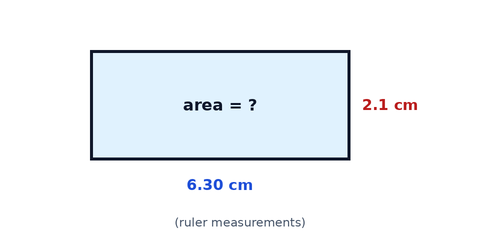
قيست أبعاد مستطيل بالمسطرة فكان طوله \(6.30\,cm\) وعرضه \(2.1\,cm\). فإن مساحته مكتوبة بعدد الأرقام المعنوية الصحيح:The dimensions of a rectangle measured with a ruler are length \(6.30\,cm\) and width \(2.1\,cm\). Its area written with the correct number of significant figures is:
\(13\,cm^2\)\(13\,cm^2\)
\(13.2\,cm^2\)\(13.2\,cm^2\)
\(13.23\,cm^2\)\(13.23\,cm^2\)
\(14\,cm^2\)\(14\,cm^2\)
الحلSolution
📌 الضرب: \(6.30\times2.1=13.23\,cm^2\)
📌 في الضرب نحتفظ بأقل عدد من الأرقام المعنوية بين المقدارين (2.1 له رقمان معنويان): \(13.23\;\rightarrow\;13\,cm^2\)
✅ \(13\,cm^2\)
📌 Multiplication: \(6.30\times2.1=13.23\,cm^2\)
📌 In multiplication keep the fewest significant figures among the factors (2.1 has two): \(13.23\;\rightarrow\;13\,cm^2\)
✅ \(13\,cm^2\)
\[29\,\star\star\star\]
باستخدام قواعد الأرقام المعنوية في الجمع، فإن ناتج \(12.52+1.4+0.368\) يعادل:Using the significant-figure rules for addition, \(12.52+1.4+0.368\) equals:
14.2914.29
14.28814.288
14.314.3
1414
الحلSolution
📌 المجموع: \(12.52+1.4+0.368=14.288\)
📌 في الجمع نقرّب إلى أقل عدد من المنازل العشرية (1.4 له منزلة عشرية واحدة): \(14.288\;\rightarrow\;14.3\)
✅ 14.3
📌 Sum: \(14.288\)
📌 In addition round to the fewest decimal places (1.4 has one): \(14.288\;\rightarrow\;14.3\)
✅ 14.3
\[30\,\star\star\star\]
أي المعادلات التالية صحيحة بُعديًا (\(x\) إزاحة، \(v\) سرعة، \(a\) تسارع، \(t\) زمن)؟Which of the following equations is dimensionally correct (\(x\) displacement, \(v\) speed, \(a\) acceleration, \(t\) time)?
\(x=vt^{2}\)\(x=vt^{2}\)
\(x=\tfrac12at^{2}\)\(x=\tfrac12at^{2}\)
\(v=at^{2}\)\(v=at^{2}\)
\(a=vt\)\(a=vt\)
الحلSolution
📌 نكتب بُعد كل طرف: \([at^2]=\dfrac{L}{T^2}\cdot T^2=L=[x]\)
📌 أما \(vt^2\) فبعدها \(L\,T\) و\(at^2\) بعدها \(L\) وليست \(L/T\)، و\(at\) بعدها \(L/T\) وليست \(L/T^2\). \(x=\tfrac12at^2\) ✓
✅ \(x=\tfrac12at^{2}\)
📌 Write the dimension of each side: \([at^2]=\dfrac{L}{T^2}\cdot T^2=L=[x]\)
📌 Whereas \(vt^2\) has dimension \(L\,T\), \(at^2\) is \(L\) not \(L/T\), and \(at\) is \(L/T\) not \(L/T^2\). \(x=\tfrac12at^2\) ✓
✅ \(x=\tfrac12at^{2}\)
\[31\,\star\star\star\]
في قانون هوك \(F=kx\) حيث \(F\) بالنيوتن و\(x\) بالمتر، فإن وحدة ثابت النابض \(k\) بالوحدات الأساسية:In Hooke’s law \(F=kx\) with \(F\) in newtons and \(x\) in metres, the unit of the spring constant \(k\) in base units is:
\(kg\cdot m/s^2\)\(kg\cdot m/s^2\)
\(kg\cdot m^2/s^2\)\(kg\cdot m^2/s^2\)
\(kg/s^2\)\(kg/s^2\)
\(kg\cdot s^2\)\(kg\cdot s^2\)
الحلSolution
📌 نكتب ثابت النابض: \(k=\dfrac{F}{x}=\dfrac{N}{m}\)
📌 بالتعويض \(N=kg\cdot m/s^2\): \(k=\dfrac{kg\cdot m/s^2}{m}=kg/s^2\)
✅ \(kg/s^2\)
📌 The spring constant: \(k=\dfrac{F}{x}=\dfrac{N}{m}\)
📌 Substituting \(N=kg\cdot m/s^2\): \(k=\dfrac{kg\cdot m/s^2}{m}=kg/s^2\)
✅ \(kg/s^2\)
\[32\,\star\star\star\]
الضغط \(P=\dfrac{F}{A}\) يُقاس بالباسكال \(Pa\). فإن الباسكال يكافئ بالوحدات الأساسية:Pressure \(P=\dfrac{F}{A}\) is measured in pascals \(Pa\). A pascal is equivalent, in base units, to:
\(\dfrac{kg}{m\cdot s^2}\)\(\dfrac{kg}{m\cdot s^2}\)
\(\dfrac{kg\cdot m}{s^2}\)\(\dfrac{kg\cdot m}{s^2}\)
\(\dfrac{kg}{m^2}\)\(\dfrac{kg}{m^2}\)
\(\dfrac{kg\cdot m^2}{s^2}\)\(\dfrac{kg\cdot m^2}{s^2}\)
الحلSolution
📌 نعوّض الوحدات: \(Pa=\dfrac{N}{m^2}=\dfrac{kg\cdot m/s^2}{m^2}=\dfrac{kg}{m\cdot s^2}\)
✅ \(\dfrac{kg}{m\cdot s^2}\)
📌 Substitute the units: \(Pa=\dfrac{N}{m^2}=\dfrac{kg\cdot m/s^2}{m^2}=\dfrac{kg}{m\cdot s^2}\)
✅ \(\dfrac{kg}{m\cdot s^2}\)
\[33\,\star\star\star\]
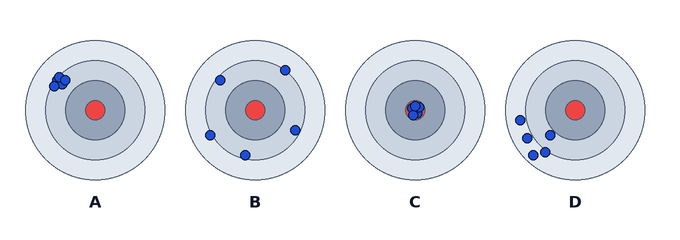
يمثل الشكل أربع لوحات رماية أصاب فيها كل رامٍ خمس طلقات. أي لوحة تدل على دقة (ضبط) عالية وصحة (accuracy) منخفضة؟The figure shows four dartboards, each with five shots. Which board shows high precision but low accuracy?
اللوحة ABoard A
اللوحة BBoard B
اللوحة CBoard C
اللوحة DBoard D
الحلSolution
📌 التعريفان: الدقة (Precision): تقارب النتائج من بعضها، والصحة (Accuracy): قرب النتائج من القيمة الحقيقية (مركز اللوحة).
📌 اللوحة A: الطلقات متقاربة جدًا (دقة عالية) لكنها بعيدة عن المركز (صحة منخفضة). اللوحة C دقيقة وصحيحة، واللوحتان B وD مبعثرتان.
✅ اللوحة A
📌 Definitions: Precision: how close the results are to each other; accuracy: how close they are to the true value (the centre of the board).
📌 Board A: the shots are tightly grouped (high precision) but far from the centre (low accuracy). Board C is precise and accurate; B and D are scattered.
✅ Board A
\[34\,\star\star\star\]
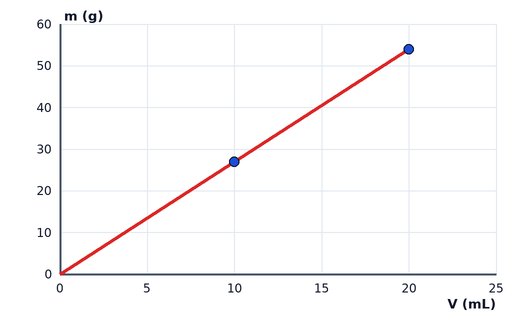
الرسم يبين العلاقة بين كتلة عينة من مادة وحجمها. فإن كتلة \(35\,mL\) من المادة نفسها تعادل:The graph shows mass against volume for a sample of a material. The mass of \(35\,mL\) of the same material is:
\(87\,g\)\(87\,g\)
\(70\,g\)\(70\,g\)
\(94.5\,g\)\(94.5\,g\)
\(105\,g\)\(105\,g\)
الحلSolution
📌 ميل الخط البياني هو الكثافة: \(\rho=\dfrac{54-0}{20-0}=2.7\,g/mL\)
📌 العلاقة طردية تمر بالأصل: \(m=\rho V=2.7\times35=94.5\,g\)
✅ \(94.5\,g\)
📌 The slope of the graph is the density: \(\rho=\dfrac{54-0}{20-0}=2.7\,g/mL\)
📌 A direct proportion through the origin: \(m=\rho V=2.7\times35=94.5\,g\)
✅ \(94.5\,g\)
\[35\,\star\star\star\]
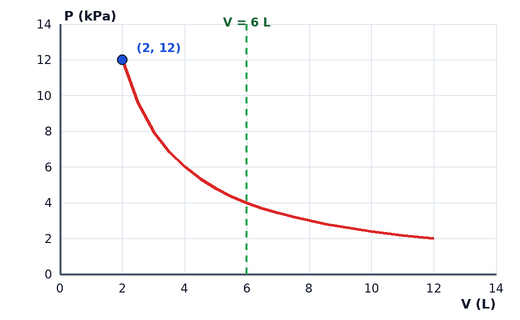
الرسم يبين العلاقة بين ضغط كمية من الغاز وحجمها عند درجة حرارة ثابتة. فإن الضغط عند الحجم \(6\,L\) يعادل:The graph shows pressure against volume of a gas at constant temperature. The pressure at a volume of \(6\,L\) is:
\(8\,kPa\)\(8\,kPa\)
\(3\,kPa\)\(3\,kPa\)
\(18\,kPa\)\(18\,kPa\)
\(4\,kPa\)\(4\,kPa\)
الحلSolution
📌 العلاقة عكسية (منحنى قطع زائد)، أي أن حاصل الضرب ثابت: \(PV=12\times2=24\,kPa\cdot L\)
📌 عند الحجم \(6\,L\): \(P=\dfrac{24}{6}=4\,kPa\)
✅ \(4\,kPa\)
📌 The relation is inverse (hyperbola), so the product is constant: \(PV=12\times2=24\,kPa\cdot L\)
📌 At \(6\,L\): \(P=\dfrac{24}{6}=4\,kPa\)
✅ \(4\,kPa\)
\[36\,\star\star\star\]
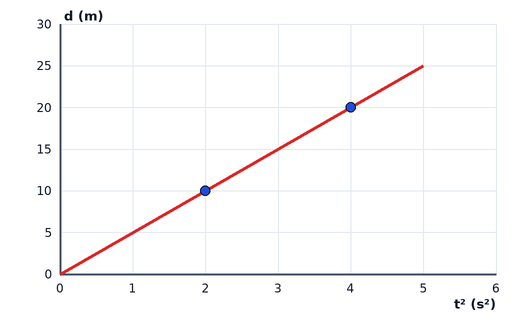
سقط جسم من السكون وسُجلت المسافة \(d\) مقابل مربع الزمن \(t^2\) فنتج الخط البياني المرسوم. فإن تسارع الجسم (علمًا أن \(d=\tfrac12at^2\)) يعادل:An object falls from rest and the distance \(d\) is plotted against the square of time \(t^2\) giving the straight line shown. The acceleration of the object (given \(d=\tfrac12at^2\)) is:
\(10\,m/s^2\)\(10\,m/s^2\)
\(5\,m/s^2\)\(5\,m/s^2\)
\(20\,m/s^2\)\(20\,m/s^2\)
\(2.5\,m/s^2\)\(2.5\,m/s^2\)
الحلSolution
📌 الرسم \(d\) مقابل \(t^2\) خط مستقيم ميله: \(\text{slope}=\dfrac{25-0}{5-0}=5\,m/s^2\)
📌 من \(d=\tfrac12at^2\) الميل يساوي \(\tfrac12a\): \(a=2\times5=10\,m/s^2\)
✅ \(10\,m/s^2\)
📌 The \(d\) against \(t^2\) graph is a straight line with slope: \(\text{slope}=\dfrac{25-0}{5-0}=5\,m/s^2\)
📌 From \(d=\tfrac12at^2\) the slope equals \(\tfrac12a\): \(a=2\times5=10\,m/s^2\)
✅ \(10\,m/s^2\)
\[37\,\star\star\]
كثافة الحديد \(7800\,kg/m^3\). فإن كثافته بوحدة \(g/cm^3\) تعادل:The density of iron is \(7800\,kg/m^3\). In \(g/cm^3\) it equals:
\(78\,g/cm^3\)\(78\,g/cm^3\)
\(0.78\,g/cm^3\)\(0.78\,g/cm^3\)
\(7.8\,g/cm^3\)\(7.8\,g/cm^3\)
\(7800\,g/cm^3\)\(7800\,g/cm^3\)
الحلSolution
📌 نحوّل: \(1\,kg=1000\,g\) و\(1\,m^3=10^6\,cm^3\): \(7800\,\dfrac{kg}{m^3}=7800\times\dfrac{1000\,g}{10^6\,cm^3}=7.8\,g/cm^3\)
✅ \(7.8\,g/cm^3\)
📌 Convert: \(1\,kg=1000\,g\) and \(1\,m^3=10^6\,cm^3\): \(7800\,\dfrac{kg}{m^3}=7800\times\dfrac{1000\,g}{10^6\,cm^3}=7.8\,g/cm^3\)
✅ \(7.8\,g/cm^3\)
📝 حل المسائل التالية
📝 Solve the Following Problems
\[1\,\star\star\]
قام أحد الطلاب بإجراء تجربة لقياس زمن سقوط كرة والمسافة التي قطعتها، فنتج الخط البياني التالي. أجب عن الأسئلة التالية:A student measured a ball's fall time and the distance it covered, producing the graph below. Answer the following:
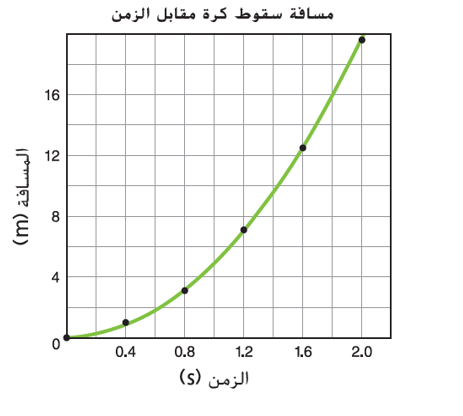
1️⃣ ما شكل الخط البياني؟
2️⃣ في الثانية \(1.8\,s\)، كم المسافة التي قطعتها الكرة؟
3️⃣ ما الزمن اللازم لتقطع الكرة مسافة \(6\,m\)؟
4️⃣ أي الصيغ التالية تعبّر عن هذا الخط البياني: \(X=a.t^2+b.t+c\;\;,\;\;X=a.t\;\;,\;\;X=at+b\;\;,\;\;X=\dfrac{a}{t}\)؟
5️⃣ ما هي القيمة الفيزيائية المستقلة في هذه التجربة؟
1️⃣ What is the shape of the graph?
2️⃣ At \(t=1.8\,s\), what distance did the ball cover?
3️⃣ What time is needed for the ball to cover \(6\,m\)?
4️⃣ Which formula represents this graph: \(X=a.t^2+b.t+c\;\;,\;\;X=a.t\;\;,\;\;X=at+b\;\;,\;\;X=\dfrac{a}{t}\)?
5️⃣ What is the independent physical quantity in this experiment?
.....................................................................
الحلSolution
1️⃣ الشكل: منحنى متزايد يبدأ من نقطة الأصل (ليس خطًا مستقيمًا) — شكل قطع مكافئ.
2️⃣📌 نستنتج من البيانات أن \(X=a.t^2\) بثابت \(a\approx4.9\) (تحقق: عند \(t=0.8s,\,X\approx3m\Rightarrow a=3/0.8^2\approx4.7\)؛ عند \(t=1.6s,\,X\approx12.5m\Rightarrow a=12.5/1.6^2\approx4.9\)): عند \(t=1.8\,s\): \(X=4.9\times1.8^2\approx15.9\,m\)
3️⃣📌 نحل للزمن عند \(X=6\,m\): \(6=4.9t^2\Rightarrow t^2\approx1.22\Rightarrow t\approx1.11\,s\)
4️⃣ \(X=a.t^2+b.t+c\) (بقيم \(b=c=0\)) — علاقة تربيعية، تمامًا كصيغة السقوط الحر \(X=\tfrac12gt^2\)
5️⃣ الزمن \(t\) — فهو الكمية التي تم التحكم بقياسها على المحور الأفقي، بينما المسافة \(X\) هي القيمة التابعة الناتجة عنه.
1️⃣ Shape: an increasing curve starting from the origin (not a straight line) — a parabola.
2️⃣📌 From the data, \(X=a.t^2\) with \(a\approx4.9\): at \(t=1.8\,s\): \(X=4.9\times1.8^2\approx15.9\,m\)
3️⃣📌 Solving for time at \(X=6\,m\): \(6=4.9t^2\Rightarrow t\approx1.11\,s\)
4️⃣ \(X=a.t^2+b.t+c\) (with \(b=c=0\)) — a quadratic relation, just like the free-fall formula \(X=\tfrac12gt^2\)
5️⃣ Time \(t\) — the quantity controlled/measured on the horizontal axis, while distance \(X\) is the resulting dependent variable.
\[2\,\star\star\star\]
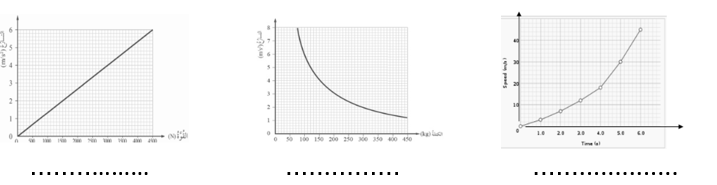
في الشكل أدناه، حدّد أي من الخطوط البيانية الثلاثة يمثّل العلاقة العكسية، وأيها يمثّل العلاقة الخطية، وأيها يمثّل العلاقة التربيعية. ثم باستخدام الخط البياني الثاني أدناه (الذي يمثّل العلاقة بين الموقع والزمن)، احسب ميل الخط البياني واكتب المعادلة المعبّرة عن موقع الجسم مستخدمًا هذا الميل:In the figure below, identify which of the three graphs represents an inverse relationship, which a linear one, and which a quadratic one. Then, using the second graph below (position vs. time), calculate its slope and write the equation for the body's position using that slope:
.....................................................................
الحلSolution
📌 تصنيف الخطوط الثلاثة: الخط المستقيم المار من نقطة الأصل → علاقة طردية. المنحنى المتناقص الذي يقترب من المحورين دون لمسهما → علاقة عكسية. المنحنى المتزايد الذي يتصاعد بشكل متسارع → علاقة تربيعية.
📌 ميل خط الموقع-الزمن: يبدأ الخط عند \(X=5\,m\) (عند \(t=0\)) ويصل إلى \(X=25\,m\) (عند \(t=8\,s\))، إذًا \(m=\dfrac{25-5}{8-0}=2.5\,m/s\)
📌 المعادلة: بما أن الخط لا يمر من نقطة الأصل (نقطة التقاطع \(b=5\,m\))، فالمعادلة خطية: \(X=2.5t+5\)
✅ طردية / عكسية / تربيعية حسب الشكل، والميل = 2.5 m/s، والمعادلة X=2.5t+5
📌 Classifying the three graphs: the straight line through the origin → direct relationship. The decreasing curve approaching both axes → inverse relationship. The increasing, accelerating curve → quadratic relationship.
📌 Slope of the position-time line: starts at \(X=5\,m\) (at \(t=0\)) and reaches \(X=25\,m\) (at \(t=8\,s\)), so \(m=\dfrac{25-5}{8-0}=2.5\,m/s\)
📌 Equation: since the line doesn't pass through the origin (intercept \(b=5\,m\)), the relation is linear: \(X=2.5t+5\)
✅ Direct / inverse / quadratic by shape, slope = 2.5 m/s, equation X=2.5t+5
لاحظت خطأ؟ أو عندك سؤال عن أحد الأسئلة؟ اكتبه بالتعليقات وحدد رقم السؤال بالضبط.
Noticed an error? Or have a question about one of the questions? Write it in the comments and specify the exact question number.