"My Lord, enable me to be grateful for Your favor which You have bestowed upon me and upon my parents, and to work righteousness of which You approve, and make righteous for me my offspring. Indeed, I have repented to You, and indeed, I am of the Muslims." (Quran 46:15)
"Our Lord, grant us from among our wives and offspring comfort to our eyes, and make us an example for the righteous." (Quran 25:74)
⚡ بنك الأسئلة: المجال الكهربائي وقانون جاوس
⚡ Question Bank: Electric Field and Gauss's Law
الصف 12 متقدم 🇦🇪 دولة الإمارات العربية المتحدة
Grade 12 Advanced 🇦🇪 United Arab Emirates
⏱️ 49 سؤال اختيار من متعدد بتصحيح فوري، و6 أسئلة مقالية محلولة بالكامل⏱️ 49 multiple-choice questions with instant feedback, plus 6 fully-solved essay questions
\[1\,\star\]
أحد وحدات القياس التالية تكافئ وحدة قياس المجال الكهربائيWhich of the following units is equivalent to the unit of electric field
A: \(Kg.m.A^{-1}.s^{-2}\)
B: \(Kg.m.A^{-1}.s^{-3}\)
C: \(Kg.m.A^{-1}.s^{-1}\)
D: \(Kg.m.A^{-2}.s^{-2}\)
الحلSolution
📌 الفكرة: وحدة المجال \(E=F/q=N/C\). بالوحدات الأساسية: \(N=kg.m/s^2\)، \(C=A.s\).
مجال كهربائي شدته \(E=500\,N/C\) وضع إلكترون داخل المجال. فإن القوة الكهربائية المؤثرة على الإلكترون تعادل \((q_e=1.6\times10^{-19}\,C)\)A uniform electric field \(E=500\,N/C\) contains an electron. The electric force on the electron is \((q_e=1.6\times10^{-19}\,C)\)
\(F_e=4\times10^{-17}\,N\) عكس اتجاه المجال\(F_e=4\times10^{-17}\,N\) opposite to the field
\(F_e=4\times10^{-17}\,N\) باتجاه المجال\(F_e=4\times10^{-17}\,N\) along the field
\(F_e=8\times10^{-17}\,N\) عكس اتجاه المجال\(F_e=8\times10^{-17}\,N\) opposite to the field
\(F_e=8\times10^{-17}\,N\) باتجاه المجال\(F_e=8\times10^{-17}\,N\) along the field
📌 Direction: The electron is negative, so the force is exactly opposite to the field direction.
✅ \(F=8\times10^{-17}\,N\) opposite to the field
\[3\,\star\star\]
في الشكل أدناه شحنتان على نفس الخط \(q_1=+9\,nC\)، والنقطة \(A\) انعدم عندها المجال الكهربائي. فإن مقدار ونوع الشحنة \(q_2\) تعادلIn the figure below, two charges lie on the same line, \(q_1=+9\,nC\), and at point \(A\) the electric field is zero. The magnitude and sign of charge \(q_2\) are
\(q_2=+1.44\times10^{-7}\,C\)
\(q_2=+2.25\times10^{-7}\,C\)
\(q_2=-3.2\times10^{-7}\,C\)
\(q_2=-4.5\times10^{-7}\,C\)
الحلSolution
📌 من الشكل: المسافة من \(q_1\) إلى \(A\) هي \(r_1=0.1\,m\)، والمسافة الكلية من \(q_1\) إلى \(q_2\) هي \(0.5\,m\)، لذا \(r_2=0.5-0.1=0.4\,m\).
📌 شرط انعدام المجال: النقطة \(A\) بين الشحنتين، والمجال ينعدم فقط إذا كانت الشحنتان من نفس النوع (فيتعاكس مجالاهما عند A ويتساويان في المقدار): \(k\dfrac{q_1}{r_1^2}=k\dfrac{q_2}{r_2^2}\)
📌 النوع: \(q_1\) موجبة، وبما أن الشحنتين من نفس النوع، فإن \(q_2\) موجبة أيضًا.
✅ \(q_2=+1.44\times10^{-7}\,C\)
📌 From the figure: The distance from \(q_1\) to \(A\) is \(r_1=0.1\,m\), and the total distance from \(q_1\) to \(q_2\) is \(0.5\,m\), so \(r_2=0.5-0.1=0.4\,m\).
📌 Zero-field condition: Point \(A\) lies between the charges; the field vanishes only if both charges are the same sign (so their fields at A are equal in magnitude and opposite in direction): \(k\dfrac{q_1}{r_1^2}=k\dfrac{q_2}{r_2^2}\)
📌 Sign: \(q_1\) is positive, and since both charges must be the same sign, \(q_2\) is positive too.
✅ \(q_2=+1.44\times10^{-7}\,C\)
\[4\,\star\star\]
في الشكل أدناه تم حساب المجال عند النقطة \(A\): \(E_{net}=500\,N/C\)، واتجاهه موضح على الرسم. فإذا كان المجال الناتج عن الشحنة الأولى \(E_1=300\,N/C\) (عموديًا)، فإن مقدار الشحنة الثانية (والتي مجالها أفقي) يعادلIn the figure below, the field at point \(A\) was found: \(E_{net}=500\,N/C\), direction shown. If the field due to the first charge is \(E_1=300\,N/C\) (vertical), the magnitude of the second charge (whose field is horizontal) is
\(q_2=+8.9\times10^{-10}\,C\)
\(q_2=+1.78\times10^{-9}\,C\)
\(q_2=-1.78\times10^{-9}\,C\)
\(q_2=+2\times10^{-9}\,C\)
الحلSolution
📌 من الشكل: المجال \(E_1\) (من \(q_1\)) عمودي، والمجال \(E_2\) (من \(q_2\)) أفقي، أي أنهما متعامدان، فيجب جمعهما بقاعدة فيثاغورس وليس بالطرح المباشر.
📌 حساب \(q_2\): من الشكل \(r_2=0.2\,m\): \(q_2=\dfrac{E_2\,r_2^2}{k}=\dfrac{400\times(0.2)^2}{9\times10^9}=\dfrac{16}{9\times10^9}\approx1.78\times10^{-9}\,C\)
📌 النوع: مجال \(q_2\) يبتعد عنها باتجاه المحصلة، فهي موجبة.
✅ \(q_2\approx+1.78\times10^{-9}\,C\)
📌 From the figure: The field \(E_1\) (from \(q_1\)) is vertical and \(E_2\) (from \(q_2\)) is horizontal, i.e. perpendicular, so they must be combined with the Pythagorean rule, not simple subtraction.
📌 Finding \(q_2\): From the figure \(r_2=0.2\,m\): \(q_2=\dfrac{E_2\,r_2^2}{k}=\dfrac{400\times(0.2)^2}{9\times10^9}=\dfrac{16}{9\times10^9}\approx1.78\times10^{-9}\,C\)
📌 Sign: The field of \(q_2\) points away from it along the resultant, so it is positive.
✅ \(q_2\approx+1.78\times10^{-9}\,C\)
\[5\,\star\]
في الشكل أدناه تم رسم خطوط المجال لثلاث شحنات فإن أحد الإجابات التالية صحيحةIn the figure below, field lines for three charges are drawn. Which of the following is correct?
📌 الاتجاه: خطوط المجال تخرج من الشحنات الموجبة وتدخل في السالبة. من الشكل: \(q_1\) موجبة (خطوط خارجة من أعلى)، و\(q_2,q_3\) سالبتان (خطوط داخلة إليهما).
📌 المقدار: كثافة الخطوط تتناسب مع مقدار الشحنة. \(q_1\) لها أكبر كثافة خطوط، بينما \(q_2,q_3\) متماثلتان في كثافة الخطوط (الشكل متماثل حولهما).
✅ \(q_1(+),\,q_2(-),\,q_3(-),\,q_1>q_2=q_3\)
📌 Direction: Field lines leave positive charges and enter negative ones. From the figure: \(q_1\) is positive (lines leaving from the top), while \(q_2,q_3\) are negative (lines entering them).
📌 Magnitude: Line density is proportional to charge magnitude. \(q_1\) has the highest density, while \(q_2,q_3\) have equal, symmetric densities.
✅ \(q_1(+),\,q_2(-),\,q_3(-),\,q_1>q_2=q_3\)
\[6\,\star\star\]
ثنائي قطب البعد بين قطبيه \(1\times10^{-10}\,m\)، وعند نقطة على امتداد محوره تبعد \(0.4\,m\) عن مركزه كانت شدة المجال \(E=9\times10^{-18}\,N/C\). فإن شحنة الثنائي تعادلAn electric dipole has separation \(1\times10^{-10}\,m\). At a point on its axis \(0.4\,m\) from its center, the field was \(E=9\times10^{-18}\,N/C\). The dipole charge is
وضع جسيم موجب الشحنة داخل المجال الموضح بالشكل أدناه فإن أحد الإجابات التالية تعبر عن حركة الجسيمA positively charged particle is placed in the field shown below. Which of the following describes its motion?
يتحرك الجسيم بسرعة ثابتةThe particle moves at constant speed
يتحرك الجسيم بعجلة ثابتةThe particle moves with constant acceleration
يتحرك الجسيم بعجلة متناقصةThe particle moves with decreasing acceleration
يتحرك الجسيم بعجلة متزايدةThe particle moves with increasing acceleration
الحلSolution
📌 طبيعة المجال: المجال في الشكل غير منتظم ويقل مع الابتعاد عن الشحنة المصدر.
📌 الاستنتاج: \(F=qE\) و\(a=F/m\)، فمع تناقص \(E\) تتناقص القوة ثم العجلة تباعًا.
✅ عجلة متناقصة
📌 Field nature: The field shown is non-uniform and decreases with distance from the source charge.
📌 Conclusion: \(F=qE\) and \(a=F/m\); as \(E\) decreases, the force and hence acceleration decrease accordingly.
✅ Decreasing acceleration
\[8\,\star\star\]
تركت كرة كتلتها \(m=5\,g\) تسقط وهي مشحونة بشحنة \(q=5\,\mu C\). فإن متجه المجال الكهربائي المنتظم الذي يجعلها متزنةA ball of mass \(m=5\,g\) carrying charge \(q=5\,\mu C\) is released. The uniform electric field vector that keeps it in equilibrium is
\(E=9.8\times10^3\,N/C\) نحو الأسفل \(\downarrow\)\(E=9.8\times10^3\,N/C\) downward \(\downarrow\)
\(E=9.8\times10^3\,N/C\) نحو الأعلى \(\uparrow\)\(E=9.8\times10^3\,N/C\) upward \(\uparrow\)
\(E=1\times10^3\,N/C\) نحو الأسفل \(\downarrow\)\(E=1\times10^3\,N/C\) downward \(\downarrow\)
\(E=1\times10^3\,N/C\) نحو الأعلى \(\uparrow\)\(E=1\times10^3\,N/C\) upward \(\uparrow\)
📌 Direction: Weight acts downward, so the electric force must be upward to balance it. Since the charge is positive, the field points the same way as the force (upward).
✅ \(E=9.8\times10^3\,N/C\) upward
\[9\,\star\star\star\]
قذف إلكترون أفقيًا وبسرعة \(v=5\times10^6\,m/s\) داخل منطقة مجال منتظم شدته \(E=1\times10^3\,N/C\) يتجه نحو المحور الرأسي الموجب. فقطع مسافة \(8\,cm\) أفقيًا، فإن الإزاحة الرأسية بنفس الفترة الزمنية تعادلAn electron is projected horizontally at \(v=5\times10^6\,m/s\) into a uniform field \(E=1\times10^3\,N/C\) directed along the positive vertical axis. It covers \(8\,cm\) horizontally. The vertical displacement in the same time is
📌 Acceleration: \(a=\dfrac{qE}{m_e}=\dfrac{1.6\times10^{-19}\times10^3}{9.11\times10^{-31}}\approx1.76\times10^{14}\,m/s^2\) (opposite the field since the electron is negative)
أحد الأشكال التالية يكون فيه عزم الدوران لثنائي القطب معدومًا في المجال الكهربائي المنتظمIn which of the following figures is the torque on a dipole zero in a uniform electric field?
A
B
C
D
الحلSolution
📌 القانون: \(\tau=pE\sin\theta\)، حيث \(\theta\) الزاوية بين محور الثنائي واتجاه المجال.
📌 الشرط: \(\tau=0\) عندما \(\sin\theta=0\)، أي عندما يكون محور الثنائي موازيًا لخطوط المجال.
📌 التطبيق: في الشكل C فقط يكون محور الثنائي موازيًا تمامًا لخطوط المجال الأفقية.
✅ الشكل C
📌 Law: \(\tau=pE\sin\theta\), where \(\theta\) is the angle between the dipole axis and the field.
📌 Condition: \(\tau=0\) when \(\sin\theta=0\), i.e. when the dipole axis is parallel to the field lines.
📌 Application: Only in figure C is the dipole axis exactly parallel to the horizontal field lines.
✅ Figure C
\[11\,\star\star\]
ثنائي قطب أقصى عزم دوران له \(\tau=1.5\times10^{-9}\,N.m\) ويتجه نحو المحور الموجب \(z\)، وهو موضوع في مجال منتظم يتجه نحو المحور الموجب \(y\) وشدته \(E=1\times10^{-3}\,N/C\)A dipole has maximum torque \(\tau=1.5\times10^{-9}\,N.m\) along the positive \(z\)-axis, placed in a uniform field along the positive \(y\)-axis of strength \(E=1\times10^{-3}\,N/C\)
\(p=1.5\times10^{-6}\,C.m\) باتجاه المحور الأفقي الموجب\(p=1.5\times10^{-6}\,C.m\) along the positive horizontal axis
\(p=1.5\times10^{-8}\,C.m\) باتجاه المحور الأفقي الموجب\(p=1.5\times10^{-8}\,C.m\) along the positive horizontal axis
\(p=1.5\times10^{-8}\,C.m\) باتجاه المحور الأفقي السالب\(p=1.5\times10^{-8}\,C.m\) along the negative horizontal axis
\(p=1.5\times10^{-6}\,C.m\) باتجاه المحور الأفقي السالب\(p=1.5\times10^{-6}\,C.m\) along the negative horizontal axis
📌 Direction: \(\vec\tau=\vec p\times\vec E\), and since \(\hat z=\hat x\times\hat y\), \(\vec p\) points along \(\hat x\) (positive horizontal axis).
✅ \(p=1.5\times10^{-6}\,C.m\) along the positive horizontal axis
\[12\,\star\star\]
سلك طوله لا نهائي، عند نقطة تبعد عنه \(0.3\,m\) كانت شدة المجال \(2.5\times10^3\,N/C\) والاتجاه موضح على الشكل. فإن عدد الإلكترونات المكتسبة أو المفقودة في وحدة الطول يعادلAn infinitely long wire: at a point \(0.3\,m\) away, the field was \(2.5\times10^3\,N/C\), direction shown. The number of electrons gained or lost per unit length is
📌 Analysis: In base units: \(\phi=\dfrac{kg.m/s^2\cdot m^2}{A.s}=kg.m^3.A^{-1}.s^{-3}\)
✅ \(Kg.m^3.A^{-1}.S^{-3}\)
\[14\,\star\star\]
قشرة كروية مشحونة بشحنة \(-4\,\mu C\) وضع بداخلها شحنة \(+4\,\mu C\). فإن شحنة السطح الداخلي \(q_1\) والخارجي \(q_2\) للقشرة على التتابعA spherical shell has charge \(-4\,\mu C\) and contains a charge \(+4\,\mu C\) inside. The inner-surface charge \(q_1\) and outer-surface charge \(q_2\) of the shell, respectively, are
\(q_1=+4\,\mu C\quad q_2=+4\,\mu C\)
\(q_1=0.0\quad q_2=0.0\)
\(q_1=-4\,\mu C\quad q_2=+4\,\mu C\)
\(q_1=-4\,\mu C\quad q_2=0.0\)
الحلSolution
📌 المجال داخل الموصل: يجب أن يكون صفرًا، فالشحنة الكلية المحصورة بأي سطح جاوس داخل مادة الموصل تساوي صفرًا: \(q_1=-q_{center}=-4\,\mu C\)
📌 السطح الخارجي: \(q_2=q_{shell}-q_1=-4-(-4)=0\)
✅ \(q_1=-4\,\mu C,\;q_2=0\)
📌 Field inside the conductor: Must be zero, so the total charge enclosed by any Gaussian surface within the conductor material is zero: \(q_1=-q_{center}=-4\,\mu C\)
📌 Outer surface: \(q_2=q_{shell}-q_1=-4-(-4)=0\)
✅ \(q_1=-4\,\mu C,\;q_2=0\)
\[15\,\star\star\star\]
سلكان لا نهائيان في الطول، كثافة الشحنات والأبعاد موضحة بالشكل أدناه، فإن النقطة \(A\) لها شدة مجال تعادلTwo infinitely long wires, charge densities and distances shown below. The field at point \(A\) is
\(E=4200\,N/C\) نحو اليمين \(\rightarrow\)\(E=4200\,N/C\) to the right \(\rightarrow\)
\(E=2800\,N/C\) نحو اليسار \(\leftarrow\)\(E=2800\,N/C\) to the left \(\leftarrow\)
\(E=4800\,N/C\) نحو اليمين \(\rightarrow\)\(E=4800\,N/C\) to the right \(\rightarrow\)
\(E=3500\,N/C\) نحو اليسار \(\leftarrow\)\(E=3500\,N/C\) to the left \(\leftarrow\)
الحلSolution
📌 من الشكل: السلك الأول \(\lambda_1=-4\times10^{-8}\,C/m\) يبعد \(0.2+0.1=0.3\,m\) عن A، والسلك الثاني \(\lambda_2=+4\times10^{-8}\,C/m\) يبعد \(0.1\,m\) عن A.
📌 مجال السلك الأول: \(E_1=\dfrac{2k\lambda_1}{r_1}=\dfrac{2\times9\times10^9\times4\times10^{-8}}{0.3}=2400\,N/C\)، ويتجه نحو السلك (يسارًا عند A، لأن الشحنة سالبة).
📌 مجال السلك الثاني: \(E_2=\dfrac{2k\lambda_2}{r_2}=\dfrac{2\times9\times10^9\times4\times10^{-8}}{0.1}=7200\,N/C\)، ويبتعد عن السلك (يمينًا عند A، لأن الشحنة موجبة).
📌 المحصلة: \(E_{net}=E_2-E_1=7200-2400=4800\,N/C\) نحو اليمين (لأن \(E_2>E_1\)).
✅ \(E=4800\,N/C\) نحو اليمين
📌 From the figure: The first wire \(\lambda_1=-4\times10^{-8}\,C/m\) is \(0.2+0.1=0.3\,m\) from A, and the second wire \(\lambda_2=+4\times10^{-8}\,C/m\) is \(0.1\,m\) from A.
📌 Field of wire 1: \(E_1=\dfrac{2k\lambda_1}{r_1}=\dfrac{2\times9\times10^9\times4\times10^{-8}}{0.3}=2400\,N/C\), pointing toward the wire (leftward at A, since negative).
📌 Field of wire 2: \(E_2=\dfrac{2k\lambda_2}{r_2}=\dfrac{2\times9\times10^9\times4\times10^{-8}}{0.1}=7200\,N/C\), pointing away from the wire (rightward at A, since positive).
📌 Net: \(E_{net}=E_2-E_1=7200-2400=4800\,N/C\) to the right (since \(E_2>E_1\)).
✅ \(E=4800\,N/C\) to the right
\[16\,\star\star\]
لوحان موصلان لا نهائيان في الطول مشحونان بكثافة متساوية في المقدار ومتعاكسة في النوع. أحد الإجابات التالية صحيحةTwo infinite conducting plates carry equal-magnitude, opposite-sign charge density. Which of the following is correct?
\(E_A=E_C=0\quad,\quad E_B=E_D\neq0\)
\(E_A>E_C\quad,\quad E_B=E_D\)
\(E_A=E_B=E_C=E_D\)
\(E_A=E_B\quad,\quad E_D=E_C\)
الحلSolution
📌 خارج اللوحين: النقطتان \(C\) (يسار اللوح السالب) و\(A\) (يمين اللوح الموجب) تقعان خارج المنطقة بين اللوحين، حيث يتلاشى مجالا اللوحين المتعاكسان: \(E_A=E_C=0\)
📌 بين اللوحين: النقطتان \(D\) و\(B\) تقعان بين اللوحين، حيث يتراكم المجالان: \(E_B=E_D=\dfrac{\sigma}{\varepsilon_0}\neq0\)
✅ \(E_A=E_C=0,\;E_B=E_D\neq0\)
📌 Outside the plates: Points \(C\) (left of the negative plate) and \(A\) (right of the positive plate) lie outside the region between the plates, where the two opposite fields cancel: \(E_A=E_C=0\)
📌 Between the plates: Points \(D\) and \(B\) lie between the plates, where the fields add: \(E_B=E_D=\dfrac{\sigma}{\varepsilon_0}\neq0\)
✅ \(E_A=E_C=0,\;E_B=E_D\neq0\)
\[17\,\star\star\]
لوحان لا نهائيان غير موصلين يمتلكان نفس مقدار الشحنة (متعاكستان في النوع). المجال الكهربائي بينهما عند النقطة \(A\) كانت شدته \(E=1\times10^3\,N/C\). فإن كثافة الشحنة على كل لوح تعادلTwo infinite non-conducting plates carry equal-magnitude (opposite-sign) charge. The field between them at point \(A\) was \(E=1\times10^3\,N/C\). The charge density on each plate is
\(\sigma=3.6\times10^{-9}\,C/m^2\)
\(\sigma=8.85\times10^{-9}\,C/m^2\)
\(\sigma=4.8\times10^{-9}\,C/m^2\)
\(\sigma=3.9\times10^{-8}\,C/m^2\)
الحلSolution
📌 القانون: بين لوحين غير موصلين متعاكسي الشحنة: \(E=\dfrac{\sigma}{\varepsilon_0}\)
ثلاث شحنات متساوية في المقدار والنوع وضعت على رؤوس مثلث متساوي الأضلاع. القوة المتبادلة بين شحنتين \(12\,N\). فإن محصلة القوى المؤثرة على أي شحنة تعادلThree equal charges are placed at the vertices of an equilateral triangle. The force between any two is \(12\,N\). The resultant force on any charge is
\(F_{net}=24\,N\)
\(F_{net}=16.65\,N\)
\(F_{net}=10.39\,N\)
\(F_{net}\approx20.8\,N\)
الحلSolution
📌 التحليل: كل شحنة تتأثر بقوتين متساويتين \(F=12\,N\) من الشحنتين الأخريين، والزاوية بينهما \(60^\circ\) (زاوية المثلث متساوي الأضلاع).
قشرة كروية غير مشحونة نصف قطرها الداخلي \(0.5\,m\) والخارجي \(0.7\,m\)، وضع داخلها في مركزها شحنة نقطية \(-6\,\mu C\). فإن شدة المجال عند نقطة تبعد \(0.6\,m\) عن المركز تعادلAn uncharged spherical shell has inner radius \(0.5\,m\) and outer radius \(0.7\,m\), with a point charge \(-6\,\mu C\) at its center. The field at a point \(0.6\,m\) from the center is
\(E=2.3\times10^5\,N/C\)
\(E=4.6\times10^5\,N/C\)
\(E=0.0\)
\(E=1.5\times10^5\,N/C\)
الحلSolution
📌 الموقع: النقطة عند \(0.6\,m\) تقع بين \(0.5\,m\) و\(0.7\,m\)، أي داخل مادة الموصل (القشرة) نفسها.
📌 النتيجة: المجال الكهربائي داخل مادة الموصل في حالة السكون الكهروستاتيكي يساوي صفرًا دائمًا.
✅ \(E=0\)
📌 Location: The point at \(0.6\,m\) lies between \(0.5\,m\) and \(0.7\,m\), i.e. inside the conductor material of the shell itself.
📌 Result: The electric field inside conductor material in electrostatic equilibrium is always zero.
✅ \(E=0\)
\[20\,\star\star\star\]
تم رسم العلاقة بين المجال والبعد عن سطح موصل كروي أجوف فنتج الخط البياني التالي. فإن الموصل مشحون بشحنة قدرهاThe relationship between field and distance from the surface of a hollow spherical conductor was plotted. The conductor carries a charge of
\(q=1.34\times10^{-9}\,C\)
\(q=1.78\times10^{-9}\,C\)
\(q=2.56\times10^{-9}\,C\)
\(q=2.14\times10^{-9}\,C\)
الحلSolution
📌 من الرسم: المجال عند السطح \(E=400\,N/C\)، ونصف قطر الكرة \(R=0.2\,m\).
تم رسم العلاقة بين المجال والبعد عن مركز كرة مشحونة مصمتة غير موصلة فكان الخط البياني التالي. مقدار المجال عند نقطة تبعد \(0.15\,m\) عن مركز الكرة يعادلThe field vs. distance from the center of a solid non-conducting charged sphere was plotted. The field at a point \(0.15\,m\) from the center is
\(E=2800\,N/C\)
\(E=3000\,N/C\)
\(E=2700\,N/C\)
\(E=2900\,N/C\)
الحلSolution
📌 من الرسم: المجال عند السطح \(E_{max}=4000\,N/C\) عند \(R=0.2\,m\).
📌 المجال داخل الكرة (\(r\lt R\)): \(E=\dfrac{kQr}{R^3}=\dfrac{9\times10^9\times1.78\times10^{-8}\times0.15}{(0.2)^3}\approx3000\,N/C\)
✅ \(E\approx3000\,N/C\)
📌 From the graph: Field at the surface \(E_{max}=4000\,N/C\) at \(R=0.2\,m\).
📌 Total charge: \(Q=\dfrac{E_{max}R^2}{k}=\dfrac{4000\times(0.2)^2}{9\times10^9}\approx1.78\times10^{-8}\,C\)
📌 Field inside the sphere (\(r\lt R\)): \(E=\dfrac{kQr}{R^3}=\dfrac{9\times10^9\times1.78\times10^{-8}\times0.15}{(0.2)^3}\approx3000\,N/C\)
✅ \(E\approx3000\,N/C\)
\[22\,\star\star\star\]
لنفس الكرة في السؤال السابق، مقدار الشحنة الموجودة داخل كرة نصف قطرها \(0.1\,m\) (ضمن الكرة المشحونة) يعادلFor the same sphere as the previous question, the charge inside a radius of \(0.1\,m\) (within the charged sphere) is
\(q=2.45\times10^{-9}\,C\)
\(q=1.78\times10^{-9}\,C\)
\(q=7.45\times10^{-9}\,C\)
\(q=2.2\times10^{-9}\,C\)
الحلSolution
📌 الفكرة: الشحنة موزعة بانتظام حجميًا، فالشحنة المحصورة تتناسب مع مكعب نصف القطر: \(q_{inside}=Q\left(\dfrac{r}{R}\right)^3\)
📌 Idea: The charge is uniformly distributed by volume, so the enclosed charge scales with the cube of the radius: \(q_{inside}=Q\left(\dfrac{r}{R}\right)^3\)
كرة مصمتة غير موصلة مشحونة بانتظام نصف قطرها \(R=0.5\,m\). عند نقطة تبعد \(r=0.3\,m\) عن المركز كانت شدة المجال \(E=4\times10^3\,N/C\). فإن شحنة الكرة تعادلA uniformly charged solid non-conducting sphere has radius \(R=0.5\,m\). At \(r=0.3\,m\) from the center, the field was \(E=4\times10^3\,N/C\). The sphere charge is
\(q=5.71\times10^{-7}\,C\)
\(q=6.28\times10^{-7}\,C\)
\(q=3.54\times10^{-7}\,C\)
\(q=1.85\times10^{-7}\,C\)
الحلSolution
📌 الموقع: \(r=0.3\,m\lt R=0.5\,m\)، أي داخل الكرة، فيُستخدم \(E=\dfrac{kQr}{R^3}\)
قشرة كروية شحنتها \(-7\,\mu C\)، نصف قطرها الداخلي \(2\,m\) والخارجي \(3\,m\). عند نقطة تبعد \(4\,m\) عن المركز كانت شدة المجال \(E=3\times10^3\,N/C\) واتجاهه نحو القشرة. فإن الشحنة الموجودة داخل القشرة تعادلA spherical shell has charge \(-7\,\mu C\), inner radius \(2\,m\), outer radius \(3\,m\). At \(4\,m\) from the center, the field was \(E=3\times10^3\,N/C\), directed toward the shell. The charge inside the shell is
\(q=+5.33\times10^{-6}\,C\)
\(q=-5.33\times10^{-6}\,C\)
\(q=+1.67\times10^{-6}\,C\)
\(q=-1.67\times10^{-6}\,C\)
الحلSolution
📌 الشحنة الكلية المحصورة (خارج القشرة): \(E=\dfrac{kQ_{total}}{r^2} \Rightarrow Q_{total}=\dfrac{Er^2}{k}=\dfrac{3000\times16}{9\times10^9}\approx5.33\times10^{-6}\,C\)، وإشارتها سالبة لأن المجال يتجه نحو القشرة.
📌 Total enclosed charge (outside the shell): \(E=\dfrac{kQ_{total}}{r^2} \Rightarrow Q_{total}=\dfrac{Er^2}{k}=\dfrac{3000\times16}{9\times10^9}\approx5.33\times10^{-6}\,C\), negative since the field points toward the shell.
شحنة كهربائية تولد حولها مجالًا. عند النقطة \(A\) كانت شدة المجال \(E=6\times10^4\,N/C\)، وعند النقطة \(B\) كانت \(E=3\times10^4\,N/C\). فإن النسبة \(r_A/r_B\) تعادلA charge generates a field. At point \(A\), \(E=6\times10^4\,N/C\); at point \(B\), \(E=3\times10^4\,N/C\). The ratio \(r_A/r_B\) is
في الشكل أدناه شحنة نقطية تولد مجالًا، فإن النسبة بين مجال النقطة \(A\) إلى مجال النقطة \(B\) تعادلIn the figure below, a point charge generates a field. The ratio of the field at \(A\) to the field at \(B\) is
\(E_A/E_B=16\)
\(E_A/E_B=3\)
\(E_A/E_B=9\)
\(E_A/E_B=4\)
الحلSolution
📌 من الشكل: \(r_A=r\)، و\(r_B=r+3r=4r\) (المسافة من الشحنة إلى A ثم من A إلى B).
يوضح الشكل أربعة أسطح جاوس تحيط بتوزيع الشحنات. أي سطح جاوس لا يوجد به تدفق كهربائيThe figure shows four Gaussian surfaces surrounding a charge distribution. Which Gaussian surface has zero electric flux through it?
السطح الأولSurface 1
السطح الثانيSurface 2
السطح الثالثSurface 3
السطح الرابعSurface 4
الحلSolution
📌 قانون جاوس: \(\phi=\dfrac{Q_{enc}}{\varepsilon_0}\)، فالتدفق يعتمد فقط على الشحنة المحصورة داخل السطح.
📌 التحليل: السطح الأول لا يحيط بأي شحنة، فتدفقه صفر. باقي الأسطح تحيط بشحنات، فتدفقها غير صفري.
✅ السطح الأول
📌 Gauss's law: \(\phi=\dfrac{Q_{enc}}{\varepsilon_0}\), so flux depends only on the enclosed charge.
📌 Analysis: Surface 1 encloses no charge, so its flux is zero. The other surfaces enclose charges, so their flux is non-zero.
✅ Surface 1
\[28\,\star\star\]
يتم وضع سطح جاوس (شكل حبة الفاصولياء) في أربع حالات مختلفة نسبةً للمجال الكهربائي. في أي حالة يكون التدفق الكهربائي الكلي أعلى ما يمكن عبر السطح المغلقA bean-shaped Gaussian surface is placed in four different situations relative to the electric field. In which case is the total electric flux through the closed surface the highest?
A
B
C
D
الحلSolution
📌 قانون جاوس: \(\phi=\dfrac{Q_{enc}}{\varepsilon_0}\)، يعتمد فقط على الشحنة المحصورة، وليس على شكل السطح أو موقعه.
📌 التحليل: الحالة D تُظهر خطوطًا خارجة بانتظام من نقطة مصدر واحدة داخل السطح (شحنة صافية غير صفرية)، بينما الحالات الأخرى (خطوط عابرة، أو ثنائي قطب، أو خطوط دائرية مغلقة) تعطي تدفقًا صافيًا أقل أو معدومًا.
✅ الحالة D
📌 Gauss's law: \(\phi=\dfrac{Q_{enc}}{\varepsilon_0}\), depends only on the enclosed charge, not on the surface shape or position.
📌 Analysis: Case D shows lines radiating uniformly outward from a single source point inside the surface (non-zero net enclosed charge), while the other cases (pass-through lines, a dipole, or closed circulating loops) give a smaller or zero net flux.
✅ Case D
\[29\,\star\star\]
شحنة نقطية موجبة \(+4q\) وضعت داخل كرة موصلة، وشحنة نقطية سالبة \(-3q\) وضعت خارج الكرة. أحد الإجابات التالية تعبر بشكل صحيح عن نتائج قانون جاوسA positive point charge \(+4q\) is placed inside a conducting sphere, and a negative point charge \(-3q\) outside it. Which of the following correctly expresses the results of Gauss’s law?
الشحنة خارج الموصل تؤثر بقوة أكبر على الشحنة داخل الموصلThe outside charge exerts a greater force on the inside charge
الشحنة داخل الموصل تؤثر بقوة أكبر على الشحنة خارج الموصلThe inside charge exerts a greater force on the outside charge
كلا الشحنتين تؤثران بنفس القوة ولكن باتجاه متعاكسBoth charges exert the same force but in opposite directions
الشحنة داخل الموصل لن تتأثر بقوة، والشحنة خارج الموصل تتأثر بقوةThe inside charge feels no force, while the outside charge does feel a force
الحلSolution
📌 المجال داخل الموصل: يساوي صفرًا دائمًا في حالة السكون الكهروستاتيكي.
📌 الاستنتاج: الشحنة \(+4q\) داخل الموصل محاطة بمجال صفري (تحجبها الشحنات المستحثة على السطح الداخلي)، فلا تتأثر بأي قوة من الخارج. أما \(-3q\) خارج الموصل فتتأثر بمجال الموصل (شحناته المستحثة على سطحه الخارجي).
✅ الشحنة داخل الموصل لا تتأثر بقوة، وخارجها تتأثر بقوة
📌 Field inside the conductor: Always zero in electrostatic equilibrium.
📌 Conclusion: The \(+4q\) charge inside the conductor is shielded by a zero field (screened by the induced charge on the inner surface), so it feels no force from outside. The \(-3q\) charge outside, however, does feel the field of the conductor (its induced outer-surface charge).
✅ The inside charge feels no force; the outside charge does
\[30\,\star\star\]
وضعت شحنة داخل سطح كروي فكان التدفق عبره \(\phi=3\times10^2\,N.m^2/C\). إذا تم مضاعفة نصف قطر السطح، فإن التدفق على السطح الجديد يكونA charge is placed inside a spherical surface with flux \(\phi=3\times10^2\,N.m^2/C\). If the radius is doubled, the new flux is
\(\phi=6\times10^2\,N.m^2/C\)
\(\phi=3\times10^2\,N.m^2/C\)
\(\phi=12\times10^2\,N.m^2/C\)
\(\phi=1.5\times10^2\,N.m^2/C\)
الحلSolution
📌 قانون جاوس: \(\phi=\dfrac{Q_{enc}}{\varepsilon_0}\)، يعتمد فقط على الشحنة المحصورة، وليس على حجم السطح أو شكله.
📌 الاستنتاج: الشحنة المحصورة لم تتغير، فالتدفق يبقى كما هو تمامًا.
✅ \(\phi=3\times10^2\,N.m^2/C\)
📌 Gauss's law: \(\phi=\dfrac{Q_{enc}}{\varepsilon_0}\), depends only on the enclosed charge, not the size or shape of the surface.
📌 Conclusion: The enclosed charge is unchanged, so the flux stays exactly the same.
✅ \(\phi=3\times10^2\,N.m^2/C\)
\[31\,\star\star\star\]
مجال كهربائي شدته \(E=8\hat X+3\hat Y+4\hat Z\,(N/C)\). فإن التدفق عبر السطح الجانبي الأيمن لمكعب طول ضلعه \(10\,cm\) يعادلAn electric field is given by \(E=8\hat X+3\hat Y+4\hat Z\,(N/C)\). The flux through the right side surface of a cube of side \(10\,cm\) is
\(\phi=6\times10^{-2}\,N.m^2/C\)
\(\phi=8\times10^{-2}\,N.m^2/C\)
\(\phi=2\times10^{-2}\,N.m^2/C\)
\(\phi=4\times10^{-2}\,N.m^2/C\)
الحلSolution
📌 تحديد السطح: السطح الجانبي الأيمن عمودي على المحور \(X\)، فالتدفق يعتمد فقط على المركبة \(E_x=8\,N/C\).
كرة موصلة مجوفة نصف قطرها \(0.2\,m\) فقدت \(n=5\times10^{12}\) إلكترون. فإن كثافة الشحنات على سطحها تعادل \((q_e=1.6\times10^{-19}\,C)\)A hollow conducting sphere of radius \(0.2\,m\) lost \(n=5\times10^{12}\) electrons. The surface charge density is \((q_e=1.6\times10^{-19}\,C)\)
\(\sigma=1.6\times10^{-6}\,C/m^2\)
\(\sigma=6\times10^{-6}\,C/m^2\)
\(\sigma=3.6\times10^{-6}\,C/m^2\)
\(\sigma=4.8\times10^{-6}\,C/m^2\)
الحلSolution
📌 الشحنة الكلية: \(Q=ne=5\times10^{12}\times1.6\times10^{-19}=8\times10^{-7}\,C\) (موجبة، لأنها فقدت إلكترونات)
📌 مساحة السطح: \(A=4\pi R^2=4\pi(0.2)^2\approx0.503\,m^2\)
شبه مخروط (اسطوانة ناقصة) عازل، نصف قطر قاعدته الصغرى \(0.1\,m\) والكبرى \(0.2\,m\)، وضع في مجال منتظم شدته \(500\,N/C\) موازٍ لمحوره. فإن التدفق عبر السطح الجانبي يعادلAn insulating truncated cone with small radius \(0.1\,m\) and large radius \(0.2\,m\) is placed in a uniform field of \(500\,N/C\) parallel to its axis. The flux through the lateral surface is
\(\phi=0.0\)
\(\phi=-35.2\,N.m^2/C\)
\(\phi=47.1\,N.m^2/C\)
\(\phi=25.3\,N.m^2/C\)
الحلSolution
📌 قانون جاوس: لا شحنة محصورة داخل السطح المغلق (قاعدتان + سطح جانبي)، فمجموع التدفق الكلي يساوي صفرًا: \(\phi_{bases}+\phi_{lateral}=0\)
📌 Gauss's law: No charge is enclosed by the closed surface (two bases + lateral surface), so the total flux sums to zero: \(\phi_{bases}+\phi_{lateral}=0\)
📌 Flux through the bases: \(\phi_{bases}=E(A_{large}-A_{small})=500\times\pi(0.2^2-0.1^2)=500\pi(0.03)\approx47.1\,N.m^2/C\)
📌 Flux through the lateral surface: \(|\phi_{lateral}|=|\phi_{bases}|\approx47.1\,N.m^2/C\)
✅ \(\phi\approx47.1\,N.m^2/C\)
\[34\,\star\star\star\]
مكعب وضعت في مركزه شحنة نقطية \(8\times10^{-9}\,C\). فإن التدفق عبر السطحين العلوي والسفلي معًا يعادل \((\varepsilon_0=8.85\times10^{-12}\,C^2/N.m^2)\)A cube has a point charge \(8\times10^{-9}\,C\) at its center. The combined flux through the top and bottom surfaces is \((\varepsilon_0=8.85\times10^{-12}\,C^2/N.m^2)\)
📌 Total flux: \(\phi_{total}=\dfrac{Q}{\varepsilon_0}=\dfrac{8\times10^{-9}}{8.85\times10^{-12}}\approx904\,N.m^2/C\)
📌 Per face: The charge is at the center, so the flux splits equally among the six faces: \(\phi_{face}=904/6\approx150.7\,N.m^2/C\)
📌 Top + bottom: \(\phi=2\times150.7\approx301\,N.m^2/C\)
✅ \(\phi\approx301\,N.m^2/C\)
\[35\,\star\star\star\]
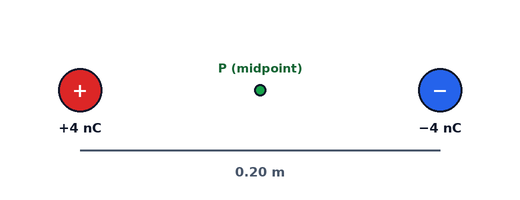
شحنتان \(+4\,nC\) و\(-4\,nC\) تفصل بينهما \(0.20\,m\) كما في الشكل. فإن المجال الكهربائي عند النقطة \(P\) في منتصف المسافة بينهما (\(k=9\times10^9\)):Charges \(+4\,nC\) and \(-4\,nC\) are \(0.20\,m\) apart as shown. The electric field at the midpoint \(P\) between them is (\(k=9\times10^9\)):
صفرzero
3600 N/C نحو الشحنة السالبة3600 N/C toward the negative charge
7200 N/C نحو الشحنة الموجبة7200 N/C toward the positive charge
7200 N/C نحو الشحنة السالبة7200 N/C toward the negative charge
الحلSolution
📌 الخطوة 1: البعد عن كل شحنة \(r=0.10\,m\) والمجال الناتج عن كل منهما: \(E=\dfrac{kq}{r^2}=\dfrac{9\times10^9\times4\times10^{-9}}{0.1^2}=3600\,N/C\)
📌 الخطوة 2: عند المنتصف يكون المجالان في الاتجاه نفسه (يبتعد عن الموجبة ويتجه نحو السالبة) فيجمعان: \(E=3600+3600=7200\,N/C\) نحو الشحنة السالبة.
✅ 7200 N/C نحو الشحنة السالبة
📌 Step 1: البعد عن كل شحنة \(r=0.10\,m\) والمجال الناتج عن كل منهما: \(E=\dfrac{kq}{r^2}=\dfrac{9\times10^9\times4\times10^{-9}}{0.1^2}=3600\,N/C\)
📌 Step 2: At the midpoint the two fields point the same way (away from the positive, toward the negative) so they add: \(E=3600+3600=7200\,N/C\) toward the negative charge.
✅ 7200 N/C toward the negative charge
\[36\,\star\star\star\]
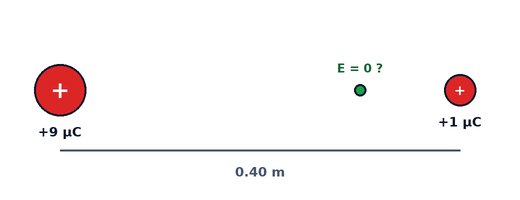
شحنتان موجبتان \(+9\,\mu C\) و\(+1\,\mu C\) تفصل بينهما \(0.40\,m\) كما في الشكل. فإن النقطة الواقعة بينهما التي ينعدم عندها المجال الكهربائي تبعد عن الشحنة \(+1\,\mu C\):Positive charges \(+9\,\mu C\) and \(+1\,\mu C\) are \(0.40\,m\) apart as shown. The point between them where the electric field is zero is at a distance from the \(+1\,\mu C\) charge of:
\(0.2\,m\)\(0.2\,m\)
\(0.3\,m\)\(0.3\,m\)
\(0.1\,m\)\(0.1\,m\)
\(0.05\,m\)\(0.05\,m\)
الحلSolution
📌 الخطوة 1: عند نقطة انعدام المجال يتساوى المجالان: \(\dfrac{k(9)}{(0.4-x)^2}=\dfrac{k(1)}{x^2}\)
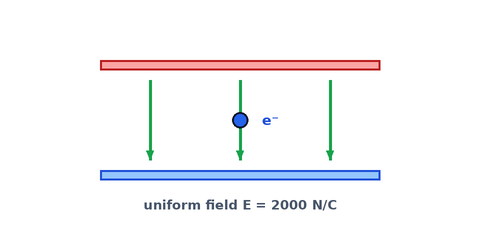
إلكترون في مجال كهربائي منتظم شدته \(2000\,N/C\) كما في الشكل (\(e=1.6\times10^{-19}\,C\)، \(m_e=9.11\times10^{-31}\,kg\)). فإن تسارعه:An electron is in a uniform electric field of \(2000\,N/C\) as shown (\(e=1.6\times10^{-19}\,C\), \(m_e=9.11\times10^{-31}\,kg\)). Its acceleration is:
📌 الخطوة 1: القوة الكهربائية: \(F=eE=1.6\times10^{-19}\times2000=3.2\times10^{-16}\,N\)
📌 الخطوة 2: من قانون نيوتن الثاني: \(a=\dfrac{F}{m}=\dfrac{3.2\times10^{-16}}{9.11\times10^{-31}}=3.5\times10^{14}\,m/s^2\) (عكس اتجاه المجال لأن الشحنة سالبة).
✅ \(3.5\times10^{14}\,m/s^2\)
📌 Step 1: القوة الكهربائية: \(F=eE=1.6\times10^{-19}\times2000=3.2\times10^{-16}\,N\)
📌 Step 2: From Newton’s second law: \(a=\dfrac{F}{m}=\dfrac{3.2\times10^{-16}}{9.11\times10^{-31}}=3.5\times10^{14}\,m/s^2\) (opposite to the field since the charge is negative).
✅ \(3.5\times10^{14}\,m/s^2\)
\[38\,\star\star\star\]
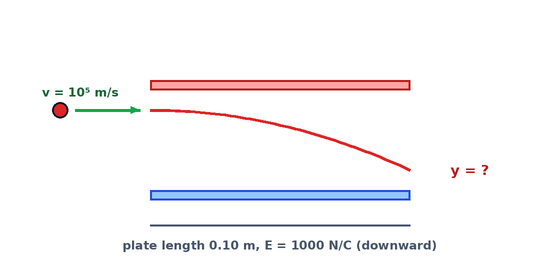
بروتون يدخل أفقيًا بسرعة \(10^5\,m/s\) بين لوحين طولهما \(0.10\,m\) والمجال بينهما \(1000\,N/C\) رأسيًا للأسفل كما في الشكل (\(m_p=1.67\times10^{-27}\,kg\)). فإن انحرافه الرأسي عند خروجه:A proton enters horizontally at \(10^5\,m/s\) between plates of length \(0.10\,m\) with a downward field of \(1000\,N/C\) as shown (\(m_p=1.67\times10^{-27}\,kg\)). Its vertical deflection on leaving is:
\(9.6\,cm\)\(9.6\,cm\)
\(0.48\,cm\)\(0.48\,cm\)
\(1.0\,cm\)\(1.0\,cm\)
\(4.8\,cm\)\(4.8\,cm\)
الحلSolution
📌 الخطوة 1: زمن العبور: \(t=\dfrac{0.10}{10^5}=10^{-6}\,s\) والتسارع: \(a=\dfrac{eE}{m_p}=\dfrac{1.6\times10^{-19}\times1000}{1.67\times10^{-27}}=9.6\times10^{10}\,m/s^2\)
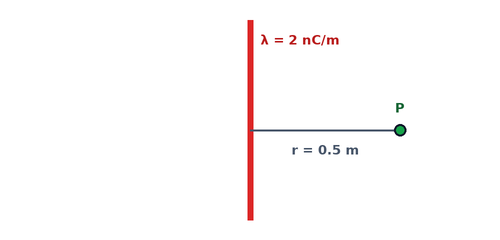
سلك طويل جدًا يحمل كثافة شحنة طولية \(\lambda=2\,nC/m\) كما في الشكل. فإن شدة المجال عند نقطة تبعد \(0.5\,m\) عنه (\(k=9\times10^9\)):A very long wire carries a linear charge density \(\lambda=2\,nC/m\) as shown. The field strength at a point \(0.5\,m\) from it is (\(k=9\times10^9\)):
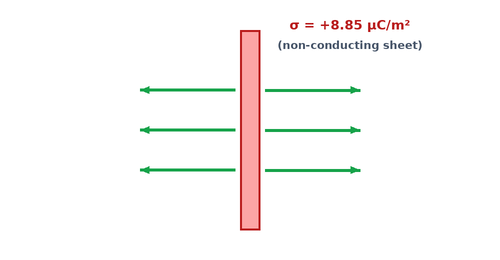
صفيحة لا نهائية غير موصلة كثافة شحنتها السطحية \(\sigma=8.85\,\mu C/m^2\) كما في الشكل (\(\varepsilon_0=8.85\times10^{-12}\)). فإن شدة المجال بالقرب منها:An infinite non-conducting sheet has surface charge density \(\sigma=8.85\,\mu C/m^2\) as shown (\(\varepsilon_0=8.85\times10^{-12}\)). The field strength near it is:
\(1\times10^6\,N/C\)\(1\times10^6\,N/C\)
\(2.5\times10^5\,N/C\)\(2.5\times10^5\,N/C\)
\(5\times10^5\,N/C\)\(5\times10^5\,N/C\)
\(8.85\times10^6\,N/C\)\(8.85\times10^6\,N/C\)
الحلSolution
📌 الخطوة 1: للصفيحة غير الموصلة: \(E=\dfrac{\sigma}{2\varepsilon_0}=\dfrac{8.85\times10^{-6}}{2\times8.85\times10^{-12}}=5\times10^5\,N/C\) (ويكون ضعف هذه القيمة للصفيحة الموصلة).
✅ \(5\times10^5\,N/C\)
📌 Step 1: For a non-conducting sheet: \(E=\dfrac{\sigma}{2\varepsilon_0}=\dfrac{8.85\times10^{-6}}{2\times8.85\times10^{-12}}=5\times10^5\,N/C\) (twice this value for a conducting plate).
✅ \(5\times10^5\,N/C\)
\[41\,\star\star\star\]
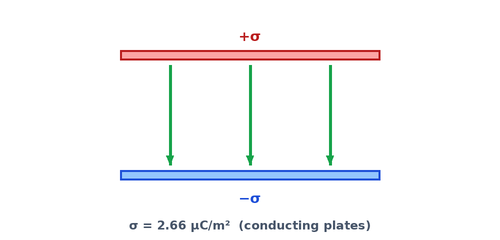
لوحان موصلان متوازيان متقابلان كثافة الشحنة السطحية على كل منهما \(2.66\,\mu C/m^2\) كما في الشكل. فإن شدة المجال بين اللوحين:Two parallel conducting plates carry surface charge density \(2.66\,\mu C/m^2\) each as shown. The field strength between the plates is:
📌 الخطوة 1: بين لوحين موصلين: \(E=\dfrac{\sigma}{\varepsilon_0}=\dfrac{2.66\times10^{-6}}{8.85\times10^{-12}}=3.0\times10^5\,N/C\)
✅ \(3.0\times10^5\,N/C\)
📌 Step 1: بين لوحين موصلين: \(E=\dfrac{\sigma}{\varepsilon_0}=\dfrac{2.66\times10^{-6}}{8.85\times10^{-12}}=3.0\times10^5\,N/C\)
✅ \(3.0\times10^5\,N/C\)
\[42\,\star\star\star\]
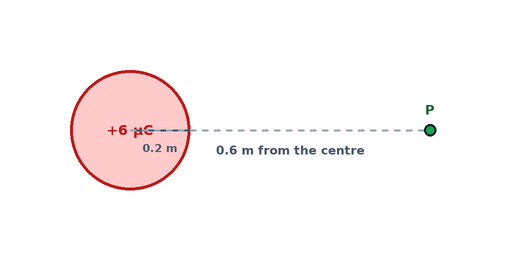
كرة موصلة شحنتها \(+6\,\mu C\) ونصف قطرها \(0.2\,m\) كما في الشكل. فإن شدة المجال عند نقطة تبعد \(0.6\,m\) عن مركزها:A conducting sphere of charge \(+6\,\mu C\) and radius \(0.2\,m\) is shown. The field strength at a point \(0.6\,m\) from its centre is:
\(4.5\times10^5\,N/C\)\(4.5\times10^5\,N/C\)
\(0\)\(0\)
\(1.35\times10^6\,N/C\)\(1.35\times10^6\,N/C\)
\(1.5\times10^5\,N/C\)\(1.5\times10^5\,N/C\)
الحلSolution
📌 الخطوة 1: خارج الكرة يكون المجال كأن الشحنة كلها في المركز: \(E=\dfrac{kQ}{r^2}=\dfrac{9\times10^9\times6\times10^{-6}}{0.6^2}=1.5\times10^5\,N/C\)
✅ \(1.5\times10^5\,N/C\)
📌 Step 1: خارج الكرة يكون المجال كأن الشحنة كلها في المركز: \(E=\dfrac{kQ}{r^2}=\dfrac{9\times10^9\times6\times10^{-6}}{0.6^2}=1.5\times10^5\,N/C\)
✅ \(1.5\times10^5\,N/C\)
\[43\,\star\star\star\]
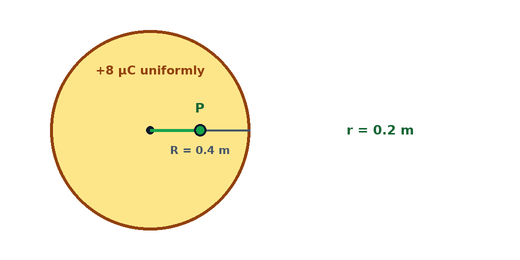
كرة مصمتة غير موصلة نصف قطرها \(R=0.4\,m\) مشحونة بانتظام بشحنة \(+8\,\mu C\) كما في الشكل. فإن شدة المجال عند نقطة داخلها تبعد \(0.2\,m\) عن المركز:A solid non-conducting sphere of radius \(R=0.4\,m\) is uniformly charged with \(+8\,\mu C\) as shown. The field strength at a point inside it \(0.2\,m\) from the centre is:
\(4.5\times10^5\,N/C\)\(4.5\times10^5\,N/C\)
\(2.25\times10^5\,N/C\)\(2.25\times10^5\,N/C\)
\(1.8\times10^6\,N/C\)\(1.8\times10^6\,N/C\)
\(0\)\(0\)
الحلSolution
📌 الخطوة 1: داخل الكرة المصمتة المشحونة بانتظام: \(E=\dfrac{kQr}{R^3}=\dfrac{9\times10^9\times8\times10^{-6}\times0.2}{0.4^3}=2.25\times10^5\,N/C\)
📌 الخطوة 2: (ويكون المجال داخل الكرة الموصلة صفرًا بخلاف المصمتة غير الموصلة).
✅ \(2.25\times10^5\,N/C\)
📌 Step 1: داخل الكرة المصمتة المشحونة بانتظام: \(E=\dfrac{kQr}{R^3}=\dfrac{9\times10^9\times8\times10^{-6}\times0.2}{0.4^3}=2.25\times10^5\,N/C\)
📌 Step 2: (Inside a conducting sphere the field is zero, unlike a uniformly charged non-conducting sphere).
✅ \(2.25\times10^5\,N/C\)
\[44\,\star\star\star\]
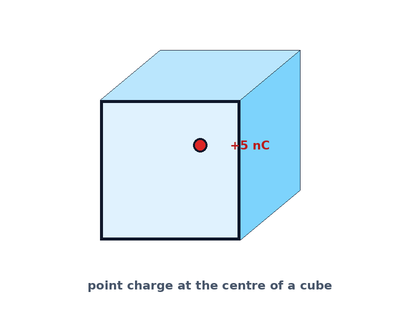
شحنة نقطية \(5\,nC\) في مركز مكعب كما في الشكل (\(\varepsilon_0=8.85\times10^{-12}\)). فإن التدفق الكهربائي عبر وجه واحد من أوجه المكعب:A point charge \(5\,nC\) is at the centre of a cube as shown (\(\varepsilon_0=8.85\times10^{-12}\)). The electric flux through one face of the cube is:
📌 Step 2: يتوزع بالتساوي على الأوجه الستة: \(\Phi_{face}=\dfrac{565}{6}\approx94\,N\cdot m^2/C\)
✅ \(94\,N\cdot m^2/C\)
\[45\,\star\star\star\]
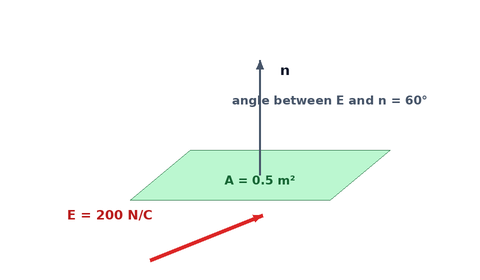
سطح مستوٍ مساحته \(0.5\,m^2\) في مجال منتظم شدته \(200\,N/C\) والزاوية بين المجال والعمودي على السطح \(60^\circ\) كما في الشكل. فإن التدفق عبر السطح:A flat surface of area \(0.5\,m^2\) is in a uniform field of \(200\,N/C\) and the angle between the field and the normal to the surface is \(60^\circ\) as shown. The flux through the surface is:
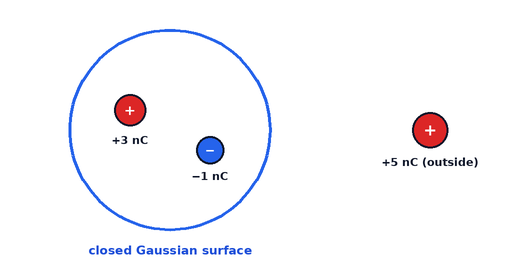
يحيط سطح جاوس مغلق بشحنتين \(+3\,nC\) و\(-1\,nC\) وتوجد شحنة \(+5\,nC\) خارجه كما في الشكل (\(\varepsilon_0=8.85\times10^{-12}\)). فإن التدفق الكلي عبر السطح:A closed Gaussian surface encloses charges \(+3\,nC\) and \(-1\,nC\) while a \(+5\,nC\) charge lies outside as shown (\(\varepsilon_0=8.85\times10^{-12}\)). The total flux through the surface is:
\(226\,N\cdot m^2/C\)\(226\,N\cdot m^2/C\)
\(791\,N\cdot m^2/C\)\(791\,N\cdot m^2/C\)
\(339\,N\cdot m^2/C\)\(339\,N\cdot m^2/C\)
\(452\,N\cdot m^2/C\)\(452\,N\cdot m^2/C\)
الحلSolution
📌 الخطوة 1: الشحنة المحصورة داخل السطح فقط: \(Q_{enc}=3-1=2\,nC\) (الشحنة الخارجية لا تساهم في التدفق الكلي).
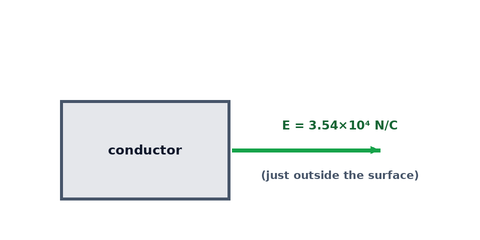
المجال الكهربائي بالقرب من سطح موصل شدته \(3.54\times10^4\,N/C\) كما في الشكل (\(\varepsilon_0=8.85\times10^{-12}\)). فإن كثافة الشحنة السطحية عند تلك النقطة:The electric field just outside a conductor’s surface is \(3.54\times10^4\,N/C\) as shown (\(\varepsilon_0=8.85\times10^{-12}\)). The surface charge density at that point is:
📌 الخطوة 1: بجوار سطح موصل: \(E=\dfrac{\sigma}{\varepsilon_0}\Rightarrow\sigma=\varepsilon_0E=8.85\times10^{-12}\times3.54\times10^4=3.13\times10^{-7}\,C/m^2\)
✅ \(3.13\times10^{-7}\,C/m^2\)
📌 Step 1: بجوار سطح موصل: \(E=\dfrac{\sigma}{\varepsilon_0}\Rightarrow\sigma=\varepsilon_0E=8.85\times10^{-12}\times3.54\times10^4=3.13\times10^{-7}\,C/m^2\)
✅ \(3.13\times10^{-7}\,C/m^2\)
\[48\,\star\star\star\]
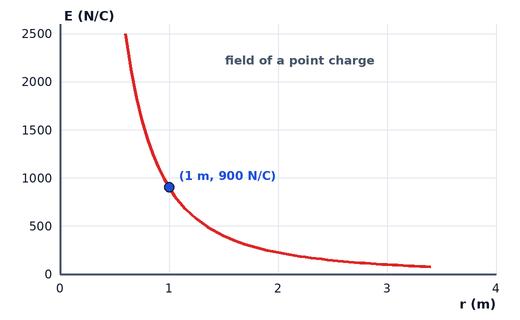
يمثل الرسم المجال الكهربائي لشحنة نقطية مع البعد عنها (يمر بالنقطة \((1\,m,\,900\,N/C)\)). فإن المجال عند بعد \(3\,m\):The graph shows the electric field of a point charge against distance (passing through \((1\,m,\,900\,N/C)\)). The field at a distance of \(3\,m\) is:
\(300\,N/C\)\(300\,N/C\)
\(33\,N/C\)\(33\,N/C\)
\(100\,N/C\)\(100\,N/C\)
\(900\,N/C\)\(900\,N/C\)
الحلSolution
📌 الخطوة 1: المجال يتناسب عكسيًا مع مربع البعد: \(\dfrac{E_2}{E_1}=\left(\dfrac{r_1}{r_2}\right)^2=\left(\dfrac{1}{3}\right)^2=\dfrac19\)
📌 الخطوة 2: \(E_2=\dfrac{900}{9}=100\,N/C\)
✅ \(100\,N/C\)
📌 Step 1: المجال يتناسب عكسيًا مع مربع البعد: \(\dfrac{E_2}{E_1}=\left(\dfrac{r_1}{r_2}\right)^2=\left(\dfrac{1}{3}\right)^2=\dfrac19\)
📌 Step 2: \(E_2=\dfrac{900}{9}=100\,N/C\)
✅ \(100\,N/C\)
\[49\,\star\star\star\]
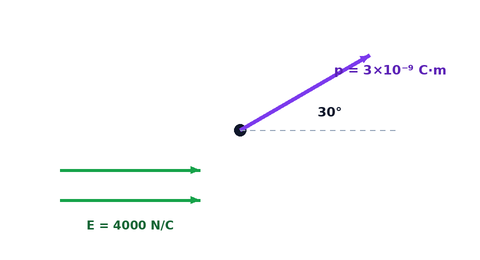
ثنائي قطب عزمه \(p=3\times10^{-9}\,C\cdot m\) في مجال منتظم شدته \(4000\,N/C\) ويصنع \(30^\circ\) معه كما في الشكل. فإن عزم الدوران المؤثر عليه:A dipole of moment \(p=3\times10^{-9}\,C\cdot m\) is in a uniform field of \(4000\,N/C\) making \(30^\circ\) with it as shown. The torque on it is:
📌 الخطوة 1: عزم الدوران على ثنائي القطب: \(\tau=pE\sin\theta=3\times10^{-9}\times4000\times\sin30^\circ=6\times10^{-6}\,N\cdot m\)
✅ \(6\times10^{-6}\,N\cdot m\)
📌 Step 1: عزم الدوران على ثنائي القطب: \(\tau=pE\sin\theta=3\times10^{-9}\times4000\times\sin30^\circ=6\times10^{-6}\,N\cdot m\)
✅ \(6\times10^{-6}\,N\cdot m\)
✍️ الأسئلة المقالية
✍️ Essay Questions
\[1\,\star\star\star\]
شحنتان نقطيتان على استقامة واحدة: \(q_1=8\,nC\) موجبة، ثم \(q_2=?\) على بعد \(0.2\,m\) منها، ثم النقطة \(A\) على بعد \(0.1\,m\) أخرى من \(q_2\). المجال الكلي عند \(A\): \(E_{net}=500\,N/C\) باتجاه الابتعاد عن الشحنتين. 1. ما نوع \(q_2\)؟ 2. احسب مقدار \(q_2\)Two point charges on a line: \(q_1=8\,nC\) positive, then \(q_2=?\) at \(0.2\,m\) from it, then point \(A\) a further \(0.1\,m\) from \(q_2\). The net field at \(A\): \(E_{net}=500\,N/C\), directed away from both charges. 1. What is the sign of \(q_2\)? 2. Calculate the magnitude of \(q_2\)
نوع الشحنة \(q_2\)Sign of \(q_2\)
مقدار \(q_2\)Magnitude of \(q_2\)
الحلSolution
📌 من الشكل: \(r_1\) (من \(q_1\) إلى A) \(=0.2+0.1=0.3\,m\)، و\(r_2\) (من \(q_2\) إلى A) \(=0.1\,m\).
📌 مجال \(q_1\) عند A: \(E_1=\dfrac{kq_1}{r_1^2}=\dfrac{9\times10^9\times8\times10^{-9}}{(0.3)^2}=800\,N/C\)، ويتجه بعيدًا عن \(q_1\) (أي مع اتجاه المحصلة).
📌 تحديد النوع: المحصلة \(500\,N/C\) أصغر من \(E_1\) وحدها \((800\,N/C)\)، فلا بد أن مجال \(q_2\) يعاكس مجال \(q_1\) جزئيًا؛ وبما أن A تقع خارج \(q_2\) (على بعدها)، فإن معاكسة الاتجاه تعني أن مجال \(q_2\) يتجه نحوها، أي أن \(q_2\) سالبة.
📌 مقدار مجال \(q_2\): \(E_2=E_1-E_{net}=800-500=300\,N/C\)
📌 حساب \(q_2\): \(|q_2|=\dfrac{E_2\,r_2^2}{k}=\dfrac{300\times(0.1)^2}{9\times10^9}=\dfrac{3}{9\times10^9}\approx3.33\times10^{-10}\,C\)
📌 From the figure: \(r_1\) (from \(q_1\) to A) \(=0.2+0.1=0.3\,m\), and \(r_2\) (from \(q_2\) to A) \(=0.1\,m\).
📌 Field of \(q_1\) at A: \(E_1=\dfrac{kq_1}{r_1^2}=\dfrac{9\times10^9\times8\times10^{-9}}{(0.3)^2}=800\,N/C\), pointing away from \(q_1\) (i.e. along the net direction).
📌 Determining the sign: The net field \(500\,N/C\) is smaller than \(E_1\) alone \((800\,N/C)\), so \(q_2\)’s field must partly oppose \(q_1\)’s; since A lies beyond \(q_2\), an opposing field there means it points toward \(q_2\), so \(q_2\) is negative.
📌 Magnitude of \(q_2\)’s field: \(E_2=E_1-E_{net}=800-500=300\,N/C\)
✅ \(q_2\) is negative, \(|q_2|\approx3.33\times10^{-10}\,C\)
\[2\,\star\star\star\]
كرة نخاع بيلسان كتلتها \(m=5\,g\) مشحونة، علقت بخيط، ووضعت داخل مجال منتظم شدته \(E=1\times10^3\,N/C\) فانحرفت نحو اليمين (اتجاه المجال)، بحيث يصنع الخيط زاوية \(\theta=8^\circ\) مع الرأسي. 1. حدد نوع شحنة الكرة. 2. احسب مقدار شحنة الكرة.A pith ball of mass \(m=5\,g\) is charged and suspended by a string in a uniform field \(E=1\times10^3\,N/C\); it deflects toward the field direction (right), making \(\theta=8^\circ\) with the vertical. 1. Determine the sign of the ball's charge. 2. Calculate the magnitude of the charge.
نوع الشحنةSign of the charge
مقدار الشحنةCharge magnitude
الحلSolution
📌 النوع: الكرة انحرفت باتجاه المجال، فالقوة الكهربائية عليها بنفس اتجاه المجال، أي أن الشحنة موجبة.
موصل كروي نصف قطره \(R=0.05\,m\) شحنته موزعة بانتظام على سطحه بكثافة \(\sigma=8.5\,nC/m^2\). احسب المجال الكهربائي عند سطح هذا الموصل.A spherical conductor of radius \(R=0.05\,m\) has surface charge density \(\sigma=8.5\,nC/m^2\). Calculate the electric field at its surface.
\(E=\)\(E=\)
الحلSolution
📌 طريقة أولى (مباشرة): \(E=\dfrac{\sigma}{\varepsilon_0}=\dfrac{8.5\times10^{-9}}{8.85\times10^{-12}}\approx960\,N/C\)
📌 طريقة ثانية (تأكيدية عبر الشحنة الكلية): \(Q=\sigma\times4\pi R^2=8.5\times10^{-9}\times4\pi(0.05)^2\approx2.67\times10^{-10}\,C\)، ثم \(E=\dfrac{kQ}{R^2}\approx961\,N/C\) (تطابق تقريبي مع الطريقة الأولى).
📌 Method 2 (cross-check via total charge): \(Q=\sigma\times4\pi R^2=8.5\times10^{-9}\times4\pi(0.05)^2\approx2.67\times10^{-10}\,C\), then \(E=\dfrac{kQ}{R^2}\approx961\,N/C\) (matches method 1, up to rounding).
✅ \(E\approx960\,N/C\)
\[4\,\star\star\star\]
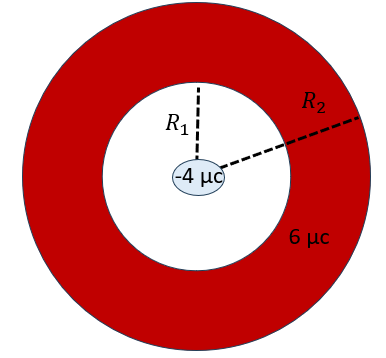
قشرة كروية نصف قطرها الداخلي \(R_1=0.5\,m\) والخارجي \(R_2=0.8\,m\)، شحنتها \(6\,\mu C\)، ووضع في مركزها شحنة \(-4\,\mu C\). 1. احسب المجال عند \(r_1=0.4\,m\) من المركز. 2. احسب المجال عند \(r_2=0.7\,m\) من المركز. 3. احسب المجال عند \(r_3=1\,m\) من المركز.A spherical shell has inner radius \(R_1=0.5\,m\), outer radius \(R_2=0.8\,m\), shell charge \(6\,\mu C\), with a charge \(-4\,\mu C\) at its center. 1. Find the field at \(r_1=0.4\,m\) from the center. 2. Find the field at \(r_2=0.7\,m\) from the center. 3. Find the field at \(r_3=1\,m\) from the center.
\(E(r_1=0.4\,m)=\)\(E(r_1=0.4\,m)=\)
\(E(r_2=0.7\,m)=\)\(E(r_2=0.7\,m)=\)
\(E(r_3=1\,m)=\)\(E(r_3=1\,m)=\)
الحلSolution
📌 عند \(r_1=0.4\,m\) (داخل الفراغ، قبل القشرة): \(E_1=\dfrac{kq_{center}}{r_1^2}=\dfrac{9\times10^9\times(-4\times10^{-6})}{(0.4)^2}\approx-2.25\times10^5\,N/C\) (باتجاه المركز، أي المقدار \(2.25\times10^5\,N/C\) نحو الداخل)
📌 عند \(r_2=0.7\,m\) (داخل مادة القشرة الموصلة): \(E_2=0\) (المجال داخل مادة الموصل يساوي صفرًا دائمًا)
📌 عند \(r_3=1\,m\) (خارج القشرة): \(Q_{total}=q_{center}+q_{shell}=-4+6=+2\,\mu C\)، ثم \(E_3=\dfrac{kQ_{total}}{r_3^2}=\dfrac{9\times10^9\times2\times10^{-6}}{1^2}=1.8\times10^4\,N/C\) للخارج
📌 At \(r_1=0.4\,m\) (in the vacuum before the shell): \(E_1=\dfrac{kq_{center}}{r_1^2}=\dfrac{9\times10^9\times(-4\times10^{-6})}{(0.4)^2}\approx-2.25\times10^5\,N/C\) (toward the center, magnitude \(2.25\times10^5\,N/C\) inward)
📌 At \(r_2=0.7\,m\) (inside the shell material): \(E_2=0\) (the field inside conductor material is always zero)
📌 At \(r_3=1\,m\) (outside the shell): \(Q_{total}=q_{center}+q_{shell}=-4+6=+2\,\mu C\), then \(E_3=\dfrac{kQ_{total}}{r_3^2}=\dfrac{9\times10^9\times2\times10^{-6}}{1^2}=1.8\times10^4\,N/C\) outward
مكعب طول ضلعه \(0.3\,m\) وضع في مجال منتظم يتجه نحو المحور الموجب \(x\) شدته \(E=200\,N/C\). 1. احسب التدفق عبر كل سطح والتدفق الكلي. 2. وضعت شحنة نقطية \(q=20\,pC\) في مركز المكعب. احسب التدفق الإضافي الناتج عنها عبر السطح الجانبي الأيسر. \((\varepsilon_0=8.85\times10^{-12}\,C^2/N.m^2)\)A cube of side \(0.3\,m\) is placed in a uniform field along the positive \(x\)-axis, \(E=200\,N/C\). 1. Find the flux through each face and the total flux. 2. A point charge \(q=20\,pC\) is placed at the cube’s center. Find the additional flux it produces through the left side surface. \((\varepsilon_0=8.85\times10^{-12}\,C^2/N.m^2)\)
التدفق الكلي (من المجال المنتظم)Total flux (from the uniform field)
التدفق الإضافي عبر السطح الأيسر (من الشحنة)Additional flux through the left face (from the charge)
الحلSolution
📌 مساحة الوجه: \(A=(0.3)^2=0.09\,m^2\)
📌 التدفق في المجال المنتظم: \(\phi_{right}=EA=200\times0.09=18\,N.m^2/C\)، \(\phi_{left}=-18\,N.m^2/C\)، وبقية الأوجه صفر (موازية للمجال). التدفق الكلي \(=18-18=0\) (متوقع، لا شحنة محصورة).
📌 إضافة الشحنة النقطية في المركز: تدفقها الكلي \(\phi_{total}=\dfrac{q}{\varepsilon_0}=\dfrac{20\times10^{-12}}{8.85\times10^{-12}}\approx2.26\,N.m^2/C\)، ولتناظر موقعها في المركز يتوزع بالتساوي على الأوجه الستة: \(\phi_{left,\,charge}=2.26/6\approx0.377\,N.m^2/C\)
✅ تدفق المجال المنتظم الكلي = صفر؛ التدفق الإضافي عبر السطح الأيسر من الشحنة \(\approx0.377\,N.m^2/C\)
📌 Face area: \(A=(0.3)^2=0.09\,m^2\)
📌 Flux from the uniform field: \(\phi_{right}=EA=200\times0.09=18\,N.m^2/C\), \(\phi_{left}=-18\,N.m^2/C\), other faces zero (parallel to the field). Total flux \(=18-18=0\) (expected, no enclosed charge).
📌 Adding the point charge at the center: Its total flux \(\phi_{total}=\dfrac{q}{\varepsilon_0}=\dfrac{20\times10^{-12}}{8.85\times10^{-12}}\approx2.26\,N.m^2/C\), and by the symmetry of its central position it splits equally among the six faces: \(\phi_{left,\,charge}=2.26/6\approx0.377\,N.m^2/C\)
✅ Total flux from the uniform field = zero; additional flux through the left face from the charge \(\approx0.377\,N.m^2/C\)
\[6\,\star\star\star\]
مكعب يحتوي على 12 بروتون و13 نيوترون وعدد من الإلكترونات. التدفق الكهربائي المقاس عبره \(\phi=9.05\times10^{-8}\,N.m^2/C\). 1. احسب الشحنة الكلية داخل المكعب. 2. احسب عدد الإلكترونات داخل المكعب. \((\varepsilon_0=8.85\times10^{-12}\,C^2/N.m^2)\)A cube contains 12 protons, 13 neutrons, and some electrons. The measured flux through it is \(\phi=9.05\times10^{-8}\,N.m^2/C\). 1. Find the total charge inside the cube. 2. Find the number of electrons inside the cube. \((\varepsilon_0=8.85\times10^{-12}\,C^2/N.m^2)\)
الشحنة الكلية داخل المكعبTotal charge inside the cube
عدد الإلكتروناتNumber of electrons
الحلSolution
📌 من قانون جاوس: \(Q_{net}=\phi\times\varepsilon_0=9.05\times10^{-8}\times8.85\times10^{-12}\approx8.01\times10^{-19}\,C\)
📌 شحنة البروتونات: \(Q_p=12\times1.6\times10^{-19}=1.92\times10^{-18}\,C\) (النيوترونات متعادلة، لا تسهم بشحنة)
📌 عدد الإلكترونات: \(Q_{net}=Q_p-ne \Rightarrow n=\dfrac{Q_p-Q_{net}}{e}=\dfrac{1.92\times10^{-18}-8.01\times10^{-19}}{1.6\times10^{-19}}\approx7\)
✅ \(Q_{net}\approx8.01\times10^{-19}\,C\)، عدد الإلكترونات \(\approx7\)
📌 From Gauss's law: \(Q_{net}=\phi\times\varepsilon_0=9.05\times10^{-8}\times8.85\times10^{-12}\approx8.01\times10^{-19}\,C\)
📌 Charge of the protons: \(Q_p=12\times1.6\times10^{-19}=1.92\times10^{-18}\,C\) (neutrons are neutral, contribute no charge)
📌 Number of electrons: \(Q_{net}=Q_p-ne \Rightarrow n=\dfrac{Q_p-Q_{net}}{e}=\dfrac{1.92\times10^{-18}-8.01\times10^{-19}}{1.6\times10^{-19}}\approx7\)
✅ \(Q_{net}\approx8.01\times10^{-19}\,C\), number of electrons \(\approx7\)