🎯 بنك الأسئلة: الحركة في بعدين وثلاثة أبعاد
🎯 Question Bank: Motion in Two and Three Dimensions
القذف الأفقي وبزاوية، معادلات الموقع والسرعة اللحظية، مقارنة المدى، والسرعة النسبية
Horizontal and Angled Projectile Motion, Position/Velocity Equations, Range Comparison, and Relative Velocity
⏱️ 41 سؤال اختيار من متعدد بتصحيح فوري، و3 مسائل محلولة بالكامل⏱️ 41 multiple-choice questions with instant feedback, plus 3 fully-solved problems
\[1\,\star\]
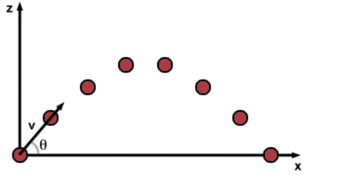
في القذف بزاوية، يكون التسارع عند أقصى ارتفاع يصل إليه المقذوفIn projectile motion at an angle, the acceleration at the maximum height reached by the projectile is
\(a=0\;m/s^2\)\(a=0\;m/s^2\)
\(a=-9.81\;m/s^2\)\(a=-9.81\;m/s^2\)
\(a=-4.95\;m/s^2\)\(a=-4.95\;m/s^2\)
\(a=-6.25\;m/s^2\)\(a=-6.25\;m/s^2\)
الحلSolution
📌 الفكرة: عند أقصى ارتفاع، تصبح المركبة الرأسية للسرعة صفرًا لحظيًا (\(v_y=0\))، لكن التسارع يبقى ثابتًا طوال الرحلة ويساوي تسارع الجاذبية، لأن التسارع ينتج عن قوة الجاذبية المستمرة وليس عن السرعة نفسها.
✅ \(a=-9.81\;m/s^2\)
📌 Idea: At maximum height, the vertical velocity component is momentarily zero (\(v_y=0\)), but the acceleration stays constant throughout the flight and equals gravitational acceleration, since acceleration comes from the continuous force of gravity, not from the velocity itself.
✅ \(a=-9.81\;m/s^2\)
\[2\,\star\star\]
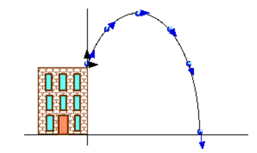
قذف أحمد كرة بسرعة ابتدائية \(\vec v=(31\hat X+20\hat Y)\) من سطح مبنى، فوصلت الكرة إلى الأرض بعد زمن قدره \(t=3.8\,s\). فإن سرعة ارتطام الكرة بالأرض تعادلAhmed launches a ball with initial velocity \(\vec v=(31\hat X+20\hat Y)\) from a building's roof, and it reaches the ground after \(t=3.8\,s\). The ball's impact speed equals
\(v=31.4\;m/s\)\(v=31.4\;m/s\)
\(v=35.5\;m/s\)\(v=35.5\;m/s\)
\(v=51\;m/s\)\(v=51\;m/s\)
\(v=41.3\;m/s\)\(v=41.3\;m/s\)
الحلSolution
📌 المركبة الأفقية ثابتة: \(v_x=31\;m/s\)
📌 المركبة الرأسية عند الارتطام: \(v_{yf}=v_{yi}-gt=20-9.81(3.8)\approx-17.28\;m/s\)
📌 مقدار سرعة الارتطام: \(v=\sqrt{31^2+17.28^2}\approx35.5\;m/s\)
✅ \(v\approx35.5\;m/s\)
📌 Horizontal component (constant): \(v_x=31\;m/s\)
📌 Vertical component at impact: \(v_{yf}=20-9.81(3.8)\approx-17.28\;m/s\)
📌 Impact speed magnitude: \(v=\sqrt{31^2+17.28^2}\approx35.5\;m/s\)
✅ \(v\approx35.5\;m/s\)
\[3\,\star\star\]
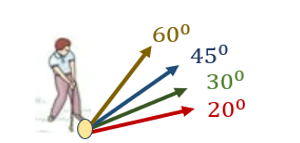
في لعبة الغولف، تم ضرب الكرة من سطح الأرض أربع مرات وبنفس السرعة الابتدائية وبزوايا مختلفة. فإن أقصى مدى تصل إليه الكرة عند ضربها بزاوية: \(\theta_1=20^0,\;\theta_2=30^0,\;\theta_3=45^0,\;\theta_4=60^0\)In golf, a ball is hit from the ground four times with the same initial speed but different angles. The ball reaches its maximum range when hit at angle: \(\theta_1=20^0,\;\theta_2=30^0,\;\theta_3=45^0,\;\theta_4=60^0\)
\(\theta=20^0\)\(\theta=20^0\)
\(\theta=30^0\)\(\theta=30^0\)
\(\theta=45^0\)\(\theta=45^0\)
\(\theta=60^0\)\(\theta=60^0\)
الحلSolution
📌 معادلة المدى الأفقي (إطلاق وهبوط بنفس الارتفاع): \(R=\dfrac{v_0^2\sin(2\theta)}{g}\)
📌 المدى أقصى ما يمكن عندما \(\sin(2\theta)\) أعظمي، أي \(2\theta=90^0\): \(\theta=45^0\)
✅ \(\theta=45^0\) (أقصى مدى ممكن لنفس السرعة الابتدائية)
📌 Range equation (equal launch/landing height): \(R=\dfrac{v_0^2\sin(2\theta)}{g}\)
📌 Range is maximum when \(\sin(2\theta)\) is maximum, i.e. \(2\theta=90^0\): \(\theta=45^0\)
✅ \(\theta=45^0\) (maximum possible range for the same launch speed)
\[4\,\star\star\]
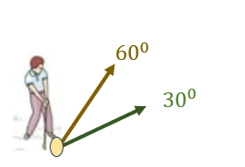
في لعبة الغولف، تم ضرب الكرة من سطح الأرض مرتين وبنفس السرعة الابتدائية، ولكن بزاويتين مختلفتين \(\theta_1=30^0,\;\theta_2=60^0\). عند مقارنة مدى الكرتين، أحد الإجابات التالية تعبر بشكل صحيح عن المدى الأفقي للكرتينIn golf, a ball is hit twice with the same initial speed but two different angles \(\theta_1=30^0,\;\theta_2=60^0\). Comparing the two ranges, which of the following correctly describes them?
\(R_1>R_2\)\(R_1>R_2\)
\(R_1=R_2\)\(R_1=R_2\)
\(R_2>R_1\)\(R_2>R_1\)
البيانات غير كافيةInsufficient data
الحلSolution
📌 الزاويتان متكاملتان: \(30^0+60^0=90^0\)
📌 خاصية دالة الجيب: \(\sin(2\times30^0)=\sin60^0\) و\(\sin(2\times60^0)=\sin120^0=\sin60^0\) — قيمتان متساويتان
✅ \(R_1=R_2\) (أي زاويتين متكاملتين تعطيان نفس المدى)
📌 The two angles are complementary: \(30^0+60^0=90^0\)
📌 Sine identity: \(\sin(60^0)=\sin(120^0)\) — equal values
✅ \(R_1=R_2\) (any pair of complementary angles gives the same range)
\[5\,\star\star\star\]
معادلة الموقع لجسم على المحور الأفقي بدلالة الزمن \(X(t)=3-6t-4t^2+t^3\)، ومعادلة الموقع لنفس الجسم على المحور الرأسي بدلالة الزمن \(Y(t)=-5t^2+t^3\). فإن السرعة التي يتحرك بها الجسم في اللحظة \(t=4\,s\) تعادلA body's horizontal position is \(X(t)=3-6t-4t^2+t^3\), and its vertical position is \(Y(t)=-5t^2+t^3\). The body's velocity at \(t=4\,s\) equals
\(\vec v=(11\hat X,9\hat Y)\;m/s\)\(\vec v=(11\hat X,9\hat Y)\;m/s\)
\(\vec v=(18\hat X,12\hat Y)\;m/s\)\(\vec v=(18\hat X,12\hat Y)\;m/s\)
\(\vec v=(10\hat X,8\hat Y)\;m/s\)\(\vec v=(10\hat X,8\hat Y)\;m/s\)
\(\vec v=(16\hat X,9\hat Y)\;m/s\)\(\vec v=(16\hat X,9\hat Y)\;m/s\)
الحلSolution
📌 السرعة اللحظية هي مشتقة الموقع بالنسبة للزمن: \(v_x=\dfrac{dX}{dt}=-6-8t+3t^2\)، \(v_y=\dfrac{dY}{dt}=-10t+3t^2\)
📌 عند \(t=4\,s\): \(v_x=-6-8(4)+3(16)=-6-32+48=10\;m/s\)
\(v_y=-10(4)+3(16)=-40+48=8\;m/s\)
✅ \(\vec v=(10\hat X,8\hat Y)\;m/s\)
📌 Instantaneous velocity is the time derivative of position: \(v_x=-6-8t+3t^2\), \(v_y=-10t+3t^2\)
📌 At \(t=4\,s\): \(v_x=-6-32+48=10\;m/s\)
\(v_y=-40+48=8\;m/s\)
✅ \(\vec v=(10\hat X,8\hat Y)\;m/s\)
\[6\,\star\star\star\]
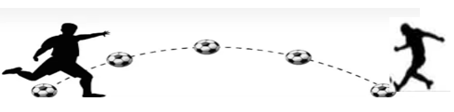
قام لاعب بركل كرة (مقذوف بزاوية) بسرعة ابتدائية قدرها \(v_0=45\,m/s\) لتصل إلى زميله الذي يبعد \(X=30.6\,m\). فإن الزاوية التي رمى بها الكرة تصنع مع الأفق زاوية قدرهاA player kicks a ball with initial speed \(v_0=45\,m/s\) to reach a teammate \(X=30.6\,m\) away. The angle the kick makes with the horizontal equals
\(\theta=3.1^0\)\(\theta=3.1^0\)
\(\theta=10.3^0\)\(\theta=10.3^0\)
\(\theta=8.5^0\)\(\theta=8.5^0\)
\(\theta=4.25^0\)\(\theta=4.25^0\)
الحلSolution
📌 معادلة المدى: \(X=\dfrac{v_0^2\sin(2\theta)}{g}\Rightarrow\sin(2\theta)=\dfrac{Xg}{v_0^2}=\dfrac{30.6\times9.81}{45^2}\approx0.1482\)
📌 حل للزاوية: \(2\theta=\arcsin(0.1482)\approx8.5^0\Rightarrow\theta\approx4.25^0\)
✅ \(\theta\approx4.25^0\)
📌 Range equation: \(\sin(2\theta)=\dfrac{Xg}{v_0^2}=\dfrac{30.6\times9.81}{45^2}\approx0.1482\)
📌 Solving for the angle: \(2\theta\approx8.5^0\Rightarrow\theta\approx4.25^0\)
✅ \(\theta\approx4.25^0\)
\[7\,\star\star\]
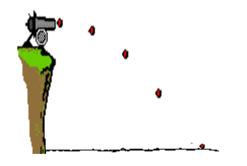
قذف مدفع قذيفة بسرعة أفقية ابتدائية \(v_0=31\,m/s\) من سطح مبنى، فوصلت القذيفة إلى الأرض بعد زمن قدره \(t=4\,s\). فإن سرعة ارتطام القذيفة بالأرض تعادلA cannon fires a shell horizontally at \(v_0=31\,m/s\) from a building's roof, landing after \(t=4\,s\). The shell's impact speed equals
\(v=67\;m/s\)\(v=67\;m/s\)
\(v=43\;m/s\)\(v=43\;m/s\)
\(v=31\;m/s\)\(v=31\;m/s\)
\(v=50\;m/s\)\(v=50\;m/s\)
الحلSolution
📌 المركبة الأفقية ثابتة (قذف أفقي): \(v_x=31\;m/s\)
📌 المركبة الرأسية عند الارتطام (بدأت من صفر): \(v_y=gt=9.81(4)\approx39.24\;m/s\)
📌 مقدار سرعة الارتطام: \(v=\sqrt{31^2+39.24^2}\approx50.0\;m/s\)
✅ \(v\approx50\;m/s\)
📌 Horizontal component (constant, horizontal launch): \(v_x=31\;m/s\)
📌 Vertical component at impact (started from zero): \(v_y=gt\approx39.24\;m/s\)
📌 Impact speed magnitude: \(v=\sqrt{31^2+39.24^2}\approx50.0\;m/s\)
✅ \(v\approx50\;m/s\)
\[8\,\star\star\star\]
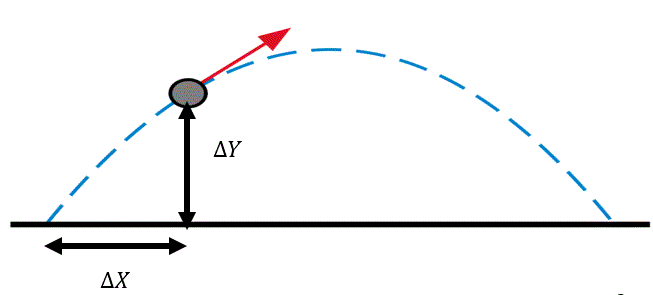
تمت كتابة معادلة الإزاحة الأفقية لمقذوف كما يلي: \(\Delta X=36t\)، ومعادلة الإزاحة الرأسية لنفس الجسم وبنفس اللحظة: \(\Delta Y=48t-4.9t^2\). فإن السرعة الابتدائية التي قُذف بها الجسم تعادلA projectile's horizontal displacement is \(\Delta X=36t\), and its vertical displacement is \(\Delta Y=48t-4.9t^2\). The initial launch speed equals
\(v_i=40\;m/s\)\(v_i=40\;m/s\)
\(v_i=60\;m/s\)\(v_i=60\;m/s\)
\(v_i=45\;m/s\)\(v_i=45\;m/s\)
\(v_i=55\;m/s\)\(v_i=55\;m/s\)
الحلSolution
📌 قارن مع معادلتي الحركة القياسيتين: \(\Delta X=v_{x0}t\Rightarrow v_{x0}=36\;m/s\). \(\Delta Y=v_{y0}t-\frac12 gt^2\Rightarrow v_{y0}=48\;m/s\) (ويتفق \(\frac12 g=4.9\) مع \(g=9.8\,m/s^2\))
📌 مقدار السرعة الابتدائية: \(v_i=\sqrt{36^2+48^2}=\sqrt{3600}=60\;m/s\)
✅ \(v_i=60\;m/s\)
📌 Compare with the standard kinematic equations: \(v_{x0}=36\;m/s\), \(v_{y0}=48\;m/s\) (and \(\frac12g=4.9\) matches \(g=9.8\,m/s^2\))
📌 Initial speed magnitude: \(v_i=\sqrt{36^2+48^2}=60\;m/s\)
✅ \(v_i=60\;m/s\)
\[9\,\star\star\]
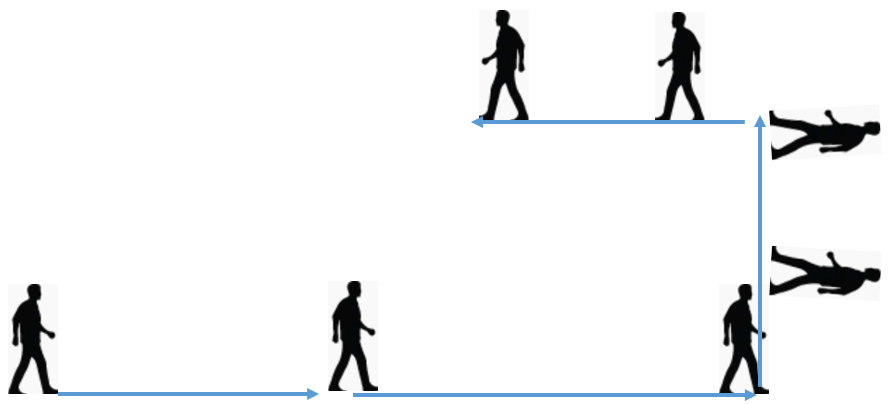
تحرك ماجد باتجاه الشرق مسافة \(60\,m\)، ثم تابع سيره بنفس الاتجاه مسافة \(80\,m\)، ثم غيّر اتجاهه نحو الشمال وقطع مسافة \(50\,m\)، ثم اتجه نحو الغرب وقطع مسافة \(40\,m\). فإن المسافة الكلية والإزاحة المقطوعة تعادلانMajid moves \(60\,m\) east, continues \(80\,m\) further east, then turns north for \(50\,m\), then heads west for \(40\,m\). The total distance and the resultant displacement equal
\(s=130\,m,\;r=170\,m\)، بزاوية 32° شمال الشرق\(s=130\,m,\;r=170\,m\), at 32° north of east
\(s=130\,m,\;r=132\,m\)، بزاوية 15° شمال الشرق\(s=130\,m,\;r=132\,m\), at 15° north of east
\(s=230\,m,\;r=127\,m\)، بزاوية 18° شمال الشرق\(s=230\,m,\;r=127\,m\), at 18° north of east
\(s=230\,m,\;r\approx111.8\,m\)، بزاوية \(\approx26.6^0\) شمال الشرق\(s=230\,m,\;r\approx111.8\,m\), at \(\approx26.6^0\) north of east
الحلSolution
📌 المسافة الكلية (مجموع أطوال المسار): \(s=60+80+50+40=230\,m\)
📌 الإزاحة الصافية شرقًا: \(60+80-40=100\,m\) شرقًا. والإزاحة شمالًا: \(50\,m\)
📌 مقدار الإزاحة المحصّلة: \(r=\sqrt{100^2+50^2}=\sqrt{12500}\approx111.8\,m\)
📌 الاتجاه: \(\theta=\arctan(50/100)\approx26.6^0\) شمال الشرق
✅ \(s=230\,m\)، \(r\approx111.8\,m\) بزاوية \(\approx26.6^0\) شمال الشرق
📌 Total distance (sum of path lengths): \(s=60+80+50+40=230\,m\)
📌 Net eastward displacement: \(60+80-40=100\,m\) east. Net northward: \(50\,m\)
📌 Resultant displacement magnitude: \(r=\sqrt{100^2+50^2}\approx111.8\,m\)
📌 Direction: \(\theta=\arctan(50/100)\approx26.6^0\) north of east
✅ \(s=230\,m\), \(r\approx111.8\,m\) at \(\approx26.6^0\) north of east
\[10\,\star\star\]
رامي سهام يقف على تلة ترتفع عن سطح الأرض \(30\,m\)، ورمى سهمًا بزاوية \(35^0\)، فوصل السهم إلى أقصى ارتفاع عن سطح الأرض \(52\,m\). فإن السرعة الابتدائية التي قُذف بها السهم تعادلAn archer stands on a \(30\,m\) hill and shoots an arrow at \(35^0\), reaching a maximum height above the ground of \(52\,m\). The arrow's initial speed equals
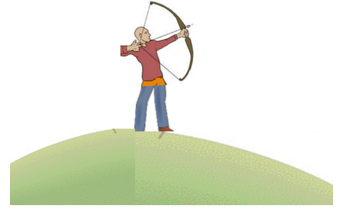
\(v_0=18.67\;m/s\)\(v_0=18.67\;m/s\)
\(v_0=25.36\;m/s\)\(v_0=25.36\;m/s\)
\(v_0=36.26\;m/s\)\(v_0=36.26\;m/s\)
\(v_0=21.24\;m/s\)\(v_0=21.24\;m/s\)
الحلSolution
📌 الارتفاع فوق نقطة الإطلاق (وليس فوق سطح الأرض): \(h=52-30=22\,m\)
📌 عند أقصى ارتفاع \(v_y=0\)، فنستخدم: \((v_0\sin\theta)^2=2gh\Rightarrow v_0\sin35^0=\sqrt{2(9.81)(22)}\approx20.78\;m/s\)
📌 السرعة الابتدائية: \(v_0=\dfrac{20.78}{\sin35^0}\approx36.26\;m/s\)
✅ \(v_0\approx36.26\;m/s\)
📌 Height above the launch point (not above the ground): \(h=52-30=22\,m\)
📌 At max height \(v_y=0\), so: \(v_0\sin35^0=\sqrt{2(9.81)(22)}\approx20.78\;m/s\)
📌 Initial speed: \(v_0\approx36.26\;m/s\)
✅ \(v_0\approx36.26\;m/s\)
\[11\,\star\]
ركل أحمد الكرة من الأرض بسرعة \(20\,m/s\) وبزاوية تصنع مع المستوى الأفقي \(15^0\). فإن أقصى ارتفاع تصل إليه الكرةAhmed kicks a ball from the ground at \(20\,m/s\) at \(15^0\) above horizontal. The ball's maximum height equals
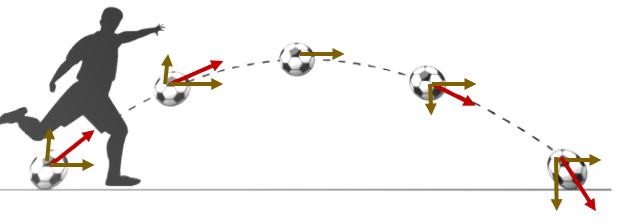
\(H=0.98\;m\)\(H=0.98\;m\)
\(H=2.11\;m\)\(H=2.11\;m\)
\(H=1.36\;m\)\(H=1.36\;m\)
\(H=1.75\;m\)\(H=1.75\;m\)
الحلSolution
📌 معادلة أقصى ارتفاع (انطلاق وهبوط بنفس المستوى): \(H=\dfrac{(v_0\sin\theta)^2}{2g}=\dfrac{(20\sin15^0)^2}{2(9.81)}=\dfrac{5.18^2}{19.62}\approx1.36\;m\)
✅ \(H\approx1.36\;m\)
📌 Max height equation (level launch/landing): \(H=\dfrac{(v_0\sin\theta)^2}{2g}\approx\dfrac{5.18^2}{19.62}\approx1.36\;m\)
✅ \(H\approx1.36\;m\)
\[12\,\star\]
قُذف جسم بسرعة ابتدائية \(v_i\) تميل فوق الأفق بزاوية \(\theta\) من قمة جرف كما في الشكل. أحد الخطوط البيانية الأربعة التالية يعبّر عن العلاقة بين السرعة الرأسية والزمن خلال رحلة القذفA body is launched with initial speed \(v_i\) at angle \(\theta\) above horizontal from the top of a cliff, as shown. Which of the following four graphs correctly represents vertical velocity vs. time during the flight?
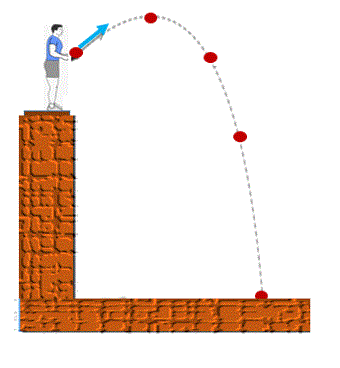
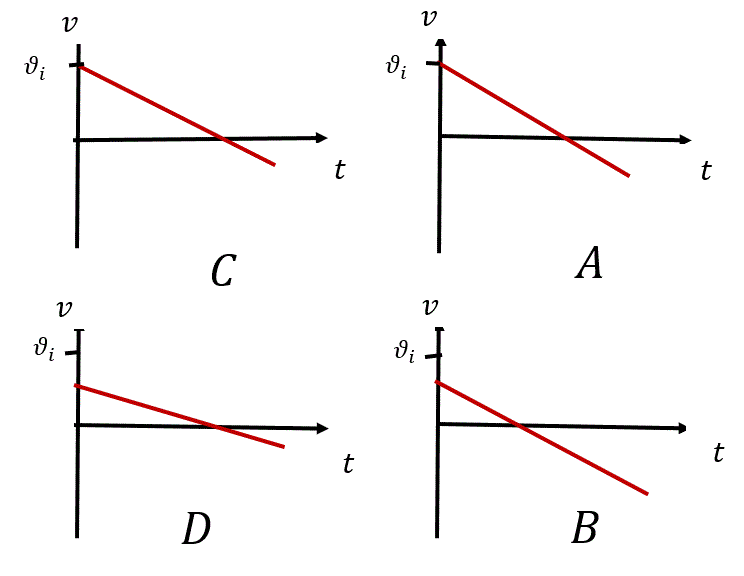
الشكل AGraph A
الشكل BGraph B
الشكل CGraph C
الشكل DGraph D
الحلSolution
📌 معادلة السرعة الرأسية: \(v_y(t)=v_i\sin\theta-gt\) — علاقة خطية في \(t\)، بميل ثابت يساوي \(-g\)
📌 السلوك المطلوب في الرسم: خط مستقيم (ليس منحنى) يبدأ من \(v_i\sin\theta\) عند \(t=0\)، وينحدر بميل ثابت سالب، يعبر الصفر عند أقصى ارتفاع، ثم يستمر سالبًا حتى الارتطام
✅ الشكل B (طبقًا لترقيم الشكل المرفق)
📌 Vertical velocity equation: \(v_y(t)=v_i\sin\theta-gt\) — linear in \(t\), with constant slope \(-g\)
📌 Required graph behavior: a straight line (not curved) starting at \(v_i\sin\theta\) at \(t=0\), with constant negative slope, crossing zero at max height, then continuing negative to impact
✅ Graph B (per the labeling in the attached figure)
\[13\,\star\]
في القذف بزاوية، الشكل الصحيح لمتجه السرعة ومتجه التسارع عند أقصى ارتفاع يصل إليه المقذوف هو أحد الأشكال الأربعة التاليةIn angled projectile motion, the correct picture of the velocity vector and acceleration vector at maximum height is one of the following four figures
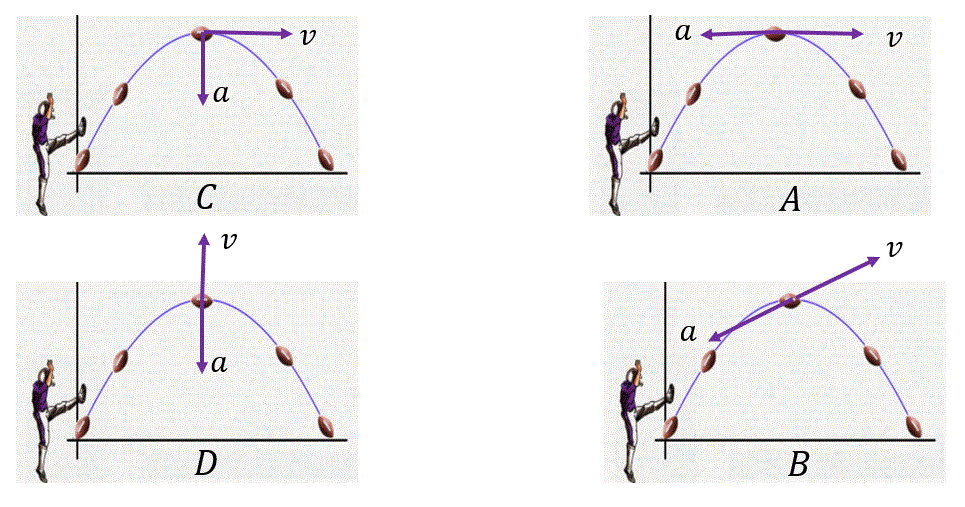
الشكل AFigure A
الشكل BFigure B
الشكل CFigure C
الشكل DFigure D
الحلSolution
📌 عند أقصى ارتفاع: \(v_y=0\)، فتبقى السرعة الكلية أفقية بالكامل (تساوي \(v_x\) الثابتة طوال الرحلة)، بينما التسارع يبقى دائمًا \(g\) نحو الأسفل، بغض النظر عن موضع الجسم.
📌 في الشكل المرفق: الشكل C هو الوحيد الذي يُظهر متجه السرعة أفقيًا تمامًا ومتجه التسارع رأسيًا للأسفل معًا.
✅ الشكل C
📌 At max height: \(v_y=0\), so total velocity is purely horizontal (equal to the constant \(v_x\)), while acceleration remains \(g\) downward at all times, regardless of position.
📌 In the attached figure: Figure C is the only one showing the velocity vector fully horizontal together with the acceleration vector straight down.
✅ Figure C
\[14\,\star\star\]
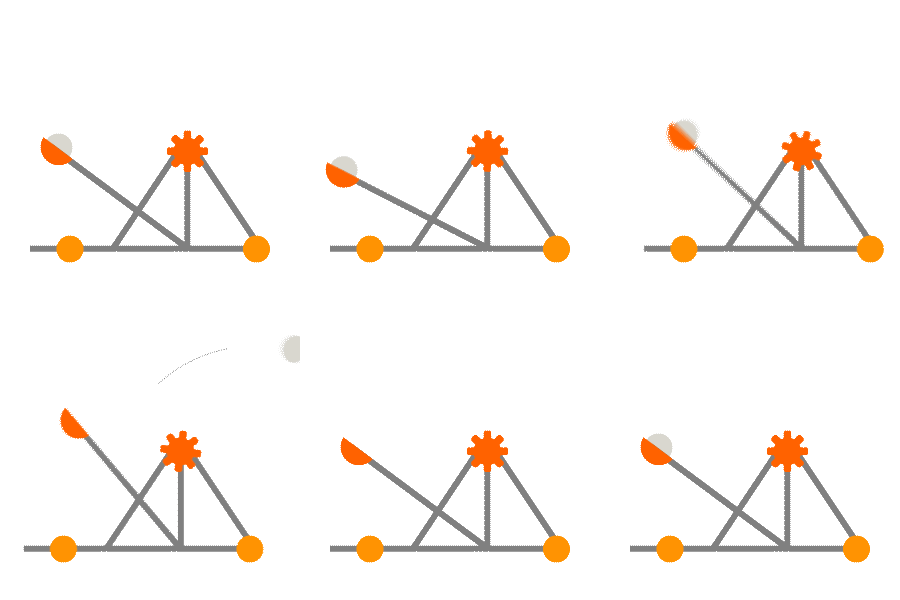
منجنيق يرمي حجرًا بسرعة ابتدائية مقدارها \(40\,m/s\) وبزاوية مقدارها \(30^0\) فوق الأفق. فإن سرعة الحجر على ارتفاع \(8\,m\) تعادلA catapult launches a stone at \(40\,m/s\) at \(30^0\) above horizontal. The stone's speed at a height of \(8\,m\) equals
\(v=28.5\;m/s\)\(v=28.5\;m/s\)
\(v=22.3\;m/s\)\(v=22.3\;m/s\)
\(v=45.6\;m/s\)\(v=45.6\;m/s\)
\(v=37.9\;m/s\)\(v=37.9\;m/s\)
الحلSolution
📌 المركبة الأفقية ثابتة: \(v_x=40\cos30^0\approx34.64\;m/s\)
📌 المركبة الرأسية عند الارتفاع \(h=8\,m\): \(v_y^2=(v_0\sin\theta)^2-2gh=(40\times0.5)^2-2(9.81)(8)=400-156.96=243.04\Rightarrow v_y\approx15.59\;m/s\)
📌 مقدار السرعة الكلي: \(v=\sqrt{34.64^2+15.59^2}\approx37.9\;m/s\)
✅ \(v\approx37.9\;m/s\)
📌 Horizontal component (constant): \(v_x=40\cos30^0\approx34.64\;m/s\)
📌 Vertical component at \(h=8\,m\): \(v_y^2=(40\times0.5)^2-2(9.81)(8)=243.04\Rightarrow v_y\approx15.59\;m/s\)
📌 Total speed magnitude: \(v=\sqrt{34.64^2+15.59^2}\approx37.9\;m/s\)
✅ \(v\approx37.9\;m/s\)
\[15\,\star\]
تم ركل كرة بسرعة ابتدائية \(\vec v=(12\hat X+6\hat Y)\). فإن مقدار السرعة الابتدائية والزاوية التي تصنعها مع المحور الأفقي تعادلانA ball is kicked with initial velocity \(\vec v=(12\hat X+6\hat Y)\). Its speed magnitude and angle with the horizontal axis equal
\(v_0=20\;m/s,\;\theta=26.5^0\)\(v_0=20\;m/s,\;\theta=26.5^0\)
\(v_0=13.4\;m/s,\;\theta=26.5^0\)\(v_0=13.4\;m/s,\;\theta=26.5^0\)
\(v_0=20\;m/s,\;\theta=21.3^0\)\(v_0=20\;m/s,\;\theta=21.3^0\)
\(v_0=13.4\;m/s,\;\theta=21.3^0\)\(v_0=13.4\;m/s,\;\theta=21.3^0\)
الحلSolution
📌 المقدار: \(v_0=\sqrt{12^2+6^2}=\sqrt{180}\approx13.4\;m/s\)
📌 الزاوية: \(\theta=\arctan(6/12)\approx26.5^0\)
✅ \(v_0\approx13.4\;m/s,\;\theta\approx26.5^0\)
📌 Magnitude: \(v_0=\sqrt{12^2+6^2}\approx13.4\;m/s\)
📌 Angle: \(\theta=\arctan(6/12)\approx26.5^0\)
✅ \(v_0\approx13.4\;m/s,\;\theta\approx26.5^0\)
\[16\,\star\star\]
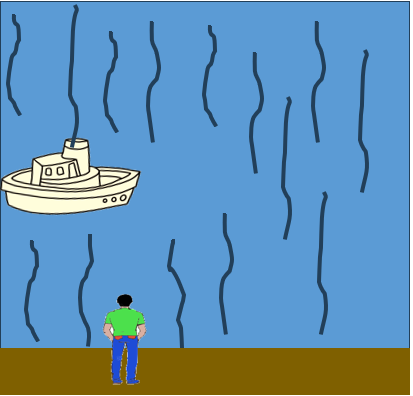
قارب يتحرك في نهر باتجاه الشرق بسرعة \(v=8\,m/s\)، في حين يجري النهر نحو الشمال بسرعة \(v=6\,m/s\). فإن سرعة القارب واتجاه حركته بالنسبة لمراقب يقف على الضفة تعادلانA boat heads east across a river at \(v=8\,m/s\), while the river flows north at \(v=6\,m/s\). The boat's speed and direction relative to an observer on the bank equal
\(v_{Be}=10\;m/s,\;\theta=18.6^0\)\(v_{Be}=10\;m/s,\;\theta=18.6^0\)
\(v_{Be}=14\;m/s,\;\theta=36.8^0\)\(v_{Be}=14\;m/s,\;\theta=36.8^0\)
\(v_{Be}=10\;m/s,\;\theta=36.8^0\)\(v_{Be}=10\;m/s,\;\theta=36.8^0\)
\(v_{Be}=14\;m/s,\;\theta=18.6^0\)\(v_{Be}=14\;m/s,\;\theta=18.6^0\)
الحلSolution
📌 جمع متجهي السرعة (متعامدان): \(v_{Be}=\sqrt{8^2+6^2}=\sqrt{100}=10\;m/s\)
📌 الاتجاه (من الشرق نحو الشمال): \(\theta=\arctan(6/8)\approx36.8^0\) شمال الشرق
✅ \(v_{Be}=10\;m/s\) بزاوية \(36.8^0\) شمال الشرق
📌 Adding the two perpendicular velocity vectors: \(v_{Be}=\sqrt{8^2+6^2}=10\;m/s\)
📌 Direction (from east toward north): \(\theta=\arctan(6/8)\approx36.8^0\) north of east
✅ \(v_{Be}=10\;m/s\) at \(36.8^0\) north of east
\[17\,\star\]
قُذف جسم من سطح الأرض بسرعة ابتدائية \(v_0=25\,m/s\) وبزاوية \(37^0\) فوق الأفق (على نفس مستوى الإطلاق والهبوط). فإن الزمن الكلي الذي يبقى فيه الجسم معلّقًا في الهواء يعادلA body is launched from the ground at \(v_0=25\,m/s\) at \(37^0\) above horizontal (level launch and landing). The total time the body remains in the air equals
\(t=1.53\;s\)\(t=1.53\;s\)
\(t=3.06\;s\)\(t=3.06\;s\)
\(t=6.12\;s\)\(t=6.12\;s\)
\(t=2.55\;s\)\(t=2.55\;s\)
الحلSolution
📌 زمن الطيران الكلي (إطلاق وهبوط بنفس المستوى): \(t=\dfrac{2v_0\sin\theta}{g}=\dfrac{2(25)\sin37^0}{9.81}\approx\dfrac{30.09}{9.81}\approx3.06\;s\)
✅ \(t\approx3.06\;s\)
📌 Total time of flight (level launch/landing): \(t=\dfrac{2v_0\sin\theta}{g}\approx\dfrac{30.09}{9.81}\approx3.06\;s\)
✅ \(t\approx3.06\;s\)
\[18\,\star\star\]
قُذف جسم بسرعة ابتدائية \(v_0=20\,m/s\) وبزاوية \(53^0\) فوق الأفق. فإن المدى الأفقي الذي يقطعه الجسم يعادلA body is launched at \(v_0=20\,m/s\) at \(53^0\) above horizontal. The horizontal range the body covers equals
\(R=19.6\;m\)\(R=19.6\;m\)
\(R=39.2\;m\)\(R=39.2\;m\)
\(R=78.4\;m\)\(R=78.4\;m\)
\(R=45.2\;m\)\(R=45.2\;m\)
الحلSolution
📌 معادلة المدى: \(R=\dfrac{v_0^2\sin(2\theta)}{g}=\dfrac{20^2\sin106^0}{9.81}=\dfrac{400(0.961)}{9.81}\approx39.2\;m\)
✅ \(R\approx39.2\;m\)
📌 Range equation: \(R=\dfrac{v_0^2\sin(2\theta)}{g}=\dfrac{400\sin106^0}{9.81}\approx39.2\;m\)
✅ \(R\approx39.2\;m\)
\[19\,\star\star\]
قُذف جسم أفقيًا بسرعة \(v_0=15\,m/s\) من ارتفاع \(45\,m\) فوق سطح الأرض. فإن المدى الأفقي الذي يقطعه الجسم حتى يصطدم بالأرض يعادلA body is launched horizontally at \(v_0=15\,m/s\) from a height of \(45\,m\). The horizontal range it covers before hitting the ground equals
\(R=30.3\;m\)\(R=30.3\;m\)
\(R=45.4\;m\)\(R=45.4\;m\)
\(R=60.6\;m\)\(R=60.6\;m\)
\(R=15.0\;m\)\(R=15.0\;m\)
الحلSolution
📌 زمن السقوط: \(t=\sqrt{\dfrac{2h}{g}}=\sqrt{\dfrac{2(45)}{9.81}}\approx3.03\;s\)
📌 المدى الأفقي: \(R=v_0t=15(3.03)\approx45.4\;m\)
✅ \(R\approx45.4\;m\)
📌 Fall time: \(t=\sqrt{2h/g}\approx3.03\;s\)
📌 Horizontal range: \(R=v_0t\approx45.4\;m\)
✅ \(R\approx45.4\;m\)
\[20\,\star\star\star\]
معادلتا موقع جسم قُذف من سطح الأرض: \(X(t)=5t\)، \(Y(t)=8t-4.905t^2\). فإن أقصى ارتفاع يصل إليه الجسم يعادلA launched body's position equations are \(X(t)=5t\), \(Y(t)=8t-4.905t^2\). The maximum height the body reaches equals
\(H=1.63\;m\)\(H=1.63\;m\)
\(H=3.26\;m\)\(H=3.26\;m\)
\(H=6.52\;m\)\(H=6.52\;m\)
\(H=4.08\;m\)\(H=4.08\;m\)
الحلSolution
📌 عند أقصى ارتفاع \(v_y=0\): \(v_y=\dfrac{dY}{dt}=8-9.81t=0\Rightarrow t\approx0.816\,s\)
📌 نعوّض في معادلة الموقع: \(Y(0.816)=8(0.816)-4.905(0.816)^2\approx6.53-3.27\approx3.26\;m\)
✅ \(H\approx3.26\;m\)
📌 At max height \(v_y=0\): \(v_y=8-9.81t=0\Rightarrow t\approx0.816\,s\)
📌 Substitute into the position equation: \(Y(0.816)\approx6.53-3.27\approx3.26\;m\)
✅ \(H\approx3.26\;m\)
\[21\,\star\star\]
في لحظة معيّنة خلال رحلة قذف، كانت مركبتا سرعة الجسم \(v_x=12\,m/s\) و\(v_y=-9\,m/s\) (الإشارة السالبة تعني أنه في طور الهبوط). فإن مقدار سرعة الجسم في تلك اللحظة، والزاوية التي تصنعها مع الأفق، يعادلانAt a certain instant during a projectile's flight, its velocity components are \(v_x=12\,m/s\) and \(v_y=-9\,m/s\) (negative meaning it is descending). The body's speed at that instant, and the angle it makes with the horizontal, equal
\(v=13.4\;m/s,\;\theta=41.2^0\)\(v=13.4\;m/s,\;\theta=41.2^0\)
\(v=15\;m/s,\;\theta=36.9^0\)\(v=15\;m/s,\;\theta=36.9^0\)
\(v=21\;m/s,\;\theta=30^0\)\(v=21\;m/s,\;\theta=30^0\)
\(v=15\;m/s,\;\theta=53.1^0\)\(v=15\;m/s,\;\theta=53.1^0\)
الحلSolution
📌 المقدار: \(v=\sqrt{12^2+9^2}=\sqrt{225}=15\;m/s\)
📌 الزاوية (تحت الأفق، لأن \(v_y\) سالبة): \(\theta=\arctan(9/12)\approx36.9^0\)
✅ \(v=15\;m/s,\;\theta\approx36.9^0\) تحت الأفق
📌 Magnitude: \(v=\sqrt{12^2+9^2}=15\;m/s\)
📌 Angle (below horizontal, since \(v_y\) is negative): \(\theta=\arctan(9/12)\approx36.9^0\)
✅ \(v=15\;m/s,\;\theta\approx36.9^0\) below horizontal
\[22\,\star\star\star\]
أراد رامي سهام أن يصيب هدفًا يبعد عنه \(100\,m\) أفقيًا (على نفس ارتفاع الإطلاق)، بزاوية إطلاق \(40^0\). فإن السرعة الابتدائية اللازمة لإصابة الهدف تعادلAn archer wants to hit a target \(100\,m\) away horizontally (same launch height), at a launch angle of \(40^0\). The required initial speed equals
\(v_0=25.4\;m/s\)\(v_0=25.4\;m/s\)
\(v_0=31.6\;m/s\)\(v_0=31.6\;m/s\)
\(v_0=40.2\;m/s\)\(v_0=40.2\;m/s\)
\(v_0=35.0\;m/s\)\(v_0=35.0\;m/s\)
الحلSolution
📌 معادلة المدى: \(R=\dfrac{v_0^2\sin(2\theta)}{g}\Rightarrow v_0^2=\dfrac{Rg}{\sin(2\theta)}=\dfrac{100(9.81)}{\sin80^0}=\dfrac{981}{0.985}\approx996.1\)
📌 السرعة الابتدائية: \(v_0=\sqrt{996.1}\approx31.6\;m/s\)
✅ \(v_0\approx31.6\;m/s\)
📌 Range equation: \(v_0^2=\dfrac{Rg}{\sin(2\theta)}\approx996.1\)
📌 Initial speed: \(v_0\approx31.6\;m/s\)
✅ \(v_0\approx31.6\;m/s\)
\[23\,\star\star\]
قُذفت كرتان بنفس السرعة الابتدائية من سطح الأرض، لكن بزاويتين مختلفتين ومتكاملتين: \(\theta_1=25^0\)، \(\theta_2=65^0\). أحد العبارات التالية صحيحة بخصوص زمن بقاء كل كرة في الهواءTwo balls are launched with the same initial speed from the ground, but at two different complementary angles: \(\theta_1=25^0\), \(\theta_2=65^0\). Which of the following is correct regarding each ball's time of flight?
زمنا الطيران متساويان \(t_1=t_2\)The times of flight are equal \(t_1=t_2\)
\(t_1>t_2\)\(t_1>t_2\)
\(t_2>t_1\)\(t_2>t_1\)
البيانات غير كافية للمقارنةInsufficient data to compare
الحلSolution
📌 زمن الطيران: \(t=\dfrac{2v_0\sin\theta}{g}\) — يعتمد على \(\sin\theta\) فقط (وليس \(\sin2\theta\) كما في المدى)
📌 المقارنة: \(\sin65^0\approx0.906>\sin25^0\approx0.423\)، فالزاوية الأكبر تعطي زمن طيران أطول
✅ \(t_2>t_1\) (رغم أن الزاويتين متكاملتان وتعطيان نفس المدى، إلا أن زمن الطيران مختلف)
📌 Time of flight: \(t=\dfrac{2v_0\sin\theta}{g}\) — depends on \(\sin\theta\) only (not \(\sin2\theta\) as in the range)
📌 Comparison: \(\sin65^0\approx0.906>\sin25^0\approx0.423\), so the larger angle gives a longer flight time
✅ \(t_2>t_1\) (even though the complementary angles give the same range, their flight times differ)
\[24\,\star\star\]
رُمي حجر أفقيًا بسرعة \(v_0=12\,m/s\) من قمة جرف يرتفع \(25\,m\) عن سطح الأرض. فإن سرعة الحجر عند اصطدامه بالأرض تعادلA stone is thrown horizontally at \(v_0=12\,m/s\) from a \(25\,m\) cliff. The stone's speed at impact equals
\(v=22.2\;m/s\)\(v=22.2\;m/s\)
\(v=12.0\;m/s\)\(v=12.0\;m/s\)
\(v=25.2\;m/s\)\(v=25.2\;m/s\)
\(v=34.2\;m/s\)\(v=34.2\;m/s\)
الحلSolution
📌 زمن السقوط: \(t=\sqrt{2h/g}=\sqrt{50/9.81}\approx2.258\,s\)
📌 المركبة الرأسية عند الارتطام: \(v_y=gt\approx22.15\;m/s\)
📌 مقدار السرعة الكلي: \(v=\sqrt{12^2+22.15^2}\approx25.2\;m/s\)
✅ \(v\approx25.2\;m/s\)
📌 Fall time: \(t=\sqrt{2h/g}\approx2.258\,s\)
📌 Vertical component at impact: \(v_y=gt\approx22.15\;m/s\)
📌 Total speed magnitude: \(v=\sqrt{12^2+22.15^2}\approx25.2\;m/s\)
✅ \(v\approx25.2\;m/s\)
\[25\,\star\star\]
سبّاح يسبح نحو الشمال بسرعة \(1.5\,m/s\) بالنسبة للماء، بينما يجري تيار النهر نحو الشرق بسرعة \(2\,m/s\). فإن سرعة السبّاح بالنسبة لمراقب واقف على الضفة تعادلA swimmer swims north at \(1.5\,m/s\) relative to the water, while the river current flows east at \(2\,m/s\). The swimmer's speed relative to an observer on the bank equals
\(v=3.5\;m/s,\;\theta=53.1^0\)شرق الشمال\(v=3.5\;m/s,\;\theta=53.1^0\) east of north
\(v=2.5\;m/s,\;\theta=53.1^0\)شرق الشمال\(v=2.5\;m/s,\;\theta=53.1^0\) east of north
\(v=2.5\;m/s,\;\theta=36.9^0\)شرق الشمال\(v=2.5\;m/s,\;\theta=36.9^0\) east of north
\(v=0.5\;m/s,\;\theta=53.1^0\)شرق الشمال\(v=0.5\;m/s,\;\theta=53.1^0\) east of north
الحلSolution
📌 جمع متجهي السرعة (متعامدان): \(v=\sqrt{1.5^2+2^2}=\sqrt{6.25}=2.5\;m/s\)
📌 الاتجاه (من الشمال نحو الشرق): \(\theta=\arctan(2/1.5)\approx53.1^0\) شرق الشمال
✅ \(v=2.5\;m/s\) بزاوية \(53.1^0\) شرق الشمال
📌 Adding the two perpendicular velocity vectors: \(v=\sqrt{1.5^2+2^2}=2.5\;m/s\)
📌 Direction (from north toward east): \(\theta=\arctan(2/1.5)\approx53.1^0\) east of north
✅ \(v=2.5\;m/s\) at \(53.1^0\) east of north
\[26\,\star\star\star\]
قُذف جسم بسرعة ابتدائية \(v_0=20\,m/s\) وبزاوية \(60^0\) فوق الأفق من سطح الأرض. فإن سرعة الجسم عندما يصل إلى نصف أقصى ارتفاع (أثناء صعوده) تعادلA body is launched at \(v_0=20\,m/s\) at \(60^0\) above horizontal from the ground. The body's speed when it reaches half its maximum height (while ascending) equals
\(v=10.0\;m/s\)\(v=10.0\;m/s\)
\(v=15.8\;m/s\)\(v=15.8\;m/s\)
\(v=17.3\;m/s\)\(v=17.3\;m/s\)
\(v=20.0\;m/s\)\(v=20.0\;m/s\)
الحلSolution
📌 أقصى ارتفاع: \(H_{max}=\dfrac{(v_0\sin\theta)^2}{2g}=\dfrac{(20\sin60^0)^2}{19.62}\approx15.29\;m\)، ونصفه \(h=7.65\;m\)
📌 المركبة الرأسية عند \(h\): \(v_y^2=(v_0\sin\theta)^2-2gh\approx300-150\approx150\Rightarrow v_y\approx12.25\;m/s\)
📌 المركبة الأفقية (ثابتة): \(v_x=v_0\cos60^0=10\;m/s\)
📌 مقدار السرعة الكلي: \(v=\sqrt{10^2+12.25^2}\approx15.8\;m/s\)
✅ \(v\approx15.8\;m/s\)
📌 Max height: \(H_{max}\approx15.29\;m\), half of it \(h=7.65\;m\)
📌 Vertical component at \(h\): \(v_y^2\approx300-150\approx150\Rightarrow v_y\approx12.25\;m/s\)
📌 Horizontal component (constant): \(v_x=v_0\cos60^0=10\;m/s\)
📌 Total speed magnitude: \(v=\sqrt{10^2+12.25^2}\approx15.8\;m/s\)
✅ \(v\approx15.8\;m/s\)
\[27\,\star\star\star\]
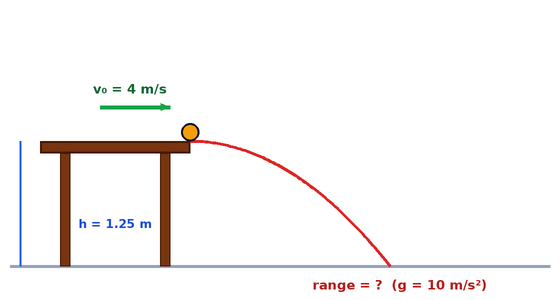
تدحرجت كرة عن حافة طاولة ارتفاعها \(1.25\,m\) بسرعة أفقية \(4\,m/s\). فإن المدى الأفقي الذي تقطعه حتى تصل إلى الأرض (\(g=10\,m/s^2\)):A ball rolls off the edge of a \(1.25\,m\) high table with horizontal speed \(4\,m/s\). The horizontal range it covers before reaching the ground is (\(g=10\,m/s^2\)):
\(2\,m\)\(2\,m\)
\(1\,m\)\(1\,m\)
\(4\,m\)\(4\,m\)
\(0.5\,m\)\(0.5\,m\)
الحلSolution
📌 زمن السقوط (الحركة الرأسية سقوط حر): \(h=\tfrac12gt^2\Rightarrow t=\sqrt{\dfrac{2(1.25)}{10}}=0.5\,s\)
📌 المدى الأفقي (سرعة ثابتة): \(R=v_0t=4\times0.5=2\,m\)
✅ \(2\,m\)
📌 Fall time (the vertical motion is free fall): \(h=\tfrac12gt^2\Rightarrow t=\sqrt{\dfrac{2(1.25)}{10}}=0.5\,s\)
📌 Horizontal range (constant velocity): \(R=v_0t=4\times0.5=2\,m\)
✅ \(2\,m\)
\[28\,\star\star\star\]
قُذف جسم أفقيًا بسرعة \(8\,m/s\) من قمة جرف ارتفاعه \(45\,m\). فإن مقدار سرعته لحظة اصطدامه بالأرض (\(g=10\,m/s^2\)):An object is thrown horizontally at \(8\,m/s\) from the top of a \(45\,m\) cliff. Its speed just before hitting the ground is (\(g=10\,m/s^2\)):
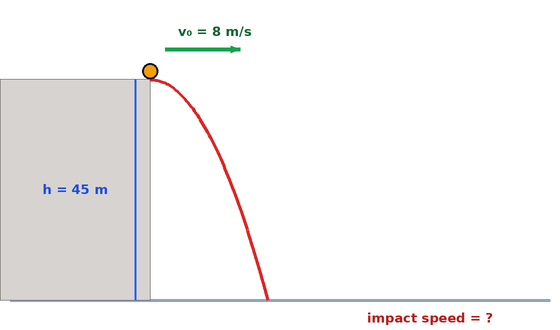
\(30\,m/s\)\(30\,m/s\)
\(38\,m/s\)\(38\,m/s\)
\(8\,m/s\)\(8\,m/s\)
\(31\,m/s\)\(31\,m/s\)
الحلSolution
📌 المركبة الأفقية ثابتة، والرأسية من السقوط الحر: \(v_x=8\,m/s,\quad v_y=\sqrt{2gh}=\sqrt{2(10)(45)}=30\,m/s\)
📌 المحصلة: \(v=\sqrt{8^2+30^2}=\sqrt{964}=31\,m/s\)
✅ \(31\,m/s\)
📌 The horizontal component is constant, the vertical one comes from free fall: \(v_x=8\,m/s,\quad v_y=\sqrt{2gh}=\sqrt{2(10)(45)}=30\,m/s\)
📌 The resultant: \(v=\sqrt{8^2+30^2}=\sqrt{964}=31\,m/s\)
✅ \(31\,m/s\)
\[29\,\star\star\star\]
قُذفت كرة من سطح الأرض بسرعة \(30\,m/s\) بزاوية \(30^\circ\) فوق الأفق. فإن أقصى ارتفاع تبلغه (\(g=10\,m/s^2\)):A ball is launched from the ground at \(30\,m/s\) at \(30^\circ\) above the horizontal. The maximum height it reaches is (\(g=10\,m/s^2\)):
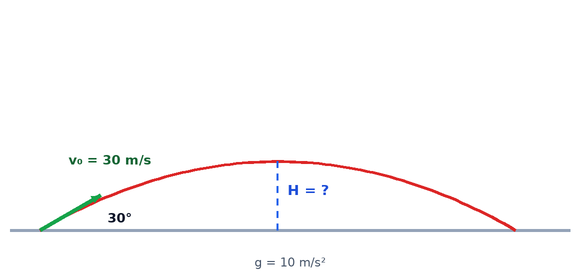
\(11.25\,m\)\(11.25\,m\)
\(22.5\,m\)\(22.5\,m\)
\(45\,m\)\(45\,m\)
\(5.6\,m\)\(5.6\,m\)
الحلSolution
📌 المركبة الرأسية الابتدائية: \(v_{0y}=v_0\sin30^\circ=15\,m/s\)
📌 عند أقصى ارتفاع \(v_y=0\): \(H=\dfrac{v_{0y}^2}{2g}=\dfrac{15^2}{20}=11.25\,m\)
✅ \(11.25\,m\)
📌 The initial vertical component: \(v_{0y}=v_0\sin30^\circ=15\,m/s\)
📌 At the top \(v_y=0\): \(H=\dfrac{v_{0y}^2}{2g}=\dfrac{15^2}{20}=11.25\,m\)
✅ \(11.25\,m\)
\[30\,\star\star\star\]
قُذفت كرة من الأرض بسرعة \(50\,m/s\) بزاوية \(37^\circ\) فوق الأفق. فإن مداها الأفقي (\(g=10\,m/s^2\)):A ball is launched from the ground at \(50\,m/s\) at \(37^\circ\) above the horizontal. Its horizontal range is (\(g=10\,m/s^2\)):
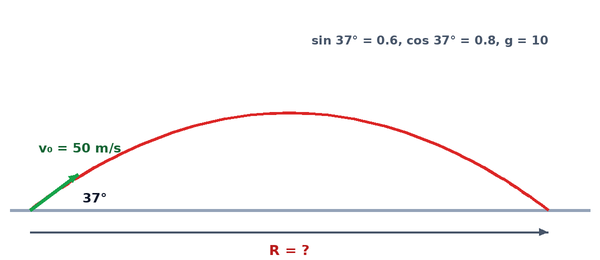
\(120\,m\)\(120\,m\)
\(200\,m\)\(200\,m\)
\(250\,m\)\(250\,m\)
\(240\,m\)\(240\,m\)
الحلSolution
📌 المركبتان: \(v_x=50\times0.8=40\,m/s,\quad v_y=50\times0.6=30\,m/s\)
📌 زمن التحليق ثم المدى: \(T=\dfrac{2v_y}{g}=6\,s,\quad R=v_xT=40\times6=240\,m\)
✅ \(240\,m\)
📌 The components: \(v_x=50\times0.8=40\,m/s,\quad v_y=50\times0.6=30\,m/s\)
📌 Time of flight then range: \(T=\dfrac{2v_y}{g}=6\,s,\quad R=v_xT=40\times6=240\,m\)
✅ \(240\,m\)
\[31\,\star\star\star\]
يبين الرسم المركبة الرأسية لسرعة كرة مقذوفة مع الزمن، وتعود الكرة إلى مستوى القذف نفسه، والمركبة الأفقية ثابتة \(15\,m/s\). فإن مداها الأفقي:The graph shows the vertical component of velocity of a projectile against time; the ball returns to its launch level and its horizontal component is constant at \(15\,m/s\). Its horizontal range is:
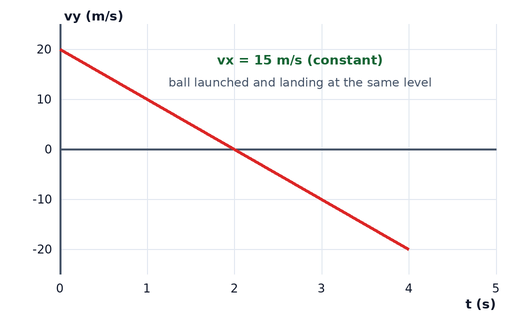
\(80\,m\)\(80\,m\)
\(40\,m\)\(40\,m\)
\(60\,m\)\(60\,m\)
\(30\,m\)\(30\,m\)
الحلSolution
📌 تصل المركبة الرأسية إلى \(-20\,m/s\) عند \(t=4\,s\) أي أن زمن التحليق: \(T=4\,s\)
📌 المدى: \(R=v_xT=15\times4=60\,m\)
✅ \(60\,m\)
📌 The vertical component reaches \(-20\,m/s\) at \(t=4\,s\), so the time of flight is: \(T=4\,s\)
📌 The range: \(R=v_xT=15\times4=60\,m\)
✅ \(60\,m\)
\[32\,\star\star\star\]
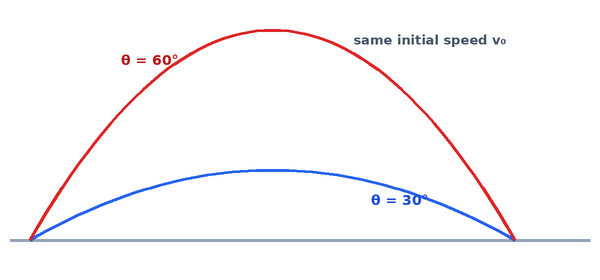
قُذفت كرتان بالسرعة الابتدائية نفسها من سطح الأرض بزاويتين \(30^\circ\) و\(60^\circ\) كما في الشكل. فإن النسبة بين أقصى ارتفاع للثانية إلى الأولى \(\dfrac{H_{60}}{H_{30}}\):Two balls are launched with the same initial speed from the ground at \(30^\circ\) and \(60^\circ\) as shown. The ratio of the maximum height of the second to the first \(\dfrac{H_{60}}{H_{30}}\) is:
\(3\)\(3\)
\(1\)\(1\)
\(\dfrac13\)\(\dfrac13\)
\(\sqrt3\)\(\sqrt3\)
الحلSolution
📌 أقصى ارتفاع يتناسب مع \(\sin^2\theta\): \(H=\dfrac{v_0^2\sin^2\theta}{2g}\)
📌 النسبة: \(\dfrac{H_{60}}{H_{30}}=\dfrac{\sin^260^\circ}{\sin^230^\circ}=\dfrac{0.75}{0.25}=3\)
✅ \(3\)
📌 The maximum height is proportional to \(\sin^2\theta\): \(H=\dfrac{v_0^2\sin^2\theta}{2g}\)
📌 The ratio: \(\dfrac{H_{60}}{H_{30}}=\dfrac{\sin^260^\circ}{\sin^230^\circ}=\dfrac{0.75}{0.25}=3\)
✅ \(3\)
\[33\,\star\star\star\]
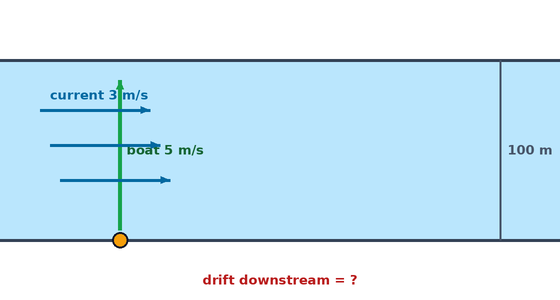
يعبر قارب نهرًا عرضه \(100\,m\) موجّهًا مقدمته عموديًا على الضفة بسرعة \(5\,m/s\) بالنسبة للماء، وتيار النهر \(3\,m/s\). فإن انحراف القارب مع التيار عند وصوله الضفة الأخرى:A boat crosses a \(100\,m\) wide river heading perpendicular to the bank at \(5\,m/s\) relative to the water, and the current is \(3\,m/s\). The boat’s drift downstream when it reaches the other bank is:
\(100\,m\)\(100\,m\)
\(33\,m\)\(33\,m\)
\(20\,m\)\(20\,m\)
\(60\,m\)\(60\,m\)
الحلSolution
📌 زمن العبور تحدده المركبة العمودية فقط: \(t=\dfrac{100}{5}=20\,s\)
📌 الانحراف بفعل التيار: \(d=v_{current}\,t=3\times20=60\,m\)
✅ \(60\,m\)
📌 The crossing time depends on the perpendicular component only: \(t=\dfrac{100}{5}=20\,s\)
📌 The drift due to the current: \(d=v_{current}\,t=3\times20=60\,m\)
✅ \(60\,m\)
\[34\,\star\star\star\]
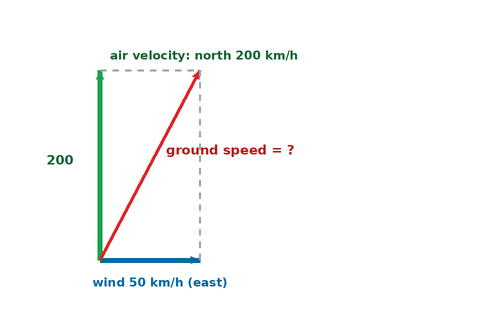
تتجه طائرة نحو الشمال بسرعة \(200\,km/h\) بالنسبة للهواء، بينما تهب رياح نحو الشرق بسرعة \(50\,km/h\). فإن مقدار سرعة الطائرة بالنسبة للأرض:A plane heads north at \(200\,km/h\) relative to the air while a wind blows east at \(50\,km/h\). The speed of the plane relative to the ground is:
\(206\,km/h\)\(206\,km/h\)
\(250\,km/h\)\(250\,km/h\)
\(150\,km/h\)\(150\,km/h\)
\(194\,km/h\)\(194\,km/h\)
الحلSolution
📌 السرعتان متعامدتان فنجمعهما اتجاهيًا: \(v_g=\sqrt{200^2+50^2}\)
📌 الناتج: \(v_g=\sqrt{42500}=206\,km/h\)
✅ \(206\,km/h\)
📌 The two velocities are perpendicular, so add them as vectors: \(v_g=\sqrt{200^2+50^2}\)
📌 Result: \(v_g=\sqrt{42500}=206\,km/h\)
✅ \(206\,km/h\)
\[35\,\star\star\star\]
موقع جسم يعطى بالمعادلتين \(x(t)=2t\) و\(y(t)=5t-5t^2\) (بالمتر). فإن مقدار سرعته عند اللحظة \(t=1\,s\):The position of an object is given by \(x(t)=2t\) and \(y(t)=5t-5t^2\) (in metres). Its speed at \(t=1\,s\) is:
\(2\,m/s\)\(2\,m/s\)
\(5\,m/s\)\(5\,m/s\)
\(7\,m/s\)\(7\,m/s\)
\(5.4\,m/s\)\(5.4\,m/s\)
الحلSolution
📌 مشتقة كل مركبة: \(v_x=\dfrac{dx}{dt}=2,\quad v_y=\dfrac{dy}{dt}=5-10t\)
📌 عند \(t=1\,s\): \(v_y=-5\Rightarrow v=\sqrt{2^2+(-5)^2}=\sqrt{29}=5.4\,m/s\)
✅ \(5.4\,m/s\)
📌 Differentiate each component: \(v_x=\dfrac{dx}{dt}=2,\quad v_y=\dfrac{dy}{dt}=5-10t\)
📌 At \(t=1\,s\): \(v_y=-5\Rightarrow v=\sqrt{2^2+(-5)^2}=\sqrt{29}=5.4\,m/s\)
✅ \(5.4\,m/s\)
\[36\,\star\star\star\]
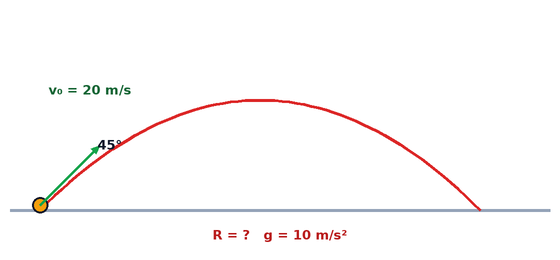
ركل لاعب كرة بسرعة \(20\,m/s\) بزاوية \(45^\circ\) فوق الأفق. فإن مداها الأفقي (\(g=10\,m/s^2\)):A player kicks a ball at \(20\,m/s\) at \(45^\circ\) above the horizontal. Its horizontal range is (\(g=10\,m/s^2\)):
\(40\,m\)\(40\,m\)
\(20\,m\)\(20\,m\)
\(80\,m\)\(80\,m\)
\(28\,m\)\(28\,m\)
الحلSolution
📌 قانون المدى: \(R=\dfrac{v_0^2\sin2\theta}{g}\)
📌 بالتعويض: \(R=\dfrac{400\times\sin90^\circ}{10}=40\,m\)
✅ \(40\,m\)
📌 The range formula: \(R=\dfrac{v_0^2\sin2\theta}{g}\)
📌 Substituting: \(R=\dfrac{400\times\sin90^\circ}{10}=40\,m\)
✅ \(40\,m\)
\[37\,\star\star\star\]
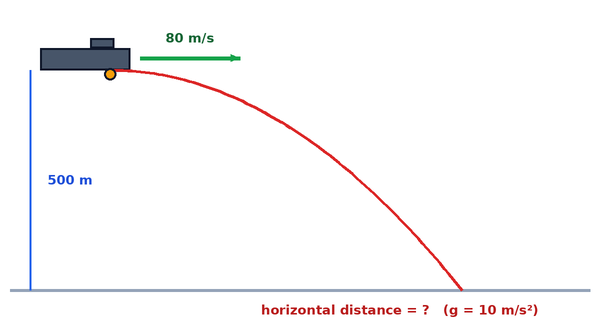
تطير طائرة أفقيًا بسرعة \(80\,m/s\) على ارتفاع \(500\,m\) وأسقطت صندوقًا. فإن المسافة الأفقية بين نقطة الإسقاط ونقطة سقوط الصندوق (\(g=10\,m/s^2\)):A plane flies horizontally at \(80\,m/s\) at an altitude of \(500\,m\) and drops a crate. The horizontal distance from the release point to the impact point is (\(g=10\,m/s^2\)):
\(400\,m\)\(400\,m\)
\(800\,m\)\(800\,m\)
\(500\,m\)\(500\,m\)
\(1000\,m\)\(1000\,m\)
الحلSolution
📌 زمن السقوط: \(t=\sqrt{\dfrac{2h}{g}}=\sqrt{\dfrac{2(500)}{10}}=10\,s\)
📌 الصندوق يحتفظ بسرعة الطائرة الأفقية: \(x=v_xt=80\times10=800\,m\)
✅ \(800\,m\)
📌 Fall time: \(t=\sqrt{\dfrac{2h}{g}}=\sqrt{\dfrac{2(500)}{10}}=10\,s\)
📌 The crate keeps the plane’s horizontal speed: \(x=v_xt=80\times10=800\,m\)
✅ \(800\,m\)
\[38\,\star\star\star\]
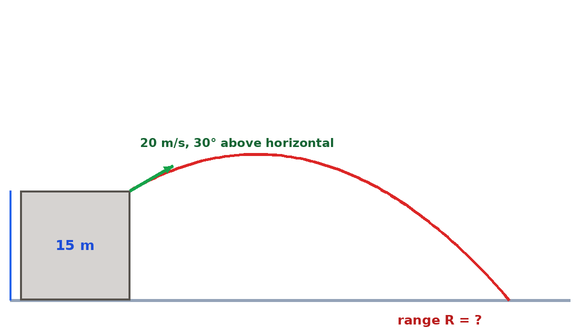
قُذفت كرة من سطح مبنى ارتفاعه \(15\,m\) بسرعة \(20\,m/s\) بزاوية \(30^\circ\) فوق الأفق. فإن مداها الأفقي حتى تصل إلى الأرض (\(g=10\,m/s^2\)):A ball is thrown from the roof of a \(15\,m\) building at \(20\,m/s\) at \(30^\circ\) above the horizontal. Its horizontal range until it reaches the ground is (\(g=10\,m/s^2\)):
\(35\,m\)\(35\,m\)
\(69\,m\)\(69\,m\)
\(26\,m\)\(26\,m\)
\(52\,m\)\(52\,m\)
الحلSolution
📌 المركبتان: \(v_x=20\cos30^\circ=17.3\,m/s,\quad v_y=20\sin30^\circ=10\,m/s\)
📌 الإزاحة الرأسية \(-15\,m\): \(-15=10t-5t^2\Rightarrow t^2-2t-3=0\Rightarrow t=3\,s\)
📌 المدى: \(R=17.3\times3=52\,m\)
✅ \(52\,m\)
📌 The components: \(v_x=20\cos30^\circ=17.3\,m/s,\quad v_y=20\sin30^\circ=10\,m/s\)
📌 The vertical displacement \(-15\,m\): \(-15=10t-5t^2\Rightarrow t^2-2t-3=0\Rightarrow t=3\,s\)
📌 Range: \(R=17.3\times3=52\,m\)
✅ \(52\,m\)
\[39\,\star\star\star\]
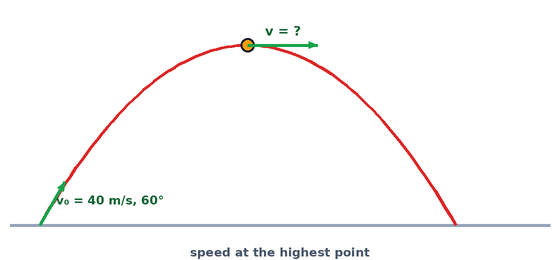
قُذف مقذوف بسرعة \(40\,m/s\) بزاوية \(60^\circ\) فوق الأفق. فإن مقدار سرعته عند أعلى نقطة في مساره:A projectile is launched at \(40\,m/s\) at \(60^\circ\) above the horizontal. Its speed at the highest point of its path is:
\(20\,m/s\)\(20\,m/s\)
\(34.6\,m/s\)\(34.6\,m/s\)
\(40\,m/s\)\(40\,m/s\)
\(0\)\(0\)
الحلSolution
📌 عند أعلى نقطة تنعدم المركبة الرأسية وتبقى الأفقية ثابتة: \(v_y=0,\quad v=v_x=v_0\cos\theta\)
📌 التعويض: \(v=40\cos60^\circ=20\,m/s\)
✅ \(20\,m/s\)
📌 At the top the vertical component is zero and the horizontal one stays constant: \(v_y=0,\quad v=v_x=v_0\cos\theta\)
📌 Substituting: \(v=40\cos60^\circ=20\,m/s\)
✅ \(20\,m/s\)
\[40\,\star\star\star\]
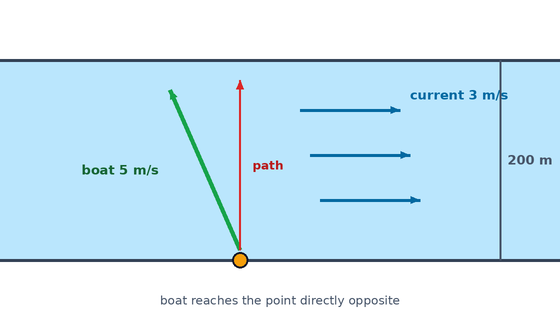
يريد قارب أن يعبر نهرًا عرضه \(200\,m\) بحيث يصل إلى النقطة المقابلة تمامًا. سرعة القارب بالنسبة للماء \(5\,m/s\) وسرعة التيار \(3\,m/s\). فإن زمن العبور:A boat wants to cross a \(200\,m\) wide river and arrive at the point directly opposite. The boat’s speed relative to the water is \(5\,m/s\) and the current is \(3\,m/s\). The crossing time is:
\(50\,s\)\(50\,s\)
\(40\,s\)\(40\,s\)
\(67\,s\)\(67\,s\)
\(25\,s\)\(25\,s\)
الحلSolution
📌 يوجّه القارب مقدمته عكس التيار بحيث تلغي مركبته الأفقية التيار؛ السرعة الفعالة عبر النهر: \(v_\perp=\sqrt{5^2-3^2}=4\,m/s\)
📌 الزمن: \(t=\dfrac{200}{4}=50\,s\)
✅ \(50\,s\)
📌 The boat is aimed upstream so its horizontal component cancels the current; the effective speed across the river: \(v_\perp=\sqrt{5^2-3^2}=4\,m/s\)
📌 The time: \(t=\dfrac{200}{4}=50\,s\)
✅ \(50\,s\)
\[41\,\star\star\star\]
قُذف جسم من سطح الأرض بسرعة ابتدائية \(\vec v_0=(6\hat i+8\hat j)\,m/s\). فإن أقصى ارتفاع يبلغه (\(g=10\,m/s^2\)):An object is launched from the ground with initial velocity \(\vec v_0=(6\hat i+8\hat j)\,m/s\). The maximum height it reaches is (\(g=10\,m/s^2\)):
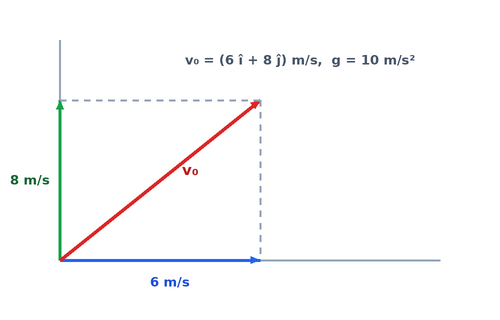
\(3.2\,m\)\(3.2\,m\)
\(1.8\,m\)\(1.8\,m\)
\(5\,m\)\(5\,m\)
\(6.4\,m\)\(6.4\,m\)
الحلSolution
📌 مركبة الارتفاع هي المركبة الرأسية فقط: \(v_{0y}=8\,m/s\)
📌 أقصى ارتفاع: \(H=\dfrac{v_{0y}^2}{2g}=\dfrac{64}{20}=3.2\,m\)
✅ \(3.2\,m\)
📌 Only the vertical component determines the height: \(v_{0y}=8\,m/s\)
📌 Maximum height: \(H=\dfrac{v_{0y}^2}{2g}=\dfrac{64}{20}=3.2\,m\)
✅ \(3.2\,m\)
✏️ حلّ المسائل التالية
✏️ Solve the Following Problems
المسألة 1Problem 1
في مشهد سينمائي، قفز ممثل من مبنى يرتفع عن سطح الأرض \(30\,m\) إلى مبنى آخر يرتفع عن سطح الأرض \(26\,m\)، بسرعة ابتدائية وزاوية قدرها \(\theta=13^0\)، فوصل إلى المبنى الثاني الذي يبعد عن الأول \(5\,m\) أفقيًا. ما أقل سرعة ابتدائية تحقق له السلامة (تجعله يصل تمامًا لحافة المبنى الثاني)؟In a movie scene, an actor jumps from a building \(30\,m\) high to another building \(26\,m\) high, launching at angle \(\theta=13^0\), with the second building \(5\,m\) away horizontally. What is the minimum initial speed for him to safely land exactly at the edge of the second building?
الحلSolution
📌 الهبوط الصافي المطلوب: \(\Delta y=26-30=-4\,m\) (ينخفض 4م عن ارتفاع الانطلاق)، والمدى الأفقي المطلوب \(\Delta x=5\,m\)
📌 من معادلة \(\Delta x\): \(t=\dfrac{5}{v_0\cos13^0}\)
📌 نعوّض في معادلة \(\Delta y=v_0\sin13^0\,t-\frac12 gt^2=-4\): بحل المعادلة (تربيعية في \(1/v_0\)) نحصل على
\(v_0\approx5.0\;m/s\)
✅ أقل سرعة ابتدائية لازمة \(\approx5.0\;m/s\)
📌 Required net drop: \(\Delta y=26-30=-4\,m\), and required horizontal range \(\Delta x=5\,m\)
📌 From the \(\Delta x\) equation: \(t=\dfrac{5}{v_0\cos13^0}\)
📌 Substitute into \(\Delta y=v_0\sin13^0\,t-\frac12 gt^2=-4\): solving (quadratic in \(1/v_0\)) gives
\(v_0\approx5.0\;m/s\)
✅ Minimum required initial speed \(\approx5.0\;m/s\)
المسألة 2Problem 2
قُذفت كرة أفقيًا من سطح مبنى يرتفع عن سطح الأرض \(20\,m\)، واصطدمت بالأرض على بعد \(30\,m\) من قاعدة المبنى. احسب: (أ) الزمن الذي بقيت فيه الكرة معلّقة في الهواء. (ب) السرعة التي قُذفت بها الكرة. (ج) سرعة اصطدام الكرة بالأرض.A ball is thrown horizontally from a building \(20\,m\) high, and lands \(30\,m\) from the building's base. Find: (a) the time the ball is in the air. (b) the launch speed. (c) the impact speed.
الحلSolution
📌 (أ) زمن السقوط (قذف أفقي، \(v_{y0}=0\)): \(h=\frac12 gt^2\Rightarrow t=\sqrt{\dfrac{2h}{g}}=\sqrt{\dfrac{2(20)}{9.81}}\approx2.02\,s\)
📌 (ب) سرعة القذف (أفقية، ثابتة): \(v_0=\dfrac{x}{t}=\dfrac{30}{2.02}\approx14.86\;m/s\)
📌 (ج) عند الارتطام: \(v_y=gt=9.81(2.02)\approx19.81\;m/s\)
\(v=\sqrt{v_0^2+v_y^2}=\sqrt{14.86^2+19.81^2}\approx24.76\;m/s\)
✅ \(t\approx2.02\,s\)، \(v_0\approx14.86\;m/s\)، \(v_{impact}\approx24.76\;m/s\)
📌 (a) Fall time (horizontal launch, \(v_{y0}=0\)): \(t=\sqrt{2h/g}\approx2.02\,s\)
📌 (b) Launch speed (horizontal, constant): \(v_0=x/t\approx14.86\;m/s\)
📌 (c) At impact: \(v_y=gt\approx19.81\;m/s\), \(v=\sqrt{v_0^2+v_y^2}\approx24.76\;m/s\)
✅ \(t\approx2.02\,s\), \(v_0\approx14.86\;m/s\), \(v_{impact}\approx24.76\;m/s\)
المسألة 3Problem 3
أطلق رامي سهام سهمًا على هدف يبعد عنه \(80\,m\)، بحيث كان الهدف على نفس ارتفاع إطلاق السهم. احسب الزاوية التي يجب أن يُطلَق بها السهم ليضرب مركز الهدف، إذا كانت سرعته الابتدائية \(v_0=30\,m/s\). ثم: وُجدت عارضة أفقية مستندة على قواعد في منتصف المسافة بين الرامي والهدف، على ارتفاع \(3.5\,m\) فوق ارتفاع إطلاق السهم. هل سيمر السهم فوق العارضة أم تحتها؟An archer shoots an arrow at a target \(80\,m\) away, at the same height as the launch point, with initial speed \(v_0=30\,m/s\). Find the launch angle needed to hit the target's center. Then: a horizontal beam is mounted at the midpoint between archer and target, \(3.5\,m\) above the launch height. Does the arrow pass above or below the beam?
الحلSolution
📌 معادلة المدى: \(R=\dfrac{v_0^2\sin(2\theta)}{g}\Rightarrow\sin(2\theta)=\dfrac{80\times9.81}{30^2}\approx0.872\)
📌 حل للزاوية (نختار المسار الأكثر استواءً المناسب للرماية): \(2\theta\approx60.8^0\Rightarrow\theta\approx30.4^0\)
📌 عند منتصف المسافة \(x=40\,m\)، الزمن اللازم: \(t=\dfrac{40}{v_0\cos\theta}=\dfrac{40}{30\times\cos30.4^0}\approx1.55\,s\)
📌 الارتفاع عند تلك اللحظة: \(y=v_0\sin\theta\,t-\frac12 gt^2\approx30(0.506)(1.55)-4.905(1.55)^2\approx23.5-11.8\approx11.7\,m\)
✅ \(\theta\approx30.4^0\)، وبما أن \(y\approx11.7\,m\) أكبر بكثير من ارتفاع العارضة (3.5م)، فإن السهم يمر فوق العارضة
📌 Range equation: \(\sin(2\theta)=\dfrac{80\times9.81}{30^2}\approx0.872\)
📌 Solving (choosing the flatter, archery-appropriate trajectory): \(2\theta\approx60.8^0\Rightarrow\theta\approx30.4^0\)
📌 At the midpoint \(x=40\,m\), time needed: \(t\approx1.55\,s\)
📌 Height at that moment: \(y\approx23.5-11.8\approx11.7\,m\)
✅ \(\theta\approx30.4^0\), and since \(y\approx11.7\,m\) is well above the beam's height (3.5 m), the arrow passes above the beam
لاحظت خطأ؟ أو عندك سؤال عن الاختبار؟ اكتبه بالتعليقات وحدد مكانه بالضبط.
Noticed an error? Or have a question? Write it in the comments and specify exactly where.