🌊 بنك الأسئلة: الاهتزازات والأمواج
🌊 Question Bank: Vibrations and Waves
الحركة التوافقية البسيطة، الزنبرك والبندول، طاقة الاهتزاز، وخصائص الأمواج المستعرضة والطولية
Simple Harmonic Motion, Springs and Pendulums, Vibrational Energy, and the Properties of Transverse and Longitudinal Waves
⏱️ 52 سؤال اختيار من متعدد بتصحيح فوري، و5 مسائل محلولة بالكامل⏱️ 52 multiple-choice questions with instant feedback, plus 5 fully-solved problems
\[1\,\star\]
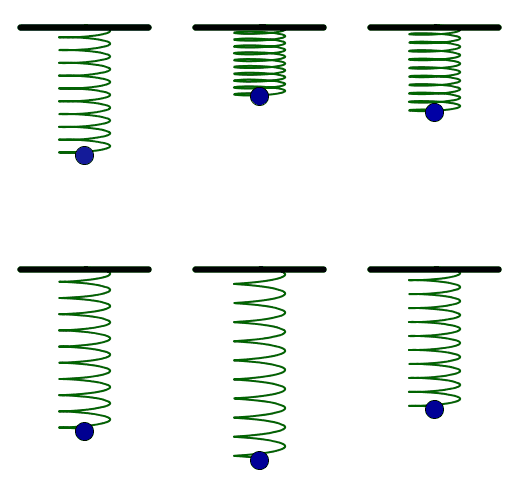
جسم يهتز حول موضع الاتزان مكوّنًا ما يعرف بالحركة التوافقية البسيطة. أحد الإجابات التالية تمثل العلاقة بين قوة الإرجاع والإزاحةA body oscillates about its equilibrium position, performing simple harmonic motion. Which of the following represents the relationship between the restoring force and displacement?
قوة الإرجاع تتناسب طرديًا مع الإزاحة ولهما نفس الاتجاهRestoring force is directly proportional to displacement and in the same direction
قوة الإرجاع تتناسب طرديًا مع الإزاحة وتعاكسها في الاتجاهRestoring force is directly proportional to displacement and opposite in direction
قوة الإرجاع تتناسب عكسيًا مع الإزاحة ولهما نفس الاتجاهRestoring force is inversely proportional to displacement and in the same direction
قوة الإرجاع تتناسب عكسيًا مع الإزاحة وتعاكسها في الاتجاهRestoring force is inversely proportional to displacement and opposite in direction
الحلSolution
📌 قانون هوك للإرجاع: \(F=-kx\)؛ الإشارة السالبة تعني أن قوة الإرجاع تعاكس اتجاه الإزاحة دائمًا (تدفع الجسم نحو موضع الاتزان)، بينما مقدارها يتناسب طرديًا مع مقدار الإزاحة.
✅ قوة الإرجاع تتناسب طرديًا مع الإزاحة وتعاكسها في الاتجاه
📌 Hooke's restoring-force law: \(F=-kx\); the negative sign means the restoring force always opposes the displacement direction (pushing the body back toward equilibrium), while its magnitude is directly proportional to the displacement's magnitude.
✅ Restoring force is directly proportional to displacement and opposite in direction
\[2\,\star\]
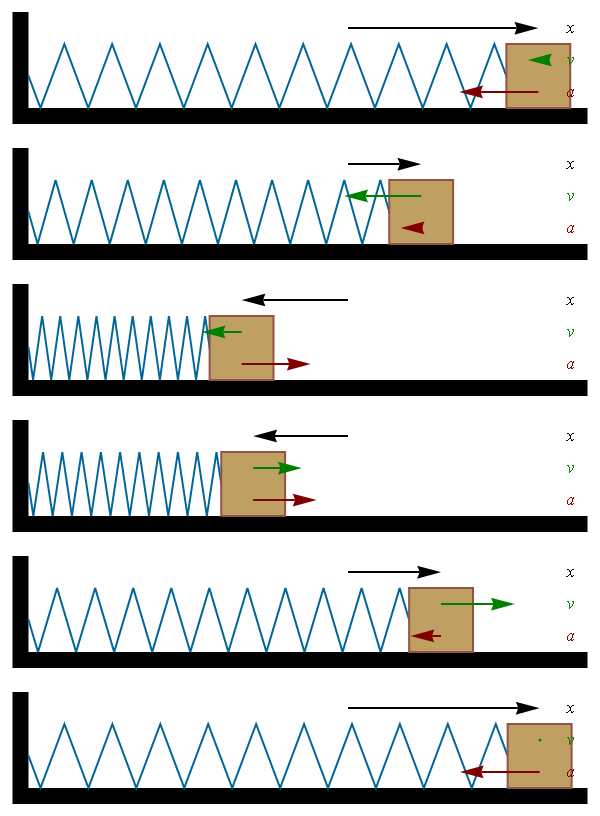
جسم يتحرك حركة توافقية بسيطة، وأثناء الحركة تتحول الطاقة من شكل إلى آخر. عند موضع الاتزان، أحد الإجابات التالية صحيحةA body performs simple harmonic motion, and during the motion energy transforms from one form to another. At the equilibrium position, which of the following is correct?
\(KE=0\;\;\;\;\;Pe_s>0\)\(KE=0\;\;\;\;\;Pe_s>0\)
\(KE>0\;\;\;\;\;Pe_s=0\)\(KE>0\;\;\;\;\;Pe_s=0\)
\(KE=Pe_s\neq0\)\(KE=Pe_s\neq0\)
\(KE=Pe_s=0\)\(KE=Pe_s=0\)
الحلSolution
📌 عند موضع الاتزان: الإزاحة \(x=0\)، فتكون طاقة الوضع المرونية \(Pe_s=\tfrac12kx^2=0\)، بينما تكون السرعة عظمى فتكون الطاقة الحركية \(KE>0\) (كل الطاقة الكلية تكون على صورة طاقة حركية عند هذه اللحظة).
✅ \(KE>0,\;Pe_s=0\)
📌 At the equilibrium position: displacement \(x=0\), so the elastic potential energy \(Pe_s=\tfrac12kx^2=0\), while speed is maximum so kinetic energy \(KE>0\) (all the total energy is kinetic at this instant).
✅ \(KE>0,\;Pe_s=0\)
\[3\,\star\star\]
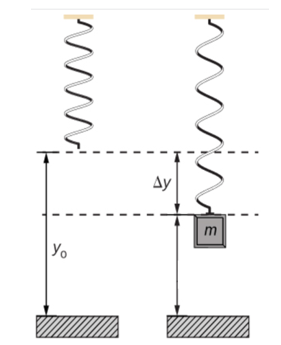
زنبرك طوله \(L_1=50\,cm\) ثُبّت من أحد أطرافه، وعُلّقت في الطرف الآخر كتلة مقدارها \(m=0.6\,kg\) دون أن يتجاوز الزنبرك حد المرونة، فأصبح طول الزنبرك \(L_2=55\,cm\). فإن ثابت الزنبرك يعادل (اعتبر \(g=9.81\,m/s^2\))A spring of length \(L_1=50\,cm\) is fixed at one end, and a mass \(m=0.6\,kg\) is hung from the other end without exceeding the elastic limit, so the spring's length becomes \(L_2=55\,cm\). The spring constant equals (take \(g=9.81\,m/s^2\))
\(k=55.8\,N/m\)\(k=55.8\,N/m\)
\(k=93.6\,N/m\)\(k=93.6\,N/m\)
\(k=76.3\,N/m\)\(k=76.3\,N/m\)
\(k=117.7\,N/m\)\(k=117.7\,N/m\)
الحلSolution
📌 الاستطالة: \(x=L_2-L_1=55-50=5\,cm=0.05\,m\)
📌 عند الاتزان، وزن الكتلة يساوي قوة الزنبرك: \(mg=kx\Rightarrow k=\dfrac{mg}{x}=\dfrac{0.6\times9.81}{0.05}\approx117.7\,N/m\)
✅ \(k\approx117.7\,N/m\)
📌 Extension: \(x=L_2-L_1=5\,cm=0.05\,m\)
📌 At equilibrium, the weight equals the spring force: \(k=\dfrac{mg}{x}=\dfrac{0.6\times9.81}{0.05}\approx117.7\,N/m\)
✅ \(k\approx117.7\,N/m\)
\[4\,\star\star\]
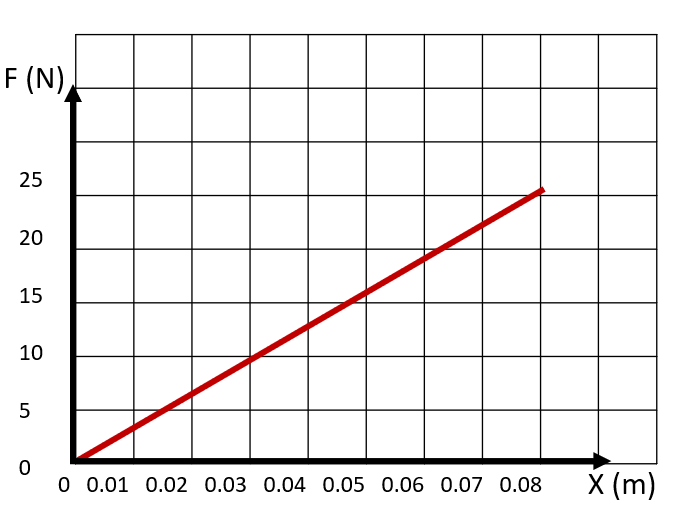
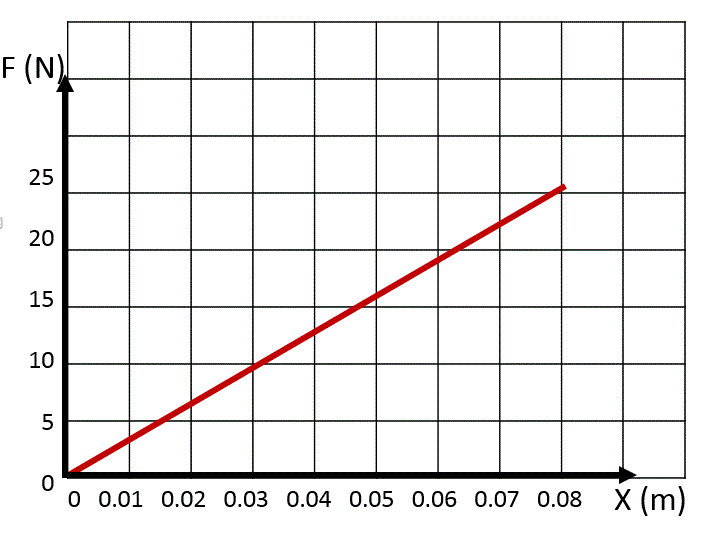
في تجربة تم تعليق كتل مختلفة في زنبرك مثبت من أحد الأطراف، مما أدى إلى استطالة الزنبرك دون تجاوز حد المرونة. رُسمت العلاقة بين قوة الشد والاستطالة فنتج الخط البياني أدناه. فإن أقصى طاقة وضع يختزنها الزنبرك تعادلIn an experiment, different masses were hung from a spring fixed at one end, stretching it without exceeding the elastic limit. The force-extension relationship was plotted as shown below. The maximum elastic potential energy stored in the spring equals
\(Pe_s=0.75\,J\)\(Pe_s=0.75\,J\)
\(Pe_s=0.52\,J\)\(Pe_s=0.52\,J\)
\(Pe_s\approx1\,J\)\(Pe_s\approx1\,J\)
\(Pe_s=0.16\,J\)\(Pe_s=0.16\,J\)
الحلSolution
📌 طاقة الوضع المرونية = المساحة تحت الخط البياني (مثلث): من الخط البياني، عند أقصى استطالة \(x\approx0.08\,m\) تكون القوة \(F\approx24\,N\).
📌 المساحة: \(Pe_s=\tfrac12\times F\times x=\tfrac12\times24\times0.08\approx0.96\,J\approx1\,J\)
✅ \(Pe_s\approx1\,J\)
📌 Elastic PE = area under the F-x line (a triangle): from the graph, at max extension \(x\approx0.08\,m\), \(F\approx24\,N\).
📌 Area: \(Pe_s=\tfrac12\times24\times0.08\approx0.96\,J\approx1\,J\)
✅ \(Pe_s\approx1\,J\)
\[5\,\star\star\]
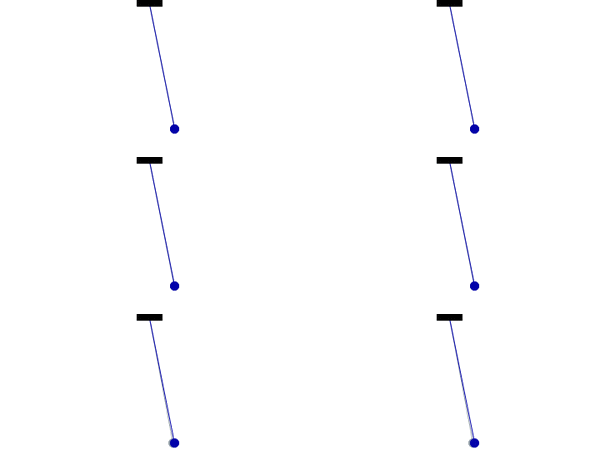
بندول يتحرك حركة توافقية بسيطة، ويقطع خلال زمن دوري واحد مسافة كلية قدرها \(x=0.4\,m\). فإن سعة الحركة الاهتزازية تعادلA pendulum performs simple harmonic motion and travels a total distance of \(x=0.4\,m\) during one period. The amplitude of oscillation equals
\(A=0.3\,m\)\(A=0.3\,m\)
\(A=0.2\,m\)\(A=0.2\,m\)
\(A=0.1\,m\)\(A=0.1\,m\)
\(A=0.4\,m\)\(A=0.4\,m\)
الحلSolution
📌 خلال زمن دوري واحد كامل: يقطع الجسم المسافة \(0\to A\to0\to-A\to0\)، أي مسافة كلية \(=4A\).
📌 الحل: \(4A=0.4\Rightarrow A=0.1\,m\)
✅ \(A=0.1\,m\)
📌 During one full period: the body travels \(0\to A\to0\to-A\to0\), a total distance \(=4A\).
📌 Solving: \(4A=0.4\Rightarrow A=0.1\,m\)
✅ \(A=0.1\,m\)
\[6\,\star\]
تُقسم الأمواج إلى ثلاثة أنواع رئيسة: الأمواج المستعرضة، والأمواج الطولية، والأمواج السطحية. أحد الأمواج التالية هي أمواج طوليةWaves are divided into three main types: transverse, longitudinal, and surface waves. Which of the following are longitudinal waves?

أمواج الضوءLight waves
أمواج الحبلRope waves
أمواج الصوتSound waves
أمواج سطح البحرOcean surface waves
الحلSolution
📌 الموجة الطولية: اهتزاز الجسيمات فيها موازٍ لاتجاه انتقال الموجة (تضاغطات وتخلخلات)، وهذا بالضبط ما يحدث في الصوت (اهتزاز جزيئات الهواء). أما الضوء (مستعرضة كهرومغناطيسية) وأمواج الحبل وسطح البحر (مستعرضة أو سطحية) فليست طولية.
✅ أمواج الصوت
📌 A longitudinal wave: particle vibration is parallel to the wave's direction of travel (compressions and rarefactions), exactly what happens with sound (vibrating air molecules). Light (transverse EM) and rope/ocean-surface waves (transverse or surface) are not longitudinal.
✅ Sound waves
\[7\,\star\star\]
بندول طوله \(L=2\,m\) عُلّق في سقف مركبة فضائية، وفي مكان ما في الفضاء تُرك ليتحرك حركة توافقية بسيطة لمعرفة عجلة الجاذبية. قِيس الزمن الدوري فكان يعادل \(T=3.6\,s\). فإن عجلة الجاذبية في تلك المنطقة تعادلA pendulum of length \(L=2\,m\) is hung from the ceiling of a spacecraft. Somewhere in space it is left to perform simple harmonic motion to find the local gravitational acceleration. The period was measured as \(T=3.6\,s\). The gravitational acceleration in that region equals
\(g=4.5\,m/s^2\)\(g=4.5\,m/s^2\)
\(g=7.6\,m/s^2\)\(g=7.6\,m/s^2\)
\(g=5.3\,m/s^2\)\(g=5.3\,m/s^2\)
\(g=6.1\,m/s^2\)\(g=6.1\,m/s^2\)
الحلSolution
📌 زمن البندول البسيط: \(T=2\pi\sqrt{L/g}\Rightarrow g=\dfrac{4\pi^2L}{T^2}=\dfrac{4\pi^2(2)}{3.6^2}=\dfrac{78.96}{12.96}\approx6.09\,m/s^2\)
✅ \(g\approx6.1\,m/s^2\)
📌 Simple pendulum period: \(T=2\pi\sqrt{L/g}\Rightarrow g=\dfrac{4\pi^2L}{T^2}=\dfrac{4\pi^2(2)}{3.6^2}\approx6.09\,m/s^2\)
✅ \(g\approx6.1\,m/s^2\)
\[8\,\star\star\]
بندول طوله \(L\) قِيس زمنه الدوري على سطح الأرض، ثم صعد بنفس البندول على سطح القمر الذي تعادل عجلة الجاذبية عليه سدس عجلة الجاذبية على سطح الأرض. فإن النسبة بين الزمن الدوري للبندول على سطح الأرض إلى الزمن الدوري للبندول على سطح القمر تعادلA pendulum of length \(L\) has its period measured on Earth, then the same pendulum is taken to the Moon, where gravitational acceleration is one-sixth of Earth's. The ratio of the pendulum's period on Earth to its period on the Moon equals
\(0.17\)\(0.17\)
\(0.4\)\(0.4\)
\(6\)\(6\)
\(2.4\)\(2.4\)
الحلSolution
📌 بما أن \(T\propto1/\sqrt g\): \(\dfrac{T_{earth}}{T_{moon}}=\sqrt{\dfrac{g_{moon}}{g_{earth}}}=\sqrt{\dfrac16}\approx0.408\)
✅ \(\approx0.4\)
📌 Since \(T\propto1/\sqrt g\): \(\dfrac{T_{earth}}{T_{moon}}=\sqrt{\dfrac{g_{moon}}{g_{earth}}}=\sqrt{\dfrac16}\approx0.408\)
✅ \(\approx0.4\)
\[9\,\star\star\]
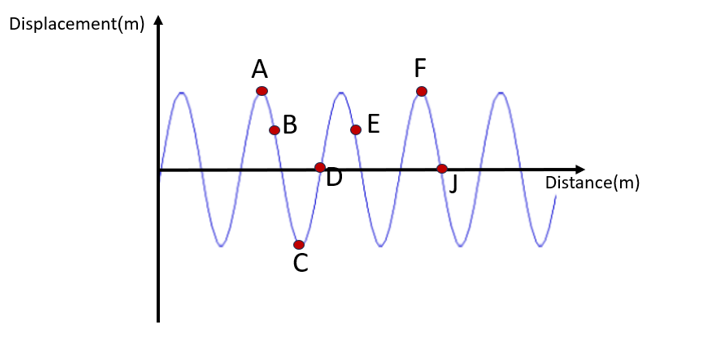
حبل يشكّل موجة مستعرضة كما في الشكل أدناه. أحد الإجابات التالية تعبّر عن مسافة بين نقطتين تعادل طول الموجةA rope forms a transverse wave as shown below. Which of the following distances between two points equals the wavelength?
\(DJ=\lambda\)\(DJ=\lambda\)
\(AF=\lambda\)\(AF=\lambda\)
\(AC=\lambda\)\(AC=\lambda\)
\(BE=\lambda\)\(BE=\lambda\)
الحلSolution
📌 تعريف طول الموجة: هو المسافة بين أي نقطتين متتاليتين تهتزان بنفس الطور تمامًا (بنفس الإزاحة واتجاه الحركة في كل لحظة). النقطتان \(B,E\) تقعان في نفس موضع الطور النسبي من دورتين متتاليتين، فالمسافة بينهما تساوي طول الموجة كاملاً.
✅ \(BE=\lambda\)
📌 Definition of wavelength: the distance between any two consecutive points vibrating in exactly the same phase (same displacement and direction of motion at every instant). Points \(B\) and \(E\) sit at the same relative phase position in two consecutive cycles, so the distance between them equals one full wavelength.
✅ \(BE=\lambda\)
\[10\,\star\star\star\]
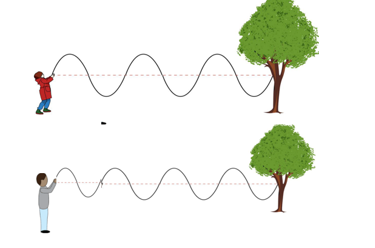
قام أحد الطلاب بعمل موجة في حبل وسجّل القيم التالية لها: \(v=8\,\dfrac{m}{s}\;\;\;\;f=4\,Hz\;\;\;\;\lambda=2\,m\). كرّر طالب آخر التجربة على نفس الحبل، ولوحظ أن طول الموجة أصبح \(\lambda=1.5\,m\). أحد الإجابات التالية تعبّر عمّا حدثA student created a wave on a rope with values: \(v=8\,\dfrac{m}{s}\;\;\;\;f=4\,Hz\;\;\;\;\lambda=2\,m\). Another student repeated the experiment on the same rope, and the wavelength became \(\lambda=1.5\,m\). Which of the following describes what happened?
\(f=4\,Hz\;\;\;\;v=6\,m/s\)\(f=4\,Hz\;\;\;\;v=6\,m/s\)
\(f=6\,Hz\;\;\;\;v=9\,m/s\)\(f=6\,Hz\;\;\;\;v=9\,m/s\)
\(f=5.33\,Hz\;\;\;\;v=8\,m/s\)\(f=5.33\,Hz\;\;\;\;v=8\,m/s\)
\(f=3.5\,Hz\;\;\;\;v=5.25\,m/s\)\(f=3.5\,Hz\;\;\;\;v=5.25\,m/s\)
الحلSolution
📌 سرعة الموجة تعتمد على خصائص الوسط (الحبل نفسه) لا على مصدر الموجة: بما أن الحبل نفسه لم يتغيّر، تبقى \(v=8\,m/s\) ثابتة.
📌 التردد الجديد: \(f=\dfrac{v}{\lambda}=\dfrac{8}{1.5}\approx5.33\,Hz\) (تغيّر بسبب اختلاف معدل اهتزاز يد الطالب الثاني)
✅ \(f\approx5.33\,Hz,\;v=8\,m/s\)
📌 Wave speed depends on the medium's properties (the rope itself), not on the source: since the rope itself didn't change, \(v=8\,m/s\) stays the same.
📌 New frequency: \(f=\dfrac{v}{\lambda}=\dfrac{8}{1.5}\approx5.33\,Hz\) (changed because the second student's hand shook the rope at a different rate)
✅ \(f\approx5.33\,Hz,\;v=8\,m/s\)
\[11\,\star\star\]
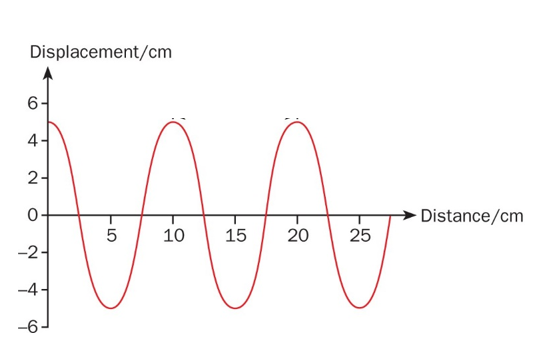
موجة مستعرضة رُسمت العلاقة بين الإزاحة والبعد عن المصدر فنتج الخط البياني التالي. فإذا كانت سرعة الموجة تعادل \(v=4\,m/s\)، فإن تردد المصدر يعادلA transverse wave's displacement-vs-distance-from-source graph is shown below. If the wave speed is \(v=4\,m/s\), the source frequency equals
\(f=40\,Hz\)\(f=40\,Hz\)
\(f=2.5\,Hz\)\(f=2.5\,Hz\)
\(f=20\,Hz\)\(f=20\,Hz\)
\(f=10\,Hz\)\(f=10\,Hz\)
الحلSolution
📌 من الرسم البياني: طول الموجة \(\lambda\approx10\,cm=0.1\,m\)
📌 معادلة الموجة: \(f=\dfrac{v}{\lambda}=\dfrac{4}{0.1}=40\,Hz\)
✅ \(f=40\,Hz\)
📌 From the graph: wavelength \(\lambda\approx10\,cm=0.1\,m\)
📌 Wave equation: \(f=\dfrac{v}{\lambda}=\dfrac{4}{0.1}=40\,Hz\)
✅ \(f=40\,Hz\)
\[12\,\star\star\]
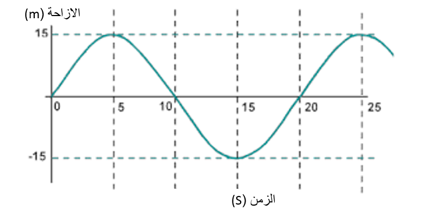
في الشكل أدناه رُسمت العلاقة بين الإزاحة والزمن لموجة مستعرضة، وكانت سرعة الموجة \(v=3\,m/s\). من خلال المعلومات والشكل، فإن التردد وطول الموجة يعادلانThe displacement-vs-time graph of a transverse wave is shown below, with wave speed \(v=3\,m/s\). From the information and the graph, the frequency and wavelength equal
\(f=10\,Hz\;\;\;\;\lambda=0.3\,m\)\(f=10\,Hz\;\;\;\;\lambda=0.3\,m\)
\(f=0.2\,Hz\;\;\;\;\lambda=100\,m\)\(f=0.2\,Hz\;\;\;\;\lambda=100\,m\)
\(f=0.05\,Hz\;\;\;\;\lambda=60\,m\)\(f=0.05\,Hz\;\;\;\;\lambda=60\,m\)
\(f=0.1\,Hz\;\;\;\;\lambda=30\,m\)\(f=0.1\,Hz\;\;\;\;\lambda=30\,m\)
الحلSolution
📌 من الرسم البياني: الزمن الدوري \(T\approx20\,s\Rightarrow f=\dfrac1T=0.05\,Hz\)
📌 معادلة الموجة: \(\lambda=\dfrac{v}{f}=\dfrac{3}{0.05}=60\,m\)
✅ \(f=0.05\,Hz,\;\lambda=60\,m\)
📌 From the graph: period \(T\approx20\,s\Rightarrow f=\dfrac1T=0.05\,Hz\)
📌 Wave equation: \(\lambda=\dfrac{v}{f}=\dfrac{3}{0.05}=60\,m\)
✅ \(f=0.05\,Hz,\;\lambda=60\,m\)
\[13\,\star\star\star\]
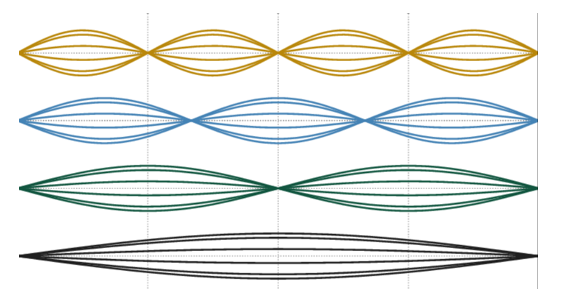
حبل طوله \(L=2\,m\) أُحدث فيه اضطراب واصطدم بحاجز مكوّنًا أمواجًا مستقرة بأشكال مختلفة. أحد الأطوال الموجية التالية لا يمكن أن يكون موجة مستقرة على هذا الحبلA rope of length \(L=2\,m\) is disturbed and reflects off a barrier, forming standing waves of different shapes. Which of the following wavelengths CANNOT form a standing wave on this rope?
\(\lambda=2\,m\)\(\lambda=2\,m\)
\(\lambda=3\,m\)\(\lambda=3\,m\)
\(\lambda=4\,m\)\(\lambda=4\,m\)
\(\lambda=1.33\,m\)\(\lambda=1.33\,m\)
الحلSolution
📌 شرط الموجة المستقرة على حبل طوله L (طرفان ثابتان): \(L=\dfrac{n\lambda}{2}\Rightarrow\lambda=\dfrac{2L}{n}=\dfrac{4}{n}\) لأعداد صحيحة \(n=1,2,3,...\)
📌 القيم الممكنة: \(n=1\Rightarrow4\,m\)، \(n=2\Rightarrow2\,m\)، \(n=3\Rightarrow1.33\,m\)؛ أما \(\lambda=3\,m\) فيعطي \(n=4/3\) (غير صحيح)، فلا يمكن أن يكون موجة مستقرة.
✅ \(\lambda=3\,m\)
📌 Standing-wave condition on a rope of length L (both ends fixed): \(L=\dfrac{n\lambda}{2}\Rightarrow\lambda=\dfrac{2L}{n}=\dfrac{4}{n}\) for integer \(n=1,2,3,...\)
📌 Possible values: \(n=1\Rightarrow4\,m\), \(n=2\Rightarrow2\,m\), \(n=3\Rightarrow1.33\,m\); but \(\lambda=3\,m\) requires \(n=4/3\) (not an integer), so it cannot form a standing wave.
✅ \(\lambda=3\,m\)
\[14\,\star\star\]
جهاز سونار على غواصة يرسل إشارة إلى جسم ساكن، ويعود صدى الصوت بعد زمن \(t=5\,s\). احسب سرعة الصوت في الماء إذا كانت مسافة الجسم عن الغواصة \(X=3625\,m\)A sonar device on a submarine sends a signal to a stationary object, and the echo returns after \(t=5\,s\). Calculate the speed of sound in water if the object is at a distance \(X=3625\,m\) from the submarine
\(v=1750\,m/s\)\(v=1750\,m/s\)
\(v=1350\,m/s\)\(v=1350\,m/s\)
\(v=1450\,m/s\)\(v=1450\,m/s\)
\(v=1650\,m/s\)\(v=1650\,m/s\)
الحلSolution
📌 يقطع الصوت المسافة ذهابًا وإيابًا: المسافة الكلية \(=2X=2\times3625=7250\,m\)
📌 السرعة: \(v=\dfrac{2X}{t}=\dfrac{7250}{5}=1450\,m/s\)
✅ \(v=1450\,m/s\)
📌 Sound travels the distance there and back: total distance \(=2X=7250\,m\)
📌 Speed: \(v=\dfrac{2X}{t}=\dfrac{7250}{5}=1450\,m/s\)
✅ \(v=1450\,m/s\)
\[15\,\star\star\]
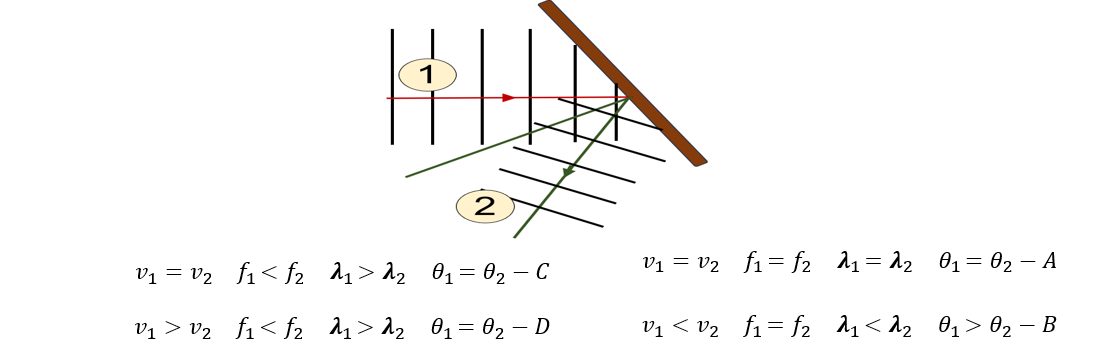
حوض مائي شُكِّلت فيه موجة مستقيمة اصطدمت بحاجز فحدث انعكاس. أحد الإجابات التالية تعبّر عن صفات الموجة الساقطة والمنعكسةIn a ripple tank, a straight wave hits a barrier and reflects. Which of the following describes the incident and reflected waves?
نفس الطول الموجي ونفس الترددSame wavelength and same frequency
طول موجي مختلف ونفس السرعةDifferent wavelength and same speed
نفس السعة وتردد مختلفSame amplitude and different frequency
سرعة مختلفة ونفس الطول الموجيDifferent speed and same wavelength
الحلSolution
📌 الانعكاس لا يغيّر الوسط: الموجة تبقى في نفس الوسط (نفس الحوض المائي) قبل الانعكاس وبعده، لذا تبقى سرعتها وطولها الموجي وترددها كلها كما هي (يتغيّر اتجاه الانتشار فقط، وربما الطور).
✅ نفس الطول الموجي ونفس التردد
📌 Reflection doesn't change the medium: the wave stays in the same medium (the same water tank) before and after reflecting, so its speed, wavelength, and frequency all stay the same (only the direction of travel, and possibly the phase, changes).
✅ Same wavelength and same frequency
\[16\,\star\star\star\]
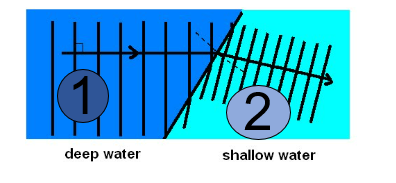
حوض مائي عميق شُكِّلت فيه موجة مستقيمة انتقلت إلى وسط ضحل فحدث انكسار. أحد الإجابات التالية لا تعبّر عن صفات الموجة الساقطة والمنكسرةIn a ripple tank, a straight wave travels from deep water into shallow water and refracts. Which of the following does NOT describe the incident and refracted waves?
\(f_1>f_2\)\(f_1>f_2\)
\(v_1>v_2\)\(v_1>v_2\)
\(\lambda_1>\lambda_2\)\(\lambda_1>\lambda_2\)
\(\theta_1>\theta_2\)\(\theta_1>\theta_2\)
الحلSolution
📌 التردد يبقى ثابتًا دائمًا عند الانكسار: التردد يحدده المصدر فقط، ولا يتغيّر عند عبور الموجة إلى وسط آخر، لذا \(f_1=f_2\) دائمًا — أي أن \(f_1>f_2\) عبارة خاطئة.
📌 بقية الخصائص صحيحة فعلاً: في الماء الضحل تقل السرعة (\(v_1>v_2\) صحيحة)، ولأن \(\lambda=v/f\) وf ثابت، يقل الطول الموجي تناسبيًا (\(\lambda_1>\lambda_2\) صحيحة)، وتنحني الموجة نحو العمود عند دخولها الوسط الأبطأ (\(\theta_1>\theta_2\) صحيحة).
✅ العبارة الخاطئة: \(f_1>f_2\)
📌 Frequency always stays constant across refraction: frequency is set only by the source and never changes when a wave crosses into another medium, so \(f_1=f_2\) always — meaning \(f_1>f_2\) is the false statement.
📌 The other statements are actually true: speed decreases in shallow water (\(v_1>v_2\) is true), and since \(\lambda=v/f\) with f constant, wavelength decreases proportionally (\(\lambda_1>\lambda_2\) is true), and the wave bends toward the normal entering the slower medium (\(\theta_1>\theta_2\) is true).
✅ The false statement: \(f_1>f_2\)
\[17\,\star\star\]
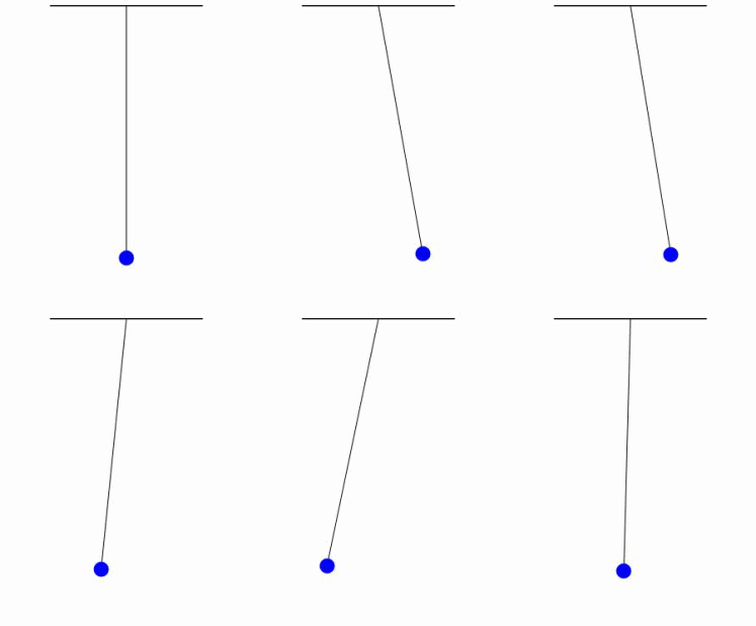
بندول يتحرك حركة توافقية بسيطة زمنه الدوري \(T\). إذا زاد طول خيط البندول البسيط إلى أربعة أضعاف طوله الأصلي، فإن زمنه الدوري يصبحA pendulum performs simple harmonic motion with period \(T\). If the length of the pendulum's string increases to four times its original length, its period becomes
يزداد إلى الضعفDoubles
يقل إلى الربعBecomes one-quarter
يقل إلى النصفBecomes half
يزداد إلى أربعة أضعافQuadruples
الحلSolution
📌 \(T=2\pi\sqrt{L/g}\Rightarrow T\propto\sqrt L\): إذا أصبح الطول \(4L\)، فإن \(T_{new}=2\pi\sqrt{4L/g}=2\times2\pi\sqrt{L/g}=2T\)
✅ يزداد إلى الضعف
📌 \(T=2\pi\sqrt{L/g}\Rightarrow T\propto\sqrt L\): if the length becomes \(4L\), then \(T_{new}=2\pi\sqrt{4L/g}=2T\)
✅ Doubles
\[18\,\star\]
العلاقة بين الزمن الدوري \(T\) والتردد \(f\) لجسم يتحرك حركة توافقية بسيطة تُعطى بالعلاقةThe relationship between period \(T\) and frequency \(f\) for a body performing simple harmonic motion is given by
\(f=T\)\(f=T\)
\(f=1/T\)\(f=1/T\)
\(f=2T\)\(f=2T\)
\(f=T/2\)\(f=T/2\)
الحلSolution
📌 بالتعريف: التردد هو عدد الدورات الكاملة في الثانية، وهو مقلوب الزمن الدوري: \(f=1/T\)، بصرف النظر عن نوع الحركة الدورية.
✅ \(f=1/T\)
📌 By definition: frequency is the number of complete cycles per second, the reciprocal of the period: \(f=1/T\), regardless of the type of periodic motion.
✅ \(f=1/T\)
\[19\,\star\star\]
جسيم يتحرك حركة توافقية بسيطة بزمن دوري \(T=0.5\,s\). فإن تردده الزاوي \(\omega\) يساوي تقريبًاA particle performs simple harmonic motion with period \(T=0.5\,s\). Its angular frequency \(\omega\) approximately equals
\(\omega\approx12.57\,rad/s\)\(\omega\approx12.57\,rad/s\)
\(\omega\approx6.28\,rad/s\)\(\omega\approx6.28\,rad/s\)
\(\omega\approx3.14\,rad/s\)\(\omega\approx3.14\,rad/s\)
\(\omega\approx25.13\,rad/s\)\(\omega\approx25.13\,rad/s\)
الحلSolution
📌 التردد الزاوي: \(\omega=\dfrac{2\pi}{T}=\dfrac{2\pi}{0.5}=4\pi\approx12.57\,rad/s\)
✅ \(\omega\approx12.57\,rad/s\)
📌 Angular frequency: \(\omega=\dfrac{2\pi}{T}=\dfrac{2\pi}{0.5}=4\pi\approx12.57\,rad/s\)
✅ \(\omega\approx12.57\,rad/s\)
\[20\,\star\]
بندول بسيط طوله \(L\) وكتلته \(m\) يتأرجح بزمن دوري \(T\). إذا ضاعفنا الكتلة إلى \(2m\) مع بقاء \(L\) ثابتًا، فإن الزمن الدوري الجديد يصبحA simple pendulum of length \(L\) and mass \(m\) swings with period \(T\). If the mass is doubled to \(2m\) while \(L\) stays the same, the new period becomes
\(2T\)\(2T\)
\(T\) (لا يتغيّر)\(T\) (unchanged)
\(T/2\)\(T/2\)
\(\sqrt2\,T\)\(\sqrt2\,T\)
الحلSolution
📌 صيغة زمن البندول البسيط: \(T=2\pi\sqrt{L/g}\) — لاحظ أن الكتلة \(m\) لا تظهر في الصيغة إطلاقًا، فزمن البندول البسيط مستقل عن كتلته تمامًا.
✅ \(T\) يبقى كما هو دون تغيير
📌 Simple pendulum period formula: \(T=2\pi\sqrt{L/g}\) — notice that mass \(m\) does not appear in the formula at all, so a simple pendulum's period is completely independent of its mass.
✅ \(T\) stays unchanged
\[21\,\star\star\]
كتلة \(m\) معلّقة بزنبرك ثابته \(k\) تهتز بزمن دوري \(T\). إذا ضاعفنا الكتلة إلى \(4m\) مع بقاء \(k\) ثابتًا، فإن الزمن الدوري الجديد يصبحA mass \(m\) hung from a spring of constant \(k\) oscillates with period \(T\). If the mass is increased to \(4m\) while \(k\) stays the same, the new period becomes
\(T\) (لا يتغيّر)\(T\) (unchanged)
\(2T\)\(2T\)
\(4T\)\(4T\)
\(T/2\)\(T/2\)
الحلSolution
📌 صيغة زمن نظام كتلة-زنبرك: \(T=2\pi\sqrt{m/k}\Rightarrow T\propto\sqrt m\)
📌 عند تربيع الكتلة أربع مرات: \(T_{new}=2\pi\sqrt{4m/k}=2\times2\pi\sqrt{m/k}=2T\)
✅ \(2T\)
📌 Mass-spring system period formula: \(T=2\pi\sqrt{m/k}\Rightarrow T\propto\sqrt m\)
📌 With the mass quadrupled: \(T_{new}=2\pi\sqrt{4m/k}=2T\)
✅ \(2T\)
\[22\,\star\]
جسم يتحرك حركة توافقية بسيطة بسعة \(A\)، مرتبط بزنبرك ثابته \(k\). الطاقة الكلية للنظام تساويA body performs simple harmonic motion with amplitude \(A\), attached to a spring of constant \(k\). The total energy of the system equals
\(E=kA\)\(E=kA\)
\(E=\tfrac12kA^2\)\(E=\tfrac12kA^2\)
\(E=kA^2\)\(E=kA^2\)
\(E=\tfrac12k^2A\)\(E=\tfrac12k^2A\)
الحلSolution
📌 الطاقة الكلية: \(E=\tfrac12kA^2\)، وتبقى ثابتة طوال الحركة (تتبادل باستمرار بين طاقة حركية وطاقة وضع مرونية، لكن مجموعهما ثابت).
✅ \(E=\tfrac12kA^2\)
📌 Total energy: \(E=\tfrac12kA^2\), and it stays constant throughout the motion (continuously exchanged between kinetic and elastic potential energy, but their sum is constant).
✅ \(E=\tfrac12kA^2\)
\[23\,\star\]
أثناء الحركة التوافقية البسيطة، تكون سرعة الجسم عظمى عندما يكون الجسمDuring simple harmonic motion, the body's speed is maximum when the body is
عند أقصى إزاحةAt maximum displacement
عند موضع الاتزانAt the equilibrium position
في منتصف المسافة بين الاتزان وأقصى إزاحةHalfway between equilibrium and maximum displacement
السرعة لا تتغيّر أبدًاSpeed never changes
الحلSolution
📌 عند موضع الاتزان: كل الطاقة الكلية للنظام تكون على صورة طاقة حركية (طاقة الوضع المرونية معدومة هناك)، لذا تكون السرعة عظمى عند هذه النقطة بالتحديد، وتصبح صفرًا عند أقصى إزاحة.
✅ عند موضع الاتزان
📌 At the equilibrium position: all the system's total energy is kinetic (elastic potential energy is zero there), so speed is maximum exactly at this point, and becomes zero at maximum displacement.
✅ At the equilibrium position
\[24\,\star\star\]
اتجاه تسارع الجسم في الحركة التوافقية البسيطة يكون دائمًاThe direction of a body's acceleration in simple harmonic motion is always
بعيدًا عن موضع الاتزانAway from the equilibrium position
نحو موضع الاتزانToward the equilibrium position
عموديًا على اتجاه الإزاحةPerpendicular to the displacement direction
ثابت الاتجاه دون تغيّر طوال الحركةFixed in direction throughout the motion
الحلSolution
📌 من \(a=-\omega^2x\): التسارع يتناسب طرديًا مع الإزاحة لكنه يعاكسها دائمًا في الاتجاه — أي يشير دائمًا نحو موضع الاتزان، وهذا هو جوهر قوة الإرجاع المسببة للحركة التوافقية البسيطة.
✅ نحو موضع الاتزان
📌 From \(a=-\omega^2x\): acceleration is directly proportional to displacement but always opposite in direction — i.e., it always points toward the equilibrium position, which is the essence of the restoring force that produces simple harmonic motion.
✅ Toward the equilibrium position
\[25\,\star\star\]
إذا تضاعفت سعة حركة توافقية بسيطة لجسم مرتبط بزنبرك (بينما بقي ثابت الزنبرك \(k\) ثابتًا)، فإن طاقته الكليةIf the amplitude of a spring-mass system's simple harmonic motion doubles (while the spring constant \(k\) stays fixed), its total energy
تتضاعفDoubles
تصبح أربعة أضعافBecomes four times as large
تبقى كما هيStays the same
تصبح النصفBecomes half
الحلSolution
📌 \(E=\tfrac12kA^2\Rightarrow E\propto A^2\): عند مضاعفة السعة \(A\to2A\)، تصبح الطاقة \(E_{new}=\tfrac12k(2A)^2=4\times\tfrac12kA^2=4E\)
✅ تصبح أربعة أضعاف
📌 \(E=\tfrac12kA^2\Rightarrow E\propto A^2\): doubling the amplitude \(A\to2A\) gives \(E_{new}=\tfrac12k(2A)^2=4E\)
✅ Becomes four times as large
\[26\,\star\star\]
عند توصيل زنبركين ثابتاهما \(k_1,k_2\) على التوالي (أحدهما خلف الآخر)، فإن ثابت الزنبرك المكافئ \(k_{eq}\)When two springs of constants \(k_1,k_2\) are connected in series (one after the other), the equivalent spring constant \(k_{eq}\)
يزداد عن كل من \(k_1,k_2\)Is greater than both \(k_1\) and \(k_2\)
يساوي \(k_1+k_2\)Equals \(k_1+k_2\)
أصغر من كل من \(k_1,k_2\)Is smaller than both \(k_1\) and \(k_2\)
يساوي المتوسط الحسابي لهماEquals their arithmetic average
الحلSolution
📌 التوصيل على التوالي: \(\dfrac1{k_{eq}}=\dfrac1{k_1}+\dfrac1{k_2}\Rightarrow k_{eq}\) أصغر دائمًا من أصغر الزنبركين — لأن التوصيل على التوالي يجعل النظام أسهل في التمدد (أقل صلادة) من أي زنبرك بمفرده.
✅ أصغر من كل من \(k_1,k_2\)
📌 Series connection: \(\dfrac1{k_{eq}}=\dfrac1{k_1}+\dfrac1{k_2}\Rightarrow k_{eq}\) is always smaller than the smaller of the two springs — since a series connection makes the system easier to stretch (less stiff) than either spring alone.
✅ Smaller than both \(k_1\) and \(k_2\)
\[27\,\star\star\]
كتلة مقدارها \(m=2\,kg\) معلّقة بزنبرك رأسي ثابته \(k=50\,N/m\). فإن الزمن الدوري لاهتزازها يساوي تقريبًاA mass \(m=2\,kg\) hangs from a vertical spring with constant \(k=50\,N/m\). The period of its oscillation approximately equals
\(T\approx0.63\,s\)\(T\approx0.63\,s\)
\(T\approx1.26\,s\)\(T\approx1.26\,s\)
\(T\approx2.51\,s\)\(T\approx2.51\,s\)
\(T\approx6.28\,s\)\(T\approx6.28\,s\)
الحلSolution
📌 صيغة زمن نظام كتلة-زنبرك: \(T=2\pi\sqrt{\dfrac{m}{k}}=2\pi\sqrt{\dfrac{2}{50}}=2\pi\sqrt{0.04}=2\pi(0.2)\approx1.26\,s\)
✅ \(T\approx1.26\,s\)
📌 Mass-spring period formula: \(T=2\pi\sqrt{\dfrac{m}{k}}=2\pi\sqrt{\dfrac{2}{50}}\approx1.26\,s\)
✅ \(T\approx1.26\,s\)
\[28\,\star\]
موجة سرعتها \(v=340\,m/s\) وترددها \(f=170\,Hz\)، فإن طولها الموجي يساويA wave with speed \(v=340\,m/s\) and frequency \(f=170\,Hz\) has a wavelength equal to
\(\lambda=0.5\,m\)\(\lambda=0.5\,m\)
\(\lambda=2\,m\)\(\lambda=2\,m\)
\(\lambda=340\,m\)\(\lambda=340\,m\)
\(\lambda=57800\,m\)\(\lambda=57800\,m\)
الحلSolution
📌 معادلة الموجة: \(\lambda=\dfrac{v}{f}=\dfrac{340}{170}=2\,m\)
✅ \(\lambda=2\,m\)
📌 Wave equation: \(\lambda=\dfrac{v}{f}=\dfrac{340}{170}=2\,m\)
✅ \(\lambda=2\,m\)
\[29\,\star\]
الموجة التي يكون فيها اهتزاز الجسيمات عموديًا على اتجاه انتقال الموجة تسمىA wave in which particle vibration is perpendicular to the direction of wave travel is called
موجة طوليةA longitudinal wave
موجة مستعرضةA transverse wave
موجة صوتيةA sound wave
موجة مستقرةA standing wave
الحلSolution
📌 تعريف الموجة المستعرضة: اهتزاز الجسيمات فيها عمودي على اتجاه انتقال الطاقة، كما في أمواج الحبل والضوء والأمواج الكهرومغناطيسية عمومًا.
✅ موجة مستعرضة
📌 Definition of a transverse wave: particle vibration is perpendicular to the direction energy travels, as in rope waves, light, and electromagnetic waves generally.
✅ A transverse wave
\[30\,\star\]
أي من الأمواج التالية يمكنها الانتقال في الفراغ (الخلاء) دون الحاجة إلى وسط مادي؟Which of the following waves can travel through a vacuum without needing a material medium?
أمواج الصوتSound waves
الأمواج المائيةWater waves
الأمواج الكهرومغناطيسية (كالضوء)Electromagnetic waves (like light)
أمواج الحبلRope waves
الحلSolution
📌 الأمواج الميكانيكية مقابل الكهرومغناطيسية: الصوت والأمواج المائية وأمواج الحبل كلها أمواج ميكانيكية تحتاج وسطًا ماديًا تنتقل خلاله. أما الأمواج الكهرومغناطيسية (كالضوء) فتنتج عن تذبذب مجالين كهربائي ومغناطيسي، ولا تحتاج وسطًا ماديًا إطلاقًا، لذا تنتقل عبر الفراغ (كما يصل ضوء الشمس إلى الأرض عبر الفضاء).
✅ الأمواج الكهرومغناطيسية
📌 Mechanical vs. electromagnetic waves: sound, water waves, and rope waves are all mechanical waves that need a material medium to travel through. Electromagnetic waves (like light), however, arise from oscillating electric and magnetic fields and need no medium at all, so they travel through vacuum (as sunlight reaches Earth through space).
✅ Electromagnetic waves
\[31\,\star\star\]
تقترب سيارة إسعاف بصفارة إنذار من شخص واقف على الرصيف. فإن هذا الشخص يسمع صوتًا ترددهAn ambulance with its siren on approaches a person standing on the sidewalk. That person hears a sound whose frequency is
أعلى من التردد الحقيقي للصفارةHigher than the siren's actual frequency
أقل من التردد الحقيقي للصفارةLower than the siren's actual frequency
يساوي التردد الحقيقي تمامًاExactly equal to the actual frequency
صفرًاZero
الحلSolution
📌 ظاهرة دوبلر: عندما يقترب مصدر الصوت من المراقب، تتقارب قمم الموجات الصوتية الواصلة إليه (تنضغط في زمن أقصر)، فيدرك المراقب ترددًا أعلى من التردد الحقيقي المُصدَر. والعكس صحيح عند ابتعاد المصدر.
✅ أعلى من التردد الحقيقي
📌 The Doppler effect: when a sound source approaches an observer, the wave crests reaching them get compressed into a shorter time, so the observer perceives a higher frequency than the actual emitted one. The opposite happens as the source moves away.
✅ Higher than the actual frequency
\[32\,\star\]
عندما تتراكب موجتان متطابقتان في الطور (قمة مع قمة، وقاع مع قاع) عند نقطة معينة، يحدثWhen two waves overlap in phase (crest meets crest, trough meets trough) at a point, this produces
تداخل هدّامDestructive interference
تداخل بنّاءConstructive interference
انعكاس كليTotal reflection
حيودDiffraction
الحلSolution
📌 التداخل البنّاء: عندما تتطابق موجتان في الطور تمامًا، تتجمع إزاحتاهما (مبدأ التراكب) فتنتج إزاحة محصلة أكبر (سعة أكبر) من إزاحة كل موجة بمفردها.
✅ تداخل بنّاء
📌 Constructive interference: when two waves are exactly in phase, their displacements add (superposition principle), producing a larger combined displacement (greater amplitude) than either wave alone.
✅ Constructive interference
\[33\,\star\]
عندما تتراكب موجتان بحيث تلتقي قمة إحداهما مع قاع الأخرى تمامًا وبنفس السعة، يحدثWhen two waves overlap such that the crest of one exactly meets the trough of the other, with equal amplitudes, this produces
تداخل بنّاءConstructive interference
تداخل هدّامDestructive interference
رنينResonance
انكسارRefraction
الحلSolution
📌 التداخل الهدّام: عندما تكون الموجتان متعاكستين تمامًا في الطور وبنفس السعة، تُلغي إحداهما الأخرى تمامًا عند نقطة التراكب (المحصلة = صفر).
✅ تداخل هدّام
📌 Destructive interference: when the two waves are completely out of phase with equal amplitudes, they exactly cancel each other at the point of overlap (resultant = zero).
✅ Destructive interference
\[34\,\star\]
انحناء الموجة عند مرورها عبر فتحة ضيقة أو حول حافة حاجز يسمىThe bending of a wave as it passes through a narrow opening or around the edge of a barrier is called
الانعكاسReflection
الانكسارRefraction
الحيودDiffraction
التداخلInterference
الحلSolution
📌 الحيود (الانعراج): ظاهرة انحناء الموجة حول حواف الحواجز أو عند مرورها من فتحات ضيقة، وتزداد وضوحًا كلما اقترب اتساع الفتحة من طول الموجة نفسه.
✅ الحيود
📌 Diffraction: the phenomenon of a wave bending around the edges of barriers or when passing through narrow openings, becoming more pronounced as the opening's width approaches the wavelength itself.
✅ Diffraction
\[35\,\star\]
في الموجة المستقرة، النقطة التي تكون إزاحتها معدومة دائمًا تسمىIn a standing wave, the point whose displacement is always zero is called
بطنAn antinode
عقدةA node
قمةA crest
بؤرةA focus
الحلSolution
📌 العقدة: نقطة ثابتة في الموجة المستقرة تنتج عن تداخل هدّام تام مستمر عندها (بين الموجة الساقطة والمنعكسة)، فتبقى إزاحتها صفرًا طوال الزمن. أما البطن فهو نقطة الإزاحة القصوى (تداخل بنّاء).
✅ عقدة
📌 A node: a fixed point in a standing wave produced by continuous total destructive interference there (between the incident and reflected waves), so its displacement stays zero at all times. An antinode is the point of maximum displacement (constructive interference).
✅ A node
\[36\,\star\]
اهتزاز جسم بأقصى سعة ممكنة عندما يتطابق تردد القوة الدافعة الخارجية مع تردده الطبيعي يسمىA body vibrating with maximum possible amplitude when the frequency of an external driving force matches its natural frequency is called
التداخلInterference
الحيودDiffraction
الرنينResonance
الانعكاسReflection
الحلSolution
📌 الرنين: عندما يتطابق تردد قوة دافعة دورية خارجية مع التردد الطبيعي لنظام مهتز، تُضخّ الطاقة إليه بكفاءة قصوى مع كل دورة، فتتراكم وتكبر سعة اهتزازه إلى أقصى حد ممكن (مثال: دفع أرجوحة بالتوقيت الصحيح).
✅ الرنين
📌 Resonance: when a periodic external driving force's frequency matches a vibrating system's natural frequency, energy is pumped into it with maximum efficiency each cycle, building up its vibration amplitude to the largest possible value (example: pushing a swing at just the right timing).
✅ Resonance
\[37\,\star\]
موجة صوتية طولها الموجي \(\lambda=1.5\,m\) وسرعتها في الهواء \(v=330\,m/s\)، فإن ترددها يساوي تقريبًاA sound wave with wavelength \(\lambda=1.5\,m\) and speed \(v=330\,m/s\) in air has a frequency approximately equal to
\(f=220\,Hz\)\(f=220\,Hz\)
\(f=495\,Hz\)\(f=495\,Hz\)
\(f=1.5\,Hz\)\(f=1.5\,Hz\)
\(f=330\,Hz\)\(f=330\,Hz\)
الحلSolution
📌 معادلة الموجة: \(f=\dfrac{v}{\lambda}=\dfrac{330}{1.5}=220\,Hz\)
✅ \(f=220\,Hz\)
📌 Wave equation: \(f=\dfrac{v}{\lambda}=\dfrac{330}{1.5}=220\,Hz\)
✅ \(f=220\,Hz\)
\[38\,\star\star\star\]
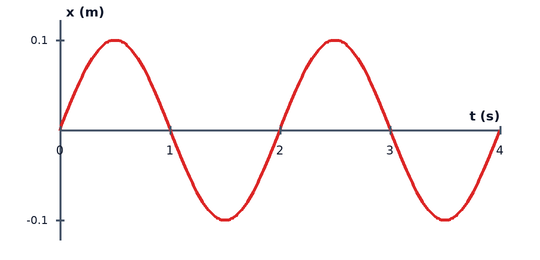
يمثل الرسم إزاحة جسم مهتز حركة توافقية بسيطة مع الزمن. فإن أكبر سرعة يصل إليها الجسم:The graph shows the displacement of an object in simple harmonic motion against time. The maximum speed of the object is:
\(0.31\,m/s\)\(0.31\,m/s\)
\(0.63\,m/s\)\(0.63\,m/s\)
\(0.10\,m/s\)\(0.10\,m/s\)
\(0.05\,m/s\)\(0.05\,m/s\)
الحلSolution
📌 من الرسم السعة والزمن الدوري: \(A=0.1\,m,\quad T=2\,s\Rightarrow\omega=\dfrac{2\pi}{T}=\pi\,rad/s\)
📌 السرعة العظمى عند موضع الاتزان: \(v_{max}=A\omega=0.1\times\pi=0.31\,m/s\)
✅ \(0.31\,m/s\)
📌 From the graph the amplitude and period: \(A=0.1\,m,\quad T=2\,s\Rightarrow\omega=\dfrac{2\pi}{T}=\pi\,rad/s\)
📌 The maximum speed occurs at the equilibrium position: \(v_{max}=A\omega=0.1\times\pi=0.31\,m/s\)
✅ \(0.31\,m/s\)
\[39\,\star\star\star\]
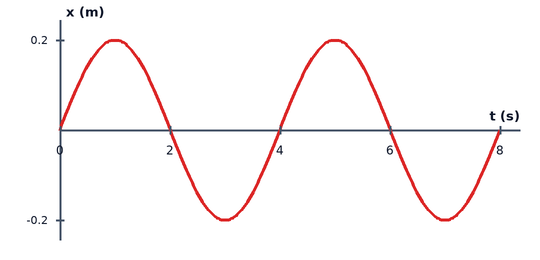
يمثل الرسم إزاحة جسم مهتز حركة توافقية بسيطة مع الزمن. فإن أكبر مقدار لتسارعه:The graph shows the displacement of an object in simple harmonic motion against time. The maximum magnitude of its acceleration is:
\(0.10\,m/s^2\)\(0.10\,m/s^2\)
\(0.31\,m/s^2\)\(0.31\,m/s^2\)
\(1.97\,m/s^2\)\(1.97\,m/s^2\)
\(0.49\,m/s^2\)\(0.49\,m/s^2\)
الحلSolution
📌 من الرسم: \(A=0.2\,m,\quad T=4\,s\Rightarrow\omega=\dfrac{2\pi}{4}=\dfrac{\pi}{2}\,rad/s\)
📌 التسارع العظمى عند أقصى إزاحة: \(a_{max}=A\omega^2=0.2\times\left(\dfrac{\pi}{2}\right)^2=0.49\,m/s^2\)
✅ \(0.49\,m/s^2\)
📌 From the graph: \(A=0.2\,m,\quad T=4\,s\Rightarrow\omega=\dfrac{2\pi}{4}=\dfrac{\pi}{2}\,rad/s\)
📌 The maximum acceleration occurs at maximum displacement: \(a_{max}=A\omega^2=0.2\times\left(\dfrac{\pi}{2}\right)^2=0.49\,m/s^2\)
✅ \(0.49\,m/s^2\)
\[40\,\star\star\star\]
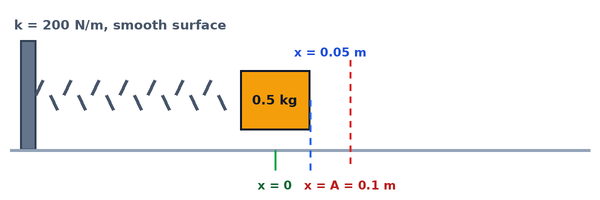
كتلة \(0.5\,kg\) مرتبطة بنابض أفقي ثابته \(200\,N/m\) على سطح أملس، سُحبت مسافة \(0.1\,m\) ثم تُركت لتهتز. فإن سرعتها عندما تكون على بعد \(0.05\,m\) من موضع الاتزان:A \(0.5\,kg\) mass is attached to a horizontal spring of constant \(200\,N/m\) on a smooth surface, pulled \(0.1\,m\) and released. Its speed when it is \(0.05\,m\) from equilibrium is:
\(1.73\,m/s\)\(1.73\,m/s\)
\(2.0\,m/s\)\(2.0\,m/s\)
\(1.0\,m/s\)\(1.0\,m/s\)
\(3.0\,m/s\)\(3.0\,m/s\)
الحلSolution
📌 حفظ الطاقة الميكانيكية: \(\tfrac12kA^2=\tfrac12mv^2+\tfrac12kx^2\)
📌 نحل لـ \(v\): \(v=\sqrt{\dfrac{k(A^2-x^2)}{m}}=\sqrt{\dfrac{200(0.01-0.0025)}{0.5}}=\sqrt{3}=1.73\,m/s\)
✅ \(1.73\,m/s\)
📌 Conservation of mechanical energy: \(\tfrac12kA^2=\tfrac12mv^2+\tfrac12kx^2\)
📌 Solve for \(v\): \(v=\sqrt{\dfrac{k(A^2-x^2)}{m}}=\sqrt{\dfrac{200(0.01-0.0025)}{0.5}}=\sqrt{3}=1.73\,m/s\)
✅ \(1.73\,m/s\)
\[41\,\star\star\star\]
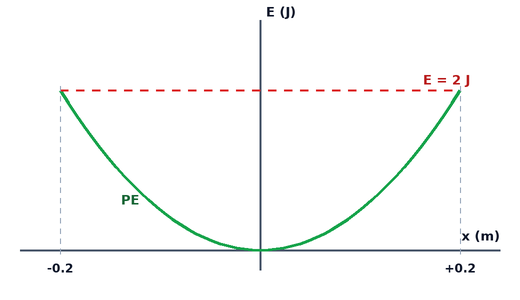
يبين الرسم طاقة الوضع لنابض مقابل إزاحته، وخط الطاقة الكلية \(2\,J\) للنظام الذي يهتز بين \(\pm0.2\,m\). فإن ثابت النابض:The graph shows the potential energy of a spring against its displacement together with the total energy line \(2\,J\) for a system oscillating between \(\pm0.2\,m\). The spring constant is:
\(50\,N/m\)\(50\,N/m\)
\(100\,N/m\)\(100\,N/m\)
\(20\,N/m\)\(20\,N/m\)
\(400\,N/m\)\(400\,N/m\)
الحلSolution
📌 عند أقصى إزاحة كل الطاقة طاقة وضع: \(E=\tfrac12kA^2\)
📌 بالتعويض: \(k=\dfrac{2E}{A^2}=\dfrac{2(2)}{0.2^2}=100\,N/m\)
✅ \(100\,N/m\)
📌 At maximum displacement all the energy is potential: \(E=\tfrac12kA^2\)
📌 Substituting: \(k=\dfrac{2E}{A^2}=\dfrac{2(2)}{0.2^2}=100\,N/m\)
✅ \(100\,N/m\)
\[42\,\star\star\star\]
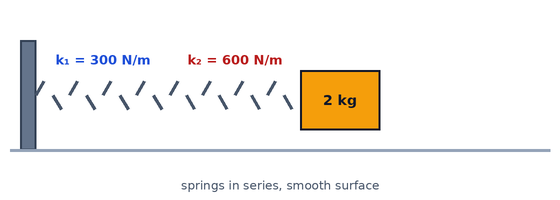
ربطت كتلة \(2\,kg\) بنابضين على التوالي ثابتاهما \(300\,N/m\) و\(600\,N/m\) على سطح أملس. فإن زمنها الدوري إذا اهتزت:A \(2\,kg\) mass is attached to two springs in series of constants \(300\,N/m\) and \(600\,N/m\) on a smooth surface. Its period of oscillation is:
\(0.44\,s\)\(0.44\,s\)
\(1.0\,s\)\(1.0\,s\)
\(0.63\,s\)\(0.63\,s\)
\(0.31\,s\)\(0.31\,s\)
الحلSolution
📌 ثابت النابضين على التوالي: \(\dfrac1{k}=\dfrac1{300}+\dfrac1{600}=\dfrac{3}{600}\Rightarrow k=200\,N/m\)
📌 الزمن الدوري: \(T=2\pi\sqrt{\dfrac mk}=2\pi\sqrt{\dfrac{2}{200}}=0.63\,s\)
✅ \(0.63\,s\)
📌 The series spring constant: \(\dfrac1{k}=\dfrac1{300}+\dfrac1{600}=\dfrac{3}{600}\Rightarrow k=200\,N/m\)
📌 The period: \(T=2\pi\sqrt{\dfrac mk}=2\pi\sqrt{\dfrac{2}{200}}=0.63\,s\)
✅ \(0.63\,s\)
\[43\,\star\star\star\]
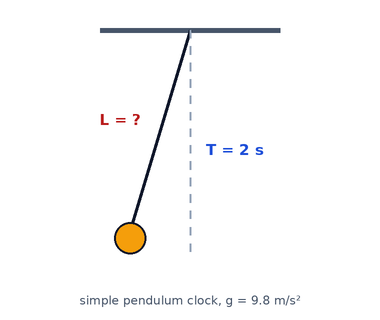
ساعة بندولية تتأرجح بزمن دوري \(2\,s\) (\(g=9.8\,m/s^2\)). فإن طول خيط بندولها البسيط يقارب:A pendulum clock swings with period \(2\,s\) (\(g=9.8\,m/s^2\)). The length of its simple pendulum is approximately:
\(0.99\,m\)\(0.99\,m\)
\(0.25\,m\)\(0.25\,m\)
\(1.99\,m\)\(1.99\,m\)
\(3.9\,m\)\(3.9\,m\)
الحلSolution
📌 من \(T=2\pi\sqrt{L/g}\): \(L=\dfrac{gT^2}{4\pi^2}\)
📌 التعويض: \(L=\dfrac{9.8\times4}{39.5}=0.99\,m\)
✅ \(0.99\,m\)
📌 From \(T=2\pi\sqrt{L/g}\): \(L=\dfrac{gT^2}{4\pi^2}\)
📌 Substituting: \(L=\dfrac{9.8\times4}{39.5}=0.99\,m\)
✅ \(0.99\,m\)
\[44\,\star\star\star\]
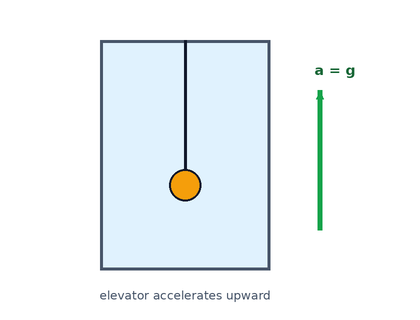
بندول بسيط زمنه الدوري \(T\) في مصعد ساكن. فإذا تسارع المصعد إلى الأعلى بتسارع يساوي \(g\) فإن زمنه الدوري يصبح:A simple pendulum has period \(T\) in a stationary elevator. If the elevator accelerates upward with an acceleration equal to \(g\), its period becomes:
\(T\sqrt2\)\(T\sqrt2\)
\(2T\)\(2T\)
\(\dfrac{T}{2}\)\(\dfrac{T}{2}\)
\(\dfrac{T}{\sqrt2}\)\(\dfrac{T}{\sqrt2}\)
الحلSolution
📌 التسارع الفعّال للجاذبية في المصعد المتسارع للأعلى: \(g_{eff}=g+a=2g\)
📌 الزمن الدوري: \(T'=2\pi\sqrt{\dfrac{L}{2g}}=\dfrac{T}{\sqrt2}\)
✅ \(\dfrac{T}{\sqrt2}\)
📌 Effective gravity in an upward-accelerating elevator: \(g_{eff}=g+a=2g\)
📌 The period: \(T'=2\pi\sqrt{\dfrac{L}{2g}}=\dfrac{T}{\sqrt2}\)
✅ \(\dfrac{T}{\sqrt2}\)
\[45\,\star\star\star\]
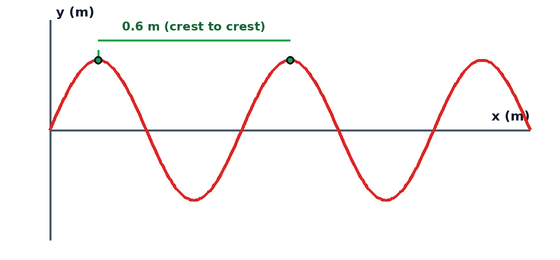
يمثل الرسم موجة مستعرضة في حبل في لحظة معينة، وترددها \(5\,Hz\). فإن سرعة انتشارها:The graph shows a transverse wave on a rope at a given instant, with frequency \(5\,Hz\). Its speed of propagation is:
\(3.0\,m/s\)\(3.0\,m/s\)
\(0.12\,m/s\)\(0.12\,m/s\)
\(1.5\,m/s\)\(1.5\,m/s\)
\(6.0\,m/s\)\(6.0\,m/s\)
الحلSolution
📌 الطول الموجي هو المسافة بين قمتين متتاليتين: \(\lambda=0.6\,m\)
📌 سرعة الموجة: \(v=f\lambda=5\times0.6=3.0\,m/s\)
✅ \(3.0\,m/s\)
📌 The wavelength is the distance between two successive crests: \(\lambda=0.6\,m\)
📌 Wave speed: \(v=f\lambda=5\times0.6=3.0\,m/s\)
✅ \(3.0\,m/s\)
\[46\,\star\star\star\]
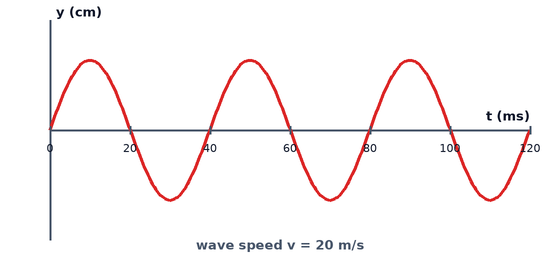
يمثل الرسم إزاحة نقطة من وسط انتقال موجة مستعرضة مع الزمن، وسرعة الموجة \(20\,m/s\). فإن طولها الموجي:The graph shows the displacement of a point in a medium carrying a transverse wave against time, and the wave speed is \(20\,m/s\). Its wavelength is:
\(0.5\,m\)\(0.5\,m\)
\(0.4\,m\)\(0.4\,m\)
\(1.25\,m\)\(1.25\,m\)
\(0.8\,m\)\(0.8\,m\)
الحلSolution
📌 الزمن الدوري من الرسم (إزاحة كاملة): \(T=40\,ms=0.04\,s\Rightarrow f=\dfrac1T=25\,Hz\)
📌 الطول الموجي: \(\lambda=\dfrac vf=\dfrac{20}{25}=0.8\,m\)
✅ \(0.8\,m\)
📌 The period from the graph (one full oscillation): \(T=40\,ms=0.04\,s\Rightarrow f=\dfrac1T=25\,Hz\)
📌 The wavelength: \(\lambda=\dfrac vf=\dfrac{20}{25}=0.8\,m\)
✅ \(0.8\,m\)
\[47\,\star\star\star\]
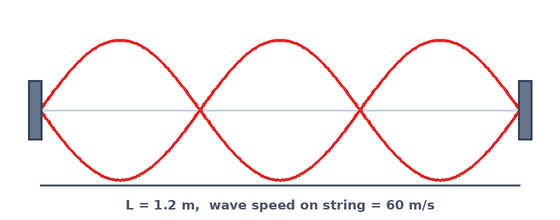
وتر طوله \(1.2\,m\) مثبت من طرفيه وتتكون فيه موجة موقوفة (مستقرة) كما في الشكل وسرعة الموجة في الوتر \(60\,m/s\). فإن تردد الاهتزاز:A string of length \(1.2\,m\) fixed at both ends carries a standing wave as shown, and the wave speed in the string is \(60\,m/s\). The vibration frequency is:
\(50\,Hz\)\(50\,Hz\)
\(25\,Hz\)\(25\,Hz\)
\(75\,Hz\)\(75\,Hz\)
\(150\,Hz\)\(150\,Hz\)
الحلSolution
📌 في الشكل ثلاث بطون: الطول يساوي ثلاثة أنصاف أطوال موجية: \(L=\dfrac{3\lambda}{2}\Rightarrow\lambda=\dfrac{2L}{3}=0.8\,m\)
📌 التردد: \(f=\dfrac v\lambda=\dfrac{60}{0.8}=75\,Hz\)
✅ \(75\,Hz\)
📌 The figure shows three loops: the length equals three half-wavelengths: \(L=\dfrac{3\lambda}{2}\Rightarrow\lambda=\dfrac{2L}{3}=0.8\,m\)
📌 The frequency: \(f=\dfrac v\lambda=\dfrac{60}{0.8}=75\,Hz\)
✅ \(75\,Hz\)
\[48\,\star\star\star\]
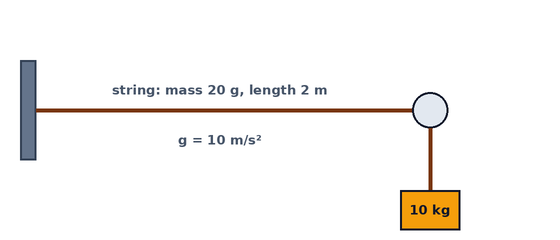
حبل كتلته \(20\,g\) وطوله \(2\,m\) مشدود بكتلة \(10\,kg\) معلقة في طرفه كما في الشكل (\(g=10\)). فإن سرعة الموجة المستعرضة فيه:A rope of mass \(20\,g\) and length \(2\,m\) is stretched by a \(10\,kg\) mass hanging from its end as shown (\(g=10\)). The speed of a transverse wave on it is:
\(100\,m/s\)\(100\,m/s\)
\(50\,m/s\)\(50\,m/s\)
\(10\,m/s\)\(10\,m/s\)
\(1000\,m/s\)\(1000\,m/s\)
الحلSolution
📌 الشد = وزن الكتلة، والكتلة لكل وحدة طول: \(T=mg=100\,N,\quad\mu=\dfrac{0.02}{2}=0.01\,kg/m\)
📌 السرعة: \(v=\sqrt{\dfrac{T}{\mu}}=\sqrt{\dfrac{100}{0.01}}=100\,m/s\)
✅ \(100\,m/s\)
📌 The tension = the weight of the hanging mass, and the mass per unit length: \(T=mg=100\,N,\quad\mu=\dfrac{0.02}{2}=0.01\,kg/m\)
📌 The speed: \(v=\sqrt{\dfrac{T}{\mu}}=\sqrt{\dfrac{100}{0.01}}=100\,m/s\)
✅ \(100\,m/s\)
\[49\,\star\star\star\]
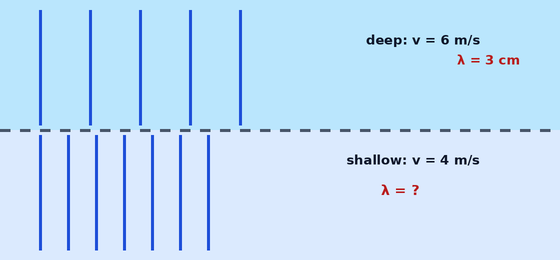
تنتقل موجة مائية من منطقة عميقة سرعتها \(6\,m/s\) وطولها الموجي \(3\,cm\) إلى منطقة ضحلة سرعتها \(4\,m/s\). فإن طولها الموجي في المنطقة الضحلة:A water wave passes from a deep region where its speed is \(6\,m/s\) and wavelength \(3\,cm\) to a shallow region where its speed is \(4\,m/s\). Its wavelength in the shallow region is:
\(4.5\,cm\)\(4.5\,cm\)
\(3\,cm\)\(3\,cm\)
\(1\,cm\)\(1\,cm\)
\(2\,cm\)\(2\,cm\)
الحلSolution
📌 التردد لا يتغير عند الانتقال بين الوسطين (يحدده المصدر): \(f=\dfrac{v_1}{\lambda_1}=\dfrac{6}{0.03}=200\,Hz\)
📌 الطول الموجي الجديد: \(\lambda_2=\dfrac{v_2}{f}=\dfrac{4}{200}=0.02\,m=2\,cm\)
✅ \(2\,cm\)
📌 The frequency does not change across the boundary (set by the source): \(f=\dfrac{v_1}{\lambda_1}=\dfrac{6}{0.03}=200\,Hz\)
📌 The new wavelength: \(\lambda_2=\dfrac{v_2}{f}=\dfrac{4}{200}=0.02\,m=2\,cm\)
✅ \(2\,cm\)
\[50\,\star\star\star\]
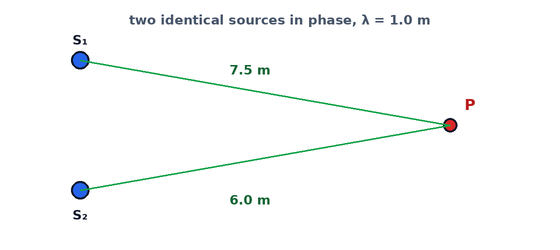
مصدران متطابقان متزامنان في الطور يصدران موجتين طولهما الموجي \(1.0\,m\)، والنقطة \(P\) تبعد عنهما \(7.5\,m\) و\(6.0\,m\) كما في الشكل. فإن نوع التداخل عند \(P\):Two identical in-phase sources emit waves of wavelength \(1.0\,m\), and point \(P\) is \(7.5\,m\) and \(6.0\,m\) from them as shown. The type of interference at \(P\) is:
تداخل بنّاء (تقوية)Constructive interference
تداخل هدام (تضاد في الطور)Destructive interference
لا يحدث تداخلNo interference
تداخل بنّاء جزئي فقطOnly partial constructive interference
الحلSolution
📌 فرق المسار: \(\Delta=7.5-6.0=1.5\,m=1.5\lambda\)
📌 فرق المسار عدد فردي من أنصاف الأطوال الموجية (\(3\times\tfrac\lambda2\)) فتلتقي قمة بقاع فيحدث تداخل هدام.
✅ تداخل هدام
📌 The path difference: \(\Delta=7.5-6.0=1.5\,m=1.5\lambda\)
📌 The path difference is an odd number of half-wavelengths (\(3\times\tfrac\lambda2\)) so crest meets trough: destructive interference.
✅ Destructive interference
\[51\,\star\star\star\]
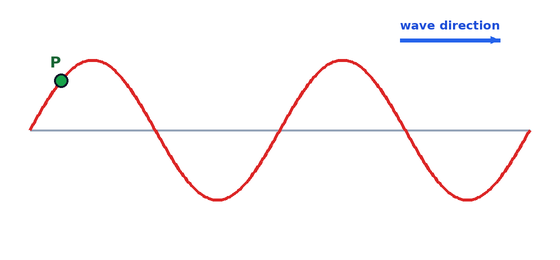
تنتقل موجة مستعرضة في حبل نحو اليمين كما في الشكل. فإن اتجاه حركة الجسيم \(P\) من الحبل في اللحظة التالية مباشرة:A transverse wave travels to the right along a rope as shown. The direction in which the rope particle \(P\) moves immediately afterwards is:
إلى الأسفلDownward
إلى الأعلىUpward
إلى اليمينTo the right
إلى اليسارTo the left
الحلSolution
📌 الجسيمات في الموجة المستعرضة تهتز عموديًا على اتجاه الانتشار فلا تتحرك أفقيًا.
📌 الموجة تتحرك نحو اليمين فتأخذ النقطة إزاحة النقطة التي على يسارها (وهي أخفض) لأنها على منحدر صاعد نحو القمة.
✅ إلى الأسفل
📌 In a transverse wave the particles oscillate perpendicular to the propagation direction, so they do not move horizontally.
📌 The wave moves right, so P takes the displacement of the point to its left (which is lower) because it sits on an ascending slope toward the crest: P moves down.
✅ Downward
\[52\,\star\star\star\]
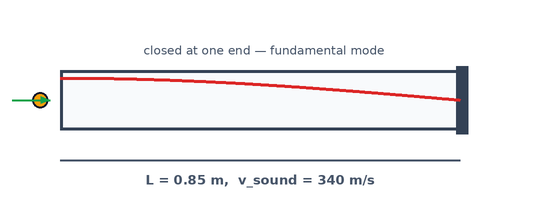
أنبوب هوائي مغلق من أحد طرفيه طوله \(0.85\,m\) وسرعة الصوت في الهواء \(340\,m/s\). فإن تردد الرنين الأساسي لعمود الهواء:An air column closed at one end has length \(0.85\,m\) and the speed of sound in air is \(340\,m/s\). The fundamental resonance frequency of the air column is:
\(100\,Hz\)\(100\,Hz\)
\(200\,Hz\)\(200\,Hz\)
\(50\,Hz\)\(50\,Hz\)
\(400\,Hz\)\(400\,Hz\)
الحلSolution
📌 في الأنبوب المغلق الطول يساوي ربع الطول الموجي للنمط الأساسي: \(L=\dfrac\lambda4\Rightarrow\lambda=4L=3.4\,m\)
📌 التردد: \(f_1=\dfrac v\lambda=\dfrac{340}{3.4}=100\,Hz\)
✅ \(100\,Hz\)
📌 In a closed pipe the length equals a quarter of the fundamental wavelength: \(L=\dfrac\lambda4\Rightarrow\lambda=4L=3.4\,m\)
📌 The frequency: \(f_1=\dfrac v\lambda=\dfrac{340}{3.4}=100\,Hz\)
✅ \(100\,Hz\)
📝 أجب عن الأسئلة التالية (مسائل محلولة)
📝 Answer the Following Questions (Solved Problems)
\[1\,\star\star\]
زنبرك طوله \(L_1=50\,cm\) ثُبّت من أحد أطرافه، وعُلّقت في الطرف الآخر كتلة مقدارها \(m=0.6\,kg\) دون أن يتجاوز الزنبرك حد المرونة، فأصبح طول الزنبرك \(L_2=55\,cm\). اعتبر \(g=9.81\,m/s^2\). احسب ثابت الزنبرك.A spring of length \(L_1=50\,cm\) is fixed at one end, and a mass \(m=0.6\,kg\) is hung from the other end without exceeding the elastic limit, so its length becomes \(L_2=55\,cm\). Take \(g=9.81\,m/s^2\). Calculate the spring constant.
.....................................................................
الحلSolution
📌 الاستطالة: \(x=L_2-L_1=0.05\,m\)
📌 عند الاتزان: \(mg=kx\Rightarrow k=\dfrac{mg}{x}=\dfrac{0.6\times9.81}{0.05}\approx117.7\,N/m\)
✅ \(k\approx117.7\,N/m\)
📌 Extension: \(x=L_2-L_1=0.05\,m\)
📌 At equilibrium: \(k=\dfrac{mg}{x}=\dfrac{0.6\times9.81}{0.05}\approx117.7\,N/m\)
✅ \(k\approx117.7\,N/m\)
\[2\,\star\star\]
في تجربة عُلّقت كتل مختلفة في طرف زنبرك حر (مثبت من الطرف الآخر)، مما أدى إلى استطالته دون تجاوز حد المرونة. رُسمت العلاقة بين قوة الشد والاستطالة فنتج الخط البياني أدناه. احسب أقصى طاقة وضع مرونية يختزنها الزنبرك مستعينًا بالخط البياني.In an experiment, different masses were hung from the free end of a spring (fixed at the other end), stretching it without exceeding the elastic limit. The force-extension relationship was plotted as shown below. Calculate the maximum elastic potential energy stored in the spring using the graph.
.....................................................................
الحلSolution
📌 من الرسم البياني: عند أقصى استطالة \(x\approx0.08\,m\)، \(F\approx24\,N\)
📌 طاقة الوضع = مساحة المثلث تحت الخط: \(Pe_s=\tfrac12\times24\times0.08\approx0.96\,J\approx1\,J\)
✅ \(Pe_s\approx1\,J\)
📌 From the graph: at max extension \(x\approx0.08\,m\), \(F\approx24\,N\)
📌 Elastic PE = triangle area under the line: \(Pe_s\approx0.96\,J\approx1\,J\)
✅ \(Pe_s\approx1\,J\)
\[3\,\star\star\star\]
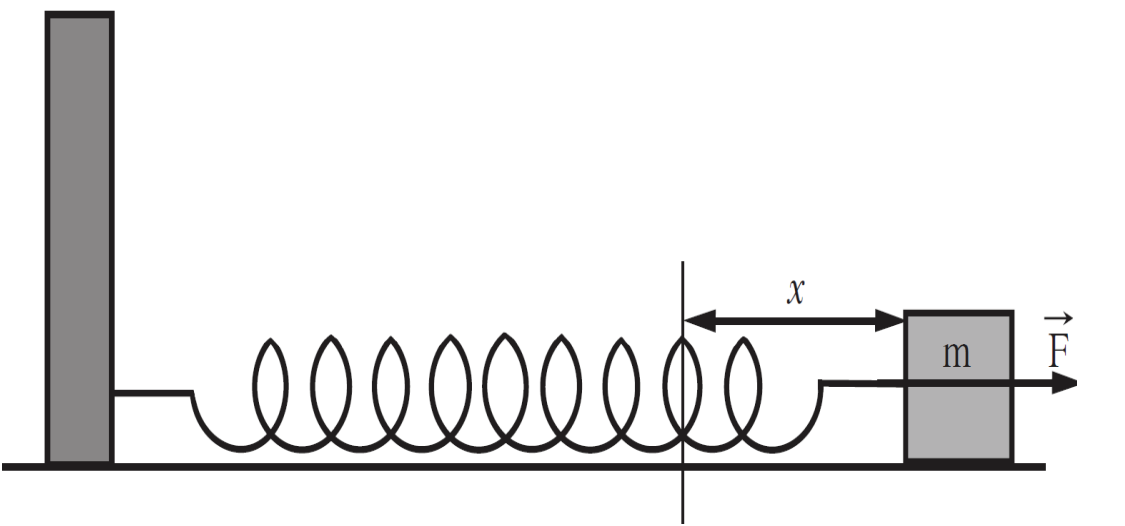
جسم كتلته \(0.5\,kg\) مربوط بنابض أفقي مثبت على سطح أملس، ثابت مرونة النابض \(200\,N/m\). سُحب الجسم نحو اليمين مسافة \(X=0.1\,m\) وتُرك ليتحرك حركة توافقية بسيطة. احسب: (أ) القوة المؤثرة على الجسم عند أقصى إزاحة. (ب) الطاقة الحركية عند موضع الاتزان.A \(0.5\,kg\) mass is attached to a horizontal spring on a smooth surface, with spring constant \(200\,N/m\). The mass is pulled \(X=0.1\,m\) to the right and released to perform simple harmonic motion. Find: (a) the force on the mass at maximum displacement. (b) the kinetic energy at the equilibrium position.
.....................................................................
الحلSolution
📌 (أ) القوة عند أقصى إزاحة (قانون هوك): \(F=kX=200\times0.1=20\,N\)
📌 (ب) الطاقة الكلية للنظام (محفوظة): \(E=\tfrac12kX^2=\tfrac12(200)(0.1)^2=1\,J\)
📌 عند موضع الاتزان: طاقة الوضع المرونية صفر، فتكون كل الطاقة حركية: \(KE=E=1\,J\)
✅ \(F=20\,N\)، \(KE=1\,J\)
📌 (a) Force at max displacement (Hooke's law): \(F=kX=200\times0.1=20\,N\)
📌 (b) Total system energy (conserved): \(E=\tfrac12kX^2=\tfrac12(200)(0.1)^2=1\,J\)
📌 At equilibrium: elastic PE is zero, so all energy is kinetic: \(KE=E=1\,J\)
✅ \(F=20\,N\), \(KE=1\,J\)
\[4\,\star\star\]
بندول طوله \(L=2\,m\) عُلّق في سقف مركبة فضائية، وفي مكان ما في الفضاء تُرك ليتحرك حركة توافقية بسيطة. قِيس زمنه الدوري فكان \(T=3.6\,s\). احسب: (أ) عجلة الجاذبية في تلك المنطقة. (ب) تردد البندول.A pendulum of length \(L=2\,m\) is hung from the ceiling of a spacecraft. Somewhere in space it is left to perform simple harmonic motion, and its period is measured as \(T=3.6\,s\). Find: (a) the gravitational acceleration in that region. (b) the pendulum's frequency.
.....................................................................
الحلSolution
📌 (أ) من \(T=2\pi\sqrt{L/g}\): \(g=\dfrac{4\pi^2L}{T^2}=\dfrac{4\pi^2(2)}{3.6^2}\approx6.1\,m/s^2\)
📌 (ب) التردد: \(f=\dfrac1T=\dfrac1{3.6}\approx0.28\,Hz\)
✅ \(g\approx6.1\,m/s^2\)، \(f\approx0.28\,Hz\)
📌 (a) From \(T=2\pi\sqrt{L/g}\): \(g=\dfrac{4\pi^2L}{T^2}\approx6.1\,m/s^2\)
📌 (b) Frequency: \(f=\dfrac1T\approx0.28\,Hz\)
✅ \(g\approx6.1\,m/s^2\), \(f\approx0.28\,Hz\)
\[5\,\star\star\star\]
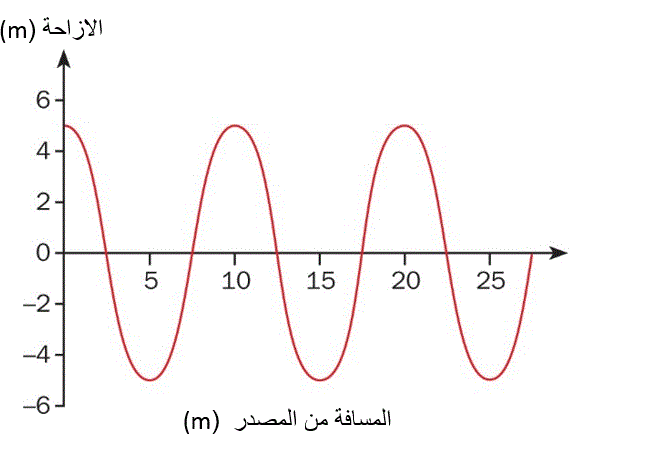
موجة مستعرضة رُسمت العلاقة بين الإزاحة والبعد عن المصدر فنتج الخط البياني أدناه، وسرعة الموجة \(v=4\,m/s\). (أ) حدّد سعة الموجة. (ب) احسب تردد الموجة.A transverse wave's displacement-vs-distance-from-source graph is shown below, with wave speed \(v=4\,m/s\). (a) Determine the wave's amplitude. (b) Calculate the wave's frequency.
.....................................................................
الحلSolution
📌 (أ) السعة (تُقرأ مباشرة من محور الإزاحة): \(A=5\,m\)
📌 (ب) الطول الموجي (من تكرار النمط على محور المسافة): \(\lambda\approx10\,m\)
📌 التردد: \(f=\dfrac{v}{\lambda}=\dfrac{4}{10}=0.4\,Hz\)
✅ \(A=5\,m\)، \(f=0.4\,Hz\)
📌 (a) Amplitude (read directly off the displacement axis): \(A=5\,m\)
📌 (b) Wavelength (from the pattern's repeat on the distance axis): \(\lambda\approx10\,m\)
📌 Frequency: \(f=\dfrac{v}{\lambda}=\dfrac{4}{10}=0.4\,Hz\)
✅ \(A=5\,m\), \(f=0.4\,Hz\)
لاحظت خطأ؟ أو عندك سؤال عن أحد الأسئلة؟ اكتبه بالتعليقات وحدد رقم السؤال بالضبط.
Noticed an error? Or have a question about one of the questions? Write it in the comments and specify the exact question number.