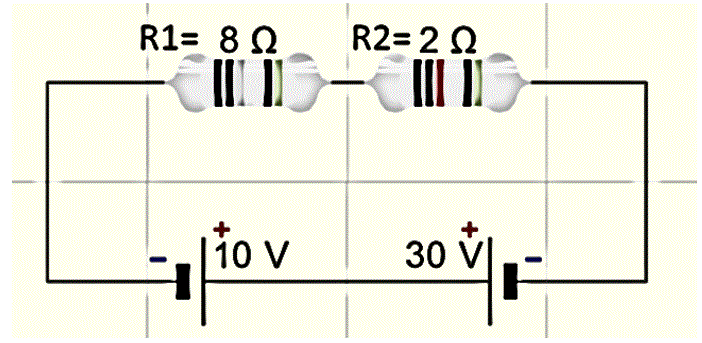
✅ حلول مفصّلة لكل سؤال📂 الكهرباء والدارات🎯 مستوى متقدم
للتواصل: 00971504825082
بنك أسئلة شامل من 42 سؤالًا محلولًا يغطي قوانين كيرشوف (قاعدة الوصلة وقاعدة الحلقة)، قنطرة وتستون، مقاومتي المجزئ والمضاعف، وشحن المكثفات في دوائر RC — كل سؤال مع رسم توضيحي وحل مصوّر.
A comprehensive bank of 42 solved questions covering Kirchhoff's laws (junction and loop rules), the Wheatstone bridge, shunt and multiplier resistors, and RC capacitor charging — each with a diagram and an illustrated solution.
في الدائرة أدناه شدة التيار \[ I_2 =?\]In the circuit below, the current \[ I_2 =?\]
\[i_2 =15 \;A\]\[i_2 =15 \;A\]
\[i_2 =7 \;A\]\[i_2 =7 \;A\]
\[i_2 =5 \;A\]\[i_2 =5 \;A\]
\[i_2 =3 \;A\]\[i_2 =3 \;A\]
الحلSolution
لم يتم توفير حل مفصل لهذا السؤال في المصدر الأصلي.
✅ الإجابة الصحيحة: B
No detailed solution was provided for this question in the original source.
✅ Correct answer: B
\[2\,\star\]
في الحلقة المشار إليها بالرقم 1 فرق الجهد بين طرفي المقاوم \[ V_{R2} = ? \]In the loop indicated by number 1, the voltage across the resistor \[ V_{R2} = ? \]
\[𝑉_{𝑅2 }= 8.75 \;𝑉\]\[𝑉_{𝑅2 }= 8.75 \;𝑉\]
\[𝑉_{𝑅2 }= 15.25 \;𝑉\]\[𝑉_{𝑅2 }= 15.25 \;𝑉\]
\[𝑉_{𝑅2 }= 15.25 \;𝑉\]\[𝑉_{𝑅2 }= 15.25 \;𝑉\]
\[𝑉_{𝑅2 }= 5.36 \;𝑉\]\[𝑉_{𝑅2 }= 5.36 \;𝑉\]
الحلSolution
✅ الإجابة الصحيحة: D
✅ Correct answer: D
\[3\,\star\]
في الشكل ادناه شدة التيار المار في \[ R_1 , R_2 \] تعادلIn the figure below, the current through \[ R_1 , R_2 \] is equal to
في الشكل ادناه باستخدام قوانين كيرشوف أحسب قيمة المقاومة المجهولة \[ R= .... \]In the figure below, using Kirchhoff's laws, calculate the value of the unknown resistance \[ R= .... \]
\[ R = 2\; Ω \]\[ R = 2\; Ω \]
\[ R = 3\; Ω \]\[ R = 3\; Ω \]
\[ R = 4\; Ω \]\[ R = 4\; Ω \]
\[ R = 5\; Ω \]\[ R = 5\; Ω \]
الحلSolution
✅ الإجابة الصحيحة: C
✅ Correct answer: C
\[5\,\star\]
في الشكل أدناه باستخدام قوانين كيرشوف فإن قيمة المقاومة المجهولة \[ R= .... \] تعادلIn the figure below, using Kirchhoff's laws, the value of the unknown resistance \[ R= .... \] is equal to
\[ R = 5\; Ω \]\[ R = 5\; Ω \]
\[ R = 10\; Ω \]\[ R = 10\; Ω \]
\[ R = 15\; Ω \]\[ R = 15\; Ω \]
\[ R = 20\; Ω \]\[ R = 20\; Ω \]
الحلSolution
✅ الإجابة الصحيحة: B
✅ Correct answer: B
\[6\,\star\]
في الشكل أدناه باستخدام قوانين كيرشوف فإن قيمة المقاومة المجهولة \[ R= .... \] تعادلIn the figure below, using Kirchhoff's laws, the value of the unknown resistance \[ R= .... \] is equal to
\[ R = 8\; Ω \]\[ R = 8\; Ω \]
\[ R = 9\; Ω \]\[ R = 9\; Ω \]
\[ R = 10\; Ω \]\[ R = 10\; Ω \]
\[ R = 6\; Ω \]\[ R = 6\; Ω \]
الحلSolution
✅ الإجابة الصحيحة: B
✅ Correct answer: B
\[7\,\star\]
في الشكل المجاور تم تغير قيمة المقاومة المتغيرة حتى أصبحت قراءة الجلفانومتر صفر فإن قيمة المقاومة \[ R_X = .... \]In the adjacent figure, the value of the variable resistor was changed until the galvanometer reading became zero, so the value of the resistance \[ R_X = .... \]
\[ R = 4\; Ω \]\[ R = 4\; Ω \]
\[ R = 3\; Ω \]\[ R = 3\; Ω \]
\[ R = 5\; Ω \]\[ R = 5\; Ω \]
\[ R = 6\; Ω \]\[ R = 6\; Ω \]
الحلSolution
✅ الإجابة الصحيحة: B
✅ Correct answer: B
\[8\,\star\]
فرق الجهد بين طرفي الجلفانومتر يساوي الصفر عندما تكون قيم المقاومات تعادلThe potential difference across the galvanometer is zero when the resistance values are equal to
\[ A \]\[ A \]
\[ B \]\[ B \]
\[ C\]\[ C\]
\[ D \]\[ D \]
الحلSolution
✅ الإجابة الصحيحة: B
✅ Correct answer: B
\[9\,\star\star\]
جهاز الأميتر يستخدم لقياس شدة التيار ويتم توصيله على التوالي في الدائرة لزيادة مدى جهاز الأميتر في القياس يتم توصيلThe ammeter is used to measure current intensity and is connected in series in the circuit. To increase the range of the ammeter, we connect
مقاومة صغيرة على التوازيA small resistor in parallel
مقاومة عالية القيمة على التواليA high-value resistor in series
مقاومة عالية القيمة على التوازيA high-value resistor in parallel
مقاومة صغيرة على التواليA small resistor in series
الحلSolution
✅ الإجابة الصحيحة: A
✅ Correct answer: A
\[10\,\star\star\]
جهاز الفولتميتر يستخدم لقياس فرق الجهد ويتم توصيله على التوازي في الدائرة لزيادة مدى جهاز الفولتميتر في القياس يتم توصيلThe voltmeter is used to measure potential difference and is connected in parallel in the circuit. To increase the range of the voltmeter, we connect
مقاومة صغيرة على التوازيA small resistor in parallel
مقاومة عالية القيمة على التواليA high-value resistor in series
مقاومة عالية القيمة على التوازيA high-value resistor in parallel
مقاومة صغيرة على التواليA small resistor in series
الحلSolution
✅ الإجابة الصحيحة: B
✅ Correct answer: B
\[11\,\star\star\]
جهاز أميتر يستخدم لقياس التيارات المنخفضة مقاومته الداخلية \[2Ω \]أراد متعلم أن يضاعف قدرته على قياس التيار بما يعادل 50 مرة فإن مقدار المقاومة اللازم وصلها على التوازي للوصول للنتيجة المطلوبة تعادلAn ammeter used to measure low currents has an internal resistance of \[2Ω \]. A learner wanted to multiply its current measurement capacity by 50 times. The value of the resistance to be connected in parallel to achieve the required result is
\[ R = 0.02\; Ω \]\[ R = 0.02\; Ω \]
\[ R = 0.03\; Ω \]\[ R = 0.03\; Ω \]
\[ R = 0.04\; Ω \]\[ R = 0.04\; Ω \]
\[ R = 0.05\; Ω \]\[ R = 0.05\; Ω \]
الحلSolution
✅ الإجابة الصحيحة: C
✅ Correct answer: C
\[12\,\star\star\]
جهاز فولتميتر يستخدم لقياس فرق جهد قدره \[1v\] مقاومته الداخلية \[ 500Ω \]أراد متعلم أن يجعل الجهاز قادر على قياس فرق جهد يعادل \[50v\] فإن مقدار المقاومة اللازم وصلها على التوالي للوصول للنتيجة المطلوبة تعادلA voltmeter used to measure a potential difference of \[1V\] has an internal resistance of \[500Ω\]. A learner wanted to make the device capable of measuring a potential difference of \[50V\]. The value of the resistance to be connected in series to achieve the required result is
\[ R = 37000 \; Ω \]\[ R = 37000 \; Ω \]
\[ R = 24500 \; Ω \]\[ R = 24500 \; Ω \]
\[ R = 40000 \; Ω \]\[ R = 40000 \; Ω \]
\[ R = 54000 \; Ω \]\[ R = 54000 \; Ω \]
الحلSolution
✅ الإجابة الصحيحة: B
✅ Correct answer: B
\[13\,\star\star\]
في الشكل ادناه عند الوصلة \[A\] أحد العبارات التالية صحيحةIn the figure below, at node \[A\], one of the following statements is correct
\[𝐼_2+𝐼_5+𝐼_4=𝐼_1\]\[𝐼_2+𝐼_5+𝐼_4=𝐼_1\]
\[𝐼_2+𝐼_3+𝐼_5=𝐼_1\]\[𝐼_2+𝐼_3+𝐼_5=𝐼_1\]
\[𝐼_2+𝐼_3=𝐼_1\]\[𝐼_2+𝐼_3=𝐼_1\]
\[𝐼_3+𝐼_5+𝐼_4=𝐼_1\]\[𝐼_3+𝐼_5+𝐼_4=𝐼_1\]
الحلSolution
✅ الإجابة الصحيحة: B
✅ Correct answer: B
\[14\,\star\star\]
في الدائرة أدناه جهد البطارية يعادلIn the circuit below, the battery voltage is equal to
\[E=300 \;\;V\]\[E=300 \;\;V\]
\[E=150 \;\;V\]\[E=150 \;\;V\]
\[E=250 \;\;V\]\[E=250 \;\;V\]
\[E=350 \;\;V\]\[E=350 \;\;V\]
الحلSolution
✅ الإجابة الصحيحة: D
✅ Correct answer: D
\[15\,\star\star\]
في الشكل أدناه فرق الجهد بين طرفي المقاوم الأول والثالث على الترتيب يعادلIn the figure below, the potential difference across the first and third resistors respectively is equal to
\[V1=7\; V \;\;\;\;\;\; ,\;\;\;\;\;\; V3=2 \;V\]\[V1=7\; V \;\;\;\;\;\; ,\;\;\;\;\;\; V3=2 \;V\]
\[V1=5\; V \;\;\;\;\;\; ,\;\;\;\;\;\; V3=7 \;V\]\[V1=5\; V \;\;\;\;\;\; ,\;\;\;\;\;\; V3=7 \;V\]
\[V1=7\; V \;\;\;\;\;\; ,\;\;\;\;\;\; V3=5 \;V\]\[V1=7\; V \;\;\;\;\;\; ,\;\;\;\;\;\; V3=5 \;V\]
\[V1=2\; V \;\;\;\;\;\; ,\;\;\;\;\;\; V3=7 \;V\]\[V1=2\; V \;\;\;\;\;\; ,\;\;\;\;\;\; V3=7 \;V\]
الحلSolution
✅ الإجابة الصحيحة: A
✅ Correct answer: A
\[16\,\star\star\]
في الشكل أدناه فإن قيمة المقاوم \[R\] تعادلIn the figure below, the value of the resistance \[R\] is equal to
\[R = 6.42 \; Ω\]\[R = 6.42 \; Ω\]
\[R =2.5\; Ω\]\[R =2.5\; Ω\]
\[R = 3.33\; Ω\]\[R = 3.33\; Ω\]
\[R = 5.35\; Ω\]\[R = 5.35\; Ω\]
الحلSolution
✅ الإجابة الصحيحة: C
✅ Correct answer: C
\[17\,\star\star\]
في الشكل أدناه شدة التيار المار في المقاوم \[1Ω\] تعادلIn the figure below, the current through the resistor \[1Ω\] is equal to
\[𝐼 =0.13 \;A\]\[𝐼 =0.13 \;A\]
\[𝐼 =0.35 \;A\]\[𝐼 =0.35 \;A\]
\[𝐼 =0.54 \;A\]\[𝐼 =0.54 \;A\]
\[𝐼 =0.25 \;A\]\[𝐼 =0.25 \;A\]
الحلSolution
✅ الإجابة الصحيحة: A
✅ Correct answer: A
\[18\,\star\star\]
جهاز أميتر مقاومته الداخلية \[10 Ω\] و قادر على قياس تيار شدته \[8 mA\] أراد متعلم أن يزيد مدى الجهاز حتى يكون قادر على قياس تيار شدته \[2A\] فتم وصل مقاومة على التوازي لزيادة مدى الجهاز فإن مقدار المقاومة اللازمة لهذا الغرض تعادلAn ammeter with internal resistance \[10 Ω\] can measure a current of \[8 mA\]. A learner wanted to increase the range of the device to measure a current of \[2A\]. A resistor was connected in parallel to increase the range. The value of the required resistor for this purpose is
\[R_s = 0.08 \; Ω\]\[R_s = 0.08 \; Ω\]
\[R_s =0.06\; Ω\]\[R_s =0.06\; Ω\]
\[R_s = 0.04 \; Ω\]\[R_s = 0.04 \; Ω\]
\[R_s = 0.01\; Ω\]\[R_s = 0.01\; Ω\]
الحلSolution
✅ الإجابة الصحيحة: C
✅ Correct answer: C
\[19\,\star\star\]
جهاز فولتيميتر مقاومته الداخلية \[1000 Ω\] و قادر على قياس فرق جهد مقداره \[0.05 V\] أراد متعلم أن يزيد مدى الجهاز حتى يكون قادر على قياس فرق جهد \[10 V\] فتم وصل مقاومة على التوالي لزيادة مدى الجهاز فإن مقدار المقاومة اللازمة لهذا الغرض تعادلA voltmeter with internal resistance \[1000 Ω\] can measure a potential difference of \[0.05 V\]. A learner wanted to increase the range of the device to measure a potential difference of \[10 V\]. A resistor was connected in series to increase the range. The value of the required resistor for this purpose is
\[R_{es}=109000\; Ω\]\[R_{es}=109000\; Ω\]
\[R_{es} =165000\; Ω\]\[R_{es} =165000\; Ω\]
\[R_{es}=199000 \; Ω\]\[R_{es}=199000 \; Ω\]
\[R_{es} = 250000\; Ω\]\[R_{es} = 250000\; Ω\]
الحلSolution
✅ الإجابة الصحيحة: C
✅ Correct answer: C
\[20\,\star\star\star\]
مكثف سعته \[20𝜇𝐹\] غير مشحون تم وصله بمقاوم \[150 Ω\] على التوالي و بطارية كما في الشكل أدناه فإن النسبة المئوية لشحن المكثف بعد زمن قدره \[3 ms\]تعادلA capacitor of capacitance \[20𝜇𝐹\] initially uncharged is connected to a resistor \[150 Ω\] in series and a battery as shown in the figure below. The percentage of charge of the capacitor after a time of \[3 ms\] is equal to
\[0.75\]\[0.75\]
\[0.63\]\[0.63\]
\[0.47\]\[0.47\]
\[0.82\]\[0.82\]
الحلSolution
لم يتم توفير حل مفصل لهذا السؤال في المصدر الأصلي.
✅ الإجابة الصحيحة: B
No detailed solution was provided for this question in the original source.
✅ Correct answer: B
\[21\,\star\star\star\]
مكثف سعته \[6𝜇𝐹\] غير مشحون تم وصله بمقاومين \[ R_1=90 Ω ,R_2=30 Ω \] وبطارية جهدها \[50V\] فإن الزمن اللازم لإتمام عملية شحن 50% من المكثف تعادلA capacitor of capacitance \[6𝜇𝐹\] initially uncharged is connected to two resistors \[ R_1=90 Ω ,R_2=30 Ω \] and a battery of voltage \[50V\]. The time required to complete 50% charging of the capacitor is equal to
مكثف سعته \[2𝜇𝐹\] تم وصله بمقاومين \[ R_1=500 Ω ,R_2=300 Ω \] وبطارية حتى تمت عملية الشحن كما في الشكل أدناه فإن الثابت الزمني لإتمام عملية التفريغ تعادلA capacitor of capacitance \[2𝜇𝐹\] is connected to two resistors \[ R_1=500 Ω ,R_2=300 Ω \] and a battery until charging is completed as shown in the figure below. The time constant for the discharging process is equal to
\[𝜏=2.6×10^{-3} \;\;S\]\[𝜏=2.6×10^{-3} \;\;S\]
\[𝜏=4.2×10^{-3} \;\;S\]\[𝜏=4.2×10^{-3} \;\;S\]
\[𝜏=1.6×10^{-3} \;\;S\]\[𝜏=1.6×10^{-3} \;\;S\]
\[𝜏=3.1×10^{-3} \;\;S\]\[𝜏=3.1×10^{-3} \;\;S\]
الحلSolution
✅ الإجابة الصحيحة: C
✅ Correct answer: C
\[23\,\star\star\star\]
تتكون الدائرة الكهربائية من أربعة مقاومات محدد قيمتها كما في الشكل أدناه فإن شدة التيار المار في كل مقاومThe electrical circuit consists of four resistors with values as shown in the figure below. The current through each resistor is
\[I_1=0.25 A, I_2=0.25 A, I_3=0.5 A\]\[I_1=0.25 A, I_2=0.25 A, I_3=0.5 A\]
\[I_1=0.5 A, I_2=0.5 A, I_3=0.2 A\]\[I_1=0.5 A, I_2=0.5 A, I_3=0.2 A\]
\[I_1=0.35 A, I_2=0.35 A, I_3=0.7 A\]\[I_1=0.35 A, I_2=0.35 A, I_3=0.7 A\]
\[I_1=0.2 A, I_2=0.2 A, I_3=0.4 A\]\[I_1=0.2 A, I_2=0.2 A, I_3=0.4 A\]
الحلSolution
✅ الإجابة الصحيحة: A
✅ Correct answer: A
\[24\,\star\star\star\]
في الشكل أدناه دائرة كهربائية المقاومات والبطاريات واتجاه التيار والاتجاه الموجب موضح على الشكل أحد المعادلات تعبر بشكل صحيح عن معادلة أحد الحلقات في الدائرة (قانون كيرشوف الثاني)In the figure below, an electrical circuit with resistors, batteries, current direction, and positive direction is shown. One of the equations correctly represents the equation of one of the loops in the circuit (Kirchhoff's second law)
\[6−I_1−2I_2=0\]\[6−I_1−2I_2=0\]
\[-2−2I_1−2I_2−4I_3=0\]\[-2−2I_1−2I_2−4I_3=0\]
\[2−2I_1−2I_2−4I_3=0\]\[2−2I_1−2I_2−4I_3=0\]
\[-4−I_1+4I_3=0\]\[-4−I_1+4I_3=0\]
الحلSolution
✅ الإجابة الصحيحة: D
✅ Correct answer: D
\[25\,\star\star\star\]
في الدائرة أدناه فرق الجهد بين النقطتين \[ A,B \] تعادلIn the circuit below, the potential difference between points \[ A,B \] is equal to
\[∆𝑉=8.66\;\;V\]\[∆𝑉=8.66\;\;V\]
\[∆𝑉=13.57\;\;V\]\[∆𝑉=13.57\;\;V\]
\[∆𝑉=11.44\;\;V\]\[∆𝑉=11.44\;\;V\]
\[∆𝑉=5.42\;\;V\]\[∆𝑉=5.42\;\;V\]
الحلSolution
✅ الإجابة الصحيحة: C
✅ Correct answer: C
\[26\,\star\star\star\]
أنشأت قنطرة ويتستون باستخدام سلك من النحاس طولة \[2m\] به نقطة اتصال يمكنها الانزلاق على طول السلك وضع مقاومين على الطرف الأخر \[R_1=80 Ω , R_2=R\] تم تحريك نقطة الاتصال حتى أصبحت قراءة الجلفانوميتر معدومة عند نقطة اتصال \[C\] تبعد عن طرف السلك \[A\] مسافة \[0.4 m\] فإن قيمة \[R_2\] تعادلA Wheatstone bridge was constructed using a copper wire of length \[2m\] with a contact point that can slide along the wire. Two resistors were placed at the other end \[R_1=80 Ω , R_2=R\]. The contact point was moved until the galvanometer reading became zero at contact point \[C\] which is at a distance of \[0.4 m\] from end \[A\] of the wire. The value of \[R_2\] is equal to
\[R_2 = 20\; Ω\]\[R_2 = 20\; Ω\]
\[R_2 =40\; Ω\]\[R_2 =40\; Ω\]
\[ R_2 = 10\; Ω \]\[ R_2 = 10\; Ω \]
\[R _2= 30\; Ω\]\[R _2= 30\; Ω\]
الحلSolution
✅ الإجابة الصحيحة: A
✅ Correct answer: A
\[27\,\star\star\star\]
في الشكل أدناه الحلقة 1 و حسب اصطلاحات الإشارة والاتجاه الموجب المفروض مع عقارب الساعة فإن أحد مكونات الحلقة جهدها سالبIn the figure below, loop 1, according to the sign conventions and the assumed positive direction clockwise, one of the components of the loop has a negative voltage
البطارية 5 فولت5 volt battery
المقاوم 10 أوم10 ohm resistor
المقاوم 21 أوم21 ohm resistor
البطارية 7 فولت7 volt battery
الحلSolution
✅ الإجابة الصحيحة: B
✅ Correct answer: B
\[28\,\star\star\star\]
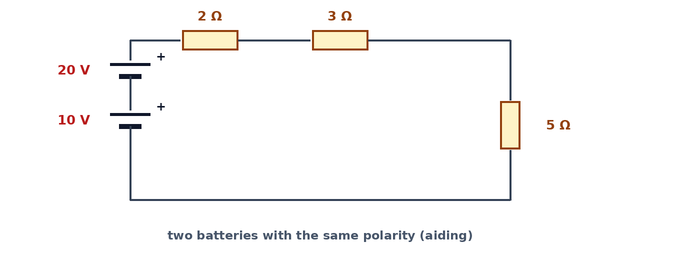
بطاريتان \(20\,V\) و\(10\,V\) موصولتان على التوالي بنفس القطبية مع ثلاث مقاومات \(2\,\Omega\) و\(3\,\Omega\) و\(5\,\Omega\) في حلقة واحدة كما في الشكل (مقاومة البطاريتين مهملة). فإن شدة التيار:A \(20\,V\) and a \(10\,V\) battery are connected in series with the same polarity along with \(2\,\Omega\), \(3\,\Omega\) and \(5\,\Omega\) resistors in one loop as shown (negligible battery resistance). The current is:
\(2 A\)\(2 A\)
\(6 A\)\(6 A\)
\(1.5 A\)\(1.5 A\)
3 A3 A
الحلSolution
📌 الخطوة 1: قانون كيرشوف الثاني حول الحلقة: \[20+10-I(2+3+5)=0\Rightarrow I=\dfrac{30}{10}=3\,A\]
✅ الإجابة الصحيحة: D (3 A)
📌 Step 1: Kirchhoff’s second law around the loop: \[20+10-I(2+3+5)=0\Rightarrow I=\dfrac{30}{10}=3\,A\]
✅ Correct answer: D (3 A)
\[29\,\star\star\star\]
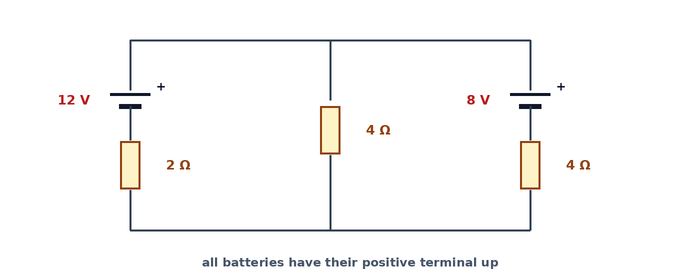
في الدائرة الموضحة ثلاثة فروع بين العقدتين العلوية والسفلية: فرع فيه \(12\,V\) و\(2\,\Omega\)، وفرع \(4\,\Omega\)، وفرع فيه \(8\,V\) و\(4\,\Omega\) (القطب الموجب لكل بطارية إلى الأعلى). فإن التيار في المقاومة \(4\,\Omega\) الوسطى:The circuit shown has three branches between the top and bottom junctions: one with \(12\,V\) and \(2\,\Omega\), one with \(4\,\Omega\), and one with \(8\,V\) and \(4\,\Omega\) (positive terminal of each battery up). The current in the middle \(4\,\Omega\) resistor is:
2 A2 A
\(3 A\)\(3 A\)
\(1 A\)\(1 A\)
\(4 A\)\(4 A\)
الحلSolution
📌 الخطوة 1: نفرض فرق الجهد بين العقدتين \(V\) فتكون تيارات الفروع: \(I_1=\dfrac{12-V}{2},\;I_2=\dfrac{V}{4},\;I_3=\dfrac{8-V}{4}\)
📌 الخطوة 2: قانون كيرشوف الأول عند العقدة العلوية \(I_1+I_3=I_2\): \[2(12-V)+(8-V)=V\Rightarrow32=4V\Rightarrow V=8\,V\]
📌 الخطوة 3: التيار الأوسط: \(I_2=\dfrac{8}{4}=2\,A\) (ويمر \(2\,A\) في الفرع الأيسر ولا يمر تيار في الأيمن).
✅ الإجابة الصحيحة: A (2 A)
📌 Step 1: Let the potential difference between the junctions be \(V\) so the branch currents are: \(I_1=\dfrac{12-V}{2},\;I_2=\dfrac{V}{4},\;I_3=\dfrac{8-V}{4}\)
📌 Step 2: Kirchhoff’s first law at the top junction \(I_1+I_3=I_2\): \[2(12-V)+(8-V)=V\Rightarrow32=4V\Rightarrow V=8\,V\]
📌 Step 3: The middle current: \(I_2=\dfrac{8}{4}=2\,A\) (\(2\,A\) flows in the left branch and none in the right one).
✅ Correct answer: A (2 A)
\[30\,\star\star\star\]
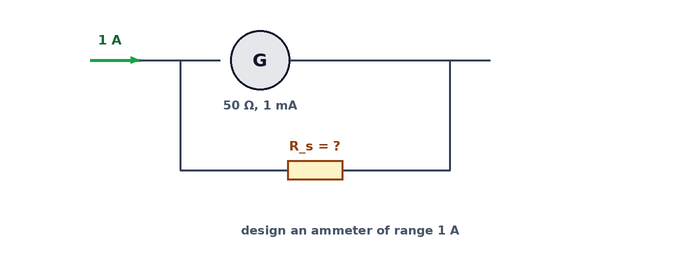
جلفانومتر مقاومته \(50\,\Omega\) وأقصى تيار له \(1\,mA\) يُراد تحويله إلى أميتر مداه \(1\,A\) بتوصيل مقاومة تفرّع \(R_s\) على التوازي معه كما في الشكل. فإن قيمة \(R_s\):A galvanometer of resistance \(50\,\Omega\) and full-scale current \(1\,mA\) is to be converted to a \(1\,A\) ammeter by connecting a shunt resistor \(R_s\) in parallel as shown. The value of \(R_s\) is:
\(50 Ω\)\(50 Ω\)
\(0.5 Ω\)\(0.5 Ω\)
\(5 Ω\)\(5 Ω\)
0.05 Ω0.05 Ω
الحلSolution
📌 الخطوة 1: يمر في المقاومة المفرّعة التيار الباقي: \(I_s=1-0.001=0.999\,A\)
📌 الخطوة 2: الجهد متساوٍ على الفرعين المتوازيين: \[R_s=\dfrac{I_gR_g}{I_s}=\dfrac{0.001\times50}{0.999}\approx0.05\,\Omega\]
✅ الإجابة الصحيحة: D (0.05 Ω)
📌 Step 1: The shunt carries the remaining current: \(I_s=1-0.001=0.999\,A\)
📌 Step 2: The voltage across the two parallel branches is equal: \[R_s=\dfrac{I_gR_g}{I_s}=\dfrac{0.001\times50}{0.999}\approx0.05\,\Omega\]
✅ Correct answer: D (0.05 Ω)
\[31\,\star\star\star\]
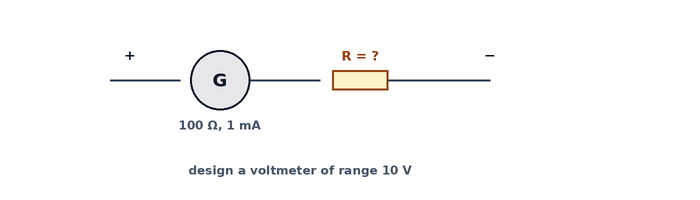
جلفانومتر مقاومته \(100\,\Omega\) وأقصى تيار له \(1\,mA\) يُراد تحويله إلى فولتمتر مداه \(10\,V\) بتوصيل مقاومة على التوالي معه كما في الشكل. فإن قيمة هذه المقاومة:A galvanometer of resistance \(100\,\Omega\) and full-scale current \(1\,mA\) is to be converted to a \(10\,V\) voltmeter by connecting a series resistor as shown. The value of this resistor is:
9900 Ω9900 Ω
\(10000 Ω\)\(10000 Ω\)
\(100 Ω\)\(100 Ω\)
\(990 Ω\)\(990 Ω\)
الحلSolution
📌 الخطوة 1: المقاومة الكلية اللازمة لمدى \(10\,V\): \(R_{tot}=\dfrac{V}{I_g}=\dfrac{10}{0.001}=10000\,\Omega\)
📌 الخطوة 2: المقاومة المضافة على التوالي: \[R=R_{tot}-R_g=10000-100=9900\,\Omega\]
✅ الإجابة الصحيحة: A (9900 Ω)
📌 Step 1: The total resistance needed for a \(10\,V\) range: \(R_{tot}=\dfrac{V}{I_g}=\dfrac{10}{0.001}=10000\,\Omega\)
📌 Step 2: The series resistor to add: \[R=R_{tot}-R_g=10000-100=9900\,\Omega\]
✅ Correct answer: A (9900 Ω)
\[32\,\star\star\star\]
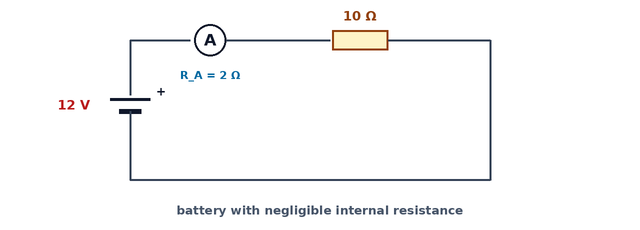
بطارية \(12\,V\) (مقاومتها الداخلية مهملة) موصولة بمقاومة \(10\,\Omega\) وأميتر مقاومته \(2\,\Omega\) على التوالي كما في الشكل. فإن قراءة الأميتر:A \(12\,V\) battery (negligible internal resistance) is connected to a \(10\,\Omega\) resistor and an ammeter of resistance \(2\,\Omega\) in series as shown. The ammeter reading is:
\(1.2 A\)\(1.2 A\)
1.0 A1.0 A
\(0.83 A\)\(0.83 A\)
\(6 A\)\(6 A\)
الحلSolution
📌 الخطوة 1: الأميتر يضيف مقاومته على التوالي: \(R_{tot}=10+2=12\,\Omega\)
📌 الخطوة 2: \[I=\dfrac{12}{12}=1.0\,A\] (بدل \(1.2\,A\) لو كان الأميتر مثاليًا، أي أن قراءته أقل من التيار الحقيقي).
✅ الإجابة الصحيحة: B (1.0 A)
📌 Step 1: The ammeter adds its resistance in series: \(R_{tot}=10+2=12\,\Omega\)
📌 Step 2: \[I=\dfrac{12}{12}=1.0\,A\] (instead of \(1.2\,A\) for an ideal ammeter, i.e. it reads lower than the true current).
✅ Correct answer: B (1.0 A)
\[33\,\star\star\star\]
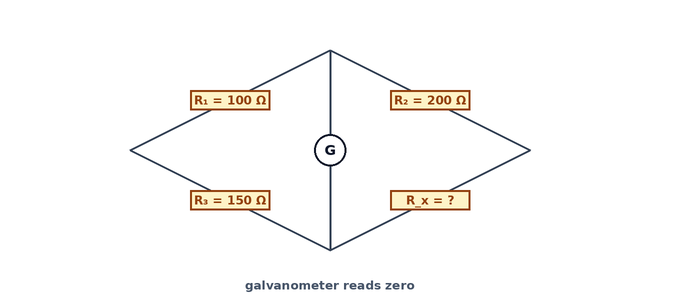
في قنطرة ويتستون الموضحة لا يمر تيار في الجلفانومتر عند الاتزان، و\(R_1=100\,\Omega\) و\(R_2=200\,\Omega\) و\(R_3=150\,\Omega\). فإن المقاومة المجهولة \(R_x\):In the Wheatstone bridge shown no current flows through the galvanometer at balance, with \(R_1=100\,\Omega\), \(R_2=200\,\Omega\) and \(R_3=150\,\Omega\). The unknown resistance \(R_x\) is:
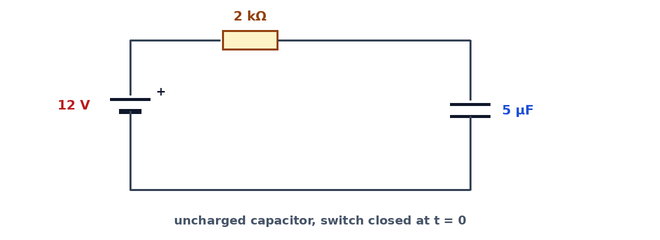
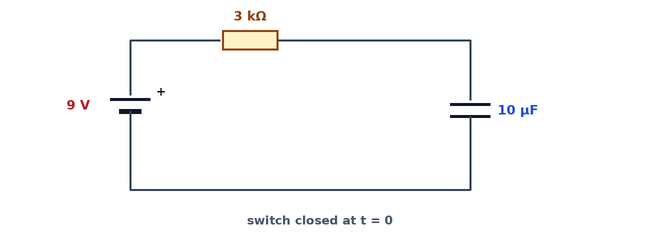
مكثف \(5\,\mu F\) غير مشحون موصول على التوالي بمقاومة \(2\,k\Omega\) وبطارية \(12\,V\) وأُغلق المفتاح عند \(t=0\) كما في الشكل. فإن فرق الجهد على المكثف بعد زمن يساوي الثابت الزمني \(\tau\):An uncharged \(5\,\mu F\) capacitor is in series with a \(2\,k\Omega\) resistor and a \(12\,V\) battery and the switch is closed at \(t=0\) as shown. The potential difference across the capacitor after one time constant \(\tau\) is:
📌 الخطوة 2: عند \(t=\tau\): \[V_C=\varepsilon\left(1-e^{-1}\right)=12\times0.632=7.6\,V\]
✅ الإجابة الصحيحة: A (7.6 V)
📌 Step 1: The time constant: \(\tau=RC=2000\times5\times10^{-6}=10\,ms\)
📌 Step 2: At \(t=\tau\): \[V_C=\varepsilon\left(1-e^{-1}\right)=12\times0.632=7.6\,V\]
✅ Correct answer: A (7.6 V)
\[35\,\star\star\star\]
في دائرة RC الموضحة (مكثف \(10\,\mu F\) غير مشحون ومقاومة \(3\,k\Omega\) وبطارية \(9\,V\)) أُغلق المفتاح عند \(t=0\). فإن التيار في الدائرة عندما \(t=\tau\):In the RC circuit shown (an uncharged \(10\,\mu F\) capacitor, a \(3\,k\Omega\) resistor and a \(9\,V\) battery) the switch is closed at \(t=0\). The current in the circuit at \(t=\tau\) is:
\(3 mA\)\(3 mA\)
1.1 mA1.1 mA
\(1.9 mA\)\(1.9 mA\)
\(0\)\(0\)
الحلSolution
📌 الخطوة 1: التيار الابتدائي (المكثف كسلك): \(I_0=\dfrac{\varepsilon}{R}=\dfrac{9}{3000}=3\,mA\)
📌 الخطوة 2: التيار يتناقص أسّيًا: \[I(\tau)=I_0e^{-1}=3\times0.368=1.1\,mA\]
✅ الإجابة الصحيحة: B (1.1 mA)
📌 Step 1: The initial current (the capacitor acts like a wire): \(I_0=\dfrac{\varepsilon}{R}=\dfrac{9}{3000}=3\,mA\)
📌 Step 2: The current decays exponentially: \[I(\tau)=I_0e^{-1}=3\times0.368=1.1\,mA\]
✅ Correct answer: B (1.1 mA)
\[36\,\star\star\star\]
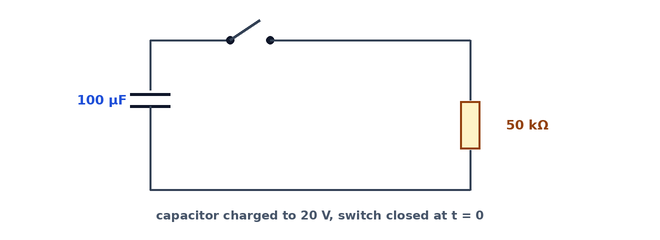
مكثف \(100\,\mu F\) مشحون إلى \(20\,V\) يُفرَّغ عبر مقاومة \(50\,k\Omega\) عند إغلاق المفتاح كما في الشكل. فإن فرق الجهد عليه بعد \(5\,s\):A \(100\,\mu F\) capacitor charged to \(20\,V\) discharges through a \(50\,k\Omega\) resistor when the switch is closed as shown. The potential difference across it after \(5\,s\) is:
📌 الخطوة 2: في التفريغ: \[V=V_0e^{-t/\tau}=20\,e^{-1}=7.4\,V\]
✅ الإجابة الصحيحة: D (7.4 V)
📌 Step 1: The time constant: \(\tau=RC=50\times10^3\times100\times10^{-6}=5\,s\)
📌 Step 2: In discharge: \[V=V_0e^{-t/\tau}=20\,e^{-1}=7.4\,V\]
✅ Correct answer: D (7.4 V)
\[37\,\star\star\star\]
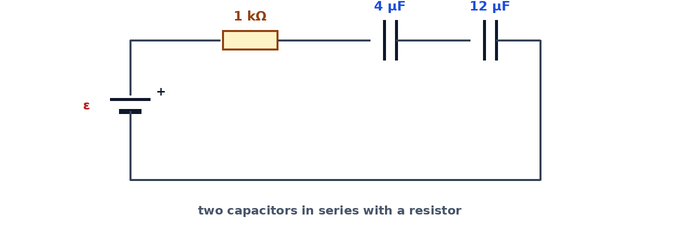
مكثفان \(4\,\mu F\) و\(12\,\mu F\) موصولان على التوالي مع مقاومة \(1\,k\Omega\) وبطارية كما في الشكل. فإن الثابت الزمني لشحن المكثفين:Capacitors \(4\,\mu F\) and \(12\,\mu F\) are connected in series with a \(1\,k\Omega\) resistor and a battery as shown. The time constant for charging them is:
\(16 ms\)\(16 ms\)
\(12 ms\)\(12 ms\)
\(1 ms\)\(1 ms\)
3 ms3 ms
الحلSolution
📌 الخطوة 1: السعة المكافئة على التوالي: \(C_{eq}=\dfrac{4\times12}{4+12}=3\,\mu F\)
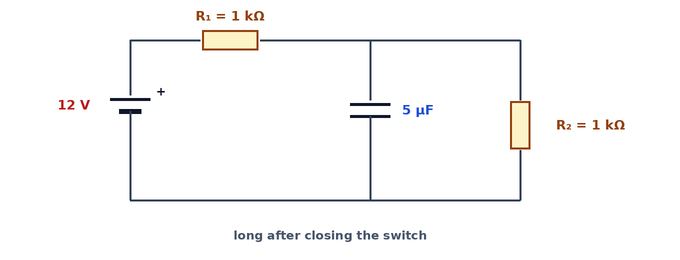
في الدائرة الموضحة مقاومتان \(R_1=R_2=1\,k\Omega\) ومكثف \(5\,\mu F\) على التوازي مع \(R_2\) وبطارية \(12\,V\). بعد زمن طويل من إغلاق المفتاح فإن شحنة المكثف:In the circuit shown, \(R_1=R_2=1\,k\Omega\) and a \(5\,\mu F\) capacitor is in parallel with \(R_2\) with a \(12\,V\) battery. Long after the switch is closed the charge on the capacitor is:
30 μC30 μC
\(60 μC\)\(60 μC\)
\(15 μC\)\(15 μC\)
\(0\)\(0\)
الحلSolution
📌 الخطوة 1: بعد زمن طويل لا يمر تيار في فرع المكثف، فيمر التيار في المقاومتين على التوالي: \(I=\dfrac{12}{1000+1000}=6\,mA\)
📌 Step 1: After a long time no current flows in the capacitor branch, so the current flows through the two resistors in series: \(I=\dfrac{12}{1000+1000}=6\,mA\)
📌 Step 2: The capacitor voltage equals that across \(R_2\): \(V_C=IR_2=6\,V\) and the charge: \[Q=CV_C=5\times6=30\,\mu C\]
✅ Correct answer: A (30 μC)
\[39\,\star\star\star\]
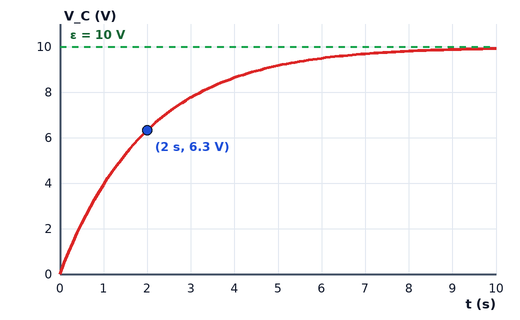
يمثل الرسم جهد مكثف يُشحن عبر مقاومة \(R=100\,k\Omega\) من بطارية \(10\,V\) مع الزمن. فإن سعة المكثف:The graph shows the voltage of a capacitor being charged through a \(R=100\,k\Omega\) resistor from a \(10\,V\) battery against time. The capacitance of the capacitor is:
\(2 μF\)\(2 μF\)
\(200 μF\)\(200 μF\)
\(63 μF\)\(63 μF\)
20 μF20 μF
الحلSolution
📌 الخطوة 1: عند الثابت الزمني يبلغ الجهد \(63\%\) من القيمة النهائية: \(0.63\times10=6.3\,V\) وهذا عند \(t=2\,s\) فيكون \(\tau=2\,s\)
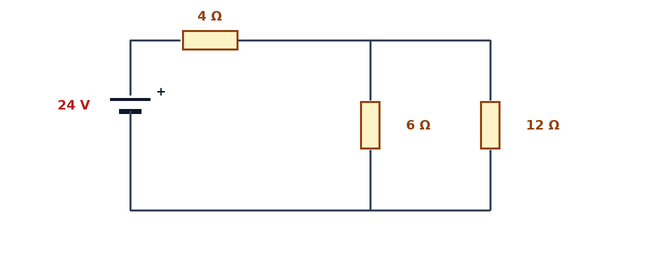
بطارية \(24\,V\) موصولة بمقاومة \(4\,\Omega\) على التوالي مع مقاومتين \(6\,\Omega\) و\(12\,\Omega\) على التوازي كما في الشكل. فإن التيار في المقاومة \(12\,\Omega\):A \(24\,V\) battery is connected to a \(4\,\Omega\) resistor in series with \(6\,\Omega\) and \(12\,\Omega\) resistors in parallel as shown. The current in the \(12\,\Omega\) resistor is:
📌 Step 1: The parallel branch is \(\dfrac{6\times12}{18}=4\,\Omega\), the total \(4+4=8\,\Omega\) and the total current \(I=\dfrac{24}{8}=3\,A\)
📌 Step 2: The voltage across the parallel branch \(V=3\times4=12\,V\): \[I_{12}=\dfrac{12}{12}=1\,A\]
✅ Correct answer: A (1 A)
\[41\,\star\star\star\]
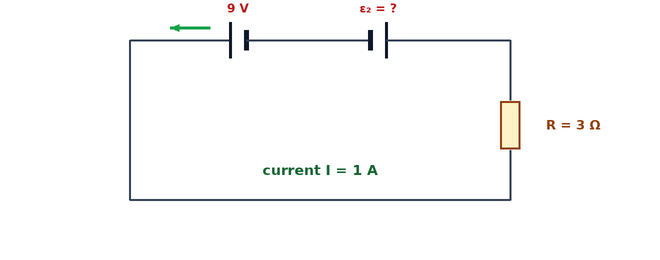
بطاريتان \(9\,V\) و\(\varepsilon_2\) موصولتان على التوالي بقطبين متعاكسين مع مقاومة \(3\,\Omega\) (مقاومة البطاريتين مهملة)، وشدة التيار \(1\,A\) باتجاه البطارية \(9\,V\) كما في الشكل. فإن \(\varepsilon_2\):Batteries \(9\,V\) and \(\varepsilon_2\) are connected in series with opposing polarities and a \(3\,\Omega\) resistor (negligible battery resistance), with a current of \(1\,A\) in the direction of the \(9\,V\) battery as shown. \(\varepsilon_2\) is:
\(12 V\)\(12 V\)
6 V6 V
\(3 V\)\(3 V\)
\(9 V\)\(9 V\)
الحلSolution
📌 الخطوة 1: قانون كيرشوف الثاني: \(9-\varepsilon_2-IR=0\)
📌 الخطوة 2: \[\varepsilon_2=9-1\times3=6\,V\]
✅ الإجابة الصحيحة: B (6 V)
📌 Step 1: Kirchhoff’s second law: \(9-\varepsilon_2-IR=0\)
📌 Step 2: \[\varepsilon_2=9-1\times3=6\,V\]
✅ Correct answer: B (6 V)
\[42\,\star\star\star\]
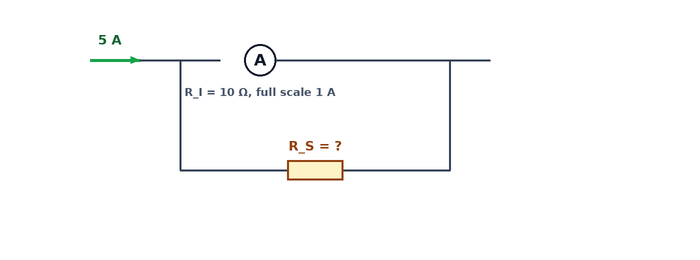
أميتر مقاومته الداخلية \(R_I=10\,\Omega\) وأقصى تيار له \(1\,A\) يُراد توسيع مداه إلى \(5\,A\) بمقاومة تفرّع \(R_S\) كما في الشكل. فإن \(R_S\):An ammeter of internal resistance \(R_I=10\,\Omega\) and full-scale current \(1\,A\) is to be extended to \(5\,A\) with a shunt \(R_S\) as shown. \(R_S\) is:
2.5 Ω2.5 Ω
\(10 Ω\)\(10 Ω\)
\(0.4 Ω\)\(0.4 Ω\)
\(5 Ω\)\(5 Ω\)
الحلSolution
📌 الخطوة 1: يمر في المقاومة المفرّعة \(I_S=5-1=4\,A\) والجهد متساوٍ: \(I_IR_I=I_SR_S\)
أربعة تدريبات إضافية على شحن المكثفات في دوائر RC، للتمرّن الذاتي؛ اضغط زر «إظهار الحل» تحت كل تدريب لرؤية الحل.
Four additional RC-circuit charging problems for self-practice; press “Show Solution” under each problem to see the worked solution.
تدريب 1: دائرة كهربائية بها مقاوم \(R=6\Omega\). احسب التيار المار فيه. ثم احسب القدرة المصروفة في مقاوم آخر \(R=2.5\Omega\).Practice 1: a circuit has a resistor \(R=6\Omega\). Find the current through it. Then find the power consumed in another resistor \(R=2.5\Omega\).
الحلSolution
📌 الخطوة 1: نفرض فرق الجهد بين العقدتين \(V\) (من اليسار إلى اليمين) فتكون التيارات: السفلي \(I_3=\dfrac{45-V}{3}\)، الأوسط \(I_6=\dfrac{V}{6}\)، العلوي \(I_{2.5}=\dfrac{V-18}{2.5}\)
📌 الخطوة 2: قانون كيرشوف الأول عند العقدة اليسرى \(I_3=I_6+I_{2.5}\): \[10(45-V)=5V+12(V-18)\Rightarrow666=27V\Rightarrow V=24.67\,V\]
📌 الخطوة 3: التيار في المقاوم \(6\,\Omega\): \(I_6=\dfrac{24.67}{6}=4.11\,A\) (والتيار السفلي \(6.78\,A\) يطابق القيمة في الشكل)، والتيار في المقاوم \(2.5\,\Omega\): \(I=\dfrac{24.67-18}{2.5}=2.67\,A\)
📌 الخطوة 4: القدرة في \(2.5\,\Omega\): \[P=I^2R=(2.67)^2\times2.5\approx17.8\,W\]
✅ I = 4.11 A, P ≈ 17.8 W
📌 Step 1: Let the potential difference between the junctions be \(V\) (left to right) so the currents are: bottom \(I_3=\dfrac{45-V}{3}\), middle \(I_6=\dfrac{V}{6}\), top \(I_{2.5}=\dfrac{V-18}{2.5}\)
📌 Step 2: Kirchhoff’s first law at the left junction \(I_3=I_6+I_{2.5}\): \[10(45-V)=5V+12(V-18)\Rightarrow666=27V\Rightarrow V=24.67\,V\]
📌 Step 3: The current in the \(6\,\Omega\) resistor: \(I_6=\dfrac{24.67}{6}=4.11\,A\) (the bottom current \(6.78\,A\) matches the figure), and in the \(2.5\,\Omega\) resistor: \(I=\dfrac{24.67-18}{2.5}=2.67\,A\)
📌 Step 4: The power in \(2.5\,\Omega\): \[P=I^2R=(2.67)^2\times2.5\approx17.8\,W\]
✅ I = 4.11 A, P ≈ 17.8 W
تدريب 2: أميتر مقاومته الداخلية \(R_I=27\Omega\) يقيس تيارًا \(I_I=0.1A\). وُصلت مقاومة \(R_S=0.3\Omega\) على التوازي لزيادة مداه. احسب معامل زيادة شدة التيار.Practice 2: an ammeter with internal resistance \(R_I=27\Omega\) measures \(I_I=0.1A\). A resistor \(R_S=0.3\Omega\) is connected in parallel to extend its range. Find the current multiplication factor.
📌 Step 1: The two resistances are in parallel so they have the same voltage: \(I_SR_S=I_IR_I\) hence \(I_S=\dfrac{0.1\times27}{0.3}=9\,A\)
📌 Step 2: The maximum current: \(I_{max}=I_I+I_S=0.1+9=9.1\,A\)
📌 Step 3: The multiplication factor: \[n=\dfrac{I_{max}}{I_I}=\dfrac{9.1}{0.1}=91=1+\dfrac{R_I}{R_S}\]
✅ n = 91
تدريب 3: مكثف سعته \(C=20\mu F\) غير مشحون، وُصل بمقاوم \(R=100\Omega\) على التوالي مع بطارية \(V=20V\). احسب الثابت الزمني، وزمن وصول التيار إلى \(I=0.1A\).Practice 3: an initially uncharged \(C=20\mu F\) capacitor is connected to a \(R=100\Omega\) resistor in series with a \(V=20V\) battery. Find the time constant, and the time for the current to reach \(I=0.1A\).
📌 الخطوة 2: التيار الابتدائي \(I_0=\dfrac{V}{R}=\dfrac{20}{100}=0.2\,A\) ويتناقص أسّيًا: \(I=I_0e^{-t/\tau}\)
📌 الخطوة 3: عند \(I=0.1\,A\): \[0.1=0.2e^{-t/\tau}\Rightarrow t=\tau\ln2=2\times0.693=1.39\,ms\]
✅ τ = 2 ms, t ≈ 1.39 ms
📌 Step 1: The time constant: \[\tau=RC=100\times20\times10^{-6}=2\times10^{-3}\,s=2\,ms\]
📌 Step 2: The initial current \(I_0=\dfrac{V}{R}=\dfrac{20}{100}=0.2\,A\) decays exponentially: \(I=I_0e^{-t/\tau}\)
📌 Step 3: At \(I=0.1\,A\): \[0.1=0.2e^{-t/\tau}\Rightarrow t=\tau\ln2=2\times0.693=1.39\,ms\]
✅ τ = 2 ms, t ≈ 1.39 ms
تدريب 4: دائرة تحتوي على مقاومتين ومكثفين متصلين بالبطارية عبر مفتاح. عند إغلاق المفتاح تبدأ المكثفات بالشحن. احسب الثابت الزمني لعملية الشحن.Practice 4: a circuit has two resistors and two capacitors connected to a battery via a switch. When closed, the capacitors begin charging. Find the time constant of the charging process.
الحلSolution
📌 الخطوة 1: المقاومتان على التوازي: \(R_{eq}=\dfrac{600\times300}{600+300}=200\,\Omega\)
📌 الخطوة 2: المكثفان على التوازي: \(C_{eq}=6+3=9\,\mu F\)
📌 Step 1: The resistors in parallel: \(R_{eq}=\dfrac{600\times300}{600+300}=200\,\Omega\)
📌 Step 2: The capacitors in parallel: \(C_{eq}=6+3=9\,\mu F\)
📌 Step 3: The time constant: \[\tau=R_{eq}C_{eq}=200\times9\times10^{-6}=1.8\,ms\]
✅ τ = 1.8 ms
لاحظت خطأ؟ أو عندك سؤال عن أحد الأسئلة؟ اكتبه بالتعليقات وحدد رقم السؤال.Noticed an error, or have a question about one of the questions? Write it in the comments and specify the question number.