راجع درسي دوائر التوالي ودوائر التوازي ودرس قوانين كيرشوف أولًا للنظرية والأمثلة المحلولة، ثم اختبر فهمك الشامل بالأسئلة التالية.
Review the Series Circuits and Parallel Circuits lessons and the Kirchhoff's Laws lesson first for theory and worked examples, then test your comprehensive understanding with the questions below.
📝 أسئلة الاختيار من متعدد (37 سؤالًا)
📝 Multiple-Choice Questions (37)
\[1\,\star\]
في التوصيل على التوالي، أي من العبارات التالية صحيحة؟In a series connection, which of the following is correct?
التيار المار في جميع المقاومات متساوٍThe current through all resistors is equal
الجهد على جميع المقاومات متساوٍThe voltage across all resistors is equal
المقاومة المكافئة أصغر من أصغر مقاومةThe equivalent resistance is smaller than the smallest resistance
إذا انقطع أحد المقاومات، تستمر الدائرة في العملIf one resistor breaks, the circuit continues to work
الحلSolution
بالتوالي: I=I1=I2=I3، V=V1+V2+V3، Req=R1+R2+R3 (أكبر من أكبر مقاومة). إذا انقطع أحد المكونات تنقطع الدائرة بالكامل.
✅ الإجابة الصحيحة: A (التيار المار في جميع المقاومات متساوٍ)
In series: I=I1=I2=I3, V=V1+V2+V3, Req=R1+R2+R3 (greater than the largest resistance). If one component breaks, the entire circuit stops.
✅ Correct answer: A (The current through all resistors is equal)
\[2\,\star\]
ثلاث مقاومات متصلة على التوالي قيمها: 5 أوم، 10 أوم، 15 أوم. ما المقاومة المكافئة؟Three resistors in series: 5Ω, 10Ω, 15Ω. What is the equivalent resistance?
15 أوم15 Ω
20 أوم20 Ω
25 أوم25 Ω
30 أوم30 Ω
الحلSolution
Req=5+10+15=30 أوم
✅ الإجابة الصحيحة: D (30 أوم)
Req=5+10+15=30Ω
✅ Correct answer: D (30 Ω)
\[3\,\star\]
دائرة توالي، جهد المصدر 48 فولت، والمقاومات: 4 أوم، 8 أوم، 12 أوم. ما شدة التيار؟A series circuit, source voltage 48V, resistors: 4Ω, 8Ω, 12Ω. What is the current?
1 أمبير1 A
2 أمبير2 A
3 أمبير3 A
4 أمبير4 A
الحلSolution
Req=4+8+12=24Ω، I=48/24=2A
✅ الإجابة الصحيحة: B (2 أمبير)
Req=4+8+12=24Ω, I=48/24=2A
✅ Correct answer: B (2 A)
\[4\,\star\]
بنفس الدائرة السابقة، ما جهد المقاومة 12 أوم؟In the same circuit, what is the voltage across the 12Ω resistor?
12 فولت12 V
16 فولت16 V
20 فولت20 V
24 فولت24 V
الحلSolution
I=2A لجميع المقاومات (توالي)، V=I×R=2×12=24V
✅ الإجابة الصحيحة: D (24 فولت)
I=2A for all resistors (series), V=I×R=2×12=24V
✅ Correct answer: D (24 V)
\[5\,\star\]
مقاومتان R1=6 أوم وR2=12 أوم على التوالي، والتيار 3 أمبير. ما جهد المصدر؟Resistors R1=6Ω and R2=12Ω in series, current 3A. What is the source voltage?
18 فولت18 V
36 فولت36 V
54 فولت54 V
72 فولت72 V
الحلSolution
Req=6+12=18Ω، V=I×Req=3×18=54V
✅ الإجابة الصحيحة: C (54 فولت)
Req=6+12=18Ω, V=I×Req=3×18=54V
✅ Correct answer: C (54 V)
\[6\,\star\]
في التوصيل على التوالي، أي المقاومات يأخذ الجهد الأكبر؟In a series connection, which resistor takes the largest voltage?
المقاومة الأصغرThe smallest resistor
المقاومة الأكبرThe largest resistor
جميع المقاومات جهدها متساوٍAll resistors have equal voltage
لا يمكن تحديدCannot be determined
الحلSolution
V=I×R، والتيار ثابت، فالمقاومة الأكبر تأخذ الجهد الأكبر.
✅ الإجابة الصحيحة: B (المقاومة الأكبر)
V=I×R, and current is constant, so the largest resistor takes the largest voltage.
✅ Correct answer: B (The largest resistor)
\[7\,\star\]
في التوصيل على التوازي، أي من العبارات التالية صحيحة؟In a parallel connection, which of the following is correct?
التيار في جميع المقاومات متساوٍThe current through all resistors is equal
الجهد على جميع المقاومات متساوٍ ويساوي جهد المصدرThe voltage across all resistors is equal and equals the source voltage
المقاومة المكافئة أكبر من أكبر مقاومةThe equivalent resistance is greater than the largest resistance
إذا انقطع أحد المقاومات تنقطع الدائرة بالكاملIf one resistor breaks, the entire circuit stops
الحلSolution
بالتوازي: V=V1=V2=V3، I=I1+I2+I3، 1/Req=1/R1+1/R2+1/R3 (أصغر من أصغر مقاومة).
✅ الإجابة الصحيحة: B (الجهد على جميع المقاومات متساوٍ ويساوي جهد المصدر)
In parallel: V=V1=V2=V3, I=I1+I2+I3, 1/Req=1/R1+1/R2+1/R3 (smaller than the smallest resistance).
✅ Correct answer: B (The voltage across all resistors is equal and equals the source voltage)
\[8\,\star\star\]
مقاومتان على التوازي 6 أوم و12 أوم. ما المقاومة المكافئة؟Two resistors in parallel, 6Ω and 12Ω. What is the equivalent resistance?
2 أوم2 Ω
3 أوم3 Ω
4 أوم4 Ω
18 أوم18 Ω
الحلSolution
1/Req=1/6+1/12=3/12=1/4 ⇒ Req=4Ω
✅ الإجابة الصحيحة: C (4 أوم)
1/Req=1/6+1/12=3/12=1/4 ⇒ Req=4Ω
✅ Correct answer: C (4 Ω)
\[9\,\star\star\]
ثلاث مقاومات على التوازي: 6، 12، 18 أوم، والمصدر 36 فولت. ما التيار الكلي؟Three resistors in parallel: 6, 12, 18Ω, source 36V. What is the total current?
6 أمبير6 A
9 أمبير9 A
11 أمبير11 A
36 أمبير36 A
الحلSolution
1/Req=1/6+1/12+1/18=11/36 ⇒ Req=36/11Ω، I=36/(36/11)=11A
✅ الإجابة الصحيحة: C (11 أمبير)
1/Req=1/6+1/12+1/18=11/36 ⇒ Req=36/11Ω, I=36/(36/11)=11A
✅ Correct answer: C (11 A)
\[10\,\star\star\]
في الدائرة السابقة، ما التيار المار في المقاومة 6 أوم؟In the previous circuit, what is the current through the 6Ω resistor?
2 أمبير2 A
3 أمبير3 A
6 أمبير6 A
12 أمبير12 A
الحلSolution
V=36V (ثابت بالتوازي)، I6=36/6=6A
✅ الإجابة الصحيحة: C (6 أمبير)
V=36V (constant in parallel), I6=36/6=6A
✅ Correct answer: C (6 A)
\[11\,\star\star\]
في التوصيل على التوازي، أي المقاومات يمر بها تيار أكبر؟In a parallel connection, which resistor has the largest current through it?
المقاومة الأصغرThe smallest resistor
المقاومة الأكبرThe largest resistor
جميعها متساوٍAll are equal
لا يمكن تحديدCannot be determined
الحلSolution
I=V/R، والجهد ثابت، فالمقاومة الأصغر يمر بها تيار أكبر.
✅ الإجابة الصحيحة: A (المقاومة الأصغر)
I=V/R, and voltage is constant, so the smallest resistor has the largest current through it.
✅ Correct answer: A (The smallest resistor)
\[12\,\star\star\]
ما نص قانون كيرشوف الأول (قانون التيار)؟What is Kirchhoff's First Law (Current Law)?
مجموع التيارات الداخلة = مجموع التيارات الخارجةSum of entering currents = sum of leaving currents
مجموع الجهود في الحلقة = صفرSum of voltages in a loop = zero
التيار ثابت في جميع المقاوماتCurrent is constant through all resistors
الجهد ثابت على جميع المقاوماتVoltage is constant across all resistors
الحلSolution
ΣIin = ΣIout (حفظ الشحنة عند العقدة).
✅ الإجابة الصحيحة: A (مجموع التيارات الداخلة = مجموع التيارات الخارجة)
ΣIin = ΣIout (conservation of charge at a node).
✅ Correct answer: A (Sum of entering currents = sum of leaving currents)
\[13\,\star\star\]
ما نص قانون كيرشوف الثاني (قانون الجهد)؟What is Kirchhoff's Second Law (Voltage Law)?
مجموع التيارات الداخلة = مجموع التيارات الخارجةSum of entering currents = sum of leaving currents
المجموع الجبري لارتفاع الجهد = المجموع الجبري لانخفاضهAlgebraic sum of voltage rises = algebraic sum of voltage drops
التيار ثابت في جميع المقاوماتCurrent is constant through all resistors
الجهد ثابت على جميع المقاوماتVoltage is constant across all resistors
الحلSolution
ΣVrise = ΣVdrop حول أي حلقة مغلقة (حفظ الطاقة).
✅ الإجابة الصحيحة: B (المجموع الجبري لارتفاع الجهد = المجموع الجبري لانخفاضه)
ΣVrise = ΣVdrop around any closed loop (conservation of energy).
✅ Correct answer: B (Algebraic sum of voltage rises = algebraic sum of voltage drops)
\[14\,\star\star\]
عند عقدة: I1=5A (داخل)، I2=7A (خارج)، I3=3A (خارج). ما قيمة I4 واتجاهه؟At a node: I1=5A (in), I2=7A (out), I3=3A (out). What is I4 and its direction?
I4=5A للداخلI4=5A entering
I4=5A للخارجI4=5A leaving
I4=15A للداخلI4=15A entering
I4=15A للخارجI4=15A leaving
الحلSolution
I1+I4=I2+I3 ⇒ 5+I4=10 ⇒ I4=5A للداخل
✅ الإجابة الصحيحة: A (I4=5A للداخل)
I1+I4=I2+I3 ⇒ 5+I4=10 ⇒ I4=5A entering
✅ Correct answer: A (I4=5A entering)
\[15\,\star\star\]
بطارية 24V ومقاومتان توالي R1=4Ω وR2=8Ω. ما جهد R2؟A 24V battery with two series resistors R1=4Ω and R2=8Ω. What is the voltage across R2?
8 فولت8 V
12 فولت12 V
16 فولت16 V
24 فولت24 V
الحلSolution
Req=12Ω، I=24/12=2A، V2=2×8=16V
✅ الإجابة الصحيحة: C (16 فولت)
Req=12Ω, I=24/12=2A, V2=2×8=16V
✅ Correct answer: C (16 V)
\[16\,\star\star\]
دائرة مركبة: مقاومة 4 أوم على التوالي مع توازي (6 أوم و12 أوم). ما المقاومة المكافئة الكلية؟A combined circuit: a 4Ω resistor in series with a parallel combination (6Ω and 12Ω). What is the total equivalent resistance?
4 أوم4 Ω
6 أوم6 Ω
8 أوم8 Ω
22 أوم22 Ω
الحلSolution
Rp=(6×12)/18=4Ω، Req=4+4=8Ω
✅ الإجابة الصحيحة: C (8 أوم)
Rp=(6×12)/18=4Ω, Req=4+4=8Ω
✅ Correct answer: C (8 Ω)
\[17\,\star\star\]
بنفس الدائرة، إذا كان جهد المصدر 48 فولت، ما التيار الكلي؟In the same circuit, if the source voltage is 48V, what is the total current?
2 أمبير2 A
4 أمبير4 A
6 أمبير6 A
8 أمبير8 A
الحلSolution
I=V/Req=48/8=6A
✅ الإجابة الصحيحة: C (6 أمبير)
I=V/Req=48/8=6A
✅ Correct answer: C (6 A)
\[18\,\star\star\]
بنفس الدائرة، ما التيار المار في المقاومة 6 أوم بالفرع المتوازي؟In the same circuit, what is the current through the 6Ω resistor in the parallel branch?
2 أمبير2 A
3 أمبير3 A
4 أمبير4 A
6 أمبير6 A
الحلSolution
V4=6×4=24V، Vp=48-24=24V، I6=24/6=4A
✅ الإجابة الصحيحة: C (4 أمبير)
V4=6×4=24V, Vp=48-24=24V, I6=24/6=4A
✅ Correct answer: C (4 A)
\[19\,\star\star\]
مقاومتان على التوالي، المكافئة=20 أوم، R1=8 أوم. ما R2؟Two resistors in series, equivalent=20Ω, R1=8Ω. What is R2?
4 أوم4 Ω
8 أوم8 Ω
12 أوم12 Ω
16 أوم16 Ω
الحلSolution
20=8+R2 ⇒ R2=12Ω
✅ الإجابة الصحيحة: C (12 أوم)
20=8+R2 ⇒ R2=12Ω
✅ Correct answer: C (12 Ω)
\[20\,\star\star\]
مقاومتان على التوازي، المكافئة=6 أوم، R1=12 أوم. ما R2؟Two resistors in parallel, equivalent=6Ω, R1=12Ω. What is R2?
4 أوم4 Ω
6 أوم6 Ω
8 أوم8 Ω
12 أوم12 Ω
الحلSolution
1/6=1/12+1/R2 ⇒ 1/R2=1/12 ⇒ R2=12Ω
✅ الإجابة الصحيحة: D (12 أوم)
1/6=1/12+1/R2 ⇒ 1/R2=1/12 ⇒ R2=12Ω
✅ Correct answer: D (12 Ω)
\[21\,\star\star\]
مقاومتان: مكافئهما بالتوالي=15 أوم، وبالتوازي=3.6 أوم. ما قيمتاهما؟Two resistors: their series equivalent=15Ω, and parallel equivalent=3.6Ω. What are their values?
6 أوم و9 أوم6 Ω and 9 Ω
4 أوم و11 أوم4 Ω and 11 Ω
5 أوم و10 أوم5 Ω and 10 Ω
3 أوم و12 أوم3 Ω and 12 Ω
الحلSolution
R1+R2=15، R1R2/15=3.6⇒R1R2=54. حل المعادلتين: R1=6، R2=9.
✅ الإجابة الصحيحة: A (6 أوم و9 أوم)
R1+R2=15, R1R2/15=3.6⇒R1R2=54. Solving: R1=6, R2=9.
✅ Correct answer: A (6 Ω and 9 Ω)
\[22\,\star\star\]
مقاومتان متساويتان على التوازي، مكافئهما=5 أوم. ما قيمة كل مقاومة؟Two equal resistors in parallel, equivalent=5Ω. What is the value of each resistor?
2.5 أوم2.5 Ω
5 أوم5 Ω
10 أوم10 Ω
25 أوم25 Ω
الحلSolution
Req=R/2=5 ⇒ R=10Ω
✅ الإجابة الصحيحة: C (10 أوم)
Req=R/2=5 ⇒ R=10Ω
✅ Correct answer: C (10 Ω)
\[23\,\star\star\star\]
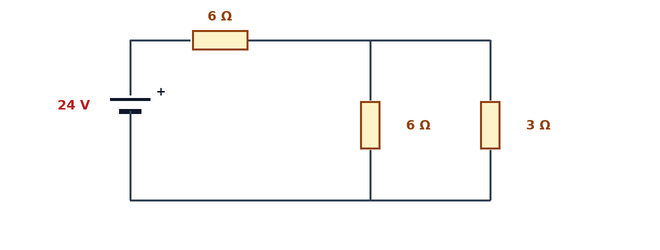
في الدائرة الموضحة بطارية \(24\,V\) تغذي مقاومة \(6\,\Omega\) على التوالي مع مقاومتين \(6\,\Omega\) و\(3\,\Omega\) على التوازي. فإن فرق الجهد بين طرفي المقاومة \(3\,\Omega\):In the circuit shown a \(24\,V\) battery supplies a \(6\,\Omega\) resistor in series with \(6\,\Omega\) and \(3\,\Omega\) resistors in parallel. The potential difference across the \(3\,\Omega\) resistor is:
12 V12 V
8 V8 V
24 V24 V
6 V6 V
الحلSolution
مقاومة الفرع المتوازي: \(\dfrac{6\times3}{6+3}=2\,\Omega\) والمقاومة الكلية \(6+2=8\,\Omega\) والتيار الكلي \(I=\dfrac{24}{8}=3\,A\): \[V_{3\Omega}=V_{parallel}=I\times2=6\,V\]
✅ الإجابة الصحيحة: D (6 V)
Resistance of the parallel branch: \(\dfrac{6\times3}{6+3}=2\,\Omega\), total resistance \(6+2=8\,\Omega\) and total current \(I=\dfrac{24}{8}=3\,A\): \[V_{3\Omega}=V_{parallel}=I\times2=6\,V\]
✅ Correct answer: D (6 V)
\[24\,\star\star\star\]
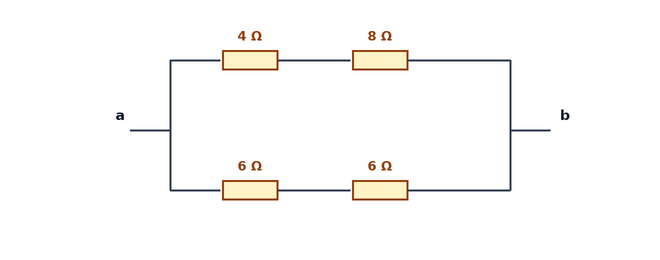
المقاومة المكافئة بين النقطتين \(a\) و\(b\) في الشكل (فرعان متوازيان في كل منهما مقاومتان على التوالي):The equivalent resistance between \(a\) and \(b\) in the figure (two parallel branches, each with two resistors in series) is:
12 Ω12 Ω
6 Ω6 Ω
3 Ω3 Ω
24 Ω24 Ω
الحلSolution
الفرع الأول: \(4+8=12\,\Omega\) والفرع الثاني: \(6+6=12\,\Omega\) وهما على التوازي: \[R_{eq}=\dfrac{12\times12}{12+12}=6\,\Omega\]
✅ الإجابة الصحيحة: B (6 Ω)
First branch: \(4+8=12\,\Omega\) and second branch: \(6+6=12\,\Omega\), and they are in parallel: \[R_{eq}=\dfrac{12\times12}{12+12}=6\,\Omega\]
✅ Correct answer: B (6 Ω)
\[25\,\star\star\star\]
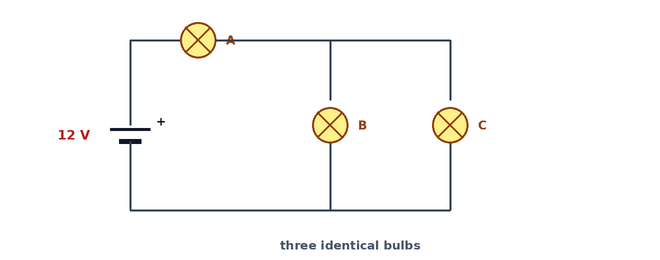
ثلاثة مصابيح متماثلة موصولة كما في الشكل (A على التوالي مع B وC المتوازيين). إذا احترق المصباح C فإن إضاءة A وB:Three identical bulbs are connected as shown (A in series with the parallel pair B and C). If bulb C burns out, the brightness of A and B:
A تقل وB تزدادA decreases and B increases
A وB كلاهما تزدادBoth A and B increase
A تزداد وB تقلA increases and B decreases
لا تتغير إضاءة أي منهماNeither changes
الحلSolution
قبل الاحتراق: \(R_{eq}=R+\dfrac R2=1.5R\) والتيار \(I=\dfrac{V}{1.5R}\) يمر في A، ونصفه في كل من B وC. بعد احتراق C: \(R_{eq}=2R\) والتيار \(I'=\dfrac{V}{2R}
✅ الإجابة الصحيحة: A (A تقل وB تزداد)
Before: \(R_{eq}=R+\dfrac R2=1.5R\) and the current \(I=\dfrac{V}{1.5R}\) flows through A, half of it through each of B and C. After C burns out: \(R_{eq}=2R\) and the current \(I'=\dfrac{V}{2R}
✅ Correct answer: A (A decreases and B increases)
\[26\,\star\star\star\]
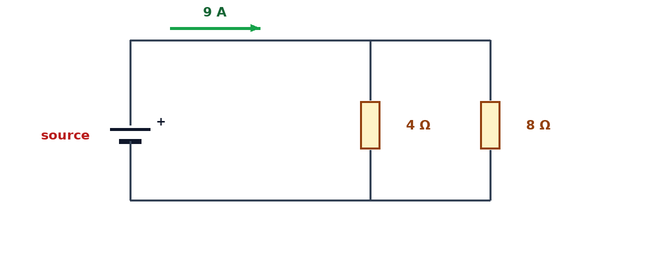
يتفرع تيار كلي \(9\,A\) بين مقاومتين \(4\,\Omega\) و\(8\,\Omega\) على التوازي كما في الشكل. فإن التيار المار في المقاومة \(4\,\Omega\):A total current of \(9\,A\) divides between \(4\,\Omega\) and \(8\,\Omega\) resistors in parallel as shown. The current in the \(4\,\Omega\) resistor is:
3 A3 A
4.5 A4.5 A
9 A9 A
6 A6 A
الحلSolution
في التوازي يتناسب التيار عكسيًا مع المقاومة (قاعدة مقسّم التيار): \[I_4=I\dfrac{R_2}{R_1+R_2}=9\times\dfrac{8}{4+8}=6\,A\] ويمر \(3\,A\) في المقاومة \(8\,\Omega\).
✅ الإجابة الصحيحة: D (6 A)
In parallel the current is inversely proportional to the resistance (current-divider rule): \[I_4=I\dfrac{R_2}{R_1+R_2}=9\times\dfrac{8}{4+8}=6\,A\] and \(3\,A\) flows in the \(8\,\Omega\) resistor.
✅ Correct answer: D (6 A)
\[27\,\star\star\star\]
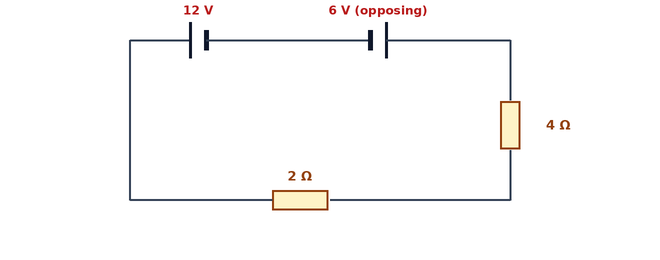
بطاريتان \(12\,V\) و\(6\,V\) موصولتان على التوالي بقطبين متعاكسين مع مقاومتين \(2\,\Omega\) و\(4\,\Omega\) كما في الشكل (مقاومة البطاريتين مهملة). فإن شدة التيار:A \(12\,V\) and a \(6\,V\) battery are connected in series with opposing polarities along with \(2\,\Omega\) and \(4\,\Omega\) resistors as shown (battery resistances neglected). The current is:
3 A3 A
1 A1 A
2 A2 A
0.5 A0.5 A
الحلSolution
قانون كيرشوف الثاني في الحلقة: \[12-6-I(2+4)=0\Rightarrow I=\dfrac{6}{6}=1\,A\]
✅ الإجابة الصحيحة: B (1 A)
Kirchhoff’s second law around the loop: \[12-6-I(2+4)=0\Rightarrow I=\dfrac{6}{6}=1\,A\]
✅ Correct answer: B (1 A)
\[28\,\star\star\star\]
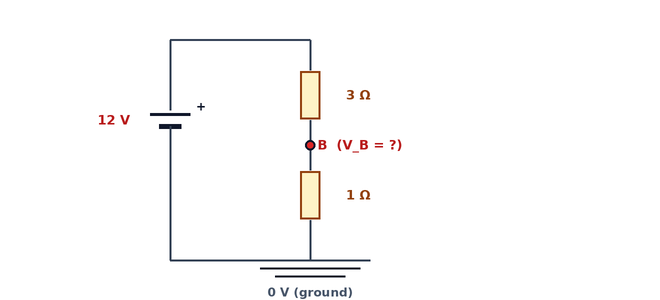
في الدائرة الموضحة نُقطة الأرض عند القطب السالب للبطارية \(12\,V\) (جهدها صفر). فإن الجهد الكهربائي عند النقطة \(B\) بين المقاومتين \(3\,\Omega\) و\(1\,\Omega\):In the circuit shown the ground (zero potential) is at the negative terminal of the \(12\,V\) battery. The electric potential at point \(B\) between the \(3\,\Omega\) and \(1\,\Omega\) resistors is:
3 V3 V
9 V9 V
6 V6 V
4 V4 V
الحلSolution
التيار في الحلقة: \(I=\dfrac{12}{3+1}=3\,A\) وجهد النقطة B يساوي فرق الجهد على المقاومة السفلية بالنسبة للأرض: \[V_B=I\times1=3\,V\] (مقسّم جهد: \(12\times\tfrac{1}{4}=3\,V\)).
✅ الإجابة الصحيحة: A (3 V)
The loop current: \(I=\dfrac{12}{3+1}=3\,A\) and the potential at B equals the voltage across the lower resistor relative to ground: \[V_B=I\times1=3\,V\] (voltage divider: \(12\times\tfrac{1}{4}=3\,V\)).
✅ Correct answer: A (3 V)
\[29\,\star\star\star\]
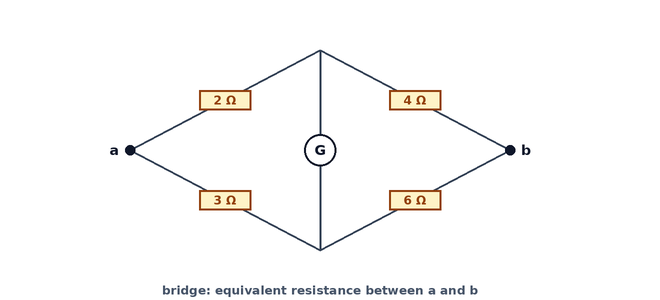
في دائرة قنطرة ويتستون الموضحة قيم المقاومات \(2,\,4,\,3,\,6\,\Omega\) كما في الشكل. فإن المقاومة المكافئة بين \(a\) و\(b\):In the Wheatstone bridge shown the resistances are \(2,\,4,\,3,\,6\,\Omega\) as marked. The equivalent resistance between \(a\) and \(b\) is:
3 Ω3 Ω
4.5 Ω4.5 Ω
7.5 Ω7.5 Ω
3.6 Ω3.6 Ω
الحلSolution
نتحقق من الاتزان: \(\dfrac{2}{4}=\dfrac{3}{6}\) فالقنطرة متزنة ولا يمر تيار في الجلفانومتر G، فيمكن حذفه: \[R_{eq}=\dfrac{(2+4)(3+6)}{(2+4)+(3+6)}=\dfrac{6\times9}{15}=3.6\,\Omega\]
✅ الإجابة الصحيحة: D (3.6 Ω)
Check the balance: \(\dfrac{2}{4}=\dfrac{3}{6}\) so the bridge is balanced and no current flows through the galvanometer G, which can be removed: \[R_{eq}=\dfrac{(2+4)(3+6)}{(2+4)+(3+6)}=\dfrac{6\times9}{15}=3.6\,\Omega\]
✅ Correct answer: D (3.6 Ω)
\[30\,\star\star\star\]
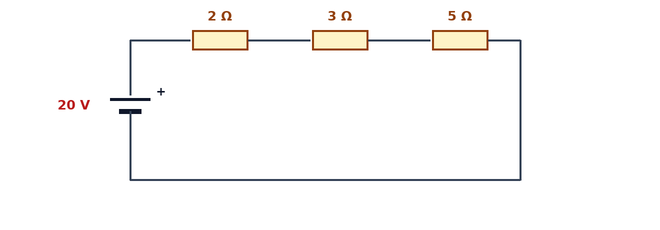
ثلاث مقاومات \(2\,\Omega\) و\(3\,\Omega\) و\(5\,\Omega\) على التوالي ببطارية \(20\,V\) كما في الشكل. فإن القدرة المستهلكة في المقاومة \(5\,\Omega\):Resistors \(2\,\Omega\), \(3\,\Omega\) and \(5\,\Omega\) are in series with a \(20\,V\) battery as shown. The power dissipated in the \(5\,\Omega\) resistor is:
40 W40 W
20 W20 W
10 W10 W
4 W4 W
الحلSolution
التيار: \(I=\dfrac{20}{2+3+5}=2\,A\) والقدرة: \[P=I^2R=2^2\times5=20\,W\] (والقدرة الكلية \(40\,W\)).
✅ الإجابة الصحيحة: B (20 W)
The current: \(I=\dfrac{20}{2+3+5}=2\,A\) and the power: \[P=I^2R=2^2\times5=20\,W\] (the total power is \(40\,W\)).
✅ Correct answer: B (20 W)
\[31\,\star\star\star\]
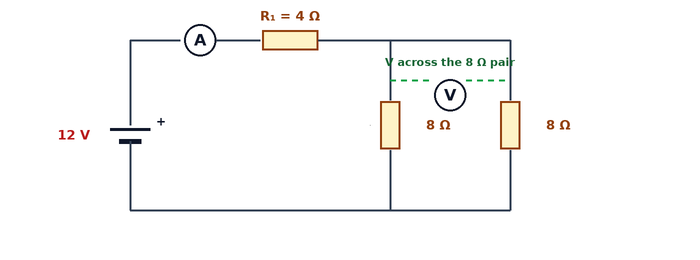
بطارية مثالية \(12\,V\) وُصلت بمقاومة \(4\,\Omega\) على التوالي مع مقاومتين \(8\,\Omega\) و\(8\,\Omega\) على التوازي، وفولتمتر موصول بين طرفي فرع التوازي كما في الشكل. فإن قراءة الفولتمتر:An ideal \(12\,V\) battery is connected to a \(4\,\Omega\) resistor in series with two parallel \(8\,\Omega\) resistors, and a voltmeter is across the parallel branch as shown. The voltmeter reads:
12 V12 V
4 V4 V
6 V6 V
8 V8 V
الحلSolution
مقاومة الفرع المتوازي \(\dfrac{8\times8}{16}=4\,\Omega\) والمقاومة الكلية \(4+4=8\,\Omega\) والتيار \(I=\dfrac{12}{8}=1.5\,A\) (قراءة الأميتر): \[V=I\times4=1.5\times4=6\,V\]
✅ الإجابة الصحيحة: C (6 V)
The parallel branch resistance is \(\dfrac{8\times8}{16}=4\,\Omega\), total \(4+4=8\,\Omega\) and current \(I=\dfrac{12}{8}=1.5\,A\) (the ammeter reading): \[V=I\times4=1.5\times4=6\,V\]
✅ Correct answer: C (6 V)
\[32\,\star\star\star\]
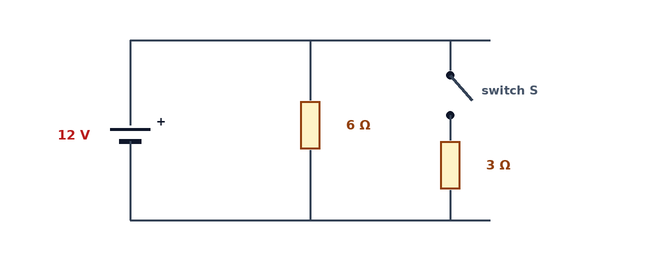
في الدائرة الموضحة مقاومة \(6\,\Omega\) على التوازي مع مقاومة \(3\,\Omega\) يتحكم بها المفتاح S، والمصدر \(12\,V\). عند فتح المفتاح (كان مغلقًا) فإن التيار الكلي:In the circuit shown a \(6\,\Omega\) resistor is in parallel with a \(3\,\Omega\) resistor controlled by switch S, and the source is \(12\,V\). When the switch is opened (it was closed), the total current:
ينخفض من 6 A إلى 2 Afalls from 6 A to 2 A
ينخفض من 6 A إلى 4 Afalls from 6 A to 4 A
يزداد من 2 A إلى 6 Arises from 2 A to 6 A
لا يتغيرdoes not change
الحلSolution
المفتاح مغلق: \(R_{eq}=\dfrac{6\times3}{9}=2\,\Omega\Rightarrow I=\dfrac{12}{2}=6\,A\). المفتاح مفتوح (فرع واحد): \(R=6\,\Omega\Rightarrow I=\dfrac{12}{6}=2\,A\) فينخفض التيار بمقدار \(4\,A\).
✅ الإجابة الصحيحة: A (ينخفض من 6 A إلى 2 A)
Switch closed: \(R_{eq}=\dfrac{6\times3}{9}=2\,\Omega\Rightarrow I=\dfrac{12}{2}=6\,A\). Switch open (one branch): \(R=6\,\Omega\Rightarrow I=\dfrac{12}{6}=2\,A\) so the current drops by \(4\,A\).
✅ Correct answer: A (falls from 6 A to 2 A)
\[33\,\star\star\star\]
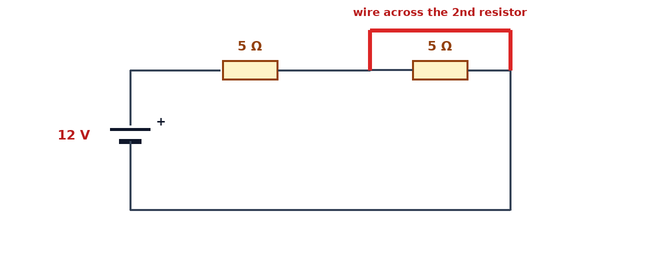
مقاومتان \(5\,\Omega\) و\(5\,\Omega\) على التوالي ببطارية \(12\,V\) وُصل سلك مهمل المقاومة بين طرفي المقاومة الثانية كما في الشكل. فإن شدة التيار في الدائرة:Two \(5\,\Omega\) resistors are in series with a \(12\,V\) battery and a negligible-resistance wire is connected across the second resistor as shown. The current in the circuit is:
1.2 A1.2 A
2.4 A2.4 A
00
4.8 A4.8 A
الحلSolution
السلك يقصّر المقاومة الثانية (يمر فيه كل التيار ولا يمر في المقاومة) فتبقى مقاومة واحدة: \[I=\dfrac{12}{5}=2.4\,A\] (بدل \(1.2\,A\) قبل التقصير).
✅ الإجابة الصحيحة: B (2.4 A)
The wire shorts the second resistor (all the current flows through the wire and none through the resistor) so only one resistor remains: \[I=\dfrac{12}{5}=2.4\,A\] (instead of \(1.2\,A\) before shorting).
✅ Correct answer: B (2.4 A)
\[34\,\star\star\star\]
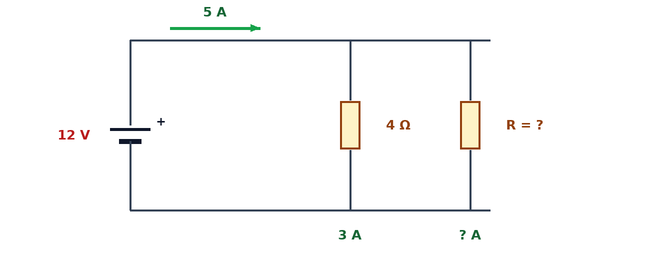
تيار كلي \(5\,A\) من مصدر \(12\,V\) يتفرع إلى مقاومتين على التوازي، يمر في إحداهما \(4\,\Omega\) تيار \(3\,A\) كما في الشكل. فإن قيمة المقاومة الأخرى:A total current of \(5\,A\) from a \(12\,V\) source divides between two parallel resistors; \(3\,A\) flows through the \(4\,\Omega\) resistor as shown. The value of the other resistor is:
3 Ω3 Ω
4 Ω4 Ω
2.4 Ω2.4 Ω
6 Ω6 Ω
الحلSolution
قانون كيرشوف الأول: التيار في الفرع الآخر \(5-3=2\,A\) وجهده \(12\,V\) (التوازي): \[R=\dfrac{V}{I}=\dfrac{12}{2}=6\,\Omega\]
✅ الإجابة الصحيحة: D (6 Ω)
Kirchhoff’s first law: the current in the other branch is \(5-3=2\,A\) at \(12\,V\) (parallel): \[R=\dfrac{V}{I}=\dfrac{12}{2}=6\,\Omega\]
✅ Correct answer: D (6 Ω)
\[35\,\star\star\star\]
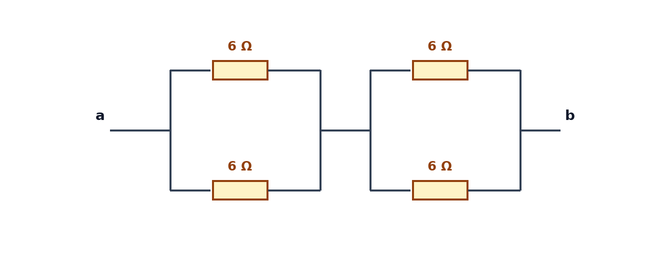
أربع مقاومات متماثلة \(6\,\Omega\) موصولة كما في الشكل (مجموعتان متوازيتان موصولتان على التوالي). فإن المقاومة المكافئة بين \(a\) و\(b\):Four identical \(6\,\Omega\) resistors are connected as shown (two parallel pairs in series). The equivalent resistance between \(a\) and \(b\) is:
3 Ω3 Ω
12 Ω12 Ω
24 Ω24 Ω
6 Ω6 Ω
الحلSolution
كل زوج متوازٍ: \(\dfrac{6\times6}{12}=3\,\Omega\) والزوجان على التوالي: \[R_{eq}=3+3=6\,\Omega\]
✅ الإجابة الصحيحة: D (6 Ω)
Each parallel pair: \(\dfrac{6\times6}{12}=3\,\Omega\) and the two pairs are in series: \[R_{eq}=3+3=6\,\Omega\]
✅ Correct answer: D (6 Ω)
\[36\,\star\star\star\]
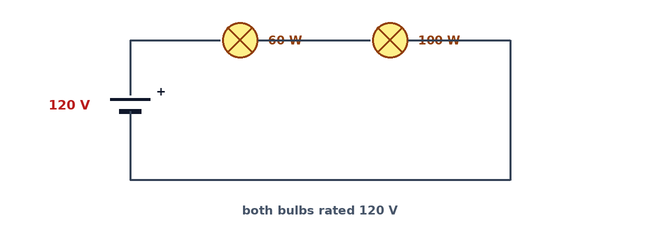
مصباحان مكتوب عليهما \(60\,W,\,120\,V\) و\(100\,W,\,120\,V\) وُصلا على التوالي بمصدر \(120\,V\) كما في الشكل. فإن المصباح الأكثر إضاءة:Two bulbs rated \(60\,W,\,120\,V\) and \(100\,W,\,120\,V\) are connected in series to a \(120\,V\) source as shown. The brighter bulb is:
مصباح 100 W لأن قدرته أكبرthe 100 W bulb because its power rating is larger
مصباح 60 W لأن مقاومته أكبرthe 60 W bulb because its resistance is larger
يتساويان لأن التيار واحدthey are equal because the current is the same
لا يضيء أي منهماneither lights up
الحلSolution
المقاومة من \(R=\dfrac{V^2}{P}\): \(R_{60}=\dfrac{120^2}{60}=240\,\Omega\) و\(R_{100}=\dfrac{120^2}{100}=144\,\Omega\). التيار واحد في التوالي فالقدرة \(P=I^2R\) أكبر للمقاومة الأكبر، فمصباح \(60\,W\) أكثر إضاءة (عكس ما يحدث في التوازي).
✅ الإجابة الصحيحة: B (مصباح 60 W لأن مقاومته أكبر)
Resistance from \(R=\dfrac{V^2}{P}\): \(R_{60}=\dfrac{120^2}{60}=240\,\Omega\) and \(R_{100}=\dfrac{120^2}{100}=144\,\Omega\). The current is the same in series so \(P=I^2R\) is larger for the larger resistance: the \(60\,W\) bulb is brighter (the opposite of what happens in parallel).
✅ Correct answer: B (the 60 W bulb because its resistance is larger)
\[37\,\star\star\star\]
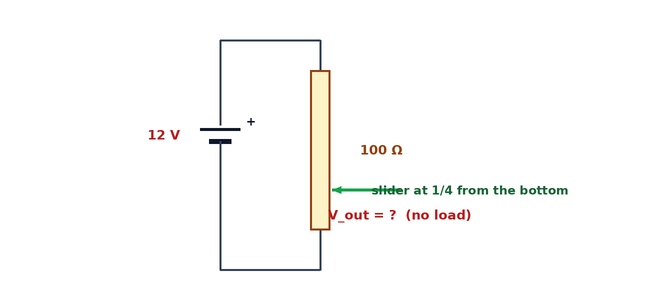
مقسّم جهد (مقاومة متغيرة \(100\,\Omega\)) موصول بمصدر \(12\,V\) والمنزلق عند ربع الطول من الطرف السالب كما في الشكل. فإن جهد الخرج بين المنزلق والطرف السالب (دون حمل):A potentiometer (\(100\,\Omega\)) is connected to a \(12\,V\) source with the slider one quarter of the length from the negative end as shown. The output voltage between the slider and the negative end (no load) is:
3 V3 V
9 V9 V
6 V6 V
4 V4 V
الحلSolution
الجهد يتوزع على المقاومة بالتناسب مع الطول: \[V_{out}=12\times\dfrac{25}{100}=3\,V\] (والتيار \(I=\dfrac{12}{100}=0.12\,A\)).
✅ الإجابة الصحيحة: A (3 V)
The voltage is distributed along the resistance in proportion to the length: \[V_{out}=12\times\dfrac{25}{100}=3\,V\] (the current is \(I=\dfrac{12}{100}=0.12\,A\)).
✅ Correct answer: A (3 V)
لاحظت خطأ؟ أو عندك سؤال عن أحد الأسئلة؟ اكتبه بالتعليقات وحدد رقم السؤال.
Noticed an error, or have a question about one of the questions? Write it in the comments and specify the question number.